What's inside
- Where to buy
- Key Takeaways
- Quick Picks
- How did we narrow down these inspection cameras?
- Articulating or dual-lens: which mechanism does your work need?
- Why does probe diameter matter more than camera resolution?
- How do the two families compare in one table?
- How do you get a usable image inside a dark cavity?
- What should you check before the probe goes in?
- Which buying mistakes send borescopes back?
- How does a cylinder inspection actually go, step by step?
- How do you run a drain or duct inspection that actually finds the problem?
- Which accessories and care habits extend a borescope’s working life?
- Screens, phone apps and recording: what do the options really change?
- How do professionals turn inspection footage into evidence?
- Which pick fits which trade?
- Where should a borescope never go?
- Final Recommendation
- Frequently Asked Questions
- Related Guides
As an Amazon Associate I earn from qualifying purchases. This post may contain affiliate links at no extra cost to you.
gizmoverdict.com is reader-supported. When you buy through links on our site, we may earn an affiliate commission.
Where to buy
Amazon’s US store is the main channel for every model in this guide, and it is where the six linked picks below are sold. Anyone shopping for the best borescopes and inspection cameras quickly discovers that the category is really two different tool families wearing one name, and confusing them is the most expensive mistake in this market. The first family articulates: a control wheel or lever at the handle physically bends the camera tip, so you steer the view left and right — on the better models, through more than 200 degrees — after the probe is already inside the engine bay, wall cavity or cylinder head. The second family keeps the probe fixed and cheats the viewing angle with a second lens on the side of the tip: you swap between the forward camera and the side camera, or watch both at once, but the probe itself points wherever the cable points it.
Neither family is universally better; they are answers to different questions. Articulation earns its keep when you must look backwards at the thing you just passed — a valve face from inside a cylinder, the far side of a joist, the inside of a turbo housing — or steer around bends in a pipe run. Dual-lens probes earn theirs when the job is a long, mostly straight look: down a drain, along a duct, through a wall void, where cable length and a side view for inspecting the walls of the passage matter more than steering. Probe diameter cuts across both families as the hard physical limit: a probe too fat for the spark-plug hole, the drain opening or the gap behind the machine simply does not enter, whatever its camera can do.
The six picks below split deliberately across the two families — four articulating models at different slimness and screen levels, and two long dual-lens probes for reach work — so that whichever question your jobs actually ask, one of these tools answers it. Read the family descriptions before the individual reviews; in this category, choosing the right family matters more than choosing the right brand.
Key Takeaways
- Articulating borescopes steer the camera tip with a mechanical control; dual-lens models keep a fixed probe and add a side-facing camera — decide which family your work needs before comparing models.
- The FOXWELL Y400’s ultra-slim probe, roughly a quarter-inch across, enters spark-plug holes and tight machinery passages that stop thicker articulating scopes.
- Teslong’s articulating scope is the established mechanic’s choice, with the control feel and accessory ecosystem that come from a brand built around inspection tools.
- The two long dual-lens picks trade steering for reach — over sixteen feet of semi-rigid cable for drains, ducts and wall voids.
- The final pick is an unbranded listing sold under a descriptive title rather than a maker’s name; it is the budget reach option, and this guide labels it as generic openly.
Quick Picks
| Pick | Badge | Why it earns its place |
|---|---|---|
| Teslong Articulating Borescope | Best for mechanics | Two-way articulation, a bright ring of eight LEDs and a brand whose whole business is inspection cameras for automotive and HVAC work. |
| FOXWELL Y400 Articulating Borescope | Slimmest probe | A 0.24-inch tip that fits where others cannot, with 220 degrees of two-way steering and a 1080P IPS screen. |
| SATA Articulating Borescope | Best tool-brand option | 210 degrees of articulation, a 4.3-inch IPS display and the backing of a professional hand-tool brand. |
| Acoath Two-Way Articulating Borescope | Articulation plus dual lens | Combines a steering tip with a second lens, covering both viewing tricks in one mid-priced tool. |
| BOILINE 2K Endoscope Camera | Best long-reach dual lens | A 2K dual-lens probe on 16.4 feet of semi-rigid, IP67 waterproof cable for drains and ducts. |
| Dual-Lens Endoscope Camera 16.4ft | Budget reach pick | An unbranded dual-lens probe with the same 16.4-foot waterproof reach for occasional jobs at the lowest commitment. |
How did we narrow down these inspection cameras?
We sorted the market by mechanism before anything else, because a comparison that mixes articulating and fixed probes on one spec table teaches the reader nothing. Within the articulating family we weighed steering range and control smoothness — a tip that sweeps a genuine 180 degrees or more can look back at its own entry point, which is the move that finds dropped fasteners and inspects valve seats — and we weighed probe diameter just as heavily, since articulation is worthless if the probe never reaches the cavity. Screen quality mattered more than spec-sheet resolution: an IPS panel you can read at an angle, under a vehicle, beats a nominally sharper sensor feeding a dim, narrow-view display.
For the dual-lens family the criteria shifted to cable craft. Semi-rigid cable that holds the shape you bend into it is the difference between steering a probe down a duct and wrestling an octopus; waterproofing to IP67 matters because the family’s natural habitat is drains and wet voids; and the side lens must be a real second camera with its own lighting, not a mirror trick. We also checked what the tool asks of your phone: some endoscopes are screenless probes that treat your phone as the display, which is fine at a workbench and miserable under a sink, so every pick here was assessed on whether it works as a self-contained tool or a phone accessory, and the reviews say which.
One more filter was honesty about branding. This category is flooded with white-label products sold under invented names, and rather than pretend otherwise, we kept one clearly-labelled generic pick where its specification genuinely serves occasional users — and we say in its review, and in its sources file, exactly what it is.
Articulating or dual-lens: which mechanism does your work need?
Picture the actual inspection. If the camera must travel a short distance and then look around — inside a cylinder through the plug hole, checking the back side of a weld, examining a heat-exchanger tube sheet, finding where a leak starts inside an appliance housing — articulation is the mechanism that finishes the job, because the fixed probe’s side camera only sees the wall it slides past, never the space behind the tip. Mechanics reach for articulating scopes instinctively for this reason: engine work is a world of short distances and impossible angles.
If the camera must travel — down a floor drain to find the blockage, along a dryer duct to find the lint dam, through a bored hole in a stud bay to find where the wire went — then reach and cable behaviour dominate, and a dual-lens probe on sixteen feet of semi-rigid cable is the right tool. The side lens earns its place on those runs by inspecting pipe walls, cracks and joints as you pass them, a job articulation does slowly and badly over distance. Many working tradespeople eventually own one of each; the picks below are ordered so the first four serve the steering jobs and the last two serve the travelling jobs, and the comparison table keeps the families visibly separate.
Why does probe diameter matter more than camera resolution?
A borescope’s image can only ever show you the cavities the probe physically entered. Diameter decides that guest list. A probe around 0.24 inches — the FOXWELL Y400’s class — passes through most spark-plug holes, many diesel glow-plug ports and the inspection gaps in compact machinery. Probes in the 8mm class, common on dual-lens models, fit drains, larger bores and open wall cavities but are turned away by exactly the small engine openings that generate the most diagnostic work. Meanwhile resolution beyond honest 1080P buys little inside a dark cavity: what you see is governed by LED brightness at the tip, the lens’s depth of field a few centimetres from the subject, and how well the screen renders contrast — which is why this guide treats megapixel claims as the least interesting number on any listing.
There is a second, subtler diameter effect: stiffness. Slim probes bend more easily around obstructions but push less willingly through long horizontal runs; thick semi-rigid cables push beautifully and turn reluctantly. Matching the probe to the passage — slim and steerable for machinery, stout and long for plumbing — is the entire craft of choosing in this category, and it is why no single pick below is labelled best for everything.

Teslong Articulating Borescope — Best for mechanics
Teslong is one of the few names in this category that means something before you read the specifications, because the company builds inspection cameras as its main business rather than as a sideline. This articulating model is aimed squarely at the mechanic and HVAC technician: a two-way steering tip worked from the handle, a 2.0MP HD camera, and a ring of eight LEDs at the tip to flood a cylinder bore or an evaporator housing with light. That lighting matters more than the megapixels — inside an engine, the camera is always working centimetres from its subject in total darkness, and even, adjustable illumination is what separates a readable image of a scored cylinder wall from a white blob surrounded by black.
The articulation control is the reason to buy it over a fixed probe. Roll into a combustion chamber through the plug hole, then bend the tip back to inspect the valve faces and the head gasket surface you entered past; steer down an intake runner and look sideways at the valve stem; check the far side of a piston crown for the detonation pitting that tells the real story of a misfire complaint. Teslong’s supporting ecosystem helps too — replacement probes, mirrors and accessories exist for this platform in a way they never will for a no-name scope, and a mechanic who uses the tool weekly is buying that continuity as much as the camera. For automotive and machinery diagnosis where the distances are short and the angles are everything, this is the default recommendation of the guide.
- Mechanism: two-way articulating tip, handle-controlled
- Camera: 2.0MP HD with eight-LED tip lighting
- Audience: automotive, HVAC and machinery inspection
- Display: built-in screen on the handle unit
- Support: established brand with accessory and probe ecosystem
- Recording: photo and video capture for documenting findings
Strengths
- Steering feel and tip control are tuned for the short-range, tight-angle work mechanics actually do all day.
- Eight LEDs give the even, close-range illumination that cylinder and housing inspection depends on.
- Brand support and accessories make it a platform you can keep, not a disposable gadget.
Trade-offs
- The probe is sized for machinery openings, not the absolute slimmest plug holes the FOXWELL below enters.
- Cable length suits engine bays and appliances, not drain runs — that is the dual-lens family’s job.
- It costs more than generic articulating scopes with similar headline specifications.
Best for: mechanics and HVAC technicians diagnosing engines, housings and equipment in place. Not suited for: long plumbing runs, or buyers who inspect once a year and cannot justify a pro tool.

FOXWELL Y400 Articulating Borescope — Slimmest probe
The Y400’s headline is a measurement: a probe roughly 0.24 inches in diameter, slimmer than the articulating competition, from a brand better known for automotive diagnostic scanners. Slimness is not a vanity specification in this category. It is the difference between inspecting a modern small-displacement engine through its spark-plug hole and removing parts to see; between checking a compact transmission passage and guessing; between a look inside a sealed appliance and a teardown. FOXWELL pairs that slim tip with 220 degrees of two-way articulation — enough sweep to look back along the probe’s own path — and a 1080P IPS display, so the picture you squeezed the probe in to get is rendered on a screen that does it justice.
The combination makes the Y400 the specialist for tight modern machinery, where engines are packaged with no spare room and access holes keep shrinking. Its articulation range also means the slim tip can do the look-back manoeuvre inside small bores that defeats thicker scopes twice over: they cannot enter, and if they could, they could not turn. The honest limits are the ones physics imposes on all slim probes — a thinner probe carries a smaller camera and lighting package, so in larger, darker cavities like big drain lines its image is less commanding than the Teslong’s, and the slim cable pushes less forcefully through long runs. Buy it for the holes nothing else fits, and it has no real rival in this list.
- Mechanism: two-way articulation, 220-degree sweep
- Probe: ultra-slim, about 0.24 inches in diameter
- Camera: 1080P HD
- Display: IPS screen with wide viewing angles
- Lighting: LED illumination at the tip
- Audience: compact engines and tight machinery access
Strengths
- Enters spark-plug holes and compact passages that physically exclude thicker articulating probes.
- Full look-back articulation lets it inspect valve faces and the entry side of small bores.
- IPS display stays readable when the handle is twisted at awkward angles under a vehicle.
Trade-offs
- Slim camera and lighting are less commanding in big, dark cavities than larger probes.
- The thin cable is a steering tool, not a pushing tool, for long horizontal runs.
- FOXWELL’s accessory range for this scope is narrower than Teslong’s platform support.
Best for: diagnosing modern compact engines and any machinery whose access holes are measured in millimetres. Not suited for: drain inspection or large-cavity work where reach and flood lighting matter more.

SATA Articulating Borescope — Best tool-brand option
SATA comes to this category from professional hand tools, and this articulating borescope is built for buyers who prefer their diagnostic equipment to come from a tool brand with a service network behind it. The specification is squarely competitive: 210 degrees of two-way articulation, a 4.3-inch IPS HD display, 1080P imaging and six LEDs at the tip. What the SATA adds over the direct rivals is less a feature than a context — it sits naturally in a professional toolbox alongside the brand’s sockets and scanners, with the build and support expectations that go with that shelf.
In the hand, the appeal is straightforward competence. The articulation sweeps far enough to look back at entry points and around the bends inside housings; the screen is large enough to share the view with a customer or a second pair of eyes, which in a workshop is a daily event rather than a luxury; and the controls follow the pattern of a tool rather than a phone accessory, so it can be worked by feel with the other hand occupied. Against the Teslong it trades a little inspection-specialist pedigree for tool-brand backing; against the FOXWELL it trades ultimate slimness for a bigger screen and a sturdier general-purpose probe. Workshops standardising on one articulating scope for mixed duties — engines one hour, equipment housings the next — will find this the balanced seat in the articulating family.
- Mechanism: two-way articulation, 210-degree sweep
- Display: 4.3-inch IPS HD screen
- Camera: 1080P image and video
- Lighting: six LEDs at the probe tip
- Brand: professional tool maker with workshop distribution
- Recording: captures stills and video for job documentation
Strengths
- The larger screen suits workshop use, where findings get shown to customers and colleagues.
- Tool-brand build and support suit buyers equipping a professional toolbox for the long term.
- Articulation range covers the look-back inspections that justify a steering scope at all.
Trade-offs
- Probe slimness is mid-pack, so the tightest plug holes belong to the FOXWELL’s territory.
- Six tip LEDs are adequate rather than class-leading for very dark, larger cavities.
- Generalist balance means it is nobody’s specialist: not the slimmest, not the longest reach.
Best for: professional workshops wanting one articulating scope from a tool brand for varied daily work. Not suited for: the absolute tightest engine access, or long-distance drain and duct runs.
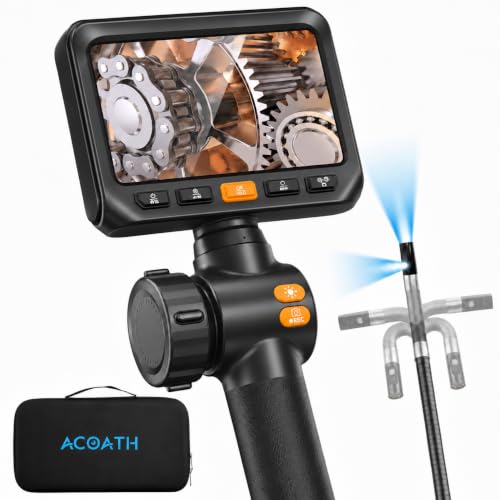
Acoath Two-Way Articulating Borescope — Articulation plus dual lens
The Acoath is the hedge made hardware: a two-way articulating borescope that also carries a dual-lens camera, so it can steer its tip like the three models above and flip to a side view like the two below. For a buyer who cannot yet say which family their work belongs to — the maintenance generalist, the facilities technician, the serious DIYer whose jobs range from a washing-machine pump to a bathroom drain — a hybrid like this covers more of the map than any purist tool at its level. The 4.3-inch IPS display and 1080P imaging match the class standard, so the compromise is not paid for in picture quality.
Where the hybrid logic shows its seams is in depth rather than breadth. The articulation mechanism and the dual-lens tip together make for a slightly larger probe head than a dedicated slim scope, so the FOXWELL keeps the tightest holes; and the cable is an inspection length, not the sixteen-foot reach of the dedicated dual-lens picks, so long drains stay their territory. Judged as a specialist it is second-best twice — judged as the one scope a varied workload actually needs, it may be the smartest purchase in this guide. Acoath is a smaller brand than Teslong or SATA, so accessory depth is thinner, but the tool’s versatility is the argument, and for mixed building, appliance and vehicle work it is a strong one.
- Mechanism: two-way articulating tip
- Camera: dual-lens 1080P — forward and side views
- Display: 4.3-inch IPS screen
- Lighting: LED illumination at the tip
- Role: hybrid covering both inspection families
- Cable: inspection length for appliances, engines and short runs
Strengths
- Steering plus a side lens means one tool handles look-back jobs and pipe-wall checks alike.
- Screen and imaging specification match the dedicated articulating models in this list.
- The natural choice for mixed maintenance work that refuses to settle into one category.
Trade-offs
- The combined tip is bulkier than a dedicated slim probe, closing off the smallest access holes.
- Cable reach is inspection-length, far short of the sixteen-foot dual-lens picks below.
- Smaller brand means a thinner accessory and replacement-probe ecosystem.
Best for: facilities and maintenance generalists whose inspection jobs change from week to week. Not suited for: buyers who already know they need maximum slimness or maximum reach.

BOILINE 2K Endoscope Camera — Best long-reach dual lens
With the BOILINE the guide crosses into the second family: no articulation, a fixed dual-lens probe, and a 16.4-foot semi-rigid cable rated IP67 waterproof. The dual-lens arrangement puts one camera looking forward and a second looking sideways from the same tip, switchable or viewable together depending on mode, and the probe’s headline resolution is 2K — which, per the principle stated earlier in this guide, matters less than the facts that the cable holds a pushed shape, the lenses have their own lighting, and the whole probe can work submerged in the drain water it was built to inspect. This is the tool for the travelling jobs: find the blockage, inspect the joint, check the duct, trace the conduit.
Semi-rigid cable is the unsung specification here. A floppy cable coils and stalls in a horizontal pipe; a properly semi-rigid one transmits your push around gentle bends and keeps the camera oriented well enough that the side lens means something. Sixteen feet covers most residential drain mysteries, dryer ducts, HVAC runs and the wall voids of a single room, and the waterproofing means the same probe that checked a gutter downspout can go straight into a trap. The BOILINE’s dual-lens view earns its keep on pipe walls specifically — cracks, root intrusion, corrosion and bad joints are wall features, invisible to a forward-only camera sliding past them. For homeowners and property maintenance work, this is the pick that answers the most common question in the category: what is actually down there.
- Mechanism: fixed probe, dual-lens (forward plus side camera)
- Camera: 2K-class imaging, 2560P headline resolution
- Cable: 16.4 ft semi-rigid, holds a pushed shape
- Waterproofing: IP67 probe for drains and wet voids
- Lighting: eight LEDs around the tip
- Role: drains, ducts, conduits and wall cavities
Strengths
- The side lens inspects pipe and duct walls, where the actual defects live, as you travel.
- Semi-rigid waterproof cable pushes properly through horizontal runs and works in water.
- Sixteen feet of reach covers the overwhelming majority of household and light-commercial runs.
Trade-offs
- No articulation, so it cannot look back at what the tip has passed inside a machine.
- The probe diameter excludes small engine openings entirely — wrong family for that work.
- Headline resolution exceeds what the lighting and distances can deliver; judge it by its images, not its numbers.
Best for: homeowners, landlords and plumbers’ helpers tracing drains, ducts and wall voids. Not suited for: engine diagnostics or any inspection needing a steered, look-back view.

Dual-Lens Endoscope Camera 16.4ft — Budget reach pick (generic)
Honesty first, because this pick demands it: this listing carries no established brand. It is sold under a descriptive title — an endoscope camera with light, 1920P HD, a 16.4-foot dual-lens probe, IP67 waterproofing — and units like it are produced generically and sold under many names. This guide includes it anyway, clearly labelled, because the specification it offers is real and the use case is legitimate: the homeowner who needs to look down one drain, check one dryer duct or find one dropped screw behind one appliance, twice a year, and cannot sensibly buy a professional platform for that. On paper it mirrors the BOILINE’s formula — forward and side lenses, eight LEDs, semi-rigid waterproof cable — for the least money of any pick here.
The generic bargain carries generic risks, and they should be priced in rather than discovered. Quality control varies between production runs in ways brand-name tools are built to prevent; the supporting app or screen arrangement, where a phone is involved, may be less polished and less durably supported; and if the probe fails in year two, there is no platform, no accessory range and likely no responsive warranty channel behind it. None of that matters much for occasional, non-critical use — a scope that finds the toy in the floor drain has paid for itself in one avoided call-out. It matters enormously for anyone whose work depends on the tool weekly. Buy this pick with your eyes open, as a consumable-grade instrument for rare jobs, and it is a rational purchase; buy it expecting Teslong support at a generic price, and the disappointment is scheduled at purchase.
- Brand: generic — sold under a descriptive listing title, no established maker
- Mechanism: fixed probe, dual-lens (forward plus side camera)
- Camera: 1920P HD headline specification
- Cable: 16.4 ft semi-rigid
- Waterproofing: IP67 probe
- Lighting: eight LEDs at the tip
Strengths
- Delivers the full dual-lens, long-reach formula for the least money in this guide.
- Perfectly adequate imaging for occasional household detective work in drains and ducts.
- Waterproof semi-rigid cable handles the wet jobs that make up most home inspections.
Trade-offs
- No brand platform behind it: support, spares and quality consistency are all uncertain.
- App or display arrangements on generic scopes tend to be the least polished part of the package.
- Not a tool to build a trade workflow around; heavy users should buy the BOILINE or a brand above.
Best for: occasional household inspections where the alternative is paying for a call-out. Not suited for: professional or frequent use, or buyers who value warranty support.
How do the two families compare in one table?
| Pick | Family | Standout trait | Natural habitat |
|---|---|---|---|
| Teslong Articulating | Articulating | Brand platform and tip lighting | Engines, HVAC, machinery |
| FOXWELL Y400 | Articulating | 0.24-inch ultra-slim probe | Compact modern engines |
| SATA Articulating | Articulating | Tool-brand build, 4.3-inch screen | Professional workshops |
| Acoath Two-Way | Articulating + dual lens | Both mechanisms in one tool | Mixed maintenance work |
| BOILINE 2K | Fixed dual-lens | 16.4 ft waterproof reach | Drains, ducts, conduits |
| Dual-Lens Endoscope 16.4ft | Fixed dual-lens | Generic budget reach | Occasional household jobs |
How do you get a usable image inside a dark cavity?
Technique decides more than hardware once the probe is inside. Start with the tip lights lower than maximum: full LED brightness at three centimetres blows out the centre of the frame and hides the very scoring or cracking you came to see, so raise brightness only as distance grows. Keep the lens clean — a single fingerprint or oil film from the last job fogs every subsequent image — and wipe the tip each time the probe comes out. Move slowly. A borescope dragged quickly through a bore produces motion-blurred mush; a slow advance with pauses at each feature lets the camera’s exposure settle and lets you actually recognise a valve edge or a crack for what it is.
Orientation is the skill nobody warns beginners about. The camera does not know which way is up, and after two bends neither will you. Articulating scopes help because bending the tip tells you where it is pointing; on fixed probes, marking the cable at the entry point with tape and noting rotations keeps the side-lens view interpretable. Capture stills generously — storage is cheap and the frame you need is always the one you did not take — and for diagnostic work, record a continuous video pass as well, because reviewing footage at the bench reveals details the live glance missed. Finally, photograph a known reference, such as a coin or a bolt head at the cavity entrance, to give later viewers of your images a sense of scale.
What should you check before the probe goes in?
Preparation separates a five-minute inspection from a lost-probe incident. Measure or estimate the access opening and compare it with the probe diameter honestly — forcing a probe through a tight hole risks the worst outcome in this category, a probe stuck or snapped off inside an engine or a wall. Check what is inside before entering: a borescope is not rated to explore live electrical enclosures, fuel systems demand obvious caution, and hot exhaust components will damage a probe rated for workshop temperatures. Confirm the cable length reaches the target with slack to spare, because an inspection abandoned two feet short teaches you nothing.
Battery and storage checks are the mundane half of the ritual. Charge the handle unit the night before if the job matters, clear old footage off the card so the decisive recording is not the one that failed for a full memory, and test the articulation sweep or the lens switching on the bench, in the light, where a fault is an inconvenience rather than a diagnosis-ruining surprise. Tradespeople who document work for customers should also decide the file-naming habit in advance — job, date, location — because a folder of identically named clips from six inspections is archaeology, not documentation.
Which buying mistakes send borescopes back?
- Buying resolution instead of access. A sharper camera on a probe too thick for the plug hole inspects nothing; diameter and mechanism decide usefulness before any pixel count does.
- Expecting a fixed probe to look backwards. Dual-lens side cameras see the walls they pass, never the space behind the tip — look-back work requires articulation, full stop.
- Underbuying cable for drain work. A five-foot inspection cable in a sixteen-foot drain problem is a down payment on the second, longer tool you buy next month.
- Ignoring the screen. Phone-dependent scopes strand you when the app updates, the phone is needed, or your hands are greasy — self-contained screens exist for a reason.
- Trusting waterproof claims casually. IP67 covers the probe on the picks rated for it, not the handle unit; submerging the wrong half ends the tool’s career.
How does a cylinder inspection actually go, step by step?
Engine diagnosis is the articulating family’s showcase job, so it is worth walking through properly. The engine should be cool enough to work around and the battery disconnected if you will be near anything that can crank. Remove the spark plug for the cylinder in question — on many modern engines that is its own small project of coils and covers — and bring that piston partway up its bore so the probe has room to enter and turn. Feed the slim or standard articulating probe in gently, lights at half, and resist the urge to look at the piston crown first; the disciplined order is bore walls on the way down, because scoring and scuffing on the walls tell you about ring and lubrication history that the crown cannot.
At the bottom of the travel, work the articulation to sweep the tip across the piston crown: look for detonation pitting at the edges, carbon patterns that suggest oil burning on one side, and the tell-tale steam-cleaned patch that betrays a head-gasket leak washing one area bright. Then bend the tip fully back — the manoeuvre that justifies the whole mechanism — and inspect the valve faces and seats from underneath, plus the gasket surface of the head itself. A valve that is not sealing often shows its story as a discoloured sector or a carbon track. Photograph each finding with the cylinder identified in the file name, withdraw the probe slowly while watching the bore walls a second time, and repeat per cylinder. Compared against a compression test, the scope’s evidence is visual and specific: it does not just say a cylinder is down on pressure, it shows you which of the four or five possible reasons is the true one, and that specificity is what the tool’s price buys.
How do you run a drain or duct inspection that actually finds the problem?
Reach work rewards a different discipline. Before the probe enters, run water if the drain still partly flows, because a moving stream carries the camera’s view past minor debris and the blockage announces itself as the place the water — and the picture — stops moving. Mark the cable with tape at measured intervals, or note the cable’s own markings if it has them, so that when the camera finds the root mass, the collapsed joint or the lint dam, you know its distance from the entry point within a foot. That distance is the difference between digging or opening the wall in the right place and exploratory demolition.
Advance slowly with a twisting motion, letting the semi-rigid cable’s shape do the steering through bends, and use the side lens on the way — pipe defects are wall events, and the forward lens will glide past a cracked hub or a belly full of grease while showing you a perfectly innocent view ahead. At the obstruction, do not ram: note the distance, withdraw, and let the finding choose the remedy, whether that is a snake from a nearer cleanout, a jetting, or a targeted repair. In ducts, the same patience finds the disconnected joint or the nest that explains a room that never warms up. Record the whole run; in rental and maintenance disputes, a timestamped video of roots inside a shared line is worth a shelf of opinions.
Which accessories and care habits extend a borescope’s working life?
The accessory that matters most costs the least: the small hook, magnet and mirror attachments that clip or thread onto many probe tips. The magnet retrieves the nut that fell into the intake manifold — the classic save that pays for a scope in one afternoon — the hook pulls wires and debris into reach, and the mirror gives fixed probes a crude side view, though it is no substitute for a true second lens. Side-view mirrors and protective tip caps vary by brand platform, which is one more practical reason the established names in this guide hold an edge for working users: the Teslong on a mechanic’s bench can be re-probed and re-accessorised years later, while a generic scope is exactly the tool it was on delivery day, forever.
Care is mostly about the lens and the cable. Wipe the tip lens after every withdrawal with a soft, clean cloth — oil film and drain residue both bake into permanent haze if left — and coil the cable in the large, loose loops it arrived in rather than the tight wraps that fatigue semi-rigid conductors and articulation wires alike. Articulating tips deserve a gentleness rule: never force the control against resistance, because the steering wires inside a slim probe are the most delicate mechanism in the tool, and a tip that will not sweep is usually a tip that was pushed past a bend it could not make. Store the handle unit dry and charged partway, keep probes capped, and the tool will be ready the day the check-engine light or the slow drain makes its demand — which, in the way of these things, will be a Sunday.
Screens, phone apps and recording: what do the options really change?
Every borescope must put its picture somewhere, and the three arrangements on the market change the working experience more than most camera specifications do. The self-contained handle screen — used by the articulating picks in this guide — makes the tool independent: no pairing, no app permissions, no phone battery anxiety, and a display positioned where your hand already is. Its limits are screen size and the ergonomics of watching a small panel at arm’s length inside an engine bay, which is why the SATA’s 4.3-inch display counts as a genuine feature rather than a rounding difference. IPS panels deserve their mention here because their wide viewing angles survive the twisted wrist positions inspection work imposes; a cheaper panel that inverts its colours at an angle is a daily annoyance disguised as a saving.
Phone-connected probes, common at the generic end of the dual-lens family, invert the trade: the screen is the big, bright one already in your pocket, and sharing a clip with a customer or a landlord is effortless. The costs arrive later — an app that stops being updated, a phone that must stay clean and charged and present, a connection ritual before every quick look. Wi-Fi-connected probes avoid the cable tether but add pairing steps; wired phone probes are instant but occupy the port. None of this makes phone scopes wrong — for occasional home drain work they are entirely sensible — but professionals converge on self-contained screens for the same reason they converge on dedicated scan tools: the instrument that works by itself, every time, without negotiation, is the one that gets used.
Recording format sounds like a footnote until the footage matters. Stills document a finding; continuous video documents a journey through a pipe or bore, and it is the video that settles arguments. Check that your chosen tool records in a standard format your computer opens without conversion heroics, and build the habit of copying footage off the device the same day, labelled, because the card inside a borescope is the worst archive in your business.
How do professionals turn inspection footage into evidence?
A borescope earns its professional keep when its pictures change a decision — authorising an engine repair, proving a drain’s condition to a landlord, clearing a machine for return to service. That requires a small evidence discipline. Begin each recording with context: state or show the job, the date and the exact location the probe is entering, because a close-up of a scored wall means nothing six weeks later without knowing which cylinder of which engine it was. Include a scale reference in at least one frame per finding. Capture the approach as well as the destination, since the path through the machine is what makes the close-up believable as belonging to that machine.
Then write the sentence the footage supports, in the report, while the inspection is fresh: not “bore worn” but “vertical scoring visible on the thrust side of cylinder three’s bore, consistent with ring wear; see clip three.” The articulating picks in this guide, with their look-back ability, produce the strongest engine evidence because they can show the valve and seat condition that compression numbers only imply. Shops that do this well find the scope changes customer conversations entirely — authorisation arguments evaporate when the customer can see the crack. That, more than any specification, is the return on a good inspection camera, and it is available to a careful homeowner documenting a contractor’s work in exactly the same way.
Which pick fits which trade?
Run the decision the way the work actually arrives. The automotive technician whose week is misfires, oil consumption and pre-purchase inspections lives in the articulating family: the Teslong as the platform tool, the FOXWELL Y400 added when the fleet turns to compact modern engines whose plug holes exclude standard probes — and many experienced techs end up owning both, because the slim scope is not a luxury duplicate but the only key to certain locks. The general workshop equipping one shared scope for whoever grabs it next is the SATA’s natural buyer, trading specialisation for screen size, sturdiness and a brand the business already has an account with.
HVAC work splits by task: coil and heat-exchanger inspection is short-range steering work that suits the articulating picks, while duct runs are reach work for the dual-lens family — a contractor doing both is precisely the Acoath hybrid’s design brief, or a two-tool owner in the making. Plumbers and drain specialists should skip straight past the articulating pages: their world is measured in cable feet and waterproofing, and the BOILINE’s sixteen feet is a starting point they may eventually extend with longer dedicated drain cameras, while the inspection scopes here still serve for the short in-building runs. Electricians fishing walls and checking conduit fall between the stools — short dual-lens work, mostly — and usually find the BOILINE or even the generic pick adequate, with the caveat that no camera pulls the wire for you. Homeowners should buy for the job they actually have this year, not the workshop they imagine: one drain mystery argues for the generic or the BOILINE; a project car argues for the Teslong. Tools bought for imaginary workloads are how garages fill with regrets, and this category, with its two genuinely different families, punishes vague buying more than most.
Where should a borescope never go?
A short safety boundary belongs in any honest guide to these tools. A standard inspection camera is not an electrical safety device: do not push a probe into live electrical panels, energised enclosures or anywhere the cable could bridge contacts, and treat any cavity in an appliance as live until you have isolated it at the breaker. Fuel systems demand the same restraint — a probe is not rated for immersion in petrol or solvents, and the inside of a fuel tank is a job for equipment built and certified for that atmosphere. Hot components, from exhaust manifolds to heating elements, exceed probe temperature ratings quickly and invisibly; let machinery cool. And never use an inspection camera on a person or animal: medical endoscopy is a regulated, sterile discipline, and a workshop tool has no place in it, however similar the pictures look. Within those boundaries the picks in this guide are safe, enormously useful instruments; outside them, the correct tool is a specialist or a professional call-out.
Final Recommendation
Choose your family first and this guide narrows itself. Mechanics and machinery diagnosticians should start with the Teslong for its platform and lighting, unless their daily work is modern compact engines, in which case the FOXWELL Y400’s slim probe is the only pick that reliably gets inside — with the SATA as the workshop-standardising alternative and the Acoath as the hybrid for genuinely mixed duties. For drains, ducts and wall voids, the BOILINE is the reach pick to beat, and the generic dual-lens model is a defensible shortcut only for rare household jobs. If one sentence must carry the whole guide, it is this: buy the mechanism your cavities demand and the slimmest probe your smallest access hole allows, because in inspection work the camera you can get in beats the camera you cannot, every single time.
Frequently Asked Questions
Can a borescope replace removing parts for diagnosis?
Often, yes — that is its economic purpose. Confirming a scored cylinder wall, a leaking valve or a blocked drain through an existing opening can settle a diagnosis without teardown labour. It cannot replace disassembly when the fault must be physically repaired, but it tells you whether the repair is justified before you commit to it.
What is the difference between a borescope and an endoscope?
In this market, almost nothing — the terms are used interchangeably for the same inspection cameras. Historically borescopes were rigid optical instruments and endoscopes flexible ones, mostly medical, but today’s listings use both words for flexible camera probes with screens. Shop by mechanism, diameter and cable, not by which noun the listing chose.
How waterproof are these probes, really?
The dual-lens picks here carry IP67-rated probes, meaning the camera cable can work submerged in shallow water for limited periods — enough for drains and wet voids. The rating applies to the probe, not the handle or screen unit, and articulating mechanisms should be treated as splash-resistant workshop tools unless their listing states otherwise.
Will a borescope work inside a wall without cutting?
It needs an entry point — an outlet box opening, a drilled hole the size of the probe, or an existing gap. Through such an opening, a dual-lens probe on semi-rigid cable can inspect a stud bay usefully. There is no camera in this class that sees through intact drywall; that is a different and much more expensive technology.
How long a cable do I need for home drain inspection?
Measure from the access point to the furthest point you realistically need to reach, then buy the next length up. Most in-home mysteries — a trap, a branch line to the main, a dryer duct’s full run — resolve within the sixteen feet both dual-lens picks here provide. Reaching a street main or a septic line from the house is longer work for dedicated drain cameras with thirty metres and more of cable; an inspection scope is the wrong tool stretched that far, and forcing the issue usually ends with a kinked cable and no answer.
Can I use a borescope to check a second-hand car or machine before buying?
Yes, and it is one of the highest-value uses in this guide: a look inside the cylinders, frame rails and hidden cavities of a used vehicle reveals rust, scoring and past repairs that a surface inspection and even a test drive can miss entirely. Bring the slim articulating pick for engine work, agree the inspection with the seller in advance, and photograph everything — the same footage that informs your decision also documents the vehicle’s condition on the day, whichever way you decide.
Do I need a model that records video?
For professional work, effectively yes: recorded findings justify repairs to customers, document warranty evidence and let a second technician review the inspection. For occasional home use, live view alone answers most questions. Every pick in this guide can capture its view in some form, so the question is really about your documentation habits.
Related Guides
Inspection cameras turn up in surprising corners of a toolkit. Vehicle-minded readers may want our fleet camera guide for recording on the road, property owners will find our barn camera picks relevant for outbuilding monitoring, and anyone documenting work on their own body-worn setup should read our body-worn camera guide before buying.



[…] at the camera. Readers comparing inspection tools for the workshop side of the hobby should see our guide to borescopes and inspection cameras, while anyone mounting cameras in outbuildings will find our barn camera recommendations useful, […]
[…] for vehicle-based systems, technicians who inspect the machines they maintain will use our borescope and inspection camera guide, and anyone securing outbuildings between shifts can look at our barn camera picks for the […]