What's inside
- Key Takeaways
- Quick Picks
- How did we choose six BenQ models for one narrow band?
- What do the best benq projectors between 800 and 900 offer that other makers do not?
- Should you choose 4K or 1080p at this level?
- How do the three BenQ families in this band divide the evenings of a week?
- What should a buyer in this band check about the room before choosing?
- Which BenQ in the band matches the way your household actually watches?
- How do the six BenQ models compare on resolution, light and intent?
- How do you audition a projector in this band before committing?
- What ownership differences separate these six after the first month?
- What mistakes do buyers make inside a single-brand band?
- Final Recommendation
- Frequently Asked Questions
- Related Guides
As an Amazon Associate I earn from qualifying purchases. This post may contain affiliate links at no extra cost to you.
gizmoverdict.com is reader-supported. When you buy through links on our site, we may earn an affiliate commission.
Where to buy: Every pick below is a BenQ, sold through Amazon and linked in the Quick Picks table and in its own review. The $800–$900 range in the keyword is this guide’s shopping frame: open the listing to confirm the live figure sits inside it on the day you order, because BenQ models cross the band’s edges as promotions come and go.
Shopping for the best benq projectors between 800 and 900 means shopping inside one maker’s range at the point where that range gets serious. Below this band, BenQ sells portables and entry machines; inside it, the catalogue opens into the models the brand is actually famous for — 4K home entertainment projectors, gaming machines with genuinely low input lag, and home theater models whose colour specifications read like cinema equipment. The band is narrow, but the variety of intent inside it is wide, which is what makes the choice interesting rather than automatic.
A word of honesty about the frame itself, because this guide attaches no price to any individual pick. Projector pricing breathes: a model can sit inside the $800–$900 window during one promotion and step outside it the following month, in either direction. The six below are BenQ’s models positioned in and around this band — the ones a buyer shopping the band will genuinely meet — and the live listing is the only authority on whether a given machine is inside the frame today. Judge the projectors on their merits here; judge the band on Amazon at the moment of purchase.
What unites the six is BenQ’s house character: a seriousness about colour accuracy and gaming latency that runs from the flagship home theater model down to the 1080p gaming machines. What divides them is purpose. Two are 4K gaming-and-film all-rounders, one is a smart LED theater model, one is a colour-purist’s cinema machine, and two are 1080p gaming specialists whose money went into brightness and response rather than resolution. The keyword’s real question is not which BenQ, but which kind of viewer you are.
Key Takeaways
- The $800–$900 range is this guide’s frame, not a price tag on any pick — live listings decide who is inside it today.
- Four of the six are true 4K machines; the two 1080p models spend the difference on gaming response and brightness.
- BenQ’s gaming figures — input lag and refresh — are the most specific in the projector market and worth reading closely.
- The HT5550 is the colour purist’s pick, claiming full DCI-P3 coverage in its listing.
- The HT4550i is the only smart-platform model here, with Android TV and Netflix built in.
- Lens shift on the TK710 is a placement luxury rarely found at this level.
Quick Picks
| Pick | Badge | Why it earns its place in the band |
|---|---|---|
| BenQ TK710 4K HDR Laser 3200 Lms Home Entertainment Movie& Gaming Projector | The complete 4K crossover | A 4K HDR laser rated at 3,200 lms with a 4ms lag headline, 240Hz support, lens shift and 1.3x zoom — the band’s most complete specification. |
| BenQ TK700 4K HDR Home Entertainment Gaming & Movie Projector 4.2ms Latency | The established 4K gamer | The earlier 4K gaming model: 3,200 lumens as listed, HDR, Dolby Atmos speaker support and console-ready positioning. |
| BenQ HT4550i 4K HDR LED Smart Home Theater Projector | The smart LED theater | A 4K HDR LED theater model rated at 3,200 lumens with Android TV, Netflix and Chromecast built in — the television-like BenQ. |
| BenQ HT5550 True 4K UHD Home Theater Projector with HDR-PRO | The colour purist’s instrument | A true 4K UHD theater projector claiming 100% DCI-P3 and 100% Rec.709 coverage with HDR-PRO and frame interpolation. |
| BenQ TH685 1080p Gaming Projector | The fast 1080p gaming specialist | A 1080p gaming machine with a 3,500lm stated figure, 120Hz refresh, 8.3ms low latency and 4K HDR support for sources. |
| BenQ TH575 1080p 3800 Lumens Home Entertainment Projector 16ms Low Latency | The bright entertainment all-rounder | The brightest stated figure in this guide — 3,800 lumens as listed — in a 1080p entertainment machine with dual HDMI and auto vertical keystone. |
How did we choose six BenQ models for one narrow band?
The first filter was the badge: every pick is a BenQ, because the keyword asks for a comparison inside one maker’s range, where the differences are about design intent rather than brand character. The second filter was the band as positioning — models that live in or around the $800–$900 frame as the market ordinarily prices them, accepting that promotions will move individual machines across the line in both directions between the writing and the reading.
Within that frame we deliberately chose across purposes rather than picking six near-identical machines. A buyer in this band might be a gamer who films, a film lover who games, a purist building a dark theater, or a household wanting one bright machine for everything including sport. Six slots allowed one strong answer for each of those, plus the smart-platform model for the household that wants the projector to behave like a television.
Specification honesty followed this site’s usual rules. Brightness figures are reported as each listing states them, without upgrading any maker’s “lumens” into ANSI measurements the title does not claim. Gaming figures are quoted from the titles where they appear — and where one model’s title carries two different lag figures for different modes, the review says so and explains it, rather than picking the flattering one.
What do the best benq projectors between 800 and 900 offer that other makers do not?
Two house specialities run through this list. The first is gaming credibility: BenQ publishes input-lag and refresh figures for its entertainment models with a specificity most makers avoid, because it courts players seriously — low-latency modes at high refresh rates, honest statements about which resolution each figure belongs to, and game modes that are engineered rather than renamed. If a console or PC shares the projector with films, that specificity lets you plan around real numbers instead of hopes.
The second speciality is colour discipline. BenQ’s theater models publish gamut coverage — Rec.709, and at the purist end the DCI-P3 space used by cinema — and the company’s factory-calibration culture means the accurate picture modes are genuinely accurate rather than approximately cinematic. In a band where rival listings often shout brightness and whisper colour, that discipline is a real differentiator for film-led households.
The practical consequence is a range with clear internal logic. The TK models chase the gaming-film crossover, the HT models chase theater, the TH models chase bright, fast 1080p value. Once you know which letter-family matches your evenings, the choice inside this guide narrows itself — and the remaining decision is about light source, smart features and placement tools rather than about quality, which the band holds roughly constant.
Should you choose 4K or 1080p at this level?
The honest answer depends on screen size and seating distance more than on taste. On a 100-inch screen viewed from three metres, true 4K detail is plainly visible in film grain, game worlds and text; move to a smaller screen or a longer sofa distance and the advantage thins until the 1080p machines’ other virtues — higher stated brightness, faster refresh at native resolution, lower lag — start to outweigh it. This is why the two TH models in this guide are not consolation prizes: they are the deliberate choice for big, bright, fast pictures where the last increment of resolution matters least.
Light source interacts with the decision. The TK710’s laser and the HT4550i’s LED engine promise stable output and colour across years, while the lamp-based models trade that stability for their own economics and, in the TH685’s case, a stated brightness figure that leads the 1080p pair. None of these is a wrong answer; they are different allocations of the same band of money, and the guide’s reviews price each allocation in quality terms rather than pretending one dominates.
One more consideration: sources. A household whose viewing is streaming in 4K, a current console and a disc collection will feed a 4K projector what it craves. A household of broadcast sport, older consoles and streamed HD will feed a 1080p machine a native diet and never miss the extra pixels. Match the projector to the library you actually own, not the one the advertisements assume.
How do the three BenQ families in this band divide the evenings of a week?
Imagine the week honestly. Monday is a film, streamed, with the lights low and a partner who notices colour. Wednesday is a game, online, where a frame of lag is a lost duel and the room is half lit because nobody plays in a cave. Saturday is sport with friends, curtains open, drinks on the table, the picture as big as the wall allows. Each of those evenings crowns a different machine in this guide — the HT models take Monday, the TK and TH models divide Wednesday by resolution, and Saturday belongs to whichever machine keeps its composure in ambient light.
Most households live all three evenings, which is why the crossover models exist and why they lead this list. But the division is still the right way to choose: count your own evenings across a month, weight them by how much you care about each, and buy for the weighted centre rather than for the single most glamorous night. A projector bought for the film society evening and endured for twenty gaming nights is a worse purchase than its specification suggests.
The families also divide by temperament in a way the week reveals. Theater models reward the owner who dims, calibrates and settles; gaming models reward the owner who tweaks modes and chases settings; the bright all-rounders reward the owner who does neither and simply watches. BenQ’s band contains all three temperaments at similar money, which is precisely what makes a single-brand shortlist worth writing.
What should a buyer in this band check about the room before choosing?
Start with the throw. Measure from the intended mount or shelf to the screen wall, decide the image width the seating can appreciate, and check the candidate’s zoom range against that pair of numbers before falling for any other feature. In this band the models divide quietly on placement: the TK710’s lens shift forgives an imperfect perch, while the theater and gaming specialists expect a more disciplined geometry. A room measured first turns those differences into a shortlist; a room measured afterwards turns them into returns.
Next, the light audit. Sit in the room at your usual viewing hour and count the light sources you are unwilling to switch off — the lamp by the reading chair, the kitchen spill, the streetlight through the blind. That honest inventory decides whether the band’s money should chase the brighter statements in this list or can afford the purer, dimmer virtues of the theater models. Projectors are bought for rooms as they are, or they are bought twice.
Last, the sound path. A projector is the picture half of a cinema; the other half is whatever the audio travels through — the machine’s own speaker for a season, a soundbar via eARC where offered, or a full system in a dedicated room. Checking that your chosen model’s audio outputs match the system you own is a five-minute task that prevents the most common post-purchase disappointment in the category.
Which BenQ in the band matches the way your household actually watches?
Read by purpose, not by rank: the gaming-film crossovers first, then the smart theater model, the colour purist’s machine, and the two 1080p gaming specialists that close the list.

BenQ TK710 4K HDR Laser 3200 Lms Home Entertainment Movie& Gaming Projector — The complete 4K crossover
The TK710 reads like BenQ answering every clause of the modern brief at once. A laser light source rated at 3,200 lms in the maker’s terms, true 4K HDR pictures for film, and a gaming specification that leads with a 4ms input-lag figure and 240Hz refresh support — figures that belong, as gaming figures always do, to their fastest modes, and which BenQ states with the specificity that lets a player plan around them. Add eARC support for proper soundbar audio and a three-year warranty in the listing, and the machine presents itself as the band’s no-compromises centre.
Its placement tools separate it from most entertainment projectors at any level. Lens shift — the ability to move the image optically, without digital correction — appears in its listing alongside a 1.3x zoom, a combination that lets a ceiling mount or a rear shelf sit where the room dictates while the picture stays geometrically honest and fully sharp. In real living rooms, where the projector almost never gets the perfect central perch, that pairing is worth more than a small increment of brightness or a duller machine’s extra feature.
The cautions are those of ambition. A laser 4K machine in this band is a considered purchase whose talents are wasted on a small screen in a bright room, and its gaming headlines, like all such figures, describe specific modes rather than every setting. Buy it as the household’s one serious projector — films at night, games at speed, sport at scale — and it is the model here least likely to be outgrown.
A placement footnote completes this pick’s case: lens shift ranges are not unlimited, and the wise installer still centres the projector as well as the room allows, spending shift on the final offset rather than the whole journey. Used that way, the TK710 delivers the rarest combination in home projection — a picture that is both geometrically perfect and fully resolved — from the shelf or mount the room actually offered. It is the connoisseur’s feature hiding inside the gamer’s machine.
The warranty line in this listing — three years — is worth more attention than buyers usually give it in this band. A laser projector is a long-life instrument, and a maker willing to stand behind it for three years is making a statement about the light source’s expected behaviour that no review can make for it. Households comparing the TK710 against cheaper 4K rivals should weigh that promise alongside the figures; it is part of why this model anchors the band rather than merely visiting it.
- Stated output: 3,200 lms as listed, in the maker’s lumen terms
- Resolution and HDR: 4K HDR, HDR10 listed
- Light source: laser, per the listing title
- Gaming figures from the title: 4ms input lag, 240Hz refresh rate
- Placement: lens shift and 1.3x zoom listed
- Audio and warranty: eARC support; three-year warranty as listed
Strengths
- Laser stability with a complete 4K specification
- Lens shift protects sharpness in real rooms
- Gaming figures stated with unusual specificity
Trade-offs
- Headline lag belongs to its fastest mode
- Talents wasted on small screens in bright rooms
- A considered purchase at the band’s serious end
Best for: one household projector for 4K film, serious gaming and big sport, mounted once and kept for years
Not suited for: a casual second-room setup where a simpler 1080p machine would be watched just as happily
A band-centre model whose promotions matter; check price on Amazon to confirm it sits inside the frame when you order.

BenQ TK700 4K HDR Home Entertainment Gaming & Movie Projector 4.2ms Latency — The established 4K gamer
The TK700 is the machine that established BenQ’s 4K gaming formula before the TK710 refined it: a 4K HDR entertainment projector rated at 3,200 lumens in the maker’s terms, pitched explicitly at gaming and movies together, with enhanced black detail, HDMI 2.0 connections and a listing that names the PlayStation and Xbox as its intended partners. As the earlier model it often sits at the keener end of the band, which makes it the value route into the same basic proposition — one projector, both arts, no apology to either.
Its listing also provides this guide’s favourite teaching example. The model name carries a 4.2ms latency figure, while the specification text cites 16ms input lag — not a contradiction but a reminder that lag is measured per mode, with the lowest figures belonging to high-refresh 1080p play and the higher figure to fuller-resolution modes. BenQ deserves credit for printing both; the buyer’s job is to read the pair together and know which mode their console will actually use, a habit worth carrying to every gaming claim in the market.
Against its laser sibling, the TK700’s lamp-based design is the main structural difference, with the usual exchange: established economics now, a lamp’s gradual dimming and eventual replacement later. For a household entering 4K projection in this band and content to maintain a lamp, it remains a thoroughly argued machine — the formula’s originator, still fluent in both of its languages.
Longevity is the TK700’s quiet argument in a band of newer names. A model with years of production behind it has known firmware, known behaviour and a known lamp path; the surprises have already been discovered by other people. For a household that values a settled purchase over a novel one, that maturity is worth real money, and it is why the earlier machine holds its place in this guide on merit rather than nostalgia.
There is a setup virtue in the TK700 that its gaming reputation overshadows: it is an easy machine to live with in a mixed room. HDMI 2.0 for the console, a picture that handles a half-lit room for sport, black detail that serves films after dark — the specification reads like a household’s actual week rather than a laboratory’s. Models that specialise too narrowly often win reviews and lose households; this one’s balance is why it has remained in BenQ’s line and in this guide.
- Stated output: 3,200 lumens as listed, in the maker’s terms
- Resolution and HDR: 4K HDR home entertainment, per the title
- Lag figures in the listing: 4.2ms in the model name; 16ms input lag in the specification text — different modes
- Connections: HDMI 2.0 listed
- Audio note from the title: Dolby Atmos speaker support
- Warranty: three years as listed
Strengths
- The proven 4K gaming-and-film formula
- Both lag figures printed honestly by the maker
- Console-ready positioning with proper connections
Trade-offs
- Lamp source means eventual replacement
- Refined by the newer TK710 above it
- Lag headlines need their mode context
Best for: a gamer-film household entering 4K projection, happy with lamp ownership economics
Not suited for: a fit-and-forget household wanting a laser source and the newest refinement of the formula
As the earlier model it is frequently the band’s value entry; check price on Amazon to see where it sits today.

BenQ HT4550i 4K HDR LED Smart Home Theater Projector — The smart LED theater
The HT4550i is the model for the household that wants a projector to behave like the best television they ever owned. Its light source is LED, rated at 3,200 lumens in the maker’s terms, feeding a 4K HDR picture with support for HDR10+, HDR10 and HLG, and its smart platform is complete in a way the rest of this list does not attempt: Android TV with Netflix, Dolby Digital Plus audio and built-in Chromecast. Turn it on and it is already the streaming device; no stick, no console, no laptop presiding over the evening.
The LED engine shapes its character beyond convenience. LED sources hold their colour and output with the stability this guide has praised in laser designs, and they suit the theater brief — accurate, consistent pictures across years of film nights — while the smart platform suits the living-room brief. It is the only pick here that covers both briefs in one box, which is why it anchors the middle of this list despite sharing its brightness figure with the gaming models.
Its compromises are the platform’s and the positioning’s. Built-in smart systems age on software time, and a dedicated gamer will find the TK models’ lag figures more persuasive than this machine’s theater manners. For the film-led household that streams everything and wants the projector to simply work like an appliance, those are easy trades — this is the BenQ in the band that asks the least of its owner.
The HT4550i also makes the best second-room argument in the list. Its platform completeness means it can migrate — main theater today, a teenager’s room or a holiday home tomorrow — without dragging a rack of sources behind it. Machines that contain their own brains travel between lives more gracefully, and in a band where the purchase is expected to serve for many years, that second and third life is part of what the money buys.
Dolby Digital Plus in the audio path is a small line with a real consequence: streamed films increasingly carry their sound in formats a projector must either pass through properly or mangle, and a theater model that handles the modern chain cleanly saves its owner a soundbar troubleshooting weekend. The HT4550i’s whole design is that saving, repeated across every feature — the projector as a finished appliance rather than a component awaiting adult supervision.
- Stated output: 3,200 lumens as listed, in the maker’s terms
- Light source: LED, per the listing title
- Resolution and HDR: 4K with HDR10+, HDR10 and HLG listed
- Platform: Android TV with Netflix and built-in Chromecast, as listed
- Audio note from the title: Dolby Digital Plus, built-in speaker
Strengths
- Complete smart platform with licensed Netflix
- LED stability for years of film nights
- Broad HDR format support including HDR10+
Trade-offs
- Smart platform ages on a software clock
- Gaming figures trail the TK specialists
- Theater manners over gaming aggression
Best for: a streaming household that wants the projector to work like a television with a cinema’s picture
Not suited for: a competitive player choosing purely on latency specifications
Smart theater models hold their band position steadily; check price on Amazon and compare what the listing bundles.

BenQ HT5550 True 4K UHD Home Theater Projector with HDR-PRO — The colour purist’s instrument
The HT5550 is the oldest soul in this list and the most single-minded: a true 4K UHD home theater projector whose listing leads with colour — 100% of DCI-P3 and 100% of Rec.709, the cinema and broadcast gamuts respectively — under BenQ’s HDR-PRO banner, with frame interpolation for fluid motion. In a guide full of machines balancing three jobs, this one does a single job with a purist’s concentration: reproducing film, in a dark room, as its makers graded it.
That DCI-P3 claim is the specification to dwell on. Modern film masters are graded in the wide P3 space, and a projector that genuinely covers it shows the deep reds, teals and skin-tone subtleties that narrower machines compress toward television colours. Paired with true 4K resolution and a theater-tuned HDR system, the HT5550 is the pick whose picture a film society would choose blind — provided the room honours it with darkness, because colour purity is the first casualty of ambient light.
Its age and focus define its limits. There is no smart platform headline and no gaming courtship in its listing; it expects a proper source, a proper screen and a proper room. Households with those things, whose projector exists for cinema and whose band money is film money, will find it the most distinguished instrument here. Households without them should take the hint from its honesty and choose a sibling.
Frame interpolation, listed among this model’s features, divides audiences and deserves a neutral word. For sport and documentary it can lend motion a striking smoothness; for film, purists usually switch it off to keep the cadence the director chose. The HT5550’s virtue is offering the choice inside a theater-tuned machine rather than forcing a house style — one more sign that its designers trusted the owner’s taste, which is the purist market’s whole expectation.
A dark room is this machine’s natural country, and it is worth describing what it does there that brighter rivals cannot. With ambient light gone, the contest becomes one of black levels, colour gradation and the subtle HDR decisions that HDR-PRO exists to make. The HT5550 was tuned by people who expect the owner to notice those things, in a room built to reveal them. If that sentence describes your evenings, no other pick in this guide is really competing with it.
- Resolution: true 4K UHD, per the listing title
- Colour claims in the title: 100% DCI-P3 and 100% Rec. 709 coverage
- HDR system: HDR-PRO as listed
- Motion: frame interpolation listed
- Role in this guide: the dedicated dark-room cinema instrument
Strengths
- Full DCI-P3 claim for true cinema colour
- True 4K detail for film at scale
- Single-minded theater engineering
Trade-offs
- Demands a dark room to show its worth
- No smart or gaming headline features
- A specialist among all-rounders
Best for: a dedicated dark theater room and a film library that deserves cinema colour
Not suited for: a bright multi-purpose living room or a gaming-led household
A specialist model whose band position varies by channel; check price on Amazon, taking care that the listing in front of you is the HT5550 and not a sibling theater model.

BenQ TH685 1080p Gaming Projector — The fast 1080p gaming specialist
The TH685 spends the band’s money the other way: not on resolution but on speed and light. Its listing states 3,500lm in the maker’s terms — the highest figure among this guide’s 1080p pair — with a 120Hz refresh rate and an 8.3ms low-latency claim in an enhanced game mode, while still accepting 4K HDR sources and downscaling them gracefully. For a player whose console renders fast frames more often than 4K stills, that allocation is not a compromise; it is the correct engineering answer to their actual evenings.
The 120Hz figure deserves emphasis because it changes what games feel like. At 1080p and high refresh, motion carries a fluidity that a 60Hz 4K picture cannot match, and the latency figure keeps the controls honest inside that fluidity. Sport benefits in parallel: the same brightness and motion handling that serve a racing game serve a football match on a big screen in a room that is not fully dark, which is why this model so often becomes the household’s big-match machine as well as its gaming one.
The trade is written on the box: the picture is 1080p. On very large screens with 4K film sources, the TK and HT models will show detail this machine cannot. A three-year warranty in the listing softens ownership, and the model’s long production run has made it a known quantity. Choose it when your library is games and sport first and its specialisation stops being a trade at all.
Console generations matter to this pick’s story. Its 120Hz, low-latency brief was written for the current generation of machines that render fast at 1080p, and it remains the natural partner for them; a household whose play is split between those consoles and a PC will find the TH685’s specification reads like a letter addressed to them. In a band full of resolution arguments, it is refreshing to meet a machine that knows exactly which frames it is for.
The three-year warranty appears in this listing too, and on a gaming machine it carries a particular meaning: gaming hours accumulate faster than film hours, because sessions run long and often. A maker warranting a high-refresh gaming projector for three years is pricing its confidence in the cooling and the panel under exactly that duty. For a household whose projector will log console hours like a second television, that confidence is a purchasing argument in itself.
- Stated output: 3,500lm as listed, in the maker’s terms
- Resolution: 1080p, with 4K HDR support for sources as listed
- Gaming figures from the title: 120Hz refresh rate, 8.3ms low latency, enhanced game mode
- Warranty: three-year industry warranty as listed
- Role in this guide: the high-refresh 1080p gaming and sport specialist
Strengths
- 120Hz fluidity for fast games and sport
- Highest stated output of the 1080p pair
- Latency figure suited to real play
Trade-offs
- Native picture is 1080p, not 4K
- Film detail trails the 4K siblings
- Lamp ownership economics apply
Best for: a gaming and sport household projecting large, fast pictures in rooms that are not caves
Not suited for: a 4K film purist measuring the purchase in pixels
A long-running model with regular promotions; check price on Amazon to catch it inside the band.
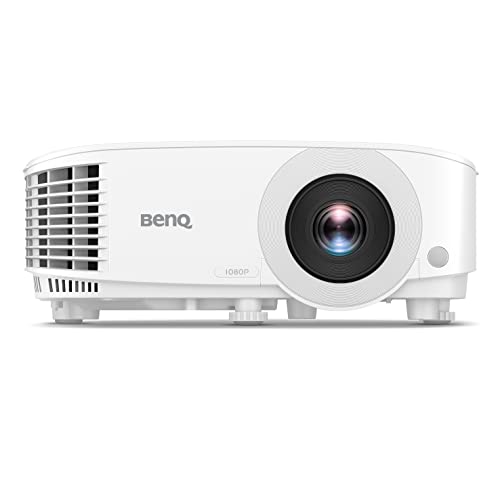
BenQ TH575 1080p 3800 Lumens Home Entertainment Projector 16ms Low Latency — The bright entertainment all-rounder
The TH575 closes the list with the largest brightness figure in it: 3,800 lumens in the maker’s terms, attached to a 1080p home entertainment projector with a 16ms low-latency claim, an enhanced game mode, dual HDMI inputs, a 1.1x zoom, 3D readiness and auto vertical keystone. Read as a whole, the specification describes the household appliance of the range — the BenQ for the family room where films, games, sport and a child’s cartoon all share one big picture and nobody wants a specialist’s compromises.
Brightness is its argument and its identity. In the maker’s own terms it out-rates everything else here, and while this guide treats all such figures as claims within one brand’s consistent labelling, the internal comparison is meaningful: this is the sibling BenQ positions for rooms with light in them. Dual HDMI quietly matters in such rooms, where a console and a streaming source both live permanently attached, and auto vertical keystone covers the commonest placement error without a menu expedition.
Its latency figure is the honest counterweight: 16ms is respectable for casual and family gaming but a clear step behind the TH685’s specialist claim, and its picture is 1080p in a list where four machines offer 4K. For the household whose projector is the room’s big screen for everything, those are fair trades for the brightest, simplest machine here — the band’s money spent on light and ease rather than on any single excellence.
Dual HDMI sounds like a footnote and behaves like a philosophy. The family room’s projector accumulates sources — a console that lives there, a streamer, an occasional laptop — and every unplugging is a small friction that discourages use. The TH575’s twin inputs let the room’s two permanent sources simply stay attached, and the projector becomes the television it was bought to be: one button, big picture, no ceremony. In family duty, ceremony is the enemy, and this machine is engineered against it.
Auto vertical keystone, the one correction this model claims in its title, covers the commonest family-room error — the projector on a coffee table throwing up at a wall — with no menu work at all. It will not rescue a machine parked far to the side, and this guide notes that limit as plainly as it notes the Epsons’ silence elsewhere. But for the standard family geometry, the TH575 quietly removes the only setup step most owners would ever have met.
- Stated output: 3,800 lumens as listed — the highest figure in this guide, in the maker’s terms
- Resolution: 1080p
- Latency claim in the title: 16ms low latency, with enhanced game mode
- Connections and optics: dual HDMI, 1.1x zoom listed
- Extras in the title: 3D ready, auto vertical keystone, three-year warranty
Strengths
- Brightest stated figure in the guide
- Dual HDMI suits a two-source family room
- Auto vertical keystone for easy placement
Trade-offs
- 1080p in a largely 4K list
- Latency a step behind the gaming specialist
- All-rounder rather than any one excellence
Best for: a family room needing one bright, simple, big picture for films, sport and casual games
Not suited for: a latency-critical player or a 4K detail devotee
Often the band’s most accessible BenQ on promotion; check price on Amazon for its position today.
How do the six BenQ models compare on resolution, light and intent?
| Pick | BenQ character |
|---|---|
| BenQ TK710 4K HDR Laser 3200 Lms Home Entertainment Movie& Gaming Projector | 3,200 lms (maker terms), 4K laser, lens shift — the most complete specification in the band. |
| BenQ TK700 4K HDR Home Entertainment Gaming & Movie Projector 4.2ms Latency | 3,200 lumens (maker terms), 4K HDR, dual lag figures — the formula’s established originator. |
| BenQ HT4550i 4K HDR LED Smart Home Theater Projector | 3,200 lumens (maker terms), 4K LED, Android TV built in — the appliance-like theater pick. |
| BenQ HT5550 True 4K UHD Home Theater Projector with HDR-PRO | True 4K, 100% DCI-P3 claimed, HDR-PRO — the purist’s cinema instrument. |
| BenQ TH685 1080p Gaming Projector | 3,500lm (maker terms), 1080p at 120Hz, 8.3ms claimed — speed and light over resolution. |
| BenQ TH575 1080p 3800 Lumens Home Entertainment Projector 16ms Low Latency | 3,800 lumens (maker terms), 1080p, dual HDMI — the bright family-room all-rounder. |
Brightness figures are reproduced as each listing states them, in the maker’s own lumen terms; the titles do not label them ANSI, and this guide does not upgrade them. Lag figures likewise follow the titles, including the TK700’s two figures for different operating modes.
How do you audition a projector in this band before committing?
Test with your own content, in your own room, at your own screen size — those three variables decide more than any specification. Put up the darkest film scene you actually watch, the fastest game you actually play and the brightest sport you actually follow. A projector in this band should handle all three without any one of them feeling like an apology; if one collapses, the reviews above tell you which sibling was built to save exactly that case.
Check the placement arithmetic before the picture impresses you into forgetting it. Measure your throw distance and screen width, confirm the zoom range covers them, and note whether the model offers lens shift — the TK710 in this list does — because shift lets a shelf or ceiling mount sit where the room demands without keystone correction spending your sharpness. A brilliant picture you cannot physically fit into the room is a return waiting to happen.
Finish by testing the evening, not the demo: the remote in the dark, the fan during a quiet scene, the time from power button to picture, the smart platform’s behaviour with your accounts if the model has one. Projectors are appliances of habit, and in this band the differences that survive a year are these small fidelities as much as the headline numbers.
While the projector is new, spend one session on the unglamorous settings: rename the inputs after the devices actually attached, set the eco or low-power mode you will honestly use, and store your preferred picture settings per source if the model allows it. Those twenty minutes compound across every evening that follows, because the machine will wake up already knowing your household instead of asking it questions in the dark.
What ownership differences separate these six after the first month?
Light-source economics draw the longest line. The laser TK710 and the LED HT4550i are built around sources rated for very long service with stable output, so their pictures in year four should closely resemble their pictures in week one. The lamp-based models will ask for a replacement lamp eventually and will dim gradually on the way there; in exchange they often deliver their brightness and features at the keener end of the band. Neither path is a trap, but they suit different temperaments — the fit-and-forget household and the household happy to maintain.
Noise and heat are the second slow difference. Bright projectors move air, and in a small room the fan’s voice during quiet film passages becomes part of the soundtrack. Models with well-designed eco and low-power modes — and light sources that do not need maximum cooling at sane brightness — age more gracefully in real living rooms than their demo-room performance suggests. Test the quiet scene, not just the spectacular one.
The third difference is the platform’s half-life. The HT4550i’s built-in Android TV will age on a software clock; the dumb-and-proud models will lean on whatever stick or console you attach, which you can replace in three years for the price of a pizza night. Households who replace streamers often may prefer the projector that asks the outside world for its brains.
Resale and hand-me-down value close the ownership story in this band. BenQ’s entertainment models are known quantities on the second-hand market, and a machine with its box, its remote and a documented light-source history — trivially easy to show for the laser and LED models — passes to its next household with its value intact. Buying inside a respected range is therefore partly a financial decision: the band’s money is spent, but a good portion of it remains recoverable when the room eventually changes.
Keep the box and the paperwork, whichever model you choose. In this band the original packaging is worth money twice: once if the machine ever travels for service, and again when it is sold or handed on. A drawer with the receipt, the warranty card and a note of the purchase date is the smallest, cheapest accessory in this entire guide. It takes ninety seconds to file, and it will be thanked for exactly once — completely.
What mistakes do buyers make inside a single-brand band?
The first is assuming the letters do not matter — that one BenQ is much like another because the badge matches. In this band the TK, HT and TH families are genuinely different machines aimed at different evenings, and buying the theater model for a gaming den, or the gaming model for a colour-critical theater, wastes the very specialisation the band’s money buys. Read the family first, the model second.
The second mistake is chasing the largest lag or brightness figure without its context. Input lag belongs to a resolution and a refresh rate; a figure quoted at 1080p does not describe 4K play, and the TK700’s listing in this very guide carries two figures for two modes. Brightness likewise belongs to a picture mode, and the brightest mode is rarely the most accurate. The honest specification is always a pair: the number and the conditions under which it was earned.
The third is forgetting the room in the excitement of the range: throw distance, mount position, screen gain and seating all outrank small specification differences. A model that fits the room with lens shift to spare will produce a better picture than a marginally finer model forced into heavy keystone correction, every single evening.
A further mistake is buying the screen last and the projector first in a dedicated room. The screen’s size and gain set the brightness the room actually needs, and a household that fixes those first sometimes discovers the band’s money buys a finer, quieter machine than the one it had been straining toward. Sequence is a form of saving: room, screen, then the BenQ that lights it.
Final Recommendation
For the household that wants one machine for films and games at 4K, the TK710 is this band’s most complete answer — laser light, lens shift and gaming figures with real specificity — while the HT4550i wins the smart-theater brief and the HT5550 remains the purist’s colour instrument. The TH685 and TH575 close the list as the bright, fast 1080p choices for players and sports households whose screens reward speed over pixels.
One last thought for the household torn between two of these: buy for the room you have, not the room in the renovation plan. Projectors in this band hold their value in use rather than in speculation, and the machine that fits today’s shelf, today’s screen and today’s console will be loved tonight. The renovated room, when it arrives, will make its own demands — and by then you will know exactly which BenQ language your household speaks.
Decide which evening you are buying for — the film, the match or the game — and the band resolves itself into a single name; that clarity, more than any figure in any listing, is what a single-brand shortlist is for.
Frequently Asked Questions
Are all six of these really priced between $800 and $900?
The band is the keyword’s frame and the guide’s organising principle: these are the BenQ models positioned in and around it. Live prices move with promotions in both directions, so a model can sit inside the frame one month and just outside it the next. This guide attaches no price to any pick; the listing on the day you order is the only figure that counts.
Why does the TK700’s listing mention two different input-lag figures?
Because input lag depends on the operating mode. The name cites a 4.2ms latency figure while the specification text cites 16ms input lag alongside its 3200-lumen rating — figures that belong to different resolution and refresh combinations. The lesson generalises: always read a lag figure together with the mode it was measured in, a habit this guide follows for every gaming claim.
Laser, LED or lamp — which light source should I choose in this band?
Choose by temperament. Laser in the TK710 and LED in the HT4550i promise long, stable service with little maintenance, which suits fit-and-forget households. Lamp models deliver their brightness and features keenly and ask for an eventual lamp change. In picture terms all six are credible; the difference is the ownership story across five years.
What does the HT5550’s DCI-P3 claim actually mean for films?
DCI-P3 is the colour space of digital cinema, wider than the Rec.709 space of broadcast television. A projector that genuinely covers it can reproduce the saturated reds and greens of modern film masters as they were graded, rather than compressing them. For a dark, dedicated theater room it is the specification that most separates a cinema instrument from a bright television substitute.
Is lens shift worth caring about at this level?
Yes, when your mount or shelf cannot sit dead-centre. Lens shift moves the image optically without the sharpness cost of keystone correction, and it is uncommon enough at this level that the TK710’s inclusion of it deserves its emphasis in the review. If your placement is perfectly central, shift is a luxury; if it is not, shift is the feature that protects the picture.
Which of the six is best purely for gaming?
For 4K gaming, the TK710’s combination of a laser engine, a headline 4ms lag figure and 240Hz refresh support leads the list. For fast 1080p play, the TH685’s 120Hz refresh and 8.3ms low-latency claim make it the specialist. Match the machine to the resolution your console actually renders most of the time.
Should I wait for a promotion rather than buying at the band’s edge?
If your chosen model sits just outside the frame today, patience is rational: this band’s models cross its edges regularly as promotions rotate, and a few weeks can move a machine from outside to inside without anything about the projector changing. Set a reminder on the listing rather than compromising on the model — in a single-brand shortlist, the right BenQ at the right month beats the wrong one at the right price.
Do these projectors need a special screen to show their quality?
A good matte screen helps every model here, but the theater picks benefit most, because their colour and contrast work assumes a neutral, even surface. A smooth pale wall serves the gaming and all-round models respectably. Spend on the screen after the projector, in the room’s real light, and let the picture itself tell you whether the wall is enough.
Related Guides
BenQ gaming projectors and input lag explained Laser versus LED versus lamp projector light sources How to choose a screen for a 4K home theater


