What's inside
- Key Takeaways
- Quick Picks: The Best Bass Soundbars at a Glance
- How Did We Choose Systems for a Bass Guide?
- Why Does Subwoofer Size Matter More Than Wattage Claims?
- What Does Good Bass Actually Sound Like?
- How Do You Place a Subwoofer? The Crawl, in Plain Language
- What Mistakes Do Bass Buyers Make?
- How Does Bass Behave in a Flat, a Family House and a Dedicated Room?
- What Should You Listen for During the First Film?
- How Long Does a Bass System Stay Satisfying?
- What About Music? The Subwoofer’s Day Job
- How Do the Six Compare Side by Side?
- Final Recommendation
- Frequently Asked Questions
- Related Guides
As an Amazon Associate I earn from qualifying purchases. This post may contain affiliate links at no extra cost to you.
gizmoverdict.com is reader-supported. When you buy through links on our site, we may earn an affiliate commission.
Where to buy: each system below links to its Amazon listing, where you can confirm the subwoofer’s dimensions and the full contents of the carton; bass is a physical purchase, so check those measurements first, and that page is where to check the price on Amazon when the room agrees.
The best bass soundbars are decided by physics before they are decided by brands. Low frequencies need air moved in quantity, and moving air requires a driver with real surface area inside a cabinet with real volume, which is why every serious entry in this guide carries a separate wireless subwoofer and why the size of that subwoofer’s driver is the most honest number in the whole category. Two of these systems bring subwoofers in the 10-inch class, the kind that reproduce the bottom of a film soundtrack as pressure you feel in the sofa. One brings a 6.5-inch-class unit as the value route to genuine depth. The smallest pairing here serves rooms where a compact bar and a modest subwoofer are all the architecture allows. Between those poles sits the whole honest map of bass in the soundbar world, and this guide walks it without pretending that all-in-one bars or processing modes can repeal it.
Bass also needs a warning label, and this guide prints it willingly. Low end is the neighbourliest problem in audio: it travels through floors and walls with an enthusiasm that dialogue never manages, it excites the room’s own resonances until a sofa in the wrong place hears boom where the sofa in the right place hears depth, and it tempts owners to turn it up because the control exists. The reviews below therefore judge each system on control as much as on output: how evenly the subwoofer integrates with its bar, how finely its level can be set, and how gracefully the whole system behaves at the volumes an apartment imposes. A bass system you can live above, below and beside other people is worth more than a louder one you cannot.
Placement is the third character in this story, and it gets its own sections below, because the difference between magnificent bass and a boomy mess is very often the same subwoofer in two different corners. Read the picks for their hardware, then read the placement guidance for the other half of the performance, the half that costs nothing and that most owners never collect.
One more distinction will help as you read: depth and loudness are different virtues, and this category’s marketing profits from confusing them. A system can be very loud in the upper bass, the region of thump and punch, while reaching no deeper than a television speaker with confidence. The systems below were chosen for the other quality, the ability to reproduce the lowest notes of a soundtrack at their proper weight, because depth is what a subwoofer exists for and loudness is what everything already does.
Key Takeaways
- Subwoofer driver size is the honest headline: the 10-inch-class units here reach depths that smaller cabinets physically cannot.
- Every pick includes a separate wireless subwoofer, because this guide does not believe in bass claims from a lone bar.
- Integration beats output; a subwoofer that disappears into the soundtrack serves films better than one that announces its corner.
- Placement is free performance: corner loading, a little experimentation and distance from the listening seat transform the same hardware.
- Apartment owners should shop for control, meaning fine level adjustment and night-friendly behaviour, as seriously as for depth.
Quick Picks: The Best Bass Soundbars at a Glance
| Pick | Badge | Why it made the cut |
|---|---|---|
| JBL Bar 2.1 Deep Bass MK2 | Value depth | A 6.5-inch wireless subwoofer brings genuine low-end weight to a simple 2.1 system that asks almost nothing of its owner. |
| Polk Signa S4 | Bass with manners | Polk pairs a 5.9-inch subwoofer with BassAdjust control, VoiceAdjust dialogue and true Atmos height in one balanced system. |
| Polk MagniFi Max AX | Ten-inch authority | A 10-inch wireless subwoofer and Polk’s SDA stage make this the deepest, widest system in the guide. |
| JBL Bar 800 | Surround that detaches | Detachable battery-powered surrounds join a 10-inch subwoofer for true surround and serious bass in one flexible system. |
| ULTIMEA Poseidon M30 | App-tuned value | A wireless subwoofer with BassMX adjustment and app control brings adjustable depth to the value tier. |
| Saiyin Soundbar Set with 5.25-inch Subwoofer | Small-room bass | An 11.7-inch bar with a 5.25-inch subwoofer gives small televisions and desks a low end they have never had. |
How Did We Choose Systems for a Bass Guide?
The entry requirement was a separate subwoofer, without exception, because a guide about bass that admitted all-in-one claims would be participating in the category’s favourite fiction. Beyond that gate, we weighed driver size as the primary physical fact, then the quality of the controls the owner is given over that driver, then the bar’s own competence, since a bass system still has to reproduce dialogue every evening. Systems were also judged on the honesty of their positioning: maker wattage figures appear in this guide only where they can be attributed as maker claims, never as our measurements.
The resulting six form a ladder rather than a contest. Two flagship-class systems with 10-inch subwoofers stand at the top for dedicated film rooms, a balanced Atmos system and a value 2.1 occupy the middle for ordinary living rooms, an app-tuned value system offers adjustability at a friendlier tier, and a compact pairing serves the small rooms the others cannot enter. Your room’s size and your building’s tolerance decide which rung is yours, and the reviews are written to make that decision honestly.
We also considered what each system asks of the room’s power and patience. Subwoofers need sockets, flagship systems need calibration time, and detachable surrounds need a charging habit; a bass guide that ignored those currencies would be recommending specifications rather than ownership. The verdicts below spend those currencies openly, so the price of each system’s depth is visible before the box arrives.
Why Does Subwoofer Size Matter More Than Wattage Claims?
A subwoofer’s job is to move air at frequencies where wavelengths are measured in metres, and the tools for that job are driver area and cabinet volume. A larger driver moves more air per excursion, which means it can reach a given depth with less strain, less distortion and less of the port noise and cabinet complaint that small units produce when asked to perform beyond their physics. Wattage figures, by contrast, describe an amplifier’s electrical capacity under conditions the maker chooses, and two systems with similar claimed wattage can differ enormously in real depth because their drivers and cabinets differ. This is why the guide names driver sizes wherever the listing provides them and treats wattage as marketing weather.
Depth also interacts with the room in a way midrange never does. A subwoofer excites the room’s natural resonances, called modes, which is why the same system can sound tight in one position and bloated a metre away. Larger, better-controlled subwoofers give the owner more clean output to work with while finding that position, and their level controls allow the final integration to be set in fine steps. The physics lesson compresses to a sentence: buy the driver and the cabinet, place them with care, and ignore the number printed largest on the box.
What Does Good Bass Actually Sound Like?
It sounds, paradoxically, like nothing in particular. A well-integrated subwoofer disappears as a location; thunder seems to come from the storm on the screen, a cello’s body from the instrument, an explosion’s weight from the event rather than from a box in the corner. You notice the effect as scale and physical ease, the sense that the soundtrack has a floor. Bad bass, by contrast, is always locatable and always slightly late to the party: a boom that follows the event, a corner that hums during quiet scenes, a one-note thump that renders every low sound as the same low sound.
The test material is not an action trailer but a familiar voice and a familiar instrument. A subwoofer crossed over and levelled correctly leaves a male newsreader’s voice entirely in the bar, adds nothing to it, and then, when the film’s score arrives, supplies the foundation without announcing the handover. Owners should tune for that invisibility first and for spectacle second, because a system set for invisibility will still thrill during the storm scene, while a system set for spectacle will annoy during every conversation that follows it.
There is a physical sensation that marks the boundary between the two. Good bass is felt in the body’s centre, as pressure shared by the whole sofa; bad bass is felt at the room’s edges, in rattling objects and a floor that seems to argue with the furniture. When your ornaments start contributing to the soundtrack, the system is not revealing its power but confessing its placement, and the cure is almost never a new product. It is the crawl, a corner reconsidered, and a level set by a voice.

JBL Bar 2.1 Deep Bass MK2 — Value depth
The name is the review’s first paragraph: this is a 2.1 system built around a wireless subwoofer with a 6.5-inch driver, and its purpose is to give ordinary living rooms the low-end foundation that transforms television sound, without surround ambitions or a flagship tier’s demands. JBL’s listing cites a 300W maximum output figure for the system; read that as the maker’s headline and attend instead to what the subwoofer’s size promises, which is genuine depth of the kind that makes film scores feel upholstered and action scenes feel weighted. The bar itself keeps dialogue clear and the whole system connects over HDMI ARC or optical with Bluetooth for the phone’s music.
The pleasure of this system is its proportionality. The subwoofer is large enough to matter and small enough to place without a furniture crisis, its output suits small and medium rooms completely, and the bar’s simplicity means the household’s least technical member will operate it without a lesson. JBL’s tuning leans toward enjoyment: there is a generosity to the low end that flatters films and playlists alike, and owners who want their bass to be felt as well as heard, at a value tier, will find this the most direct route in the guide.
Its limits are the honest companions of its simplicity. There is no Atmos, no surround expansion and no calibration suite, and very large rooms will ask more of the subwoofer than its driver can give. Within its intended territory, though, the Deep Bass MK2 is the pick that proves the guide’s thesis cheapest: one properly sized subwoofer, placed with a little care, changes television more than any processing badge.
Music listeners should not file this system under film equipment and forget it. Playlists with any low-end life, from Motown to modern pop, gain the body that makes a living room feel like a place music happens rather than a place it is tolerated, and the JBL’s generosity with that material is part of its value case. A bar that serves the album collection as faithfully as the film library earns its shelf twice, and this one was plainly tuned by people who expected both duties.
First-time subwoofer owners should also know that this system forgives their learning curve. Its output is honest enough to reveal a bad placement, and modest enough that correcting the placement is a one-person job with a tape measure and ten minutes. Many owners’ entire education in bass happens inside this system’s first month, and it is a kind curriculum compared with the flagship hardware below.
- Configuration: 2.1 channels with wireless subwoofer
- Subwoofer driver: 6.5-inch class
- Connections: HDMI ARC, optical, Bluetooth
- Character: generous, enjoyment-first tuning
Strengths
- Genuine depth from a properly sized driver at a value tier
- Simple operation the whole household can manage
- Subwoofer size suits ordinary rooms without drama
Trade-offs
- No Atmos or surround expansion path
- Very large rooms will outgrow its output
- Fewer level and tuning controls than pricier rivals
Best for: small and medium living rooms wanting real bass simply. Not suited for: home-cinema builders or very large open spaces.
Give the subwoofer a spot along the television’s wall rather than behind the sofa; when the corner is chosen, the listing is where to check price on Amazon and confirm the subwoofer’s cabinet size.
Polk Signa S4 — Bass with manners
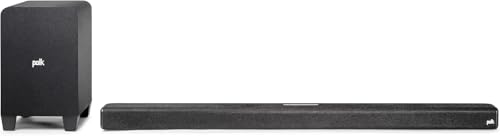
The Signa S4 is what happens when a dialogue company builds a bass system. Its wireless subwoofer carries a 5.9-inch driver, a step below the JBL’s in size, but Polk surrounds it with the controls this guide keeps praising: BassAdjust, which sets the subwoofer’s contribution as its own decision, and VoiceAdjust, which keeps dialogue sovereign no matter how the bass is set. Add genuine Dolby Atmos with up-firing drivers in the bar and HDMI eARC for the full signal, and the S4 becomes the most complete all-round system in the middle of this guide, the one that refuses to choose between the film’s floor and the film’s words.
Polk’s SDA-influenced stage and careful tuning give the system a composure the more excitable rivals lack. Bass arrives as foundation rather than event, the height channels add air to Atmos content, and the whole presentation stays balanced at the moderate volumes where family rooms actually live. It also works with 8K and 4K televisions over its eARC connection, which makes it a forward-looking purchase for a room whose screen may change before its speakers do.
Choose the S4 when your household contains both an action fan and a dialogue devotee and the purchase must satisfy each without a nightly negotiation. Its subwoofer will not match the 10-inch systems for outright depth, and Polk does not pretend otherwise; what it offers instead is the best-governed bass in this guide, depth with a volume knob on its manners.
The S4’s eARC connection deserves a second mention in a bass context, because the full-bandwidth feed carries the low-frequency channel of a soundtrack exactly as mixed, without the compression compromises older connections impose. Owners upgrading an older ARC-era bar often report that the bass feels cleaner before it feels louder, and that cleanliness, the sense of a floor with edges rather than a fog, is this Polk’s signature improvement to a room.
There is a households-with-teenagers footnote to the S4 as well. Its controls are legible enough that the family’s younger engineers can be taught the house rules, bass at this level for films, that level after ten, instead of discovering the subwoofer as an unsupervised toy. Systems that can be governed by agreement rather than by hiding the remote tend to survive their first year in better humour all round.
- Configuration: 3.1.2 Atmos system with wireless subwoofer
- Subwoofer driver: 5.9-inch class
- Controls: BassAdjust and VoiceAdjust independent levels
- Connection: HDMI eARC, works with 8K and 4K televisions
Strengths
- Independent bass and dialogue controls end household arguments
- True up-firing Atmos adds height to the foundation
- Composed tuning suits mixed content and mixed audiences
Trade-offs
- Subwoofer depth trails the 10-inch systems here
- No separate rear speakers for full surround
- Feature richness asks for a slightly longer setup
Best for: family rooms balancing films, dialogue and diplomacy. Not suited for: bass maximalists building a dedicated cinema room.
Start with its bass control at the middle setting and adjust in single steps over the first week; the product page is the place to confirm the current price on Amazon when you are ready.

Polk MagniFi Max AX — Ten-inch authority
The MagniFi Max AX is the flagship argument for this guide’s thesis. Its wireless subwoofer carries a 10-inch driver, the largest class here, and the difference is not subtle: the lowest reaches of a film soundtrack, the floor of an orchestra, the pressure wave of an explosion, arrive with an ease that smaller cabinets strain to imitate. Around that foundation Polk builds a 5.1.2 Atmos and DTS:X system with its patented SDA technology widening the stage and VoiceAdjust keeping dialogue enthroned above it all. This is a system for a room that takes films seriously enough to give them a corner, a calibration session and the run of the evening.
The bar itself is substantial, the subwoofer is a serious piece of furniture, and the system’s setup deserves an unhurried hour, after which its behaviour is exemplary: eARC carries the full signal, the processing stays out of the way of good material, and the low end integrates with a smoothness that reveals how much engineering separates a flagship subwoofer from a loud one. Music benefits equally; a system that can reproduce an orchestra’s floor can certainly handle the household’s albums, and the MagniFi’s stage gives recordings a scale that flatters listening as a deliberate activity.
There is no point pretending this system suits a flat with thin floors or a room where the subwoofer would be exiled behind a door. Its audience is the dedicated space, the detached house, the household that has decided films are an event. For that audience, the MagniFi Max AX is the deepest water in this guide, and the pick against which the others’ bass should be measured.
Concert films are this system’s private triumph, a category worth singling out because they expose weak subwoofers mercilessly. A kick drum and a bass guitar occupy neighbouring territory for two hours, and lesser systems smear them into a single warm blur; the MagniFi keeps them as separate citizens of the same foundation, which is the difference between hearing a band and hearing about one. Households whose film nights alternate with concert nights will find that discipline addictive.
Installation day deserves a word of expectation-setting. A system of this scale arrives in serious packaging, wants two pairs of hands for its placement, and rewards a calibration session conducted without an audience of impatient viewers. Schedule it the way you would schedule a furniture delivery rather than a gadget unboxing, and the flagship will start its life in the room on the terms it deserves.
- Configuration: 5.1.2 channels with wireless subwoofer
- Subwoofer driver: 10-inch class
- Formats: Dolby Atmos and DTS:X
- Extras: SDA stage widening, VoiceAdjust dialogue control
Strengths
- Deepest, most authoritative low end in this guide
- Flagship stage width and height complete the cinema picture
- Dialogue control keeps voices sovereign over the spectacle
Trade-offs
- Subwoofer needs real floor space and a tolerant building
- Largest setup commitment of the six
- Its abilities exceed what small rooms can express
Best for: dedicated film rooms and detached houses wanting maximum depth. Not suited for: flats, small rooms or buyers avoiding furniture-scale subwoofers.
Measure the subwoofer’s intended corner against the cabinet dimensions on the listing, including clearance behind it; afterwards, that page is where to look up the price on Amazon.

JBL Bar 800 — Surround that detaches
The Bar 800 pairs the guide’s other 10-inch-class subwoofer with the most theatrical idea in soundbars: its ends detach to become battery-powered surround speakers, placed behind the sofa for a film and returned to the bar afterwards to recharge and resume life as a single unit. The result is a 5.1.2 Atmos system that asks for no permanent rear installation, which makes genuine surround, with genuine bass beneath it, available to renters and tidy rooms that could never host wired rears. When the surrounds are docked, the bar remains a formidable unit in its own right; when they are deployed, the room gains the envelopment that bass this deep deserves as a partner.
JBL’s tuning gives the system its character: confident, cinematic and generous, with the subwoofer supplying the physical floor for action and the detachable rears supplying the space. Built-in Wi-Fi with AirPlay, Chromecast and Alexa multi-room support covers the music hours properly, elevating the Bar 800 beyond film duty into the room’s general audio system. The battery discipline is the one habit owners must learn: surrounds left deployed for days will eventually need their dock, and households develop a rhythm for it the way they do for charging anything else.
Choose the Bar 800 when you want flagship bass and real surround without committing the room to permanent speakers. It is the most flexible system in this guide and, for households whose film nights are events staged in otherwise ordinary rooms, possibly the cleverest. The MagniFi counters with a more traditional flagship composure; the JBL counters back with a trick nobody else here can perform.
Gaming households should imagine the detachable surrounds in their other life: a story-driven title played after dark, rears placed on the shelves behind the chair, the subwoofer carrying the world’s weather through the floor. Positional audio over a foundation this solid is a different hobby from television speakers, and the fact that the whole arrangement packs itself away by morning keeps the room’s daytime identity intact, which is the compromise most shared houses are actually negotiating.
The Bar 800’s streaming completeness also makes it the bass system most likely to be used at full stretch on an ordinary day. A Saturday that begins with radio through its Wi-Fi, continues with a match and ends with a film in deployed surround is a day in which every part of the system has worked, and equipment that works all day justifies its footprint in a way a film-only flagship, however magnificent, has to argue for.
- Configuration: 5.1.2 channels with detachable battery surround speakers
- Subwoofer: 10-inch class wireless unit
- Streaming: built-in Wi-Fi with AirPlay, Chromecast and Alexa multi-room
- Formats: Dolby Atmos
Strengths
- True surround available on demand, with no permanent installation
- Ten-inch subwoofer gives films flagship physical weight
- Wi-Fi streaming makes it the room’s music system as well
Trade-offs
- Detachable surrounds need recharging discipline
- Bar is wide, and the system is a substantial presence
- Renters gain most; permanent cinema rooms may prefer fixed rears
Best for: film-night households wanting surround without installation. Not suited for: buyers who would never remember to dock the surrounds.
Decide where the surrounds will sit during films before they arrive, even if that home is a bookshelf edge; the listing lets you check price on Amazon once the staging is imagined.

ULTIMEA Poseidon M30 — App-tuned value
The Poseidon M30 brings the value tier a feature the flagship systems would approve of: control. Its wireless subwoofer’s output can be shaped through BassMX adjustment inside the companion app, joined by VoiceMX for dialogue, so the owner of this 2.1 system can tune the balance between floor and words from the sofa rather than accepting a factory compromise. ULTIMEA’s materials cite a 240W peak power figure, which this guide attributes plainly as the maker’s claim; the system’s real credentials are its adjustable subwoofer, its HDMI and optical connections and a Bluetooth 6.0 link for the phone, the newest wireless standard in this guide.
In the room, the M30 delivers the essential bass experience honestly: a separate subwoofer giving films and music a foundation no lone bar can, with the app letting the household find its preferred level of generosity and store it. That adjustability matters more at this tier than at the flagship end, because value systems are bought into more varied rooms, and a subwoofer that can be tailored to a flat’s thin floors or a bedroom’s small volume will be used at its best rather than endured at its default. The bar’s own presentation is clear and energetic, and the system’s setup through the app is guided rather than mysterious.
Choose the M30 when the budget is firm but the desire for control is not negotiable. It will not reach the depths of the 10-inch systems, and its brand lacks the veterans’ decades, but as an adjustable, honest bass system at a value tier it understands its assignment precisely: give the owner the driver, the controls and the app, and let the room decide the rest.
There is a first-apartment story this system fits precisely. A young household with a firm budget, a rented living room and a phone-centric life gets, in one purchase, a television system with a real subwoofer and a music system their friends can connect to in seconds. Equipment that meets a household where it lives, rather than where a brochure imagines it, tends to be kept and used, and the M30’s whole design reads as an argument for that realism.
The app also changes the ownership rhythm in a way worth anticipating. Firmware and features can improve after purchase, and the system’s settings live in an account the household controls, which makes the M30 feel less like a finished appliance and more like a small platform. Buyers who enjoy that rhythm will find it a virtue; buyers who want their audio finished on delivery day have been honestly warned by this review and by the guide’s structure alike.
- Configuration: 2.1 channels with wireless subwoofer
- Controls: BassMX and VoiceMX adjustment through the app
- Connections: HDMI, optical, Bluetooth 6.0
- Note: 240W figure is the maker’s stated peak claim
Strengths
- App-based bass control is rare and valuable at this tier
- Separate subwoofer delivers the category’s essential experience
- Newest Bluetooth version here for phone streaming
Trade-offs
- Depth cannot match the larger-driver systems above
- App dependence will not suit every household
- Younger brand with a shorter support history
Best for: value buyers who still want to tune their bass properly. Not suited for: flagship depth seekers or app-averse households.
Because its bass is adjustable in fine steps, plan a first-week evening for tuning rather than judging it out of the box; check the price on Amazon on the product page beforehand.

Saiyin Soundbar Set with 5.25-inch Subwoofer — Small-room bass
The Saiyin set miniaturises this guide’s thesis for the rooms the other systems cannot enter. Its bar is just 11.7 inches long, sized for small televisions, PC monitors and the tight shelves of bedrooms, kitchens and caravans, and it is paired with a wired subwoofer carrying a 5.25-inch driver, which gives that small bar a low-end partner of its own. The maker’s 88W peak figure appears in its listing; as ever, treat it as the manufacturer’s framing and weigh the pairing by its proportions, which are the point: this is bass scaled to a small room, where even a modest subwoofer transforms a tiny television’s sound from a rumour into a presence.
Connections cover the small-room reality with Bluetooth, AUX and optical, so the set can serve a television, a computer or a phone without adapters or arguments. In a bedroom or a study, the effect is disproportionate to the hardware: dialogue gains body, films gain a floor, and music from the phone sounds like it belongs to the room. Nobody should mistake this pairing for the flagship systems above it, and the Saiyin does not ask to be mistaken; its subwoofer is a companion for a small bar, not a cinema foundation, and its pleasures are scaled accordingly.
Choose it when the screen is small and the room is smaller, and when the alternative was no subwoofer at all. Between the Saiyin’s honest little system and a larger bar pretending to produce bass it cannot, this guide chooses the honest little system every time, and small-room owners who make the same choice tend to be pleasantly surprised for years.
Caravan and small-space dwellers form this set’s most devoted constituency, and it is easy to see why. Spaces that cannot host even a compact television bar can usually host this pairing, and the transformation of a tiny screen’s sound, from a metallic whisper to something with a floor under it, is proportionally the largest upgrade in this entire guide. Bass is a relative experience, and relative to a small television’s own speakers, the Saiyin’s little subwoofer is a giant.
Students furnishing a first room deserve a specific pointer here, because this set answers the classic problem of that life: one small screen that must be television, monitor and speaker, in a room where the neighbours are separated by a partition rather than a wall. The Saiyin’s scale respects all three constraints while still refusing the tinny compromise, and it packs away at term’s end without a removal van.
- Configuration: compact 11.7-inch bar with wired subwoofer
- Subwoofer driver: 5.25-inch
- Connections: Bluetooth, AUX, optical
- Fit: small televisions, monitors, bedrooms and caravans
Strengths
- Only pick sized for genuinely small screens and shelves
- A real subwoofer partner at a miniature scale
- Input set matches small-room devices exactly
Trade-offs
- Bass depth is modest in absolute terms
- Subwoofer is wired, limiting placement freedom
- Not a candidate for living-room film duty
Best for: bedrooms, studies, kitchens and small televisions. Not suited for: main living rooms or anyone chasing cinematic depth.
Check the shelf depth for both pieces before ordering, since the subwoofer needs its own small footprint; its listing shows today’s price on Amazon to verify.
How Do You Place a Subwoofer? The Crawl, in Plain Language
There is a famous technique for finding a subwoofer’s best position, and it sounds like a joke until you try it. Put the subwoofer where you normally sit, at your listening position, play something with steady, varied bass, and then move around the room’s edges on your hands and knees, listening. Where the bass sounds smoothest and most even to your ears at floor level is where the subwoofer wants to live, because the relationship between that spot and your seat is reciprocal. Place the subwoofer there, return to your seat, and the soundtrack’s low end will arrive with the evenness you heard while crawling. It takes ten minutes, it looks ridiculous, and it outperforms any amount of guessing.
General rules support the experiment. Corners load a subwoofer’s output, adding free volume at the cost of evenness, which suits smaller units in large rooms and overwhelms large units in small ones. Positions along a wall, roughly a third of the way along its length, often balance output and smoothness. Keep the subwoofer out of cabinets and away from direct contact with the bar’s furniture where vibration can join in, and once placed, set its level against dialogue rather than against an explosion: if voices sound natural and the floor is simply there when the music arrives, the integration is right.
Furniture participates more than owners expect. A subwoofer firing toward a sofa’s back will be felt as much as heard, which some film fans love and others find distracting, while a subwoofer near a bookcase may recruit the bookcase as an unwilling resonator on particular notes. If a specific frequency always buzzes, the culprit is often a picture frame, a cabinet door or a radiator cover rather than the system, and a hand pressed gently to each suspect during the offending scene will find it faster than any equaliser.
What Mistakes Do Bass Buyers Make?
The first is shopping by wattage, the number makers print largest and listeners should weight least, instead of by the driver in the cabinet. The second is placing the subwoofer where the room looks tidy rather than where it sounds right, then compensating with the level control until the system booms. Third comes setting the bass level during an action trailer and never revisiting it, which condemns every dialogue scene that follows to a humming undercurrent. Fourth, apartment buyers sometimes choose the largest system in a guide like this one and spend years playing it at a fraction of its ability, when a smaller, better-controlled system would have been used joyfully at full permission. Buy the bass your building allows you to enjoy, place it like you mean it, and set it against a voice before a bomb, and the category will reward you nightly.
A fifth mistake is forgetting that other people live in the soundtrack’s path. Bass travels downward and outward with democratic indifference, and the buyer who never learns the night settings or the subwoofer’s level control becomes, in a shared building, a story the neighbours tell. The systems in this guide all provide the tools for peace; the mistake is treating those tools as features for other people.
How Does Bass Behave in a Flat, a Family House and a Dedicated Room?
The same system is three different products in three buildings. In a flat, its defining quality is restraint: the subwoofer’s level lives in the lower half of its range, the night settings are not optional extras but the main interface, and the winning systems are the ones, like the Polk S4 and the ULTIMEA, whose controls are fine enough to find the exact level where the room feels full and the floor below feels nothing. A flat owner should read every review in this guide through that filter, because a system that cannot be governed precisely will be governed crudely, by being switched off.
In a family house the question becomes scheduling rather than physics. The subwoofer can breathe during the day and during film night, and the discipline required is the household’s own: a shared understanding of when the big levels are welcome. Dedicated rooms remove even that constraint, and there the flagship systems justify themselves completely, because a room built for films is the one place a 10-inch subwoofer’s abilities are not a negotiation. Match the system to the building first and the films second; the ladder in this guide is arranged so that each building finds its rung without apology in either direction.
What Should You Listen for During the First Film?
Choose a film you know well and watch the whole of it at your intended level before adjusting anything beyond the subwoofer’s basic setting. Listen first for dialogue: if voices ever acquire a chesty echo or a hum beneath them, the subwoofer is set too high or crossed into territory the bar should own, and one step down will usually restore the words. Listen next for the moments you did not notice, the room tone, the weather, the score’s quiet floor, because a system doing its job disappears into exactly those moments. Keep a note of the level you settle on, and revisit it after a week of varied content rather than after a single evening’s enthusiasm.
Then, and only then, play the spectacle scene. A system tuned for invisibility will still deliver the storm with its full weight, because correct integration does not reduce bass; it aims it. Owners who reverse this order, spectacle first and dialogue as an afterthought, spend months chasing a boom they installed themselves on the first night. The ten minutes of patience this section asks for is the cheapest expertise in the whole category, and it is available to every buyer in this guide regardless of which rung of the ladder they chose.
How Long Does a Bass System Stay Satisfying?
Longer than most technology, because its pleasures are physical rather than format-dependent. A well-made subwoofer does not care which streaming service is fashionable, and the systems here connect through standards that change slowly, so a purchase made on driver size and control quality ages at the pace of furniture rather than the pace of phones. What does change is the owner’s ear. The first month with real bass is a festival of rediscovery, old films revealing floors they always had; the mature relationship that follows is quieter and better, in which the system is simply how films sound in this house, and its absence, on a television elsewhere, feels like a deprivation.
That longevity argues for buying the rung of the ladder your building genuinely supports rather than the cheapest rung that quiets the urge. A system bought too small for its room is replaced within a few years, at twice the total cost of the right system bought once, while a system bought too large for its building is resented nightly at low volume. The middle of this guide exists because most households live between those errors, and the reviews have tried to make the middle feel like what it is: not a compromise, but the correct answer for most rooms on earth.
What About Music? The Subwoofer’s Day Job
Films may justify the purchase, but music audits it daily, and a subwoofer that integrates beautifully for a soundtrack can still misbehave under an album if its level was set by an explosion. The discipline that serves both is to set the subwoofer against the most honest material you own, an acoustic recording or a familiar voice, and then leave the setting alone for music and film alike, using the system’s modes rather than its level control to mark the difference between a Tuesday playlist and a Saturday blockbuster. Owners who adopt that discipline discover that their bass system has become the house’s music system almost by accident, because a bar-and-subwoofer pairing in the living room outclasses every portable speaker the household owns.
Genres divide the field informatively. Electronic and hip-hop recordings interrogate depth and control simultaneously, and the 10-inch systems answer with a composure the smaller cabinets admire from below. Jazz and acoustic music interrogate integration, the handover between bar and subwoofer where double basses live, and there the Polk systems’ governance earns its praise. Rock asks for punch at moderate depth, the home ground of the JBL pair. A buyer whose listening leans heavily toward one genre can let that lean break ties between otherwise equal systems, which is a more honest tiebreaker than any specification in this guide.
How Do the Six Compare Side by Side?
| Pick | Layout | Subwoofer driver | Signature strength | Choose it when |
|---|---|---|---|---|
| JBL Bar 2.1 Deep Bass MK2 | 2.1 | 6.5-inch class | Simple, generous depth | Value and ease lead the brief |
| Polk Signa S4 | 3.1.2 Atmos | 5.9-inch class | BassAdjust plus VoiceAdjust | The household argues about bass and dialogue |
| Polk MagniFi Max AX | 5.1.2 Atmos | 10-inch class | Flagship depth and stage | The room is a dedicated cinema |
| JBL Bar 800 | 5.1.2 Atmos | 10-inch class | Detachable surround speakers | You want surround without installation |
| ULTIMEA Poseidon M30 | 2.1 | Wireless, app-tuned | BassMX app control | Budget is firm, control is not negotiable |
| Saiyin set | Compact 2.1 | 5.25-inch | Miniature footprint | The screen and room are both small |
Final Recommendation
For the dedicated film room, the Polk MagniFi Max AX is this guide’s summit, the deepest and most composed system here, with the JBL Bar 800 beside it for households that want the same class of bass with surround that appears only when summoned. Most living rooms will be served best by the middle of the ladder: the Polk Signa S4 where dialogue and bass must be governed separately, the JBL Deep Bass MK2 where simplicity and value lead, and the ULTIMEA M30 where app control matters at a firm budget. The Saiyin owns the small rooms outright. Whichever rung you choose, spend the first evening on placement and level before spending anything on judgement, because in this category the room is the second subwoofer, and a well-placed system will keep astonishing you long after a careless one has become expensive furniture.
End with the simplest test of all, the one owners apply unconsciously within a month: do you still notice the system, or do you notice the films? The six here were chosen so that the second answer wins, each at its own scale, from the Saiyin’s small-room floor to the MagniFi’s cinema foundation. Bass, properly bought and patiently placed, stops being a feature and becomes the ground the whole evening stands on.
If you take one sentence from this guide into the shop, let it be the physics: the driver moves the air, the room shapes the result, and your patience with placement decides which of the two you end up hearing. Everything else, the badges, the wattage, the modes, is commentary on that single transaction between a cabinet and a room.
Choose well, place patiently, and then stop adjusting. A bass system that has found its corner and its level should be left to its work, because the final stage of ownership is forgetting that the floor of your films is a machine at all.
Frequently Asked Questions
Is a bigger subwoofer driver always better?
It is better at depth and ease, which are the qualities that matter most, provided the room and the building can accommodate the output. In a small room or a flat, a smaller driver with good controls will be enjoyed at its best more often than a large one perpetually restrained.
Where is the worst place to put a subwoofer?
Inside a cabinet, where its output is muffled and its vibrations are amplified by the furniture, and directly behind the listening seat, where its output arrives as a localised thump rather than a foundation. Both errors are common because both look tidy.
Can I use one of these systems in a flat without angering neighbours?
Yes, with the middle and smaller systems especially, provided you use their level controls and night-friendly settings and place the subwoofer away from shared walls where possible. The flagship systems can also behave, but they ask their owners for more discipline.
Why does my bass sound boomy in one seat and thin in another?
That is the room’s resonances at work: low frequencies form standing patterns with peaks and nulls in different positions. Moving the subwoofer, even by a foot, changes the pattern, which is why the placement experiment described in this guide is worth its ten undignified minutes.
Do I need two subwoofers for good bass?
Two subwoofers can smooth a room’s bass across more seats, and some flagship owners eventually go that way, but none of these systems requires it. One well-placed subwoofer, correctly levelled, delivers the overwhelming majority of the experience.
How loud should the subwoofer be relative to the bar?
Quiet enough that you cannot point at it. Set the level so dialogue stays entirely in the bar and the low end registers as weight beneath the soundtrack rather than a separate event, then check with a familiar scene. Most owners’ first setting is two steps too high; nearly everyone’s settled setting surprises them with its modesty.
Does a soundbar’s own bass setting do the same job as a subwoofer?
No. A bass control on a lone bar raises the level of the low frequencies the bar can already produce; it cannot create the lowest octave the bar’s drivers and cabinet cannot reach. That physical gap is the entire reason the systems in this guide carry separate subwoofers.
Related Guides
Readers balancing bass against budget should read Best Affordable Atmos Soundbars next, those whose rooms are small can continue with Best Compact Soundbars, and anyone comparing wireless convenience across the category will find Best Bluetooth Soundbars a useful companion. The under-monitor end of the bar market is covered by the best desktop soundbars.


