What's inside
- Where to buy
- Key Takeaways
- Quick Picks
- How did we choose art desks for people with too much stuff?
- What kinds of storage does an art desk actually need?
- How do the best art desks compare on storage and surface?
- How do you organise an art desk so it stays organised?
- Which mistakes do buyers of art desks keep making?
- How do you set up lighting over a storage-heavy art desk?
- What should live somewhere else, even with a big art desk?
- How do you move and maintain a heavier storage desk?
- How does an art desk grow with a practice over the years?
- Final Recommendation
- Frequently Asked Questions
- Related Guides
As an Amazon Associate I earn from qualifying purchases. This post may contain affiliate links at no extra cost to you.
gizmoverdict.com is reader-supported. When you buy through links on our site, we may earn an affiliate commission.
Where to buy
Amazon’s US store carries all six desks in this roundup; follow the link inside any detailed section and you will land on the checked listing, and what you read about its cabinet, drawers and wheels will match the item that ships. Storage-heavy desks are especially prone to lookalike listings with different drawer counts, which makes arriving through the verified link more than a formality.
The best art desks are bought by people whose materials have staged a slow occupation of their home. Paints colonise the kitchen table, sketchbooks annex the sofa, and a household that once ate dinner in peace now negotiates with a half-finished canvas for the salt. What this buyer needs from a desk is not primarily a surface — surfaces are everywhere — but a territory: a tilting top for the work itself, standing on a body of cabinets, drawers and shelves that gives every tube, brush and board a permanent address. That is the lens of this entire roundup. Where our adjustable art desks guide led with tilt mechanics, this one leads with storage, because the readers arriving here have usually solved the angle question and are now solving the where-does-it-all-live question.
The six picks arrange themselves along a storage spectrum. At one end stands the Lurinthal, a drafting table wrapped around a storage cabinet with drawers and open shelves — furniture that could plausibly replace a small chest of drawers in the same room. In the middle sit the ZENY and VECELO stations, whose drawers handle the daily tool economy, and the JupiterForce, whose slide drawers and wheels suit a studio that rearranges itself. At the lighter end, the Athena keeps its supplies inside a mobile glass-topped frame, and the Triflex — the sit-to-stand outlier — stores least and moves most, for artists whose storage already lives on the wall. Every one of them tilts, because an art desk that cannot tilt is just a desk with ambitions, but they are ranked in your reading by how completely they end the materials occupation.
One honest boundary before the tour. None of these desks is a plan chest: the wide, shallow, archival drawers that store large sheets perfectly flat belong to a different and pricier furniture family. The storage here is working storage — deep enough for supplies, tools, sketchbooks and works in progress — and buyers whose primary need is flat archival housing for large paper should treat these desks as the working half of a two-piece solution. Within that honest scope, the best of them will transform a chaotic corner into a studio that resets itself in minutes, and a studio that resets quickly is a studio that gets used on ordinary weeknights rather than only on ambitious weekends.
Key Takeaways
- The Lurinthal carries the deepest storage here — a cabinet, drawers and open shelves wrapped around its tilting top.
- ZENY adds a built-in outlet to its drawer storage, while the VECELO bundles drawers with a matched stool for a complete corner.
- JupiterForce and Athena both roll on wheels, suiting studios that rearrange around projects and daylight.
- The Triflex is the sit-to-stand entry, trading storage depth for height range in silver and blue glass styling.
- All six tilt for drawing; they differ in how much of your material life they can swallow between sessions.
Quick Picks
| Pick | Badge | Why it earns its place |
|---|---|---|
| Lurinthal Drafting Table with Storage Cabinet | Storage flagship | A cabinet, drawers and open shelves make this the desk most able to end a room’s materials sprawl. |
| JupiterForce Adjustable Drafting Table | Rolling glass all-rounder | Glass top, two slide drawers and wheels — a versatile station for art, craft and reading alike. |
| ZENY Adjustable Drafting Table with Stool | Powered convenience | Drawers, a bundled stool and a built-in outlet cover the daily needs of a working corner in one box. |
| Athena Collection Glass Drafting Table | Mobile glass station | Casters and frame storage let this grey glass desk follow the light around a multi-use room. |
| VECELO Drafting Table with Drawers and Stool | Complete value station | Two drawers and a stool with a tilting top — the straightforward route from bare corner to studio. |
| SD Studio Designs Triflex Drawing Table | Sit-to-stand artist | Height conversion over a silver-and-blue glass top, for artists who work at two postures daily. |
How did we choose art desks for people with too much stuff?
We inventoried an imaginary but representative artist: forty tubes and pans of paint, a dozen sketchbooks in rotation, brushes in jars, pencils in everything, boards, pads, a cutter, a ruler tribe, and three works in progress that cannot be stacked. Then we asked of each candidate desk a single question — how much of that inventory can you house within arm’s reach of the chair? Desks that answered with a cabinet or a bank of drawers rose; desks that answered with a bare frame had to justify themselves through mobility or posture range, which is how the Athena and Triflex kept their places in a storage-led guide.
The second filter was the reset test. A good art desk should let its owner go from mid-project chaos to a clear, civilised surface in under five minutes, because studios that cannot reset do not get used for anything else and slowly stop getting used at all. Drawers that open where the hand already is, shelves that take jars upright, cabinets that swallow the ugly boxes — these unglamorous geometries decided more places in this roundup than any finish or styling flourish. We also checked the tilt hardware as a given rather than a headline: every pick tilts for drawing, and their sections note the surface character that matters to painters and pencil artists respectively.
Finally, we spread the six across the real shapes of art practice. Painters need upright storage and wipeable order; illustrators need paper and tool drawers; multi-craft households need a cabinet that does not care what it holds. No single desk wins all three briefs, and the sections below are written to expose which brief each desk serves best, rather than to crown one product and apologise for the rest.
What kinds of storage does an art desk actually need?
Three kinds, and they are not interchangeable. The first is the daily drawer: shallow, near the hand, holding the pencils, erasers, nibs and brushes that every session touches. The second is the project shelf: open, visible, sized for the jars, bottles and current sketchbooks whose owner needs to see them to remember them. The third is the cabinet: deep, closable, unglamorous, where the bulk supplies, the spare paper and the ugly-but-essential boxes go to stop colonising the room. Desks in this roundup combine these in different proportions, and matching the proportions to your own material life is the real selection skill.
Painters lean toward shelves and cabinets, because their supplies are bottles and tubes that stand, spill and multiply. Pencil and ink artists lean toward drawers, because their tools are many, small and determined to roll. Paper is the awkward citizen in every system: sketchbooks stack happily almost anywhere, but loose sheets and boards want flat, undisturbed territory, and only the cabinet-style storage here begins to offer it. Audit your own supplies by kind before shopping — count what stands, what rolls and what lies flat — and the comparison table later in this guide will suddenly read like it was written about your house.
A closing storage truth that no listing will tell you: capacity you cannot see into becomes a museum of forgotten purchases. Open shelves and shallow drawers stay honest because their contents stay visible; deep cabinets need a periodic audit or they fill with good intentions. The best art desk is therefore not the one with the most storage in the abstract, but the one whose storage matches how honestly you organise — a point each detailed section revisits for its own design.

Lurinthal Drafting Table with Storage Cabinet — Storage flagship
Most drafting tables treat storage as a garnish. The Lurinthal treats the drafting table as the garnish on a piece of storage furniture, and for the artist whose materials have overrun a room, that inversion is exactly right. A storage cabinet anchors the design, drawers handle the daily tools, and open shelves take the visible working supplies, all beneath an adjustable drawing top that tilts for painting, sketching and craft work. The listing addresses artists and painters directly, and the design backs the address up: this is a station built to absorb a practice, not merely to host a session.
Live with that much organised capacity and the working day changes texture. The cabinet swallows the bulk — spare paper, canvases waiting their turn, the boxes everything arrived in — while the shelves keep the current project’s paints and jars in view, and the drawers run the pencil-and-brush economy beside the chair. Resetting at the end of a session becomes a matter of returning things to addresses rather than finding hiding places, and the room around the desk starts to recover its other purposes. In a one-room studio or a spare bedroom, that recovery is the product being bought; the tilting top is almost the bonus.
The cabinet format carries two honest consequences. The desk is a committed piece of furniture with a committed footprint, better measured twice and placed once than treated as a movable feast — this is not the pick for weekly rearrangers. And a cabinet invites the museum problem described above: its depth will hide whatever you fail to organise, so the Lurinthal rewards owners who assign its spaces deliberately in the first week, when the assigning is still fun.
Painters in particular should linger here. A cabinet-and-shelf station keeps wet-work supplies upright, separated and visible in a way drawer-only desks cannot, and the broad top takes canvas boards and paper with equal indifference. If your art life currently lives in bags and boxes around a borrowed table, the Lurinthal is the roundup’s most complete eviction notice for the clutter — the desk most likely to make the room feel like a studio that was planned rather than a spill that was tolerated.
Households with children will find a secondary virtue in that cabinet: doors close. Paints, blades, solvents and the general beautiful danger of an art practice can be shut away from small investigators in a way open drawer stations cannot match, and the studio can share a family room without negotiating a permanent exclusion zone. For artist-parents, that closable depth is not a footnote — it is often the feature that makes having a studio corner in a lived-in home possible at all.
- Storage: cabinet plus drawers plus open shelves — the fullest arrangement here
- Top: adjustable tilting drawing surface for art and craft work
- Character: committed furniture, placed once and organised deliberately
- Shelves: open storage for jars, bottles and current projects in view
- Typical duties: painting, drawing and craft practices with large inventories
Strengths
- Houses bulk supplies, daily tools and visible projects in three distinct systems.
- Resets a chaotic corner into an organised studio more completely than any rival here.
- Shelf storage suits painters whose bottles and jars need to stand and be seen.
Trade-offs
- The cabinet footprint is a commitment — measure the room as if for a wardrobe.
- Deep storage hides forgotten supplies unless the owner audits it occasionally.
- Not a mobile station; rearrangers should look to the wheeled picks instead.
Best for: painters and multi-craft artists whose materials need a permanent, capacious home. Not suited for: small rooms, frequent rearrangers or minimalists with a shoebox of supplies.

JupiterForce Adjustable Drafting Table — Rolling glass all-rounder
The JupiterForce writes its versatility into its own listing — art, craft, reading, working — and equips itself accordingly: a glass tabletop that tilts for drawing, two slide drawers beneath it for the tools of the moment, and wheels that let the whole station relocate as projects and daylight dictate. Where the Lurinthal is a headquarters, this is a field unit: lighter in storage, quicker to move, and content to serve a household whose art shares the room with everything else the household does.
The slide drawers deserve their adjective. Sliding rather than swinging, they open into the space directly under the top, which is where the seated artist’s hands already live; pencils, brushes and the current palette’s companions ride there without the knee collisions of deeper drawer banks. Two drawers will not file a practice — the JupiterForce assumes shelves or boxes nearby for the archive — but for the active session they are the right storage in the right place, and the glass above them wipes clean after the inks and adhesives of a craft afternoon.
Wheels change a desk’s relationship with its room in ways owners consistently underestimate before purchase and praise afterwards. The station rolls to the window for a morning of colour-critical work, retreats to the wall when the room hosts guests, and turns its glass toward the best light for photographing finished pieces. The usual wheeled cautions apply — lock or chock before leaning into detailed work, and expect thick carpet to negotiate — but on hard floors the mobility is a daily dividend rather than a novelty.
Reading, the listing’s quiet fourth claim, is genuinely served: a tilted glass top with a ledge is a fine lectern for pattern books, scores and textbooks, which makes this desk a household all-rounder in homes where the art corner must also be the study corner. Buyers wanting maximum storage should pass toward the Lurinthal; buyers wanting a capable, mobile, glass-topped station that several hobbies can share will find the JupiterForce the most easy-going pick in this guide.
Teachers and workshop leaders form another quiet constituency for a desk like this. A station that rolls to the front of a room, presents a clean glass demonstration surface, and carries its materials in its own drawers is a portable classroom in embryo. Home tutors, scout leaders and grandparents running holiday craft academies will all recognise the pattern. Furniture that can go to the students, rather than seating the students around furniture, has a flexibility that fixed studio desks never develop.
- Top: glass, tilting for drawing and reading angles
- Storage: two slide drawers directly beneath the work surface
- Mobility: wheels fitted for repositioning around the room
- Character: versatile station for art, craft, study and reading
- Typical duties: mixed household art and homework in shared rooms
Strengths
- Slide drawers put session tools exactly where the seated hands already are.
- Wheels let the station chase light and vacate space on demand.
- Glass cleans in seconds after ink, glue and paint sessions.
Trade-offs
- Two drawers organise a session, not a whole practice’s archive.
- Wheeled bases must be secured before heavy, detailed leaning.
- Glass declines edge clamps, so lamps need alternative mounting.
Best for: shared rooms, mixed crafts and households wanting one mobile art-and-study station. Not suited for: artists needing cabinet-scale storage or a permanently anchored desk.

ZENY Adjustable Drafting Table with Stool — Powered convenience
Storage in the ZENY’s design is aimed at the session rather than the archive: drawers beneath a tilting top, sized and placed for the tools an artist touches daily, in a station that also includes its stool and — the detail returning users mention most — a built-in outlet on the workstation. That outlet quietly reorganises the corner’s whole electrical life. The daylight lamp plugs in where it stands, the tablet showing reference charges beside the sketchbook, and the cable that used to cross the floor to the wall socket simply stops existing as a trip hazard and a visual nuisance.
As a storage proposition, judge the ZENY against the daily economy rather than the Lurinthal’s warehouse. Pencils, ink, brushes, the current sketchbook, the chargers — the drawers run that inventory completely, and the top resets in the two minutes this guide keeps praising because everything on it has a slot beneath it. Bulk supplies still belong in the room’s other furniture, and the ZENY makes no pretence otherwise; its promise is that the working layer of an art practice can live, entirely and tidily, inside one station that arrives in one box with its seat included.
The stool deserves a fair sentence. Bundled stools in this class are honest starters — height-matched to their desk in a way borrowed chairs rarely are, and perfectly serviceable for the sessions of an evening. Artists who draw for whole days will eventually promote themselves to a chosen chair, and the ZENY’s drawers and outlet will still be earning their place long after that promotion. Think of the bundle as the fastest route from delivery to drawing, with the chair upgrade left as a pleasant future decision rather than a day-one obstacle.
Rooms short on sockets are this desk’s home turf. Older houses, rented rooms and studio corners frequently offer one awkwardly placed outlet for the entire wall, and a station that distributes power at the point of work turns that scarcity into a non-issue. If your corner has power problems and your supplies are session-sized, the ZENY solves both with the same purchase — a combination none of its five companions here can duplicate.
Night workers should notice a small compounding benefit of the outlet: the lamp it feeds can be a proper mains daylight lamp, the kind whose even, honest light makes colour mixing after dark trustworthy. Battery lamps dim across an evening; a lamp plugged into the desk does not, and winter drawing — which for most working artists means most drawing — happens under that lamp. A storage feature that quietly upgrades the light you work by has earned its place twice over.
- Top: tilting drawing surface for art, craft and reading
- Storage: drawers beneath the top for the daily tool economy
- Power: outlet built into the workstation for lamp and chargers
- Seating: stool included in the box, matched to the desk
- Typical duties: home studio corners with limited wall sockets
Strengths
- Surface power removes the worst cable run in socket-poor rooms.
- Drawers clear the top completely, making the nightly reset a two-minute act.
- Desk, storage and seat arrive together as one coherent station.
Trade-offs
- Storage is session-scale; bulk supplies still need the room’s help.
- The station still needs one lead to the wall, so placement follows sockets.
- The bundled stool suits evenings better than all-day drawing marathons.
Best for: socket-scarce corners and artists whose storage needs are daily rather than archival. Not suited for: cabinet-scale inventories or buyers wanting a purely mechanical desk.

Athena Collection Glass Drafting Table — Mobile glass station
The Athena’s storage idea is inseparable from its wheels: the supplies live inside the frame, and the frame goes where the work is. Built-in storage within a grey-finished, caster-mounted glass drafting table means the pencils, boards and current project travel with the station when it rolls from wall to window — a small logistical miracle for renters and room-sharers whose art corner is renegotiated weekly. A storage system that moves with its desk never gets left behind in the wrong room, which is more than can be said for most shelf-based arrangements.
The glass top plays its familiar double role: a firm, cool surface for drawing that shrugs off ink and paint at cleanup time, and a window for light when a pad or lamp sits beneath it during tracing work. The grey finish keeps the station visually calm in living spaces, reading as considered furniture rather than studio equipment on loan. Assembly is presented as straightforward, and the whole design assumes a home, not a workshop, as its habitat.
Capacity is the honest limit, and it should be sized correctly: the Athena stores a working kit, not a collection. Artists whose practice fits in a caddy’s worth of tools plus the current project will find the frame storage perfectly judged; artists with the Lurinthal-scale inventory will find it a tidy annex rather than a headquarters. The wheeled bargain applies too — brakes and hard floors are friends, deep carpet is a negotiation — and a rolling station should be locked into stillness before the detailed passages begin.
Where the Athena wins its place in a storage-led guide is the shared-room scenario, which is where most art actually happens. A station that contains its kit, presents a clean glass surface, and then rolls into the corner when the room changes jobs at six o’clock is a storage solution in the dimension that matters most in such homes: time. If your studio must clock in and out of a living room, this is the desk designed around your timetable.
Seasonal light is the connoisseur’s argument for this desk. The corner that glows in June is a cave in December, and a fixed station spends half the year in the wrong place, while the Athena simply migrates with the sun’s changing address. Artists who work in natural light as a matter of principle — watercolourists above all, whose mixtures lie under artificial light — will find that migration worth more than a drawer bank. Storage that travels is good; storage that travels toward daylight is better.
- Top: tilting glass in a grey-finished frame
- Storage: built into the frame, travelling with the desk
- Mobility: rolling casters as standard equipment
- Character: calm, contemporary, suited to living spaces
- Typical duties: shared-room art, tracing and craft on a schedule
Strengths
- Supplies move with the station, so the kit is never in the wrong room.
- Rolls away when the room changes purpose, then rolls back complete.
- Glass surface handles ink cleanup and tracing duty with equal ease.
Trade-offs
- Frame storage holds a working kit rather than a full collection.
- Wheel locks must be a reflex before detailed work starts.
- Deep carpet dulls the mobility that justifies the whole design.
Best for: renters, shared rooms and artists whose studio must appear and disappear on schedule. Not suited for: large inventories or carpeted rooms where rolling is a chore.

VECELO Drafting Table with Drawers and Stool — Complete value station
Some buyers do not want a storage philosophy; they want the boxes ticked. Tilting top: yes. Drawers for the supplies: two. A seat: included. The VECELO in this listing is that desk — a complete drafting station whose two drawers under the worktop swallow the everyday inventory of pencils, tubes, brushes and pads, and whose bundled stool means the corner is operational the evening the box is emptied. In a guide led by storage, it represents the sensible baseline: enough organisation to run a practice’s daily life, without the cabinet commitment of the Lurinthal or the electrical ambitions of the ZENY.
The drawers’ placement shapes the experience more than their count. Riding beneath the top, they open into the seated artist’s lap zone, so putting things away mid-session is a motion of inches rather than a stand-and-fetch expedition. That proximity is what turns storage from furniture into habit: supplies that are easy to file get filed, and the VECELO’s top consequently spends its life clearer than the tops of desks whose storage lives across the room. Sketchbooks and boards too large for the drawers will still need a shelf, and the design is honest about that division.
The tilting top covers the standard art repertoire — drawing, painting on boards, craft assembly at flatter angles — and the station’s overall lightness keeps it friendly to spare rooms and student houses where furniture migrates between terms. Its frame, like others in this class, prefers drawing pressure to being leaned on like a workbench, and its stool is a starter seat that longer-session artists will eventually upgrade. Neither point dents the central proposition, which is completeness at a qualitative value position this guide does not need to price to describe.
First studios are where this desk shines brightest. A beginner’s inventory is exactly drawer-scale, a beginner’s room is exactly corner-scale, and a beginner’s budget is exactly the kind that appreciates the seat arriving in the same box. As the practice grows, the VECELO remains useful as the second station — the inking desk, the craft desk, the homework desk — which is the fate of well-chosen simple furniture everywhere. Buy it as a beginning that does not need to be re-bought, and it will not disappoint.
There is a gift-buying angle here that deserves plain statement. This is the desk relatives can buy a young artist without a follow-up shopping list: no seat to source, no storage unit to match, no lamp clamp compatibility to research. It arrives as a complete answer to a corner of a bedroom, and completeness is a kindness in a gift. The recipient can be drawing the same evening, which is more than can be said for most ambitious presents aimed at creative teenagers.
- Top: tilting drawing surface with a ledge for boards and sheets
- Storage: two drawers beneath the worktop
- Seating: stool included, matched by the maker
- Character: complete, light and easy to place in spare rooms
- Typical duties: drawing, painting on boards and everyday craft
Strengths
- Proximity of the drawers turns tidying into a habit rather than a chore.
- The full station — desk, storage, seat — arrives in a single purchase.
- Light enough to migrate between rooms and houses as life changes.
Trade-offs
- Large boards and portfolio cases still need a home outside the drawers.
- The frame prefers drawing pressure to workbench-style leaning.
- The starter stool will eventually yield to a chosen chair for long sessions.
Best for: first studios, students and anyone wanting a complete drawer station without ceremony. Not suited for: archival storage needs or artists who lean heavily into their work.
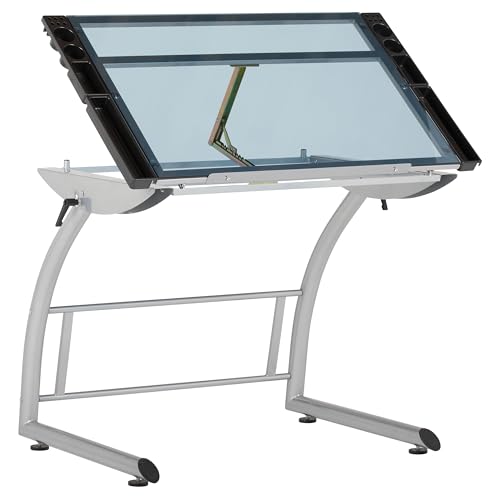
SD Studio Designs Triflex Drawing Table — Sit-to-stand artist
The Triflex appears in this guide in its silver and blue glass livery — a sibling of the charcoal version in our animation roundup — and it earns its place in a storage-led list by honestly representing the opposite priority. Its storage is modest, and its genius is motion: a drawing table that converts between sitting and standing, across a glass surface sized 35.25 by 23.5, for artists whose supplies already live on shelves and whose real problem is that eight seated hours with a pencil is a posture sentence. Judge it as the roundup’s movement specialist and its specification makes complete sense.
Standing to draw changes the work itself, not just the worker. Lines swing from the shoulder, large gestures open up, and stepping back from the page — the oldest quality-control move in art — becomes a half-pace rather than a chair extraction. The Triflex’s conversion serves that rhythm, and its glass top adds the tracing option when a pad slides beneath, plus the instant cleanup that ink artists prize. In studios where wall shelves already run the archive, a desk that contributes posture instead of more boxes is contributing the scarcer resource.
The compromises are the mirror of the Lurinthal’s. Where the cabinet desk stores everything and moves never, the Triflex stores little and moves constantly — which means the room must supply the storage system, in shelves, caddies or a nearby cabinet, and the buyer should budget that system honestly rather than discovering its absence. The conversion mechanism also rewards a routine rather than restless adjustment: pick your seated hours and your standing hours, and let the desk’s day have a shape.
Artists returning to drawing after years at a screen often find this desk the most inviting route back, because it refuses to recreate the office chair’s posture in the studio. The blue-tinted glass and silver frame give it a lighter, more playful presence than the black studio norm, suiting rooms that want their art corner to look like a pleasure rather than a workplace. If your shelves are full and your back is bored, the Triflex is the pick that understands you.
Illustrators working to deadlines will recognise another benefit of the standing mode: energy management across a long day is a production skill, and alternating postures is the simplest version of it that furniture can provide. The desk will not make the work faster, but it changes the texture of the hours spent doing it, and many professionals protect that variety as fiercely as they protect their reference library. In a guide about storage, the Triflex is the reminder that what an artist most needs to store, sometimes, is stamina.
- Top: glass work surface measuring 35.25 x 23.5, finished in silver and blue
- Adjustment: converts between sitting and standing work, plus tilt
- Storage: modest — designed to pair with the room’s shelves
- Tracing: pad beneath the transparent top when needed
- Typical duties: drawing and illustration across two postures daily
Strengths
- Standing drawing unlocks shoulder-led lines and easy step-back reviews.
- Glass offers tracing-through and fast ink cleanup in one surface.
- A long-proven Studio Designs platform with a distinctive, lighter look.
Trade-offs
- The room must provide the storage this desk deliberately does not.
- Conversion suits a daily rhythm better than constant small adjustments.
- Glass etiquette applies — no edge clamps, and wipe before sliding paper.
Best for: shelf-equipped studios and artists who want posture variety above storage. Not suited for: buyers needing the desk itself to house their whole inventory.
How do the best art desks compare on storage and surface?
| Desk | Storage system | Top | Mobility | Seat |
|---|---|---|---|---|
| Lurinthal | Cabinet + drawers + shelves | Tilting | Placed once | Not included |
| JupiterForce | 2 slide drawers | Glass, tilting | Wheels | Not included |
| ZENY | Drawers + built-in outlet | Tilting | Fixed station | Included |
| Athena Collection | Storage in frame | Glass, tilting | Casters | Not included |
| VECELO | 2 drawers | Tilting | Light to move | Included |
| Triflex | Modest | Glass, tilting | Sit-to-stand | Not included |
Read the storage column as a descending staircase and the guide’s logic becomes visible. The Lurinthal stands alone at the top with a three-part system; the ZENY and VECELO occupy the practical middle where most practices actually live; the JupiterForce and Athena trade depth for wheels; and the Triflex steps off the staircase entirely, spending its budget on posture. None of these is the correct amount of storage in the abstract — the correct amount is the one that matches the inventory you counted in the buying section, plus a shelf’s worth of humility about how collections grow.
How do you organise an art desk so it stays organised?
Assign by frequency, not by category. The tools touched in every session belong in the top drawer or the nearest shelf edge, whatever they are; the tools touched weekly go one level deeper; the materials touched monthly go to the cabinet, the back of the shelf, or another room entirely. Category-based systems — all paints together, all pencils together — look beautiful in photographs and fail in practice, because they scatter the daily kit across three locations. Frequency-based systems keep the session’s whole world within one arm’s reach, which is the only organisational metric a working desk should be judged by.
Then give works in progress their own rule, because they are the clutter that defeats most systems. A piece in progress may live on the top or in one designated flat place — a drawer, a shelf, a board leaning in its assigned slot — and nowhere else. The moment a second piece joins it outside that place, the desk has begun its slide back into occupation, and the five-minute reset becomes an hour’s excavation. Studios that hold this single rule tend to stay usable for years; studios that organise everything except the active work are tidying around the actual problem.
Finally, schedule the audit the storage section promised. Once a season, empty one storage zone completely, wipe it, and return only what you can name a use for. Cabinets and deep drawers across this roundup will thank you for it, and the recovered supplies — the duplicate tubes, the forgotten good paper — regularly fund the next month of making. Organisation is not a personality trait; on a desk like these, it is a calendar appointment.
Which mistakes do buyers of art desks keep making?
The first is buying storage by photograph rather than by inventory. A cabinet desk looks like salvation in a listing and becomes a very large junk drawer in a home whose supplies were actually shelf-shaped. Count what stands, what rolls and what lies flat before choosing, as the buying section insists. The second mistake is forgetting the chair’s claim: only two picks here include a stool, and a desk whose storage is perfect but whose seat is a kitchen chair at the wrong height will still lose the posture argument every evening.
Third, buyers place storage desks like occasional tables. A cabinet model needs its doors and drawers audited against the room — a drawer that opens into a bed frame is a drawer that will be used twice and abandoned, and a cabinet door that cannot swing fully becomes a shelf you reach into sideways forever. Fourth comes the glass oversight: artists who clamp lamps, vises and lights to their desk edge buy glass tops and discover the incompatibility at the first session. And fifth, the flat-storage fantasy — expecting any desk here to archive large sheets like a plan chest — ends in curled paper and quiet resentment. These are working desks with working storage, and judged as such, honestly and in the rooms they were built for, the best of them are superb at the unglamorous work of keeping a practice tidy, reachable and ready to resume at a moment’s notice on any ordinary evening of the working week, without a preliminary excavation of the surface before a single new line can be drawn or a single fresh wash can be laid down in peace at the end of a long day spent making other things for other people in other rooms of the house entirely.
How do you set up lighting over a storage-heavy art desk?
Cabinets and shelves cast shadows that bare desks never meet, so lighting deserves a plan rather than an afterthought. Aim the main task light from the side opposite your drawing hand, high enough to clear the shelf line, so the hand’s shadow falls away from the work and the storage below stays visible enough to use. On the glass-topped picks, remember that a lamp beneath the surface serves tracing passes, not general illumination, and the two lighting states — bright room for drawing, dim room for tracing — should both be reachable without rewiring anything.
Daylight deserves the same deliberateness. A storage desk is heavy furniture that will not chase the sun the way the wheeled Athena can, so its first placement should be its best one: near a window’s side light if the room allows, never with the window directly behind the monitor or the page, where glare negotiates against you all afternoon. Spend one day observing where the light actually falls in the chosen corner before the desk arrives; that single day of patience decides years of squinting or not squinting.
What should live somewhere else, even with a big art desk?
Some citizens of the studio should never move into the desk, however capacious it is. Solvents and sprays belong ventilated and upright, ideally in a metal box or a ventilated cupboard away from the working chair. The archive of finished work belongs flat, dry and undisturbed — a portfolio under a bed serves it better than any working drawer. And the household’s shared tools, the scissors and tape that every roommate believes they own, belong in the kitchen drawer where the treaty already exists, or the art desk will become a lending library with a drawing surface on top.
Knowing what to exclude is what keeps a storage desk a studio rather than a warehouse. The desks in this roundup are sized for the active practice — this month’s materials, this week’s tools, today’s piece — and they perform beautifully inside that boundary. Ask them to also be the attic, and even the Lurinthal’s cabinet will eventually file a complaint in the only language furniture knows: a surface that will not clear and drawers that will not close.
How do you move and maintain a heavier storage desk?
Storage furniture should be emptied before it is moved — a rule that sounds obvious and is broken in every household move ever recorded. Drawers and cabinets travel best empty and, where the design allows, removed, both to protect the frame’s joints from leveraged weight and to protect the mover’s back from a desk that has quietly become a library. Measure the route as carefully as the destination: door widths, stair turns and the lift’s honest dimensions have ended more cabinet-desk stories than any defect of manufacture.
Maintenance is the quarterly ritual this family of guides keeps recommending because it keeps working: a cloth for the surfaces, a check of the tilt hinge and every reachable fastener, a glance at caster axles on the wheeled picks, and one storage zone emptied and audited while you are there. Twenty minutes, four times a year, is the entire contract. Desks that receive it stay square, silent and smooth; desks that do not will eventually describe their neglect in creaks, and by then the fix is a Saturday rather than a coffee break.
How does an art desk grow with a practice over the years?
Few artists keep the same inventory for long, and a well-chosen desk accommodates the growth in stages. The beginner’s drawers hold everything; the intermediate’s practice adds a shelf beside the desk and a portfolio beneath it; the established artist’s desk becomes the working heart of a small system, with the archive exiled to a plan chest or a cupboard and only the active materials in residence. The desks in this roundup survive those stages differently — the Lurinthal absorbs the most growth internally, the Triflex the least — but all six can serve as the permanent working surface while storage accretes around them.
That is the right way to judge the purchase: not whether the desk holds everything you own today, but whether it can remain the place you work while everything you own changes around it. A tilting top at the right height, a surface your media respects, and storage for the daily layer — those needs do not expire. Buy for them, let the archive grow its own furniture in its own time, and the desk you choose this year will still be the desk your practice is organised around in five years, which is the only definition of value this category should be allowed to use when artists are spending their own money on furniture they will live with daily.
Final Recommendation
Let your inventory cast the deciding vote. If it has overrun the room, the Lurinthal is the only pick that answers at the scale of the problem, and its cabinet, drawers and shelves will repay the footprint they claim. If your supplies are session-sized but your room is socket-poor, the ZENY’s drawers and outlet tidy both problems in one station; if you simply want the complete, uncomplicated corner, the VECELO’s drawers and stool remain the straightest line from box to drawing. Mobile studios should choose between the JupiterForce’s slide drawers and the Athena’s travelling frame storage by how much kit must roll with the desk, and artists whose shelves are full but whose posture is not should let the Triflex spend its budget on standing instead. An art desk has done its job when the materials have addresses and the artist has a clear surface — pick the storage that matches your stuff, and the making, not the tidying, becomes the story of the room.
Frequently Asked Questions
Can any of these desks store large sheets of paper flat?
Not in the archival, plan-chest sense. Drawers and cabinets here suit sketchbooks, pads, boards and supplies, while truly large loose sheets still want a portfolio or a plan chest beside the desk, where they can rest flat, dry and undisturbed between sessions. Buyers whose work is large-format should treat the desk as the working station and budget flat storage separately — a division of labour that professional studios, with their plan chests beside their easels, have observed for a century.
Which desk holds the most supplies overall?
The Lurinthal, by design: its cabinet takes bulk, its drawers take daily tools and its open shelves take the visible working stock, a three-layer system none of its companions fully matches. The ZENY and VECELO follow at session scale, the JupiterForce and Athena store a working kit inside mobile frames, and the Triflex deliberately stores least, expecting the room’s shelves to run the archive while it runs the artist’s posture.
Are the included stools worth relying on?
As starter seating, yes — they are matched to their desks in height and perfectly serviceable for evening sessions, which is the use most home studios actually see. Artists drawing for full days usually upgrade to a chosen chair eventually, and both stool-bundling picks here, the ZENY and the VECELO, keep their drawer value long after that upgrade. Treat the stool as the desk’s honest beginning rather than its final word on comfort.
Glass or wooden top for painting?
Glass wipes clean after paint and ink and offers tracing with a pad beneath, which suits illustrators and mixed-media artists whose cleanup time matters. Wooden-tone tops grip paper and boards more kindly and tolerate clamps and cutting, which suits painters who work on boards and crafters generally. The roundup splits between the two characters on purpose, and most artists know their own camp within one honest look at their last three projects.
Do the wheeled desks stay put while I draw?
On hard floors with their casters locked or the desk settled, yes, for ordinary drawing pressure. Build the locking habit before detailed work — it takes two seconds and becomes as automatic as sharpening a pencil — expect thick carpet to make rolling and stability both worse, and the JupiterForce and Athena will behave like the fixed stations they imitate. Artists who lean with real force during erasing should still favour a fixed desk, honestly assessed.
How much room does the cabinet-style Lurinthal need?
Measure it like furniture, not like a desk: its full footprint plus clearance for drawers and cabinet access to open without meeting the bed, the door or the chair’s travel, plus standing room for the artist in front of an open cabinet. Taping the outline on the floor and miming a full session inside it — sitting, opening everything, standing back — remains the cheapest way to be sure before the box arrives.
Related Guides
Continue the studio build-out with best adjustable art desks for the tilt-first view of drafting tables, best animation desks when light and tracing lead the brief, and best adjustable desks for the sit-stand workstations serving the digital half of a practice.
Related guides
- Best Enterprise SATA SSDs: Endurance Classes, Power-Loss Protection and Fleet Sense
- Best Color Product Label Printers: Six Desktop Machines for Short-Run Product Labels
- Best Printers for Dental Practices
- Best 1440p 165Hz Monitors: One Native 165Hz Pick, Three 180Hz Upgrades, an Overclock Headline and a 160Hz Ultrawide


