What's inside
- Key Takeaways
- Quick Picks
- How Did We Judge Desks of This Size?
- Who Genuinely Needs a Desk This Wide?
- How Do the Six 70 Inch Desks Compare?
- What Mistakes Do Buyers Make at This Scale?
- How Should a Desk This Size Be Assembled and Placed?
- How Do You Keep a Very Long Desk Tidy?
- Can Two Adults Work at One 70 Inch Desk Full-Time?
- How Do You Handle Delivery Day for Furniture This Size?
- How Do Cables and Power Behave Across a 70 Inch Span?
- What Can Makers and Creatives Do With This Much Surface?
- How Should the Rest of the Room Be Arranged Around It?
- Is a Desk This Size a Sensible Buy for a Growing Family?
- How Do You Maintain a Desk of This Size Across the Years?
- What Should You Budget Beyond the Desk Itself?
- Final Recommendation
- Frequently Asked Questions
- Related Guides
As an Amazon Associate I earn from qualifying purchases. This post may contain affiliate links at no extra cost to you.
gizmoverdict.com is reader-supported. When you buy through links on our site, we may earn an affiliate commission.
Where to buy: the six desks below link to their Amazon listings, where you should confirm the precise width — this class lives between 70 and 71 inches depending on the model — and check the delivery details, because furniture of this size rewards a planned arrival.
A 70-inch desk is not a bigger version of a normal desk; it is a different category of household decision. Shoppers looking for the best 70 computer desks have usually crossed a threshold — two full workstations’ worth of equipment, a gaming command centre, a shared family headquarters, or a craft practice that consumes surface the way other hobbies consume shelves. At this width the desk stops fitting into a room and starts organising it. Walls are chosen for it. Doors are measured for it. In return, it offers the one thing no smaller desk can counterfeit: simultaneous room for everything, all day, without a single object being put away to make space for another.
The listings in this class cluster between 70 and 70.9 inches, with a couple of models at a full 71. We state each desk’s real width in its review, because at this scale an inch is the difference between a desk that enters the room and a desk that hosts an argument in the doorway. Read those numbers alongside your own measurements of doors, hall turns and stair landings — the route matters as much as the destination, and the honest time to discover a problem is before the carton arrives, not inside it.
One more framing note before the picks. Desks at this size accumulate accessories in their listings — LED strips, cup holders, banks of outlets — and those extras are genuinely pleasant. They are also, in the hierarchy of what makes a 70-inch desk good, decoration on the real questions: is the top thick and well supported across its span, does the frame keep a span this long from swaying, and can the whole thing be assembled by two people in the room where it will live? This guide keeps that hierarchy straight throughout, praising the extras where they help and never mistaking them for the desk itself.
Key Takeaways
- Measure the route, not just the wall: doorways, hall turns and stairs decide whether a 70-inch desk can move in at all.
- Every model here is a two-person assembly; plan the build in the room of final residence.
- Real widths in this class run 70 to 71 inches — check your pick’s exact figure against your space.
- Top thickness and frame support across the span matter more than any accessory fitted to the surface.
- LED lighting and outlet banks are pleasant extras; judge the desk first as furniture, then as electronics.
Quick Picks
| Pick | Badge | Why it earns its place |
|---|---|---|
| Huuger 70 Inch Office Desk with Storage | Best all-round 70 | A long, simple desk with storage and large legroom that keeps the big-desk brief calm and credible. |
| PRAISUN 70 x 24 Inch Desk with Power Outlets | Best powered workbench | Four AC outlets plus USB and USB-C on a heavy-duty metal frame for the device-dense workstation. |
| SEDETA Gaming Desk 70.8 Inch with LED | Best gaming command centre | Monitor stand, storage shelves, lighting and even a cup holder arranged around a serious gaming span. |
| Coleshome 71 Inch Computer Desk with USB Ports | Best straightforward 71 | A long rustic brown study desk with USB charging and no agenda beyond space, honestly delivered. |
| PRAISUN 71 Inch Desk with Thicker Desktop | Best heavy top | A 25mm-thicker desktop on a sturdy frame for users who load a long span and expect it to stay silent. |
| SEDETA Farmhouse 70.9 Inch Executive Desk | Best executive storage | File drawers and a storage cabinet in farmhouse dress for a home office that handles real paperwork. |
How Did We Judge Desks of This Size?
Scale changes the judging criteria, so we changed them openly. At 70 inches, the first questions are logistical and structural rather than cosmetic: can the desk plausibly enter an ordinary home, can two people assemble it without a engineering degree, and does its design acknowledge that a top this long is a span, with a middle that must be supported against sag and sway? Models whose listings spoke to frame construction and top thickness earned more confidence than those that spoke only of lighting colours.
We also read the accessory lists the way an owner experiences them in month six. Features that interact with the desk’s structure — a monitor stand’s height, a cabinet’s dimensions, an outlet bank’s position — were weighed as design decisions with daily consequences. Features that merely attach to the experience, like lighting colours and cup holders, were noted with pleasure and weighted accordingly. That distinction sounds obvious and is violated by half the listings in this class, which is why this guide keeps returning to it.
The second tier of judgement concerned how the width is furnished. This class contains open workbenches, storage hybrids and one executive design with file drawers and a cabinet, and each philosophy was weighed for the household it suits. We were sceptical, throughout, of accessory inflation: a cup holder is a nice afternoon, not a buying reason, and a desk that leads with its LED remote while staying silent about its frame has its priorities available for inspection.
Ownership cost was the last lens, applied gently. A desk at this size will be assembled once, moved rarely and judged for a decade, so small differences in build quality compound while small differences in purchase convenience evaporate. We favoured designs whose weaknesses, where they exist, are the kind an owner can remedy — a cable tray added, a lamp upgraded — over designs whose weaknesses are structural and permanent. That bias runs quietly through every verdict below.
Finally, we considered the room after the desk. A 70-inch desk will be the largest piece of furniture in most rooms it enters, and it will set the terms for everything else — where the bookshelf can stand, whether a second chair fits, how the light falls. Designs that could share a room gracefully, in calmer finishes and without visual shouting, scored well for the bedrooms and spare rooms where many of these desks will actually live.
Who Genuinely Needs a Desk This Wide?
Three households, mainly. The first runs two real setups in one place: a work laptop driving two screens beside a personal machine, or a gaming rig beside a study station, where smaller desks forced a daily eviction contest. The second is the shared headquarters — the family desk where homework, household admin, a parent’s work and a printer all hold permanent addresses, and where the surface must absorb simultaneous use by design rather than by negotiation. The third is the maker: sewing, model building, electronics and art practices whose projects are measured in feet and cannot be folded away between sessions.
There is a fourth household worth a sentence: the one running a small business from home. Packing benches, label printers, stock boxes and a computer form a production line that eats surface in sequence, and a 70-inch desk can host that line in a spare room with a dignity that folding tables never achieve. If orders are part of your evenings, measure the line — printer, scale, packing zone, screen — and you will likely find it totals almost exactly the width of this class, which is no coincidence: desks grow to the size of the work that needs them.
If none of those descriptions fits, read this guide as a warning label with excellent photography. A 70-inch desk bought for a single laptop and a lamp will spend its life as a monument to elbow room, collecting the household’s homeless objects across its empty steppe, while the room around it feels smaller every year. Width is a tool. The households above will feel its value daily; everyone else will feel its footprint, its assembly afternoon, and its quiet demand that the room be arranged around it for years to come.

Huuger Computer Desk, 70 Inch with Storage — Best all-round 70
Huuger’s 70-inch desk extends the maker’s long-desk philosophy to its fullest reach: a long, simple top, storage designed into the whole, and the large legroom the brand treats as a signature. At this width, that combination becomes quietly luxurious. The storage absorbs the permanent population — printer paper, files, the device fleet’s cables — while the top stays clear enough for two projects to coexist, and the legroom underneath lets a tall user, a footrest and a sleeping pet share the span without a summit meeting.
The desk’s restraint is its credential. There is no lighting rig demanding attention and no thicket of features to learn; the design trusts width and order to do the persuading. In a spare room or a dedicated study, that trust is repaid daily, because a calm 70-inch surface is the most flexible object a household can own: office in the morning, homework headquarters at four, project bench at the weekend, and a buffet or wrapping station twice a year without changing its clothes.
Assembly and placement follow the class rules — two people, built in its room, levelled with patience — and the storage should be loaded after the frame has settled for a day, so any bolt that wants a final quarter-turn can ask for it before the drawers fill. For buyers who want the definitive big desk without a gaming accent or an executive price of admission, this is the guide’s centre of gravity.
- True width: 70 inches as listed
- Storage: built into the design across the span
- Legroom: generous, in line with the maker’s long-desk pattern
- Style: long and simple, suited to study or spare room
Strengths
- Two projects coexist on top while clutter lives inside.
- Calm design shares a room with beds and sofas politely.
- Legroom suits tall users and under-desk companions.
Trade-offs
- No desktop power or lighting extras are included.
- Two-person assembly is effectively mandatory.
- Its size commits the room’s layout around it.
Best for: households wanting one definitive desk for work, homework and projects. Not suited for: single-laptop users or rooms that rearrange often.
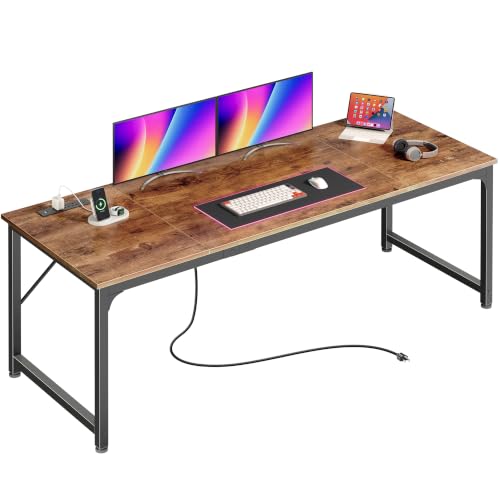
PRAISUN 70 x 24 Inch Desk with Power Outlets and USB-C — Best powered workbench
Device-dense workstations have a cabling problem that grows with the desk, and this PRAISUN attacks it at the source: four AC outlets ride on the desktop alongside USB and USB-C charging, all fed by one supply cable. On a 70 by 24 inch top, that means a laptop, two monitors’ worth of bricks, a phone and a lamp can all be powered from the surface they serve, and the floor beneath the desk stays a floor instead of a substation. For a renter whose desk wall has one socket in the wrong county, this arrangement is close to liberation.
The frame is a heavy-duty metal construction, which matters at this span for a practical reason: a long top loaded with monitors at its back edge transmits real leverage to its supports, and a frame built generously keeps the whole arrangement feeling like one object rather than a surface with opinions. The rustic brown finish softens the workbench brief for domestic rooms, letting the desk serve a bedroom-office without importing an industrial aesthetic.
Electrical manners apply as ever. Four outlets invite enthusiasm, but they remain a convenience feed for electronics, not a circuit for kettles and heaters; the desk’s own cable should be the only thing making the trip to the wall, routed down a rear leg where feet cannot find it. Set up with that discipline, this is the most self-sufficient workstation in the guide — the desk you would choose for a room whose wiring you cannot change.
- True size: 70 by 24 inches as listed
- Power: four AC outlets plus USB and USB-C on the desktop
- Frame: heavy-duty metal construction
- Finish: rustic brown for domestic rooms
Strengths
- Surface power ends floor-level cable sprawl at scale.
- USB-C covers the current generation of devices natively.
- A sturdy frame suits monitor-heavy back edges.
Trade-offs
- Storage is not this model’s headline; plan your own.
- The outlet bank concentrates plugs at one zone of the top.
- High-draw appliances still belong on a wall socket.
Best for: device-dense home offices in rooms with poorly placed sockets. Not suited for: paper-heavy workers who need drawers more than power.

SEDETA Gaming Desk, 70.8 Inches with LED Lights and Monitor Stand — Best gaming command centre
SEDETA’s gaming entry measures 70.8 inches and furnishes nearly all of them. A monitor stand raises the main screen and stacks the setup vertically; storage shelves take the console, the games and the headset economy; LED lighting provides the evening glow the genre expects; power outlets are built in; and a cup holder stands guard over the whole arrangement, because at a gaming desk a drink is not a hypothetical. As a command centre — one chair, one player, everything within reach — the design is coherent in a way that piecemeal setups rarely achieve.
The honest appraisal separates the layers. The width, the stand and the shelves are the desk: they organise a large gaming setup into zones and keep the primary surface clear for keyboard and mouse at full sweep. The lighting is atmosphere — enjoyable, harmless, and no substitute for a lamp when you need to read. The cup holder is a small mercy that will, once in its life, save a keyboard. Judge the package in that order and it judges well: a genuinely organised gaming span with garnish, rather than garnish with a desk attached.
Two practical notes. The monitor stand fixes screen height, so check it against your chair and your eye line as with any stand design. And a desk furnished this completely is a commitment to one layout; players who reconfigure their rigs seasonally may prefer the open Huuger or Coleshome and their own shelving. For the player who knows their setup and wants it housed properly at full width, this is the roundup’s most complete gaming answer.
- True width: 70.8 inches as listed
- Furnishing: monitor stand plus storage shelves
- Extras: LED lighting, built-in power outlets, cup holder
- Brief: a zoned, single-chair gaming command centre
Strengths
- Zones for screen, console and peripherals at full width.
- The stand returns the surface beneath the screen to use.
- Built-in power keeps chargers on the desk, not the floor.
Trade-offs
- The furnished layout resists seasonal reconfiguration.
- Stand height is fixed and must suit your chair.
- Lighting is ambience, never a task light substitute.
Best for: committed gamers with a settled, multi-device rig. Not suited for: minimalists or workers who rearrange their setup often.

Coleshome 71 Inch Computer Desk with USB Ports — Best straightforward 71
At a full 71 inches, the Coleshome is the widest desk in this guide by a whisker, and the most plainly spoken. Its listing promises a large office and study desk in rustic brown with USB ports for charging, aimed at students and home workers, and that is exactly the object: a long, handsome surface with a modest electrical courtesy, sold on space rather than spectacle. In a market segment addicted to features, a desk whose pitch is “room, honestly delivered” has a clarity that deserves respect.
The width serves the classic long-desk census. A student’s semester can spread across it — laptop, textbooks open in pairs, notes in progress — without the daily landslide of a smaller top. A home worker gains the two-monitor layout with a paperwork wing. A family gains a headquarters where two people can sit side by side for homework supervision or a shared project without the elbow diplomacy a 55-inch desk demands. USB charging at the desk keeps the phone economy off the floor.
Everything else is your own furnishing, and at 71 inches the furnishing plan matters: a desk this long with no built-in storage will attract the household’s drift unless drawers, boxes or a cabinet are assigned from day one. Pair it with a rolling unit and a cable tray, and the Coleshome becomes the serene workbench its photograph promises. Leave it bare and it becomes the world’s most elegant landing strip for clutter — the desk is honest; the discipline must be yours.
- True width: 71 inches as listed — the widest here
- Charging: USB ports built into the desk
- Finish: rustic brown, study-desk styling
- Audience: students and home workers with long spreads of paper
Strengths
- Maximum width for side-by-side and sprawling work.
- A calm finish that suits studies and bedrooms alike.
- No fragile feature-set to age or fail.
Trade-offs
- No drawers or shelves arrive with it.
- Clutter discipline must be supplied by the owner.
- At 71 inches, doorway checks are non-negotiable.
Best for: students and families who need maximum honest surface. Not suited for: buyers expecting storage and power systems in the box.

PRAISUN 71 Inch Large Office Desk with 25mm Thicker Desktop — Best heavy top
This PRAISUN’s headline is a number with real meaning: a desktop made 25mm thick, substantially more substantial than the thin tops common in flat-pack furniture. Across a 71-inch span, top thickness is not vanity. A thick top resists the drum-skin flex that makes long desks feel alive under typing, takes a monitor arm’s clamp with confidence, and carries heavy loads — reference libraries, a printer, a sewing machine — without the span’s middle becoming a trampoline. The sturdy metal frame beneath completes a desk engineered around the physics of its own size.
Power outlets with USB-C ports are built in, following the pattern of its smaller PRAISUN sibling, and on a top this size the convenience compounds: devices at either end of a 71-inch desk are a long way from a floor strip. The executive brief in the listing is credible in feel if not in tailoring — this is a desk that reads as serious furniture, the anchor of a study rather than a station in a bedroom, and it will suit the home worker whose office is a room of its own.
Weight is the honest cost. A thick top and a sturdy frame make this the desk you assemble exactly where it will live, with two people and no plans to move it casually afterwards. Renters who move annually should weigh that against the open, lighter designs here. Owners who are settled, load their desks heavily and hate flex with a personal hatred will find this the most satisfying object in the roundup.
- True width: 71 inches as listed
- Desktop: 25mm thicker top, per the listing
- Power: outlets with USB-C ports built in
- Frame: sturdy metal construction for a loaded span
Strengths
- The most flex-resistant top in this guide.
- Monitor arms clamp with confidence at any position.
- Surface power suits a span too long for floor strips.
Trade-offs
- The heaviest commitment here on moving day.
- Storage remains a separate furnishing decision.
- Its executive presence overwhelms small bedrooms.
Best for: settled home workers with heavy loads and zero tolerance for flex. Not suited for: frequent movers or small-room buyers.

SEDETA Farmhouse 70.9 Inch Executive Desk with File Drawers and Storage Cabinet — Best executive storage
The closing pick dresses the big desk for the boardroom’s home branch. At 70.9 inches, SEDETA’s farmhouse executive design pairs its span with the storage serious paperwork requires: file drawers sized for documents rather than trinkets, a storage cabinet for the bulk that drawers refuse, and a power outlet woven into the arrangement. The farmhouse styling — warm, panelled, domestic — keeps all that capacity from reading as office furniture, which is the trick a home executive desk must perform twice a day: authority at nine, furniture at seven.
Who is this for? The household whose desk is a registry: tax folders, school records, insurance files, the paperwork of a small business or a rental property, all needing a home that locks the visual chaos away behind doors and drawer fronts. Open desks serve such households badly, because their paperwork has nowhere to be invisible. Here it does — filed, cabineted, and off the surface, leaving the long top clear for the work of the day and the room presentable for the evening.
The cautions are those of all furnished desks, amplified by size. The storage layout is the maker’s decision, and your files must fit its drawers’ dimensions — measure the folders you actually keep. Assembly is the longest in this guide, a two-person project to schedule rather than squeeze. And a desk with this much presence should be bought for a room that will host it for years. Within those terms, it is the most complete home-office furniture piece in the roundup: not a desk with storage, but a small office that happens to be one object.
- True width: 70.9 inches as listed
- Storage: file drawers plus a closed storage cabinet
- Power: outlet built into the desk’s arrangement
- Style: farmhouse executive — authority with domestic manners
Strengths
- Real file storage swallows a household’s paperwork whole.
- Closed storage keeps a shared room presentable.
- The long top stays clear because everything has a home.
Trade-offs
- The longest, most involved assembly in this guide.
- Drawer dimensions must match the files you keep.
- A permanent-feeling piece for a settled room only.
Best for: home executives and paperwork-heavy households in settled rooms. Not suited for: renters, minimalists or anyone whose files live in the cloud alone.
How Do the Six 70 Inch Desks Compare?
| Model | True width | Signature strength | Give it a miss if |
|---|---|---|---|
| Huuger 70 with storage | 70 in | Calm span with storage and legroom | You want desktop power included |
| PRAISUN 70 x 24 powered | 70 x 24 in | Four AC outlets plus USB-C | Drawers matter more than power |
| SEDETA gaming 70.8 | 70.8 in | Stand, shelves and zoned gaming layout | Your rig’s layout changes seasonally |
| Coleshome 71 | 71 in | Maximum plain surface, USB charging | You need storage in the box |
| PRAISUN 71 thick top | 71 in | 25mm thicker desktop, sturdy frame | You move home frequently |
| SEDETA farmhouse 70.9 | 70.9 in | File drawers plus storage cabinet | Your paperwork is fully digital |
The widths differ by an inch at most, so the real comparison is furnishing philosophy. Two desks here are fields (Huuger with its quiet storage, Coleshome entirely open), two are power stations (the PRAISUN pair), and two are furnished rooms in miniature (the SEDETA gaming centre and the farmhouse executive). Your household already knows which of those it is; the table merely gives the knowledge a model name.
What Mistakes Do Buyers Make at This Scale?
The doorway mistake leads the catalogue, and it is made in two acts: measuring the destination wall but not the route, and discovering the omission with the carton open. Tape the desk’s footprint, then walk the route from front door to final wall with a tape measure at every pinch — door frames, the turn at the stair’s foot, the hallway’s narrowest embrace. Remember that these desks arrive flat, which rescues most routes, but the assembled desk’s own future moves deserve the same audit if you ever plan to change rooms without dismantling it.
The second mistake is furnishing by photograph. A 70-inch desk photographed empty in a warehouse looks like possibility; the same desk under your ceiling, with your skirting boards and your radiator, is a specific object in a specific room, and the accessories that glittered in the listing — the lighting, the cup holder — will not be what you praise or curse in month six. The frame, the top and the storage will. Buy those, and let the garnish be a bonus. The third mistake is solo assembly optimism. At this size, one person with determination can technically build most of these desks and will enjoy none of it; schedule the second pair of hands and the clear floor, and the build becomes an hour of competence instead of an evening of leverage and regret.
How Should a Desk This Size Be Assembled and Placed?
Clear the room’s centre, not just the desk’s wall. A 70-inch top needs a working field around itself during assembly, and parts laid on the bed or the floor in build order prevent the mid-project scavenger hunt that breaks concentration. Assemble the frame loosely, stand it with help, and level it empty before the top’s full weight and the equipment arrive; long frames find their posture gradually, and the levelling feet should meet the floor’s real slopes, not the ones you hoped for. Tighten in stages, re-check after a day of load, and again after a week — spans settle, and the second tightening is where long desks become silent.
Placement follows the light-and-traffic rules of smaller desks, amplified. A window perpendicular to the desk is ideal; a window behind a 70-inch span of monitors is a glare farm. Leave a genuine walkway at one end at least, because a desk that must be climbed around will be resented by everyone who does not sit at it. And place the chair’s territory before the accessories: the sitter’s square metre is the room’s capital, and shelves, cabinets and lamps should be arranged as its suburbs, not its invaders.
How Do You Keep a Very Long Desk Tidy?
Zoning is the whole secret. Divide the span, in your mind and then in fact, into territories with names: the working centre where the chair lives, a device wing, a paper wing, and a far reach for the things in progress. Objects may migrate within a session but must return to their territory at the session’s end, a five-minute ritual that scales where willpower alone does not. Storage models — the Huuger, the farmhouse SEDETA — give territories a backstage to retreat into; open models need a rolling cabinet or boxes that play the same role.
Visitors will test your system, because a big clear desk reads to every other member of a household as available space, and available space attracts deposits the way a clear kitchen counter attracts post. The defence is not territorial signage; it is the visible evidence of a system — zones occupied by named things, a landing strip that absorbs arrivals, and a five-minute evening reset that restores the pattern before drift becomes archaeology. Households that run this light governance report the same discovery: the desk stays large. Households that rely on occasional heroic clean-ups report that the desk somehow shrinks, month by month, without moving a single leg.
The second discipline is the landing strip rule: one defined place, ideally a tray near the door-side end, where incoming objects are allowed to land — post, keys, the thing someone hands you “for the desk”. Without a landing strip, arrivals distribute themselves across the whole 70 inches like weather. With one, the desk’s weather has a climate zone, and the weekly sort takes minutes. Big desks do not stay tidy by being cleaned; they stay tidy by being governed, lightly and daily.
Can Two Adults Work at One 70 Inch Desk Full-Time?
This is the width where the answer finally becomes “sometimes, carefully”. Two laptop-based workers, each with modest storage and a shared printer between them, can hold permanent territories at a 70-inch desk — especially the open models, where a rolling cabinet per person draws the border. Two monitor-based workers cannot: dual screens each, plus keyboards, plus the radius of two chairs with working room, exceed what one span and one chair-line can host without daily friction.
If your household is attempting the shared arrangement, invest in the treaties: a chair each that truly fits its owner, a rule that territories are cleaned by their owners, headphones as the acoustic wall, and a shared centre strip that belongs to neither. Many couples and siblings run exactly this constitution happily for years. Just enter it knowing that the desk is the junior partner in the arrangement — the diplomacy does the work, and the width merely gives diplomacy room to stand.
How Do You Handle Delivery Day for Furniture This Size?
Plan the arrival like a small event. Clear the route from the front door to the desk’s room before the van comes — the hallway chair, the shoe rack, the door that never quite opens fully — because a long carton steered by a delivery driver and a hopeful owner forgives nothing. Check the carton for damage before signing anything, photograph any crushed corner, and keep the packaging until the desk is built and level; returns of furniture this size are a logistics project nobody wants, and the original box is the project’s only friend.
Stage the parts in the room of residence in build order, hardware in a bowl, tools charged and ready. A cordless driver with a torque setting you trust will save an hour of hex-key labour across a frame this size, but finish every bolt by hand so the final tightness is felt rather than guessed. If the build must pause — life intervenes — pause it with the frame stable and the small parts bagged and taped to the underside of the top, never scattered “somewhere safe” across three rooms. Furniture projects fail in their interruptions more often than in their instructions.
How Do Cables and Power Behave Across a 70 Inch Span?
At this width, cable management stops being tidiness and becomes infrastructure. The robust pattern is a tray or raceway running the rear underside like a service duct, with a power strip living inside it and devices dropping short leads into the tray from above. The powered models in this guide — both PRAISUNs and both SEDETAs — relocate much of that economy onto the desktop, which shortens device leads beautifully, but their own supply cables still make the journey to the wall, and that journey should be planned as a single, protected line down the leg nearest the socket.
Two habits keep the system editable. First, label cables at both ends when more than a handful share the tray; at 70 inches, tracing an unlabelled lead by hand is a journey under the desk with a torch. Second, leave deliberate slack behind anything that moves — monitors on arms, a tower pulled forward for cleaning, a laptop that commutes — coiled gently in the tray rather than stretched tight in the air. Cables fail at their connectors, under tension, in the dark, during the week you can least afford it. Slack is cheap insurance bought in advance.
What Can Makers and Creatives Do With This Much Surface?
Seventy inches is a workbench wearing office clothes, and creative practices notice immediately. A sewing station can hold the machine, the fabric’s spread and the pattern pieces simultaneously, in the order the work consumes them. An electronics bench gains an assembly zone, a testing zone and a zone where finished work waits without being handled. A painter or model builder can run the rarest luxury in hobby life: a project that stays out, mid-stage, for a fortnight, while ordinary desk work continues at the other end of the same span. That continuity — no nightly dismantling, no morning reconstruction — is what makers are actually buying at this width, and it transforms a hobby’s rhythm more than any tool does.
Protect the surface accordingly. A cutting mat, a silicone work mat or a sheet of hardboard under the messy zone keeps glue, solder and blade work from tattooing the top, and the open models here accept such overlays without argument. Lighting for making is stricter than lighting for screens: a bright, adjustable lamp that can be aimed into the work, ideally from the side opposite the dominant hand, turns the desk’s evening shift into its most productive hours. Add that lamp to the budget from the start, and the 70-inch desk becomes two pieces of furniture for the price of the floor it stands on.
How Should the Rest of the Room Be Arranged Around It?
Once the desk claims its wall, the room’s remaining furniture should be arranged by relationship rather than by leftover space. Storage that serves the desk — the bookshelf of reference material, the cabinet of supplies — belongs within the chair’s swivel or a single step, because a workstation whose supplies live across the room leaks minutes and temper all day. Seating for a second person, even a folding chair, deserves a planned home; big-desk rooms attract consultation, homework conferences and shared projects, and a guest perched on the bed’s edge is a room admitting it was arranged for one.
Watch the vertical plane as carefully as the floor. A 70-inch desk beneath an empty wall looks like a stage awaiting scenery, and the scenery should be installed deliberately: shelves for the working library, a board for the current project, art that rests the eyes at screen distance’s opposite. Keep heavy shelving fixings honest — a shelf of reference books above a desk is a load with an address, and that address should be a stud or a proper anchor, not optimism in plasterboard. Arranged this way, the room stops being a space with a huge desk in it and becomes a workplace that a huge desk made possible, which is the entire ambition of buying at this scale.
Is a Desk This Size a Sensible Buy for a Growing Family?
Often, yes — with the caveat that the desk will change jobs as the family changes shape. In the toddler years it is the household’s admin and work headquarters, safely adult territory. Through the school years it becomes the homework front line, wide enough for a child, a parent and the sprawling archaeology of a science project to coexist. In the teenage years it may be annexed entirely by one young person’s gaming and study empire, and the household will find itself buying a second, smaller desk for the adults — a succession every large-desk owner should budget for emotionally, if not financially.
The desks that survive this relay best are the calm, strongly built ones whose styling does not belong to a single age or genre: the Huuger and Coleshome in this guide are the obvious heirs, with the thick-topped PRAISUN as the buy-it-for-decades candidate. Gaming-styled and executive-styled models serve their eras brilliantly and date more visibly. None of this argues against them; it argues for buying the desk your household needs now, with eyes open about which future it is also being bought for. At 70 inches, you are not purchasing a product. You are adopting a piece of the house.
How Do You Maintain a Desk of This Size Across the Years?
Scale turns maintenance from a wipe into a route. Dust travels: work the top in sections, moving each zone’s objects once, cleaning beneath them, and returning them to their territories — a quarterly full clear doubles as the clutter audit that keeps the zoning system honest. Frame bolts across a long span should be walked twice a year with a hex key, a ten-minute patrol that keeps the structure’s silence. Levelling feet deserve the same patrol, because a floor that settles under a 47-inch desk announces itself politely, while under a 70-inch span it can twist the frame’s posture enough to make drawers sulk and doors drift.
The furnished models have their own small liturgies. Fabric and file drawers should be emptied and inspected annually — not for tidiness theatre, but because a drawer you never empty becomes an archive you never chose. Outlet units and USB ports should be kept dry, vacuumed of dust with a soft brush, and retired from service at the first sign of a loose socket or a warm plug; the desk will outlive its electronics, and treating the electronics as replaceable servants rather than as the desk itself is the correct philosophy at this scale. A desk maintained this lightly but this regularly does not merely survive a decade — it stays the room’s anchor without ever becoming its burden.
What Should You Budget Beyond the Desk Itself?
The desk’s price of admission is not the whole ticket, and planning the remainder prevents the familiar month of makeshift. A chair worthy of the span belongs at the top of the list — a wide desk with a failing chair is a theatre with a broken seat. Then a cable tray or its equivalent, a lamp that can light a territory rather than a corner, and, for the open models, one piece of real storage so the surface does not become the storage. None of these need arrive on the same day; the desk functions from day one, and the companions can be added in the order your first month of use ranks them.
Keep a small reserve, too, for the discovery every big-desk owner makes in week two: the one accessory your particular work demands that no guide predicted — a document holder, a headphone stand, a second monitor’s arm, a footrest that finally civilises the legroom. A desk of this size is a platform for a decade of small adaptations, and the households that enjoy them most are the ones that treat the purchase as the beginning of an arrangement rather than its conclusion. Buy the span once, furnish it gradually, and let the room teach you the rest.
Final Recommendation
Take the Huuger for the calm, complete big desk; the powered PRAISUN 70 for a device fleet in a socket-poor room; the SEDETA gaming model for a settled rig that deserves a command centre; the Coleshome for maximum honest surface on a student’s or family’s budget of attention; the thick-topped PRAISUN 71 if your loads are heavy and your address is settled; and the farmhouse SEDETA if your household’s paperwork needs filing furniture with manners. Measure the route before the wall, build with a second person, and a 70-inch desk stops being an extravagance and becomes what its owners consistently call it: the surface the whole household quietly organises itself around — the table where work, homework and projects finally have room to happen at the same time.
Frequently Asked Questions
Will a 70 inch desk fit through a standard doorway?
The flat-pack carton will, in almost every case. The assembled desk is another matter: at 70-plus inches it must be tilted and pivoted with help, and some hallways will refuse it. Plan to assemble in the room of residence and to dismantle for any future house move.
Is a 70 inch desk overkill for a single gaming setup?
For one monitor and a console, a 63-inch desk already provides generous room, and the extra width becomes a project wing, a display shelf for the collection, or simply air. Players running two screens, a streaming setup or a sim rig with dedicated controls will use every inch, however. Buy for the rig you actually field on a Saturday night, not the one in the photograph that inspired the search.
How much wall does a desk this size really need?
Its own width plus a margin at each end for cables, a lamp’s swing and the human pleasure of not feeling wedged — call it the width plus a hand’s breadth each side. A desk that exactly fills its wall alcove is hard to clean around and harder to cable.
What chair size pairs with a desk of this span?
The chair does not need to grow with the desk, but its travel does: you will roll further between zones than at a compact desk, so castors that roll cleanly and a base that stays stable at the edge of a reach matter more than sheer size. If two people share the span in turns, each deserves a chair adjusted to them — or one chair with genuinely quick adjustments and a household habit of using them.
Do I need a monitor arm at this width?
Not for space — two monitors fit on stands comfortably. An arm still earns consideration for posture, since it places the screen at your exact eye height and frees the strip beneath it, but it is a refinement here rather than the necessity it becomes on compact desks.
How do I stop a long desk from dominating a bedroom?
Choose the calmer finishes — the rustic browns and farmhouse tones in this guide were designed for exactly this diplomacy — keep the surface visibly clear at night by giving everything a drawer, a cabinet or a tray to retire into, and let the wall above carry one or two personal objects rather than a gallery of equipment. A big desk that closes down tidily reads as furniture after hours; one that glows and sprawls reads as a shift that never ended.
Are LED strips on gaming desks useful for work?
They provide evening ambience that softens screen contrast in a dark room. For reading, paperwork or detailed craft work you still need a real lamp; treat the lighting as atmosphere that happens to be pleasant, not as illumination with a job to do.
How many monitors can a 70 inch desk hold sensibly?
Two large monitors sit comfortably with a laptop or paperwork still in play, and three mainstream screens can be arranged across the span if at least one rides an arm. Beyond the geometry, consider the human: a wall of glass wider than your natural field of view means head-turning as a work style, so most owners settle on two generous screens and a wing of honest desk, which this width hosts better than any other class.
Can a desk this size work in a rental property?
Yes, provided the tenancy is measured in years rather than months and the building’s doors and stairs pass the route audit. Choose the lighter open models if you expect to move within the lease, keep every fixing and the instructions in one labelled bag, and photograph the cable arrangement before dismantling — the second assembly of a big desk is always faster when the first one’s decisions were recorded.
What flooring suits a desk and chair zone this large?
Hard floors take chair castors best, ideally with a mat sized to the chair’s travel. On carpet, choose a firmer chair mat so the chair does not excavate a hollow at the desk’s centre, and check the desk’s levelling feet after the first week as the pile compresses.
Related Guides
A final practical ritual before any order: stand in the doorway of the room the desk will enter, look at the wall it will claim, and say the width out loud. Seventy inches is nearly six feet of furniture. If the sentence still sounds like a plan rather than a surprise, proceed — the six desks above have been waiting for a room that knows what it wants.
Compare the class below and the adjustable alternative: best 60 computer desks, best adjustable desks and best executive desks for home offices.
Related guides
- Best Enterprise SATA SSDs: Endurance Classes, Power-Loss Protection and Fleet Sense
- Best Color Product Label Printers: Six Desktop Machines for Short-Run Product Labels
- Best Printers for Dental Practices
- Best 1440p 165Hz Monitors: One Native 165Hz Pick, Three 180Hz Upgrades, an Overclock Headline and a 160Hz Ultrawide



[…] the sizes either side of this class: best 50 inch computer desks, best 70 computer desks and best dual monitor desk […]
[…] next radiator size up, best 10 cpu coolers for the air-versus-liquid landscape in one place, and best 120mm cpu air coolers if a simple tower would serve the build just as […]