Our Top Picks
 APC Genuine UPS Replacement Battery APCRBC124 for BX1500MAPCRBC1248.86 x 7.24 x 3.78 inches1.3 poundsCheck on Amazon
 APC Genuine UPS Replacement Battery APCRBC154 for Back-UPSAPCRBC1545.94 x 2.01 x 3.86 inches5.07 poundsCheck on Amazon
 APC Genuine UPS Replacement Battery APCRBC123 for ModelAPCRBC1238.86 x 7.24 x 3.78 inches1 poundsCheck on Amazon
 APC Genuine UPS Replacement Battery RBC17 for ModelsRBC176 x 2.5 x 3.75 inches6.31 poundsCheck on Amazon
 APC Genuine UPS Replacement Battery RBC7 for Smart-UPS1 Count (Pack of 1)4 x 11.9 x 1.4 inches25.7 poundsCheck on Amazon

What's inside
- How the RBC numbering system maps cartridges to UPS models
- Inside a cartridge: blocks, strings, voltage, and capacity
- Genuine cartridges versus third party blocks inside an old tray
- Estimating runtime honestly from load, curves, and age
- Warning signs that a cartridge is approaching failure
- Hot swapping on ranges that support it, and caution elsewhere
- Performing the physical exchange with care
- Runtime calibration after fitting a fresh cartridge
- Charging infrastructure around the UPS and related equipment
- Recycling the spent cartridge through proper channels
- When replacing the whole UPS beats another cartridge
- Self tests, event logs, and management cards as early warning systems
- Choosing bare blocks by datasheet when rebuilding a tray
- Float charging, standby service, and why these packs age at rest
- Spares, storage, and rotation for sites that cannot wait
- Rack mount, tower, and extended runtime configurations compared
- Verifying a genuine cartridge and avoiding relabelled stock
- Seasonal checks and outage season preparation
- Bringing the decision together for a specific installation
- How ambient conditions in real rooms shorten or extend service intervals
- Documentation habits that make support conversations productive
- Check prices on Amazon
- A short pre purchase audit any owner can complete in one visit
As an Amazon Associate I earn from qualifying purchases. This post may contain affiliate links at no extra cost to you.
Readers should know this publication may receive a referral commission when purchases follow links leaving this page, which supports its editorial work without changing reader prices.
An uninterruptible power supply earns its keep in seconds nobody remembers, bridging outages long enough for servers to ride through flickers or shut down gracefully. Inside nearly every APC unit doing that work sits a sealed lead acid battery pack with a finite service life, quietly ageing whether or not it ever discharges. When that pack fades, the UPS becomes a heavy power strip with confidence it has not earned. APC organises replacements through its RBC system, a catalogue of cartridges matched to specific models, while a parallel market sells bare blocks and third party assemblies promising equivalent performance. This guide explains how to identify the correct cartridge, judge alternatives honestly, predict runtime under real loads, swap safely, calibrate the electronics afterward, recognise failure signs early, recycle the spent unit, and decide when the UPS itself, rather than its battery, has reached the end.
How the RBC numbering system maps cartridges to UPS models
RBC stands for replacement battery cartridge, and each number designates a defined pack: a specific count of sealed lead acid blocks, of stated voltage and capacity, wired in a stated configuration, mounted in a tray or housing with particular connectors, fusing, and dimensions. One UPS model family may accept a single cartridge number across several production years, while a neighbouring model with a similar nameplate requires an entirely different pack because its internal string voltage differs. APC publishes compatibility charts and product pages tying model numbers to cartridge numbers, and that documentation, rather than physical resemblance, is the authority owners should consult first.
Finding the right code starts with the exact model identifier printed on the rear label or shown in the management interface, including suffixes that denote region, rack mount format, or extended runtime variants. Serial numbers help support staff narrow production revisions when a family spans many years. Owners should record the cartridge number currently installed as well, since a previous maintainer may have fitted an incorrect pack that functioned partially. Photographing labels before ordering protects against transcription errors involving characters that look alike, a mundane step that prevents the most common and most avoidable ordering failure in this entire category.
Extended runtime models complicate the picture because external battery packs chain additional strings alongside the internal cartridge. Documentation for those systems distinguishes the internal replacement from the external pack modules, each with its own designation and service interval. Replacing only the internal unit while external blocks remain exhausted yields disappointing endurance that owners sometimes misattribute to a defective new cartridge. A complete inventory of every battery enclosure attached to the system, with ages noted for each, gives a truthful picture before any purchase is contemplated.
Inside a cartridge: blocks, strings, voltage, and capacity
The building block is a valve regulated lead acid cell group sealed inside a plastic case, most commonly a twelve volt block with terminals on top, though some cartridges combine six volt or other configurations in series to reach the string voltage the inverter requires. Series connections add voltage while capacity in ampere hours stays that of a single block; parallel arrangements add capacity at equal voltage. Understanding which arrangement a cartridge uses explains why two packs with identical block counts can deliver different runtimes and why substituting a block of wrong capacity unbalances a string, stressing its neighbours during every charge and discharge cycle.
Ampere hour ratings for these blocks follow standardised discharge conventions, typically quoted at a twenty hour rate down to a defined end voltage at a stated temperature. A block labelled with a given capacity will deliver less total energy under the heavy, minutes long draw a UPS inverter imposes, a relationship described by the discharge curves in manufacturer datasheets. This is why runtime estimation must use the curves or calculators based upon them, not headline capacity arithmetic. Datasheets from established block manufacturers publish tables for constant power discharge per cell, the exact format UPS runtime charts are built from, and those tables reward careful reading.
Temperature quietly governs both capacity and lifespan. Lead acid chemistry delivers reduced capacity in cold rooms and ages dramatically faster in heat, with widely published guidance indicating service life roughly halves for sustained operation well above the reference temperature range. A UPS baking inside an unventilated cupboard beside other equipment may consume cartridges at twice the expected rate. Owners puzzled by short cartridge life should measure the actual ambient temperature around the unit across a working day before blaming suppliers, because relocating the UPS or improving airflow sometimes extends the next pack life more than any brand choice could.
Genuine cartridges versus third party blocks inside an old tray
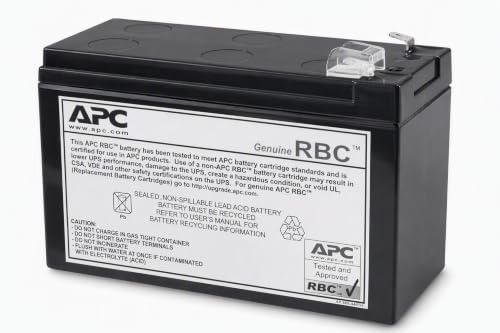
A genuine APC cartridge arrives as a complete assembly: fresh blocks already mounted, interconnects torqued and insulated, fuses of correct rating fitted where the design includes them, the proper connector keyed for the model, and in relevant ranges a temperature sensor or identification element the UPS uses for monitoring. The buyer pays for that integration and for traceability if something misbehaves. For many owners, especially those maintaining equipment at remote sites or under time pressure during an outage scare, the premium buys certainty and a swap measured in minutes.
The alternative route reuses the existing tray and hardware, replacing only the bare blocks with third party equivalents of matching voltage, capacity, and dimensions. This approach can work well when the tray, cables, fuse holders, and connector remain sound and the installer respects polarity, insulation, and torque. It fails badly when corroded interconnects are reused uncritically, when a fuse is bypassed or replaced with an incorrect rating, when terminal adapters wobble, or when blocks of slightly different height strain the housing and chafe insulation. Published experiences from facilities maintainers draw exactly this line between disciplined block replacement and careless improvisation.
Sensors and smart communication deserve particular scrutiny in higher ranges. Some APC systems identify the cartridge, track its installation date, estimate remaining life, or read temperature through components embedded in the genuine assembly. A bare block swap preserves none of those functions automatically, and a third party assembly may omit elements the firmware expects, producing warnings or inaccurate runtime estimates even while backup power itself works. Owners should research how their specific model monitors its pack before assuming equivalence, consulting APC documentation and established user community threads describing the behaviour of each approach for that family.
Fusing is the detail most often underestimated. Cartridge fuses protect wiring and blocks against catastrophic short currents that lead acid chemistry can deliver in enormous surges. Their rating, type, and placement are engineering choices matched to the string. Substituting a fuse because its shape fits, reusing one with heat discoloured holders, or omitting it during a hurried tray rebuild removes a layer of protection whose absence only becomes visible during a fault, when options have narrowed to damage limitation. Any rebuild that cannot reproduce the original fusing faithfully should stop and reconsider the genuine cartridge route.
Estimating runtime honestly from load, curves, and age
Runtime promises collapse when owners estimate from nameplate wattage instead of measured draw. A desktop tower with a high rated supply may pull a fraction of that figure during office work, while a gaming load or a server under computation approaches it closely. Measuring actual consumption with a plug in meter over representative activity, or reading the load percentage the UPS itself reports through its display or network card, grounds every later calculation. APC publishes runtime graphs per model across load levels, and interpolating between published points using a measured load yields estimates far closer to reality than generic minutes quoted in marketing summaries.
The relationship between load and minutes is not linear. Halving the load more than doubles the runtime in many published charts, because lighter discharge extracts capacity more efficiently from lead acid blocks and the inverter overhead forms a smaller relative share. Conversely, adding one hungry device to a heavily loaded unit can cut remaining minutes disproportionately. Owners planning purchases should decide which equipment genuinely needs protection: typically the computer or server, its storage, and the networking gear required to reach it, while printers, heaters, and other heavy or non essential loads belong on surge only outlets or elsewhere entirely.
Age bends every chart downward. A cartridge near the end of its service window may deliver half its original minutes while still passing casual observation, because the UPS sits idle on mains power almost all of the time. Self tests that run briefly on battery reveal gross failure but cannot map full capacity precisely. Facilities guidance therefore combines calendar age, self test results, event history showing actual discharge performance, and periodic controlled runtime checks where the environment allows them. An owner who logs how long the system genuinely supported its load during real outages owns better data than any estimate printed on a box.
Warning signs that a cartridge is approaching failure
The most explicit signal is the replace battery indicator, whether a front panel light, a display message, an audible pattern described in the manual, or an alert through network management software. That indication follows a failed self test or internal diagnostics and should never be dismissed as a nuisance alarm. Manuals for APC ranges explain how self tests can be scheduled and how their results are reported, and support documentation advises prompt replacement once the indication appears, because a pack that fails a brief test will rarely survive a genuine outage of any length.
Physical signs carry equal weight. Bulging block cases visible when a tray is withdrawn, cracked housings, corroded or heat discoloured terminals, a sharp odour near the unit, or electrolyte residue all indicate a pack under distress. Swelling in lead acid blocks reflects internal pressure from gassing, often driven by overcharge, heat, or advanced age, and a deformed block can jam inside its compartment, complicating removal. Anyone encountering leakage should follow the safety data guidance for the product, avoid skin contact, ventilate the area, and treat cleanup as a hazardous materials task rather than ordinary dusting.
Behavioural clues accumulate quietly before alarms sound. Runtime during brief outages shrinks noticeably compared with earlier events at similar load. The UPS recharges suspiciously quickly after a discharge, suggesting reduced capacity accepting less energy. Fans run more often, the unit transfers to battery during minor mains disturbances it once ignored, or logs show increasing counts of brief battery events. Owner communities for these systems describe exactly such patterns preceding outright failure, and keeping a simple event log transforms vague unease into a documented trend a purchasing decision can rest upon.
Hot swapping on ranges that support it, and caution elsewhere
Certain APC designs explicitly support replacing the cartridge while the UPS continues protecting its load, a feature documentation calls hot swappable. On those models the tray slides out on rails or from a front compartment, connectors are engineered for live exchange, and the manual describes the sequence, including the brief period during which the load runs without battery backup. That exposed interval is the crucial caveat: an outage arriving mid swap leaves equipment unprotected, so experienced maintainers choose quiet periods, confirm mains stability, and sometimes schedule the work when the protected systems can tolerate a short planned shutdown instead.
Models without that design intent demand a different discipline. Powering down attached equipment in an orderly sequence, switching the UPS off according to its manual, disconnecting input power where instructed, and waiting the specified time for internal capacitors to discharge all precede opening compartments on non swappable units. Assuming a range supports live exchange because a sibling model does has caused documented accidents and damaged connectors. The manual for the exact model, available through APC support resources, settles the question definitively and should be read in full before hands touch hardware.
Personal safety underlies every step. Lead acid strings inside larger units reach voltages capable of delivering serious shock and enormous short circuit current through a dropped tool or a ring. Removing jewellery, using insulated tools where specified, keeping one hand away from simultaneous contact points on larger systems, and never bypassing interlocks all appear in professional handling guidance. The battery may be a consumable, but the energy it stores commands the same respect as the mains supply the UPS conditions, and haste is the ingredient present in nearly every incident report the maintenance community circulates.
Performing the physical exchange with care
Preparation separates smooth swaps from improvised struggles. Gather the correct cartridge, confirm its number against the documentation once more on arrival, inspect it for shipping damage or leakage, and assemble any tools the manual lists. Notify users of attached systems, save work, and note current UPS settings and load readings for later comparison. Photographing the existing installation before touching connectors preserves a reference for cable routing and label positions that memory alone reconstructs poorly under pressure.
During removal, support the weight of the tray or pack with both hands, because lead is dense and a cartridge dropped even a short distance can crack its housing or injure feet. Slide rather than yank where rails exist, watch for cables snagging at the rear, and set the old unit directly onto a stable surface rather than balancing it on the rack edge. If a swollen block resists extraction, forcing it risks rupturing the case; support guidance for severe swelling recommends stopping and seeking qualified service. Installing the fresh cartridge reverses the sequence with attention to full connector seating, since a partially mated plug can arc, overheat, or produce intermittent faults that masquerade as defective electronics.
After seating, restore power following the manual order, confirm the unit recognises the new pack, and observe the first charge cycle. A fresh cartridge may arrive partially charged and need hours to reach full readiness, during which protection exists but runtime remains reduced. Front panel indicators and management software report charge state, and owners should resist testing endurance with a deliberate outage until the system signals full charge. Recording the installation date on the cartridge label and in maintenance notes starts the ageing clock visibly for whoever handles the next replacement cycle.
Runtime calibration after fitting a fresh cartridge
A UPS estimates remaining minutes through a model fed by learned discharge behaviour, battery age counters, and constants associated with the installed cartridge. After replacement, that model may still reflect the exhausted pack, displaying pessimistic runtime or triggering low battery shutdown earlier than the fresh chemistry warrants. APC documentation for many ranges describes a calibration procedure: with a stable, representative load attached and the battery fully charged, the unit discharges under controlled conditions until it approaches its low threshold, thereby relearning actual capacity. Management software and network cards expose this function on equipped models, alongside warnings about the temporary exposure involved.
Calibration timing matters. Running the procedure immediately on a partially charged new pack teaches the system distorted figures, while performing it during business critical hours risks an unplanned shutdown if estimates prove optimistic. Experienced administrators schedule calibration during quiet windows, ensure attached systems have saved state, apply a steady load resembling real usage rather than a token light bulb, and monitor the process through to recharge completion. Some guidance advises allowing the new cartridge a full charge and a settling period of ordinary float operation before calibrating, giving the chemistry and the monitoring electronics a stable starting point.
Manual date entry forms the quieter half of calibration. Where the interface allows recording the replacement month and year, accurate entry drives future life expectancy warnings and prevents the system nagging about a pack that is actually new. Conversely, failing to update the date after a block only rebuild can leave alerts silenced inappropriately if the monitoring assumes a genuine cartridge was fitted. Owners should align every software record with physical reality: what was installed, when, and by which route, genuine assembly or rebuilt tray, so later maintainers inherit truth rather than folklore.
Charging infrastructure around the UPS and related equipment
Facilities rarely run one battery system in isolation, and the charging bench supporting laptops, tools, and spare devices influences how reliably the whole backup plan performs on the day it is needed. Readers organising a small equipment corner may find the material filed under best 100w chargers relevant when powering service laptops beside the rack. Keeping the diagnostic machine dependable matters during an outage drill, because the person managing a graceful shutdown needs a working screen, network tools, and light, none of which the UPS can supply to equipment that was already flat before the mains failed.
Shared charging points introduce their own load questions. A dual socket brick feeding a laptop and a phone beside the rack behaves differently from the protection the UPS provides, and the comparison gathered at best 2 port usb chargers clarifies how such bricks divide output. The distinction worth holding onto is purpose: convenience chargers replenish portable devices from mains power, whereas the APC unit conditions power and bridges interruptions for stationary critical loads. Confusing those roles, such as plugging chargers for heavy tool batteries into backup outlets, inflates protected load and silently steals runtime from the systems the UPS exists to save.
Workshops maintaining fleets of removable packs for other equipment face parallel discipline around cell charging, and the reference at best 16 bay battery chargers speaks to that bench scale problem. Although the chemistries differ from sealed lead acid cartridges, the organisational lesson transfers directly: labelled slots, dated packs, rotation records, and chargers matched to the cells they serve prevent the mixed age, unknown state inventory chaos that undermines reliability everywhere. A UPS cartridge programme benefits from identical habits, scaled to a handful of heavy packs rather than drawers of cylindrical cells.
Individual cylindrical lithium cells appear in torches, test instruments, and auxiliary gear surrounding many installations, which is why the discussion collected under best 18650 chargers belongs in a complete equipment review. Technicians who keep their inspection lights and meters reliably charged notice swollen blocks, corroded terminals, and loose connectors earlier, because proper illumination and working instruments are prerequisites for honest assessment. Peripheral readiness sounds trivial until a midnight outage reveals a dead torch, at which point it becomes the difference between a calm cartridge inspection and guesswork performed in the dark.
Recycling the spent cartridge through proper channels
Lead acid batteries are among the most successfully recycled products in circulation, with collection systems recovering lead, plastic, and acid for reuse at rates environmental agencies cite as exemplary. APC operates a return and recycling programme for spent cartridges in many regions, described on its sustainability and support pages, typically involving prepaid or arranged return of the old unit when a genuine replacement is purchased, sometimes using the packaging the new cartridge arrived in. Following that route keeps a heavy, hazardous item inside a documented chain and satisfies organisational disposal policies that audits increasingly examine.
Where the manufacturer programme does not reach, municipal hazardous waste facilities, battery retailers, and automotive service centres commonly accept sealed lead acid units because the same recycling stream handles vehicle batteries. Owners should tape terminals where guidance instructs, keep a leaking or swollen pack isolated in a suitable container, transport it upright and secured against tipping, and never place it in general refuse or mixed scrap. A cartridge that has swollen severely or leaked may require specialist handling arrangements, and a phone call ahead prevents a wasted journey with a compromised pack in the boot of a car.
Documentation closes the loop for businesses. Retaining disposal receipts alongside purchase records demonstrates duty of care and completes the asset history of the UPS itself. Home users gain a simpler benefit: the old pack leaves the garage promptly instead of lingering for years as a heavy hazard awaiting a decision. Suppliers who make returns effortless deserve credit in purchasing comparisons, because the true cost of a cartridge includes retiring it responsibly, and a cheap purchase followed by an orphaned spent pack merely transfers expense to the owner and risk to whoever eventually moves it.
When replacing the whole UPS beats another cartridge
Batteries age on a schedule, but the electronics around them age too. Fans accumulate bearing wear and eventually stall or grow noisy, electrolytic capacitors dry out over years of warm operation, relays cycle toward their mechanical limits, and surge components sacrifice themselves incrementally with each transient they absorb. A unit that has consumed several cartridges across a long life may present a pattern of faults, transfer glitches, unexplained shutdowns, or fan warnings, that no fresh pack will remedy. APC support resources and independent repair commentary both recognise an economic crossover where continued cartridge investment props up a platform whose other systems are expiring together.
Load growth forces the same decision from a different direction. If attached equipment has expanded beyond the rating the UPS was bought for, a new cartridge restores minutes the unit never had at the present load, which may still be inadequate. Similarly, changing requirements such as a need for pure sine wave output for sensitive modern supplies, network management the old model cannot accept, or rack format changes can justify replacement on capability grounds. Evaluating the battery question without revisiting whether the platform still matches the job is how organisations end up with a fresh cartridge inside an undersized relic.
Conversely, a mid life unit with a clean fault history, a quiet fan, current firmware where applicable, and a load comfortably within rating is exactly the candidate a cartridge serves best. The sustainability argument reinforces the financial one: extending service through a consumable replacement avoids manufacturing an entire new chassis, inverter, and enclosure. Decision makers should weigh documented condition rather than age alone, because calendar years in a cool, lightly loaded environment differ profoundly from the same years spent hot and heavily burdened, a nuance maintenance logs capture and purchase dates alone cannot.
Self tests, event logs, and management cards as early warning systems
The automatic self test is the closest thing a UPS has to a regular health examination. At intervals the manual specifies, the unit briefly transfers its load to the inverter, watches battery voltage behaviour under that real demand, and reports pass or failure through its indicators and logs. A single failure deserves prompt investigation rather than a hopeful reset, because the conditions that produced it rarely reverse themselves. Owners can usually trigger a test manually after installation or after load changes, and doing so establishes an early baseline for the new cartridge while the purchase paperwork remains easy to find.
Network management cards extend that visibility beyond the equipment room. Configured alerts can announce a failed test, a replace battery condition, excessive load, or high ambient temperature to administrators by message before anyone walks past the rack. Support documentation for these accessories describes threshold settings and notification methods in detail. The practical lesson for smaller installations without cards is to imitate the discipline manually: a monthly glance at the front panel, a note of any lit warnings, and a check of runtime expectations after significant load changes catch most developing problems while a replacement can still be ordered calmly.
Event logs reward reading after every genuine outage, however brief. Entries reveal how far the battery discharged, how long recharge required, whether the load approached capacity, and whether the unit approached its low threshold uncomfortably fast. Comparing successive events at similar loads exposes decline earlier than calendar reminders do. Several owner accounts in community archives describe noticing a pattern across three or four logged events, ordering a cartridge at leisure, and swapping it on a chosen afternoon, which is precisely the uneventful outcome good monitoring is supposed to produce.
Choosing bare blocks by datasheet when rebuilding a tray
Owners committed to the rebuild route should shop the way engineers specify, starting from the original block datasheet rather than a marketplace title. Match nominal voltage first, then physical dimensions including terminal position and type, then capacity at the stated discharge rate, and finally the constant power figures relevant to high rate UPS duty. Established industrial block manufacturers publish all of these parameters, along with torque recommendations for terminal hardware, expected float life at reference temperature, and charging voltage windows for standby service. A block lacking published high rate data may suit alarm panels yet disappoint inside an inverter application drawing heavy current for minutes.
Freshness applies to lead acid stock just as it does to lithium cells, though the mechanism differs. Blocks self discharge slowly in storage and suffer sulphation when left sitting discharged, a degradation mode manufacturer storage guides describe with specific recharge intervals for warehoused inventory. A bargain block that rested in a warm warehouse beyond its refresh date may never reach rated capacity. Date codes, seller turnover, and a willingness to state manufacturing periods separate dependable industrial suppliers from opportunistic listings. Where a code cannot be interpreted from public documentation, asking the seller directly before purchase remains a reasonable and revealing step.
Mixing blocks is the rebuild error professionals warn against most consistently. Every block in a series string should share maker, model, capacity, and ideally production batch, because the weakest unit governs discharge behaviour and receives the harshest treatment during recharge. Combining a new block with survivors from the old string accelerates the decline of the newcomer and preserves the runtime limitations of the aged remainder. The economics of replacing only the visibly failed block are therefore largely illusory, and guidance across manufacturer literature and maintainer experience converges on renewing the complete string in one operation.
Float charging, standby service, and why these packs age at rest
A UPS battery spends nearly its entire existence on float charge, held at a carefully regulated voltage that offsets self discharge without driving excessive corrosion or water loss. That gentle sounding regime still consumes service life continuously, which is why cartridge replacement intervals are quoted in years regardless of how few outages occurred. Charging voltage accuracy matters enormously over such timescales: a regulator drifting high cooks packs steadily, while one drifting low allows chronic undercharge and sulphation. Repeated premature failures in the same chassis should therefore prompt investigation of the charger itself, a diagnostic step APC support flows include when replacement packs die young.
Standby duty also explains why cycle ratings quoted for traction or solar storage blocks mislead UPS buyers. A cartridge may endure only a modest number of deep discharges yet serve admirably for years of shallow standby punctuated by brief events. Selecting blocks by cycle headline alone optimises for the wrong job. Float life at the expected ambient temperature, high rate discharge tables, and standby charge compatibility are the datasheet properties aligned with how a UPS actually uses its battery, and rebuilders who internalise that distinction make markedly better purchasing choices.
Ripple current and ventilation add quieter stresses. Inverter and charger designs impose some alternating component on the battery, and excessive ripple heats blocks internally over time, one reason larger installations monitor it. Ventilation around the UPS preserves the temperature assumptions behind every life estimate, yet enclosures are often sealed for tidiness or noise. A cartridge programme that ignores the thermal environment is budgeting blind, because the same pack can plausibly serve twice as long in a cool equipment room as in a sealed cabinet sharing air with exhaust from neighbouring machines.
Spares, storage, and rotation for sites that cannot wait
Critical sites sometimes hold a spare cartridge so a failed pack can be exchanged immediately rather than after shipping delays. Storage discipline determines whether that insurance remains valid. Manufacturer guidance for sealed lead acid products favours cool, dry storage, periodic voltage checks, and refresh charging at stated intervals, because a spare left forgotten in a warm storeroom can expire on the shelf before its predecessor fails in service. Labelling the spare with its arrival date and refresh history, and assigning calendar reminders for its maintenance, converts a hopeful box in the corner into a managed asset.
Rotation offers an alternative for fleets of identical units. Installing the stored cartridge into service at the next convenient opportunity and placing the newest purchase into storage keeps stock turning over, though it consumes labour and introduces handling risk each time. Smaller organisations usually find a single well maintained spare sufficient, provided the model it fits remains in service. When a UPS fleet changes, orphan spares should be recycled promptly rather than retained out of optimism, since an unusable ageing cartridge is hazardous inventory with no remaining purpose.
Procurement timing can smooth budgets as effectively as spares smooth operations. Because cartridge life is broadly predictable, staggering purchases across a fleet avoids a cluster of simultaneous failures and emergency orders. Maintenance planners in larger estates map installation dates per unit and forecast replacement windows quarters ahead, negotiating supply before urgency weakens their position. Home and small office owners can borrow the principle at miniature scale: one recorded installation date and a reminder set months before the expected end of service transform replacement from a crisis purchase into an ordinary planned expense.
Rack mount, tower, and extended runtime configurations compared
Form factor changes the service experience more than the chemistry. Rack mount cartridges slide horizontally from the front of a unit installed among other equipment, demanding clear access, attention to neighbouring cables, and respect for the weight cantilevered briefly during extraction. Tower models may require laying the unit down, removing a side or bottom panel, and working around blocks oriented vertically. Convertible designs that operate in either orientation include repositionable displays and feet, and their manuals describe battery access for each arrangement separately, another reason model specific documentation outranks generic familiarity.
Extended runtime systems multiply both capability and maintenance obligation. Each external enclosure contains its own strings ageing on their own clocks, connected by heavy cables whose condition deserves inspection whenever any element is serviced. Runtime calibration on such systems must account for the full attached capacity, and replacing one enclosure while others fade produces blended performance that confuses estimates. Owners benefit from labelling every enclosure with its installation date directly on the housing, because management software does not always distinguish the age of each attached pack with the clarity a physical label provides at a glance.
Redundant configurations in larger installations change urgency rather than principles. Where parallel systems share load, a weak cartridge in one unit may be serviced with less time pressure, yet deferring it erodes the redundancy the architecture was purchased to provide. Maintenance standards for such estates treat battery findings as priority work precisely because silent erosion of backup depth defeats the design. The home user with a single unit faces the mirror image of the same logic: there is no second system quietly covering a neglected warning light.
Verifying a genuine cartridge and avoiding relabelled stock
Counterfeit and relabelled batteries circulate in this market as they do in most consumable categories. Warning signs include packaging with inconsistent print quality, labels lacking traceable serial or date information, sellers unable to describe the return programme, and prices dramatically detached from established distribution. APC provides channels for reporting suspect product and guidance on purchasing through authorised partners, and using those channels for significant orders protects both the buyer and the recycling chain that depends on legitimate product entering it.
Weight and construction offer supporting evidence. A cartridge built from full capacity industrial blocks has a heft that experienced handlers recognise, and a suspiciously light assembly invites questions about the blocks concealed inside. External inspection cannot prove internal quality, however, which is why provenance remains the primary defence. Keeping invoices, recording serial details in the maintenance log, and registering products where the manufacturer offers registration all strengthen recourse if a pack underperforms early and a warranty conversation becomes necessary.
Warranty handling differs between a genuine assembly and a tray rebuilt from loose blocks, where each block carries its own maker terms and the labour of diagnosis falls on the owner. Organisations should decide in advance which model of accountability suits their staffing. A small business without a dedicated technician often finds the single point of responsibility behind a complete cartridge worth its premium after the first ambiguous fault, while a workshop with proper equipment and experience may rationally prefer component level control. Neither answer is universally correct; the honest comparison includes time, skills, and tolerance for uncertainty alongside purchase price.
Seasonal checks and outage season preparation
Storm seasons and periods of grid instability concentrate the risk a UPS exists to absorb, so sensible owners review battery status before those periods rather than during them. A pre season routine drawn from maintenance guidance includes confirming no replace battery indication is active, reviewing recent self test outcomes, verifying the protected load has not crept upward through added devices, checking that shutdown software on attached computers remains configured and current, and confirming the spent cartridge route is known in case a swap becomes necessary. Each item takes minutes, and together they convert anxiety about approaching weather into verified readiness.
Shutdown software deserves emphasis because a healthy battery only buys time; something must use that time correctly. Agents installed on protected computers receive signals from the UPS and close applications and operating systems in an orderly fashion before capacity expires. Software that was configured for a smaller load or an earlier cartridge may trigger too late or too early relative to present reality, which is another reason calibration and settings review belong together after every replacement. Documented drills in organisational settings periodically verify the entire chain, from mains failure simulation through graceful shutdown to clean restart, exposing weak links while consequences remain imaginary.
Home users can perform a modest version of such a drill by saving all work, disconnecting mains input at a chosen moment, and observing whether systems behave as expected for a short, controlled interval well inside the estimated runtime. Manuals caution against unnecessary deep discharges, so the exercise should end promptly with mains restored and observations recorded. Even a brief rehearsal reveals practical surprises, such as a monitor accidentally plugged into a surge only outlet or a network switch left unprotected, that no amount of cartridge research would ever have uncovered from a catalogue page.
Bringing the decision together for a specific installation
The practical sequence begins with identification: exact UPS model, installed cartridge number, age of the current pack, measured load, and any active warnings. Next comes platform judgement, assessing fan behaviour, fault history, capability fit, and whether the unit merits another service cycle. Only then does the genuine versus rebuild comparison begin, informed by the monitoring features of the model, the condition of the existing tray and its fuse and connector hardware, and the skills available for the work. Runtime expectations are set from published charts at the measured load, recycling for the outgoing pack is arranged before the new one arrives, and a calibration window is pencilled into the calendar alongside the swap itself.
Executed in that order, a cartridge replacement becomes one of the most satisfying maintenance tasks in small scale computing: a heavy, well understood consumable exchanged on schedule, verified by the system own diagnostics, and retired through an established recycling stream. The failures associated with this category, dead servers after a flicker, swollen blocks jammed in bays, mystery runtimes, almost always trace back to a skipped step in identification, monitoring, or follow through rather than to any mystery in the chemistry itself. Treat the pack as the time limited heart of the protection system, record its story carefully, and the next outage becomes a brief log entry instead of the incident everyone in the building retells for years.
How ambient conditions in real rooms shorten or extend service intervals
Published service life figures assume a reference environment that few real installations match perfectly. Equipment cupboards concentrate heat from every device sharing the air, garages swing between cold nights and warm afternoons, and offices beside exterior glass experience seasonal extremes that building averages conceal. A small maximum minimum thermometer or a logging sensor placed beside the UPS for a fortnight reveals the truth cheaply. Owners who discover sustained warmth can often improve matters with a vented door, a relocated unit, or separation from a neighbouring heater, interventions costing little beside repeated premature cartridge purchases.
Cold presents the opposite trap, mainly disappointment rather than damage. A unit protecting equipment in an unheated outbuilding may show markedly reduced minutes during winter even with a healthy pack, because lead acid capacity falls as temperature drops. Runtime planning for such sites should use the cold condition figures from datasheets rather than the flattering reference values, and critical loads may justify a larger platform altogether. Recognising a physics limitation prevents owners from cycling through replacement packs in search of performance the environment will never permit any cartridge to deliver.
Dust and airflow interact with temperature quietly. Blocked intake slots, filters clogged with fibres, and fans labouring against accumulated debris all raise internal temperatures around both electronics and battery. Maintenance guidance for rack environments treats cleaning as part of battery care for exactly this reason. A soft brush, a vacuum applied carefully from outside the enclosure with power managed according to the manual, and a visual fan check during every cartridge service keep the thermal story honest. None of this requires opening sealed compartments or touching internal wiring beyond the user serviceable areas the documentation defines.
Documentation habits that make support conversations productive
When a cartridge underperforms, the quality of the owner records determines how quickly help arrives. Support teams ask predictable questions: model and serial of the UPS, cartridge number and purchase source, installation date, load percentage, ambient conditions, self test history, and the exact wording of any displayed fault. An owner who can answer from a maintained log moves directly to diagnosis, while one reconstructing events from memory spends the interaction guessing. Photographs of labels, retained invoices, and screenshots of management pages at installation form a small dossier that pays for itself the first time anything goes wrong.
That dossier also protects warranty rights. Terms for cartridges and blocks alike hinge on dates, authorised channels, and evidence that the product served in a compatible unit under reasonable conditions. Registering purchases promptly, storing receipts with the log rather than in a general inbox, and noting any anomalies observed during the first charge cycle all strengthen a legitimate claim. Manufacturers distinguish manufacturing defects from environmental damage partly through such records, and fair outcomes depend on information only the owner was positioned to capture at the time.
Finally, records outlive individual memory when equipment changes hands. A UPS sold, redeployed, or inherited with a documented cartridge age and a clean test history is a known quantity; the same unit with no history is a gamble priced accordingly. Writing the installation date on the cartridge itself, in marker on a label area where the manufacturer permits marking, gives the next person who opens the bay an immediate answer even if every digital record has vanished. That small courtesy, repeated across the industry, would eliminate a remarkable share of the uncertainty that surrounds second hand backup equipment today.
Check prices on Amazon
Live listings for the shortlist in this guide are pulled from Amazon below, so prices and availability are always current at the moment you look.

A short pre purchase audit any owner can complete in one visit
Stand in front of the unit with a notebook before opening any catalogue. Read the model and serial from the rear label, note the cartridge designation from documentation or the existing tray, observe every indicator currently lit, and record the load percentage the display reports during normal work. Listen to the fan for roughness, feel whether exhaust air seems excessively warm, and look for dust blocking vents or cables pressing against the battery compartment door. Check where the spent pack will go for recycling and confirm that route accepts the size involved. This unhurried circuit gathers every fact the subsequent purchase depends upon.
Then interrogate the history. When was the present cartridge installed, has the replace battery warning appeared before and been cleared without action, how did the system behave during the most recent genuine outage, and has the protected load grown since the last replacement through added drives, larger machines, or new networking hardware. Answers often reveal that the real requirement is not merely a fresh pack but a load reduction, a platform upgrade, or attention to a hot cupboard. Buying before asking those questions locks money into a solution shaped for a problem the installation may no longer have.
Close the audit by deciding the service route explicitly: genuine cartridge fitted live on a supported range, genuine cartridge fitted during a planned shutdown, a disciplined tray rebuild by someone equipped for it, professional service, or full platform replacement. Each route carries its own parts list, time window, and verification steps, including calibration and date entry afterward. Writing the chosen route beside the audit notes prevents drift toward improvisation on the day. Installations protected by that kind of deliberate preparation tend to experience battery maintenance as routine housekeeping, and their owners discover failing packs from calm log reviews rather than from the silence of a server that never came back after the lights blinked.
One more consideration belongs in that audit for sites where several people share responsibility: make sure at least two individuals know where the documentation lives, which cartridge the unit takes, and what the warning indicators mean. Backup power fails at inconvenient hours by definition, and the colleague on site during a holiday weekend should not need to reverse engineer decisions made years earlier. A laminated summary near the unit, covering model, cartridge code, installation date, load limit, and the recycling contact, turns private knowledge into shared operational readiness. When that summary is kept current after every service, the installation gains a resilience that no single component purchase can provide, because the humans protecting the system finally share the same clear picture of its condition.
Reviewing that shared summary whenever staff rotate or responsibilities shift keeps the picture alive rather than archival. New custodians should walk to the unit, match the summary against the physical labels, run a manual self test where the manual permits one, and introduce themselves to the management interface while nothing urgent is happening. Familiarity earned during calm conditions is what gets used during a real interruption, when alarms, ringing phones, and darkened rooms compete for attention. A cartridge programme supported by that level of ordinary human readiness delivers the full value engineered into the hardware, outage after outage, year after year, without drama or improvisation.
That is the quiet standard worth aiming for: a protection system whose battery age is known, whose limits are understood, whose warnings are believed, and whose renewal is planned long before necessity chooses the timing instead.
Owners who reach that standard rarely think about their cartridge at all, which is exactly the compliment a well maintained backup battery deserves.