What's inside
- Key Takeaways
- Quick Picks: Budget Extenders, Honestly Labelled
- How Did We Judge Cheap Extenders When Their Boxes Fib?
- Why Are Generic Coverage Claims So Wild, and What Should You Expect Instead?
- The Budget Field Compared Without the Fairy Tales
- Where Should a Cheap Extender Go to Earn Its Keep?
- What Do You Give Up at This Price, and What Do You Keep?
- Which Cheap-Extender Mistakes Waste the Most Money?
- How Does a Budget Extender Affect the Rest of the Household?
- What Should You Do With the Money a Budget Extender Saves You?
- Final Recommendation
- How Should You Test a Budget Extender During Its Return Window?
- What Do Students, Renters and Shared Houses Need to Know?
- When Should You Stop Buying Cheap and Change Strategy?
- Are Generic Extenders Safe to Run on Your Network?
- How Long Will a Budget Extender Stay Useful?
- What Do the Speed Labels on Budget Extenders Actually Mean?
- Three Budget Situations, Three Sensible Purchases
- Frequently Asked Questions
- Related Guides
As an Amazon Associate I earn from qualifying purchases. This post may contain affiliate links at no extra cost to you.
gizmoverdict.com is reader-supported. When you buy through links on our site, we may earn an affiliate commission.
Where to buy: use the Amazon listings linked below to confirm the exact model variant, since budget extenders often share near-identical names across different hardware.
The best affordable wifi extenders live in the most dishonest corner of home networking, and this guide will not pretend otherwise. Scroll the category and you will meet palm-sized boxes claiming to cover twelve thousand square feet, a figure that would blanket a small farm, from hardware that costs less than a family takeaway. Those numbers are fantasy, and any guide that repeats them with a straight face is wasting your money. What budget extenders can honestly do is rescue one weak room in an ordinary home for very little money, and the six below were chosen for exactly that job, with two trusted TP-Link models anchoring a field of cheaper generic rivals whose real performance you should calibrate with care.
Affordable in this guide is a judgement about value, not a price list, because prices in this category swing weekly. The honest bargain question is what you surrender for the saving: usually the polished setup app, sometimes the Ethernet port, often any meaningful after-sales support, and always the right to believe the coverage figure on the box. Accept those trades knowingly and a cheap extender is one of the best-value fixes in home technology. Buy one expecting the printed fantasy and it will join the drawer of disappointing gadgets by the weekend.
Key Takeaways
- Five-figure coverage claims on budget extenders are inflated beyond any plausible physics; expect one rescued room, not a rescued estate.
- The TP-Link models in this list are the calibration point: their claimed areas are still optimistic, but they sit far closer to reality than the generic rivals.
- At this end of the market, placement effort substitutes for money; a cheap extender positioned well beats a premium one positioned badly.
- Check for an Ethernet port before buying, because some ultra-cheap models omit it and strand your television or desktop on the relay.
- Buy budget extenders from somewhere with painless returns and test yours under real evening load during the first week.
Quick Picks: Budget Extenders, Honestly Labelled
| Pick | Badge | Why it made the cut |
|---|---|---|
| TP-Link AC1200 WiFi Extender (RE315) | The trustworthy budget anchor | A known brand, EasyMesh potential and an Ethernet port at the price level where generic rivals cut corners. |
| 12880 Sq.Ft Range WiFi Extender Signal Booster | Cheapest reach attempt | Dual-band 1200Mbps hardware with a headline claim to ignore and a real job, one weak room, it can actually do. |
| WiFi Extender Signal Booster for Home, 1200Mbps | Simple small-home booster | Straightforward dual-band repeating for flats and small houses where the router nearly reaches already. |
| TP-Link AX1500 WiFi Extender (RE500X) | Budget Wi-Fi 6 step-up | Gigabit port and access point mode bring genuine modern features into the affordable tier. |
| WiFi Extender Signal Booster, AC1900 Dual Band | Fastest generic radios here | AC1900-class speeds and an Ethernet port for buyers whose weak room holds a wired device. |
| WiFi Extender Internet Booster, 10000 Sq.Ft | Mesh-flavoured budget claim | Markets itself toward mesh-style coverage; judge it as a repeater and it can still serve a modest home. |
How Did We Judge Cheap Extenders When Their Boxes Fib?
We started by translating every coverage claim into the same currency: rooms. A budget extender that hears a router clearly and rebroadcasts into one adjoining weak room has succeeded, whatever its box says, and one that fails that modest test has failed entirely. By that standard the generic picks here are defensible purchases and their five-figure claims are decoration, while the TP-Link pair provide the reference point that keeps the whole category honest, because a brand with a reputation to protect prints 1,500 or 1,600 square feet where an anonymous seller prints 12,880 for similar hardware.
Features were audited for the omissions this price tier hides. Does an Ethernet port exist, and if so, is it fast enough for a wired television or merely present for the photograph? Is setup a guided app, a browser page from another decade, or a WPS button and a prayer? Does the maker publish firmware updates anywhere findable? The answers separate the merely cheap from the genuinely good value, and they explain why the two branded models anchor this list despite headline speeds no better than the generics beside them.
We also weighed the cost of being wrong. A budget extender bought from a retailer with straightforward returns is a cheap experiment: install it, test it on a busy evening, keep it if the weak room improves. That reversibility is part of the value proposition at this tier, and this guide’s advice leans on it heavily, because no review can predict your walls and your neighbours’ networks the way one evening of your own testing can.
Why Are Generic Coverage Claims So Wild, and What Should You Expect Instead?
The inflation has a simple engine: marketplaces rank and shoppers filter by the numbers on the box, so each anonymous seller prints a bigger figure than the last until the numbers detach from physics altogether. A single wall-plug extender with two small internal antennas cannot cover twelve thousand square feet of real building; the signal would have to pass through a mansion’s worth of walls at strengths no radio in this class produces. Treat any claim above a few thousand square feet from any single plug-in unit, branded or not, as a statement about the seller’s marketing department rather than about your home.
Realistic expectations look like this. In a typical flat or small house, a budget extender placed halfway to the weak room turns an unusable bedroom connection into a perfectly serviceable one for streaming, calls and browsing. In a larger house it rescues the one room it can hear clearly and politely ignores the rest. Speeds through the relay will sit well below what you measure beside the router, because repeating spends airtime, and the furthest corners will lean on the slower, longer-reaching 2.4 GHz band. Within those honest bounds, these are satisfying little machines; outside them, no budget box survives, and the mesh systems and wired access points in the wider market exist for exactly those bigger jobs.
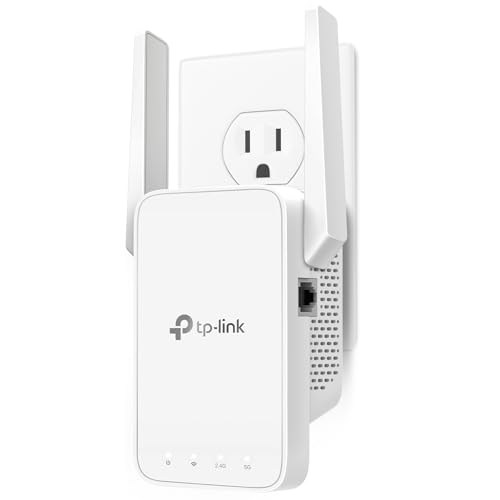
TP-Link AC1200 WiFi Extender (RE315) — The trustworthy budget anchor
Every budget category needs one product that behaves like a grown-up, and in this list the RE315 plays that role. Its AC1200 dual-band hardware matches the generic rivals beside it, but everything around the hardware differs: a setup app that speaks plain language, indicator lights that genuinely guide placement, an Ethernet port for the device that matters most in the room, and EasyMesh compatibility that lets the unit join a coordinated network if your router supports it. TP-Link’s own coverage language, up to a claimed 1,600 square feet and 32 devices, remains a maker’s figure, yet it reads almost modest beside the five-figure claims elsewhere on this page, and that relative restraint is information in itself.
For the buyer torn between saving the last few pounds and sleeping soundly, this is the resolution: the saving over the very cheapest generic boxes is small, while the gain in setup sanity, update support and resale of your own time is large. It will not outperform physics, and placed in a dead zone it will fail as cheerfully as any rival, but placed halfway and asked to rescue one room it does so with the least friction in the affordable tier. If the rest of this guide’s honesty about generic claims makes you nervous, buy this one and let the experiment be about your walls rather than about the hardware’s character.
- Radios: AC1200 dual-band repeating
- Maker’s claim: up to 1,600 sq. ft. and 32 devices, per TP-Link
- Port: one Ethernet socket for a wired device in the rescued room
- Network manners: EasyMesh compatible with a suitable router
- Support: branded app, published firmware and findable documentation
Strengths
- The least stressful setup experience in the affordable tier.
- EasyMesh gives a cheap box a future inside a coordinated network.
- A real Ethernet port, where several rivals quietly omit one.
Trade-offs
- Costs a little more than the anonymous boxes it outperforms in manners.
- AC1200 radios still cap a busy household’s relay throughput.
- One rescued room remains the honest scope of its talents.
Best for: budget buyers who want the experiment to be about placement, not hardware quirks. Not suited for: whole-house coverage or anyone expecting mesh from a single plug.

12880 Sq.Ft Range WiFi Extender Signal Booster — Cheapest reach attempt
Begin with the name, because the name is the warning: 12,880 square feet is not a specification, it is a bid for your attention, and this guide repeats it only to disarm it. Underneath the headline sits ordinary, serviceable hardware, a dual-band 1200Mbps repeater advertising compatibility with up to 105 devices, a number to treat with the same affectionate scepticism. Judged as what it physically is, a small plug-in repeater for one weak room in a modest home, it becomes a rational gamble at the bottom of the market, particularly for renters and students whose alternative is no fix at all.
Set your terms before it arrives. There will likely be no polished app shepherding you, support will be a listing page and a prayer, and the firmware will probably never change. In exchange you pay very little for a device that, positioned with the care this guide describes, can hold a bedroom’s streaming and calls together perfectly respectably. Test it hard in its first evenings, a video call while someone else streams, a large download in the weak room, and keep it only if it passes your household’s real examination rather than its box’s imaginary one. Budget networking rewards exactly this kind of clear-eyed, return-window discipline.
- Radios: dual-band, 1200Mbps class
- Maker’s claim: 12,880 sq. ft. and 105 devices, both to be heavily discounted
- Port: check the listing variant for wired options before ordering
- Setup: simple installation promised; expect WPS or a basic web page
- Buyer profile: renters, students and single-room rescues at minimum spend
Strengths
- Among the cheapest ways to attempt a one-room rescue.
- Dual-band hardware covers both reach and local speed needs.
- Small plug-in form suits rented rooms and temporary homes.
Trade-offs
- The headline coverage figure should be ignored completely.
- Support, updates and documentation are minimal at best.
- Device-count claims flatter hardware that suits a handful of active gadgets.
Best for: the cheapest possible fix for one weak room, tested honestly on arrival. Not suited for: large homes, heavy device counts or buyers wanting guided setup.

WiFi Extender Signal Booster for Home, 1200Mbps — Simple small-home booster
This generic dual-band booster advertises up to 5,000 square feet and 35 devices, figures roughly half the fantasy of its stablemate above and still comfortably beyond what its hardware will deliver through real walls. Its natural habitat is the small home where the router almost reaches: the flat whose bedroom sits one wall too far, the cottage whose thick walls eat signal between two adjoining rooms, the home office in the converted garage a few metres from the house. In that narrow, common situation, a simple repeater with 5G and 2.4 GHz bands and a straightforward installation is genuinely all the technology the problem requires.
Approach it as an appliance rather than a platform. There is no ecosystem to join, no management sophistication to grow into, and that simplicity cuts both ways: nothing to learn, nothing to update, nothing to troubleshoot beyond position and the router’s own settings. Households whose weak-signal problem is small and stable will find that bargain attractive, and the money not spent here can fund the more capable branded or Wi-Fi 6 options if the problem later grows. Households whose problem is already bigger than one room should not ask this box to be a hero; start further up the list instead.
- Radios: dual-band 1200Mbps, 5 GHz plus 2.4 GHz
- Maker’s claim: up to 5,000 sq. ft. and 35 devices, both optimistic
- Role: single-area repeating for small homes
- Setup: simple installation aimed at non-technical buyers
- Buyer profile: flats, cottages and garage offices near the router
Strengths
- Simple proposition matched to small, single-room problems.
- Dual bands let near devices use 5 GHz speed while far ones use 2.4 GHz reach.
- Low spend leaves budget for a better solution if the problem grows.
Trade-offs
- Claimed coverage still overstates a small repeater’s real bubble.
- No app polish or ecosystem features to grow into.
- Anonymous support if anything behaves oddly after month one.
Best for: small homes where the router nearly reaches and one room needs help. Not suited for: multi-room dead zones or device-heavy households.

TP-Link AX1500 WiFi Extender (RE500X) — Budget Wi-Fi 6 step-up
The RE500X is where the affordable tier stops apologising. Wi-Fi 6 radios in an AX1500 arrangement, a gigabit Ethernet port, and access point mode that converts the unit into a wired-fed broadcaster when a network cable reaches it: that is a feature set the generic boxes around it simply do not assemble at this level. TP-Link states coverage up to 1,500 square feet and 25 devices, numbers a buyer can plan a flat or small house around with appropriate humility. Paired with the Wi-Fi 6 router most new broadband contracts now supply, it keeps the whole link on one modern standard instead of translating down to older Wi-Fi 5 repeating.
Its budget identity shows in scope rather than in corners cut: this is a one-room instrument, and its radios will not stretch to a rambling house no matter how modern their standard. Within that scope it is the most future-respecting purchase in this guide, because the access point mode gives it a second career if you later run a cable, and the gigabit port never becomes the bottleneck for a wired desk. Buyers whose router still runs Wi-Fi 5 should weigh the RE315 above instead and pocket the difference; buyers on Wi-Fi 6 who can stretch slightly should stretch here, since the premium buys standards alignment that pays out every single day.
- Radios: AX1500 dual-band Wi-Fi 6
- Maker’s claim: up to 1,500 sq. ft. and 25 devices, per TP-Link
- Port: gigabit Ethernet, with access point mode for cable-fed setups
- Router partner: Wi-Fi 6 routers from recent broadband contracts
- Buyer profile: flats and small houses wanting modern standards cheaply
Strengths
- Access point mode gives it a second, better career behind a cable.
- Gigabit port respects wired desks and televisions properly.
- Wi-Fi 6 efficiency suits homes accumulating smart gadgets.
Trade-offs
- The step-up price is wasted behind a Wi-Fi 5 router.
- Scope remains one weak room, however modern the radios.
- Over-specified for a purely temporary or student fix.
Best for: Wi-Fi 6 households wanting the affordable tier’s most capable one-room fix. Not suited for: older routers, sprawling houses or the absolute minimum spend.

WiFi Extender Signal Booster, AC1900 Dual Band — Fastest generic radios here
Speed is this generic unit’s pitch: AC1900 dual-band radios, an Ethernet port, and a claimed reach of up to 13,880 square feet supporting 105 devices, a sentence in which only the AC1900 part deserves your planning attention. Faster radios do matter in one specific budget scenario, the weak room containing several active users or a wired device bridged through that Ethernet port, where an AC1200 relay becomes the ceiling everyone bumps into. If your rescued room is a teenagers’ den or a small shared office rather than a single streaming bedroom, the extra wireless headroom is the one upgrade among the generic picks with real consequences.
Everything else about the generic bargain applies undiluted: discount the coverage figure to a room or two, expect minimal software polish, and verify the port’s speed on the listing if a wired device will depend on it, because a slow port would quietly cap the very setup the fast radios were bought for. Tested against your own evening traffic and kept only if it performs, this is the generic pick for buyers whose weak room works harder than most. Buyers whose weak room merely streams should save the difference and take one of the 1200Mbps options instead, since unused radio headroom earns no interest.
- Radios: AC1900 dual-band, the fastest generic class in this list
- Maker’s claim: up to 13,880 sq. ft. and 105 devices, marketing rather than measurement
- Port: Ethernet fitted; verify its speed for wired bridging plans
- Role: busier weak rooms with several simultaneous users
- Buyer profile: shared dens and small offices on a budget
Strengths
- Headroom for several active users in the rescued room.
- An Ethernet port gives the greediest device a wired escape.
- Keeps generic pricing while lifting the radio ceiling.
Trade-offs
- The coverage claim is the least believable number in this guide.
- Port speed needs checking before a wired setup depends on it.
- Support and updates remain anonymous-tier minimal.
Best for: busy weak rooms where an AC1200 relay would become the bottleneck. Not suited for: single-streamer bedrooms or anyone trusting the box’s area figure.

WiFi Extender Internet Booster, 10000 Sq.Ft — Mesh-flavoured budget claim
Mesh is the word this generic booster borrows, advertising mesh Wi-Fi language, a claimed 10,000 square feet and faster performance than older repeaters. Read it instead as what the hardware is: a single dual-band repeater that can improve one weak area of a modest home. True mesh is a system of cooperating nodes with coordinated roaming, and no single plug-in box at this level delivers it, whatever the listing’s vocabulary. Stripped of the borrowed clothing, the unit remains a legitimate budget candidate for the same one-room rescue as its stablemates, bought for its price and its radios rather than for a networking architecture it does not contain.
That reframing matters because it sets the test the product must pass in your home: not whole-house seamless roaming, which it cannot do, but a stable, faster connection in the room that previously suffered. Buyers who run that test and find it passed own a perfectly good bargain. Buyers who needed actual mesh should redirect the budget toward a small mesh kit or toward the EasyMesh-capable RE315 paired with a compatible router, which builds toward coordination honestly. In a category addicted to borrowed finery, choosing with clear eyes is the entire skill, and this pick is its final examination.
- Radios: dual-band repeater hardware
- Maker’s claim: 10,000 sq. ft. with mesh language, to be read as one-room reality
- Role: single-area repeating in modest homes
- Setup: simple installation for non-technical households
- Buyer profile: bargain hunters who will test it as a repeater, not as mesh
Strengths
- Competitive radios for the price once claims are discounted.
- Simple setup for a straightforward one-room improvement.
- Adequate gateway purchase before committing to real mesh money.
Trade-offs
- Not a mesh system, despite the listing’s vocabulary.
- Coverage figure belongs to the same inflated family as its rivals.
- No ecosystem path if your needs outgrow a single repeater.
Best for: modest homes needing one room improved at the lowest sensible spend. Not suited for: buyers who actually need coordinated multi-node mesh coverage.
The Budget Field Compared Without the Fairy Tales
| Pick | Radios | Claim on the box | Plan around |
|---|---|---|---|
| TP-Link RE315 | AC1200 | 1,600 sq. ft., TP-Link’s figure | One weak room, with the calmest setup in the tier |
| 12880 Sq.Ft Extender | 1200Mbps dual-band | 12,880 sq. ft., heavily inflated | One weak room at the lowest spend, tested on arrival |
| 1200Mbps Home Booster | 1200Mbps dual-band | 5,000 sq. ft., optimistic | A small home where the router almost reaches |
| TP-Link RE500X | AX1500 Wi-Fi 6 | 1,500 sq. ft., TP-Link’s figure | One room done properly, with a cable-fed second career |
| AC1900 Extender | AC1900 dual-band | 13,880 sq. ft., the wildest here | A busy weak room needing radio headroom |
| 10000 Sq.Ft Extender | Dual-band repeater | 10,000 sq. ft. plus mesh wording | A repeater’s one-room job, not a mesh system |
One habit will protect you across this entire tier: screenshot the listing’s specification page on the day you order. Budget models are revised silently, names stay while hardware changes, and if the unit that arrives differs from the unit described, that screenshot is your evidence in the returns conversation. It takes five seconds and converts a he-said-she-said about ports and bands into a settled fact.
The last column is the only one to shop by. Every pick in this table can fill it creditably when placed well; none can fill the third column, and a seller’s willingness to print the third column tells you how to read everything else they say.
Where Should a Cheap Extender Go to Earn Its Keep?
Budget hardware has no spare power to waste on bad placement, so the halfway rule applies with extra force: plug the extender where your phone still shows a healthy router connection, roughly midway to the weak room, and let it rebroadcast strength rather than desperation. A cheap extender inside the dead zone produces a strong-looking signal carrying almost no data, the single most common reason these products collect furious one-star reviews from buyers who installed them in the one place they cannot work.
Spend ten minutes experimenting, because at this tier your effort is literally part of the product. Try the hallway socket, the landing socket and the socket in the room adjoining the weak one, running the same streaming test from the weak room each time. Keep the position that survives a video call, not the one with the prettiest signal bars. Raise the unit where the socket allows, keep it clear of radiators, metal cabinets and the back of the television, and write down the winning socket so a well-meaning cleaner does not relocate your network infrastructure to somewhere more convenient for the vacuum.
What Do You Give Up at This Price, and What Do You Keep?
The surrenders are predictable. Management software shrinks to a basic setup page or a WPS button, so fine control over channels and behaviour is limited. Roaming between router and extender is clumsier than in mesh systems, with devices sometimes clinging to a weakening source. Support becomes a listing page and a returns window rather than a help desk. And the coverage claims, as established, belong to fiction. A buyer who needs those things is not a budget-extender buyer and should shop the standard dual-band tier instead, where they are sold honestly.
What you keep is the core miracle of the category: for very little money, a room that could not hold a video call holds one. Streaming, browsing, messaging, smart speakers and cameras all revive inside the rescued bubble, and for the majority of households that bubble is the entire problem they ever had. The budget tier’s real scandal is not that its products are weak; it is that its marketing will not admit how adequately they solve the small problem most people actually have.
Which Cheap-Extender Mistakes Waste the Most Money?
Believing the box and buying for a mansion tops the list: a buyer with a large house purchases the loudest claim, installs it in the worst room, and concludes extenders are a scam. The second mistake is stacking two cheap repeaters in series to chase distance, compounding the repeating penalty until the far room receives a signal too slow and laggy to use. One extender within good earshot of the router, or a wired access point, beats a daisy chain every time.
Third, buyers forget to test during the return window under realistic load, discovering on a rainy Sunday a month later that the unit wilts when the whole street streams at once. Fourth, some bargain hunters buy the same generic model twice from different listings with different names, since these boxes are rebadged freely, and end up owning twins while believing they diversified. Compare photographs and specifications, not just titles, and let one honest test decide before any second purchase.
How Does a Budget Extender Affect the Rest of the Household?
An extender is a shared resource wearing a personal disguise. Every device that joins through it consumes airtime on the router’s channels twice over, once hearing and once repeating, so a rescued room streaming all evening slightly taxes the rooms that were never broken. In most homes the tax is invisible, because broadband, not local Wi-Fi, is the binding constraint. In busy homes on fast fibre with several simultaneous heavy users, it can surface at peak hours, and the cures are the familiar ones: wire the heaviest device to the extender’s port, move the extender’s clients’ heavy downloads to quieter hours, or graduate the rescued room to access point mode behind a cable.
There is a friendlier side effect worth enjoying: an extender often civilises the whole network’s geography. Devices that previously clung desperately to a distant router from the garden or the far bedroom, dragging their error rates into everyone’s evening, settle onto the nearby bubble and behave. Smart gadgets at the property’s edge stop dropping and rejoining at 3 a.m. The household simply feels less haunted, and that calm, rather than any speed figure, is what most buyers were actually shopping for.
Neighbours deserve a sentence in any budget-extender plan, because in terraces and flats your repeater joins a crowded invisible commons. A well-placed extender on a sensibly chosen channel is a good citizen; two extenders bought in frustration and placed at maximum desperation can worsen the very congestion that caused the problem, for you and for next door. If your building’s airwaves are saturated at peak hours, the wired and mesh escalations help your neighbours as much as you, which is a rare and pleasant direction for networking karma to flow.
What Should You Do With the Money a Budget Extender Saves You?
Here is a pleasant arithmetic problem the premium tier never offers: a generic extender that passes its audition leaves most of a networking budget unspent, and that remainder can buy more network health than a pricier extender would have. A long Ethernet cable and the patience to run it along skirting boards converts a future room to wired access. A surge-protected strip gives the router and extender cleaner power. Even a simple shelf that lifts the router out of its cupboard exile into open air can outperform hardware upgrades, and it costs almost nothing.
Alternatively, bank the saving toward the network’s next real chapter. Houses grow into their connectivity: a baby becomes a streamer, a spare room becomes an office, a garden office appears. The household that solved today’s weak room cheaply, and learned its walls in the process, is better prepared to buy the right mesh kit or wired backbone when the bigger problem genuinely arrives, rather than owning an expensive extender bought for a problem it never had. Frugality, spent on evidence, compounds.
Final Recommendation
Let your appetite for tinkering arbitrate. Buyers who want the calmest cheap fix should take the RE315; buyers on Wi-Fi 6 routers who can stretch slightly should stretch to the RE500X and gain access point mode as a bonus future. The generic trio divides by room rather than by claim: the 1200Mbps models for single quiet rooms, the AC1900 for a busy den, and the mesh-flavoured unit only for buyers who understand they are purchasing a repeater. Whichever arrives, install it halfway, test it on your busiest evening, and judge it by the room it rescued rather than the farm it never promised to cover.
How Should You Test a Budget Extender During Its Return Window?
Treat the first week as an audition with a script. On day one, install the extender at your best-guess halfway socket, connect the weak room’s main devices, and run the three tasks that room actually exists for: a video call at working hours quality, a streamed film at the resolution you watch, and a large download or game update if that is part of the room’s life. Note the numbers from a speed test in the weak room before the extender, through the extender, and beside the router, because those three figures together tell you exactly what the little box bought you.
On the busiest evening of the week, repeat the call and the stream while the rest of the household does its worst: another stream elsewhere, a console updating, phones backing up photographs. Budget repeaters reveal their ceilings under neighbourhood congestion, since your neighbours’ networks crowd the same channels, and a unit that sails through a quiet Tuesday morning may stutter on Friday night. If yours stutters, try one socket closer to the router before concluding anything, because placement rescues more budget installations than any other single act.
By the end of the week you will know. A keeper improves the weak room decisively on both tests and then disappears from your attention, which is the highest praise networking gear can earn. A failure goes back while the window is open, and the money moves up the list to a branded model or sideways to a cable and access point mode. This discipline, not any review, is what makes budget networking a rational category instead of a lottery.
What Do Students, Renters and Shared Houses Need to Know?
Shared houses are the budget extender’s spiritual home: one router installed wherever the line enters, several bedrooms of unequal luck, and no permission to drill anything. A personal extender in the worst-served room can rescue a study schedule, provided housemates coordinate. Announce the purchase, agree the socket, and avoid two extenders appearing independently in adjacent rooms repeating each other’s traffic into a tangle. In halls of residence, check the network rules first, because managed student networks often forbid personal repeating equipment outright, and a confiscated extender helps nobody’s degree.
Renters should prize the plug-in form itself: no fixings, no cables through walls, and the unit leaves in a coat pocket on moving day. Landlords rarely object to a device that asks only for a socket, and the same cheap box can serve three successive tenancies in three successive weak bedrooms. Buyers in temporary accommodation should resist over-investing for the same reason; the cheapest adequate model in this guide fits a six-month problem better than a premium unit bought for a home you will leave.
One caution belongs to shared living specifically: an extender repeats the network for anyone who can join it, and housemates’ guests multiply quickly. Keep the home network password disciplined, change it when housemates move out, and remember that the extender extends your security perimeter exactly as far as it extends your signal, into the garden and the street included.
When Should You Stop Buying Cheap and Change Strategy?
Three signals say the problem has outgrown this tier. The first is geography: weak rooms on several floors or at several ends of a large house, where no single bubble can reach and daisy-chaining only compounds the penalty. The second is workload: a home office moving large files daily, or a gamer whose weak room is the arena, where repeating latency and halved throughput stop being background compromises. The third is repetition itself: if you have tested two budget units with honest placement and the room still fails its audition, the building is telling you it needs a wire.
Changing strategy does not waste the budget experiment. The money taught you your walls’ true behaviour, the RE500X-style access point mode gives some units a second life behind a cable, and even a returned generic has cost you nothing but an evening. Mesh kits, wired access points and a relocated router are the escalations, in roughly that order of cost and disruption, and our standard dual-band guide walks through matching them to your router generation. The budget tier’s job is to be the cheap, honest first attempt; knowing when the attempt has answered its question is part of buying well at any price.
Are Generic Extenders Safe to Run on Your Network?
A fair question, since an extender sits inside your network’s trust boundary with your traffic flowing through it. The practical risks with anonymous hardware are mundane rather than cinematic: firmware that never receives updates, a default admin password documented somewhere public, and a setup page that encourages leaving WPS enabled. Mitigate all three in ten minutes. Change the admin password during setup if the interface allows it, disable WPS after pairing, place the extender on your ordinary home network rather than giving it any special access, and keep your router’s own firmware current, since the router remains your real gatekeeper.
Households with a guest network habit can go further, parking visitors and the least trusted smart gadgets on the guest side where the router supports it, though most extenders repeat only the main network and that limitation is worth knowing before you design around it. None of this should frighten a home user away from the generic picks here; it should simply promote the branded pair for households that prefer their network hygiene maintained by a company with a name to lose. Security, like support, is one of the quiet things the small price difference buys.
How Long Will a Budget Extender Stay Useful?
Physically, these are simple solid-state boxes that commonly run for years without drama, and their useful life is set by standards rather than failure. A Wi-Fi 5 repeater bought today stays sensible while your router remains Wi-Fi 5 or 6, since it can still repeat for either, albeit without Wi-Fi 6 refinements. The usual retirement triggers are a router upgrade to a mesh system, a house move to a bigger floor plan, or the rescued room changing jobs from streaming to something hungrier.
That longevity cuts in the budget tier’s favour when the purchase is framed correctly. A cheap extender is rarely a forever device, but three to five years of a working bedroom connection for the price of a takeaway is an exchange most households win. Buy it as the right tool for the home and router you have, test it honestly, and let the next network generation make its own case when it arrives, rather than paying today for standards your current router cannot speak.
What Do the Speed Labels on Budget Extenders Actually Mean?
The 1200Mbps printed on most of these boxes is a sum, not a speed: roughly 300 megabits of theoretical 2.4 GHz capacity added to roughly 900 of theoretical 5 GHz capacity, under laboratory conditions, with one ideal client, before repeating spends half the airtime. No device you own will ever see 1,200 megabits through one of these units, and on typical broadband the internet connection itself is slower than the repeater anyway, which is why the label rarely matters for streaming households. AC1900 raises both bands’ theoretical figures, and its genuine benefit appears only when several devices in the rescued room work at once or a wired bridge uses the headroom.
Device counts deserve the same translation. A claim of 105 devices means the hardware can keep that many associations alive, mostly idle smart plugs and sensors whispering occasionally; it does not mean 105 active streams, a load no home broadband in this price conversation could feed regardless. Judge your household by simultaneous active devices, usually well under a dozen even in enthusiastic smart homes, and every pick here clears that bar. The numbers on budget boxes are best read as the seller’s enthusiasm index, high numbers signalling a seller competing on print rather than on engineering.
Three Budget Situations, Three Sensible Purchases
A student in a shared house, worst bedroom, dissertation due, landlord’s router by the front door. The cheapest generic 1200Mbps unit, installed in the hallway socket with housemates’ blessing and tested across one weekend of real work, is the proportionate answer; the degree does not need EasyMesh, and the tenancy does not justify more. If the audition fails, the RE315 is the step up that keeps the same simple shape with better manners.
A family in a small house, Wi-Fi 6 router from a recent contract, one bedroom where the children’s calls to grandparents freeze. The RE500X fits this story precisely, matching the router’s standard, offering a gigabit port for the small television in that room, and holding an access point career in reserve if a cable ever gets run during decorating. The generic models would work here too, but the family’s horizon is years, and the branded unit’s support life matches it.
A couple in a flat with a converted cupboard office, two laptops on calls all day, one weak wall between router and desk. This room works harder than its size suggests, so the AC1900 generic earns consideration for its headroom, with the Ethernet port cabled to a small dock if the listing’s port speed checks out, or the RE315 as the calmer alternative if the calls matter more than the throughput. Each story ends with the same ritual: halfway socket, busiest-evening test, keep or return on evidence.
Frequently Asked Questions
Can a cheap extender really not cover the area printed on its box?
Correct, in any ordinary building. Those figures assume open space without walls and radios performing at their theoretical best simultaneously. Through real walls and floors, expect a budget extender to transform one weak room and improve its immediate neighbours slightly. Sellers print the fantasy because the marketplace rewards it; your tape measure and your walls will tell you the truth within one evening of testing.
Is a branded budget extender worth more than a generic one?
For most buyers, yes, and the difference is everything except raw radio speed: guided setup, sane documentation, firmware updates, a support channel that exists, and coverage claims modest enough to plan around. The RE315 and RE500X in this guide are the branded anchors for exactly those reasons. Confident tinkerers with a painless returns route can rationally pocket the saving on a generic model instead.
What speed should I expect through a budget extender?
Enough for the jobs weak rooms usually host: high-definition streaming, video calls, browsing and smart home traffic. Expect noticeably less than you measure beside the router, because repeating spends airtime on every packet twice, and expect the far edge of the bubble to rely on the slower 2.4 GHz band. Competitive gaming and huge file transfers remain poor fits for any repeater, budget or otherwise.
Should I buy two cheap extenders or one better one?
One better one, almost always. Two cheap repeaters double the setup friction and tempt the daisy-chain layout that performs worst of all. If two separate areas genuinely need help, place each extender within good range of the router rather than in series, or step up to the mesh and access-point solutions described in our standard extender guide.
Why does my phone stay connected to the far router instead of the extender?
Because phones are loyal to a fault: a device clings to its current connection until it becomes truly poor, and the handover threshold varies by manufacturer. Walking the phone in and out of aeroplane mode near the extender usually forces a fresh, sensible choice. Where a model lets you give the extender the same network name as the router, roaming decisions improve; mesh-coordinated setups solve the clinginess most completely, which is one honest reason they cost more.
Do budget extenders work with any router?
Essentially yes, since repeating is a standard Wi-Fi behaviour and these units join networks from any brand. The exceptions are polish rather than compatibility: mesh coordination, one-name roaming and app management only appear when extender and router come from cooperating ecosystems, as with the EasyMesh TP-Link pick here and a compatible router.
My budget extender worked for a month and then became unreliable. What changed?
Usually the environment rather than the unit: a neighbour’s new router crowding your channel, furniture moved during cleaning, or the extender itself nudged to a worse socket. Restart it, confirm it still sits at the winning position from your original tests, and check whether your router has changed channels automatically into a busier neighbourhood. If the flakiness survives those checks across several evenings, the unit itself may be failing, and the returns or warranty conversation should start while you can still have it.
I rent and cannot drill or run cables. Is a budget extender my only option?
It is the most renter-shaped option, since it needs only a socket and leaves no trace, but it is not quite the only one. Moving the router within the limits of its existing cable, elevating it, and clearing the metal clutter around it are all free and reversible. A mesh kit is equally fixing-free if the budget stretches and the tenancy is long. What renting rules out is the wired access point’s ideal cable route, which is why the humble plug-in repeater remains the tenant’s classic instrument.
Can a budget extender help my smart doorbell or outdoor camera?
It can, provided the extender sits inside near the wall closest to the device, where it still hears the router well and can push a usable bubble through the exterior wall. Outdoor gadgets usually live on the 2.4 GHz band, whose reach suits this job, and a rescued doorbell connection is one of the most satisfying budget-extender results. Test the camera’s live view and alert speed after installation rather than trusting signal bars in an app.
Is it worth waiting for a sale on a branded model instead of buying generic now?
If your weak room can tolerate a few more weeks and the branded anchors here regularly cycle through promotions, patience is a legitimate strategy that buys support and setup polish at generic money. Set a price alert rather than refreshing listings daily, and in the meantime run the free experiments, router relocation and socket testing with a borrowed unit if one is available, so the eventual purchase lands in a home whose geography you already understand.
Can I use a budget extender in a house with thick stone walls?
Yes, with expectations set by the stone itself. Thick masonry absorbs far more signal than stud walls, so the extender must sit closer to the router than intuition suggests, often in the doorway line between rooms where the signal threads through openings rather than through the wall. Test several sockets along that line of doorways; in stone buildings, position is measured in single metres of difference between triumph and disappointment.
Related Guides
One final encouragement for the sceptical: the gap between this tier and the premium one is narrower in lived experience than in marketing. A well-placed budget extender in a small home delivers the same evening of uninterrupted streaming as a unit costing several times more, because the limiting factors were always the walls and the broadband, not the badge. Spend the difference on something visible.
Keep the receipt and the listing screenshot together until the return window closes; after that, the little box has earned its place and can be forgotten, which is precisely what good infrastructure does.
When the budget fix is not the right fix, the neighbouring guides take over: full dual-band extenders matched to your router’s standard, cell signal boosters for weak mobile coverage and video doorbells that need solid Wi-Fi at the front door. You may also want our guide to best 4G network extenders.


