What's inside
- Key Takeaways
- Quick Picks
- How Did We Choose These Picks?
- What Does A3 Size Actually Change in Practice?
- How Does Sublimation Ink Differ From Ordinary Inkjet Ink?
- How Do the Six Picks Compare Side by Side?
- How Should You Set Up a Sublimation Corner That Works?
- What Mistakes Do Sublimation Buyers Keep Making?
- How Do You Keep Pressed Colours Matching What You Designed?
- Which Blanks Reward a Beginner and Which Punish One?
- What Does Pressing Technique Add Beyond the Machine?
- How Does a Sublimation Practice Grow From Hobby to Income?
- What Should You Do When a Press Comes Out Wrong?
- Why Does Sublimation Paper Choice Matter More Than Expected?
- How Should You Size and Prepare Designs for A3 Sheets?
- What Does the A3 Upgrade Cost Across the Whole System?
- How Do You Care for a Sublimation Printer Between Sessions?
- How Does Sublimation Compare With Vinyl and Screen Printing for Small Sellers?
- What Workspace Does a Heat Press Really Demand?
- Why Do Experienced Sellers Keep a Settings Card at the Press?
- How Should You Photograph and List Sublimated Products?
- What Is the Sensible Upgrade Path From Letter Size?
- How Do You Handle a Rush Order Without Ruining the Batch?
- Final Recommendation
- Frequently Asked Questions
- Related Guides
As an Amazon Associate I earn from qualifying purchases. This post may contain affiliate links at no extra cost to you.
gizmoverdict.com is reader-supported. When you buy through links on our site, we may earn an affiliate commission.
Where to buy: The Epson SureColor F170 below links to a verified Amazon listing from our pool, as do two wide-format machines included for honest comparison. The true A3-class sublimation machines in this guide are sold mainly through specialist and brand channels, so they are covered in prose without links rather than attached to listings that do not match them.
Shoppers hunting for the best a3 sublimation printers usually carry one specific frustration: a design that outgrew the letter page. A3, at roughly eleven by seventeen inches, is where full-front shirt graphics stop needing to be split, where a tea towel takes a complete pattern, and where a photo blanket panel prints in one pass instead of two seamed halves. Sublimation itself is the other half of the appeal. The ink turns to gas under heat and dyes the polyester fibres or polymer coating of the blank itself, so the finished image has no surface film to crack, peel or fade in the wash the way transferred vinyl and iron-on media eventually do.
Here is the complication this guide will not hide: the dedicated sublimation printer market at A3 size is thin, specialist and mostly sold outside the big marketplaces. One verified listing in our pool is a genuine sublimation printer, the Epson SureColor F170, and it is a letter-size machine — an excellent one, but a letter-size one, and it is labelled that way throughout. The true A3 step, Epson’s larger SureColor class and Sawgrass’s bigger desktop model, appears here in prose. Two wide-format inkjets from the pool are included because buyers constantly cross-shop them, with plain warnings about what they are and are not. If that honesty costs this guide a few easy links, it buys the only thing that truly matters here: nobody ordering a machine that cannot do the job they described.
One more foundation before the picks. Sublimation only works on polyester fabric and polymer-coated blanks — mugs, aluminium panels, coasters and phone cases made for the process. It does nothing on cotton and nothing on uncoated ceramic. Every printer below is therefore half of a system whose other half is a heat press and a shelf of correct blanks, and the buying advice that follows keeps returning to that system view, because the saddest sublimation purchases are technically fine printers married to a cupboard of incompatible blanks.
Key Takeaways
- True A3 sublimation means printing roughly eleven-by-seventeen designs in one pass, ending split-image workarounds for shirts.
- The verified F170 in our pool is a letter-size sublimation printer, labelled honestly as the step below A3.
- Dedicated A3 sublimation machines are mostly sold through specialist channels and appear here as prose picks.
- Sublimation dyes polyester and coated blanks only; cotton and uncoated items cannot take the image.
- A heat press matched to your largest blank matters as much as the printer itself.
- Converted general printers are a real route, but they trade warranty comfort for size and savings.
Quick Picks
| Pick | Badge | Why it earns its place |
|---|---|---|
| Epson SureColor F570-Class Desktop Sublimation Printer | The true A3 answer | Epson’s larger desktop sublimation class prints the full A3 sheet and beyond, ending split designs for garment work. |
| Sawgrass SG1000-Class Sublimation Printer | Specialist A3 alternative | The bigger Sawgrass desktop handles tabloid-size media inside a sublimation-only ecosystem built for craft businesses. |
| Epson SureColor F170 | Verified sublimation, letter size | A genuine purpose-built sublimation printer with real Epson support, sized for mugs, shirts up to letter graphics and learning the craft. |
| Converted EcoTank-Class Wide Printer (Prose Route) | The budget conversion path | A wide tank printer converted to sublimation ink by its owner delivers A3 size at the lowest entry cost, with warranty caveats. |
| Epson EcoTank Photo ET-8550 | Wide-format comparison pick | A thirteen-by-nineteen tank all-in-one for regular photo ink work, included so buyers can weigh it against true sublimation honestly. |
| Epson Expression Photo HD XP-15000 | Wide photo printer, not sublimation | A six-colour wide-format photo printer whose listing is inkjet through and through; here to close the most common cross-shopping confusion. |
How Did We Choose These Picks?
Eligibility began with a blunt question: can this machine, as sold, put sublimation ink on an A3 sheet? Only two classes of dedicated machine pass that test at desktop scale, and both are covered in prose because their natural sales channels are specialist dealers and brand stores rather than stable marketplace listings. Everything else in the guide is present for a stated reason — as the verified letter-size benchmark, as the conversion route many buyers genuinely choose, or as a comparison machine whose differences need explaining before money moves.
For the linked machines we used only the verified pool, and we describe each strictly inside its listing: the F170 as an eight-and-a-half-by-eleven sublimation printer with genuine manufacturer ink and support, the ET-8550 as a wide-format tank all-in-one for conventional inks, and the XP-15000 as a six-colour wide-format photo printer. No listing is stretched toward sublimation duty it does not claim, and the conversion discussion is kept where it belongs, in a prose pick about printers owners convert themselves, with the warranty consequence stated in the open.
Judgement criteria across all six picks were the working realities of a small sublimation practice: maximum sheet size, whether the ink system was designed for sublimation or adapted to it, colour management support, the dealer and community knowledge available when a print comes out wrong, and the total system cost once press, blanks and software join the printer. A machine that wins on sheet size but loses on support can still be the right buy; the verdicts say for whom.
What Does A3 Size Actually Change in Practice?
A full-front adult shirt design is the canonical example. At letter size, a bold graphic either shrinks to a modest chest print or splits into two prints that must align perfectly across a seam of heat-press work, with the join forever threatening to show. At A3 the same design prints once, presses once and reads as a single confident image. The difference is not vanity sizing; it changes which products a small seller can offer at all, because customers compare a full-front print against shop-bought garments, not against other home setups.
Beyond shirts, A3 unlocks tea towels and tote panels printed edge to edge, larger photo slates and aluminium panels, two-up production of smaller items — two mug wraps or several coasters ganged on one sheet, pressed in sequence — and a general reduction in per-item handling. Gang printing is the quiet economic gift of the larger page: the printer’s slowest cost is the operator’s attention per sheet, and A3 halves the sheets for small-item batches. Sellers moving from letter to A3 consistently describe the change less as bigger prints and more as fewer, calmer production sessions.
The costs scale too, and honesty requires listing them. A3 sublimation paper, larger blanks and a press with a platen that covers the sheet all cost more than their letter equivalents, and a press that cannot cover A3 makes the printer’s size theoretical. Storage grows: A3 paper wants a flat home, and large blanks colonise shelves. The upgrade is worth it for garment-led and panel-led work; for a mug-only practice, A3 buys nothing but expense, which is why the letter-size F170 remains a first-class pick rather than a consolation.
How Does Sublimation Ink Differ From Ordinary Inkjet Ink?
Ordinary inkjet ink deposits pigment or dye on a surface, where it dries as a layer. Sublimation ink is a carrier for dye particles engineered to vaporise at heat-press temperatures, travel as a gas into polyester fibres or a polymer coating, and solidify inside the material as it cools. The image becomes part of the blank, which is why a sublimated shirt feels like an unprinted shirt, why the colours survive washing that would crack a surface transfer, and why the process is useless on cotton, whose fibres offer the dye nothing to bond with.
Two practical consequences follow. First, the print on paper looks dull and wrong — muted, shifted, disappointing — because the colour only develops under heat on the blank. New owners routinely panic at their first sheet and then gasp at the pressed result; the paper is a courier, not a preview. Second, colour management matters more than in ordinary printing, because the transformation under heat must be predicted by a colour profile matched to the ink, paper and blank. Dedicated sublimation systems ship with those profiles and software tuned around them, one of their least glamorous and most valuable features.
Printed sheets also have a working life. Sublimation prints waiting for pressing should be kept flat, dry and out of strong light, and pressed reasonably promptly; a sheet stored for weeks in a humid room may press unevenly. None of this is fragile laboratory procedure, but it explains why organised small sellers print in batches matched to pressing sessions rather than stockpiling prints, and why the printer and the press so often end up living side by side on the same bench.
Epson SureColor F570-Class Desktop Sublimation Printer — The true A3 answer
Epson’s larger desktop sublimation class, represented by the F570 generation, is what most buyers picturing an A3 sublimation printer actually mean: a purpose-built machine, fed with genuine sublimation ink, printing sheets well beyond A3 width for garment and soft-goods work. Everything about the class is designed around the process rather than adapted to it — ink delivery, paper handling for wide sheets, and software with the colour profiles that make pressed colours match intentions. For a seller whose catalogue is shirts, hoodies and fabric goods, this is the straightforward professional answer at desktop scale.
The ownership proposition is support as much as size. When a colour shifts or a nozzle misbehaves mid-season, a dedicated machine comes with a manufacturer who acknowledges sublimation as the machine’s job, dealers who speak the language, and a user community troubleshooting the same process. The machine is sold mainly through those specialist channels, which is why it stands here in prose; buyers should purchase through an authorised dealer who can bundle paper, profiles and first-setup help, because that bundle is worth more than a small saving on a bare box from an unknown seller.
- Class: dedicated desktop sublimation, wide-sheet capable
- Size step: full A3 and wider, for one-pass garment graphics
- Ink: genuine manufacturer sublimation ink system
- Software: process-specific colour profiles included in the ecosystem
- Sales channel: specialist dealers and brand stores, hence prose-only
Strengths
- Purpose-built for sublimation at the size this guide is about
- Manufacturer support covers the process, not just the hardware
- Wide sheets enable gang printing of small items efficiently
Trade-offs
- Specialist pricing and channels, not casual marketplace shopping
- Needs a press with a platen that covers the larger sheets
- Overkill entirely for a mug-and-coaster-only practice
Best for: garment-led sellers and fabric crafters ready to print full-front designs in one pass with proper support behind them.
Not suited for: hobbyists whose blanks are all small, who gain nothing from the width.
Sawgrass SG1000-Class Sublimation Printer — Specialist A3 alternative
Sawgrass occupies the other pole of dedicated sublimation: a company that makes nothing else, whose larger desktop class handles tabloid-size media and whose entire ecosystem — inks, software, education, dealer network — assumes the owner is building products to sell. The design software bundled in this ecosystem is a genuine differentiator for craft sellers, with templates for common blanks that remove the sizing guesswork which ruins first attempts on other systems, and a creative library that helps a new seller produce respectable designs before their own illustration skills arrive.
The trade is a closed ecosystem with consumable pricing set by a single source, which owners either accept as the cost of the support structure or resent monthly. Print size reaches the A3 class through the bypass path on this class of machine, a detail worth confirming with a dealer against your exact blank list. Like the Epson class above, this pick is prose because the sensible purchase route is a dealer who sets the system up with you, not a marketplace box shipped into the unknown.
- Class: dedicated sublimation from a sublimation-only maker
- Size step: tabloid-class media via the machine’s paper paths
- Software: design tools and blank templates central to the offer
- Ink: manufacturer’s own sublimation ink system
- Sales channel: authorised dealers, hence prose-only
Strengths
- The most hand-held ecosystem for craft sellers in this guide
- Blank templates remove early sizing failures
- Education and community resources are extensive and specific
Trade-offs
- Closed consumable ecosystem with single-source pricing
- Exact large-sheet handling should be confirmed per blank type
- Ecosystem polish costs more than open alternatives
Best for: craft-business starters who value templates, teaching and dealer support over open-system savings.
Not suited for: confident self-supporters who would rather manage profiles and inks themselves for less.

Epson SureColor F170 — Verified sublimation, letter size
The F170 is the one machine in this guide that is simultaneously a genuine sublimation printer and a verified listing in our pool, and its listing states its size without embarrassment: a compact eight-and-a-half-by-eleven format, supplied with genuine Epson ink and full manufacturer support. Read that as the definition of its role. For mugs, coasters, phone cases, small panels and chest-sized shirt graphics, this is the most worry-free sublimation ownership available anywhere: the ink is the ink the machine was born for, the profiles exist, the warranty contemplates exactly the work you will do, and the learning curve is the craft itself rather than the craft plus systems administration.
What it cannot do is the subject of this guide’s title. An A3 design does not fit its page, and no setting changes that geometry. Buyers whose hearts are set on full-front garments should treat the F170 as the machine they will outgrow and decide whether a season of letter-size learning is worth buying first — for many sellers it genuinely is, since the press, blanks knowledge and design skills transfer completely when the wide machine arrives. Buyers whose product list is small-blank work may never outgrow it at all.
- Type: dedicated sublimation printer, verified listing
- Maximum sheet: letter, 8.5 by 11 inches, per listing
- Ink: genuine Epson sublimation ink included per listing
- Support: full manufacturer support per listing
- A3 capable: no — this is the letter-size step, stated plainly
Strengths
- True sublimation with zero conversion or warranty anxiety
- Compact footprint suits a craft corner rather than a workshop
- Manufacturer profiles make early colour results predictable
Trade-offs
- Letter width caps garment graphics at chest-print scale
- Sellers will outgrow it exactly when business improves
- No path to larger sheets within the same machine
Best for: mug, coaster and small-goods sellers, and garment beginners happy to learn at letter size on fully supported hardware.
Not suited for: anyone whose first product is already a full-front A3 design.
Converted EcoTank-Class Wide Printer (Prose Route) — The budget conversion path
The conversion route is the worst-kept secret in sublimation: buy a wide tank printer from a general inkjet line, fill it with third-party sublimation ink instead of the supplied ink, install the community colour profiles, and print A3 sublimation sheets at a total entry cost well below the dedicated machines. It works — a large, cheerful community proves it daily — and for a careful, technical owner it is a legitimate way to reach A3 size on a budget. This guide presents it as a prose route because the machine being converted varies, the ink is third-party, and no honest listing can be attached to a transformation the buyer performs themselves.
The price of admission is responsibility. The printer’s manufacturer warrants a machine for its own inks, and sublimation ink is not its own ink, so support for print-quality problems becomes the community’s forums and your own methodical testing. Colour management is yours to build. Clogs are yours to prevent with regular printing. Owners who treat the converted machine as a small system to be understood tend to print happily for years; owners who expected dedicated-machine support at conversion prices tend to write angry posts. Choose this route with open eyes and it is the value champion of the guide.
- Class: general wide tank printer converted by its owner
- Size step: A3-class sheets, depending on the base machine
- Ink: third-party sublimation ink, owner-sourced
- Colour: community or self-built profiles
- Support: community forums; manufacturer warranty does not cover the ink swap
Strengths
- Lowest total cost of entry to genuine A3 sublimation
- Wide choice of base machines and ink suppliers
- Huge, practical community knowledge for every symptom
Trade-offs
- Warranty comfort ends where the ink swap begins
- Colour accuracy is a project, not a factory feature
- Neglected machines clog, and the fixing is also yours
Best for: technical, budget-led buyers who enjoy owning the whole system and accept the support trade knowingly.
Not suited for: anyone who wants to call a manufacturer when colours drift.

Epson EcoTank Photo ET-8550 — Wide-format comparison pick
The ET-8550 appears in this guide because it sits in the same shopping basket, not because it is a sublimation printer. Its verified listing describes a cartridge-free six-colour wide-format photo all-in-one printing up to thirteen by nineteen inches with conventional inks, scanning and copying besides. As a photo and graphics machine for ordinary ink work — prints for framing, portfolios, documents with rich colour — it is a genuinely strong device, and some readers who arrived here chasing sublimation will realise, reading the system sections, that their actual projects were paper goods all along. For them this pick is the answer wearing the wrong search term.
For actual sublimation shoppers, its role is to be the temptation examined honestly. Yes, tank machines of this class are the ones owners convert, and the prose pick above describes that route in full. But this listing is sold as a photo printer with photo inks, and this guide will not blur the distance between those facts. Buy it as the excellent photo all-in-one it is, or choose the conversion route deliberately as its own decision — never drift between the two by accident at checkout.
- Type: wide-format tank photo all-in-one, verified listing
- Maximum sheet: 13 by 19 inches per listing
- Ink system: six-colour cartridge-free conventional ink
- Functions: print, scan and copy per listing
- Sublimation status: not a sublimation printer as sold
Strengths
- Superb wide photo printing with low-hassle tank refills
- Scanner and copier make it a studio hub beyond printing
- Large sheets serve poster and portfolio work beautifully
Trade-offs
- Sold for conventional ink work, not sublimation
- Conversion is a separate, warranty-affecting decision
- Photo focus means office document features are secondary
Best for: photographers and paper-goods makers who discover their projects never needed dye gas at all.
Not suited for: sublimation sellers who need supported, process-ready hardware.
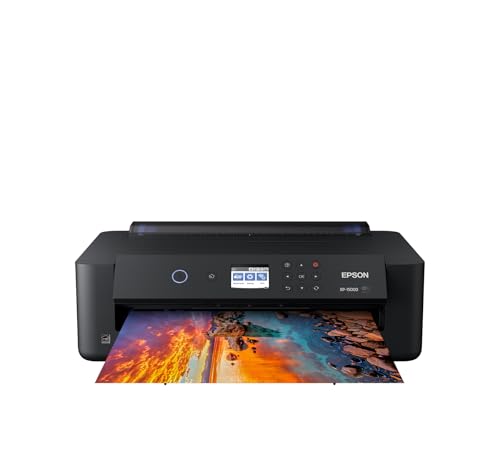
Epson Expression Photo HD XP-15000 — Wide photo printer, not sublimation
The XP-15000 closes the list as the second comparison machine, a six-colour wide-format photo printer whose listing promises thirteen-by-nineteen prints, automatic two-sided printing and wireless convenience for photographers and home studios. It earns a place because its wide page and photo branding put it in front of sublimation shoppers constantly, and a guide that ignored it would leave the most common comparison unexamined. As a machine for photographic prints on paper, its colour system and wide path are exactly what its audience wants.
As a sublimation candidate it is the weakest idea in this guide, and the verdict is deliberately blunt: cartridge architecture makes it a poor conversion base compared with tank machines, and nothing in its design or listing gestures at the process. Its presence here is a signpost, not a suggestion. Readers who love its photo output should buy it for photographs with a clear conscience; readers who need sublimation should walk past it to the four picks above without a backward glance.
- Type: wide-format six-colour photo inkjet, verified listing
- Maximum sheet: 13 by 19 inches per listing
- Duplex: automatic two-sided printing per listing
- Connectivity: wireless per listing
- Sublimation status: not suitable; included to close a common confusion
Strengths
- Wide, rich photographic output on paper media
- Compact take on wide-format for home studios
- Wireless and duplex conveniences are properly modern
Trade-offs
- Cartridge system makes it a poor conversion candidate
- No sublimation support, profiles or process intent
- Photo inks on cartridges cost more per page than tanks
Best for: home-studio photographers printing wide on paper.
Not suited for: sublimation buyers in any form — this is the guide’s clearest pass.
How Do the Six Picks Compare Side by Side?
| Pick | True A3 sublimation? | Ink system | Support model | Best role |
|---|---|---|---|---|
| F570-class Epson | Yes, and wider | Genuine sublimation | Manufacturer and dealer | Garment-led production |
| Sawgrass SG1000-class | Yes, tabloid class | Proprietary sublimation | Dealer and ecosystem | Guided craft business |
| SureColor F170 | No — letter size | Genuine sublimation | Full manufacturer | Small blanks, learning |
| Converted EcoTank-class | Yes, owner-built | Third-party sublimation | Community self-support | Budget A3 route |
| EcoTank Photo ET-8550 | No — photo inkjet | Six-colour conventional | Manufacturer, for photo use | Wide photo printing |
| XP-15000 | No — photo inkjet | Six-colour cartridges | Manufacturer, for photo use | Wide photo printing |
How Should You Set Up a Sublimation Corner That Works?
Arrange the bench as a production line in miniature: printer feeding sheets to a flat staging area, press at the centre with room to swing or slide its platen, finished-goods cooling space beyond it, because freshly pressed items are hot and their images benefit from undisturbed cooling. Blanks live within arm’s reach sorted by type, with the lint roller and heat tape — the two unglamorous tools that decide professional results — closer still. A shirt with one fibre of lint pressed into it carries that fibre forever; the thirty-second lint pass is the cheapest quality control in the entire craft.
Ventilation and heat awareness shape the room choice. A heat press is a large, hot appliance that runs for hours in production sessions, so the corner needs power capacity, clearance from anything meltable, and air movement for comfort. Keep printed sheets in a flat, dry stack near the press rather than across the room, and keep a waste bin exactly where failed prints land, because a tidy failure pile becomes diagnostic evidence when a colour or alignment problem needs tracing back through a session.
Finally, build the reference wall. Tape up a pressed sample of your standard colours on your standard blanks, your sizing templates for recurring products, and your pressing settings per blank type. Sublimation rewards this dull organisational layer extravagantly: the seller who presses the fiftieth mug of a design from written settings produces the same mug as the first, and consistency across a product line is what separates a shop from a hobby that occasionally sells things.
What Mistakes Do Sublimation Buyers Keep Making?
The founding mistake is buying the printer before the blank list. A machine chosen for a catalogue of mugs is a different machine from one chosen for full-front hoodies, and the A3 question cannot even be asked intelligently until the products are named. The second mistake is the cotton surprise: ordering a bale of ordinary cotton shirts for a process that physically cannot dye them, a heartbreak repeated in craft forums every week. The third is judging prints on paper, where sublimation output looks dull by design, and tweaking colours endlessly before ever pressing the sheet that tells the truth.
Press mistakes follow close behind: a press too small for the sheet, guessed temperatures, skipped pre-pressing of fabric to remove moisture, and unprotected platens gathering ghost images from earlier jobs. Each produces defects that get blamed on the printer, which is why this guide treats the system rather than the machine as the purchase. Buyers who budget printer, press, blanks and profiles as one decision almost never regret any component of it.
How Do You Keep Pressed Colours Matching What You Designed?
Colour in sublimation is a prediction problem: the screen shows light, the paper shows a dull rehearsal, and only the pressed blank shows the performance. The chain that makes the performance match the intention is a profile — a data file describing how a specific ink, on a specific paper, pressed onto a specific blank family, transforms colours. Dedicated systems ship matched profiles and quietly do this work for you. Converted systems rely on profiles published by ink makers for common printer-and-paper pairings, which are good starting points that still reward a test-press of a colour chart on your actual blanks.
The working method is unglamorous and decisive. Press a standard test image containing skin tones, saturated primaries, greys and fine text onto each blank type you sell, photograph it beside the screen image, and adjust once, at the profile or driver level, rather than per design. Blacks deserve special attention because rich photographic blacks can press brown or green when the profile and the blank disagree, and a seller who fixes black once, systemically, never troubleshoots it again. Keep the pressed test blanks; they are your true catalogue of what the system can say.
Also respect the blank as a colour variable. The same print pressed onto a bright-white polyester shirt, a cream ceramic mug coating and an aluminium panel will render three siblings rather than triplets, because the base colour of the blank participates in every hue. Professional sellers design with the blank in the room, sometimes at the desk, and that physical habit explains more about consistent product photography than any software setting in this guide.
Which Blanks Reward a Beginner and Which Punish One?
Ceramic sublimation mugs are the kindest starting blank: rigid, consistent, inexpensive in small cases, and pressed in a dedicated mug press that removes most variables. Coasters and aluminium key tags share that forgiveness on flat presses. Polyester shirts are the natural second step, adding fabric handling — lint removal, moisture pre-pressing, careful alignment — to the same colour skills. By the third month a beginner working this sequence has saleable products in three categories and a settings notebook that actually describes their own bench.
The punishing blanks share a trait: unforgiving geometry or invisible coatings. Glass and clear acrylic items demand specific coated variants and show every flaw. Dark garments cannot receive a process that adds dye without adding a white base, so designs vanish into the fabric colour. Cheap unbranded blanks with inconsistent coatings produce the patchy, faded results that beginners blame on their printer. The discipline is simple: buy blanks that declare themselves sublimation-ready from sellers who serve the craft, until experience lets you evaluate bargains with a test press rather than a production run.
What Does Pressing Technique Add Beyond the Machine?
Two presses of the same print can differ more than two printers ever will. Pre-pressing fabric for a few seconds drives out moisture that would otherwise turn to steam and blur the image. Firm, even pressure closes the gap between paper and blank so the dye gas takes the shortest path; a faded centre or edge almost always traces to pressure or platen coverage rather than ink. Heat-resistant tape keeps the sheet registered during closing, and a protective sheet above and below the work keeps stray dye from ghosting the next job through the platen.
Timing discipline matters in the other direction too. Under-pressed work looks washed out because the dye transfer never completed; over-pressed polyester scorches and yellows, and over-pressed coatings can gloss unevenly. The manufacturer of each blank publishes a starting window for time and temperature, and the owner’s job is to tune within that window on test blanks, then write the result down where the press lives. Sublimation forums are full of mysteries that dissolve the moment a settings card appears beside the machine.
How Does a Sublimation Practice Grow From Hobby to Income?
The growth pattern repeats across successful small shops. It begins with one blank category mastered properly — mugs are the classic — sold through one channel to one recognisable audience, often a local team, school or hobby community whose designs repeat. Repeat designs are the economic engine: the artwork is made once, the settings are known, and production becomes pressing rather than problem-solving. A3 capability enters the story when that audience asks for garments, which is exactly the moment the wide printer pays for its shelf space in a single season of team orders.
The shops that stall usually stall on breadth: twelve blank types, three marketplaces and custom one-offs that consume design hours out of all proportion to their price. The printer cannot fix a catalogue problem, but the discipline of this guide can — name the products, master their blanks, let the sheet size follow the orders rather than the other way round. Equipment bought in that order arrives as a tool with work waiting; equipment bought on speculation arrives as rent owed to a shelf.
What Should You Do When a Press Comes Out Wrong?
Diagnose by defect shape before touching any setting. Fading that follows the platen’s edges points at pressure or coverage. A sharp image shifted or doubled points at the sheet moving during closing — tape and handling, not ink. Colours that are uniformly wrong point at profile or paper orientation, including the classic error of printing on the wrong side of sublimation paper. A single dull band across the design points back at the printer, where a nozzle check belongs before any deeper surgery.
Keep the failures. A labelled box of ruined blanks, each annotated with its suspected cause, becomes the fastest teacher in the workshop and the reference that stops a solved problem from recurring in a busy season. Sublimation is a physical process with a short list of physical causes; the sellers who learn to read defects own a skill that transfers across every printer in this guide and every blank they will ever buy.
Why Does Sublimation Paper Choice Matter More Than Expected?
Sublimation paper is not a passive carrier; its coating decides how much dye releases under heat and how much stays behind as waste. A high-release paper leaves a ghost of the image on the sheet after pressing and puts the colour in the blank where it belongs, while a mismatched paper can hold dye back and produce the washed-out result that sends beginners troubleshooting their printer for a paper problem. Paper weight and drying behaviour matter too, because a sheet that cockles under heavy ink coverage can shift against the blank and blur fine detail.
The practical rule is to standardise. Choose the paper your ink or system maker recommends, buy it in the sizes your printer actually uses — including A3 sheets bought as A3 rather than trimmed from larger stock, for clean edges and honest feeding — and resist experimenting mid-season. Paper is one of the cheapest variables in the system and one of the most consequential, which makes it the worst place to chase small savings and the best place to buy boring consistency.
Storage closes the loop: keep paper flat, sealed against humidity, and away from the press’s heat. A sheet that absorbed a damp week presses like it, with mottled transfer in the heavy-coverage areas. Small sellers in humid climates learn to treat paper like photographic stock, and their defect rates quietly separate from competitors who store it on the floor.
How Should You Size and Prepare Designs for A3 Sheets?
Design at the size of the finished blank, not the size of the sheet. A shirt graphic built for its true chest width, a mug wrap built to the mug’s circumference and height, and a coaster set built to the coaster — each placed on the A3 canvas with margins for tape and handling — produces predictable results and honest previews. Designs built vaguely and scaled at print time accumulate small errors that pressing makes permanent, because heat offers no undo.
Resolution discipline is the second half. Photographic work should carry enough pixels for the final size so the press is never asked to enlarge softness, and line art should be vector where possible so edges stay clean at garment scale. Mirror the image before printing — the transfer reverses it — and build that step into a checklist rather than memory, because every sublimation seller owns at least one backwards-text shirt, and the goal is to own exactly one, made early, kept as a reminder.
Gang layouts deserve a planning minute. Arranging several small designs on one A3 sheet saves paper only if the pressing sequence suits it: items pressed together share settings happily, while items needing different times belong on separate sheets. A moment of layout thought per sheet, multiplied across a season, is the difference between A3 as an economy and A3 as merely a bigger sheet of waste.
What Does the A3 Upgrade Cost Across the Whole System?
The printer is the visible cost; the system is the real one. A press with an A3-capable platen, A3 paper stock, larger blanks, and storage for all three typically add a sum comparable to the printer’s own price difference over a letter setup. None of that should discourage the upgrade when the product list justifies it — garment work at A3 earns differently from mug work — but a budget that buys the wide printer and strands it beside a letter-size press has purchased a specification rather than a capability.
Running costs scale gently rather than dramatically. Ink use per garment is similar whether the design prints on one A3 sheet or strains across letter pages, paper costs a little more per sheet while saving sheets per product, and the dominant cost in small sublimation remains the operator’s time, which A3 reduces for garment and batch work. The upgrade’s economics are therefore really about product mix: the more of your week is wide work, the faster the system pays for its shelf.
How Do You Care for a Sublimation Printer Between Sessions?
Sublimation ink, like all inkjet ink, punishes neglect. A printer that sits for weeks invites the nozzle problems that regular short prints prevent, so a standing habit of a small weekly print — a test pattern, a coaster, anything that moves ink through every channel — protects the machine more reliably than any cleaning cycle after the fact. Dedicated machines make this easy with maintenance routines; converted machines depend entirely on the owner’s calendar.
Keep the paper path clean, the ink supply honest — refilling with a different ink family mid-stream muddies every profile you built — and the firmware and driver state stable during your selling season. Sublimation is a tuned system disguised as a printer, and the owners who change one variable at a time, on test blanks, with notes, are the owners whose product photographs look identical in January and June.
How Does Sublimation Compare With Vinyl and Screen Printing for Small Sellers?
Heat-transfer vinyl excels at bold, simple graphics on almost any fabric colour, including the dark garments sublimation cannot touch, but every colour is a layer to cut, weed and align, and complex photographic designs are effectively out of reach. Screen printing produces superb garments at volume, with an economy that improves as quantities grow, yet each design carries setup that punishes small runs. Sublimation occupies the fertile middle: full-colour, photographic, one-off-friendly, with no weeding and no screens, on light polyester goods.
Many thriving small shops run two of the three processes and route each order to its natural home — sublimation for the photographic team shirt, vinyl for the dark hoodie with a single-colour mark. The printer decision in this guide should therefore be made inside a shop strategy rather than as a referendum on technologies. A seller whose orders are photographic and light-coloured needs nothing beyond sublimation done well; a seller serving dark garments daily should budget the second process from the start instead of resenting the first.
What Workspace Does a Heat Press Really Demand?
A swing-away or slide-out press needs clearance on every side it moves through, a surface that tolerates both its weight and its heat, and an operator position that keeps forearms away from the platen during loading. Clamshell presses save floor space but bring the hot upper platen toward the operator’s hands and face on every cycle, which is why many garment sellers graduate to swing designs. Mug presses are compact but single-purpose, and combination presses trade some excellence in each mode for one footprint.
Electrical reality deserves a sentence of respect: a large press is a serious heating appliance, and a bench sharing a circuit with other hungry equipment will announce the fact through nuisance trips mid-production. Give the press a circuit that can carry it, keep its cable clear of the platen’s travel, and treat the press with the same household seriousness as a kitchen oven — because thermodynamically, that is the family it belongs to.
Why Do Experienced Sellers Keep a Settings Card at the Press?
Because memory is the least reliable component in the entire system. A settings card — blank type, temperature, time, pressure note, paper side, any quirk — converts each product from a performance into a procedure, so a design pressed in a rush in December matches the one photographed for the listing in September. When a helper or partner joins the bench, the card is also the whole training programme, and when a defect appears, the card proves what the settings were, narrowing the diagnosis to materials and machine.
Build the card from test blanks, not from internet tables. Published settings are starting windows written for other presses whose thermometers may read differently from yours. The card on your wall, earned on your equipment, is one of those unglamorous assets that separates a sublimation practice from a sublimation experiment, and it costs nothing but the discipline of writing down what the test press just taught you.
How Should You Photograph and List Sublimated Products?
Sublimation’s selling point — an image with no surface texture, indistinguishable from the garment itself — is also its photographic challenge, because a camera sees a plain shirt where the customer should perceive craft. Photograph finished goods worn or in use, at angles that catch the print’s colour against real light, and include one close frame that shows the print sitting in the fabric rather than on it. That single honest close-up frame answers the question every buyer of a printed garment silently asks: will this crack, peel or feel like plastic? Your process’s honest answer is its best advertisement.
Listings should name the material truthfully — the polyester content of garments, the coating on hard goods — because sublimation buyers increasingly shop by fibre content, and because a customer who knows what they bought washes it correctly and reviews it kindly. The shops that thrive on this process treat education as part of the product, and their repeat orders show it.
What Is the Sensible Upgrade Path From Letter Size?
Start where the F170 shines, with small blanks and supported hardware, and let orders pull the upgrade. The signals are consistent: garment requests arriving weekly, designs repeatedly split across letter sheets, pressing sessions bottlenecked by sheet handling rather than by the press itself. When two of those three signals persist for a season, the A3 step has stopped being a wish and become a capacity decision, and the dedicated wide machines in this guide can be evaluated against a known workload instead of a hopeful one.
Keep the letter machine when you upgrade. It remains the faster tool for mug wraps and small goods, it covers the wide machine’s downtime, and a two-printer bench lets one machine print while the other’s output presses. Sellers who planned that bench from the beginning describe the F170 not as a starter compromise but as the small-goods station of a grown-up little factory — which is the most useful way to think about every pick in this guide.
How Do You Handle a Rush Order Without Ruining the Batch?
Rush work is where sublimation benches earn or lose their reputation, because the process punishes hurry in specific ways: sheets loaded before the printer has settled produce banding, blanks pressed without their moisture pre-press blur, and alignment done by eye at speed drifts visibly across a team set. The countermeasure is procedural, not heroic. Keep the settings cards current, keep a small reserve of your standard blanks and paper on the shelf, and let the production line run at its practised tempo while the clock is handled by starting earlier rather than pressing faster.
A team order pressed calmly at standard settings ships as a matching set; the same order pressed in a panic ships as twelve near-relatives and one remake. Sellers learn, usually from one expensive evening, that the wide printer’s real contribution to rush work is not raw speed but the calm of one sheet, one press, no seams — the A3 advantage expressed as temperament.
Final Recommendation
Let the blank list decide. If full-front garments and wide fabric goods are the business, the dedicated A3 classes are the honest purchases: Epson’s wide desktop sublimation class for open manufacturer support, the Sawgrass class for a guided ecosystem with templates and teaching. If the budget rules and your temperament is technical, the converted tank route reaches the same sheet size for less, with support traded away in writing. If your products are mugs, coasters and small goods, stop apologising for letter size and buy the F170, the only fully supported sublimation machine with a verified listing here, and spend the savings on a better press. And if the comparison picks taught you that your projects were paper all along, the ET-8550 awaits with no dye gas required. Sublimation rewards the buyer who names the product first — so name yours, and the printer chooses itself, the way the best tools always do when the work is honestly described.
Frequently Asked Questions
Can I sublimate on cotton shirts?
No. Sublimation dye bonds with polyester, not cotton fibres. Cotton garments need high-polyester blends for acceptable results, with the image living in the polyester share, or a different decoration process entirely.
Why does my printed sheet look dull before pressing?
That is the process working correctly. Sublimation colour develops under heat as the dye vaporises into the blank. Judge colour only on pressed samples, never on the paper.
Is the F170 big enough for T-shirts?
For chest logos and smaller graphics, yes. For full-front designs that span the garment, no — that is precisely the A3 step this guide is about, and no setting enlarges a physical page.
Do I need a special heat press?
You need a press whose platen covers your largest sheet, with even heat and pressure. Shirt presses, mug presses and combination units each suit different blank lists, which is why the blank list comes first.
Can any EcoTank be converted to sublimation?
Tank printers are the common conversion base, but conversion means third-party ink, community profiles and no manufacturer support for the swap. It is a deliberate technical project, not a feature of the printer as sold.
What blanks should a beginner buy first?
A small set of polyester shirts, sublimation mugs and coasters covers the three core skills — fabric, curved hard goods and flat hard goods — without a large investment in stock that may not suit your market.
Related Guides
Round out the print bench with our companion guides: Best wide-format printers Best printers for heat transfers Best photo printers for home studios, covering the paper side of large-format work in equal detail.


