Our Top Picks
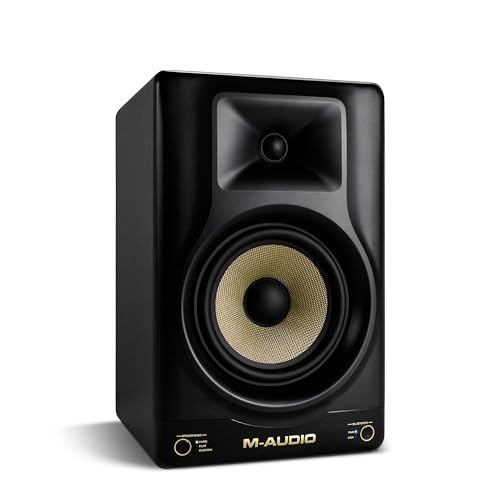 M-AUDIO Forty Sixty 6.5" Studio Monitor SpeakerForthy Sixty8.6 x 8.5 x 13.2 inches15.9 poundsCheck on Amazon
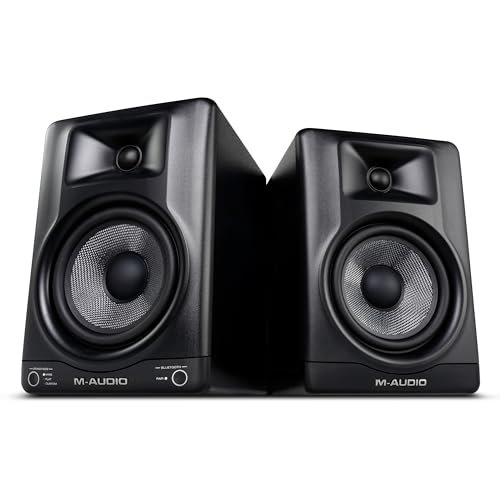
 M-AUDIO BX4BT 4.5" Bluetooth Studio Monitors PairBX4BT7.7 x 6.1 x 8.8 inches9.5 poundsCheck on Amazon


What's inside
- How to Choose M-Audio Speakers for Your Setup
- The Six Models at a Glance
- M-Audio BX3 3.5-Inch Wired Studio Monitors
- M-Audio BX4 4.5-Inch Wired Studio Monitors
- M-Audio BX5BT 5-Inch Bluetooth Studio Monitors with DSP
- M-Audio BX3BT 3.5-Inch Bluetooth Studio Monitors
- M-Audio Forty Sixty 6.5-Inch Studio Monitor
- M-Audio BX4BT 4.5-Inch Bluetooth Studio Monitors
- Setting Up Any of These Monitors Well
- Which M-Audio Speaker Should You Buy?
- Frequently Asked Questions
- Check prices on Amazon
- Final Verdict
As an Amazon Associate I earn from qualifying purchases. This post may contain affiliate links at no extra cost to you.
Choosing studio monitors is different from choosing ordinary computer speakers. A Bluetooth speaker made for a party is voiced to feel exciting, with lifted bass and bright treble that flatter almost anything you play. A studio monitor has the opposite job. It should tell you what is actually in your recording, including the parts you would rather not hear: a muddy vocal, a bass line that disappears on small speakers, or a mix that sounds balanced in headphones but falls apart in a room. The M-Audio range covered in this guide stays close to that honest purpose while remaining approachable for home recording, video editing, podcasting, and everyday desktop listening.
This guide compares six current M-Audio options: the wired BX3 and BX4 pairs, their Bluetooth counterparts the BX3BT and BX4BT, the 5-inch BX5BT with DSP and app control, and the larger 6.5-inch Forty Sixty. They share a family resemblance, but they are not interchangeable. Woofer size, connection type, and control options change who each model suits best. A 3.5-inch pair that fits neatly beside a laptop in a small bedroom studio is a sensible choice for spoken word and light music work, while a 6.5-inch monitor gives a mixing engineer more low-frequency information to work with, provided the room can support it.
Our approach in this article is specification-led. We reviewed the specifications and product titles provided by the manufacturer, compared woofer sizes and connection types across the range, and checked how each model is positioned for recording, mixing, and multimedia use. We also considered widely understood principles of studio monitoring: nearfield placement, the relationship between woofer size and bass extension, the trade-off between wired reliability and wireless convenience, and the role of room acoustics. Where a feature is only listed for a specific model, such as DSP and app control on the BX5BT and Forty Sixty, we describe it only for that model and do not assume it carries across the line.
How to Choose M-Audio Speakers for Your Setup
Woofer size and what it changes
Woofer size is the clearest dividing line in this range. The BX3 and BX3BT use 3.5-inch woofers, the BX4 and BX4BT use 4.5-inch woofers, the BX5BT uses a 5-inch woofer, and the Forty Sixty uses a 6.5-inch woofer. In general terms, a larger woofer can move more air and reproduce lower frequencies with less strain, which helps when you are judging kick drums, bass guitars, synths, and cinematic sound effects. A smaller woofer will usually roll off earlier in the bass, which means very low content may be quieter or less distinct. That is not automatically a flaw. In a small, untreated room, a large woofer can excite room modes and make bass harder, not easier, to judge. Many home producers work more accurately on a compact monitor and check low end on headphones.
Think about the material you work on most. Podcast editors and video creators who mainly handle dialogue often prioritise clarity in the midrange, where the human voice lives, and a 3.5-inch or 4.5-inch pair serves that work well. Music producers working across pop, hip-hop, electronic, or rock usually benefit from stepping up to 5 inches or 6.5 inches, because decisions about bass balance become a larger part of the mix. Multimedia listeners fall somewhere in between: they want dialogue to stay intelligible and music to feel full, without needing the last degree of low-frequency accuracy a dedicated mixing room demands.
Wired, Bluetooth, or both in your workflow
The BX3 and BX4 in this guide are described as wired studio monitors. The BX3BT, BX4BT, and BX5BT add Bluetooth, and the Forty Sixty also lists Bluetooth among its features. The practical difference shows up in daily habits. A wired pair connects to your audio interface, computer, or mixer and stays there, with a stable signal path and no pairing steps. That stability matters when you are tracking audio, editing tightly to picture, or working with timing-sensitive material, because wireless links can introduce delay that wired connections avoid.
Bluetooth earns its place in a different set of moments. It lets you play a reference track from a phone without reaching for a cable, compare your mix against streaming services on the device your audience actually uses, or use the same speakers for work calls and casual listening after a session. For a shared home office or a creator desk that doubles as an entertainment space, that flexibility can be the deciding factor. The key is to choose it deliberately rather than by default, and to understand that the Bluetooth versions in this line are distinct models with their own names, not the same speaker with a switch flipped.
Nearfield listening and desk space
All of the BX models here are compact desktop monitors intended for nearfield listening, meaning you sit relatively close to them, typically at arm’s length to a few feet away, and hear more direct sound from the speaker and less reflected sound from the room. That design suits bedrooms, home offices, dorm rooms, and small project studios. The Forty Sixty, with its larger 6.5-inch woofer, is still a monitor for home and studio mixing according to its product title, but it needs more physical space and a little more listening distance to make sense.
DSP, EQ, and app control
Two models in this guide explicitly list digital signal processing features. The BX5BT is described with DSP and app control, and the Forty Sixty lists a precision DSP crossover, EQ, a control app, and Bluetooth. In broad terms, DSP in a studio monitor can manage how frequencies are divided between drivers, apply EQ adjustments, and help tailor the speaker’s response to its position or room. App control moves those adjustments to a phone or tablet interface instead of, or in addition to, controls on the speaker itself.
The Six Models at a Glance
- M-Audio BX3, 3.5-inch, wired, pair: the most compact wired option here, positioned for recording, mixing, and multimedia, with a music production software suite included.
- M-Audio BX4, 4.5-inch, wired, pair: a step up in woofer size from the BX3 while keeping a wired-only, compact desktop format and the included software suite.
- M-Audio BX5BT, 5-inch, Bluetooth, pair: the only 5-inch model in this list, with DSP and app control, aimed at mixing, video editing, podcasting, and music production.
- M-Audio BX3BT, 3.5-inch, Bluetooth, pair: the wireless counterpart to the BX3 concept, keeping the compact 3.5-inch size while adding Bluetooth for PC and multimedia use.
- M-Audio Forty Sixty, 6.5-inch, single speaker format in its title: the largest woofer here, with precision DSP crossover, EQ, control app, and Bluetooth for home and studio mixing.
- M-Audio BX4BT, 4.5-inch, Bluetooth, pair: the Bluetooth version at the 4.5-inch size, balancing a slightly larger woofer than the BX3BT with wireless convenience.
Readers comparing these monitors with higher-output options for larger rooms may also find our guide to best 100 watt studio monitors useful as a point of contrast, since power handling and room size change the decision quite a bit once you move beyond a desktop nearfield setup.
M-Audio BX3 3.5-Inch Wired Studio Monitors
The BX3 is the entry point to this range and, for many home creators, the most realistic starting point. Sold as a pair of wired studio monitors with 3.5-inch woofers, it is positioned by M-Audio for recording, mixing, and multimedia. That combination of tasks matters. This is not presented as a single-purpose mixing tool for a treated studio, nor as a pure entertainment speaker. It is a compact desktop pair meant to handle the mixed reality of a modern home desk, where the same speakers might carry a vocal edit in the morning, a video timeline in the afternoon, and music or a film in the evening.
Who the BX3 suits best
The BX3 makes the most sense for beginners setting up a first recording space, podcasters who need to hear their voice clearly without headphone fatigue, and video editors working in small rooms. Its compact footprint is a genuine advantage. On a narrow desk, a 3.5-inch monitor can sit on stands or isolation pads, angled correctly, where a larger cabinet would be forced into a corner or left lying at the wrong height. For spoken-word work, where the critical information sits in the midrange and upper midrange, the smaller woofer is less of a limitation than buyers sometimes fear. Dialogue intelligibility, sibilance, plosives, and edits between takes are all audible on a monitor of this size when it is placed well.
Working with a wired connection
Because the BX3 is a wired model, your signal path stays simple and predictable. Connect it to an audio interface for recording work and you get a stable setup for tracking and editing, without pairing menus or wireless delay to consider. That simplicity also helps troubleshooting. If sound stops, the chain is short: source, cable, speaker. For students, schools, and shared workspaces, that reliability is worth more than it first appears. There is no Bluetooth device list to manage and no risk of a phone in another room connecting unexpectedly during a session.
The trade-off is obvious: playing music from a phone across the room requires a cable or a separate device in the chain. If your daily routine involves frequent wireless playback from multiple devices, compare this model directly with the BX3BT below, which keeps the same 3.5-inch size class but adds Bluetooth. If your routine is mostly interface-based recording and editing, the wired BX3 keeps the desk tidy in a different way, with fewer wireless variables and a clear, dedicated role.
In short, choose the BX3 if space is tight, your work leans toward voice, video, and general production, and you prefer a wired connection. Step up in size if bass-heavy music mixing is your main job, or step sideways to the BX3BT if wireless playback is essential at this size.
M-Audio BX4 4.5-Inch Wired Studio Monitors
The BX4 keeps the same wired, pair-based concept as the BX3 but moves to a 4.5-inch woofer. That single change shifts the balance of the speaker. A 4.5-inch woofer can generally offer a fuller low-midrange and a little more bass presence than a 3.5-inch design, which helps music sound more complete at the desk and gives mixing decisions slightly more information to work with. It remains a compact desktop monitor for recording, mixing, and multimedia, and it also lists the music production software suite as included, but it is aimed at the buyer who has a bit more desk space and wants a bit more body from the sound without jumping to a 5-inch or 6.5-inch cabinet.
The middle ground of the wired pair
Many home studios land naturally at this size. A 4.5-inch monitor is large enough that kick drums and bass lines have more weight than on a 3.5-inch model, yet small enough that a bedroom or spare-room setup does not get overwhelmed. If you produce music at home, edit video with music and effects as well as dialogue, or simply listen for long stretches and want less listening fatigue than tiny speakers tend to cause, the BX4 is a thoughtful compromise. It also suits creators who record instruments such as acoustic guitar, piano, or voice, where the low midrange carries much of the warmth and character and benefits from the larger woofer.
Wired reliability for recording and editing
The BX4 is described as wired, with no Bluetooth in its title, and that should be read as a feature for the right user rather than a missing extra. Studios tend to value repeatability. You turn on the interface, open the session, and the monitors are simply there, session after session, with consistent level and timing. For editing dialogue or aligning audio to video, that consistency removes a source of friction. There is also no wireless codec or connection state standing between your source and the speaker, which purists and practical editors alike tend to appreciate.
Software, multimedia, and long sessions
For everyday multimedia, the BX4 pair offers a step up from basic computer speakers in clarity and separation, making it a comfortable all-day desk companion for work, study, and entertainment. Choose the BX4 if you want wired simplicity, a fuller sound than the BX3 can offer, and a cabinet that still fits a typical home desk. Consider the BX5BT if you also want DSP, app control, and Bluetooth in a larger 5-inch design.
M-Audio BX5BT 5-Inch Bluetooth Studio Monitors with DSP
The BX5BT occupies a distinctive place in this line-up. It is the only 5-inch model among the six, it is sold as a pair of desktop studio monitors, and its title lists Bluetooth, DSP, and app control together. M-Audio positions it for mixing, video editing, podcasting, and music production, a broad brief that reflects how many creators now move between those tasks in a single day. If the BX3 and BX4 are straightforward wired tools, the BX5BT is the more configurable option, designed for a desk where wired production work and wireless everyday use overlap.
Why the 5-inch size matters
Five inches is a classic nearfield woofer size for home studios, and for good reason. Compared with the 3.5-inch and 4.5-inch models here, a 5-inch woofer generally provides more low-frequency extension and a greater sense of scale, which helps when judging bass instruments, drums, and the lower harmonics of piano and guitar. Compared with the 6.5-inch Forty Sixty, it asks for less room and less listening distance, so it fits the average bedroom studio more comfortably. For many buyers, this is the size where a monitor starts to feel like a complete music speaker rather than a compact desktop compromise, while still behaving well at close range.
DSP and app control in practice
The BX5BT is the BX model in this guide that explicitly lists DSP and app control. In practical terms, digital processing in a monitor can shape the speaker’s response and manage settings in ways that purely analogue controls cannot easily match, and an app gives you a visual interface for those adjustments from your listening position. That last point is underrated. Adjusting a control on the back of a speaker, then walking back to your chair to listen, is an awkward loop. Changing a setting from the chair itself, while the music plays, lets you hear the effect in the exact spot where it matters.
Bluetooth for reference checks and daily life
Bluetooth on the BX5BT supports the way modern production actually happens. A mix is rarely finished when it sounds right in the studio; it also needs to make sense against commercial references streamed from a phone, and it will ultimately be heard by listeners on wireless devices. Sending a reference track or a bounced mix from a phone to the same monitors you mixed on removes one variable from that comparison. Between sessions, the same pair handles music, video, and calls without cable swapping.
For timing-critical recording and detailed editing, a wired connection to your interface remains the sensible primary path, as it does for every Bluetooth model in this guide. Think of Bluetooth as an additional input for convenience and comparison, not a replacement for the studio connection at the centre of your setup. Readers who use wireless speakers mainly for casual listening in other rooms might compare this category with best 2 1 bluetooth speakers, which cover a different, entertainment-first approach with a separate subwoofer.
Choose the BX5BT if you want the most versatile BX pair here: a 5-inch woofer for fuller music work, Bluetooth for modern reference habits, and DSP with app control for tuning the result to your room. It is the natural step up for BX3 or BX4 owners who feel limited by size or features, and the most complete all-rounder in this list for a mixed workload.
M-Audio BX3BT 3.5-Inch Bluetooth Studio Monitors
The BX3BT takes the compact 3.5-inch concept of the BX3 and adds wireless Bluetooth, and that one addition changes its audience. Still sold as a pair of studio monitors for recording, editing, and multimedia, and still listing the music production software suite as included, the BX3BT is aimed at the creator whose desk is also a general-purpose computer space. It is the smallest Bluetooth option in this guide, which makes it interesting for dorm rooms, small apartments, and portable setups where every inch of desk matters.
Compact size, wireless freedom
The appeal is easy to understand. A laptop, a small interface or microphone, and a pair of BX3BT monitors can form a complete creator desk without a web of cables. When you want to play a track from a phone, show a guest a video, or listen to music while the computer is closed, Bluetooth keeps the speakers useful rather than tied to one source. For students and casual creators who move between study, content creation, and entertainment on the same desk, that flexibility often matters more than the last measure of bass extension.
The 3.5-inch woofer defines the limits as clearly as it defines the benefits. Expect a monitor suited to voice, acoustic instruments, and general music listening at close range, with deep bass presented lightly rather than forcefully. Podcasters, streamers, and video editors will find the size well matched to their material. Producers of bass-heavy electronic or hip-hop music should plan to check low frequencies on headphones, or look at the BX4BT, BX5BT, or Forty Sixty for more woofer area.
Recording and editing on a Bluetooth model
A common question is whether a Bluetooth monitor can still serve as a studio monitor. The answer lies in how you connect it for each task. For recording and editing, use the wired connection to your computer or interface as your main path, so timing stays tight and the setup stays predictable. Use Bluetooth for playback, references, and casual listening. The BX3BT supports both habits in one small cabinet, which is precisely its point. It does not force a choice between a work speaker and a lifestyle speaker; it covers both roles at a compact scale.
Who should skip it, and who should choose it
Skip the BX3BT if your room and budget allow a larger monitor and your work depends on judging bass accurately, or if you know you will never use Bluetooth and prefer the simplest wired-only path of the BX3. Choose it if your desk is small, your sources are many, and your content leans toward voice and video as much as music. Among the six models here, it is the easiest to fit into a life that is not centred on a permanent studio, and for many buyers that ease is the deciding quality.
M-Audio Forty Sixty 6.5-Inch Studio Monitor
The Forty Sixty is the largest and most studio-focused model in this guide. Its title describes a 6.5-inch studio monitor speaker, in the singular, with a precision DSP crossover, EQ, a control app, and Bluetooth, intended for home and studio mixing. That wording deserves attention. Unlike the BX models above, which are explicitly described as pairs, the Forty Sixty title refers to a speaker, so buyers should check the listing carefully for exactly what is included and plan accordingly if a stereo pair is required. What is clear is the intent: this is the model for listeners who want the most low-frequency information and the most processing control that this particular M-Audio selection offers.
The case for a 6.5-inch woofer
A 6.5-inch woofer moves the conversation from compact desktop convenience toward fuller-range monitoring. In general studio terms, that size can reproduce bass with more depth and less strain than the smaller BX models, which matters when mixes contain sub-bass, extended kick drums, bass synths, or cinematic low effects. Decisions that are partly guesswork on a 3.5-inch monitor become more audible here: whether the bass guitar and kick are competing, whether a vocal sits above or inside the low end, whether a reverb tail is muddying the bottom of the mix.
The condition attached to that advantage is space. A larger monitor needs a larger desk or proper stands, more distance from walls, and enough listening distance for the sound from its drivers to blend before it reaches you. In a small untreated bedroom, a Forty Sixty can produce more bass than the room handles gracefully, and the result can be less accurate, not more. In a medium-sized room with sensible placement and some basic treatment, it is the model here most likely to satisfy a serious mixing workflow without a separate subwoofer for many styles of music.
Precision DSP crossover, EQ, and control app
The Forty Sixty’s processing list is more specific than the BX5BT’s. Its title names a precision DSP crossover, which in monitor design refers to digitally managing how the frequency range is divided between the woofer and the tweeter, a division that affects clarity and imaging in the critical midrange where the two drivers meet. It also lists EQ, which allows response adjustments, and a control app, which brings those settings to a screen at your listening position.
Bluetooth on a serious mixing monitor
Bluetooth might seem unexpected on the most studio-oriented model here, but it fits modern mixing habits. Clients send references from phones. Collaborators share links that are easiest to open on a mobile device. A quick wireless check of a mix bounce, played from the phone your audience will use, is genuinely informative. The Forty Sixty keeps that convenience available while its primary role remains wired studio work through your interface for recording and mixing sessions.
Choose the Forty Sixty if mixing is your main purpose, your room can support a 6.5-inch monitor, and you value DSP-based control over crossover and EQ. It is less suited to a cramped desk or a purely casual setup, where its size and capability would go unused. For buyers building a stereo system, confirm the contents of the listing before ordering, given the singular wording of its title, and budget for placement, stands, and basic room care as part of the real cost of using a monitor of this size well.
M-Audio BX4BT 4.5-Inch Bluetooth Studio Monitors
The BX4BT completes the BX family picture in this guide: a pair of studio monitors with 4.5-inch woofers and Bluetooth, positioned as wireless PC speakers for recording, editing, and multimedia, with the music production software suite included. If the BX3BT is the compact wireless choice and the BX5BT is the larger, DSP-equipped choice, the BX4BT is the balanced middle. It offers more woofer than the smallest model without the size, cost class, or feature complexity of the largest BX.
The balanced wireless option
Balance is a useful quality in a home setup. A 4.5-inch woofer generally gives music more body and low-midrange warmth than a 3.5-inch design, which helps everything from recorded guitar to film scores feel more complete at the desk. At the same time, the cabinet remains a compact desktop format that fits the desks most people actually own. For a creator who records podcasts, edits video, produces music as a serious hobby, and listens for pleasure on the same system, the BX4BT covers all four without forcing a compromise that feels severe in any one of them.
Bluetooth strengthens that all-round case. Reference tracks from a phone, a quick listen to a collaborator’s track on a tablet, background music while you answer email, and clearer audio for calls and online lessons all flow through the same pair. When it is time to record or edit in earnest, connect through your interface or computer in the wired path and work as you would with any studio monitor. The BX4BT’s identity is that it does not make you pick a side between studio and everyday use.
Comparing BX4BT with BX4 and BX3BT
Against the wired BX4, the BX4BT trades nothing in woofer size and adds wireless playback, so the decision between them rests on whether Bluetooth will actually be used and on the current difference in what each listing includes. Against the BX3BT, the BX4BT steps up from 3.5 inches to 4.5 inches, which will matter most to listeners who found the smallest monitors light in the bass or who work on music more than speech. Against the BX5BT, it gives up the 5-inch woofer and the listed DSP and app control, in exchange for a smaller footprint and a simpler feature set.
Everyday strengths and honest limits
In daily use, expect the strengths of the format: clear dialogue for editing and calls, a present midrange for voice and instruments, and enough low end for most popular music at nearfield distance to feel engaging. The honest limit, shared with every compact monitor, is very deep bass. If your productions rely on sub-bass, verify those decisions on headphones or a larger system. The included software suite again helps beginners start recording without an immediate additional purchase, and the pair format means stereo imaging for mixing and film work is available from day one.
Listeners building a larger living-room system rather than a nearfield desk setup are in a different category altogether; our coverage of best 1000 tower speakers addresses that floor-standing world, which trades desk-friendly accuracy for room-filling scale. For a desk, though, the BX4BT is arguably the easiest recommendation in this guide to live with: big enough to satisfy, small enough to place, and wireless where it counts.
Setting Up Any of These Monitors Well
Whichever model you choose, setup decides a large share of what you hear. Start with symmetry. Place the two speakers of a pair at equal distances from your head and from the side walls where possible, forming a triangle with your listening position at its point. Angle each speaker inward so it faces your ears rather than firing straight ahead past you. Raise them so the tweeters sit near ear height when you are seated. If stands are not practical, use desktop stands or isolation pads to lift and decouple the cabinets from the desk surface, which otherwise adds its own resonances and reflections to the sound.
Finally, manage expectations about bass in small rooms. None of the compact models here attempts to reproduce the deepest octave with authority, and even the Forty Sixty works within the limits of its room. Producers who need to judge sub-bass precisely often pair careful headphone checks with their monitors. That is normal professional practice, not an admission of failure. By contrast, very large drivers belong to a different conversation about live sound and big spaces, as explored in best 12 inch speakers, and bringing that scale into a bedroom studio rarely improves accuracy.
Which M-Audio Speaker Should You Buy?
- Smallest desk, voice and video focus, wired: the BX3 pair keeps things compact, simple, and affordable in spirit, with the included software suite for getting started.
- Smallest desk, but wireless matters: the BX3BT adds Bluetooth to the same 3.5-inch class, suiting students, streamers, and multi-device desks.
- A fuller wired sound that still fits at home: the BX4 pair steps up to 4.5 inches for music and multimedia with a direct, reliable connection.
- The balanced all-rounder with Bluetooth: the BX4BT pairs that 4.5-inch size with wireless convenience for recording, editing, and daily listening.
- One versatile pair for serious mixed work: the BX5BT combines a 5-inch woofer, Bluetooth, DSP, and app control for mixing, editing, podcasting, and production.
- Mixing first, with the most control and bass information here: the Forty Sixty brings a 6.5-inch woofer, precision DSP crossover, EQ, app control, and Bluetooth, with the caveat that its title describes a single speaker.
Frequently Asked Questions
Do studio monitors work as everyday computer speakers?
Yes, and every model here is positioned for multimedia as well as studio work. Expect a clearer, flatter sound than typical entertainment speakers, which aim for excitement over accuracy. Many listeners prefer that honesty once they adjust to it, especially for dialogue, acoustic music, and long listening sessions. If you mainly want heavy bass for films and games, a dedicated entertainment system may suit you better, but for a desk that mixes work and listening, monitors are a strong single solution.
Is Bluetooth good enough for recording?
For playback and reference listening, Bluetooth is convenient and entirely practical. For recording and tight editing, a wired connection is the better primary path because it avoids wireless delay and keeps the signal chain simple and repeatable. That is why the Bluetooth models in this guide are best used in both modes: wired for the session itself, wireless for references, casual listening, and sharing audio from phones and tablets.
How important is room treatment for a home setup?
More important than most first-time buyers expect, and cheaper than many fear. You do not need a professionally treated room to benefit from monitors. Soft furnishings, a rug, curtains, and sensible speaker placement already reduce the worst reflections. Add treatment gradually if mixing becomes serious, starting with the points where sound first reflects toward your listening position. Even in an untreated room, nearfield listening helps, because sitting close means you hear more of the speaker and less of the room.
Check prices on Amazon
Live listings for the shortlist in this guide are pulled from Amazon below, so prices and availability are always current at the moment you look.

Final Verdict
The strength of this M-Audio selection is that each model has a clear job. The BX3 and BX3BT serve compact desks, differing in the one feature that matters most at that size: wired simplicity versus Bluetooth freedom. The BX4 and BX4BT repeat that same clean choice at 4.5 inches, for listeners who want a fuller sound without leaving the compact category. The BX5BT steps into more serious territory with its 5-inch woofer, DSP, and app control, and it is the most complete single pair here for a creator who does a bit of everything. The Forty Sixty stands apart as the mixing-focused 6.5-inch option, with the deepest processing toolkit and the greatest demands on your room.
Choose by room, workload, and connection habits rather than by chasing the longest feature list. Measure your desk, think honestly about how much bass your material contains, decide whether wireless playback will be a daily habit or a rare novelty, and reserve some budget and attention for placement. Any of these six, set up carefully and learned through reference recordings, will reveal more about your work than the speakers built into a laptop or a typical entertainment system, and that revelation is the whole point of a studio monitor.
Disclosure for this guide: some links in this article are Amazon affiliate links, which means this site may receive a commission if you buy through them, at no additional cost to you. As an Amazon Associate we earn from qualifying purchases. Prices and stock availability shown on Amazon can change at any time, so please treat any listing details as accurate only at the moment you check them, and confirm the current price and availability on the product page before ordering. This article was prepared from manufacturer specifications and editorial research, and the inclusion or order of products here does not guarantee that a given speaker will suit every room or workflow.


