Our Top Picks
 Yamaha NS-AW390 All Weather Indoor/Outdoor 6.5-inch 2-Way SpeakersPair14.2 x 8.8 x 17.6 inches8.3 poundsCheck on Amazon


What's inside
- The RX-V6A as a power source: what 100 watts per channel really buys
- Impedance behaviour and the selector debate
- Choosing a layout: 5.1, 7.2 and 5.1.2 on this receiver
- Front left and right: sensitivity targets between 86 and 92 decibels
- YPAO room correction: its limits and the speaker traits that help it
- MusicCast wireless surrounds and rears: the cable-free option
- Subwoofer pairing: the 80-hertz crossover and the case for two
- Bookshelf or tower at this power level
- Gaming, HDMI 2.1 and dialogue clarity
- Owner-reported pairings by speaker family
- Reading a speaker specification sheet like an engineer
- Three worked room examples
- Buying checklist
- Check prices on Amazon
- Frequently asked questions
As an Amazon Associate I earn from qualifying purchases. This post may contain affiliate links at no extra cost to you.
Every recommendation in this guide is funded by affiliate commissions, yet the order of the argument runs the other way, from published output figures and driver specifications toward a shortlist rather than from any commission table toward a justification. That distinction matters most with a receiver like the Yamaha RX-V6A, because the right speakers for it are decided by a handful of measurable relationships: how much power the amplifier can deliver cleanly, how loudly a given loudspeaker plays with one watt, how its impedance behaves across the bass, and how well its centre channel preserves dialogue when a film mix gets dense. Read those relationships correctly and the RX-V6A sounds generous, controlled and far more expensive than its class suggests. Read them badly, by pairing it with hungry, low-sensitivity speakers and then compensating with volume, and the same receiver can sound strained long before the display shows an alarming number.
This guide works through those relationships in the order a buyer actually faces them. It starts with the amplifier itself, moves through impedance and layout choices for 5.1, 7.2 and 5.1.2 systems, then covers front and centre matching, YPAO room correction, wireless surround options, subwoofer pairing, the bookshelf-versus-tower decision, and gaming through HDMI 2.1. Speaker families are discussed by class and by documented specification rather than by rumour, and aggregated owner reports are used only where they describe repeatable pairing behaviour, such as a bright speaker exciting a lively room, rather than as proof of anything a single listener happened to prefer. No listening claim in this guide comes from the site auditioning the products, and none needs to: the specification sheets, the receiver manual and established acoustic principles are enough to narrow the field honestly.
The RX-V6A as a power source: what 100 watts per channel really buys
Yamaha rates the RX-V6A at 100 watts per channel into 8 ohms with two channels driven, measured across the full audio band at low distortion by the standards the company publishes for this model. Each clause in that sentence deserves attention. Two channels driven means the figure describes stereo conditions, not all seven channels pushed to the same level at the same moment. Into 8 ohms describes the load used for the rating, and real loudspeakers rarely present a flat 8-ohm load across their range. Full-band measurement matters because a rating taken only at 1 kilohertz would flatter the amplifier, hiding how it behaves in the bass where programme material demands the most current.
In practice, film and music almost never ask every channel for full output simultaneously. Dialogue anchors the centre, effects visit the surrounds in bursts, and the front pair carries the sustained load. A powered subwoofer, which this guide strongly recommends, removes the deepest bass from the receiver entirely, and that single decision transforms the power budget. Cross the front speakers over at 80 hertz and the amplifier no longer funds the most current-hungry octaves; its supply is spent on the midrange and treble where clarity lives. Owners who report that the receiver feels more powerful with a subwoofer engaged are describing arithmetic, not magic.
The useful way to think about the 100-watt figure is headroom above your normal listening level. Sound pressure rises slowly with power: doubling amplifier power buys only about 3 decibels of extra level, and a tenfold rise buys 10 decibels. A speaker that produces 88 decibels from one watt at one metre will produce roughly 91 decibels from two watts, 94 from four, and so on, before distance and room losses are counted. Listening distance then subtracts level, very roughly 6 decibels each time distance doubles in free space and rather less in a reflective room. Work that chain backwards from the loudest level you honestly use, often lower than people claim, and the RX-V6A usually has comfortable margin with sensibly chosen speakers.
Where the margin disappears is at the extremes: very large rooms, seating far from the front speakers, a taste for sustained high levels, and speakers of low sensitivity with difficult impedance. That combination, not the receiver alone, produces the thin, hard sound people blame on amplification. The specification to watch first is therefore not the wattage printed on the carton but the sensitivity and impedance published for each candidate speaker, because those two numbers decide how hard this receiver must work for every decibel you hear.
Impedance behaviour and the selector debate
A loudspeaker impedance rating is a nominal label, not a constant. A design sold as 8 ohms may dip toward 4 or 5 ohms in the upper bass and rise far higher at resonance and in the treble. A design sold as 6 ohms may spend much of its working life near that value with a lower minimum somewhere in the crossover region. What stresses an amplifier is the combination of low impedance and high phase angle at frequencies where music carries real energy, because that pairing draws current out of proportion to the voltage delivered. Published impedance curves, where manufacturers or independent measurements provide them, tell a buyer more than the single nominal figure on a retail page.
For the RX-V6A, mainstream 6-ohm and 8-ohm speakers from established ranges are the natural territory. They let the receiver deliver its rated behaviour without thermal complaint at domestic levels. Four-ohm nominal speakers deserve a more careful conversation. Many will play perfectly well at moderate volume in a small room, and some carry benign phase behaviour despite the low nominal figure. Others combine a low minimum with demanding phase angles and low sensitivity, and those are the designs that can push a mid-priced receiver toward protection or audible strain during loud passages. The honest rule is to look at the minimum impedance and sensitivity together rather than treating the nominal number as a pass or fail stamp.
The receiver offers an impedance selector in its setup, and the debate around it recurs in owner discussions. The lower setting exists to satisfy safety and thermal certification conditions with low-impedance loads, and it does so by limiting available voltage swing. That protection comes at a cost in dynamic headroom with speakers that could otherwise use the full rail. Yamaha documentation and long-standing engineering commentary on such selectors point the same way: the setting is a limiter, not a sound-quality feature. Owners running ordinary 6-ohm or 8-ohm speakers should leave the receiver at its default 8-ohm setting, keep ventilation clear, and let the protection circuits do their job in the rare event they are needed. Owners determined to run genuinely difficult 4-ohm speakers at high levels in a large room should reconsider the speaker choice rather than expect a menu setting to rewrite physics.
Cable questions belong in this section only briefly. For typical domestic runs, ordinary copper cable of adequate gauge for the length involved is electrically sufficient, and money not spent on exotic cable is better spent on the centre channel or a second subwoofer. Keep runs to matched speakers roughly equal in length where practical, ensure bare connections are tight and free of stray strands, and route cables so they cannot be pinched or shorted at the terminals. A short circuit will silence or stress an amplifier channel far more reliably than any subtle cable property will improve it.
best 7 1 home theater speakers
Choosing a layout: 5.1, 7.2 and 5.1.2 on this receiver
The RX-V6A provides seven channels of amplification and processing for up to a 7.2 arrangement, with the option to assign channels to a 5.1.2 configuration in which two channels serve overhead or height speakers for Dolby Atmos and DTS:X material. That flexibility is a genuine strength, and also the first real fork in a buying decision, because the same two channels cannot serve rear surrounds and height speakers at once. The right assignment depends on room geometry and on the material watched most often.
A well-executed 5.1 system remains the foundation recommendation for small and medium rooms. Five well-matched speakers and one or two subwoofers, positioned carefully and calibrated, will outperform a crowded 7.2 installation in a room too small to give rear surrounds the distance they need. Surround speakers placed almost against the backs of listeners localise badly and call attention to themselves. If the sofa sits against the rear wall, 5.1 or 5.1.2 will almost always serve better than a forced 7.2 layout, and the money saved on the extra pair can fund a better centre channel, which repays the investment in every programme.
Where the room allows seating away from the rear wall, with space for rear surrounds behind the listening position at a sensible distance and angle, 7.2 adds envelopment in films mixed for it and in games with positional audio. The benefit is real but incremental compared with the jump from poor to good front speakers. Buyers building in stages should therefore fund the front three and subwoofer first, add side surrounds next, and treat rear surrounds as the final refinement rather than the starting point. That sequence also protects dialogue quality, which no quantity of surround channels can rescue once the centre channel is outclassed.
The 5.1.2 option deserves particular attention because height information changes the character of Atmos mixes in a way extra rear channels do not. Rain, aircraft, vertical pans and the general sense of a room having a ceiling all gain from even a modest height layer. Practical implementations include dedicated height speakers mounted high on the front wall, ceiling-installed speakers where construction allows, and up-firing modules placed on or near the front speakers. Each involves compromise. Ceiling speakers give the most convincing overhead image and the most installation work. Front-height speakers are easier and still effective for many mixes. Up-firing modules depend on a flat, reflective ceiling of moderate height and lose their effect in vaulted or heavily treated rooms. Yamaha setup documentation describes the supported placements, and buyers should measure their ceiling and seating geometry before choosing rather than after unboxing.
Two subwoofer outputs invite a dual-subwoofer arrangement, discussed in detail later, but note that the layout label 7.2 or 5.2.2 describes connection capacity rather than independent bass management sophistication. The practical gain of two subwoofers is smoother bass across seats through placement, and that gain is available in any of the layouts above. Decide the channel layout for the room first, then decide the subwoofer count for the seating area, and keep the two decisions separate in the budget.
Front left and right: sensitivity targets between 86 and 92 decibels
For front speakers on this receiver, a sensitivity range of roughly 86 to 92 decibels, measured by the common convention of output at one metre from one watt or from 2.83 volts, is the productive hunting ground. Within that band, the RX-V6A reaches satisfying levels in typical rooms without living at the top of its volume range. Speakers near the bottom of the band suit smaller rooms, nearer seating and listeners who value a particular tonal character enough to accept lower maximum level. Speakers near the top suit larger spaces, cinematic listening levels and anyone who wants headroom in reserve for dynamic peaks that arrive without warning in film mixes.
Sensitivity figures need reading with care because measurement conventions differ. A figure quoted in-room, at a different distance, or with 2.83 volts into a 4-ohm speaker, which actually delivers two watts, can flatter a design by several decibels compared with a strict one-watt anechoic figure. When comparing candidates, look for the conditions stated alongside the number, and discount any listing that quotes sensitivity with no conditions at all. A conservative 88-decibel speaker from a manufacturer that publishes full conditions will usually behave more predictably than a claimed 93-decibel speaker with no stated method.
Tonal balance is the second front-speaker decision, and it interacts with the room as much as with the receiver. The RX-V6A follows the broadly neutral house approach Yamaha is known for in this class, so the speaker largely sets the character. Neutral studio-style speakers reveal poor recordings and reward good ones, and they tend to integrate predictably with YPAO correction because there is less baked-in emphasis for the correction to fight. Warmer designs soften the top end and flatter older film soundtracks and bright rooms with hard floors and glass. More forward, high-efficiency designs bring voices and effects closer and can excite a lively room if their treble emphasis meets reflective walls. None of these characters is correct in the abstract; each is correct for a room, a distance and a catalogue of material.
Driver size follows room and subwoofer decisions rather than fashion. With an 80-hertz crossover and a competent subwoofer, a bookshelf front speaker is not a compromise in bass extension, because the system no longer asks it to produce the bottom octaves. Its smaller baffle and closer driver spacing can image precisely at near and medium distances. Towers earn their cost when the room is large, when two-channel music without a subwoofer matters to the owner, or when their extra sensitivity and output headroom serve cinematic levels. Paying for tower bass extension that a crossover then discards is a common budget error; paying for tower sensitivity and composure at level is not.
The centre channel: matching matters more than brand loyalty
The centre channel carries the majority of dialogue and anchors on-screen action, and it is the speaker most often under-bought in systems assembled from attractive front pairs. Matching means more than a shared badge. The centre should come from the same product family as the front pair, sharing tweeter design, voicing targets and ideally driver materials, so that a voice panning from left to centre to right keeps one timbre instead of changing character mid-sentence. Where a family offers two centre sizes, the larger one, with greater cone area and output capacity, is usually the better purchase for film-led systems, provided the cabinet fits the furniture and can sit at a sensible height.
Placement decides much of what a centre can do. It belongs as close to the screen height as furniture allows, angled toward ear level at the main seat, and pulled to the front edge of any shelf so that the surface in front of it does not reflect the first arrival into a smear. A centre buried inside a cabinet cavity will sound boxed regardless of its specification, and no calibration system fully undoes that geometry. If the television sits on a stand, check the combined height of stand and centre speaker before purchase, because a speaker that blocks the bottom of the screen or the remote sensor creates daily irritation out of proportion to its price.
Dialogue clarity problems are often blamed on the centre when the true causes sit elsewhere: a rear wall immediately behind listeners reflecting energy forward, a centre level set low relative to the fronts, dynamic range compression left off for late-night listening, or a room with long reverberation that blurs consonants. The buying advice follows from that diagnosis. Choose a centre with strong, even off-axis response, because listeners sit across a sofa rather than in one sweet spot, and designs whose response collapses off axis will serve the middle seat at the expense of everyone else. Published dispersion information, where available, is worth more here than a glamorous cabinet finish.
best 5 1 home theater speakers without receiver
YPAO room correction: its limits and the speaker traits that help it
YPAO, Yamaha Parametric room Acoustic Optimizer, measures the system with a supplied microphone and applies level, distance, size and equalisation decisions intended to tame the room. On the RX-V6A this includes measurement routines that account for reflected sound in ways earlier basic systems did not. Used well, YPAO is a powerful finishing tool. Used as a substitute for placement, it disappoints, and understanding that boundary helps a buyer choose speakers that cooperate with correction instead of fighting it.
Equalisation can reduce the level of a room-driven peak, and peaks are where most audible bass trouble lives. It cannot usefully fill a deep null caused by cancellation, because pouring power into a cancellation point mostly heats the amplifier and excites other positions while the null at the seat persists. It cannot repair a speaker with ragged direct response without consequences elsewhere, and it cannot restore dispersion that the speaker never had. The practical conclusion is that speaker selection and placement do the heavy lifting, and YPAO polishes the result. Choose speakers with smooth published response and even dispersion, place them away from immediate boundaries where possible, position the subwoofer by measurement or careful trial, and then let YPAO handle what remains.
Several speaker traits consistently help correction succeed. Consistent voicing across the five or seven speakers gives the system a common target rather than five unrelated problems. Controlled directivity, where the off-axis response resembles the on-axis response at reduced level, means the reflected sound the room returns is tonally similar to the direct sound, so correction that flattens one does not wreck the other. Adequate sensitivity keeps the system away from large positive trim levels, which consume headroom. Modest bass extension in the satellite speakers, relative to a subwoofer-led system, avoids overlapping bass sources that complicate the crossover region.
After running YPAO, owners should inspect rather than blindly accept its decisions. Check the speaker size and crossover settings it selected; large full-range settings for small bookshelf speakers are a common automatic error, and resetting such speakers to small with an 80-hertz crossover usually improves both clarity and headroom. Check distance settings as delay rather than tape-measure truth, especially for the subwoofer, whose reported distance often differs because of internal processing delay in the subwoofer itself. Check channel levels with familiar dialogue material. Small, documented adjustments after measurement are normal practice, and keeping notes of the original values makes experimentation reversible.
Microphone technique influences everything downstream. Place the microphone at ear height at the main seat, away from immediate reflections from a sofa back, and keep the room quiet during measurement. Follow the multi-position guidance in the manual where the system supports it, because averaging across positions produces correction that serves a seating area rather than over-fitting one exact point at the expense of the seats beside it. A system tuned to perfection for a single microphone position that no head occupies is a laboratory exercise, not a home cinema improvement.
MusicCast wireless surrounds and rears: the cable-free option
Yamaha MusicCast gives the RX-V6A a route to wireless surround and rear speakers using compatible MusicCast speakers, and for many rooms this feature decides whether surround sound happens at all. Renters who cannot run cable across a doorway, owners of finished rooms with no conduit, and anyone whose seating sits in the middle of open-plan space face a physical problem that conventional wiring advice ignores. A wireless surround pair that gets installed will outperform, in every real sense, a wired pair that remains a plan.
The trade-offs should be stated plainly. Wireless surround speakers still need mains power, so cable-free means free of signal cable, not free of all cable, and a socket near each surround position is part of the plan. The choice of models is limited to the compatible ecosystem rather than the entire passive speaker market, so the surround pair will rarely be a perfect family match for passive fronts from another maker. For surround duty that compromise is usually acceptable, because surrounds carry ambience, effects and pans more than sustained dialogue, and level and delay calibration can integrate them convincingly. It would be a stranger decision to build the front three around small wireless speakers purely for symmetry.
Network reliability becomes part of system reliability. A stable home network, sensible router placement and avoidance of congested wireless conditions matter more once speakers join the network as audio endpoints. Owners who experience dropouts should treat them as network problems first, checking signal strength at the speaker positions, rather than assuming the speakers themselves are faulty. Where the receiver and router allow a wired network connection for the receiver, that stability at the hub of the system is worth having.
MusicCast also extends to multi-room listening, which changes how the front speakers get used day to day. A system that plays radio in the morning, streams music while cooking and handles films at night earns its place in a household differently from a system switched on twice a month. Buyers who expect heavy music use should weight two-channel behaviour of the front pair more heavily in their decision, because the surrounds will be silent for most of the hours the system actually plays.
Subwoofer pairing: the 80-hertz crossover and the case for two
No speaker choice in this guide returns more audible benefit per unit of budget than a competent subwoofer, correctly placed and crossed over. The RX-V6A bass management assumes a subwoofer-led system for film, and the standard starting point, an 80-hertz crossover for the main speakers, endures because it solves several problems at once. It relieves the receiver and main speakers of deep bass duty, reduces distortion in the speakers that remain, places the transition below the frequencies where listeners localise a single subwoofer easily, and follows the convention around which most film mixes are produced.
Deviations from 80 hertz should have a reason. Very small satellite speakers may need a higher crossover, sometimes 100 or 120 hertz, to avoid a gap where their output fades before the subwoofer takes over, accepting some localisation risk as the lesser problem. Large towers used mainly for music might be crossed lower or run full range for two-channel material, accepting the receiver load that follows. In both cases the setting follows the speakers actually bought, which is another reason to decide the subwoofer and crossover strategy before finalising the front pair rather than after.
Subwoofer size and specification need the same scepticism applied to sensitivity figures. Published extension claims should state the level at which that extension is measured; a subwoofer described as reaching very low frequencies at a greatly reduced level is not delivering usable output there. Cone diameter, amplifier power, enclosure type and room size interact. Sealed designs generally trade ultimate output for tighter decay behaviour that many music listeners prefer. Ported designs generally deliver more output near their tuning point for film effects at a given size and cost. Neither is universally superior, and room gain at low frequencies will reshape either one substantially once installed.
Two subwoofers earn their place by smoothing seat-to-seat variation, not simply by playing louder. Placed thoughtfully, often at different points along the front wall or in opposing positions recommended by established setup guidance, two smaller subwoofers can give several seats good bass where one larger subwoofer gives one seat excellent bass and the next seat a boom or a hole. The RX-V6A provides the outputs to explore this, and buyers with a wide sofa or two rows of seating should consider the dual route seriously. Buyers with one seat in a small room may be better served by one good subwoofer and the placement freedom to put it where measurement says it works.
Placement method matters more than placement folklore. The subwoofer crawl, moving a microphone, or modern measurement applications all serve the same goal: find the position where the response at the listening area has the fewest deep problems, then let YPAO trim the peaks that remain. Corner placement maximises output and often maximises boom at the same time. A position along a wall away from the corner frequently trades a little output for a much smoother result, and output is the one thing most subwoofers have in surplus at domestic levels.
best on wall speakers home theater
Bookshelf or tower at this power level
The bookshelf-versus-tower question resolves differently on a receiver of this class than on a high-power separates system, because the RX-V6A rewards efficiency and punishes waste. In a subwoofer-led film system in a small or medium room, good bookshelf speakers on proper stands are frequently the rational optimum. Stands belong in the budget from the start, since a bookshelf speaker on an actual bookshelf, surrounded by resonant objects and boundaries, rarely delivers what its specification promises. At ear height, pulled modestly into the room, the same speaker becomes a precise imaging instrument.
Towers justify themselves in defined circumstances. A large room needs the output and headroom. A listener who plays two-channel music at level without a subwoofer needs the extension. A household that prefers floor-standing furniture to stands for safety or appearance reasons has a legitimate practical case. In each circumstance the buyer should be buying sensitivity, output capacity or genuine extension, and should be able to say which. Towers bought purely because they look more serious, with low sensitivity and a difficult load, are the pairing most likely to make this receiver sound smaller than it is.
On-wall speakers form a third path for rooms where floor space and stand placement are impossible, and modern designs in this class are far better than the decorative panels of earlier decades. Their boundary placement is part of their design assumption rather than an accident, which can actually help bass balance. The compromise is placement flexibility: once mounted, experimentation ends, so measuring and marking positions carefully before fixing matters. For open-plan living rooms that double as cinemas at night, a matched on-wall front set with a hidden subwoofer can be the system that survives household negotiation, and a surviving system that gets used is the correct engineering answer for that home.
Rear and surround choices should follow the same logic at smaller scale. Surround speakers do not need the output or extension of the fronts, and compact models from the same family preserve voicing where it matters for pans. Dipole and bipole designs, which spread surround energy less directly, still have advocates for film ambience in smaller rooms, while direct-radiating models give the precise localisation that modern object-based mixes and games exploit. On this receiver, with Atmos available in the 5.1.2 configuration, direct-radiating surrounds are the more future-aligned default unless the seating sits very close to the surround positions.
Gaming, HDMI 2.1 and dialogue clarity
The RX-V6A was among the receivers that brought HDMI 2.1 features to its price class, including 4K at 120 hertz passthrough for compatible game consoles and graphics hardware, variable refresh rate and automatic low latency mode support as features were enabled and as the platform matured. Speaker choice interacts with gaming more than buyers expect. Positional audio in modern games rewards speakers with even dispersion and a matched surround set, because a sound that changes timbre as it pans around the room breaks the illusion the mix is building. It also rewards low-latency, direct listening modes for competitive play, where processing delay matters, and owners should learn which of the receiver sound programs add delay and which pass audio with minimal handling.
Early HDMI 2.1 implementation across the whole receiver industry included well-documented compatibility complications with certain sources at 4K and 120 hertz, and Yamaha addressed its models through service programmes and firmware development over time. The speaker-relevant lesson is simpler: verify the specific unit, its firmware and its board status when buying used, and connect the highest-bandwidth source through the receiver only after confirming the chain works, with a direct-to-television connection plus audio return as a fallback that sacrifices nothing in sound quality for most systems. Speaker money should not be spent until the video chain the owner actually uses is known to work.
Audio return through eARC deserves its place here because television applications and console-through-television routing both depend on it. A stable eARC connection lets the television remain the video hub while the receiver and its speakers handle sound, and the speakers chosen benefit directly: internal television speakers are the baseline almost any matched front pair will transform. Buyers comparing soundbar convenience against a receiver system should weigh that a soundbar solves wiring and space problems elegantly for one room position, while the receiver system scales to better centre performance, real surrounds and subwoofer choice over time.
Dialogue clarity in games mirrors dialogue clarity in film, with one addition: game audio competes with voice chat. A centre channel with clean midrange output and a system level balance that does not bury the centre under bass-heavy effects will serve both. Late-night modes and dynamic range control on the receiver help when overall level must fall, and they work better when the underlying speakers are efficient enough that low average levels still carry detail. Shouting over a badly balanced system is a setup failure, not a content feature.
For music, the front pair carries everything, and two listening modes divide owners. Pure direct style modes remove processing for listeners who trust their speakers and room. Correction-engaged modes suit rooms that need help and speakers voiced with correction in mind. Neither mode changes which speakers should be bought: smooth response, adequate sensitivity and a centre from the same family remain the answer, and a speaker that only sounds acceptable under heavy correction is a speaker whose problems will follow it to every future room and amplifier.
Owner-reported pairings by speaker family
Aggregated owner reports cannot rank speakers, but patterns across many reports do describe how families of speakers tend to behave with a receiver of this character. Three broad classes recur, and each maps to a room type and a listening priority. Treat the classes as a way to organise a shortlist before checking the specific published specifications of any model under consideration.
High-efficiency designs
Speakers built around horn-loaded tweeters or other high-sensitivity architectures, commonly quoting sensitivity in the mid to high nineties by their makers conventions, are reported with this receiver as vivid, immediate and capable of cinematic level in large rooms with power to spare. Owners in big open spaces value exactly that headroom. The recurring cautions are equally consistent: the same forward presentation can feel relentless in small reflective rooms, at short distances, or with poorly recorded material, and claimed sensitivity for this class needs the measurement-condition scepticism described earlier, because conventions in this segment are generous. For a large room and a film-first owner, this class solves the power question completely. For a desk-distance or small-room system, it may solve a problem the owner does not have while creating one they do.
Neutral studio-style designs
Speakers descended from studio monitor thinking, with flat published response, controlled dispersion and modest sensitivity in the mid eighties, form the second class. Owner reports emphasise accuracy, stable imaging and predictable behaviour with room correction, alongside a consistent observation that this class uses more of the receiver capability at a given level than efficient designs do. In small and medium rooms at sensible levels that trade is usually invisible. In large rooms it becomes the limiting factor. Buyers who listen to a wide range of music, value a voice sounding like a voice, and sit at moderate distance will find this class the easiest to live with and the easiest to integrate with a matching centre, because several makers in this tradition publish unusually complete measurement data.
Warm British-style designs
The third class covers speakers in the long British tradition of a gently softened top end, generous midrange and bass tuned for rooms smaller than the North American average. Reports pair them happily with this receiver for music-led systems and for rooms with hard surfaces, where their treble restraint reads as relaxation rather than dullness. The cautions involve maximum level and bass control when such speakers are driven hard in big rooms, and the need to confirm that the matching centre keeps dialogue consonants clear, since a voicing that flatters music can blur speech if the centre is too reticent. In a carpeted room with a modest screen and a mixed film and music diet, this class is often the one owners describe with the word effortless.
Across all three classes, the reports agree on the structural points this guide has made from specifications: the centre channel decision dominates satisfaction with film, a subwoofer changes the receiver apparent power more than any speaker swap, and YPAO results improve when speakers are consistent across the bed layer. Where reports disagree is almost always tonal preference, which is personal, room-dependent and impossible to settle from a specification sheet. That disagreement is healthy information. It tells a buyer that the final choice among competent, well-matched candidates can safely be made on taste, appearance and budget once the measurable gates are passed.
Reading a speaker specification sheet like an engineer
A specification sheet rewards slow reading because the most useful numbers are rarely the largest ones on the page. Frequency response should carry a tolerance, such as plus or minus 3 decibels, and a stated measurement condition. A response claim with no tolerance can describe a speaker that is audibly uneven while remaining technically true at some extreme point. Compare the low-frequency limit at the stated tolerance with the planned crossover: a front speaker whose honest response reaches 60 or 70 hertz hands over to an 80-hertz subwoofer crossover cleanly, while one whose output is already fading at 100 hertz leaves a thin region that no level adjustment fully repairs.
Maximum output and power handling need translation rather than trust. A power-handling figure describes how much input a speaker can survive under the test conditions the maker chose; it is not a recommendation to feed it that power, not a promise of clean sound at that level, and not a minimum amplifier requirement. Owners sometimes reject a suitable efficient speaker because its handling figure looks lower than the receiver rating, which reverses the logic entirely. The receiver does not force its rated power into a speaker. The volume control, the speaker sensitivity and the listening distance together decide the power actually delivered moment by moment, and at ordinary levels that figure is often under one watt, with brief peaks many times higher.
Port behaviour deserves a line of attention on bookshelf designs. A rear-ported speaker placed hard against a wall will have its bass tuning altered by the boundary and can sound thick at low volume even when its measured response in open space is tidy. Front-ported and sealed designs tolerate close placement more gracefully. The specification sheet rarely warns about this, but the port location is visible in product photographs and stated in manuals, and matching it to the actual furniture plan prevents a predictable disappointment. Where a rear-ported speaker must sit near a wall, many makers supply port plugs and guidance for them; follow that guidance rather than improvising with household materials.
Cabinet dimensions interact with the centre-channel furniture problem and with stand height for bookshelf fronts. A stand should place the tweeter near ear height for a seated listener, so the correct stand height is the difference between that ear height and the cabinet dimension to the tweeter axis, a number the manual or a careful look at the driver layout supplies. Guessing produces the familiar sight of good speakers aimed at knees or foreheads, with stands that cannot be returned once assembled. Measure the sofa, the screen, the stand and the speaker as one system on paper before any of them is ordered.
Three worked room examples
Consider first a compact flat with a combined living space, seating about two and a half metres from the screen and a sofa close to the rear wall. The disciplined answer is a 5.1 system built from bookshelf fronts of about 88 decibels sensitivity, the matching centre, compact surrounds at the sides, and one sealed subwoofer placed along the front wall after a placement trial. Height speakers could replace nothing here because the layout is already correct for the geometry; if Atmos matters to the household, the same room becomes 5.1.2 with front-height speakers and the side surrounds stay. What this room should not buy is a tower pair with low sensitivity chosen for appearance, because the seating distance and level habits simply do not reward it.
Consider next a detached house with a dedicated room, two rows of seating and a screen wall that allows towers to stand clear of boundaries. Here 7.2 becomes defensible, because the rear surrounds gain the distance they need, and dual subwoofers earn their cost by covering two rows rather than one sofa. Front sensitivity toward 90 decibels or above protects headroom at the rear row distance. The centre decision grows in importance rather than shrinking, since two rows mean listeners at different heights and distances, and a centre with broad vertical and horizontal dispersion serves the back row without punishing the front. YPAO multi-position measurement across both rows, weighted toward the row used most, becomes part of the plan from the beginning.
Consider finally an open-plan space with glass along one side, a hard floor and a household that will not accept visible cable runs or a room that looks like a showroom. This is the room where on-wall fronts, a discreet subwoofer placed after measurement rather than hidden where it booms, and MusicCast wireless surrounds produce the system that survives. Acoustic treatment may be limited to a rug, curtains and upholstered furniture, and speaker voicing should lean neutral to mildly warm so the lively surfaces do not sharpen the top end. The lesson across all three rooms is identical: the same receiver supports three different correct answers, and the specification-led process, not a universal product list, is what finds each one.
Buying checklist
Begin with the room, written down: dimensions, seating distance, whether the sofa touches the rear wall, ceiling construction if height speakers are planned, and the surfaces that will reflect sound. Those facts decide the layout before any product is considered. Next, fix the layout itself, 5.1, 7.2 or 5.1.2, and refuse to buy speakers for a layout the room cannot support. Then set the subwoofer strategy, one or two units and the likely crossover, because it determines how much bass the main speakers must produce.
For the front pair, require published sensitivity with stated conditions, a nominal impedance of 6 or 8 ohms or a documented benign minimum for lower ratings, and a matching centre from the same family that physically fits the furniture. For the centre, prioritise off-axis performance and cabinet placement over almost everything else. For surrounds, choose family consistency and a mounting method the room allows, including the MusicCast wireless route where wiring is genuinely impossible. For every candidate, read the manufacturer specification sheet rather than a retail summary, and note the conditions behind each headline number.
Budget in the order of audible return: front three speakers and subwoofer first, stands and placement hardware with them rather than after them, surrounds next, height or rear channels last. Keep the receiver ventilation in the installation plan, with clear space above it as the manual directs. After installation, run YPAO with careful microphone placement, then audit its size, crossover, distance and level decisions, correct the common errors, and live with the system for several days of varied material before making further changes. Most systems that disappoint were never given that final disciplined hour.
When buying used, add condition checks: all drivers present and undamaged, no pushed-in domes described as purely cosmetic without a discount to match, surrounds on older woofers free of cracking foam, and a demonstration at moderate level listening for rattles, dropouts or one channel sounding different from the other. For the receiver itself when bought used, confirm firmware status and HDMI behaviour with the exact sources the household uses. A used bargain that fails the video chain is not a bargain.
Check prices on Amazon
Live listings for the shortlist in this guide are pulled from Amazon below, so prices and availability are always current at the moment you look.


Yamaha NS-IC600 110 Watt 6.5-Inch 2-Way In-Ceiling Speakers – Pair (White)

Yamaha WS-X1ABL True X Speaker 1A Portable Surround Speaker – Pair
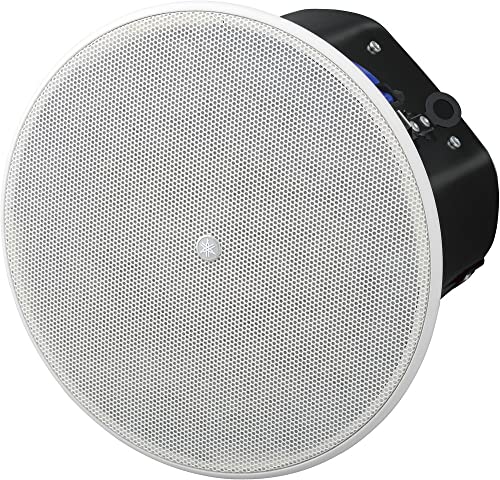
YAMAHA VXC6W 6.5-inch in-Ceiling Speaker – White (Pair)


Yamaha GNSMS01 3-piece Speaker System for Genos Arranger Workstation Black
Frequently asked questions
Can the RX-V6A drive 4-ohm speakers?
It can play many 4-ohm nominal speakers at domestic levels without incident, especially efficient designs with benign impedance curves in smaller rooms. It is not the ideal partner for insensitive 4-ohm speakers with low impedance minima and demanding phase angles played loudly in large rooms. Judge the specific speaker by its minimum impedance, phase behaviour where published, and sensitivity, keep ventilation generous, and leave the impedance selector at its default unless the manual directs otherwise for a specific case.
Should every speaker be set to small with an 80-hertz crossover?
For film-led systems with a capable subwoofer, that is the correct starting point for almost every satellite and centre speaker, and often for towers too. Adjust upward for very small speakers that cannot reach 80 hertz cleanly, and consider different handling only for dedicated two-channel listening without a subwoofer. If YPAO sets speakers to large automatically, treat that as a suggestion to review rather than a finding to obey.
Is 5.1.2 better than 7.2?
Neither is better in the abstract. In a room where seating can sit well away from the rear wall, 7.2 gives smoother rear coverage for material mixed with rear surrounds. In a room where the sofa is near or against the rear wall, or where Atmos material dominates viewing, 5.1.2 usually gives the more convincing result. Room geometry and viewing habits decide, and a strong 5.1 system beats both compromised versions.
How important is a matching centre channel, really?
It is the single most consequential matching decision in the system. A mismatched centre makes panning voices change character and often leaves dialogue tonally separate from the rest of the soundtrack. Same-family centres share voicing by design. If budget forces a staged purchase, buying the matched centre before surrounds is almost always the better sequence for film viewing.
Do two subwoofers need to be identical?
Identical models simplify setup because their output, extension and control behaviour match, and that is the safer recommendation. Mixed subwoofers can work but make level and phase integration harder and can leave the weaker unit limiting the pair near its limits. Whatever the combination, the gain comes from placement smoothing response across seats, and that requires the same measurement care as a single unit.
What sensitivity should a buyer target for a large room?
Toward the top of the range discussed in this guide, around 90 to 92 decibels by a strict convention, or a verified equivalent under a stated convention. Large rooms combine greater listening distance with higher level expectations, and sensitivity is the cheapest headroom available because it costs no amplifier strain at all. Pair that sensitivity with a subwoofer-led crossover plan and the receiver stays comfortably within its abilities.
Should the front speakers be bi-wired or bi-amplified from this receiver?
For nearly every system in this guide, neither is a priority. A single run of adequate cable to each front speaker delivers everything the design was voiced to produce, and the spare amplifier channels in a 5.1 layout are usually better reserved for a future layout change, a second zone, or simply left unused than assigned to a bi-amplification arrangement whose audible benefit with passive crossovers still inside the speakers is widely debated and rarely documented under controlled conditions. Owners who enjoy experimenting may try it with careful level matching, but no buyer should choose a speaker, or reject one, because its terminal plate carries one pair of binding posts instead of two.
For the listener whose room, seating and habits are now written down, the RX-V6A stops being a specification to decode and becomes a known quantity around which one honest system, matched channel by channel to that particular space, can finally be assembled with confidence.

