Our Top Picks



What's inside
- What an adjustable weight set actually is
- Mechanism types and how fast they really change
- Increments and the small-jump problem
- Handle geometry: knurling, diameter and length at full load
- Cradles, stands and floor footprint
- Durability: drops, rattle and mechanism wear
- Adjustable dumbbells, adjustable kettlebells and plate-loadable handles
- Who should not buy an adjustable set
- Pairing adjustable sets with benches and racks
- Total cost of ownership, counted in increments rather than currency
- Programming training around one adjustable pair
- Care, cleaning and pre-session checks
- Reading specification sheets without being misled
- Movement by movement: where adjustable sets shine and strain
- Buying checklist
- Check prices on Amazon
- Frequently asked questions
As an Amazon Associate I earn from qualifying purchases. This post may contain affiliate links at no extra cost to you.
Reader support keeps this guide independent, because affiliate commissions fund the research time behind it while the recommendations themselves follow published specifications, dimensional drawings and aggregated owner reports rather than commission rates. Where a heavier handle, a finer increment or a sturdier cradle matters more than a headline weight range, this guide says so, even when the better answer is the less elaborate product. No manufacturer supplied units for evaluation, and no claim in the pages that follow rests on a workout performed for this publication.
What an adjustable weight set actually is
An adjustable weight set is, in its most common form, a pair of selectorised dumbbells that replaces a full rack of fixed dumbbells with two handles and a stack of nested plates. Instead of owning separate pairs at every step from light to heavy, the lifter owns one handle that can present many different loads depending on which plates the mechanism engages. Turn a dial, slide a pin or twist a collar, and the handle leaves its cradle carrying only the plates selected, while the plates not needed stay behind in the tray. The idea is simple, but the engineering that makes it feel solid in the hand is not.
Two weight classes dominate the market described in manufacturer literature. The lighter class typically runs from about 5 lb to 52.5 lb per handle, a range that covers most pressing, rowing and isolation work for beginners and many intermediate lifters. The heavier class extends from about 10 lb to 90 lb per handle, adding the top end needed for strong rows, heavy chest presses and goblet work without requiring a second purchase later. Between those poles sit mid-range designs in the 50 to 70 lb region, and a smaller number of expandable systems that start modestly and accept add-on plate kits when the owner outgrows the base set.
The weight range printed on a box is only the beginning of the specification that matters. Equally important is how many distinct settings fall inside that range, because a handle that jumps in large steps may technically cover 5 to 90 lb while offering too few usable stops for progressive training. A set with many small steps behaves more like the rack it replaces. A set with few large steps behaves like a handful of fixed dumbbells sharing one handle. Both are adjustable, but they support very different training over months and years.
Selectorised dumbbells should not be confused with traditional spinlock dumbbells, although both adjust. A spinlock handle is a short bar with threaded ends; the owner slides ordinary plates onto it and secures them with a threaded collar. That design is slower to change, uses standard plates that can be shared with other equipment, and tolerates rough handling far better. Selectorised designs trade some of that rugged simplicity for speed, using proprietary plates that usually cannot be used on any other bar. Understanding that trade, speed and compactness against compatibility and toughness, frames every other decision in this guide.
Footprint is the reason most buyers arrive here. A full rack of fixed dumbbells from light to heavy occupies a long wall, needs a tiered stand, and asks for clear floor on both sides for safe pickup and return. A selectorised pair occupies roughly the area of its two cradles, often less than the area of a single exercise mat folded in half. For a spare room, a garage corner shared with a car, or an apartment where training equipment must coexist with furniture, that difference is not a convenience. It is the difference between a home gym that exists and one that remains a plan.
Finally, an adjustable set is a system, not just two handles. The cradle, the selection mechanism, the plates, the handle geometry and any optional stand form one product, and a weakness in any part shows up in daily use. A fast dial attached to a flimsy tray still frustrates. A comfortable knurled handle attached to plates that rattle still distracts during a set. Read the sections that follow as a system review, because that is how ownership feels after the novelty of the first week fades.
best fitness and music smartwatches
Mechanism types and how fast they really change
Dial systems are the most recognisable selectorised design. The lifter rotates a dial at one or both ends of the handle while it rests in the cradle, and internal pins or plates engage the number of plates corresponding to the selected weight. Dial designs are usually the fastest to operate once learned, because selection happens with a wrist turn rather than by hunting for a separate pin. Their weakness is complexity: the dial, detents and engaging tabs form a mechanism with more moving interfaces than simpler designs, and manufacturer manuals consistently warn against forcing a dial that resists, because resistance usually means a plate is misaligned in the tray.
Pin systems borrow their logic from selectorised strength machines in commercial gyms. A sliding or removable pin, sometimes spring loaded and sometimes moved along a rail, determines which plates travel with the handle. Pins are mechanically transparent; the owner can see what is engaged and understand immediately why a setting feels wrong. Changeover is slightly slower than a dial, especially when a pin must be set at both ends to keep the load balanced, but the mechanism tolerates dust and chalk better than fine dial detents and is easier to inspect for wear.
Twist-lock designs shorten or lengthen the effective handle, or rotate an internal cam, as the grip itself is turned while seated in the cradle. The appeal is elegance: there is no separate dial or pin to lose, and some twist designs change weight with a single motion that feels natural after practice. The risk is accidental ambiguity. Because the grip is also the selector, manuals for twist systems stress returning the handle fully to the cradle before changing weight, and checking the indicated setting on both ends before lifting, since a half-completed twist can leave the two ends set differently.
Plate-loadable handles sit at the other end of the spectrum. These are essentially short loading bars, using small-diameter plates secured by collars, sometimes threaded and sometimes using a cam or clamp collar. They are the slowest to change, measured in tens of seconds rather than a few seconds, and the loaded handle grows in diameter or length as plates are added. In return they offer the highest load capacity in the category, compatibility with plates the owner may already own, and a failure mode that is visible and mechanical rather than hidden inside a selector housing.
Changeover speed deserves honest framing. Manufacturers quote best-case times for a practised change in a clean cradle. Real sessions add fatigue, sweat, chalk, a plate seated slightly crooked, and the need to change both handles for bilateral work, which doubles every operation. For straight sets with generous rest periods, even the slowest plate-loadable system is acceptable. For supersets, circuits or drop sets, where the training method itself depends on changing load within a short rest window, dial and pin systems earn their complexity. Match the mechanism to the training style actually planned, not to a demonstration video watched once.
Balanced selection is a safety point that cuts across all selector types. Most systems require the same setting at both ends of a handle, and many include interlocks intended to prevent lifting a handle with mismatched ends. Those interlocks reduce risk but do not replace the habit of glancing at both indicators before a lift. An unevenly loaded dumbbell does not merely feel odd; it shifts the centre of mass toward one wrist, changes the torque during presses and rows, and can twist out of a fatigued grip. The two seconds spent checking both ends are the cheapest insurance in this entire category.
What to check in the manual before buying
Manufacturer documentation reveals more than marketing pages. Look for the stated procedure when a selector jams, the cleaning method recommended for the mechanism, whether replacement plates and cradles are listed as service parts, and any explicit statement about dropping. A manual that describes service parts and cleaning in detail signals a product intended to be maintained. A manual that offers no path beyond whole-unit replacement signals a product whose mechanism should be treated as sealed and finite.
Increments and the small-jump problem
Progressive overload depends on small, repeatable increases. When a lifter can press a given weight for the target repetitions across several sessions, the next step should be challenging but not a leap. Adjustable sets differ sharply here. Some lighter-class sets move in 2.5 lb steps through much of their range, which mirrors the spacing of a good fixed rack. Others move in 5 lb steps, and some heavier sets move in 5 lb steps at the bottom and 10 lb steps near the top, exactly where a large jump is hardest to absorb on pressing movements.
The small-jump problem appears first on overhead presses, lateral raises, curls and triceps work, where the muscles involved are smaller and the absolute load is lower. Adding 5 lb to a 20 lb press is a proportionally large increase, and adding 10 lb can turn a controlled set into a failed attempt. Rows and presses with larger muscle groups tolerate bigger steps more easily, which is why a set that feels perfectly graduated for back training can feel crude for shoulders. Buyers who train a full programme with one set should judge increments by their smallest movements, not their largest.
Adder weights are the traditional answer. Small add-on weights, often around 1.25 lb or 2.5 lb per side in plate-loadable contexts, or magnetic and clip-on micro-weights in modern accessory catalogues, bridge the gap between fixed settings. Selectorised systems handle this differently: some build half-steps into the dial itself, allowing the handle alone, the handle plus a partial plate engagement, or an internal adder to create intermediate weights. When comparing two sets with the same headline range, count the actual distinct settings from the specification sheet. The set with more genuine settings inside the range used most often is usually the better training tool.
Uneven starting weights also matter. A handle that weighs 5 lb empty behaves differently from one whose lightest setting is 10 lb. For rehabilitation work, for beginners learning movement patterns, and for high-repetition shoulder work, a genuinely light starting point has real value. Conversely, a heavy base handle wastes none of its range on weights a strong lifter never uses. Neither is universally better; the correct starting weight is the one that matches the weakest movement in the programme the set must serve.
There is also a psychological dimension documented in training literature rather than in product manuals. Visible, achievable next steps keep a programme moving. When the next setting feels impossibly far, lifters repeat the same load for months or attempt jumps they are not ready for, and both paths stall progress. Fine increments are therefore not a luxury feature for perfectionists. They are the mechanism by which a home lifter, training without a coach selecting loads, keeps progressing steadily and safely.
Handle geometry: knurling, diameter and length at full load
Handle geometry decides whether a heavy adjustable dumbbell feels like gym equipment or like luggage. Grip diameter is the first dimension to check on a specification sheet. Most fixed dumbbells use handles in a familiar moderate range, thick enough to distribute pressure across the palm but thin enough for smaller hands to close fully around. Some adjustable handles run noticeably thicker because the selector mechanism passes through or sits inside the grip. A thicker grip increases forearm demand and can limit pressing performance for lifters with small hands, while some larger lifters prefer it. There is no universal ideal, only a match or mismatch with the hands that will use it.
Knurling, the cross-hatched texture cut or moulded into the grip, varies from aggressive diamond patterns on plate-loadable steel handles to smooth or lightly textured coatings on selectorised handles whose grips must also rotate or house mechanisms. Aggressive knurling improves grip security at heavy loads and in sweaty conditions but can tear skin during high-repetition work without gloves or careful hand care. Smooth grips feel pleasant for light work and become a liability as load rises. Manufacturer photographs rarely convey texture honestly, so owner reports aggregated across many reviews are the practical source here, and consistent comments about grip slipperiness or harshness deserve weight.
Length at full load is the dimension most often overlooked. Several selectorised designs grow longer as more plates are engaged, because the selected plates stack outward from the handle ends. At maximum weight the dumbbell can be substantially longer than a fixed dumbbell of the same weight. Length changes how the dumbbell behaves: it sits differently on the thighs before a press, it is harder to keep clear of the body during curls, and during floor presses or renegade rows the extra length alters clearance and balance. Specification sheets that list length at minimum and maximum settings are giving the buyer genuinely useful information, and its absence is worth noting.
Handle shape matters in smaller ways that accumulate. A perfectly round grip rotates predictably in the hand. Contoured or slightly ergonomic grips can feel secure for pressing but awkward for movements where the dumbbell should sit neutrally. Rubber or polymer coatings protect floors and reduce noise, and they also change friction as they age and absorb chalk. Steel grips clean easily and telegraph wear honestly. None of these choices is decorative; each changes the interface through which every repetition passes.
For presses and rows specifically, the practical test described across owner feedback is consistent. During presses, the concern is wrist alignment: a handle that is too thick or too long pushes the load path off the forearm and adds wrist strain at lockout. During rows, the concern is clearance and control: a long dumbbell can strike the bench or the lifter’s leg at the top of the stroke, shortening the range of motion. Buyers planning heavy bench-supported rows should pay particular attention to maximum length figures, because that movement exposes length problems more than any other.
Cradles, stands and floor footprint
Almost every selectorised set depends on its cradle in a way fixed dumbbells never depend on a rack. Selection only works correctly when the handle sits fully and squarely in the tray, with plates aligned so the mechanism can engage or release them cleanly. That makes the cradle a functional part of the lifting system rather than a storage accessory. A warped, cracked or flexing tray produces mis-selections, sticking dials and plates that hang up on return. When reading specifications, treat cradle construction, and whether replacement cradles are available, as primary information.
Cradles can sit directly on the floor or mount on an optional stand. Floor placement costs nothing extra and keeps the loaded handle low, which some lifters prefer for very heavy sets because there is less distance to lift the pair into position. The cost is repeated deep bending to select and return weights, which becomes a genuine burden during high-volume sessions and a problem for anyone with a sensitive back. A stand raises the cradles to a comfortable height, presents the dials at reading distance, and usually adds storage or a media shelf, at the cost of money, assembly time and a slightly larger footprint.
Footprint figures should be read with the stand included if a stand will be used, and with working clearance added either way. The lifter needs room to stand in front of the cradles, bend, select, and step back with a heavy handle in each hand. A set that technically fits a corner but leaves no room to pick it up safely does not fit that corner. Measure the intended space, compare it with the manufacturer’s stated dimensions for cradle and stand, and then add the human space in front. That simple arithmetic prevents the most common placement regret reported by owners.
Flooring deserves a sentence of its own. Selectorised plates and cradles concentrate weight on small contact areas, and repeated placement of a heavy cradle on bare wood or tile can mark or crack surfaces. Dense rubber matting under the cradles distributes load, damps the small impacts of returning handles, and keeps trays from creeping across smooth floors during selection. Matting is not an upsell in this category; it is part of making a concentrated, heavy system safe for the room it lives in.
Durability: drops, rattle and mechanism wear
Aggregated owner feedback tells a consistent durability story across brands, and it begins with drops. Selectorised dumbbells are not designed to be dropped. Their plates are held by mechanisms rather than by a solid head cast or welded around a handle, and an impact that a fixed dumbbell would shrug off can bend a selection tab, crack a plate housing or knock a dial out of alignment. Manufacturer manuals state this plainly, often as an explicit exclusion from warranty coverage. A lifter whose training style involves dropping dumbbells after heavy sets should read that exclusion as a product definition, not as legal fine print.
Controlled lowering is the ownership skill this category demands. Finishing a set means guiding the handles down, not letting go of them from height onto the floor. On rubber matting, a short, controlled set-down from a few centimetres is ordinary use. A drop from bench height after a failed press is the event owners repeatedly associate with later mechanism problems. Buyers should be honest about their habits under fatigue, because the last repetition of a hard set is exactly when careful handling is hardest.
Plate rattle is the second recurring theme. Because selectorised plates must be free to engage and release, some clearance exists by design, and many sets produce audible movement and a slight shifting feel during dynamic exercises. Owners describe the effect as most noticeable during snatches, cleans, farmer’s carries and fast curls, and least noticeable during slow presses and rows. Rattle is rarely a safety issue when plates are properly engaged, but it changes confidence: a lifter who does not trust what they hear may shorten movements or grip harder than needed. Sets described repeatedly as tight and quiet in owner reports earn that reputation through closer tolerances, and it is a legitimate reason to prefer one design over another.
Mechanism wear develops slowly and shows in specific ways. Dials become less positive in their detents. Pins slide less freely. Plates that once released cleanly begin to hang on the cradle lip. Dust, chalk and floor grit accelerate all of it, which is why manuals recommend periodic cleaning of trays and engagement surfaces and storage away from the dirtiest floor areas of a garage. A set used in a clean spare room and wiped down occasionally lives a different life from the same set stored beside a workbench. Environment is a durability specification the buyer controls.
Warranty terms complete the picture. Compare not just warranty length but what the warranty covers: mechanism, plates, cradle and handle may carry different terms, and commercial use commonly voids residential coverage. Also check whether warranty service means parts shipped to the owner, return of a heavy product at the owner’s effort, or advance replacement. For a product this heavy, the logistics of a claim matter almost as much as its legal terms.
Adjustable dumbbells, adjustable kettlebells and plate-loadable handles
Adjustable kettlebells apply the same space-saving logic to a different implement. A selectorised or plate-loaded kettlebell shell offers several loads in one body, serving swings, goblet squats, presses and carries. The compromise is geometry: a fixed kettlebell’s size grows with its weight, while an adjustable shell usually keeps one size across its range, and window size, handle diameter and the distance from handle to body may suit some loads better than others. For ballistic work, where the bell rotates around the hand and lands on the forearm, shell shape matters more than the convenience of adjustment, and owners of adjustable bells most often praise them for goblet work and carries while reserving judgement on high-repetition snatches.
Plate-loadable dumbbell handles are the oldest adjustable design and remain the most flexible. They accept the same small plates across handles, kettlebell handles and sometimes short bars, so one plate collection serves several implements. They reach the highest loads in this discussion, tolerate rough handling, and can be repaired with generic parts. Their costs are speed, noise from plates against collars, and the discipline of loading both sides evenly. For a lifter building a garage gym around shared plates, they integrate beautifully. For a lifter who wants to train in a spare room with minimal fuss, they can feel like a project before every session.
Selectorised dumbbells win on speed, tidiness and predictable dimensions at light and moderate loads. They lose on ultimate toughness, maximum load and cross-equipment compatibility. The honest comparison is not which category is best but which compromise matches the room, the programme and the lifter’s habits. Many experienced home lifters end with a hybrid: selectorised dumbbells for the light-to-moderate range where changes are frequent, and plate-loadable handles or a barbell for the heaviest work where drops and maximal loads are part of training.
best android smartwatches fitness trackers under 100
Who should not buy an adjustable set
Some lifters should walk past this entire category, and naming them plainly saves money and frustration. Lifters who train heavy deadlift variations with dumbbells and finish sets by dropping the weights are the clearest example. The drop sensitivity described earlier is not a quirk that careful brands have solved; it follows from how selectorised plates are held. A lifter committed to that style needs fixed dumbbells, plate-loadable handles or a barbell, in that order of practicality.
Commercial gyms and shared facilities form the second group. Multiple users multiply drops, mis-selections and cleaning neglect, and a mechanism that survives years with one careful owner can fail quickly under anonymous use. Warranty terms usually recognise this by excluding commercial settings. A small studio with supervised training is a borderline case; a busy shared gym is not. Facility buyers should also weigh theft and tampering, because proprietary plates and handles are useless separately and frustrating to replace individually when a single plate disappears.
Lifters pursuing maximal dumbbell loads beyond the heaviest selectorised class should also look elsewhere. When the programme calls for loads at or beyond the top of the 90 lb class for rows and presses, the adjustable set becomes the ceiling on progress. Plate-loadable handles extend further, and a barbell extends furthest of all. Similarly, competitive lifters who need calibrated, predictable implements for specific preparation may find the shifting feel and variable length of adjustable designs a poor substitute for the fixed implements they will face in competition.
Finally, buyers who dislike maintaining mechanisms should be cautious. Selectorised sets ask for aligned cradles, occasional cleaning, careful set-downs and periodic checks that both ends are set equally. None of that is onerous, but all of it is real. A fixed dumbbell asks for nothing. A spinlock asks only for a tightened collar. If the appeal of home training is its simplicity, the most mechanical product in the room deserves a second thought before purchase.
Pairing adjustable sets with benches and racks
An adjustable set reaches its full value when the surrounding equipment lets the lifter use its whole range. A flat bench unlocks chest and shoulder pressing and supported rows. An adjustable bench, with incline and decline positions, multiplies that list and is the single most common companion purchase owners describe. Bench specifications to match against the dumbbells are weight capacity, remembering that capacity must cover the lifter plus both loaded handles, and pad width, which affects shoulder stability during presses.
Storage and workflow belong in the same plan. Placing the cradles or stand beside the bench shortens the walk with heavy handles, which is both a convenience and a safety point, since fatigued carries across a room invite drops. Keep the path between cradle and bench clear of plate storage, cables and other equipment. Where a stand includes a media or tablet shelf, position it so watching a programme timer does not require turning away from the lifting area.
Racks enter the picture for lifters combining dumbbell work with barbell training. A power rack or squat stand does not interact directly with adjustable dumbbells, but the combined footprint decides room layout, and the barbell covers the heavy bilateral work where adjustable dumbbells are weakest, including deadlifts and heavy squats. Planned together, the three pieces divide labour sensibly: barbell for maximal compound lifts, adjustable dumbbells for unilateral and accessory work, bench for pressing variations. Planned separately, they compete for the same floor and the room ends up serving none of them well.
Smaller accessories complete the pairing. A set of light fixed dumbbells or micro-weights can cover the very light range for warm-ups and rehabilitation movements, sparing constant re-selection of the main handles. Resistance bands pair naturally for movements where dumbbell increments are too coarse. None of this needs to arrive at once; the advantage of a home gym is that it can grow in the order the programme demands.
Total cost of ownership, counted in increments rather than currency
Comparing value without leaning on headline offers requires a different unit of account, and the most useful one in this category is cost per covered increment. Count the distinct, usable weight settings a set provides per handle, consider that the pair serves both hands, and weigh that coverage against the total outlay including cradle, any stand the buyer will realistically need, matting and eventual add-on kits. A set with a modest range but fine steps may deliver more usable increments for a given programme than a heavier set with coarse steps, and usable increments are what training consumes.
Expansion paths change the arithmetic. An expandable system bought in stages spreads outlay over time and lets the lifter pay for heavier plates only when strength demands them, but the staged total usually exceeds the cost of buying the full range at once, and discontinued add-on kits are a real risk late in a product’s life. A non-expandable set has a simpler profile: its cost is known on day one, and so is its ceiling. Buyers should decide which risk they prefer, paying more later for capacity they may never need, or replacing a set outright if they outgrow it.
Ownership costs continue quietly after purchase. Replacement cradles, plates and selector parts, where they are sold separately, keep a set in service after accidents; where they are not sold, a single cracked tray can end the product’s life. Cleaning supplies are trivial, matting is a one-time purchase, and stands last indefinitely. The meaningful long-term variable is parts availability, which is why checking the manufacturer’s parts catalogue before purchase is a financial decision as much as a technical one.
Resale and second lives deserve a mention. Fixed dumbbells hold value stubbornly because they are indestructible and universal. Selectorised sets resell well when complete with cradles and when the mechanism still selects cleanly, and poorly when parts are missing, because a buyer cannot easily complete the system. Keeping the original cradles, any tools supplied, and documentation is therefore part of ownership value, even for buyers who never intend to sell.
best adventure fit smartwatches
Programming training around one adjustable pair
A single adjustable pair changes how a training week is organised, because both handles are usually needed at once and every load change passes through the cradles. Bilateral pressing and rowing work smoothly: select once, lift both handles, return both, and change for the next movement. Difficulties appear in circuits that alternate very different loads, or in sessions shared by two lifters of different strength, where constant re-selection interrupts rhythm. Programming around the equipment means grouping movements by similar load, placing the heaviest work early while patience for careful handling is highest, and leaving isolation work, where changes are small, for the end of a session.
Warm-up structure also adapts. With a fixed rack, a lifter picks up progressively heavier pairs scattered along the stand. With a selectorised pair, each warm-up step is a return to the cradle and a new selection. That is fast with a dial or pin, but it still rewards planning: write the warm-up loads into the session plan rather than improvising them, and keep the cradle area clear so returns are never rushed. Rushed returns, with a plate seated crookedly and the next selection forced, are the moment owners most often link to later sticking or uneven engagement.
Unilateral work is where adjustable dumbbells quietly excel. Single-arm presses, rows, carries and split-stance movements need only one handle, leaving the second free at a different setting for the next exercise or for a training partner. Programmes built around unilateral work also expose left-right strength differences that bilateral barbell work can hide, and fine increments make correcting those differences practical, because the weaker side can progress in small steps while the stronger side waits or works for additional repetitions rather than load.
Tempo and control suit this equipment. Slow eccentrics, paused presses and controlled rows place no impact load on the mechanism and play to the strengths of a set that may rattle slightly during ballistic movement. Explosive dumbbell work, such as snatches and high pulls, remains possible at moderate loads on many designs, but owners consistently describe greater confidence in fixed or plate-loaded implements for fast lifts. A programme honest about that distinction, controlled work on the adjustable pair and ballistic work elsewhere or at modest load, will feel better and age the equipment more gently.
Record keeping closes the loop. Because one pair presents many loads through a selector, it is easy to forget which setting corresponded to which movement last week, especially where half-steps create settings that do not match round numbers. A simple training log noting movement, setting and repetitions removes that ambiguity and makes the fine increments genuinely useful. Without a log, lifters drift toward memorable round settings and quietly discard the graduated progression they paid for.
Care, cleaning and pre-session checks
Maintenance for a selectorised set is light but specific, and manufacturer manuals converge on the same few tasks. Keep the cradles free of chalk, dust and floor grit, because debris under a plate changes how it seats and therefore how the mechanism engages it. Wipe engagement surfaces with a dry or slightly damp cloth as the manual directs, and avoid flooding a selector housing with liquid cleaners or lubricants that the manufacturer has not named. A mechanism designed to run dry can be harmed by enthusiastic oiling, which collects grit and turns a clean interface into an abrasive one.
Handles need attention proportionate to their finish. Bare or knurled steel benefits from occasional brushing to clear chalk from the texture and, in humid garages, vigilance for surface rust. Coated and moulded grips need only cleaning and inspection for cracks or peeling that could change grip security. Any handle damage that creates a sharp edge or an uneven surface should end use of that handle until it is repaired or replaced, because hands under heavy load find every defect.
A short pre-session check prevents most mid-session surprises. Seat both handles fully in their cradles, cycle through the settings planned for the session, and lift each handle a short distance at each setting to confirm clean engagement and release before any working weight is involved. Listen for new sounds and feel for new resistance while the stakes are low. This takes less than a minute once habitual, and it converts potential failures under load into maintenance tasks performed standing safely beside the cradle.
Storage habits matter over years. Always return handles to their cradles rather than leaving them on the floor, where they can be kicked, rolled on or exposed to moisture. Keep the cradles on a level surface so plates stack as designed. In households with children, treat a loaded adjustable dumbbell with the same seriousness as any heavy tool: it should be stored where small hands cannot attempt a selection change or pull a handle from its tray, and its weight at even moderate settings is far beyond what a child can control.
When a problem does appear, stop conditions are clear. A handle that selects unevenly, a plate that remains attached when it should release or releases when it should remain, a cracked cradle, or a selector that must be forced all mean the set leaves service until the cause is understood. Manufacturer support channels and parts catalogues exist for exactly this moment. Continuing to train around a faulty engagement is how a repairable issue becomes an injury or a destroyed mechanism.
Reading specification sheets without being misled
Specification sheets reward sceptical reading. The headline range should be checked against the number of settings listed, the weight of the handle alone, and whether the stated maximum applies to each handle or describes the pair combined, a distinction marketing summaries occasionally blur. Dimensions should state whether they describe the handle alone, the handle in its cradle, or the optional stand, because those three footprints differ considerably and only the largest describes the installed reality.
Materials language deserves translation. Steel plates, cast plates with protective coatings, and moulded plate housings behave differently in noise, durability and feel, and each is legitimate when described honestly. What matters is consistency between the materials list, the stated total weight and the maintenance instructions. A product whose manual forbids all moisture, outdoor storage and chalk exposure is telling the buyer something important about its finishes and mechanism tolerances, whatever the promotional photographs show.
Weight tolerance, warranty exclusions and parts lists are the least glamorous lines on a specification sheet and the most predictive of ownership. A stated tolerance tells the buyer the manufacturer has measured its own product honestly. Exclusions for dropping and commercial use define the intended environment. A parts list with individual plates, cradles and selector components signals a product designed to be kept. Reading those three items takes minutes and prevents the majority of mismatched purchases described in owner feedback.
Finally, compare like with like across brands. Put two candidate sheets side by side and align range, settings count, step size at light loads, handle diameter, maximum length, cradle dimensions, stand requirement and warranty terms in a single list. Differences that marketing language hides become obvious in aligned columns, and the better match for a particular lifter usually identifies itself without any need for superlatives.
Movement by movement: where adjustable sets shine and strain
Chest pressing is the benchmark movement for this category, and it suits selectorised dumbbells well. Loads are moderate to heavy, the path is controlled, and the lifter begins from the thighs or from a careful pickup beside the bench. The watchpoints are length at full load, which affects how comfortably the handles rest on the thighs before the lifter rocks back, and grip diameter, which affects wrist position at lockout. Floor pressing removes the bench from the equation and shortens the range of motion, and there the width and shape of the plate profile decide whether the upper arm can reach the floor naturally.
Rowing exposes different traits. Bent-over and bench-supported rows use some of the heaviest loads a set will see, and they reward a handle that stays tight and quiet under a hard pull. Length again matters, because a long handle can meet the bench or the lifter’s body before the shoulder blade has finished its travel, silently trimming repetitions. Owners who row heavily and often are the group most likely to value the heavier 90 lb class and to notice rattle, so their aggregated comments should carry extra weight for buyers with the same priorities.
Lower-body work divides into movements where dumbbells are the main load and movements where they assist. Goblet squats need one handle held securely at the chest, and a compact, comfortable plate profile matters more than maximum load. Split squats, step-ups and walking lunges need a pair that can be carried without the plates striking the legs, which brings length and plate width back into the decision. Romanian deadlifts with dumbbells suit adjustable sets well at controlled tempo, while conventional deadlift patterns from the floor are better served by a barbell for the reasons covered earlier.
Carries deserve separate mention because they combine load, grip endurance and movement through space. Farmer’s carries with selectorised handles are entirely practical on designs that lock plates securely, and they reveal grip texture honestly within a few lengths of a room. Suitcase carries add an anti-rotation demand that fine increments serve well, since the correct load is the heaviest one that keeps the torso upright, and that threshold rarely falls on a round number. Keep carry paths clear and short enough that a fatigued grip never has to choose between dropping a handle and reaching the set-down point.
Shoulder and arm work brings the discussion back to increments and starting weight. Overhead pressing, lateral raises, curls and extensions all progress in small steps, expose any slipperiness in a coated grip, and punish a base handle that is already too heavy for the weakest variation in the programme. A set chosen only for its maximum load can fail this entire family of movements while succeeding at presses and rows, which is why this guide keeps returning to the bottom of the range as well as the top.
Noise and neighbours form the last practical filter, especially in apartments. Selectorised sets are quieter than plate-loaded handles with loose collars, because their plates are captured, but selection clicks, cradle contact and set-down sounds still travel through floors. Training on dense matting, controlling every set-down and avoiding early-morning heavy work in a room above a neighbour are courtesies that also protect the mechanism. A set that must be used quietly will, conveniently, also be a set that is handled gently enough to last.
Buying checklist
Start with range and increments. Write down the lightest and heaviest dumbbell loads the programme actually uses, then check that a candidate set covers both, and count its settings between those points on the specification sheet. Confirm the starting weight of the bare handle, the size of the step at the loads used for shoulders and arms, and whether half-steps or adder options exist where steps are coarse.
Move to the mechanism and the manual. Decide whether dial, pin, twist-lock or plate loading matches the pace of training, read the manual’s statements on dropping, cleaning and jammed selectors, and confirm that replacement cradles and plates appear as orderable parts. Check that both ends of the handle must be set, and whether an interlock prevents lifting with mismatched ends.
Then measure the physical product against the room and the lifter. Note grip diameter, grip texture from aggregated owner reports, handle length at maximum load, cradle and stand dimensions, and the clearance needed in front of the cradles. Confirm bench capacity covers lifter plus both handles at maximum. Plan matting under the cradles from the first day rather than after the floor complains.
Finish with warranty and fit to habits. Compare coverage for mechanism, plates and cradle separately, note the commercial-use exclusion, and be honest about dropping habits, shared use and willingness to clean and align the system. If any answer conflicts with how the product must be treated, choose a different category rather than hoping habits will change around an expensive purchase.
Check prices on Amazon
Live listings for the shortlist in this guide are pulled from Amazon below, so prices and availability are always current at the moment you look.

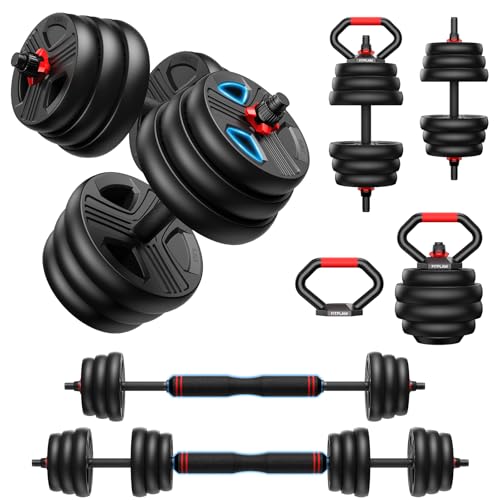
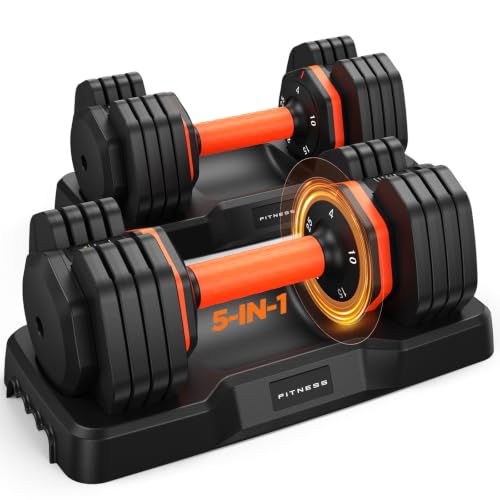
SAUVOO Adjustable Dumbbell Set, 22lbs Free Weight Set, 5-in-1 Dumbbell Set

BDSHE 20lbs Adjustable Dumbbell Set, 5-in-1 Dumbbell set,Suitable Men/Women


Frequently asked questions
Are adjustable dumbbells accurate at their marked weights?
Manufacturer specifications state nominal weights, and owner reports aggregated across many sets suggest selectorised handles are generally close to their markings, with small variation from plate tolerances and the weight of the handle itself. Lifters who need exact loads for structured progression can weigh a handle at several settings on a suitable scale and note any consistent offset. For ordinary progressive training, consistency from session to session matters more than laboratory accuracy, and a selectorised set is highly consistent because it presents the same plates each time.
Can adjustable dumbbells be used for push-ups and renegade rows?
Only designs whose shape gives a stable, flat base should be considered for support work, and many selectorised handles have rounded or irregular plate profiles that rock under body weight. Manuals for several designs explicitly discourage using the handles as push-up stands. Where renegade rows are a programme staple, check the base geometry in specifications and owner reports, keep loads moderate, and prefer fixed dumbbells with flat faces if the movement is central rather than occasional.
How long should a selectorised set last?
Service life depends on handling, environment and use volume more than on calendar time. A set that is never dropped, kept clean, stored in its cradles and used by one lifter can serve for many years, while the same set dropped weekly in a dusty garage may develop selector problems far sooner. Parts availability extends life more than any other factor, which is why this guide returns to it so often.
Is one heavy set better than two lighter sets?
For most home lifters, one set covering the full needed range with fine increments serves better than two overlapping sets, because it halves the footprint and the mechanism count to maintain. Two sets make sense when two people train together regularly, or when a very light set with small steps complements a heavy set whose steps are coarse at the bottom of its range.
Do adjustable sets suit two lifters sharing one room?
They can, provided the programme is arranged so the pair is not being re-selected between every exercise. Partners of similar strength can share settings across paired movements, while partners at very different levels do better training in sequence, one completing a movement while the other rests, rather than alternating sets at different loads. Communication matters as much as scheduling: each lifter should confirm the setting at both ends before lifting, every time, without assuming the previous user left the handles at the weight shown last session. That shared discipline protects both lifters and keeps the mechanism’s wear pattern even across the full range of plates.
What is the first sign a mechanism needs attention?
Resistance during selection is the earliest and most useful warning. A dial that needs force, a pin that no longer slides cleanly, or a plate that begins to hang on the cradle is asking for cleaning and alignment checks before the next session, not for greater force. Manufacturer manuals consistently frame forcing a selector as the action most likely to convert a minor alignment issue into a repair.
Choose the set whose increments, handle and mechanism match the programme and the room in front of you, and it will quietly disappear into training, which is the highest compliment any piece of strength equipment can earn.


