What's inside
- Where to buy
- Key Takeaways
- Quick Picks
- How did we sort the music claims from the music facts?
- Which watches actually play music without a phone?
- How do the six line up on the music question?
- How much music is enough on a wrist?
- How do you load up and train phone-free for the first time?
- What mistakes do buyers make with fitness and music watches?
- How does the gym change the ranking?
- What does a hybrid training week look like on each pick?
- Where do subscriptions and services fit the music picture?
- What about fit, sweat and the life of a strap?
- How long does a fitness and music watch stay useful?
- Can a watch really coach, or is it all recording?
- What should the first phone-free month look like?
- Why do playlists change workouts, anyway?
- Should you buy one watch for fitness and music, or two devices?
- A note on gifts and shared households
- What if you hate earbuds?
- One more check before you order: the app on your phone
- And if the watch is for a teenager?
- What does “water-resistant” mean for a swimmer here?
- Final Recommendation
- Frequently Asked Questions
- Related Guides
As an Amazon Associate I earn from qualifying purchases. This post may contain affiliate links at no extra cost to you.
gizmoverdict.com is reader-supported. When you buy through links on our site, we may earn an affiliate commission.
Where to buy
The listings checked for this guide are one click away under each pick’s name, but pause on the variant menus before you commit: on the Garmin pages, Music and non-Music editions of near-identical watches sit side by side, and on the budget pages, band colour is sometimes the only difference between two listings that look like different products. The word “Music” in the product name is the whole ballgame in this category — if it is absent from the listing you are about to buy, the watch almost certainly expects your phone to do the playing.
The best fitness and music smartwatches answer a very specific modern desire: to exercise with a soundtrack and without a phone bouncing in a pocket, digging into a hip on the rowing machine, or waiting theft-temptingly on the gym floor. But the phrase “music smartwatch” hides two completely different machines. One kind stores songs on the wrist and plays them straight to your earbuds while the phone stays home. The other kind is a remote control — it pauses and skips whatever the phone in your bag is playing, and goes silent the moment you walk out of Bluetooth range. Both are sold with musical imagery. Only one of them frees you.
This guide sorts the six by which kind they are, using only what their listings state. Two Garmins carry music in their names and their storage. The Amazfit declares its storage in gigabytes, the only hard number of its kind here. The Flylin does something stranger — it keeps a pair of earbuds inside the watch itself. One Garmin in the six is a fitness specialist whose listing sells health rather than songs, included deliberately so the fitness half of the keyword gets its due. And the budget closer answers calls and tracks a hundred-plus sport modes while leaving the music to your phone. Every health figure mentioned along the way is a wellness estimate from a wrist sensor, not a medical reading — these watches coach your habits; they do not examine your body.
Key Takeaways
- “Music” on a watch means one of two things — onboard storage that plays phone-free, or Bluetooth control of a phone nearby — and the listings here split honestly between them.
- The Forerunner 245 Music and Forerunner 170 Music both put music on the wrist by name; the 170 adds newer coaching with adaptive training plans per its listing.
- The Amazfit Active Max states 4GB of storage, enough for a large offline library, alongside offline maps and a maker-claimed 25-day battery.
- The Flylin stores its earbuds inside the watch case — a genuine 2-in-1 novelty, judged here on its stated local music storage and Bluetooth calling.
- The vivoactive 5 in ivory is the fitness-first pick: its listing leads with health monitoring, a Sleep Coach and recovery guidance rather than music.
- The budget fitness tracker takes calls and counts 120-plus sport modes per its listing, but your phone remains the music player.
Quick Picks
| Watch | Badge | Why it is here |
|---|---|---|
| Garmin Forerunner 245 Music | Best proven music runner | A long-serving GPS running watch with music and advanced dynamics in its very name. |
| Garmin Forerunner 170 Music | Best modern coaching | A 43mm music watch whose listing adds adaptive training plans to the Garmin Coach recipe. |
| Garmin vivoactive 5 Ivory | Best fitness all-rounder | Health monitoring, Sleep Coach and Body Battery in a 42mm ivory finish that suits smaller wrists. |
| Amazfit Active Max | Best storage and stamina | 4GB for music and media, offline maps, and the longest maker-claimed battery in the guide. |
| Flylin Smart Watch with Earbuds | Most unusual | Earbuds docked inside the watch, local music storage and Bluetooth calling in one gadget. |
| Smart Watch Fitness Tracker with Call | Best budget | A 2.01-inch screen, 120-plus sport modes and call handling at the shelf’s entry end. |
How did we sort the music claims from the music facts?
By reading listings the way a contracts lawyer reads footnotes. A watch earned the label “onboard music” only when its listing said so in words — “with Music”, “Music On Your Wrist”, a stated storage capacity, or “local music storage capability”. Watches whose listings promised fitness tracking and call handling without those words were classified as phone-companion devices, however musical their photography looked. That single discipline rearranged this shortlist twice during preparation, and it is the discipline to apply yourself whenever a product page shows a watch beside a pair of earbuds: imagery is not a specification.
Fitness depth was judged on what the watch does with your effort after recording it. Sport-mode counts are the weakest currency here — a list of 120 modes usually means 120 labels over the same heart-rate-and-timer core — while coaching structure is the strongest: does the watch suggest tomorrow’s session, adapt when life intervenes, and frame recovery in terms a tired person can act on? The Garmins trade in that stronger currency. The budget entries trade in breadth and price of admission, and the reviews grade each on the currency it actually holds.
Which watches actually play music without a phone?
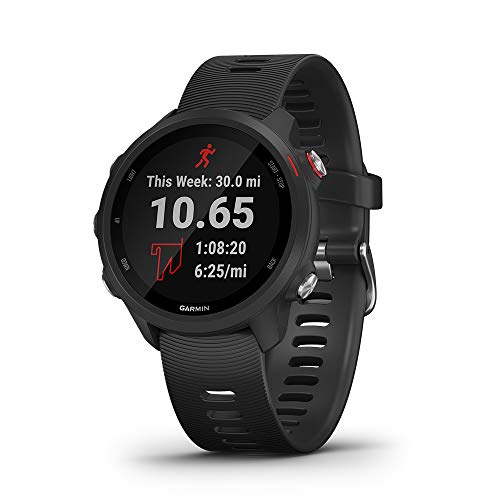
Garmin Forerunner 245 Music — Best proven music runner
Some products in a fast-moving category earn a review that begins with respect for their service record, and the Forerunner 245 Music is one. Its listing describes a GPS running smartwatch with music and advanced dynamics, in black — a plain summary of a watch that has carried a generation of runners through marathon blocks with playlists aboard. The formula it established is the one this whole category still follows: store the music on the watch, pair earbuds directly to the wrist, and let the phone stay in the locker, the car, or another postcode.
“Advanced dynamics” is the phrase to unpack, because it marks the 245 Music’s seriousness as a training instrument rather than a music player with a stopwatch. In Garmin’s vocabulary that means the watch pays attention to how you run, not merely where — the mechanics of your stride as estimated from the wrist or a paired pod, feeding the same coaching ecosystem of plans and suggested effort that defines the brand. For the gym-and-run hybrid athlete this guide addresses, that matters: the watch treats a tempo run as data, not just as forty minutes during which songs played.
Age is its honest caveat. This is an earlier-generation design beside the AMOLED newcomers in this guide, with a screen philosophy from the transflective era — superb in sunlight, muted in a dim gym — and a feature set that has since been built upon by its successors. None of that diminishes what it does on the road today: GPS running, phone-free music, structured training. Buyers who value the proven over the newest will find it the most defensible purchase in this guide; buyers who want the current coaching generation should read the next review.
- Identity: GPS running smartwatch with onboard music, per the listing
- Training: advanced dynamics and Garmin’s coaching ecosystem
- Finish: black as listed
- Display character: sunlight-first screen from an earlier generation
- Phone role: optional on runs — that is the point of the Music edition
Strengths
- A battle-tested combination of phone-free music and genuine running analysis.
- Advanced dynamics give form feedback most music watches never attempt.
- A mature accessory and app ecosystem surrounds it after years on the market.
Trade-offs
- An older design beside the current AMOLED models in this guide.
- No adaptive-plan language in its listing — the newer 170 carries that flag.
- Its screen rewards outdoor runners more than indoor gym users.
Best for: runners who want music without a phone and trust a proven instrument over a new one. Not suited for: buyers who want the latest display technology or the newest coaching features.

Garmin Forerunner 170 Music — Best modern coaching
The Forerunner 170 Music reads like the 245’s idea rewritten by a decade of feedback. The listing gives a 43mm case in black and amp yellow, music on the wrist, pace and distance from GPS, daily suggested workouts, Garmin Coach and — the phrase that separates it from its elder — adaptive training plans. Adaptivity is the difference between a plan that scolds you for a missed Tuesday and a plan that quietly rebuilds the week around the Tuesday life actually gave you. For fitness-minded buyers whose schedules are negotiated with employers, children and weather, that is not a detail; it is the feature that decides whether a plan survives contact with a real calendar.
Music sits in this watch not as a headline gimmick but as infrastructure. The listing’s “Music On Your Wrist” means the same phone-free freedom the 245 pioneered — playlists and podcasts stored aboard, earbuds paired to the watch — now wrapped in the current generation’s case and coaching. The 43mm size keeps it in the wearable-everywhere class, and the black-and-yellow finish admits what it is: a training tool that expects to be seen at the track, not a dress watch in disguise.
Set it against the 245 Music honestly and the choice is generational rather than functional. Both run, both play music phone-free, both coach. The 170 adds the adaptive layer and the modern platform; the 245 counters with a longer public track record and an established accessory world. A buyer new to the category, starting fresh today, should default to the newer recipe — adaptivity compounds across a season in a way that a spec sheet cannot dramatise but a training log will.
- Case: 43mm, black/amp yellow as listed
- Music: onboard, phone-free playback to earbuds
- Coaching: Garmin Coach, daily suggested workouts, adaptive training plans
- Positioning: GPS pace and distance
- Character: the current-generation expression of the music-runner idea
Strengths
- Adaptive plans that rebuild around missed days instead of collapsing.
- Phone-free music integrated into a modern, mid-size case.
- Daily suggested workouts for the days when no plan applies.
Trade-offs
- The sporty colourway will not pretend to be formal wear.
- Adaptivity needs consistent wear — including sleep — to judge your recovery fairly.
- Runners who already own the 245 Music gain refinement here, not reinvention.
Best for: fitness-focused runners with unpredictable schedules who want music aboard. Not suited for: buyers who prefer a watch that disappears under evening wear.

Garmin vivoactive 5 Ivory — Best fitness all-rounder
Every guide in this series needs one pick that argues for the other half of its keyword, and the vivoactive 5 in ivory is this guide’s fitness-first statement. Its listing does not lead with music at all. It leads with round-the-clock health monitoring, built-in sports apps, a Sleep Coach, Body Battery energy monitoring and workout benefit with recovery time, wrapped in a 42mm ivory case that suits wrists the black training watches overwhelm. Read that emphasis correctly: this is the watch for the buyer whose exercise life is varied — gym classes, swims, cycles, weekend hikes — and whose listening already has a home.
The fitness philosophy here is breadth with interpretation. Where the Forerunners analyse a single sport deeply, the vivoactive watches your whole active life and translates it into two questions answered daily: how much energy do you have, and what did that workout do for you? Body Battery is the first answer, an estimate woven from sleep, activity and stress patterns; Workout Benefit is the second, a plain-language verdict on whether a session built aerobic fitness, recovery or something in between. As with every figure in this guide, these are wellness estimates — but as prompts for a varied training life they are unusually well aimed.
On music, be precise about what you are buying: this listing sells the watch as a health and fitness instrument, and your phone remains the centre of your listening life, with the watch as its wrist companion during workouts. Buyers for whom that arrangement is normal — the phone rides in the gym bag, the armband, the bike mount — lose nothing and gain the best all-round fitness brain in this guide. Buyers whose dream is the phone left at home should choose one of the three onboard-music picks instead, and the reviews above and below make that choice easy.
- Case: 42mm, ivory finish as listed
- Headline features: 24/7 health monitoring, built-in sports apps
- Coaching: Sleep Coach, Body Battery, Workout Benefit and Recovery Time
- Positioning: GPS for outdoor activities
- Music role: phone-companion listening — the listing’s emphasis is fitness
Strengths
- The broadest fitness interpretation in the guide, across sports and across the day.
- An ivory 42mm case that fits smaller wrists and softer dress codes.
- Sleep coaching that connects the night to the next day’s training advice.
Trade-offs
- Not the pick for phone-free music — its listing does not sell onboard listening.
- Touch-led operation is less precise than the Forerunners’ buttons mid-workout.
- Serious runners will eventually want the running-specific analysis of the Forerunner line.
Best for: varied athletes — gym, classes, swims, rides — who keep music on the phone. Not suited for: phone-free listeners, or single-sport runners chasing deep metrics.

Amazfit Active Max — Best storage and stamina
The Active Max is the only watch here that states its music capacity in a number a buyer can plan around: 4GB of storage, per its listing. Translate that into a listening life and it means a serious offline library — hundreds of songs or a deep bench of podcast episodes — living on the wrist with no phone consulted. Around that storage the listing wraps a 1.5-inch AMOLED display in a 48mm case, GPS with offline maps, more than 170 sport modes, water resistance, and a battery the maker claims at 25 days. That last figure is a best case under the maker’s conditions; discount it for heavy GPS and music use, and the watch still measures its stamina in a different unit from its rivals here.
Consider what the combination means for a travelling athlete, the person this watch seems designed by. One charge covers the trip. The maps work where the phone has no signal or no local SIM. The music is already aboard, immune to roaming, aircraft mode and patchy hotel WiFi. The sport modes cover the hotel gym, the strange city’s river path and the hike on the free day. No other pick in this guide assembles that whole paragraph; each of the others does one clause of it better.
The costs are presence and polish. At 48mm the Active Max is a large object that announces itself on the wrist and crowds a narrow cuff, and Amazfit’s app world, while capable and cross-platform, lacks the coaching depth Garmin has spent years building — there is no adaptive-plan language in this listing, and the fitness interpretation leans toward recording over advising. Buy it as a superbly equipped recorder and travelling companion, not as a coach, and it will not disappoint.
- Case: 48mm; the AMOLED panel measures 1.5 inches across
- Storage: 4GB as stated — the guide’s only hard capacity figure
- Navigation: GPS with offline maps
- Battery: 25 days at the very most, by the maker’s own reckoning
- Modes: 170+ sport modes; water-resistant per the listing
Strengths
- Stated storage you can plan a real offline music library around.
- Offline maps plus long endurance make it the traveller’s pick.
- Cross-platform pairing with both iOS and Android phones.
Trade-offs
- The 48mm case is simply too much watch for slim wrists.
- Coaching is thinner than Garmin’s — it records more than it advises.
- The battery headline assumes gentle use; GPS and music marathons shorten it.
Best for: travelling athletes and big-wristed buyers who want music and maps aboard. Not suited for: small wrists, or athletes who want a coach’s voice in their training.

Flylin Smart Watch with Earbuds — Most unusual
And now for the watch that stores its earbuds inside itself. The Flylin’s listing describes a 2-in-1 device: a Bluetooth-calling smartwatch whose case docks a pair of earbuds, with heart-rate and sleep monitoring, local music storage capability and a black silicone band. Frame it exactly as that — a novelty executed literally — and judge it on its stated features, because there is no established category to grade it against and no brand heritage to borrow confidence from. It is the most original object in this guide and, by the same token, the purchase that asks the most faith.
The idea has a genuine logic worth acknowledging before the caveats. The two things phone-free exercisers forget are earbuds and their little charging case; a watch that carries its buds aboard cannot be separated from them, and local music storage means the pairing of watch, buds and songs travels as one object. For the gym-goer whose routine is a locker, a workout and a shower, that single-object simplicity has real charm. Bluetooth calling through the same earbuds extends the trick to the commute.
The caveats are the ones any first-of-its-kind device earns. Earbuds small enough to dock in a watch case make compromises in fit, battery and sound that standalone buds do not, and the watch itself is a white-label product whose app support and update future are unwritten. Its health figures — heart rate and sleep from a budget sensor set — are the roughest estimates in this guide, to be read as trends at most. Buy the Flylin as a delightful gadget whose core trick you personally value, with expectations set to “clever” rather than “definitive”, and it can absolutely earn its place. Buy it as your only serious training instrument and you have misread it.
- Concept: earbuds docked inside the watch case — a true 2-in-1
- Music: local storage capability per the listing
- Calls: Bluetooth calling through watch and buds
- Tracking: heart rate and sleep monitoring as listed — estimates only
- Band: black silicone as listed
Strengths
- Impossible to forget your earbuds — they live in the watch.
- Local music storage makes the single-object workout genuinely workable.
- A conversation piece with a practical core, not a gimmick alone.
Trade-offs
- Dockable buds compromise on fit and endurance versus standalone earbuds.
- White-label software support and updates are an open question.
- Sensor estimates are the least refined in this guide.
Best for: gadget lovers and gym minimalists who value the one-object workout. Not suited for: athletes who need trustworthy training data, or audiophiles.

Smart Watch Fitness Tracker with Call — Best budget
The budget end of this shelf speaks in screen inches and mode counts, and this watch’s listing is fluent: a 2.01-inch HD touchscreen, more than 120 sport modes, IP67 waterproofing as listed, a maker-claimed seven-day battery, and the ability to answer and make calls, for Android and iPhone owners alike. Taken on those stated terms it is a lot of surface for the entry tier — a big, bright window onto your activity that also handles the phone call you would otherwise dig a handset out for mid-workout.
Grade its currencies correctly, though. The sport modes are breadth, not depth: a hundred labels over a heart-rate-and-timer core, useful for logging that a session happened and roughly how hard it felt, not for coaching you through the next one. The seven-day battery is the maker’s figure under the maker’s conditions; a big bright screen used enthusiastically will argue with it. And on the keyword’s second half it is silent — there is no onboard music claim in this listing, so your phone remains the jukebox and this watch its wrist-side companion and call handler.
None of that makes it a bad buy; it makes it a correctly understood one. For the buyer whose fitness life is steps, sessions logged, calls answered and a charge once a week or so, whose music already streams happily from the phone in the gym bag, this watch delivers the visible 80 percent of the smartwatch experience at the shelf’s entry point. Its IP67 listing suggests a life unbothered by splashes and showers, and its cross-platform pairing means it survives your next phone change in either direction. Spend the savings on the earbuds you actually wanted.
- Display: 2.01-inch HD touchscreen — the largest window here
- Modes: 120+ sport modes per the listing
- Water resistance: IP67 as listed
- Battery: 7 days per the maker’s claim, under the maker’s conditions
- Calls: answer and make calls; pairs with Android and iPhone
Strengths
- A big, legible screen that makes stats and calls easy at a glance.
- Call handling at the budget tier, where it is often omitted.
- Cross-platform pairing and splash-proof listing suit an uncomplicated life.
Trade-offs
- No onboard music — the phone stays your music player.
- Sport modes are logging breadth, not coaching depth.
- Battery claims will shrink under heavy screen and call use.
Best for: budget buyers who want tracking, calls and a big screen in one device. Not suited for: runners who leave the phone at home, or anyone expecting the watch to write their training plan for them.
How do the six line up on the music question?
| Watch | Onboard music | Storage stated | Fitness character | Phone’s role |
|---|---|---|---|---|
| Forerunner 245 Music | Yes | Not stated | Running analysis with advanced dynamics | Optional on workouts |
| Forerunner 170 Music | Yes | Not stated | Coaching with adaptive plans | Optional on workouts |
| vivoactive 5 Ivory | Not claimed in listing | Not stated | All-round health and sports breadth | Your music player |
| Amazfit Active Max | Yes | 4GB | Recording breadth, 170+ modes | Optional on workouts |
| Flylin with Earbuds | Local storage | Not stated | Basic heart-rate and sleep tracking | Optional — buds are aboard |
| Fitness Tracker with Call | No | Not stated | Mode breadth, call handling | Your music player |
The “storage stated” column is the most honest in the table precisely because it is mostly empty. Only Amazfit commits to a number, which is why planners who curate large offline libraries gravitate there. “Not stated” does not mean small — the Garmins have carried respectable libraries for years — but it does mean the listing asks for trust, and a buyer who needs certainty should treat the Amazfit’s 4GB as the benchmark and the rest as ample-until-proven-otherwise.
How much music is enough on a wrist?
Do the arithmetic in listening hours rather than gigabytes and the question answers itself. A one-hour workout consumes one hour of audio; a week of training consumes perhaps six. Even a modest onboard library, refreshed monthly from your streaming service’s downloads or your own files, covers that week many times over, which is why the Garmins’ unstated capacities have satisfied runners for years. Storage becomes a real constraint only for two profiles: the podcast archivist who wants a season of episodes aboard for a long trip, and the traveller who cannot refresh the library for weeks. Both profiles are the Active Max’s home ground, and both should note that podcasts and audiobooks devour space at a rate songs do not.
The other half of the music equation lives in your ears. Every onboard-music watch here plays to Bluetooth earbuds you supply — the Flylin, characteristically, supplies its own — and the quality of that pairing decides whether phone-free listening feels like freedom or like a compromise you endure. Buds that seal well, stay put through intervals and carry their own quick-charge case turn any of the onboard picks into a system. Budget for the pair as one purchase in your mind, because a music watch with hopeless earbuds is a silent watch with extra menus.
How do you load up and train phone-free for the first time?
Prepare on a quiet evening, not in the car park before a race. Connect the watch to your home WiFi, sign into the music service or copy your files across, and download two playlists and a podcast — one playlist for easy days, one for sessions, because fumbling through menus at kilometre twelve is how phones got invited back. Pair the earbuds to the watch and test the pairing on a short walk; Bluetooth handshakes that fail at home fail worse at a start line. Then take one short, familiar run phone-free before trusting the setup with a long one, and notice the psychological difference most runners report: the run feels quieter, because the world’s messages are physically elsewhere.
Set the fitness side up with the same deliberateness. Enter your details honestly, wear the watch overnight so the recovery and energy estimates have a baseline to work from, and pick one training focus for the first month — a plan, a class schedule, a step rhythm — rather than sampling every mode the watch offers. The sport-mode lists on these devices invite butterfly behaviour; the athletes who improve are the ones who let a single programme compound. Review the week’s picture on a Sunday, adjust one variable, and repeat. That unglamorous loop, soundtracked from your wrist, is the entire promise of this category fulfilled.
What mistakes do buyers make with fitness and music watches?
The defining mistake is buying the photograph instead of the specification: a watch shown beside earbuds, assumed to store music, discovered on the first phone-free run to be a remote control. This guide’s opening lesson exists because that mistake is this category’s most common return reason. Read for the words “music storage”, a stated capacity, or “Music” in the model name, and treat everything else as choreography. The second mistake is its mirror image — paying for onboard music while owning a phone that never leaves your side during exercise anyway. The armband loyalist gains nothing from storage; the vivoactive or the budget tracker serves that life for less commitment.
Third, buyers overvalue mode counts and undervalue coaching. A watch that labels 170 activities but says nothing about tomorrow will be a diary; a watch that suggests, adapts and frames recovery becomes a participant in your fitness. Know which you are shopping for. Fourth, the health figures get misread as medical facts with depressing regularity. A sleep score is an estimate from a moving wrist; a heart-rate trace during a workout is a training guide, not a cardiac assessment. Enjoy them as mirrors for your habits. The moment a number worries you about your body rather than your training, the correct instrument is a clinician’s office, not a different watch.
How does the gym change the ranking?
Outdoor runners dominate this category’s imagery, but the keyword says fitness, and fitness happens indoors at least as often. In the gym the hierarchy shifts: screens must be readable under strip lighting, controls must work when chalk and sweat coat your fingers, and the phone is usually within Bluetooth range in a bag — which quietly rehabilitates the phone-companion picks. The vivoactive 5’s class-friendly breadth and the budget tracker’s big screen both make more sense under a roof, while the Flylin’s locker-room trick — one object, buds aboard — was practically designed for the gym bag. The Forerunners remain excellent, but their deepest gifts are GPS-shaped, and a treadmill cannot receive them. Buy for the room you train in most, and let the other room make do.
What does a hybrid training week look like on each pick?
Picture the week this keyword actually describes: two runs, two gym sessions, a class, a long walk, music through all of it. On the Forerunner 170 Music the week has a narrator — suggested sessions on the run days, an adaptive plan quietly rebalancing after the class runs long, playlists aboard for every outing. On the 245 Music the same week is recorded with an older, steadier voice: the runs analysed in depth, the music identical in spirit, the gym days logged without fuss. On the vivoactive 5 the week reads as one continuous story of energy — Body Battery falling across the heavy days, the Sleep Coach commenting on the nights between, the benefit labels telling you which session built fitness and which merely spent it.
The Active Max lives the week as a logbook with a huge memory: every mode labelled, every route mapped, the music library deep enough that Friday’s playlist is not Monday’s repeated. The Flylin lives it as a single-object ritual — watch off the nightstand, buds already inside it, locker, workout, done — with the data kept simple because the simplicity is the design. The budget tracker lives it cheerfully on the surface: big numbers, calls answered between sets, sessions counted in their dozens of modes. None of these weeks is the correct one. They are six temperaments wearing the same keyword, and the buyer who recognises their own temperament in the descriptions above has done the real work of this guide.
Where do subscriptions and services fit the music picture?
Onboard music sounds like a one-time purchase, and mostly is — but its plumbing deserves a clear-eyed paragraph. Watches that sync with streaming services generally do so through downloads tied to an active subscription with that service; let the subscription lapse and the downloaded library goes with it, while music you own as files remains yours on the wrist regardless. Buyers with a large owned library are therefore the most subscription-proof people in this category, and the Amazfit’s file-friendly storage suits them particularly well. Buyers who live entirely inside one streaming service should confirm, on the maker’s own pages, that their service and their chosen watch actually cooperate, because the partnerships differ by brand and change over time.
The fitness side has its own version of the same question. The core coaching in this guide — Garmin’s suggestions and plans, Amazfit’s tracking — is presented in the listings as part of the watch rather than as a rented layer, which distinguishes this shelf from the subscription-led tracker world examined in the sleep guide within this cluster. Where a companion app offers optional extras, they are exactly that: optional. The watch you buy should be the watch you keep if you never pay another penny, and each pick here was chosen with that test applied.
What about fit, sweat and the life of a strap?
A fitness watch is worn tighter and dirtier than any other watch you own, and its comfort is decided by details the listings rarely photograph. The strap must hold the sensor against the wrist through a rowing stroke and a burpee without sawing at the skin, which is why the soft silicone bands across this guide are functionally right even when they are aesthetically plain. Rinse the watch and strap after salty sessions, dry them before bed, and rotate to a second strap if your skin protests — the Garmins and the Amazfit live in deep accessory ecosystems where alternatives are easy to find, while the white-label picks ask more improvisation of their owners.
Case size interacts with exercise in ways a mirror cannot show you. A 48mm watch that looks bold in the shop will meet the floor on every push-up and catch the edge of a kettlebell swing; a 42mm or 43mm case stays out of the way of the work. Wrist size mediates everything — the same Active Max that crowds a slim wrist sits balanced on a large one. If your training includes the floor, the rack or a climbing wall, weight this paragraph as heavily as the music sections: the best fitness watch is the one still being worn, unconsidered, at the end of the hardest session of the week.
How long does a fitness and music watch stay useful?
Longer than the phone it replaces on your runs, if you buy the capability honestly. The hardware of music playback does not date quickly — storage is storage, and Bluetooth pairing is stable — while the fitness software evolves at the speed of coaching ideas, which is why the adaptive-plan language in the 170’s listing matters more to longevity than any screen specification. A watch whose coaching generation is current today will feel current for years; a watch bought for a photograph will feel old by the second software cycle. Straps, as ever, are the consumable: budget one replacement a year for a heavily trained-in watch, and treat the battery’s slow fade across hundreds of charges as a marathoner’s consideration rather than a weekly one — every pick here is built to be charged on a rhythm, not nursed through a day.
There is also a second life worth planning for. A music watch retired from serious training makes an excellent gym-only or travel-only device, its library intact, its expectations lowered. The Flylin and the budget tracker, conversely, should be bought as present-tense pleasures — delightful now, with no promise made about a software future. Matching your time horizon to the product’s nature is the last skill this category asks of a buyer, and it is the one that separates a satisfying purchase from a merely successful transaction.
Can a watch really coach, or is it all recording?
The distinction runs through this guide like a seam, so let us pull it into the open. A recording watch tells you what happened; a coaching watch ventures what should happen next, and accepts the risk of being wrong in public. Garmin’s suggested workouts and adaptive plans are ventures of exactly that kind — opinions formed from your sleep, your load and your history, offered each morning for you to accept, modify or ignore. Amazfit’s and the budget entries’ strengths lie closer to the recording pole: comprehensive, honest logs of an active life, with the interpretation left to you or to an app you choose. Neither pole is a fraud. Some athletes want a voice; others want a notebook and silence. The fitness half of this keyword is served by both, and the reviews above grade each watch against the pole it actually occupies, which is the only fair standard any of them can be held to.
What should the first phone-free month look like?
Week one is for logistics: music loaded, buds paired, one short run to prove the chain works end to end. Expect a small grief for the phone — the pocket feels wrong without it — and notice how quickly the grief converts into a cleaner run. Week two is for trust: take the setup on your longest regular route, let the suggested workout choose the session once, and compare how the watch’s recovery framing matches your legs the next morning. Week three is for the gym, where the phone-companion picks get their revenge and the onboard watches must prove their controls work with chalked hands and a barbell waiting. Week four is for judgement: open the month’s record and ask the only question that matters — did the watch change any decision for the better? A playlist that got you out the door on a wet Tuesday counts. A recovery warning that saved a streak counts double.
If the answer after a month is that nothing changed, the honest conclusion is not that the watch failed but that your training was already well governed — in which case the simpler picks in this guide, the vivoactive’s calm breadth or even the budget tracker’s cheerful logging, are the right-sized tools, and the coaching tiers can wait for a season when ambition needs a manager. Fitness technology earns its keep in decisions, not in data, and a month is long enough to count them.
Why do playlists change workouts, anyway?
Because effort is partly a negotiation with attention, and music is the oldest legal aid in that negotiation. A familiar playlist marks time in songs rather than in minutes, which is why the last kilometre of a long run feels shorter with the right track queued; a tempo matched to cadence steadies a runner’s rhythm without a metronome’s joylessness; a podcast stretches across an easy hour and converts it from a chore into an appointment with a story. The watches in this guide are, in the end, delivery systems for that effect with the phone removed from the equation — and removing the phone removes the negotiation’s other party, the notifications, the headlines, the message that pulls a runner out of the run and into the day. That subtraction, more than any sensor, is what buyers of this category are actually purchasing. Choose the watch that subtracts most completely from your life, and the fitness features will take care of themselves.
Should you buy one watch for fitness and music, or two devices?
The alternative to everything in this guide deserves its paragraph: a simple tracker for the wrist and a dedicated small music player, or the phone itself, for the ears. Separation has honest virtues — each device does one job, a failure strands only half the system, and the tracker can be the lightest object available. What convergence buys, and why this category exists, is the removal of friction at the exact moment motivation is thinnest. The 6 a.m. workout does not survive a scavenger hunt for a charged player, a cable and a pair of buds in three different drawers. The watch that is already on your wrist, already holding the music, already knowing today’s suggested session, converts intention into motion with no assembly required. For most buyers that conversion is worth more than the theoretical purity of separate tools — and for the minority who genuinely enjoy assembling their kit, the Flylin’s single-object trick and the Garmins’ integrated coaching will feel like over-engineering a ritual they love. Know which person you are at 6 a.m., and the shelf sorts itself.
A note on gifts and shared households
These watches are gifted constantly, and the gifting failure mode is specific: the giver buys the music edition for a runner who always carries a phone, or the fitness all-rounder for a runner whose whole dream was leaving the phone behind. If you are buying for someone else, the single most valuable question you can ask — disguised as conversation — is whether their phone joins their workouts. Everything else, size, colour, coaching depth, can be approximated from knowing the person. That one answer cannot, and it decides between halves of this guide. Gift receipts, in this category, are not pessimism; they are respect for how personal the phone question is.
What if you hate earbuds?
A fair objection, and a common one: some exercisers find in-ear buds painful, others refuse to seal off traffic sounds, and open-ear and bone-conduction headphones exist precisely for them. The good news is that every onboard-music watch here speaks standard Bluetooth, so the audio device is your choice entirely — the watch neither knows nor cares whether its playlist lands in buds, open-ear hooks or a small speaker on a bike mount. Safety argues for the open designs outdoors, where hearing a car or a cyclist’s bell is not a feature but a requirement, and several runners in this guide’s audience will find that the phone-free dream works best with their ears open to the world the run is happening in. Choose the watch for its storage and coaching; choose the audio for your ears and your roads, independently and in that order.
One more check before you order: the app on your phone
Every watch here is half of a pair, and the other half is an app you will open more often than any watch screen. Before ordering, install the maker’s app — Garmin’s, Amazfit’s, or the companion named on the budget listings — and spend five minutes inside it. You are not testing features yet; you are testing temperament. Some people find dense training dashboards exhilarating and others find them punishing, and the app is where that temperament will live for years. The watch can be returned in a fortnight; the habit of ignoring an app you dislike cannot. It is the cheapest research in this entire guide, and the most commonly skipped.
And if the watch is for a teenager?
Briefly, because the considerations rhyme with the kids’ guide elsewhere in this cluster: durability and simplicity outrank coaching depth, onboard music removes the phone from the run in a way many parents actively want, and the budget picks’ cheerful logging suits a young athlete’s first season. The vivoactive’s size range and the budget tracker’s big screen both earn mentions in family households — but buy the teenager the watch whose loss would be a lesson rather than a catastrophe, and let ambition upgrade it later.
What does “water-resistant” mean for a swimmer here?
Only what each listing says, in its own words. The Active Max and the budget tracker both carry water-resistance language, and the Garmins are built for lives that include rain and showers — but pool swimming as a tracked sport, with laps counted and strokes recognised, is a claim to verify on the specific listing before you buy, not an assumption to swim on. Rinse any of them after salt water, keep buttons unpressed underwater unless the maker invites it, and treat resistance as protection against accidents rather than a licence for depth.
Final Recommendation
Decide the phone question first, because it halves the shelf. If your best workouts happen with the phone left behind, choose among the onboard three by temperament: the Forerunner 170 Music for coaching that adapts to a messy calendar, the 245 Music for a proven instrument with a long service record, the Active Max if your library is large and your journeys are longer. If the phone comes along anyway, spend your attention on fitness instead — the vivoactive 5 Ivory for the broadest, kindest interpretation of an active life. The Flylin is the joyful exception for the one-object minimalist, and the budget tracker is the sensible floor for tracking and calls. Whichever you choose, load the music the night before the first run, not the morning of it: freedom from the phone is a small pleasure, and it begins with a playlist that is actually there when you press play at the end of the street.
Frequently Asked Questions
Which of these watches can play music with no phone nearby?
The Forerunner 245 Music, the Forerunner 170 Music, the Amazfit Active Max and the Flylin all claim onboard or local music storage in their listings. The vivoactive 5’s listing emphasises fitness rather than music, and the budget tracker makes no music-storage claim — with both, the phone remains the player.
Do I need a streaming subscription to use onboard music?
It depends on the watch and the service. Music-edition Garmins work with downloads from supported services as well as your own files, and the Amazfit’s 4GB accepts a personal library. Check the listing and the maker’s app for the services you actually use before assuming your playlists will transfer.
How much music fits in 4GB?
Hundreds of typical songs, or a smaller shelf of podcasts and audiobook chapters, which consume space far faster than music. For a week’s training the capacity is generous; for a month-long trip with spoken-word habits, curate before you leave.
Are 120 or 170 sport modes better than 30?
Not in themselves. Mode counts mostly describe labels over a heart-rate and timer core. What improves fitness is coaching structure — suggested sessions, adaptive plans, recovery framing — which is where the Garmins in this guide distinguish themselves.
Can the Flylin’s built-in earbuds replace my normal earbuds?
For workouts and calls, they are designed to serve. For critical listening, travel endurance or a precise fit, standalone earbuds remain the stronger tool. Think of the Flylin’s buds as the pair that is always with you, which is a different virtue from being the best pair you own.
Are the fitness numbers on these watches accurate enough to train by?
They are consistent enough to train by, which is the standard that matters: trends in pace, heart rate and recovery across your own weeks are actionable. They are estimates from consumer sensors, not laboratory or medical measurements, and should never be read as health findings.
Related Guides
Pure runners should compare the deeper pace-focused shortlist in our best running smartwatches guide, where the Forerunner ladder is ranked for training alone. If the watch must also survive the office and the weekend, the best mens smartwatches roundup weighs case size and phone platform more heavily. And since every plan in this guide leans on overnight recovery, the best smartwatches with sleep tracking guide is the natural next read for the sleep-curious athlete.
Related guides
- Best 3D Art Tablets
- Best Canon Point and Shoot Digital Cameras: PowerShot Picks From Pocket Compacts to Travel Zooms
- Best Balancing Stabilizers for Mirrorless Cameras: Payload, Balancing and Native Vertical Shooting
- Best Basic Phones Camera Buyers Can Trust: Flip Phones and Simple Handsets That Still Take a Photograph



[…] who train by day and recover by night should read the best fitness and music smartwatches guide, where the coaching side of the wrist gets its own shortlist. iPhone owners weighing the […]