Our Top Picks
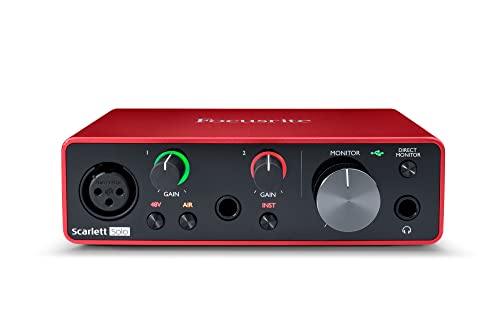 Focusrite Scarlett Solo 3rd Gen USB-C Audio InterfacePack of 11.71 x 5.65 x 3.77 inches0.77 poundsCheck on Amazon




What's inside
- Why separates exist at all
- What a matched set actually buys
- Gain staging: the arithmetic of clean volume
- Impedance matching: the ten to one rule
- Balanced XLR versus single-ended RCA
- Reading power ratings properly
- Speaker sensitivity arithmetic: how loud, honestly
- Stereo amplifier or monoblock pair
- Tube preamp, solid-state power: the hybrid strategy
- The phono stage question
- Bi-amping options
- Ventilation and rack heat
- Matching the pair to difficult speakers
- Living with separates day to day
- Buying used separates
- Check prices on Amazon
- The pre-purchase checklist
As an Amazon Associate I earn from qualifying purchases. This post may contain affiliate links at no extra cost to you.
Separates are the oldest architecture in home audio and, for many listeners, still the most satisfying. A preamplifier handles source selection, volume control, and the small signal work of preparing a source for amplification. A power amplifier does one heavy job: it takes that prepared signal and delivers the voltage and current a loudspeaker needs to move air. An integrated amplifier folds both jobs into one chassis, and a receiver folds in a tuner, processing, and often video switching as well. The separate route asks more of the buyer: more money, more shelf space, more cables, and more decisions. This guide explains what those decisions are, how to do the arithmetic behind them, and when a matched amp and preamp set removes the guesswork that buying separates one box at a time can create.
The core topics are electrical, and they reward precision. Gain staging decides whether a system hisses at low volume or clips at high volume. Impedance matching decides whether the preamp can drive the power amp cleanly across the full frequency range. Power ratings, read properly, predict how loud a system plays with a given pair of speakers far better than the single watt number printed in large type. Balanced and single-ended connections behave differently across cable lengths. Tube preamplifiers paired with solid-state power amplifiers form a hybrid strategy with real logic behind it, and monoblock pairs solve some problems while creating others. None of this requires engineering training. It requires a handful of ratios, a few worked examples, and the habit of reading specification sheets in the right order.
Why separates exist at all
The original reason for separates was simple: the jobs conflict. A preamplifier works with signals measured in fractions of a volt, where noise, interference, and tiny distortions are audible because everything downstream magnifies them. A power amplifier works with high voltages, heavy currents, large transformers, and heat. Put both in one box and the power supply of the amplifier sits inches from circuits trying to preserve a signal a thousand times smaller, while amplifier heat rises through the preamp section. Separating the two lets each designer optimize without compromise: the preamp gets a quiet, regulated supply, short signal paths, and shielding, while the power amp gets a massive transformer, deep heat sinks, and ventilation that would be wasted on small signal circuits.
Upgrade paths form the second reason. In a separates system, each half can be replaced on its own schedule. A listener who adds a turntable can change only the preamp to gain a better phono stage. A listener who moves to harder to drive speakers can change only the power amplifier. An integrated amplifier forces both decisions at once, and its resale value reflects that all or nothing character. Separates also age gracefully in a practical sense: capacitors and other wear parts can be serviced in one unit while the other keeps working, and a failed power amp does not strand a perfectly good preamp in a repair queue.
The third reason is power supply scale. A serious stereo power amplifier may carry a transformer rated in the hundreds of volt-amperes and filter capacitance that would never fit an integrated chassis shared with preamp boards, displays, and switching hardware. That supply capacity is not about headline wattage. It is about holding voltage steady when a bass drum hit asks both channels for current at the same instant, and about keeping the amplifier composed during the loudest seconds of a recording rather than merely surviving them. Receivers, which must also power processing boards and multiple channels from one supply, sit at the far end of this compromise, which is why a modest separate power amp often sounds more authoritative than a receiver rated at higher wattage on paper.
None of this makes separates automatically superior. A well designed integrated amplifier, with careful internal layout and a shared, competently engineered supply, can outperform a poorly matched pair of separates, and it does so with one remote, one power cord, and no interconnect decisions. The case for separates is strongest for listeners with demanding speakers, several sources including vinyl, a dedicated listening space, or a long term plan to build a system in stages. The case weakens for small rooms, simple source lists, and listeners who value tidiness over the last degree of control.
What a matched set actually buys
A matched set, a preamplifier and power amplifier designed and sold to work together, answers the obvious objection to separates: that the buyer must become the system engineer. Three concrete benefits follow from the pairing. The first is gain structure. The maker knows the preamp output level and the power amp input sensitivity exactly, because the same engineering team set both, so the volume control operates in its most linear, best tracking range at normal listening levels instead of spending its life near the bottom of its travel, where channel imbalance and noise live. The second benefit is a unified remote and control system: one handset runs volume, source selection, mute, and standby for both units, usually with a trigger cable linking their power states so the system wakes and sleeps as one device. The third is matched voicing, the house sound idea applied to electronics: the two units were voiced together on the maker reference speakers, so tonal balance, soundstage presentation, and dynamic character arrive as a coherent whole rather than as the accidental sum of two strangers.
Matched sets also simplify support and resale. One maker answers questions about the pair, firmware and service bulletins cover both, and a future buyer of the used pair pays for the certainty that the combination is known to work. The trade is flexibility. A set locks the buyer into one maker gain and impedance choices, one aesthetic, and one upgrade path, and the pair discount, when one exists, rarely equals the saving from hunting a used bargain in each category separately. Listeners who enjoy mixing makers, or who already own a power amplifier they love, should treat the set as one option among several rather than as the default answer.
There is also a quieter benefit that specification sheets never mention: cable sanity. A matched pair usually sits well together physically, with connector layouts, chassis depths, and ventilation patterns planned as a system, so interconnects run short and straight, trigger cables reach, and the stack looks deliberate. In real rooms, where systems live on real furniture, that tidiness has genuine value, and it reduces the chance of the hum and interference problems that long, draped, improvised cable runs invite.
The contrast with powered speakers sharpens the point. A powered speaker hides its amplifier inside the cabinet, matched by the maker to that exact driver set, which is separates logic taken to its limit and stripped of all choice. A matched amp and preamp set keeps the maker matching while preserving the freedom to choose speakers separately, to rearrange the room, and to replace one element at a time. Listeners who want the matching without the decisions should look honestly at powered designs; listeners who want both matching and freedom are the natural audience for sets.
Gain staging: the arithmetic of clean volume
Gain staging means arranging the level at every step of the chain so that each device works in its comfortable range: high enough above its noise floor to keep hiss inaudible, low enough below its clipping point to keep peaks clean. The chain has three main figures. The source produces an output voltage: a typical digital player or streamer delivers about 2 volts RMS at full scale on single-ended outputs and about 4 volts on balanced outputs, while a phono stage delivers a few hundred millivolts at its reference level. The preamplifier applies gain, commonly around 10 to 12 decibels for a line stage, which multiplies voltage by roughly three to four. The power amplifier has an input sensitivity, the input voltage needed to drive it to full rated power, commonly between 1 and 2 volts for consumer designs.
Work the numbers for a standard chain. A digital source plays a loud passage at its full 2 volt output. The preamp volume control sits between the source and the preamp gain stage in most designs, so at a typical listening setting the control passes only a fraction of that level onward. Suppose the setting passes one tenth of the incoming voltage: 0.2 volts reaches the gain stage, the stage multiplies it by about 3.5, and roughly 0.7 volts leaves the preamp for the power amplifier. Against a power amp sensitivity of 1.4 volts for full power, 0.7 volts is half the voltage needed for maximum output, which corresponds to one quarter of full power, since power scales with the square of voltage. A speaker of average sensitivity playing at a quarter of a healthy amplifier rating is already loud in a domestic room, which is why most listening happens with the system loafing far below its limits, and why headroom for peaks matters more than steady state power.
The failure modes at each extreme teach the matching rules. If the power amplifier is too sensitive, needing only 0.5 volts for full power, then even small movements of the volume control produce large level jumps, the useful control range shrinks to the first quarter of its travel, and preamp noise, which is constant at the output, becomes a larger fraction of the wanted signal at normal settings: the system hisses through quiet passages. If the power amplifier is not sensitive enough, needing 3 volts while the preamp can deliver only 2 volts cleanly, the preamp clips before the amplifier reaches full power, and loud passages harden and flatten no matter how the control is set. A matched set eliminates both failures by construction. A mixed pairing needs one check: the preamp maximum clean output voltage should exceed the power amp input sensitivity by a comfortable margin, ideally half again or more, so peaks pass without strain.
Phono sources add a second gain problem inside the first. A moving magnet cartridge delivers around 5 millivolts; a moving coil cartridge may deliver 0.5 millivolts or less, a tenth as much. The phono stage must supply roughly 40 decibels of gain for moving magnet and 60 decibels for moving coil just to bring the cartridge to line level, before the line stage gain applies. Each decibel of extra phono gain raises the noise contribution of that stage, which is why phono stage quality dominates vinyl sound in a separates system and why the phono discussion later in this guide treats inclusion and quality as separate questions.
Impedance matching: the ten to one rule
Impedance matching between a preamp and a power amp follows a rule so reliable that it deserves memorization: the output impedance of the preamplifier should be no more than one tenth of the input impedance of the power amplifier. This is voltage bridging, not the maximum power transfer matching used in radio work. The preamp acts as a voltage source, and the power amp input should sample that voltage without loading it down. When the ratio holds at ten to one or better, the signal loses less than a decibel to the connection, the frequency response stays flat, and the preamp output stage works without strain. When the ratio collapses, bass thins first, because output coupling capacitors and cable capacitance interact with the load, and dynamics compress as the preamp output stage runs out of current at low frequencies.
Worked numbers make the rule concrete. A typical solid-state preamplifier shows an output impedance between 50 and 600 ohms. A typical solid-state power amplifier shows an input impedance between 20,000 and 100,000 ohms, written as 20k to 100k. Pair a 200 ohm preamp output with a 47k power amp input and the ratio is better than two hundred to one: a textbook connection with no audible penalty. Pair a tube preamplifier with a 2,500 ohm output impedance, a common figure for designs without a cathode follower or output transformer, with a modern power amplifier whose input impedance is only 10,000 ohms, and the ratio is four to one. That pairing breaks the rule, and the predictable results are rolled off bass, a softened top end through cable capacitance, and a system that measures and sounds worse than either unit alone. The fix is a buffer stage, a different power amplifier with a higher input impedance, or a tube preamp whose output impedance sits in the hundreds of ohms, as many modern designs arrange.
Balanced connections change the figures without changing the rule. A balanced output may show an impedance of 100 to 600 ohms per leg, and a balanced input may present 20k to 100k ohms; the ten to one test applies the same way. What matters in practice is reading both specification lines before purchase, because makers print output impedance for the preamp and input impedance for the power amp in every serious manual, and the check takes thirty seconds. The same logic extends one step earlier in the chain: a source with a high output impedance, such as some passive volume controls and older disc players, can struggle into a preamp with an unusually low input impedance, so the ten to one habit should be applied at every junction, not only the famous one.
Passive preamplifiers deserve a special warning inside this topic. A passive unit is only a volume control and a selector in a box, with no gain and no buffer, so its output impedance varies with the volume setting and can reach several thousand ohms at common positions. Into a low impedance power amp input, through long cables, a passive control can dull the top end audibly. Listeners drawn to the purity argument for passive designs should keep cables very short, confirm the power amp input impedance is high, and confirm the sources deliver healthy voltage, because the passive unit adds nothing. The arithmetic, as always, decides whether the elegant idea works in a given system.
Balanced XLR versus single-ended RCA
Single-ended connections over RCA cables carry the signal on a center conductor and the return on a shield that doubles as the ground reference between the two chassis. Balanced connections over XLR cables carry the signal twice, once in each polarity, on a twisted pair, with a separate shield, and the receiving circuit responds to the difference between the two legs while rejecting noise that lands equally on both. That rejection, called common mode rejection, is the entire technical case for balanced wiring in the home: hum from ground loops, buzz from dimmers and appliances, and interference picked up along the cable run are largely cancelled at the input, while the wanted signal, present as a difference, passes at full level.
Cable length decides how much of that case applies. In a typical equipment rack, interconnects run half a meter to one meter, in a controlled environment, away from power cords. At those lengths, a well made single-ended cable between competently designed components is quiet, and many listeners with excellent systems run RCA throughout without a trace of hum. Balanced connections earn their keep as runs grow: a preamp on one side of a room feeding monoblock amplifiers beside the speakers may need five to ten meter interconnects, and at those distances, near floor level power cables and across rooms with several mains circuits, balanced rejection stops being theoretical. Balanced outputs also deliver roughly twice the voltage of single-ended outputs, about 4 volts against 2 at full scale, which shifts gain staging by about 6 decibels and can matter with insensitive power amplifiers.
Two cautions keep the comparison honest. First, a balanced connector does not guarantee a balanced circuit. Some components fit XLR sockets on a fundamentally single-ended internal design, converting at the socket; such units gain the connector robustness and some noise benefit on long runs but not the full internal advantage. Makers of serious separates usually state whether a design is fully balanced or differential from input to output, and that line in the manual is worth finding. Second, mixing connection types with adapter cables discards the rejection benefit and can introduce ground problems; if one unit offers only RCA and the other only XLR, a proper converter or a different pairing is cleaner than a drawer of adapters. For a matched set, the question usually answers itself, since the maker provides both connection types and a recommendation, and following the maker recommendation for the intended cable length is rarely wrong.
Speaker cables sit outside this debate but obey a related logic: keep them as short and as heavy in gauge as the room allows, because their resistance interacts with the amplifier damping factor discussed next, and long thin speaker cables can waste more performance than any interconnect choice in the system.
Passive speakers are the natural partners of separates, since the whole architecture assumes the amplifier lives outside the cabinet and the speaker presents only its drivers and crossover to the amplifier terminals. That division of labor is what makes the power rating and sensitivity arithmetic in the next section so important: with passive speakers, the buyer, not the speaker maker, is responsible for confirming that the amplifier can drive the chosen load to the desired level without strain.
Reading power ratings properly
The watt number on a power amplifier means less than buyers think and more than skeptics admit, depending entirely on how it was measured. A meaningful rating states the load impedance, the frequency range, the distortion limit, and whether both channels were driven at once. A rating of 100 watts per channel into 8 ohms, from 20 hertz to 20 kilohertz, at under 0.1 percent total harmonic distortion, with both channels driven, describes a substantially honest amplifier. A rating of 100 watts at 1 kilohertz into 6 ohms at 1 percent distortion, one channel driven, describes a weaker amplifier wearing a bigger number. The first discipline of reading power ratings is therefore to compare only like with like, and to treat any rating that omits its conditions as marketing rather than specification.
The 4 ohm figure reveals the power supply. An ideal amplifier doubles its power when the load impedance halves, delivering 200 watts into 4 ohms for every 100 into 8, because the load draws twice the current at the same voltage. Real amplifiers fall short of doubling to varying degrees. An amplifier rated 100 watts into 8 ohms and 180 into 4 has a strong supply and output stage. One rated 100 into 8 and only 120 into 4 is telling the buyer that current, not voltage, is its limit, and it will struggle with speakers whose impedance dips low, whatever the headline number says. Speakers rated at 8 ohms nominally often dip to 4 ohms or below in the bass, so the 4 ohm figure is not an edge case; for many real speakers it is the working figure, and it deserves more attention than the 8 ohm number that brochures enlarge.
Current delivery and damping factor complete the picture. Current, expressed in amperes of peak output, describes how the amplifier handles low impedance dips and reactive loads; high current designs keep control where voltage only designs fade. Damping factor is the ratio of the speaker impedance to the amplifier output impedance, so an amplifier with an output impedance of 0.02 ohms driving an 8 ohm speaker shows a damping factor of 400. High damping factor correlates with tight, controlled bass, because the amplifier can absorb the back electromotive force the woofer generates as its cone overshoots. Beyond a point, roughly a damping factor of 100 with reasonable cables, further gains become inaudible, and cable resistance joins the equation: a long thin speaker cable adds resistance in series and quietly lowers the effective damping at the speaker terminals, which is the technical reason behind the short, heavy cable advice given earlier.
Speaker sensitivity arithmetic: how loud, honestly
Speaker sensitivity connects the amplifier watts to the volume in the chair, and its arithmetic is simple enough to do on an envelope. Sensitivity states the sound pressure a speaker produces at one meter with one watt of input, written as decibels at 1 watt at 1 meter. A speaker rated at 87 decibels is average; 82 is insensitive and hungry; 92 is sensitive and easygoing. Every doubling of amplifier power adds 3 decibels. So the 87 decibel speaker produces 90 decibels with 2 watts, 93 with 4, 96 with 8, 99 with 16, 102 with 32, and 105 with 64 watts, all at one meter. Distance then subtracts: in a typical room the level falls by roughly 3 to 4 decibels each time the distance doubles, less than the free field figure because walls reflect energy back. At a listening distance of three meters, expect to give back around 6 to 9 decibels of the one meter figure.
Now combine the two sides into a purchase decision. Take the 87 decibel speaker, a listener seated three meters away, and a target of clean 100 decibel peaks, which covers orchestral climaxes and film effects at spirited levels without entering hearing damage territory for sustained listening. At the seat, the speaker gives roughly 79 decibels for one watt after distance losses. Reaching 100 decibel peaks requires about 21 decibels more, and since every 10 decibels demands ten times the power, 21 decibels demands roughly 125 times the power: about 125 watts per channel, with the 4 ohm behavior in reserve for impedance dips. Repeat the exercise with a 92 decibel speaker and the same target needs only about 40 watts. Repeat it with an 82 decibel speaker and the target needs several hundred watts, beyond most amplifiers, which is the arithmetic way of learning that insensitive speakers in large rooms are an expensive hobby. Average listening levels sit far below these peaks, often under a watt, but peaks are what amplifiers are bought for, because clipped peaks are the distortion listeners actually hear.
Two speakers playing together add roughly 3 decibels over one in mono terms, and room gain at low frequencies adds more, so real systems usually beat the envelope estimate slightly. The estimate remains the right planning tool because it errs on the safe side and because it exposes mismatches before money moves: a low powered amplifier with insensitive speakers in a big room fails on paper, in advance, for free.
Tower speakers often sit at the friendly end of this arithmetic, with sensitivities in the high eighties or low nineties from their larger cabinets and multiple drivers, which is one reason towers pair so naturally with separates: a mid powered amplifier drives them to full room filling level, and the budget saved on amplifier size can move to the preamp, the phono stage, or the speakers themselves. When a listing pairs a tower sensitivity figure with an amplifier recommendation, run the envelope check anyway; recommendations are written for average rooms, and yours may not be average.
Stereo amplifier or monoblock pair
A stereo power amplifier houses both channels in one chassis, usually sharing one power supply, one transformer, and one set of heat sinks. A monoblock is a complete amplifier for one channel, so a stereo system needs two, each with its own supply, its own chassis, and its own mains cord. The monoblock case rests on separation and scale. Each channel gets a power supply sized for that channel alone, so a demanding left channel bass passage cannot sag the supply feeding the right channel. Crosstalk between channels falls to nearly nothing, because the channels share no circuitry and can sit meters apart. Placement improves in one specific way: monoblocks can live beside their speakers, keeping speaker cables very short, with long balanced interconnects running back to the preamp, an arrangement that suits the balanced connection strengths described earlier.
The costs are equally concrete. Two chassis cost more than one of equivalent total quality, occupy more shelf or floor space, generate heat in two places, and double the count of power cords, fuses, and eventual service items. The shared supply in a good stereo amplifier is rarely the audible limit its critics suggest, because music rarely demands full power from both channels at the same instant on the same frequency, and competent designers size the shared transformer for realistic worst cases. Dual mono stereo designs, with two transformers and largely separate internal channels inside one box, capture much of the monoblock advantage at stereo amplifier convenience, and several respected makers build exactly that.
The decision rule that emerges from the arithmetic and the logistics is straightforward. For most rooms, most speakers, and most budgets, a strong stereo amplifier is the rational buy, and the money saved against monoblocks earns more sound when spent on speakers or sources. Monoblocks justify themselves with genuinely difficult speakers, very large rooms, a strong preference for amplifiers beside speakers, or a long term plan in which one channel at a time can be upgraded. Buyers should also count heat and ventilation for two chassis from the start, using the guidance in the rack section below, because two amplifiers that each run warm become a thermal system when placed together.
Tube preamp, solid-state power: the hybrid strategy
The most popular mixed pairing in separates pairs a tube preamplifier with a solid-state power amplifier, and the logic is division of strengths. Preamplifier circuits handle small signals at modest voltages, a job where tubes behave beautifully, adding a harmonic character many listeners describe as warmth, body, and a natural rendering of voice and strings, while generating little heat and consuming tubes slowly over years of service. Power amplification is the job where tubes are expensive, hot, and limited in current delivery, and where solid-state designs excel with firm bass control, high damping factor, and wattage that suits modern speakers. The hybrid takes the tube contribution where it is most audible and least costly, at the front of the chain, and the transistor contribution where it matters most, at the speaker terminals.
The cautions are the ones this guide has already built. A tube preamplifier output impedance can be high, so the ten to one rule must be checked against the chosen power amplifier input impedance with real numbers, not assumed. Tube preamps also ask for warm up time, gentle handling, and eventual tube replacement, and their gain can be high enough to make volume control range touchy with sensitive power amplifiers, which is the gain staging check returning in another costume. Microphony, the tendency of some tubes to ring when the chassis is tapped or when speakers play loudly into the same furniture, is a real if manageable trait, solved by sensible placement away from speaker vibration.
The reverse hybrid, a solid-state preamp feeding a tube power amplifier, exists and has devoted followers, usually listeners with sensitive speakers who want tube sound at the output stage and can live within modest wattage. For the broader market of average sensitivity speakers, the tube front and solid-state muscle arrangement remains the practical classic, and several matched sets are sold in exactly that configuration by makers who have solved the impedance and gain questions inside the pairing. A buyer assembling the hybrid from different makers should simply run the two checks, output impedance against input impedance, and preamp output voltage against power amp sensitivity, before falling in love with the idea.
The phono stage question
A preamplifier either includes a phono stage or it does not, and for vinyl listeners that single line in the specification outweighs many others. The phono stage must amplify a cartridge signal of a few millivolts, or a few tenths of a millivolt for moving coil designs, up to line level, while applying the RIAA equalization curve that corrects the bass cut and treble boost cut into every record. Inclusion saves the cost and shelf space of an external phono box and keeps the signal path short and quiet. Quality varies widely, though, and the included stages in many line preamps are competent rather than exceptional, designed for a typical moving magnet cartridge and fixed loading.
The specification details that separate a serious phono stage from a token one are gain options, loading options, and overload margin. Gain should suit the cartridge family, roughly 40 decibels for moving magnet and up to 60 or more for moving coil, ideally switchable. Loading, the resistance and capacitance the cartridge sees, shapes its frequency response, with 47,000 ohms standard for moving magnet and a menu of lower values, from under 100 ohms to 1,000 ohms, expected for moving coil. An external phono stage earns its place when a listener owns a low output moving coil cartridge, wants loading flexibility, or plans cartridge upgrades that the fixed internal stage cannot follow. A listener with one good moving magnet cartridge and no upgrade itch will usually find the included stage of a quality preamp entirely sufficient, and the money saved buys records.
Grounding belongs to this topic because it decides whether vinyl playback hums. A turntable needs a ground wire run to the preamp or phono stage ground terminal, the tonearm cable should be short, and the turntable should never share a loose, daisy chained power strip arrangement with the power amplifier if hum appears. These are five minute checks that rescue more vinyl systems than any equipment swap, and they cost nothing, which is why they belong in a buying guide.
Bi-amping options
Bi-amping uses two power amplifiers for one pair of speakers, one driving the bass sections and one driving the treble sections, on speakers fitted with separate terminals for each range. In its passive form, the speaker internal crossover still divides the signal, and each amplifier simply handles its half of the load; in its active form, an electronic crossover divides the signal before the amplifiers and the speaker crossover is bypassed, a more radical surgery. The genuine benefits of passive bi-amping are real but modest: each amplifier sees an easier load, the bass amplifier current demands stop modulating the treble amplifier supply in a shared chassis arrangement, and total available power for peaks grows. The benefit most often claimed, a dramatic transformation, rarely survives a careful level matched comparison, because the speaker crossover still governs the blend and each amplifier still receives the full range signal at its input.
The costs are concrete: a second amplifier, a second set of speaker cables, more heat, more shelf load, and a gain matching requirement that catches many first attempts. Both amplifiers must have the same gain, or the bass and treble balance shifts away from the speaker designer intent; identical amplifiers, or two channels of a matched multi channel design, remove that risk. Some preamplifiers provide dual outputs exactly for this arrangement, and some power amplifiers provide throughput connections to feed a second unit. A buyer considering bi-amping should first confirm that the speakers genuinely offer split terminals, that the linking plates between terminals are removed before power is applied, since leaving them in place while bi-amping can damage amplifiers, and that the budget would not earn more sound spent on one better amplifier instead of two lesser ones. In many systems it would, and honesty about that comparison is the mark of a mature separates plan.
best 5 1 home theater speakers without receiver
Home theater ambitions meet separates at the bypass connection. A stereo preamplifier with home theater bypass, sometimes labeled unity gain or processor pass through, lets a surround processor or receiver front channels pass through the stereo system at a fixed level, so the good stereo power amplifier and main speakers serve both music and film without a second speaker set or a tangle of swapped cables. For households building one room that must do both jobs well, that single feature can decide the preamp shortlist, and it appears in the checklist below for exactly that reason.
Ventilation and rack heat
Heat is the slow enemy of every component in a separates stack, and power amplifiers are the furnaces of the system. An amplifier converts a share of its drawn power into heat rather than sound; class A designs do this extravagantly, running hot at idle by design, class AB designs moderately, and class D designs least of all, but every design needs its heat carried away. Heat sinks need air moving across them by convection, which means clearance above and around the chassis, and the maker manual figure, often 5 to 10 centimeters above the top plate and open space at the sides, should be treated as a minimum rather than a suggestion. Stacking a preamplifier directly on a power amplifier cooks the preamp, blocks the amplifier vents, and shortens the life of capacitors in both; the standard arrangement places the power amplifier on its own shelf or at the bottom of a rack with the largest air gap in the stack above it.
Closed cabinets are the common failure. A handsome closed rack with a glass door can trap enough heat to push internal temperatures far beyond room level during a long loud session, and thermal protection circuits, when they engage, end the music to save the amplifier. Open backed racks, ventilated shelves, quiet cabinet fans, and the simple habit of leaving the door open during listening all solve the problem cheaply. Tube preamplifiers add their own heat and their own clearance needs, and monoblock pairs double the planning. Buyers should measure the intended furniture against the chassis dimensions plus clearance before purchase, because a separates system that does not fit its home with air to breathe will underperform and age early no matter how well its electrical arithmetic was done.
Matching the pair to difficult speakers
Some speakers punish careless amplifier matching, and recognizing them in advance is part of separates literacy. Electrostatic and large planar speakers present low impedance that falls further at high frequencies, combined with a strongly reactive load that asks the amplifier for current out of phase with voltage. Low sensitivity sealed box speakers ask for sheer wattage. Speakers with wild impedance curves, dipping to 3 ohms in the bass while peaking far higher in the midrange, ask for stability above all. In each case the specification lines that matter are the ones this guide has emphasized: the 4 ohm and, where published, 2 ohm power figures, the peak current rating, and any maker statement about minimum load impedance. An amplifier that publishes a confident 2 ohm figure or a high peak current number is telling the buyer it was designed for difficult loads; an amplifier whose manual warns against loads below 8 ohms is telling the buyer the opposite, and both statements should be believed.
Stability deserves its own sentence, because an amplifier can be powerful and still misbehave into reactive loads, ringing or even oscillating with certain cable and speaker combinations. Reputable makers test into standardized reactive loads and publish the results or at least the assurance. The buyer side of the discipline is simpler: never pair an amplifier with speakers below its rated minimum load, keep speaker cables reasonably short, and treat any combination that runs the amplifier hot at modest volume as a mismatch to be solved rather than a quirk to be endured. Heat at low volume is information, and in a separates system the owner is the engineer responsible for reading it.
There is also a matching question at the preamp end that difficult systems expose: long cable runs. A system with monoblocks beside the speakers may place the power amplifiers five or more meters from the preamp, and at that distance the preamp output stage must drive the cable capacitance as well as the amplifier input. Low output impedance preamps, comfortably under 600 ohms, handle such runs with ease, especially over balanced lines. High output impedance tube preamps can lose top end energy into long cables even when the ten to one impedance ratio against the amplifier input looks acceptable on paper, because cable capacitance forms a low pass filter with the output impedance. The practical rule joins the others: the longer the interconnect, the lower the preamp output impedance should be, and the stronger the case for balanced connection becomes.
Living with separates day to day
Reviews dwell on sound, but ownership is mostly ergonomics, and separates ask a little more of their owner than a single box does. Power up sequence matters in principle: sources and preamp first, power amplifier last, and the reverse at shutdown, so that turn on thumps from small signal gear never reach the speakers amplified. Trigger connections automate exactly this, which is why the checklist treats them as more than a convenience. Standby power draw multiplies across two or three chassis, modest per unit but worth knowing in a household that counts such things. Remote control line of sight can falter when a power amplifier sits low in a rack and the preamp sensor sits high, a trivial problem solved by trigger links and by placing the unit that receives remote commands where it can see the room.
Volume control quality is the daily touchpoint of the whole system, and it separates good preamps from great ones in a way specification sheets only hint at. A well implemented control tracks its two channels evenly down to low levels, moves in steps fine enough that the right level always exists, and remembers or returns to a sane level at power up rather than the level of last night film climax. Resistor ladder and relay switched controls tend to excel at channel tracking; motorized potentiometers excel at tactile feel; digital controls inside a quality analog stage can do both. When auditioning or reading about a preamp, evidence about low level tracking and step size is worth more than another paragraph about soundstage, because the volume control is the part of the system touched every single session.
Maintenance is the final daily reality. Dust restricts the ventilation that the rack section planned for, so heat sinks want a gentle clean on a household schedule. Tube preamps want their tubes reseated or replaced on a timescale of years, and owners should note the tube types at purchase so replacements are an errand rather than a research project. Connectors benefit from an occasional reseat that wipes their contact surfaces. None of this is burdensome, and most separates owners come to enjoy the ritual, but a buyer who wants an appliance that vanishes should weigh the integrated alternative honestly, because separates reward a small amount of ongoing attention and quietly tax its absence.
Buying used separates
The used market is where separates economics turn generous, because amplifiers and preamplifiers age slowly, carry no software expiry, and were often bought by careful owners. A ten year old quality power amplifier, serviced once and kept in a ventilated rack, can serve for another decade, and it commonly trades for a fraction of its original price. The inspection routine mirrors the electrical checks in this guide. Confirm both channels play cleanly at low and high volume, listen for hum, buzz, or crackle that changes when the chassis is tapped, and check that the unit runs at an even, plausible temperature after half an hour rather than cold on one side or fiercely hot overall. Ask about service history directly: recapping, the replacement of aged electrolytic capacitors, is the big scheduled expense in older amplifiers, and a unit with a documented recap by a competent technician is worth more than an untouched unit of the same age, not less. For tube preamplifiers, ask the age and type of the fitted tubes and whether spares are included. Original packaging matters more than pride suggests, because power amplifiers are heavy, awkward freight, and factory boxes with proper inserts are the difference between a safe shipment and a bent chassis. Judged with that routine, used separates let a careful buyer assemble a system a full class above what the same budget buys new.
Check prices on Amazon
Live listings for the shortlist in this guide are pulled from Amazon below, so prices and availability are always current at the moment you look.


The pre-purchase checklist
The whole guide condenses into a checklist that can be run against any candidate pairing, matched set or mixed, in about fifteen minutes with the two manuals open. Count the inputs first: every source in the system, plus the one likely to arrive within two years, needs a home, with at least one digital input path if a streamer or disc player will feed the preamp directly, and a phono input if vinyl is in the plan. Confirm the subwoofer provision: a dedicated subwoofer output, or a second pair of preamp outputs, makes adding a subwoofer clean, and a built in crossover or bass management, where offered, makes it cleaner still. Check home theater bypass if a surround system shares the room. Check trigger connections, the 12 volt links that let one remote wake the whole system, and confirm both units use compatible trigger voltages and cable types.
Then run the electrical checks this guide has built. Preamp maximum output voltage should exceed power amp input sensitivity with margin. Preamp output impedance should be one tenth or less of power amp input impedance, on the actual connection type to be used. Power amp output into 4 ohms should hold up respectably against its 8 ohm figure, and the sensitivity arithmetic should show the pair reaching target peak levels at the listening seat with the intended speakers, with power to spare rather than on the edge. Confirm the connection types suit the cable lengths the room demands, confirm dimensions and ventilation clearances against the furniture, and confirm the remote story: one handset for daily use is the matched set promise, and a mixed pairing should be judged on whether its two remotes and trigger links approximate that convenience.
Finally, apply the budget honesty that separates demand. The interconnects, the trigger cables, the shelf or rack changes, and the eventual tube or service costs belong in the total, and a pairing that only works if every accessory is free does not work. Judged on the complete figure, a matched set that passes every check on this list is one of the safest purchases in audio, and a mixed pairing that passes them all carries its own satisfaction, because the buyer engineered it and the arithmetic said it would sing before a single cable was connected.
The material in this guide comes from published documentation and manufacturer specifications reviewed during our research, and the author has not handled, installed, or used the amplifiers and preamplifiers referenced here. If a reader buys through links to the retailer on this page, the site may receive a commission on that sale, and readers should weigh the specification checks above more heavily than any sales language, wherever they read it.
Run the ten to one check and the sensitivity envelope before you fall for any pairing, and the separates you bring home will reward you every single time you press play.


