What's inside
- Key Takeaways
- Quick Picks
- How Were These Picks Chosen for Listening Rooms?
- What Makes the Best 2.0 Powered Speakers Different in a Listening Room?
- Why Does a Professional Monitor Belong in a Living Room at All?
- How Should a Listening Pair Be Placed in a Small Room?
- What Are the Album Test, the Film Test and the Ten-Year Test?
- How Does a Small Room’s Acoustics Change the Choice?
- How Do the Six Pairs Compare Across One Table?
- What Sources Will a Listening Pair Actually Meet?
- Can a Powered 2.0 Pair Grow — a Subwoofer, a Bigger Room, a New House?
- What Does an Ordinary Week With a Powered Pair Look Like?
- What Mistakes Do Powered-Bookshelf Buyers Keep Making?
- Final Recommendation
- Frequently Asked Questions
- Related Guides
As an Amazon Associate I earn from qualifying purchases. This post may contain affiliate links at no extra cost to you.
gizmoverdict.com is reader-supported. When you buy through links on our site, we may earn an affiliate commission.
Where to buy: Every pick links to a listing verified in this site’s product pool. One listing sells a single speaker rather than a pair — the JBL 305P MkII — and it is labelled as a single at every appearance, because a stereo system needs two of them and the budget must know it.
The best 2.0 powered speakers are the hi-fi for people who do not want a hi-fi system. Two bookshelf cabinets, amplification built inside, a cable to the source and a cable to the wall — and a small living room, a bedroom, a reading chair’s corner has music with real body and no rack, no receiver, no speaker wire, no ceremony. This is a guide about listening rooms, not workstations: the neighbouring guide on this site covers 2.0 speakers for computer desks, with their gaming and streaming briefs, and some names inevitably appear in both. What changes here is the question. At a desk the question is how a speaker serves the screen in front of it; in a listening room the question is how a pair of powered bookshelves serves an album, a film’s evening showing, a Sunday morning — with the listener in a chair they chose for comfort, facing the speakers on purpose.
That change of posture rearranges the virtues. Power and scale matter more, because the listener sits metres away rather than at arm’s length. A remote control stops being a luxury and becomes the difference between a system that gets used and one that gets admired. Bluetooth changes meaning too: not a desk convenience but the living room’s open door, the way guests’ phones and the household’s tablets join the music without a cable negotiation. And the stereo pair itself becomes furniture — objects that will be looked at daily for years — so finish and proportion join the specification in a way no desk ever demanded.
The six picks divide the listening room’s real budgets and temperaments. Edifier’s R1700BT leads, as the most complete powered bookshelf package for music lovers. Beside it stands the JBL 305P MkII — a professional studio monitor sold singly, included because a certain kind of listener has discovered that monitor honesty, bought twice, makes a superb small-room system. Edifier’s R1280T covers the wired classicist; the MR4 and the PreSonus Eris 3.5 bring the monitor argument in pair form; and the Creative Pebble closes the list as the small-room, small-footprint option for bedrooms and shelves where bookshelf cabinets simply will not fit. Each is judged as a listening-room citizen first — by the album test, the film test and the ten-year test.
Key Takeaways
- This guide judges powered 2.0 pairs as living-room listening systems — album first, film second, furniture always, every single evening.
- The JBL 305P MkII is sold as a SINGLE speaker: a stereo pair requires two, at every price comparison you make.
- Two picks are studio monitors by design and are labelled as such; their honesty is a listening taste some rooms adore.
- At listening distance, power and scale matter more than at a desk — the Edifier bookshelf pairs earn their size here, and small cabinets should be bought for small rooms on purpose.
- A remote control is a living-room essential, not a luxury, because the listener no longer sits within arm’s reach.
- Bluetooth in the living room is the household’s open door — for guests, tablets and the television’s late-night sessions alike.
- Judge any candidate by the week it will actually live — television on Monday, a guest’s playlist midweek, an album on Friday — rather than by a showroom minute.
Quick Picks
| Pick | Badge | Why it earns its place |
|---|---|---|
| Edifier R1700BT | The listening-room lead | 66 watts RMS, Bluetooth and a remote in an angled bookshelf pair — the most complete music-first package here. |
| JBL 305P MkII | Studio monitor — sold as a SINGLE | JBL’s professional 5-inch powered monitor; buy two for stereo, and gain a famously honest small-room sound. |
| Edifier R1280T | The wired classic | 42 watts RMS and dual analog inputs for listeners whose sources are a turntable, a television and a streamer. |
| Edifier MR4 | Studio monitor — pair form | Edifier’s 4-inch powered monitor, for listeners who prefer their recordings unvarnished. |
| PreSonus Eris 3.5 | Studio monitor — compact pair | A 50W active near-field pair whose clarity suits small rooms and speech-rich listening. |
| Creative Pebble | The small-shelf option | USB-powered spheres for bedrooms and shelves where bookshelf cabinets will not physically go. |
How Were These Picks Chosen for Listening Rooms?
The filter was the chair test: each pick had to make sense to a listener seated across a small room, remote in hand, with an evening rather than a task in front of them. That test promoted scale and wireless freedom, demoted desk-specific virtues, and admitted the monitors on a specific argument — that a measurable share of living-room listeners, once they hear a monitor’s unedited presentation in their own room, never go back to flattered sound. The JBL’s presence required the sternest labelling discipline of any pick in this batch, because its single-speaker sale is the category’s easiest budgeting error, and the guide repeats the fact rather than trusting the reader to catch it once.
Every pick is self-powered and sold as a true stereo solution — as a pair, or, in the JBL’s case, as a single that becomes a pair when bought twice with open eyes. Excluded were passive bookshelves (a different architecture, covered by this site’s passive guide), soundbars (a television accessory with its own guides), and the desktop-first small speakers whose virtues belong to the computer guide — with one deliberate exception. The Pebble survives here in a different role than it plays at a desk: not as a workstation upgrade but as the answer for shelves, bedside tables and small bedrooms where the listening is intimate and the furniture has already voted against cabinets.
Sources shaped the list as much as speakers did. A listening room’s pair must accept the household’s real inputs — a television, a turntable, a phone, a streamer — and the six divide those duties deliberately: Bluetooth where the household is wireless, dual analog where it is wired, monitor connections where it is professional. No pick serves every household; each serves a recognisable one completely.
Longevity shaped it too. A listening pair is bought against a decade of evenings, so production history mattered: designs that have been manufactured, supported and recommended for years were favoured over this season’s novelties, because a powered speaker’s amplifier makes it a single indivisible object whose maker’s memory is part of the product. The six below are all, in that specific sense, old souls — whatever their launch dates, their designs have already survived the market’s first verdict.
What Makes the Best 2.0 Powered Speakers Different in a Listening Room?
Distance rewrites the physics first. A desk listener sits about a metre from the speakers; a living-room listener sits three or four times farther, and sound thins with every metre of that journey. The bookshelf pairs that seemed generous at a desk become merely adequate across a room if they are small, which is why this guide’s centre of gravity sits with the larger Edifier cabinets and the JBL monitor rather than with compact desktop designs. Bass behaves differently too: in a room, low frequencies meet walls, corners and a sofa, gathering reinforcement in some seats and cancelling in others, so placement becomes a room conversation rather than a desk geometry exercise.
Control changes next. At a desk, the volume knob is always in reach and a remote is a toy; across a room, the remote is the interface, and a pair without one — the monitors are the honest example — asks the listener to cross the room for every adjustment, or to surrender volume duties to the source device. Households resolve this differently: a television’s remote can govern a pair fed from the set, a streamer’s app can govern its own output, and monitor owners often accept the walk as the price of the sound. The guide flags each pick’s control story rather than assuming one answer.
Finally, appearance becomes a specification. A desk speaker is seen by one person, mostly in peripheral vision, while working. A living-room pair is seen by everyone, daily, in the room where the household presents itself — and a finish that photographs well but lives badly will be resented by spring. The Edifiers’ furniture-grade presentation is therefore not decoration on the recommendation; in this guide’s brief, it is part of the recommendation, as is the monitors’ unapologetic studio black for rooms that prefer equipment to look like equipment.
And listening becomes social, which changes what good means. A desk pair serves one pair of ears at one fixed distance; a living-room pair serves a sofa, a floor cushion, a cook hearing the record from the kitchen doorway. Dispersion — how evenly a speaker spreads its sound beyond the perfect seat — becomes a first-order virtue, which is one reason the JBL monitor’s wide image earns its place here despite its studio manners, and why the audition advice in this guide keeps returning to the household’s real seats rather than the buyer’s favourite chair alone.
Why Does a Professional Monitor Belong in a Living Room at All?
Because some listeners are auditors by temperament. The JBL 305P MkII is a powered studio monitor — JBL Professional’s 5-inch two-way design, built so recording engineers can trust what they hear — and it is sold as a single speaker, one unit per box, because studios buy monitors in odd numbers for surround arrays and replacements. A stereo buyer must therefore purchase two, and this guide will keep saying so. What those two purchases buy is a presentation with the varnish removed: recordings arrive with their balances intact, their flaws itemised and their glories unassisted. Listeners raised on flattered speakers sometimes find the first week austere; a surprising number then find every other speaker in the house slightly dishonest.
The living-room monitor bargain has terms, and they should be read. There is no remote; volume lives on each cabinet or at the source. There is no Bluetooth; sources arrive by cable, as they do in studios. The connections are professional, which may mean adapter cables between a television and the pair. None of these terms is hidden — they are the monitor’s nature, stated in its listing and repeated here — and the listener who accepts them gains the most truthful sound in this guide. The MR4 and the Eris 3.5 offer the same philosophy in pair form and at smaller scales, for rooms and budgets where the JBL pair would be a statement too large.
There is a historical footnote that domestic monitor owners enjoy: the living room is where the monitor idea began. The classic British broadcast monitors of the last century were designed for small control rooms and migrated, by reputation, into the homes of listeners who valued exactly what the engineers valued. The modern powered monitor in a flat is not an eccentricity imported from the studio; it is a homecoming, with better amplifiers and a smaller bill than its ancestors ever managed.
How Should a Listening Pair Be Placed in a Small Room?
The listening-room version of the triangle is more forgiving than the desk’s and more political, because the room has other citizens. Begin with the main seat — the chair or sofa position where serious listening happens — and place the pair so that seat sits inside the stereo image: speakers roughly as far apart as they are from the listener, angled inward, tweeters near the height of a seated ear. In practice this means stands or a low credenza, a little space between cabinet and wall, and a negotiation with the room’s furniture that the speakers should win in inches rather than feet — small movements, patiently auditioned, change more than any setting on any pick here.
Then handle the room’s realities. A television between the speakers is normal and mostly harmless. A corner placement for one speaker and open space for the other will unbalance the bass, and shifting the whole arrangement a short distance along the wall is the classic cure. Rugs, curtains and upholstered furniture are the small room’s quiet allies, absorbing the reflections that make modest systems sound harsh; a bare-walled room will make even the JBL sound argumentative, and the cheapest upgrade in such a room is soft furnishing, not electronics. Place for the main seat without apology — a stereo pair can only be perfect somewhere, and it should be perfect where the listener actually sits.
Cable runs deserve their sentence in a room that people live in: powered pairs need mains at both cabinets as well as signal, and the tidy installation routes both along the skirting rather than across the doorway’s traffic. Measure before buying, because the distance between the perfect placement and the nearest socket has ended more good intentions than any specification in this guide. A pair placed where the cables allow, a few inches from where the ears would choose, still beats a perfect triangle that someone trips over nightly.
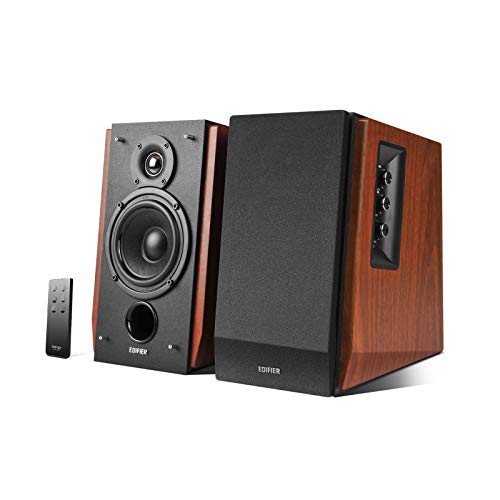
Edifier R1700BT — The listening-room lead
The R1700BT leads this guide because it answers the living room’s whole brief in one pair of cabinets. The specification opens the argument — 66 watts RMS of built-in amplification, Bluetooth alongside analog inputs, a remote control, front baffles angled to lift the sound toward a seated listener — but the argument is won by how those pieces compose a domestic object: a pair of speakers that a household can run entirely from the sofa, fed by the television at seven, a guest’s phone at nine and a record at eleven, without anyone crossing the room to negotiate with a knob. This is the powered bookshelf idea at its most complete, and in a small living room it retires the hi-fi rack without an apology tour.
The sound suits the role: generous at the low end for the cabinet size, warm through the middle where voices and most instruments live, and forgiving of the compressed streams and variable recordings that real households actually play. Critical listeners will note that forgiveness is a choice — the monitors below make the opposite one — but the living room is a democracy, and the R1700BT is the pair the whole household votes for. Its demands are space and honesty about scale: it wants a stand or a credenza, a little air behind it, and a room of small-to-medium size. Given those, it is the pair this guide would install in a friend’s flat and defend for a decade.
A Saturday-morning scene explains its lead better than any specification: coffee, a newspaper, a record playing at the volume of conversation, the pair invisible as equipment and present only as music. Systems earn their keep in those hours, not in demonstrations, and the R1700BT’s blend of warmth, wireless ease and sofa-side control is calibrated for exactly them. The household that buys it tends to stop reading speaker reviews — the sincerest metric this category has.
- Maker’s power figure: 66 watts RMS, built-in amplification
- Connections: Bluetooth plus analog inputs; remote control included
- Design: angled front baffles aimed at the seated listener
- Sold as: a stereo pair — the complete system in one purchase
Strengths
- The complete domestic package: power, wireless, remote and furniture-grade presentation together.
- Warm, generous voicing flatters the household’s real library rather than an audition playlist.
- Serves television, guests’ phones and dedicated listening without re-cabling or re-thinking.
Trade-offs
- Its forgiveness is a voicing choice; auditors should audition the monitors before committing.
- Bookshelf scale needs stands or a credenza and a little wall clearance to give its best.
- Large rooms will find its ceiling; it is a small-room champion, not a hall filler.
Best for: small living rooms and flats wanting one musical pair for television, guests and albums alike.
Not suited for: very large rooms, or listeners who want studio-monitor literalism.

JBL 305P MkII — Studio monitor, sold as a SINGLE
The labelling leads, as promised: the 305P MkII is a powered studio monitor from JBL Professional, a 5-inch two-way design, and the listing sells one speaker. Stereo requires two. Every figure in this review — the space it needs, the budget it implies — assumes the pair that a listening room actually uses, and any price comparison made elsewhere must double the single before it means anything. With that stated in full, the monitor itself can be praised without reservation: the 3 Series MkII earned its studio following with a waveguide design that spreads a wide, stable stereo image, and in a living room that image is the luxury — a sweet spot broad enough for a sofa rather than a single chair, so two listeners share the illusion instead of taking turns in it.
The ownership terms are the studio’s terms, imported whole. Each cabinet is independently powered and controlled, volume lives at the source or on the cabinets themselves, connections are professional and wired, and there is no remote and no Bluetooth to apologise for their absence — they were never the product. What the pair returns for those austerities is the most revealing listening in this guide: the recording’s own decisions, good and bad, presented at domestic scale. For the listener who has ever wondered what their favourite albums actually contain — as opposed to what their speakers prefer to emphasise — two of these, on stands, with a decent source, are the cheapest honest answer the market sells.
One domestic negotiation is worth rehearsing before the pair arrives: volume courtesy. A monitor this revealing invites listening at honest levels, and its clarity can disguise how much sound is actually entering the room — and, in a flat, the neighbours’ room. The pair rewards the listener who treats level as part of musicianship, and the household that agrees its evening ceiling in advance will find the JBLs make that ceiling feel generous rather than imposed.
- Identity: powered STUDIO MONITOR — JBL Professional 3 Series
- Driver: 5-inch two-way design with JBL’s image-control waveguide
- Sold as: a SINGLE speaker — buy TWO for a stereo pair
- Connections: professional wired inputs; no Bluetooth, no remote
Strengths
- A wide, stable stereo image that serves a whole sofa, not one anointed chair.
- Monitor honesty reveals the recording itself — the guide’s most truthful listening.
- Professional build and an enormous studio user base behind parts and knowledge.
Trade-offs
- Sold singly: the stereo budget is two units, and forgetting that is the classic error.
- No remote and no Bluetooth — volume and sources are managed the studio way.
- Professional connections may require adapter cables from domestic sources.
Best for: listeners who want studio truth at home and accept studio manners to get it.
Not suited for: buyers wanting one-box convenience, wireless, or a remote in hand.

Edifier R1280T — The wired classic
The R1280T is the R1700BT’s elder sibling and its argument is subtraction: no Bluetooth, no wireless anything, just 42 watts RMS of amplification, dual analog inputs, tone controls and a remote, in a pair of powered bookshelf cabinets that have become the default first hi-fi of the streaming era’s wired minority. The household it serves keeps its sources on cables by preference — a turntable that deserves a permanent input, a television, a dedicated streamer — and distrusts the pairing dance on principle. For that household the R1280T is not the cheaper option; it is the correct one, and the money its sibling spends on wireless is money this buyer never misses.
In the room, the pair delivers the Edifier bookshelf character in its original form: balanced, warm-leaning, scaled for small rooms, and endlessly easy to live with across a whole evening’s listening. The dual inputs quietly solve the living room’s commonest cabling problem — television and one music source, both permanently connected, switched at the speaker or the remote. Its ceiling is the format’s: large rooms and bass-led film nights will find its limits before the R1700BT’s. But as the anchor of a modest, wired, music-first room, the R1280T has earned its classic status the slow way, by being recommended from one satisfied household to the next for years.
The vinyl household deserves its specific paragraph, because this pair has become its quiet default. A turntable with its own phono stage, the R1280T on the credenza, records played at the pace records demand — the system’s total footprint is two cabinets and a deck, its total ritual is a side at a time, and its sound has started more record collections than any advertisement. Wired permanence is the aesthetic as much as the engineering: nothing pairs, nothing updates, nothing expires.
- Maker’s power figure: 42 watts RMS, built-in amplification
- Connections: dual analog inputs — two sources permanently wired
- Extras: remote control, on-cabinet tone controls
- Sold as: a stereo pair
Strengths
- Dual inputs make it a small wired hub for television plus one music source.
- The classic Edifier balance — an evening-long listen without fatigue.
- No wireless dependencies: it will connect to the next decade’s sources with the same cables.
Trade-offs
- No Bluetooth — the household’s phones join by cable or not at all.
- Less headroom than the R1700BT; big rooms and loud film nights find its edge sooner.
- Shares the bookshelf footprint, so the stand-or-credenza conversation still applies.
Best for: wired households pairing a television with a turntable or streamer in a small room.
Not suited for: wireless-first households, or larger rooms needing more authority.
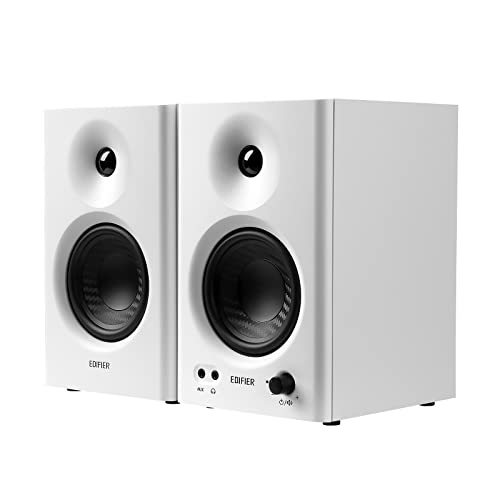
Edifier MR4 — Studio monitor honesty in pair form
The MR4 brings the monitor argument home in the friendliest possible packaging: a powered studio monitor pair — 4-inch active near-field speakers, sold as a pair — from the same Edifier stable as the hi-fi picks above. Where the JBL demands studio manners from a domestic buyer, the MR4 meets the living room halfway: monitor-flat voicing and a monitor mode for critical listening, in cabinets sized and priced for real rooms, bought once as a stereo solution rather than assembled from singles. It is the monitor for the listener who wants the truth without the professional ecosystem’s tolls.
That truth has a domestic use beyond audiophile virtue. Speech — podcasts, radio drama, film dialogue, the spoken word that fills so many evenings — sits squarely in the region where monitor honesty pays, and the MR4 renders it with a clarity that flattered speakers smudge. Music follows the same rule: great recordings sound plainly great, poor ones are identified rather than disguised, and the listener’s library slowly gets edited by the evidence. The pair’s scale is the honest limit — 4-inch drivers in a small room, not a ballroom — and bass-led listeners should hear the size in that sentence. Within it, the MR4 is the listening room’s conscience, and many rooms are better for having one.
There is a discovery path that leads many owners here, and naming it may save a reader a purchase: they bought warm speakers, enjoyed them, and slowly noticed that a handful of favourite recordings sounded vaguer than memory insisted they should. The MR4 is the pair bought at the end of that noticing. It does not make the library sound worse; it makes the library sound known — and for the listener ready for that, no amount of warmth elsewhere compensates.
- Identity: powered STUDIO MONITOR pair — active near-field design
- Driver size: 4 inch, per the listing
- Sold as: a stereo pair — no single-speaker arithmetic required
- Voicing: monitor-flat, with listening honesty as the design brief
Strengths
- Monitor truth in a pair purchase — no singles, no studio toll-booth.
- Speech and dialogue clarity that serves podcasts, radio and film superbly.
- Compact cabinets suit the small rooms this guide is actually about.
Trade-offs
- Flat voicing forgives nothing; casual listeners may initially prefer the R1700BT’s warmth.
- 4-inch drivers cap bass depth and room size honestly.
- Wired and workmanlike in its connections — no Bluetooth hospitality for guests.
Best for: listeners who prefer accuracy to warmth and listen closely in small rooms.
Not suited for: bass-led listening, large rooms, or wireless-first households.

PreSonus Eris 3.5 — The compact monitor pair
The Eris 3.5 completes the monitor trio at the smallest scale: a pair of powered studio monitors with 3.5-inch drivers and 50 watts of amplification, per the maker’s listing, designed by PreSonus for near-field truth-telling. In a listening-room guide its posting is specific — the small bedroom, the study that doubles as a guest room, the reading corner where a full bookshelf pair would colonise the furniture. At those scales, and at the modest distances they impose, the Eris pair’s midrange clarity is not a compromise but a match: voices, acoustic instruments and chamber-scale music live exactly where this monitor is strongest.
The rear-panel tuning controls, built for studio placement problems, translate gracefully to domestic ones — a pair that must live near a wall can be adjusted for the wall’s contribution rather than merely enduring it, a courtesy few domestic speakers offer at any size. The limits are the small driver’s physics, stated without varnish: deep bass is not in this cabinet, and a large room will expose the fact. Heard as what it is — a compact, honest pair for intimate rooms — the Eris 3.5 is the guide’s recommendation for the listener whose space is small and whose standards are not.
Consider the night listener specifically, because this pair may be the guide’s best answer to them. At low volumes, in a quiet house, lesser speakers lose their balance — bass vanishes, voices thin — while a near-field monitor designed for close work keeps its composure at a murmur. The reader who does their serious listening after the household sleeps will find the Eris pair’s small scale is not its limitation but its entire point.
- Identity: powered STUDIO MONITOR pair — active near-field design
- Maker’s power figure: 50W; driver size 3.5 inch
- Tuning: rear acoustic controls for placement near walls
- Sold as: a stereo pair
Strengths
- Midrange clarity serves voices and acoustic music in intimate rooms beautifully.
- Placement tuning controls domesticate the wall-proximity problem.
- The smallest footprint among the guide’s serious listening options.
Trade-offs
- It is a studio monitor: flat, revealing, and uninterested in flattering poor recordings.
- The 3.5-inch drivers set the firmest bass limit in this guide.
- Wired, studio-style connections; the household’s phones need another route in.
Best for: bedrooms, studies and reading corners where listening is close and honest.
Not suited for: main living rooms of any size, or bass-priority listeners.
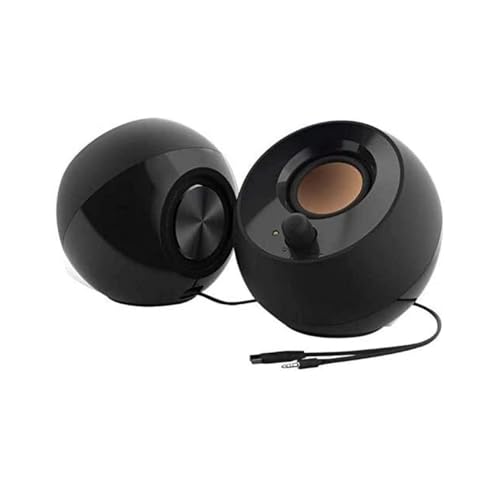
Creative Pebble — The small-shelf option
The Pebble closes the list in a role its desk fame does not predict: the powered pair for rooms where speakers must nearly disappear. Two spherical cabinets, angled upward by their shape, powered and fed by a single USB connection — in a bedroom, on a kitchen shelf, beside a bed, that one-cable minimalism and palm-sized footprint succeed where every bookshelf pick in this guide physically cannot. The listening it serves is intimate by definition: late-night radio at low volume, a podcast while cooking, music in a room too small for furniture-scale speakers. Judged on those duties rather than against the Edifiers’ scale, the Pebble is not the guide’s compromise — it is the only pick that fits the brief at all.
Its inclusion carries one condition, stated plainly: the source must be a computer or laptop within USB reach, because that single cable is both its power supply and its signal. A bedroom whose listening comes from a phone should choose a Bluetooth pick instead. But for the shelf beside the desk-adjacent bed, the spare room with a laptop, the small space where sound was previously surrendered to a tinny built-in speaker, the Pebble converts neglect into a small daily pleasure — and small daily pleasures, multiplied across years, are what most home audio actually consists of.
The bedside case deserves the last word on this pick, because it is where the Pebble’s virtues compound: a spoken-word programme at sleep-timer volume, intelligible at a whisper from a metre away, from a device that asks for one cable and no thought. Readers choosing a main system should walk past it toward the Edifiers; readers furnishing the small hours of a house should stop here and be pleased they did.
- Connection: USB — one cable carries power and audio from a computer
- Format: 2.0 stereo pair, spherical enclosures angled toward the listener
- Scale: palm-sized — for shelves, bedside tables and small bedrooms
- Sold as: a stereo pair
Strengths
- Fits the shelves and surfaces where every bookshelf pick is physically refused.
- One cable total — the simplest installation in the guide.
- Intimate-scale listening — radio, podcasts, low-volume music — is genuinely well served.
Trade-offs
- Requires a computer as its source; phones and televisions cannot feed it.
- Bass and volume are bounded by its size and USB power — a room’s main system it is not.
- Main-room listeners should step up to the Edifier pairs without hesitation.
Best for: bedrooms, kitchens and small shelves where listening is close and space is scarce.
Not suited for: a living room’s main system, or any phone- or television-led setup.
What Are the Album Test, the Film Test and the Ten-Year Test?
This guide kept invoking three tests; here they are in full, because any reader can run them in a shop or a return window. The album test is the founding one: play a record you have loved for years, in full, at the volume your room will actually use, and notice whether you listen or merely approve. A pair that passes makes you late for your next appointment. The film test follows: one dialogue-heavy scene at evening volume, checking that voices stay intelligible without the remote riding in your hand, and one loud scene, checking that the pair stays composed rather than shouting. A pair that passes both halves can carry the household’s whole viewing life.
The ten-year test is the quietest and the most decisive. Ask where the pair will live in a decade: whether its connections will still meet the household’s sources, whether its finish will still suit the room, whether its maker will still answer for it, and whether its sound is a pleasure you will still choose nightly or a novelty already fading in the shop. Powered speakers concentrate the risk — the amplifier and the cabinet age together, inseparably — which is why this guide favours designs with long production lives and makers with long memories. The pair that passes all three tests is rarely the pair with the longest feature list. It is the pair the household stops noticing, because the music took its place.
How Does a Small Room’s Acoustics Change the Choice?
Small rooms are kind to small systems and cruel to careless ones. Their kindness: modest power fills them, modest cabinets reach satisfying bass with the walls’ help, and the listener sits close enough that every pick in this guide is operating in its comfort. Their cruelty: reflections arrive early and strong, so a bright or forward pair can sound argumentative by the second track, and bass gathers in corners and along walls until one seat booms while another starves. The practical responses are placement and softness, in that order — the pair out from the wall by a hand’s breadth, the main seat out of the corner’s jurisdiction, a rug and curtains doing quiet work — and only then electronics.
The choice among the six bends accordingly. Warm-voiced pairs like the Edifiers forgive reflective rooms; the monitors report the room as faithfully as the recording, which in a bare-walled box can feel like an accusation — accurate, but an accusation. A listener in a sparsely furnished room should weight forgiveness higher than this guide’s general ranking does, and a listener in a soft, carpeted, curtain-hung room can afford the monitors’ full honesty. The room is the third speaker in every stereo system; choose the other two to get along with it.
How Do the Six Pairs Compare Across One Table?
| Pick | Type | Sold as | Connections | Natural room |
|---|---|---|---|---|
| Edifier R1700BT | Powered bookshelf | Pair | Bluetooth + analog, remote | The small living room |
| JBL 305P MkII | STUDIO MONITOR | SINGLE — buy two | Professional wired | The serious listening room |
| Edifier R1280T | Powered bookshelf | Pair | Dual analog, remote | The wired household |
| Edifier MR4 | STUDIO MONITOR | Pair | Wired, monitor inputs | The accuracy-first room |
| PreSonus Eris 3.5 | STUDIO MONITOR | Pair | Wired, with tuning controls | The intimate small room |
| Creative Pebble | Desktop 2.0 | Pair | USB only | The shelf and bedside |
Read the “sold as” column before any other: it contains the guide’s most expensive sentence. The JBL is a single; everything else is a pair. After that, the type column divides the room by taste — hi-fi warmth to the left of the monitors, studio honesty to the right — and the right choice is the one your ears have been describing all along.
What Sources Will a Listening Pair Actually Meet?
A living-room pair lives on a diet of sources, and matching the pick to the diet prevents the adapter-cable drawer from filling. The television is the commonest: fed by analog output or a small converter where the set offers only digital, it turns any pick here into the household’s film sound, with the Edifiers’ remotes earning their keep nightly. The turntable revival arrives second: a deck with a built-in phono stage feeds the R1280T’s spare input directly, which is one reason the wired classic endures. The phone is the third citizen, admitted by Bluetooth on the R1700BT and by cable elsewhere, and the household’s guests arrive with it — a pair that can host a visitor’s playlist in ten seconds is a pair that gets used socially, and social use is where living-room systems earn their furniture status.
The monitors meet the same sources on studio terms: wired, through whatever converter the source requires, with volume governed at the source or the cabinet. That friction is real and should be counted honestly — it is the toll the honesty costs. Households that entertain constantly will feel it weekly; households that listen deliberately will barely feel it at all. The guide’s structure assumes you know which household you keep.
One source deserves a caution of its own: the television’s variable output. Some sets offer a headphone socket whose volume the set’s remote governs — the simplest marriage a powered pair can have — while others offer only a fixed digital output that demands a converter with its own volume control. Check which citizen your television is before choosing the pair, because the answer can promote the remote-carrying Edifiers or acquit the monitors, whose owners often govern volume at a converter or streamer by design. Five minutes with the television’s manual is the cheapest research in this entire guide.
Can a Powered 2.0 Pair Grow — a Subwoofer, a Bigger Room, a New House?
The honest answer distinguishes between growing around the pair and growing beyond it. Around it, yes: several powered bookshelf designs accept a subwoofer’s company through their source chain, and a household that adds one for film nights gains the low-end authority no 2.0 pair of this size can counterfeit, while the pair keeps the music duties it was bought for. The monitors join such arrangements on studio terms, as they join everything. Beyond it — a move to a large open-plan space, a appetite for cinema scale — the pair does not grow; it retires, gracefully, to a bedroom or a study, where its scale becomes correct again. This second career is the powered pair’s quiet economic defence: rooms in a home form a league table of sizes, and a good pair relegated downward is still a good pair, in a way that a failed all-in-one ambition never is.
Plan the purchase with the league table in mind and the choice sharpens. A pair bought for the largest room it might serve, within reason, can holiday in smaller ones; a pair bought exactly for today’s bedsit will meet the next flat’s living room as a stranger. The Edifier bookshelf pairs sit at the size where that foresight is affordable, which is another strand of their lead in this guide — they are bought once, for the room you have and the room you are probably moving to.
What Does an Ordinary Week With a Powered Pair Look Like?
Trace the week, because specifications never do. Monday evening is the television’s: a series episode, dialogue riding clearly over a score, the remote doing its one job. Wednesday brings a guest, whose phone joins by Bluetooth in the time it takes to tell a story, and whose playlist becomes the evening’s argument and entertainment. Friday is the album’s night — the pair’s founding purpose — played whole, at length, with the chair in the triangle and the phone in another room. Sunday morning is radio and podcasts at conversation level while the house wakes, the duty where the monitors’ speech clarity and the Edifiers’ warmth divide households by taste rather than by quality.
No single pick wins all four evenings, and the guide’s six exist because households weight the evenings differently. The entertainment-led house takes the R1700BT. The album-led house auditions the monitors with its own records. The wired house keeps the R1280T’s counsel. The small-hours house takes the Eris or the Pebble by scale. The week is the specification sheet that matters; fill it in honestly and the shortlist writes itself.
What Mistakes Do Powered-Bookshelf Buyers Keep Making?
The single-versus-pair error leads, wearing this guide’s own warning label: the JBL 305P MkII is one speaker, and a budget built on its single price is a budget halved by reality at checkout. Second, auditioning at a desk for a living-room job — near-field impressions flatter small speakers and underrate the scale a room demands, so judge candidates at listening distance with the room’s own material. Third, exiling the pair to the floor or the top of a bookcase because the furniture plan never made room for them; a powered bookshelf at ankle or ceiling height is a good speaker in a bad job, and stands are cheaper than the disappointment.
Fourth, expecting a remote that does not exist: the monitors’ volume lives at the source or the cabinet, and discovering that during the first film is a preventable annoyance. Fifth, feeding a Bluetooth pair’s television habit without checking latency behaviour on the actual set — most modern combinations are fine, but the check belongs before the purchase, not during the dialogue. Sixth, buying scale for a room that cannot use it, or intimacy for a room that swallows it: the picks here span bedrooms to living rooms precisely so the room, not the discount, can decide.
Final Recommendation
For the small living room that prompted the search, the Edifier R1700BT is the answer this guide gives first: complete, warm, remote-controlled and ready for the television, the guests and the albums in equal measure. The wired household should take its sibling, the R1280T, and enjoy the permanence of cables. The listener who suspects they are an auditor should act on the suspicion properly — two JBL 305P MkIIs, bought as the pair they must become, on stands, fed by a good source — or take the same honesty in pair form from the Edifier MR4, and at the smallest scale from the PreSonus Eris 3.5. And the room with no room should take the Pebble and its one cable without a flicker of shame. Choose by the chair you actually sit in, place the pair for that chair, run the album test before the return window closes, and a modest powered system will do the thing expensive systems promise and so often postpone: it will make the room you already live in the best-sounding room you own.
Frequently Asked Questions
Is the JBL 305P MkII really sold as one speaker?
Yes — one cabinet per purchase, because it is a professional studio monitor and studios buy monitors singly for arrays and replacements. A stereo listening system needs two. This guide labels it a single at every appearance, and any budget or comparison should double the unit before proceeding.
What is the difference between this guide and the 2.0 computer speakers guide?
Posture and purpose. The computer guide judges speakers at a desk, for work, gaming and streaming, at arm’s length. This guide judges powered pairs across a room, for music and film listening, with remotes, scale and furniture presence in the brief. Some models appear in both because they genuinely serve both — judged by different questions each time.
Can powered bookshelf speakers replace a full hi-fi system?
For small and medium rooms, for most households, yes — that is the category’s founding promise. The amplification is built in, the sources plug straight in, and the sound satisfies all but the largest rooms and the most demanding listeners, who remain the separates system’s natural constituency. The honest boundary is scale and ceremony: a household that dreams of a dedicated listening room with a rack and a ritual should follow that dream into the passive and separates guides, and enjoy this category in the rooms it was born to serve.
Do I need speaker stands for these?
Need is strong, but stands or an equivalent — a low credenza at the right height — are the difference between the pair you bought and the pair you hear. Tweeters near seated ear height, a little air behind the cabinets, and the stereo triangle around your main chair repay their modest cost every evening. If the budget forces a choice between a grander pair on the floor and a modest pair on stands, this guide chooses the stands without blinking.
Are studio monitors too harsh for home listening?
They are honest rather than harsh: poor recordings sound poor, good ones sound plainly good. Some listeners find the honesty addictive and some find it fatiguing over long sessions, which is a taste question no guide can settle for you — audition with your own library, including its worst-recorded favourite, before deciding.
Can these pairs connect to a television?
The Edifier pairs connect readily by analog where the set provides it, or through a small converter where it does not, and their remotes suit the role. The monitors connect on wired studio terms with volume managed at the source. The Pebble is the exception — it serves computers only, by design.
How long should a powered pair last?
A well-bought pair should serve a decade or more of evenings: the designs in this guide come from makers with long production histories, and powered speakers ask only for sane placement — air around the amplifier side, distance from radiators and damp — in return. The likeliest agent of replacement is not failure but a change of room or taste, which is why this guide keeps recommending pairs that can retire honourably to a smaller room rather than to a cupboard. Buy the pair your next room can also love, and the decade tends to take care of itself.
Related Guides
Still arranging the room? Continue with our guides to the best 2.0 computer speakers for desk duty, the best 2.0 passive speakers and the amplifiers they need and the best powered bookshelf speakers for vinyl setups.


