Our Top Picks
 Casio Men's GG-1000-1A3CR G Shock Analog-Digital Display QuartzOne Size1 x 1 x 1 inches0.2 poundsCheck on Amazon
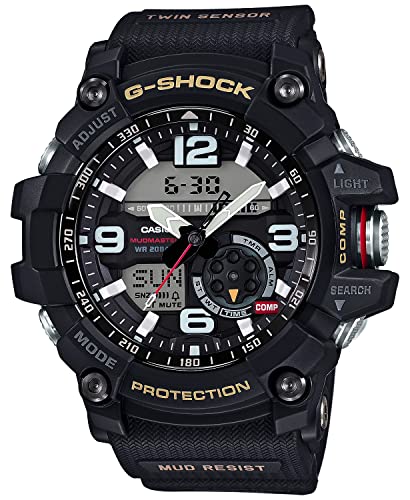
 G-Shock GGB100X-1A3 Master of G Mudmaster Quad Sensor4.3 x 4.1 x 3.8 inches0.55 poundsCheck on Amazon
 Casio Men's AE-1500WH-5AVCF Digital Sports WatchStandard4.29 x 3.43 x 2.76 inches0.37 poundsCheck on Amazon

What's inside
- Where the compass sits in the G-Shock range
- How a digital compass on the wrist actually works
- True north, magnetic north, and declination adjustment
- Bearing memory, direction lock, and logging habits
- Calibration, interference, and honest accuracy limits
- The thermometer pairing problem on sensor models
- Shock resistance and the 200 metre baseline
- Power systems: Tough Solar, radio timekeeping, and plain batteries
- Size, wearability, and operating the watch outdoors
- Reading the display outside: positive, negative, and analogue combinations
- Comparing compass models without inventing differences
- A pre-purchase checklist keyed to sensor generation
- Using the compass well once it is on the wrist
- Check prices on Amazon
- Long-term care and knowing when a reading deserves suspicion
As an Amazon Associate I earn from qualifying purchases. This post may contain affiliate links at no extra cost to you.
As an Amazon Associate we earn from qualifying purchases. This guide approaches compass-equipped G-Shock watches as a research problem rather than a lifestyle accessory, drawing on manufacturer specifications, instruction manuals, and documented feature sets to explain what the sensors actually do, where their limits sit, and which details separate a useful navigation instrument from a watch that merely displays a direction arrow. A compass on the wrist will never replace a dedicated baseplate compass for map work, and no honest guide should pretend otherwise. What it can do, when the wearer understands calibration, declination, and interference, is provide a fast directional reference during a hike, a site survey, a boat transfer, or a disorienting walk through an unfamiliar city. The sections that follow unpack sensor generations, construction, power systems, and wearability so that the final choice rests on verifiable criteria instead of colour, marketing names, or case styling alone.
Where the compass sits in the G-Shock range
The G-Shock family is unusually broad, spanning simple digital watches with no environmental sensors at all through to professional-grade instruments built for aviation, land navigation, and marine use. Compass functionality appears only in the sensor-equipped portion of that range, and understanding its position helps prevent a common buying mistake: assuming that a tough-looking case implies navigation capability. Many G-Shock models share the same muscular silhouette, oversized bezel lettering, and resin construction, yet contain no magnetometer whatsoever. The compass is a specific electronic module, not a styling cue, and it is documented in the specification table rather than implied by a rugged name. Buyers should therefore begin with the sensor list and treat case design as a secondary filter applied after navigation features have been confirmed.
Within the sensor-equipped tier, Casio has historically grouped its technology under Twin Sensor and Triple Sensor banners. A Twin Sensor configuration typically pairs a digital compass with a thermometer, while a Triple Sensor configuration adds a pressure sensor that supports both altimeter and barometer functions. That distinction matters far beyond a simple feature count. A hiker who only needs occasional direction checks may find a Twin Sensor model lighter, simpler, and easier to operate, whereas a mountaineer tracking weather trends and altitude gain benefits from the pressure data that a Triple Sensor model records. The generation of the sensor platform also matters, because later generations documented smaller sensor units, improved power efficiency, and faster or more consistent measurement behaviour compared with earlier implementations described in older manuals.
Sensor generation is rarely printed on the dial in plain language, which is why the module number and the official manual deserve attention before purchase. Two watches that look similar in a listing photograph may rely on different generations of sensing hardware, with differences in compass measuring range, altimeter resolution, and battery demand. Manufacturer documentation identifies the module, lists the functions tied to that module, and states operating intervals in precise terms. Reading that documentation is slower than scanning a product headline, but it prevents disappointment when a buyer discovers that a favoured design lacks bearing memory, lacks declination correction, or measures altitude in coarser increments than expected. In this category, the manual is not supplementary reading; it is the most reliable product description available.
Certain families within the range illustrate different priorities. Aviation-oriented models tend to emphasise large, highly legible displays, resistance to gravitational forces described in their specifications, and quick access to world time alongside the compass. Mud-resistant families prioritise sealed button structures and gaskets that keep grit away from the controls, which is relevant because a compass that cannot be activated with muddy gloves or dirty hands loses practical value outdoors. Ranger-style families focus on land navigation, often combining the compass with sunrise and sunset data, longer logging capability, and straps designed for extended wear over clothing layers. These are class-level tendencies drawn from how the families are positioned and documented, not guarantees that every individual model in a family carries identical features.
There are also fashion-led and collaboration models that borrow the sensor-watch silhouette without carrying the full sensor suite, and limited editions that retain sensors but use colourways intended primarily for collectors. Neither group is inherently poor value, but both demand extra care from a navigation-focused buyer. A limited colourway does not improve compass accuracy, and a collaboration logo does not extend battery life. If the intention is regular outdoor use, the rational order of operations is to shortlist by sensor generation and documented functions first, then by resistance features relevant to the environment, and only then by appearance. Reversing that order is the most common route to owning a watch that looks prepared for the trail yet offers little navigational help once the trail turns confusing.
How a digital compass on the wrist actually works
A watch compass does not contain a magnetised needle floating in fluid. Instead, documented G-Shock compass systems rely on a magnetic sensor, commonly described as a magnetoresistive sensor, that detects components of the Earth magnetic field along different axes. By comparing the strength of the field on those axes while the watch is held level, the module calculates the direction the top of the watch is pointing and converts that calculation into a display. The wearer sees either a degree value, a directional abbreviation, a graphic pointer, or some combination of the three, depending on the model and its display layout. The elegance of the system is that it has no moving needle to stick or demagnetise in the traditional sense, but its dependence on electronic measurement brings its own obligations, especially around calibration and nearby metal.
Most models in this class present direction in two complementary forms. A sixteen-point readout divides the circle into named sectors such as north, north-northeast, northeast, and east-northeast, giving a quick verbal reference that matches how people naturally describe a heading. Alongside that, a numeric readout in degrees offers finer precision, with north at zero degrees, east at ninety, south at one hundred and eighty, and west at two hundred and seventy. The graphic display often shows pointers indicating north and the measured direction, allowing a glanceable check without reading numerals. Each form serves a different moment: the named sector suits conversation and quick orientation, the degree value suits following a bearing from a map or route description, and the graphic pointer suits maintaining direction while moving.
Measurement is not continuous in the way a phone compass animation might suggest. Manuals for this class describe an initial measurement sequence that updates repeatedly over a short period, often with readings taken at one-second intervals for a defined window, after which the display may hold, dim, or require reactivation. This behaviour conserves power and reflects the intended use pattern: take a reading, orient, move, and then take another reading at the next decision point. Wearers who expect a constantly sweeping live needle sometimes misread this design as sluggishness. In reality, intermittent measurement is a deliberate trade-off in a watch expected to run for months or years on a small cell or a solar-charged accumulator, rather than for a day on a large rechargeable battery.
Holding position influences the result more than many first-time users expect. The sensor calculation assumes the watch face is broadly horizontal, so tilting the wrist steeply toward the body or letting the watch hang at an angle can distort the displayed direction. Manuals consistently instruct the wearer to keep the watch level, move away from obvious magnetic sources, and take the reading with the twelve o clock position aimed at the target when following a bearing. Small habits make a measurable difference: resting the forearm on a fence post or knee to steady it, pausing rather than walking while the measurement runs, and checking the same landmark twice from slightly different positions to confirm consistency. A compass reading is a sample of a magnetic environment at a moment in time, and treating it with that modest discipline produces far more trustworthy results.
For readers comparing navigation features across categories, a useful detour is to see how outdoor sports watches frame similar problems, and our coverage of best adventure fit smartwatches offers that contrasting perspective within a single sentence of context.
True north, magnetic north, and declination adjustment
The Earth magnetic field does not point neatly toward the geographic North Pole from most locations on the surface. The direction a compass detects is magnetic north, while maps are drawn relative to true north, and the angular difference between the two at a given place is called magnetic declination. In some regions the difference is small enough to ignore for casual orientation. In others it is large enough that following an uncorrected compass bearing across several kilometres would place a walker well away from the intended destination. Declination also changes slowly over time as the magnetic field shifts, so a value printed on an old map may no longer be exact. Any serious discussion of a watch compass must therefore address whether the watch allows the wearer to enter a declination correction and align its readings with true north.
Models that support declination adjustment let the wearer enter both the angle and the east or west direction of the local declination, after which the module offsets its displayed bearings accordingly. Manuals describe this as magnetic declination correction, and the setting is location-specific rather than a universal preference. Travelling to a different region with a substantially different declination means updating the value, just as a paper-compass user would redraw or re-annotate a declination diagram. Wearers who split time between home terrain and a distant work site should treat the declination setting as part of their trip preparation, alongside time zone changes. Forgetting to update it does not break the watch, but it quietly reintroduces exactly the error the feature exists to remove.
Knowing the correct local value requires a trustworthy source. National geomagnetic observatories and official mapping agencies publish declination calculators that accept a location and date and return a current estimate, and those sources are preferable to copying a number from a forum post of unknown age. The watch manual explains how to enter the value; the observatory explains what the value should be. Keeping those two roles separate avoids confusion. It is also worth recording the value used for a particular trip in a notebook or route plan, so that later track logs and bearings can be interpreted correctly. A bearing written down without noting whether it was magnetic or corrected is a future ambiguity waiting to happen.
For casual use, the practical question is how much declination matters at the scale of the activity. A runner confirming which exit of a park leads toward a station will rarely be harmed by a few degrees of uncorrected difference. A walker crossing featureless moorland in poor visibility, navigating between distant points with no linear features to follow, faces a different risk profile, and a few degrees compounded over distance becomes a genuine positional error. The honest conclusion is that declination adjustment is neither a gimmick nor a universal necessity; it is a tool whose importance scales with distance, terrain, and visibility. Choosing a model with the adjustment available preserves the option for the demanding days, even if most readings never need it.
Bearing memory, direction lock, and logging habits
Raw direction is only the beginning of navigation. Several documented features in this class help the wearer retain and reuse a direction after the initial measurement ends. Bearing memory allows a specific target direction to be stored so that a graphic indicator continues to show the relationship between the current heading and the stored bearing. In practice, that means sighting a distant summit, water tower, or coastline feature, storing its bearing, and then checking at intervals whether the route is drifting left or right of the original line. The feature is particularly valuable where the target disappears behind trees, buildings, or folds in the ground for long stretches, because the stored reference survives even when the landmark itself cannot be seen.
Direction lock functions, where present, serve a related but distinct purpose by holding a displayed direction steady despite small wrist movements, making it easier to read or communicate the value. Some implementations also record readings with time stamps or allow a sequence of measurements to be reviewed later, which supports simple route documentation. None of this replaces a map, a route card, or a satellite navigation device with a track log, and manufacturer literature does not claim otherwise. The value lies in redundancy and speed. A wrist compass that remembers a bearing offers an independent check when a phone battery fades, a signal drops in a valley, or a paper map becomes rain-soaked and difficult to handle with cold hands.
Good logging habits multiply the usefulness of these modest features. Note the time, the bearing, and a short description of the sighted feature whenever a stored direction will be relied upon later. If the watch records a reading automatically, confirm what triggered the record and how long records are retained, because manuals differ on storage limits and overwrite behaviour. When returning along the same route, remember that the reciprocal bearing differs by one hundred and eighty degrees, and that simply following the original number in reverse will lead away from the start rather than toward it. These are elementary navigation principles, yet they are exactly the points where a capable sensor watch can create false confidence if the wearer treats the display as an instruction rather than as information requiring interpretation.
Calibration, interference, and honest accuracy limits
Every electronic compass in this class requires calibration because the sensor lives inside a watch containing metal components, a battery, and circuitry that generate their own small magnetic signatures. Calibration teaches the module to distinguish the Earth field from the watch itself. Manuals describe two broad approaches depending on generation and model: a figure-eight or rotational movement in which the watch is waved through a pattern that exposes the sensor to varied orientations, and a two-point or three-point method in which the wearer turns the watch to specified positions and confirms each stage. The exact choreography belongs to the specific module, so generic online videos should never override the manual for the watch on the wrist. Completing the wrong sequence confidently is worse than pausing to read the correct one.
Calibration should be repeated after significant changes in magnetic environment, after battery replacement where the manual advises it, and whenever readings appear inconsistent with known landmarks. A practical field check is simple: stand in an open area away from vehicles and structures, take a bearing on a fixed distant feature, turn through a full circle, and return to the original stance to see whether the same feature produces a comparable reading. If successive readings wander noticeably without any movement of the target, recalibration and relocation are the first responses, not frustration with the concept of a watch compass itself. Many reported accuracy problems trace back to environment or skipped calibration rather than to a defective sensor, which is why methodical troubleshooting matters before concluding that a model is unreliable.
Magnetic interference sources are everywhere in modern life, and manuals list the usual suspects with good reason. Vehicles contain large masses of steel and active electrical systems. Reinforced concrete buildings hide grids of metal. Railway platforms, power cabinets, speakers, magnetic clasps on bags and jackets, phone cases with magnetic mounts, and even metal zips and belt buckles close to the wrist can distort a reading. The distortion does not require contact; proximity is enough, and the effect grows as the source gets closer to the sensor. Moving a few metres away from a car or stepping out from under a steel canopy often restores sensible readings immediately. Outdoor users should also consider buried pipes, fences with metal posts, and ski lift infrastructure, all of which can create local anomalies that vanish once the wearer relocates.
Accuracy statements deserve careful reading. Manufacturer specifications for this class typically express compass accuracy within a stated number of degrees under defined conditions, alongside a separate figure for the precision of the displayed direction under ideal measurement circumstances. Those numbers assume correct calibration, a level watch, and an environment free of strong interference, so field performance will sometimes be worse. Re-measurement behaviour also deserves understanding: because the module samples over a short sequence, a single outlying value at the start of a sequence should not be treated as final. Let the sequence complete, hold steady, and, for any bearing that will guide a consequential decision, measure twice from slightly different positions and compare. Agreement between independent readings builds confidence far more effectively than staring at one number and hoping it is correct.
Temperature can influence electronic sensors, and manuals note operating ranges for the module as a whole. Extreme cold affects battery behaviour and display responsiveness across digital watches generally, while extreme heat is a poor environment for any resin-cased instrument left on a dashboard. None of this makes the compass fragile; it simply defines the envelope within which the published specifications were established. A wearer planning winter mountain use should check the documented low-temperature resistance of the specific model, because that rating varies across the range and is a genuine differentiator for cold-weather work. Likewise, a wearer in desert conditions should avoid leaving the watch baking on rock or metal surfaces between readings, both for the sensor and for the longevity of seals and strap materials.
The thermometer pairing problem on sensor models
Because Twin Sensor and Triple Sensor configurations pair the compass with temperature measurement, many buyers assume the thermometer will report air temperature accurately while the watch is worn. Manufacturer manuals are candid about why that expectation fails: body heat warms the case, and the sensor reads the temperature of its immediate surroundings inside a watch influenced by the wrist. Readings taken on the wrist therefore tend to reflect a blend of skin warmth and ambient air rather than the true air temperature quoted by a weather station. This is not a defect unique to one brand or generation; it is a physical consequence of placing a temperature sensor against a warm body for hours at a time.
Manuals typically advise removing the watch and leaving it away from direct sunlight and body contact for a period before treating a temperature reading as an ambient estimate. That procedure can be useful at a campsite, where the watch can rest on a pack while a meal is prepared, giving a rough sense of how quickly the evening is cooling. It is far less useful during continuous movement, where removing the watch defeats the convenience that justified a wrist instrument. Buyers whose primary interest is temperature logging for weather observation should therefore weigh whether a wristwatch format suits that goal at all, or whether a small dedicated thermometer carried on a pack zip would serve better. The compass, by contrast, works perfectly well on the wrist, which is why this guide treats temperature as a supporting feature rather than a headline reason to buy.
The pairing still has incidental value. A sudden change in the on-wrist reading, even if offset from true air temperature, can signal a shift in conditions, such as moving from a sheltered valley into an exposed ridge wind. Trend awareness differs from absolute measurement, and a wearer who understands the offset can extract useful information without misquoting the number as an official temperature. The broader lesson extends across all sensor watches: a displayed value is only as meaningful as the wearer understanding of what the sensor is actually measuring, where it sits, and what influences it. Specification literacy, repeatedly, is the difference between a helpful instrument and a source of confident error.
Readers who split training between trails and gym sessions may appreciate a different sensor emphasis altogether, which is why the discussion in best fitness and music smartwatches sits naturally alongside this compass-focused analysis.
Shock resistance and the 200 metre baseline
The G-Shock name rests on a construction philosophy developed around protecting a quartz module from impacts that would stop an ordinary watch. Documented elements of that philosophy include a hollow case structure that allows the module to sit with a degree of isolation, cushioning materials at key points, and a raised resin bezel that absorbs first contact when the watch strikes a hard surface. Button guards and recessed glass serve the same protective logic, reducing the chance that a knock lands directly on a vulnerable component. For compass models, this protection matters doubly, because the sensor module and its connections must survive the same drops, vibrations, and abrasions as the timekeeping circuitry. A navigation watch that loses sensor function after its first fall onto rock has failed at its central promise.
Water resistance rated to two hundred metres is the class baseline for the sensor models discussed here, and that figure deserves correct interpretation. In watch terminology, the rating describes resistance under standardised static test conditions, and manufacturer guidance explains which activities the rating supports, including swimming and showering, while also clarifying the limits around operating buttons underwater and exposure to hot water or steam. The practical takeaway for compass users is that rain, river crossings, sweat, and accidental immersion during outdoor work fall comfortably within the intended envelope, provided seals are intact and the watch has not been opened by an unqualified repairer. Seal condition, not the number printed on the case, is the variable that ages, and periodic pressure testing through authorised service channels is the documented route to maintaining confidence in older watches.
Mud resistance, where a family offers it, adds sealed structures around buttons and case penetrations so that gritty water and soil cannot easily work into the controls. That feature pairs naturally with a compass, because the environments where direction checks matter most often involve wet ground, dust, or sand. After exposure, manuals advise rinsing with clean fresh water and drying thoroughly, a simple routine that protects both seals and strap. Salt water deserves the same rinse, since dried salt crystals are abrasive and can hold moisture against metal parts such as spring bars and case screws. None of this maintenance is elaborate, but neglecting it steadily undermines the resistance that the construction was designed to provide.
Resin cases and straps also age in sunlight and through contact with solvents, insect repellents, and fuels, all of which appear in outdoor and workshop settings. Manufacturer care guidance warns against prolonged chemical exposure and recommends wiping spills promptly. A compass watch bought for fieldwork should be treated as equipment rather than jewellery: rinsed after dirty use, inspected for cracks in the strap and bezel, and retired from water exposure if the case or glass is damaged until it has been assessed. That equipment mindset aligns with the design intent of the range and extends service life considerably beyond what casual neglect would allow.
Power systems: Tough Solar, radio timekeeping, and plain batteries
Power choice shapes the ownership experience of a sensor watch more than almost any other specification, because compass and pressure measurements draw more energy than simple timekeeping. Tough Solar models convert light through a solar panel integrated into the dial area and store energy in a rechargeable accumulator, allowing long operation without opening the case when light exposure is adequate. Manuals describe power levels, charging guidance, and power-saving behaviour that blanks the display after periods in darkness. For a compass user, the attraction is clear: frequent sensor use becomes less of a budgeting exercise, and the seals are never disturbed for routine battery changes. The obligation is equally clear, since a solar watch stored for months in a drawer will eventually deplete and require patient recharging before full function returns.
Radio-controlled timekeeping, marketed under names describing multi-band reception, allows compatible models to synchronise with time signal transmitters in several regions, correcting the time automatically overnight when reception conditions allow. Accurate time supports navigation-adjacent functions such as sunrise and sunset calculation, tide or moon data where present, and reliable logging time stamps. Reception depends on geography, building construction, weather, and placement near a window, so manuals frame successful synchronisation as conditional rather than guaranteed nightly. Travellers should also note that transmitter coverage is regional; a watch that synchronises reliably at home may rely on manual adjustment in parts of the world beyond transmitter range, which is normal behaviour rather than a fault.
Plain battery models remain a legitimate choice, particularly where purchase simplicity and predictable service intervals matter more than solar convenience. Manufacturer specifications state an approximate battery life under defined usage assumptions, typically including a stated number of compass or sensor operations per day, a set amount of backlight use, and ordinary timekeeping. Heavy sensor users will shorten that estimate, while light users may approach or exceed it. The key discipline is honesty about personal usage: a surveyor taking dozens of bearings daily should read the battery estimate very differently from a weekend walker taking three. When a battery does require replacement, authorised service preserves water resistance through proper gasket handling and pressure testing, a consideration that belongs in the total cost of ownership from the start.
Backlight behaviour interacts with power in ways that matter at night. Electroluminescent or LED illumination, afterglow duration settings, and automatic light functions that trigger on wrist tilt all consume energy and all appear in the specification and manual. Automatic light is convenient when hands are occupied, yet it can activate unintentionally during sleep or while driving, so many wearers disable it except during night activities. Compass readings at night also raise a human factor: preserving night vision matters on boats and in observatory or wildlife settings, and a brief, controllable light is preferable to a bright, prolonged glow. Checking how illumination is configured before a trip is a small preparation step that prevents fumbling with settings in the dark at the exact moment a direction check is needed.
Size, wearability, and operating the watch outdoors
Sensor-equipped G-Shock models are, as a class, large watches. The case must accommodate the module, protective structures, pushers large enough to operate deliberately, and in solar models a dial arrangement that admits light. Published dimensions for this segment commonly exceed those of ordinary sports watches in width, thickness, and lug-to-lug span, and the weight in resin remains manageable while metal-clad variants add noticeable heft. None of this is a flaw, but it does mean that wrist size and clothing matter. A thick case worn under a narrow shirt cuff is a daily irritation, while the same case over a hiking layer or wetsuit sleeve feels entirely appropriate. Buyers should compare the stated case thickness and lug-to-lug measurement against a watch they already wear comfortably, rather than judging scale from listing photographs that lack any reference object.
Button guards deserve particular attention during selection. Deep resin guards protect pushers from accidental activation and impact, yet they also demand a firmer, more deliberate press, sometimes with a fingernail or the edge of a gloved finger. Models with larger, textured pushers or mud-resistant button structures trade some elegance for operability in poor conditions. The compass activation control, the mode sequence needed to reach it, and the ease of returning to timekeeping should all be investigated through the manual before purchase, because a function buried under an awkward sequence will be used less often in real conditions. Speed of access matters when rain is starting, light is fading, and a quick confirmation of direction is the only task standing between the walker and a confident descent.
Strap behaviour varies across the class in ways that specifications only partly capture. Resin straps on larger models can feel stiff when new, hold a curved memory, and sit the case high on a smaller wrist, creating a gap at the lugs that some wearers find untidy and others never notice. Textured inner surfaces, multiple adjustment holes, and keeper design influence whether the watch stays centred during activity or rotates toward the outer wrist, which matters because a rotated watch changes the direction its twelve o clock position points and therefore the bearing it reports. A compass watch must sit consistently oriented to be trusted, so strap security is a navigation feature in disguise. Where a model offers strap adapters or alternative factory straps, documented compatibility is worth checking rather than assuming universal fit across the range.
Wearability also includes how the watch behaves during sleep on multi-day trips, during cycling where vibration travels through the handlebars, and during work with tools that transmit shock through the hands. A large case that is unremarkable while walking can dig into the back of the hand when the wrist flexes fully, such as during scrambling, paddling, or push-off movements on rock. Trying the full range of wrist motion while considering case height is a simple mental simulation that listing pages never prompt. For smaller wrists, earlier or more compact sensor models within the class may offer the same compass generation in a friendlier footprint, which is another reason to research by module and dimensions rather than by family name alone.
Reading the display outside: positive, negative, and analogue combinations
Display type determines how quickly a compass reading can be absorbed in bright sun, deep shade, or rain. Positive displays, with dark characters on a light background, generally offer strong contrast in daylight and remain the safer default for outdoor legibility across this class. Negative displays, with light characters on a dark background, are frequently chosen for appearance and can look striking indoors, yet many wearers find them harder to read at a glance under harsh or rapidly changing light, especially when the glass carries reflections or water droplets. Manufacturer photographs are taken under controlled lighting and cannot settle this question for an individual buyer, whose eyesight, typical environment, and tolerance for tilting the wrist toward the light all shape the real experience.
Analogue-digital combinations add another layer. Hands provide an immediate sense of time and, on some models, can indicate direction or second time zone information, while the digital windows carry the numeric bearing and sensor data. The risk is visual crowding: hands crossing a small digital window at the moment a reading is needed, or a dial so layered with scales and subdials that the compass information becomes one element among many competing for attention. Aviation-styled models manage this density as a deliberate aesthetic, and some wearers value the instrument-panel character. Navigation-focused buyers should ask a simpler question: at arm length, in poor light, with cold hands, how many seconds does it take to find and trust the bearing? The model whose display answers that question fastest is the better tool, regardless of which looks busier or more technical in a photograph.
Glass and bezel design influence readability too. A recessed crystal protected by a raised bezel collects fewer scratches but can cast a shadow line across the display edge at low sun angles. Mineral glass is the common material in this segment, with sapphire appearing on certain higher-tier metal models where scratch resistance justifies the additional manufacturing cost. Anti-reflective treatment is less common here than in dress watches, so reflections are managed mainly by wrist angle. None of these details appears in a headline feature list, yet together they decide whether the compass is a function the wearer consults willingly several times a day or a specification admired once and then ignored because reading it is a chore.
Those who train primarily for timed endurance events weigh display priorities differently again, and the perspective in best running smartwatches helps clarify when a compass watch complements rather than replaces a dedicated training instrument.
Comparing compass models without inventing differences
Responsible comparison in this category means separating documented differences from imagined ones. Documented differences include sensor generation, presence or absence of pressure measurement, declination correction, bearing memory, logging capacity, low-temperature rating, solar charging, radio reception bands, case materials, and stated dimensions and weight. Imagined differences include assumptions that a newer colourway implies newer electronics, that a metal case improves sensor accuracy, or that a higher position in a retailer sorting order reflects navigation competence. Metal and resin variants sharing a module will report direction through the same sensing system; the case changes durability character, weight, and feel, not the underlying magnetometer principle. Keeping that distinction clear protects buyers from paying for cosmetic upgrades while believing they purchased navigational ones.
Second-hand purchases introduce additional checks. A used sensor watch should be assessed for button action, seal history, strap cracking, and whether the compass calibrates and completes its measurement sequence normally. Sellers may describe a watch as fully working based on timekeeping alone, without ever entering sensor modes. Asking for confirmation that compass, thermometer, and pressure functions each display readings is a reasonable request grounded in the value of the watch. Module manuals are available from the manufacturer by module number, so a missing paper manual is not a barrier to verification. A used purchase can be excellent value in this durable category, provided the inspection focuses on sensors and seals rather than on cosmetic shine.
Gift purchases carry a related risk, because the recipient wrist size, eyesight, and intended environment are easy to guess wrong. A compass G-Shock given for hiking should prioritise a positive display, a case size the recipient can wear over layers without discomfort, and a power system matching their habits; a person who keeps watches in a dark drawer will frustrate a solar model, while a meticulous owner will enjoy it. When the recipient is new to navigation, a model with clear declination correction and bearing memory supports learning, whereas an extremely dense aviation layout may overwhelm. Thoughtful selection in this category is less about finding a universally superior watch and more about matching a documented feature set to a specific person and terrain.
A pre-purchase checklist keyed to sensor generation
Begin the checklist with the module. Identify the module number from the manufacturer listing, open the corresponding manual, and confirm that a digital compass is present, noting whether the configuration is Twin Sensor or Triple Sensor and which generation the platform represents. Record the compass measuring behaviour, the display formats offered, and whether continuous or repeated measurement follows the pattern the intended use requires. If altitude and barometric trend matter for the planned activities, confirm the pressure sensor and its documented ranges and resolutions at this stage, not after purchase. This first step eliminates the largest category of buying errors, because it replaces assumptions drawn from appearance with facts drawn from the controlling document for that exact watch.
Next, verify the navigation-specific functions. Check for declination correction and note how the value is entered. Check for bearing memory or an equivalent stored-direction function, and for any direction lock behaviour described in the manual. Look for logging or recall functions if recording readings matters, and note storage limits. Confirm the calibration method and consider whether it can be performed comfortably in the field, wearing the gloves and clothing typical for the activity. A calibration sequence that is manageable at a kitchen table but fiddly on a windy ridge deserves a mental note, because recalibration away from interference often happens outdoors rather than at home.
Then assess construction against environment. Confirm the water resistance rating and the manufacturer guidance for button use around water. Decide whether mud-resistant sealing is relevant, whether low-temperature resistance is specified for winter use, and whether case materials suit exposure to fuel, solvents, or salt water in the intended setting. Compare case width, thickness, lug-to-lug span, and weight against a known comfortable watch, and consider cuff clearance, sleeve layers, and wrist flexion during the primary activity. Examine photographs of the display type critically, favouring positive displays for maximum daylight clarity unless there is a specific reason to accept the trade-offs of a negative layout.
Power and timekeeping form the fourth block of checks. Choose between solar, radio-controlled, and plain battery operation based on storage habits, travel regions, and expected sensor frequency, using the manufacturer battery-life assumptions as a guide rather than a promise. If radio synchronisation matters, confirm that the model receives bands relevant to the home region and the usual travel destinations. Review backlight type, afterglow settings, and automatic light behaviour for night use. Consider service access as well: a watch that will need gasket care and pressure testing should be bought with a realistic plan for authorised servicing, especially if it will be used around water for many years.
Finally, interrogate the listing itself. Reputable listings reproduce the module number, dimensions, and sensor list consistently between headline, description, and specification table; contradictions among those sections are a warning sign. Be wary of listings that use the word compass in a headline for a model whose specification table omits it, a pattern that occurs when sellers copy text across similar-looking variants. Check what is included in the box, whether the manual matches the module, and whether any warranty covers sensor function. A careful listing review takes minutes and can prevent the arrival of a tough, attractive watch that simply cannot perform the navigation role it was bought for.
Broader everyday carry decisions follow a similar evidence-first logic, and readers weighing a general-purpose option can consult best activity smartwatches before returning to the narrower compass criteria set out here.
Using the compass well once it is on the wrist
Ownership skill matters as much as model selection. A sensible routine begins before departure: calibrate in an open area, set declination for the destination, confirm time and any sunrise data the route plan relies on, and check power level or battery condition. At the trailhead, take a bearing on the first unmistakable landmark and compare it with the map expectation, establishing early confidence that settings are correct while correction is still easy. During the journey, take readings at decision points rather than continuously, sighting on features that can be identified both on the ground and on the map. When visibility deteriorates, shorten the distance between checks, because small angular errors matter less over short legs and frequent confirmation prevents a slow drift from becoming a major detour.
Group travel adds a communication discipline. Bearings should be shared in a stated format, degrees with an explicit note of whether declination correction is active, so that another person with a different instrument can reproduce the direction. Ambiguity between a magnetic bearing from one device and a corrected bearing from another has misled many competent groups, and the remedy costs nothing beyond clarity. If readings within a group disagree, the productive response is to move away from vehicles and metal structures, recalibrate if necessary, and measure again from a shared position, rather than averaging numbers produced under unknown interference. Instruments disagree for physical reasons, and finding the reason is faster than arguing about whose display deserves trust.
Back at home, a short review consolidates learning. Note where readings were confusing, which environments produced interference, and whether display type or button access caused difficulty in real conditions. That record, kept with route notes, improves the next outing more than any accessory purchase. It also builds a realistic picture of personal accuracy: the distances over which wrist-compass navigation felt dependable, the terrain where map and compass checks were needed more often, and the conditions where progress should simply pause until visibility returns. A compass watch rewards this reflective habit because its value is procedural, emerging from the combination of a decent sensor, correct settings, and a wearer who understands both the instrument and its limits.
In the end, the strongest reason to choose a G-Shock with a compass is not that it promises effortless navigation, but that it places a calibrated, protected, always-worn direction reference within reach at the exact moments when other devices are packed away, depleted, or impractical to handle.
Check prices on Amazon
Live listings for the shortlist in this guide are pulled from Amazon below, so prices and availability are always current at the moment you look.
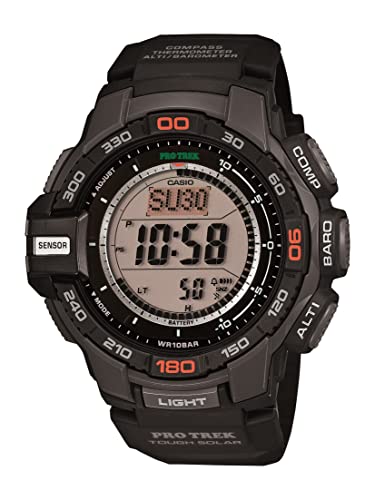
Casio Men's Pro Trek PRG-270-1 Tough Solar Triple Sensor Multifunction Digital Sport Watch


Long-term care and knowing when a reading deserves suspicion
A compass watch that is carried for years develops a history, and that history should inform how much trust each new reading receives. Seals dry gradually, straps crack at flex points, and a case that has absorbed a severe impact may continue keeping time while hiding damage that only becomes apparent during the next immersion or the next sensor calibration. Manufacturer service guidance exists for this reason, recommending inspection when water resistance is critical and whenever condensation appears inside the glass, a symptom that should never be dismissed as harmless. Condensation signals that moisture has crossed a barrier designed to exclude it, and continued use around water after that warning risks corrosion of the module and sensor contacts. Prompt assessment protects both the timekeeping and navigation functions, and it preserves the option of restoring the watch to full specification rather than replacing it after preventable internal damage spreads.
Suspicion is a skill in its own right, and experienced navigators cultivate a set of triggers that prompt a second measurement rather than immediate obedience to the display. A bearing that disagrees sharply with the visible position of the sun for the time of day, a reading that changes dramatically after walking only a few steps, a direction that contradicts a known road alignment or river course, and a value that shifts when a vehicle passes nearby all belong on that list. None of these triggers proves the watch wrong; each one identifies a moment where the cost of checking is trivial compared with the cost of walking confidently in a mistaken direction for half an hour. Building the pause into personal routine is the single most valuable habit a new owner can develop, because instruments fail quietly far more often than they fail dramatically.
Storage between trips also shapes readiness. Solar models benefit from periodic light exposure even when unworn, plain battery models should not be left with a depleted cell inside for extended periods, and every model benefits from clean, dry storage away from strong magnetic sources such as speakers and magnetic cabinet latches. Keeping the manual, or at least the module number, recorded alongside other outdoor equipment details ensures that calibration and declination procedures can be retrieved quickly before a departure rather than reconstructed from memory under time pressure. When a watch is eventually passed on, sold, or given to a younger family member beginning outdoor training, sharing those documented procedures and the known service history turns a simple handover into a genuinely useful transfer of a working navigation tool.
Ultimately, a buyer who works through sensor generation, calibration demands, display clarity, case fit, and power discipline before choosing will own a watch whose compass earns a place in real route decisions, season after season, rather than a novelty feature recalled only when a listing photograph is admired again.
That combination of preparation, scepticism, and documented specification is what separates a dependable compass watch from a decorative one, and it is achievable by any careful buyer willing to read a manual closely, practise calibration in a familiar open space before depending on it in unfamiliar terrain, and treat every important bearing as a claim to be confirmed rather than a command to be followed without question or reflection.


