Our Top Picks


What's inside
- Analog watches for kids learning to tell time, chosen for teaching clarity
- Dial markings that teach minutes, not just hours
- Hour and minute hands in different colours
- Case size for small wrists
- Strap security and independent dressing
- Water resistance for real childhood
- Durability, crystals and playground knocks
- Quartz accuracy and why it helps learning
- Numeral fonts and reading readiness
- The quarter-hour stepping stones
- Night visibility and bedroom routines
- Allergies, materials and skin contact
- Sizing growth and hand-me-down value
- When to graduate to an adult-style dial
- Classroom alignment and teacher language
- Value judgement for families
- Setting, care and battery routines parents should know
- Putting a teaching watch into daily routine
- A four-week practice plan families can actually keep
- Analog versus digital for the early school years
- What grandparents and carers should know
- Repairs, lost straps and other ordinary mishaps
- Choosing between character designs and plain teaching dials
- School policies, exams and classroom clocks
- Birthdays, first watches and making the gift land well
- Siblings, twins and sharing the learning curve
- Daylight saving changes as a teaching moment
- Estimating duration before reading exact minutes
- Music practice, sport and other timed pursuits
- Reading timetables, schedules and departure boards
- Sleep routines and the last reading of the day
- Travel, holidays and unfamiliar clocks
- When a watch breaks, gets lost or is outgrown
- Craft projects that reinforce the dial
- Left-handed children and wrist choice
- Responsibility, care and earning trust
- Kitchen clocks and the wider analog household
- Questions children ask, answered honestly
- Counting in fives: the bridge skill in detail
- The hour hand between numerals: the hardest idea
- Half past, quarter past and the language of fractions
- Choosing dial colours for contrast and calm
- What to do during the first week of wear
- Analog skills in a screen-filled childhood
- When the child teaches the watch: role reversal games
- Check prices on Amazon
- Final judgement: clarity first, charm second
As an Amazon Associate I earn from qualifying purchases. This post may contain affiliate links at no extra cost to you.
Analog watches for kids learning to tell time, chosen for teaching clarity
Learning to read a clock face is a developmental step built from several smaller skills: recognising numerals in a circle, understanding that two hands move at different speeds, linking the shorter hand to the hour, and eventually counting minutes in groups of five. A well-designed children watch supports each stage instead of merely shrinking an adult dial. Our research drew on manufacturer specification sheets, primary-school teaching guidance on time-telling milestones, and published durability standards for children products, so the comparison below focuses on dial architecture, hand differentiation and strap practicality rather than cartoon licensing alone.
Most children begin formal time work between ages five and seven, although exposure varies widely by household and curriculum. At that stage, a dial that prints every minute, separates the hour and minute tracks visually, and uses hands of unmistakably different length and colour removes the two most common sources of confusion. Case size, strap security and tolerance for playground knocks then decide whether the teaching tool survives long enough to finish the job. Families also considering connected options can compare best kids smartwatches for texting and calling once the analog foundation feels secure.
Dial markings that teach minutes, not just hours
The strongest teaching dials print an outer minute track with numerals at five-minute intervals, often in a second colour, alongside bold hour figures from 1 to 12. That dual track lets a child read the hour inside the circle and the minutes outside it, matching the language many teachers use in class. Dials that omit minute numerals force counting by fives from memory, a step many six-year-olds have not yet automated.
Try a kitchen-timer game built around the minute track: set a five-minute interval, ask the child to predict where the long hand will point when the bell rings, then verify together. Prediction turns passive reading into active estimation, and the printed five-minute numerals give the child a checking tool that works without adult help.
Verify the minute numerals personally by counting the printed five-minute markers around the dial; a few teaching models print only four of them and fill remaining space with decoration. Twelve clear hour figures plus twelve minute markers remains the complete configuration worth seeking.
Hour and minute hands in different colours
Colour separation works because it gives a child a verbal shortcut: follow the blue hand for hours, follow the red hand for minutes, or whichever pairing a maker chooses. Length still matters, since the minute hand should reach close to the minute track while the hour hand stops well short of it. A thin seconds hand in a third shade can motivate counting practice, although some teachers prefer no seconds hand at all during early lessons to reduce visual clutter.
Hide-and-seek with time works beautifully indoors: one person sets a secret target time a few minutes ahead, and the child must announce the exact moment it arrives by watching the dial alone. Success brings genuine delight, and near misses teach the geography of the minute track faster than any correction.
Compare hand widths side by side in photographs: the hour hand should look stubby and broad, the minute hand longer and slimmer, so silhouette alone separates them even before colour registers. Hands differing only in length, with identical width and shade, cause most early misreading.
Case size for small wrists
Teaching watches typically measure 28 to 35 millimetres across, with lug-to-lug lengths short enough to sit flat on a narrow wrist. A case that overhangs both edges twists during wear, rotates the dial away from the child, and makes reading practice frustrating. Lightweight resin or aluminium cases reduce that rotation, while a low profile under roughly 10 millimetres prevents catching on sleeves and desk edges.
Colour drills work well at the breakfast table: call out the colour of the hour hand, then the colour of the minute hand, then ask what number each one touches. Swapping the order on alternate mornings prevents the child from reciting a memorised sequence instead of genuinely looking at the dial each time.
Measure the child wrist with a fabric tape before ordering, then compare that figure against the strap range published for the exact model, because case diameter alone says nothing about fit. A strap near the end of its adjustment range on day one leaves no room for growth.
Strap security and independent dressing
Hook-and-loop straps let younger children fasten a watch without help, adjusting tightness in small increments as wrists grow. Elastic fabric bands offer similar independence and tolerate washing, while silicone straps with a conventional buckle teach a dressing skill and stay put during swimming lessons where permitted by the water rating. Pin buckles with closely spaced holes suit rapidly changing wrist sizes better than widely spaced holes.
Weigh the watch in the hand before buying; a case that feels heavy on an adult palm will feel far heavier on a six-year-old wrist by mid-afternoon. Children compensate for weight by pushing the watch up the forearm, where it twists, catches on clothing and stops being consulted altogether.
Test the fastening with the child wearing a jumper, since sleeve cuffs change wrist circumference slightly and can push a marginal fit into discomfort. The strap should hold the case steady without leaving a deep imprint after ten minutes of ordinary play indoors.
Water resistance for real childhood
Splash resistance covers handwashing and rain, yet children rarely respect fine distinctions during play. A rating marked 50 metres on the case generally aligns with showering and shallow swimming according to maker guidance, provided straps tolerate immersion and crowns remain seated. Leather bands undermine any water claim in practice, so a water-friendly strap material matters as much as case sealing itself.
Let the child practise the fastening at home for several evenings before the watch goes to school, because fumbling with a strap in a busy corridor is the fastest route to a lost watch. A fastening mastered at the kitchen table becomes automatic, and automatic fastening keeps the watch on the wrist where lessons happen.
Read the maker water guidance in full rather than trusting the number stamped on the dial, because button and crown restrictions often hide in the fine print. Some models tolerate swimming only if the crown is never pressed underwater, a condition children cannot be expected to police.
Location and messaging features belong to a different category entirely, surveyed in best 4g kids smartwatches, and most teachers prefer those devices left at home during lessons.
Durability, crystals and playground knocks
Acrylic crystals flex rather than shatter and can be polished, mineral glass offers harder scratch resistance, and resin cases absorb impacts that would dent metal. Raised bezels shield the crystal edge from direct strikes against walls and playground equipment. Replaceable straps extend service life because the strap, not the movement, usually fails first after months of stretching and mud exposure.
Match the rating to the child actual habits rather than optimistic intentions: a keen swimmer needs genuine immersion tolerance, while a child who hates water needs only protection against splashes, rain and enthusiastic handwashing. Overbuying water resistance often means a heavier case, so honesty about habits produces a better everyday fit.
Tap the crystal gently with a fingernail and listen: acrylic gives a softer, warmer note, mineral glass a crisper ring. The sound test, combined with the specification sheet, confirms which material a particular colour version actually uses before playground life begins.
Quartz accuracy and why it helps learning
A quartz teaching watch keeps the hands exactly where the lesson expects them, drifting only seconds per month under normal conditions. That reliability matters pedagogically: a child checking the school bus time needs the classroom clock and the wristwatch to agree closely enough to trust both. Battery life commonly spans one to three years depending on cell size, and a standard cell replacement keeps upkeep predictable for families.
Inspect the crystal edge and bezel after the first month of wear; early scuff patterns reveal whether the child catches the watch on a particular desk, door frame or playground structure. A simple habit change, such as swapping wrists during art lessons, can halve the rate of cosmetic damage.
Ask when the fitted battery was installed if the watch has sat in a display cabinet; a cell already two years old may fail within months of purchase. Retailers who fit a fresh cell at sale, or date the installation on the receipt, remove that uncertainty entirely.
Numeral fonts and reading readiness
Sans-serif numerals with an open 4 and a straight 1 mirror the figures children learn to write at school, reducing recognition errors. Decorative fonts, roman numerals and baton-only dials belong to a later stage once the underlying concept is firm. High contrast between numerals and background, such as black print on white or white print on deep navy, supports reading in bright playgrounds and dim bedrooms alike.
Check the time against a phone clock together once a week and celebrate agreement; that small ritual teaches the child that a watch is an instrument to be trusted and verified, not a decoration. If drift ever appears, a battery change or service visit becomes a lesson in how quartz movements work.
Hold the dial beside a school exercise book: numerals should resemble the printed figures in the child reading scheme, particularly the closed versus open forms of the four and nine. Familiar letterforms shorten the recognition work the child must do at every glance.
The quarter-hour stepping stones
Teachers usually sequence learning as o-clock first, then half past, quarter past and quarter to, before tackling individual minutes. A dial with highlighted quarter positions or subtle shading in those zones can reinforce the sequence without overwhelming the face. Practice at home works best in short bursts tied to real events: snack at half past three carries more meaning than abstract worksheet drills.
During car journeys, ask the child to read the watch at each landmark and predict the reading at the next one, five or ten minutes later. Travel supplies natural intervals, changing scenery keeps attention fresh, and arrival comparisons reward accurate prediction with the small triumph of being right in public.
Practise the quarter positions with a snack schedule for one weekend, announcing quarter past and the quarter before the hour moments as they arrive. Two days of lived examples usually fix the quarter concepts more firmly than a month of occasional worksheet questions.
Night visibility and bedroom routines
Simple luminous hands help a child check whether it is truly morning during winter darkness, although strong glow is unnecessary for a teaching watch. Some models add a small backlight on hybrid designs, a feature that can distract from hand-reading if overused. For pure analog learning, modest lume on the two main hands strikes a sensible balance for bedtime checks.
Read the dial font aloud together: trace each numeral with a fingertip and say its name, paying special attention to the open shape of the four and the single stroke of the one. Children who have physically traced the figures recognise them faster at a glance during hurried moments between lessons.
Check whether luminous material covers the full length of both hands or only their tips; tip-only coverage can mislead a sleepy child about hand direction in darkness. Full-length coverage on the minute hand matters most, because that hand carries the information children check at night.
Screen-based alternatives for homework time appear in best headsets for kids coverage of audio gear and in tablet guides, yet neither replaces the glanceable, always-on lesson a wrist dial provides.
Allergies, materials and skin contact
Nickel sensitivity appears in a minority of children, so makers who disclose case-back materials and offer resin or coated options give parents useful information. Fabric straps should be washable, silicone straps should be smooth without sharp moulding edges, and buckles should sit flat without pressing a single point into the wrist. A watch abandoned because it itches teaches nothing, however brilliant its dial design may be.
Build a paper plate clock with movable hands and park it beside the wristwatch at homework time; moving the plate hands to copy the watch, then reversing the direction of copying, exposes the common error of placing the hour hand exactly on a numeral regardless of minutes elapsed.
Run a fingertip across the case back and strap edges hunting for any sharp moulding seam, especially where the strap meets the lugs. Seams that feel invisible to an adult thumb can still rub a smaller, more sensitive wrist during a long school day.
Sizing growth and hand-me-down value
A teaching watch often serves siblings in sequence, so a unisex dial, a replaceable strap and a common battery size raise its household value. Colours tied too tightly to a single cartoon season date the piece quickly, whereas primary colours and classic navy or black straps transfer between children without complaint. Keeping the instruction card, which often prints a practice clock on the reverse, helps the next learner start fresh.
During dark winter mornings, make a game of reading the watch before switching on the bedroom light, using only whatever glow the hands provide. The exercise teaches the child the limits of luminous paint honestly, and motivates keeping a small bedside lamp within reach for precise checks.
Confirm that spare straps for the chosen model are sold separately and in more than one colour, because a strap that cannot be replaced turns a minor tear into the end of the watch teaching life. Standard lug widths make that search far easier.
When to graduate to an adult-style dial
Signs of readiness include reading individual minutes without counting aloud, estimating quarter hours at a glance, and asking about 24-hour notation or seconds. At that point a cleaner dial with batons, a date window or a rotating bezel becomes a rewarding step rather than a barrier. Rushing that graduation risks replacing a mastered tool with a prettier obstacle, so timing the switch to confidence rather than birthdays works better.
Before the first wear, hold the strap and case back against the inside of the child elbow for a few minutes during a story; any early itch or redness warns of sensitivity while the watch can still be exchanged. Repeating the check after a sweaty afternoon gives a fuller picture.
Notice whether the child spontaneously glances at the watch during the first week; spontaneous checking signals that the dial has become a tool rather than a novelty. A watch consulted only when prompted may have a legibility problem worth solving early.
Classroom alignment and teacher language
Asking a teacher which terms the class uses, such as minutes past and minutes to, helps parents reinforce identical wording at home. Some curricula introduce the minute hand first through counting, others anchor on the hour hand position between numerals. A watch whose dial supports both approaches, with clear hour figures and a complete minute track, avoids conflict between home practice and school method.
Photograph the watch on the child wrist at purchase and again six months later; the comparison shows growth clearly and helps judge when a longer strap or larger case will be needed. Siblings inheriting the watch benefit when that photo record travels with the box and spare strap.
Compare the vocabulary on the dial, such as past and to labels where fitted, with the terms the school uses, since conflicting labels create hesitation. A dial without such labels avoids the conflict entirely and lets classroom language lead.
Value judgement for families
Value in this category comes from teaching clarity, strap replaceability, water tolerance matched to the child habits, and a movement that keeps honest time for years. Decorative extras that do not serve those goals add fragility rather than worth. A modest resin model with an exemplary dial routinely outperforms a licensed character watch whose hands are nearly identical in length and colour.
Invite the child to explain the dial to a younger cousin or a grandparent on a video call; teaching a skill aloud is the strongest evidence that it has settled. Stumbles during that explanation point precisely at the concept needing another week of gentle practice.
Assess the clasp and crown for small-finger operation: a crown too tiny to grip frustrates time-setting practice, while an oversized crown digs into the wrist during writing. Balanced proportions, verified by handling the actual piece, beat catalogue photographs every time.
Setting, care and battery routines parents should know
Set the time by advancing hands clockwise where the maker recommends it, keep the crown pushed home afterwards, and rinse a water-rated model in fresh water after beach days to clear sand from strap and case joints. Store the watch flat rather than hanging by its strap, which stretches elastic prematurely. Noting the battery change date on the box helps predict the next replacement before a school trip depends on it.
Ask the class teacher which clock the classroom uses and whether its face matches the wristwatch style; a child moving between a roman-numeral classroom clock and an Arabic-numeral watch faces an extra translation step. Aligning the two faces, where possible, removes friction from daily practice.
After setting the time, gently pull the crown to confirm it returns fully home with a positive feel; a crown left slightly out invites moisture and stops some movements. Teaching the child that final push as part of the setting ritual protects the watch for years.
Putting a teaching watch into daily routine
Anchor practice to moments the child already cares about: departure for school, the start of a favourite programme, countdown to a friend arriving, or the final ten minutes before bedtime stories. Each anchor converts an abstract dial position into a lived interval, and repetition across weeks does more than any single long lesson. Praise precise reading, correct gently by pointing at the relevant track, and let the child announce the time to the household once confidence builds, because teaching others consolidates the skill remarkably fast.
Keep expectations matched to developmental stages documented by educators: many five-year-olds master o-clock, six-year-olds add half and quarter hours, and confident minute reading often settles during the following school year. A watch that supports that whole arc, with complete minute markings and durable construction, avoids a mid-process replacement just as practice becomes daily habit. Creative families sometimes pair analog practice with drawing exercises from best graphic tablets for kids, sketching clock faces to reinforce numeral placement.
Quick checks before choosing
- Minute numerals printed: every five minutes marked outside the hour track.
- Hands unmistakably different: colour, length and width all separate hour from minute.
- Case fits today: lugs stay within the wrist width without overhang.
- Strap fastens independently: the child manages it alone within a week.
- Rating matches habits: water tolerance chosen for swimming, baths or splashes only.
Taken together, those checks favour clarity over decoration every time. A teaching watch succeeds when it quietly disappears into routine, consulted at breakfast, glanced at during play, and trusted at bedtime, until one day the child reads a plain adult dial without thinking and the training wheels are no longer needed.
A four-week practice plan families can actually keep
Week one belongs to o-clock and half past, anchored to meals and departures the child already anticipates. Week two adds quarter past and quarter to, introduced through a favourite programme start time. Week three brings counting in fives around the full dial, using the printed minute numerals as a checking rail. Week four mixes everything in random order, with the child setting a toy clock from the wristwatch and then reversing the exercise.
Keep each session under ten minutes and end on a success, however small, because confidence compounds faster than correction. A simple chart on the refrigerator, ticked by the child, makes progress visible to the whole household and turns practice into a shared project rather than a test administered by adults.
Analog versus digital for the early school years
Digital displays state the time as a number to be read aloud, while analog faces show time as a position to be understood, including how much of an hour has passed and how much remains. That spatial sense supports later mathematics: fractions of an hour, elapsed time problems and timetable reading all lean on the circular model. Teachers therefore often ask families to keep an analog clock visible at home even when digital devices surround the child.
The two formats coexist happily once the analog foundation settles. A child who reads hands confidently treats a digital display as a shortcut rather than a crutch, and can move between a classroom wall clock, a wristwatch and a phone screen without confusion in any direction.
What grandparents and carers should know
Consistency across households matters: if one home uses minutes past language and another uses digital-style wording such as four forty-five, the child hears two systems for one concept. Agreeing on shared terms, and on which wrist the watch lives, prevents well-meant help from becoming mixed signals. Carers should also know the strap fastening the child manages independently, so assistance does not accidentally tighten the watch into discomfort.
A short note kept with the watch, listing its water limits and battery type, helps any adult supervising swimming or bath time. That note turns the watch from a parent-only responsibility into a household object everyone can look after correctly.
Repairs, lost straps and other ordinary mishaps
The commonest mishaps are mundane: a torn strap hole, a lost spring bar, a flat battery, a crystal scratched by a playground wall. Each has a cheap, quick remedy when the model uses standard parts, which is another argument for common lug widths and common cell sizes. Keep the removed old strap as a template when shopping for replacements, because its width and length settle sizing questions instantly.
If the hands ever disagree with a trusted clock by an erratic amount rather than a steady drift, the movement may have taken a knock that shifted a hand on its post. A watchmaker reseats hands quickly, and the repair visit itself can fascinate a child who is allowed to watch the case being opened.
Choosing between character designs and plain teaching dials
Licensed characters motivate some children powerfully, and motivation has genuine teaching value; a beloved figure can carry a child through the first fortnight of practice. The risk arrives when character art crowds the minute track, replaces numerals with symbols, or paints both hands in matching colours for visual harmony. Some licensed models keep exemplary teaching dials beneath the artwork, so the category deserves inspection rather than dismissal.
Apply the thumb test described earlier, check hand separation in a real photograph, and let the child choose between two finalists that both pass the legibility checks. Ownership of the choice increases wear time, and wear time is where the learning actually happens.
School policies, exams and classroom clocks
Some schools restrict connected watches during the day while welcoming plain analog models, a distinction worth confirming before purchase. In early assessments, children may meet clock questions on paper that mirror the wristwatch dial, so familiarity transfers directly. A watch that matches the classroom clock style, Arabic numerals and a full minute track, gives the child daily rehearsal for those questions without any sense of studying.
During school trips, a teaching watch helps children meet regrouping times independently, a small responsibility teachers appreciate. Choosing a strap colour visible at a distance also helps staff spot which child owns a watch found on a bench, a mundane detail that saves end-of-day confusion.
Birthdays, first watches and making the gift land well
A first analog watch often arrives as a birthday gift, and presentation shapes how the child receives the learning that comes with it. Present the watch alongside a simple promise, such as being trusted to announce when it is time to leave for a party, and the object becomes a badge of growing competence rather than a lesson in disguise. Letting the child choose between two pre-checked dials preserves that feeling of ownership while keeping legibility standards intact.
Include the spare strap and battery information in the gift box, and write the date of the first battery inside the lid for future reference. Grandparents giving the watch may enjoy adding a handwritten card naming one daily moment, like breakfast, when the child can practise reading for the family, turning relatives into allies of the routine from the very first morning.
Siblings, twins and sharing the learning curve
Households with siblings close in age face a familiar question: one watch each, or one shared teaching watch passed between wrists. Separate watches in different strap colours prevent timetable clashes on school mornings and let each child progress at an individual pace. A shared watch can still work for deliberate practice sessions at the table, provided daily wear belongs clearly to one child at a time.
Twins learning together often race each other to announce the time, a game that accelerates both learners when adults keep it light and never use it to rank them. Staggering their practice anchors, one child announcing departure time and the other bedtime, gives each a personal domain of expertise. Younger siblings watching this theatre absorb the vocabulary of hours and quarters long before their own formal lessons begin.
Daylight saving changes as a teaching moment
Twice a year, in regions observing seasonal clock changes, households move every clock by one hour, and an analog watch turns that abstract shift into a visible event. Invite the child to advance the hands personally, counting the full circle of the minute hand, and the phrase clocks go forward stops being mysterious. The same ritual in autumn, turning hands back where the maker permits or forward eleven hours where it does not, teaches mechanical care alongside time knowledge.
Expect a few days of body-clock confusion afterwards and use the watch to explain why: the dial says breakfast time while the stomach disagrees. Children who grasp that distinction early handle travel across time zones with unusual calm, because they already understand that clock time is a shared agreement layered over physical rhythms.
Estimating duration before reading exact minutes
Before children read minutes precisely, they can learn duration: how long a boiled egg takes, how a five-minute hand journey looks, how the minute hand creeps while a story unfolds. A teaching watch supports that sense every time a child watches the long hand travel between two printed numerals during a real activity. Estimation games, guessing when five minutes have passed and then checking, sharpen an internal clock that exact reading later refines.
Teachers value that estimation skill because elapsed-time problems in mathematics assume it. Parents can nurture it during cooking, toothbrushing and timed tidying games, always letting the watch arbitrate fairly. A child who feels five minutes in the body as well as reading it on the dial owns time in a way that worksheet exercises alone rarely achieve.
Music practice, sport and other timed pursuits
Instrument practice runs on minutes: scales for five, a piece repeated until the long hand reaches the next marker, a break earned at the half hour. A wristwatch on the young musician keeps those bargains visible without a phone in the room. Coaches use the same visibility for drills, asking players to check their own watches for regrouping times and building independence during training sessions.
Swimming instructors, where a suitably rated watch may join the lesson, sometimes ask children to read the poolside clock and compare it with their wrist, reinforcing transfer between dial sizes. In every setting the principle repeats: real tasks, honestly timed, teach faster than drills invented purely for practice, and the watch becomes equipment for the activity rather than homework worn on the wrist.
Reading timetables, schedules and departure boards
Bus timetables, library opening boards and train departure lists all presume a reader who can compare a printed time with the current one and judge the gap. A child fluent with an analog dial performs that comparison spatially, seeing at a glance how far the hands must travel before departure. Practise at home with a pretend timetable for the day, written together each morning, and let the child tick off events as the watch confirms them.
That pretend schedule can include one delightful event and one chore, teaching that timetables govern both. Within weeks, many children begin drafting their own schedules for weekend plans, complete with optimistic timings that adults can gently reality-check. The organisational habit outlasts the teaching watch itself and feeds directly into homework planning in later school years.
Sleep routines and the last reading of the day
Bedtime is where a teaching watch earns unusual trust: the child checks the dial, confirms story time has arrived, and later verifies that lights-out time matches the household agreement. That verification role reduces nightly negotiation, because the watch acts as a neutral referee both sides accept. Choosing a dial readable in lamplight, without dazzling glow, keeps the routine calm.
Some families park the watch on the bedside table overnight, where its ticking or silent quartz presence becomes part of the room soundscape. A child who wakes early can check whether the agreed rising time has arrived before calling out, a small independence that parents of early risers value enormously during dark winter months.
Travel, holidays and unfamiliar clocks
Holiday travel confronts children with station clocks, church towers and hotel lobby dials in unfamiliar styles, and a trusted wristwatch becomes their reference instrument. Encourage comparisons: read the tower clock, then check the wrist, and discuss any difference honestly. Crossing time zones offers the setting ritual described earlier, performed by the child under supervision, which converts jet lag confusion into a mechanical ceremony they control.
On camps and school residentials, a personal watch replaces the phone many venues prohibit, letting the child meet meal and activity times independently. A strap colour chosen for visibility and a name written inside the strap reduce loss risk in dormitory settings. Returning home with the watch still on the wrist is itself a small rite of passage worth celebrating.
When a watch breaks, gets lost or is outgrown
Losses happen, and the adult response teaches as much as the watch did. Treat a lost teaching watch as a prompt to retrace the day together, checking the usual resting places, before discussing replacement. Children who help search, and who contribute pocket money or patience to a replacement timeline, guard the next watch noticeably better.
Outgrowing is happier: the strap reaches its last hole, the case looks small, and the child reads any dial fluently. Mark the moment by letting the graduate choose the next watch style personally, perhaps a cleaner adult-style face, and retire the teaching watch to a drawer or a younger sibling with its instruction card, battery date and a note about its first owner.
Craft projects that reinforce the dial
A cardboard clock built at the kitchen table, with split-pin hands the child colours to match the wristwatch, doubles the learning surface. Drawing clock faces in a notebook, each showing a personally meaningful time such as football practice or a grandparent call, fixes numeral positions through the hand as much as the eye. Some children enjoy photographing their watch at interesting moments and assembling a small album of times.
These projects work because they reverse the usual direction: instead of only reading times set by others, the child creates times and defends them. A drawing where the hour hand sits wrongly for the stated minutes invites gentle correction from the child own wristwatch, which has become the household authority on the subject.
Left-handed children and wrist choice
Most children wear a first watch on the non-dominant wrist, which for left-handed writers means the right wrist, keeping the case clear of desk friction during handwriting. Crown position then sits toward the elbow rather than the hand on some orientations, reducing accidental knocks while writing. A few children simply prefer the dominant wrist, and comfort should win, because a watch worn happily teaches more than a correctly placed watch left at home.
Check for rubbing where the buckle meets the desk edge during writing posture, a friction point specific to the dominant wrist. Moving the watch slightly higher on the forearm during long writing sessions, then back for ordinary wear, is a compromise many left-handed adults still use and can pass on early.
Responsibility, care and earning trust
Owning a watch introduces a first cycle of personal maintenance: wiping the case, parking it in the same place nightly, reporting a loose strap before it fails. Parents can formalise that cycle lightly, a Sunday check together, without turning care into inspection. The child who notices a fading battery or a fraying strap hole and reports it has learned instrument stewardship that transfers to bicycles, instruments and eventually far larger machines.
Trust grows in steps: wearing the watch to school, then to sport, then on a residential trip. Each step passed without loss or damage is evidence the child can cite when asking for the next privilege, and the watch quietly becomes a record of reliability that the whole family recognises.
Kitchen clocks and the wider analog household
A child learning on the wrist benefits when the home itself speaks analog: a kitchen clock with clear numerals, a hallway clock visible during the morning rush, perhaps a bathroom clock for timed toothbrushing. Each additional dial is another rehearsal stage using the same visual language. Matching the style family, Arabic numerals and clear minute tracks, across those clocks avoids contradictory designs during the learning months.
Once fluency arrives, variety becomes enrichment rather than confusion, and the child reads roman numerals at a relative house or batons at a station with curiosity instead of anxiety. Families often find the adults benefit too, glancing at a real dial for the time remaining before departure instead of unlocking a phone and falling into messages.
Questions children ask, answered honestly
Why does the hour hand move if nobody pushes it? Why are there sixty minutes when the dial shows twelve numbers? Why does the watch tick, or not tick? Each question opens a small door into gears, history and the Babylonian origins of base-sixty counting. Answer at the level the child can hold, demonstrate with the toy clock, and admit cheerfully when a question deserves a library visit rather than a guess.
Recording favourite questions in the same notebook as the daily interesting times turns curiosity into a family archive. Years later, that notebook beside the retired teaching watch tells the story of a skill being built, question by question, more vividly than any school report on the topic.
Counting in fives: the bridge skill in detail
Every teacher of early mathematics recognises the moment a child stops counting minutes one by one and begins leaping in fives around the dial. That leap depends on fluent five-times knowledge, which is why printed minute numerals matter so much: they let the child check each leap against a visible landing point. Practise away from the watch as well, clapping in fives while walking or climbing stairs, so the rhythm lives in the body before the eyes must find it on a small dial under time pressure.
When a leap goes wrong, return to the dial and trace the five markers with a fingertip, saying each landing number aloud. The tactile circuit, eye following finger following voice, repairs the sequence far more reliably than verbal correction alone. Within a few weeks of such tracing, most children begin landing on the correct five without touching the dial, and the remaining task is adding the single minutes beyond the last marker, a counting-on skill that schools teach in parallel.
The hour hand between numerals: the hardest idea
Ask a room of six-year-olds where the hour hand points at half past four and many will place it exactly on the four, because their mental model assigns each hand a single numeral. Understanding that the short hand drifts continuously, sitting halfway toward five by half past, is the conceptual summit of early time learning. A teaching watch helps because the child can watch that drift happen across a real afternoon, checking the hand position against activities whose times are known.
Draw attention to the drift deliberately: at o-clock the hand sits squarely on its numeral, by quarter past it has visibly left home, by half past it patrols the border between two numbers. Naming that journey gives the child language for the observation. Once the drifting hour hand makes sense, the commonest error in school clock worksheets, placing the hour hand with no regard to minutes, usually disappears within days.
Half past, quarter past and the language of fractions
Time vocabulary smuggles fractions into daily speech long before mathematics lessons name them: half an hour, a quarter of an hour, three quarters gone. A child fluent with those phrases on a dial meets formal fraction work with a picture already installed, the circle divided by hands they have watched all year. Parents can strengthen the link by using the same words for pizza slices, cake portions and the watch face within a single week, letting one idea illuminate the others.
Regional wording varies, with some households saying half four to mean half past four and others hearing it as half before five, a famous source of cross-family confusion. Whatever the household dialect, consistency at home plus awareness that other expressions exist prepares the child for teachers, relatives and friends who may speak differently about the identical dial position.
Choosing dial colours for contrast and calm
White dials with black printing offer the strongest contrast in daylight and photograph most clearly in catalogues, which is why so many teaching models default to that scheme. Dark dials with pale printing can read equally well and show playground grime less obviously, though they demand bolder print to match the white dial performance in shade. Brightly coloured backgrounds sit between the two, delightful to children and perfectly legible when the printing stays black or white rather than a third competing colour.
Let the child handle colour choice within a shortlist that already passes contrast checks, because a favourite colour worn daily beats a theoretically ideal dial left in a drawer. Avoid dials where numerals share the background hue family, such as pale blue figures on a mid-blue face, however attractive they appear under shop lighting designed to flatter them.
What to do during the first week of wear
Day one should be ceremonial and light: fit the strap together, set the time together, and ask for the time at three predictable moments. Across the first week, scatter questions through ordinary life rather than scheduling formal tests, and answer every child-initiated time announcement with genuine attention. If the watch comes off for sport or art, agree on its single parking place at home and at school, because most early losses are really parking failures.
By the end of that week, review fit again; new straps stretch slightly, fabric bands especially, and a watch sliding toward the hand gets consulted less. Note which concept the child now handles confidently and which still wobbles, then aim the following week practice at the wobble while keeping the mastered skill in casual use so it stays warm.
Analog skills in a screen-filled childhood
Children today meet digital time everywhere, on ovens, tablets and car dashboards, which raises a fair question about why analog fluency still matters. Part of the answer is institutional: classrooms, examination halls, stations and many workplaces still display analog faces. A larger part is cognitive: the dial teaches proportion, fraction and estimation in a single glanceable instrument, a density of ideas no seven-segment display attempts to carry.
There is also a quieter benefit. An analog watch offers its owner the time and nothing else: no notifications, no games, no messages competing for attention during lessons or family meals. In a childhood negotiated against many persuasive screens, a single-purpose instrument that a child chose, wears and maintains carries a lesson about tools themselves that extends well beyond telling the time.
When the child teaches the watch: role reversal games
Set a stuffed toy in a chair as the pupil and let the child deliver a two-minute lesson on reading the dial, complete with pointing and examples. Adults listening will hear precisely which ideas are secure and which are recited without understanding, information no worksheet returns so clearly. Follow with questions from the toy, voiced by the adult, pitched just beyond the child current level to stretch without discouraging.
Recording that lesson on a phone, with permission and purely for the family, creates a keepsake that demonstrates progress when replayed months later beside a second recording. Children delight in hearing their earlier explanations and correcting them, a metacognitive exercise teachers prize. The game costs nothing, needs no preparation beyond the toy, and reliably produces the household most animated time discussions.
Check prices on Amazon
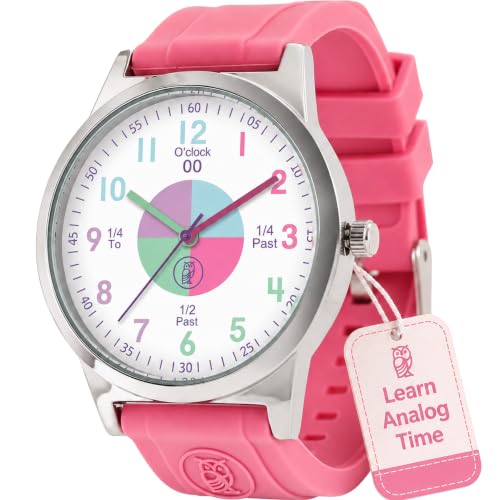
Live listings for the shortlist in this guide are pulled from Amazon below, so prices and availability are always current at the moment you look.


Final judgement: clarity first, charm second
Every criterion in this guide returns to one ordering: the dial must teach clearly before it charms, the strap must stay secure before it decorates, and the case must survive the playground before it impresses anyone. Within those constraints, charm, colour and character all have their place, because a watch the child loves gets worn, and a worn watch teaches. The ideal purchase is therefore not the plainest model available but the clearest model the child genuinely wants to put on each morning.
Hold that ordering during the final shop comparison, thumb over the artwork, hands checked for separation, numerals counted in fives around the track, strap fastened by the child unaided. A model passing those four tests in the shop will very likely still be teaching, and being worn with pride, when the school year turns and the class moves on to timetables, calendars and the wider mathematics of time.
Keep one small tradition as the learning year closes: on the last day of each school term, ask the child to read the watch at a favourite moment and write that time, with a sentence about what was happening, into the notebook started months earlier. Those dated entries accumulate into a miniature diary of competence, each line steadier than the last, and the final entry of the year usually records a time the child read entirely alone, outdoors, mid-game, without any adult prompting at all, which is precisely the independence the whole project set out to build from the first morning.
Readers should know that certain outbound links in this article are affiliate links, meaning a commission may be received if a purchase follows, at no additional cost to the buyer. Editorial selection relied on dial legibility research, published specifications and child-development guidance about time-telling stages, independent of any retail relationship.
When a child finally announces the time correctly to a grandparent over the phone, proud and unprompted, the humble teaching dial has done the finest job any small instrument can do.