Our Top Picks
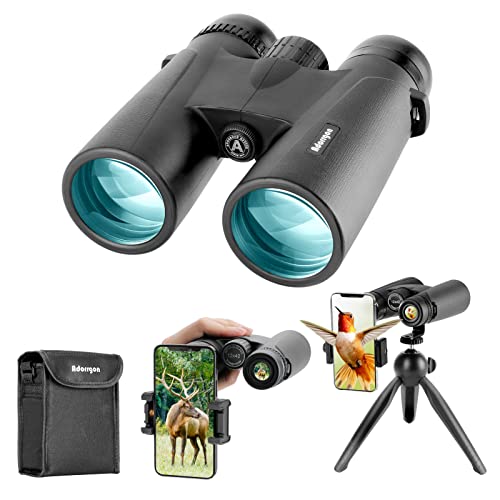 Adorrgon 12x42 High Powered Binoculars for Adults12x425.75 x 4.95 x 2.1 inches1.1 poundsCheck on Amazon


What's inside
- Why glasses change everything about binocular fit
- Eye relief in depth: reading the number like an engineer
- Twist-up eyecups, and why click stops matter
- Diopter adjustment: the setting glasses wearers must not skip
- Interpupillary distance and the hinge that sets it
- Exit pupil, brightness, and the glasses connection
- Field of view: what glasses quietly take away
- 8×42 versus 10×42 for the glasses wearer
- Prisms: BAK4, BK7, and roof versus Porro
- Coatings, transmission, and what multi-coated really means
- Build details that decide daily comfort
- A fitting routine you can repeat anywhere
- Prescriptions, astigmatism, and observing without glasses
- Care, adjustment records, and long-term ownership
- Use cases: where the specifications land in real life
- How to read a listing and spot weak evidence
- Frequently confused terms, clarified once
- Check prices on Amazon
- Disclosure
As an Amazon Associate I earn from qualifying purchases. This post may contain affiliate links at no extra cost to you.
Why glasses change everything about binocular fit
A binocular is designed around an assumed eye position, and glasses quietly move that position. Without spectacles, the eye can nestle close to the ocular lens, brow nearly touching the eyecup, and the full image circle the instrument projects will land comfortably on the retina. Add a spectacle lens, its frame, the nose pads holding that frame away from the face, and the clearance needed to keep eyelashes and glass from colliding, and the pupil ends up 10 millimetres or more farther back than the designer assumed. If the binocular cannot project its image usefully across that extra distance, the view collapses into a narrow tunnel with darkened edges.
The specification that governs this relationship is eye relief, defined as the distance from the outer surface of the ocular lens, or from the rim of the folded eyecup depending on the makers convention, to the point where the exiting light cone forms the exit pupil and the eye sees the entire field. For glasses wearers, 15 millimetres is the practical floor, and 17 to 20 millimetres provides comfortable margin for deeper frames, wrap-style sunglasses, and the small variations in how different frames sit on different noses. Below that floor, no amount of optical excellence elsewhere in the instrument can rescue the experience, because the wearer literally cannot see the field the optics produce.
Our research draws on manufacturer specifications, standard optical definitions published across the industry, and the arithmetic that connects magnification, objective size, and brightness. That arithmetic is refreshingly checkable. Exit pupil equals objective diameter divided by magnification, so the figure for any model can be verified with a pocket calculator in seconds. Field of view converts between degrees and metres at a kilometre by a fixed relationship. A buyer armed with those two formulas and a tape measure for interpupillary distance can evaluate claims in this category with unusual confidence, without relying on any reviewers impressions.
The symptoms of insufficient relief are distinctive once recognised. The image appears as a bright circle floating inside a much larger black surround. Turning the eyes to look toward the edge of the field causes the view to black out on the opposite side, a phenomenon sometimes called kidney-bean blackout when it takes a curved shape. Small head movements make the image swim in and out of visibility, and after twenty minutes the wearer develops a headache that gets blamed on the optics generally rather than on eye placement specifically. Every one of those symptoms can be produced by a superb binocular used at the wrong eye distance, and cured by a modest one used at the right distance.
It is worth stating plainly that wearing contact lenses removes most of this problem, since the eye can approach the eyecup as closely as a bare eye can. This guide addresses the many observers who wear spectacles outdoors by preference or necessity: people whose prescriptions include strong astigmatism correction poorly served by contacts, people who switch between distance glasses and reading glasses during an outing, birders who wear photochromic lenses that darken in sunlight, and anyone whose eyes dislike lenses after long hours. For all of them, the binocular must come to the glasses, not the other way around.
Eye relief in depth: reading the number like an engineer
Published eye relief figures carry an ambiguity that informed buyers should understand. Some manufacturers measure from the surface of the last lens element, others from the rim of the eyecup in its lowest position, and the difference between those reference points can reach 3 or 4 millimetres, which is a quarter of the entire budget a glasses wearer has to work with. A model claiming 17 millimetres from the lens surface may deliver less usable relief than a rival claiming 15 millimetres from the cup rim. Specification sheets that state the measurement convention are therefore more trustworthy than those printing a bare number, and the discrepancy explains many contradictory owner reports about the same instrument.
Usable relief also shrinks with eyecup position. Twist-up cups exist partly to serve non-glasses wearers, who need the cup extended to hold their eyes back at the correct distance. Each click stop a glasses wearer raises the cup, perhaps to stop spectacle lenses touching the ocular surround, consumes relief millimetre for millimetre. A design with generous headline relief tolerates one raised stop without penalty; a design at the 15 millimetre floor leaves no such freedom, forcing a choice between scratched spectacle lenses and a cropped field. Margin, in this specification, is not luxury. It is working room.
Frame geometry interacts with relief in ways no single number captures. Deep frames with large vertical lens dimensions hold the eye farther from the ocular than slim frames do. Frames with pronounced wrap curve the spectacle lens around the face, moving its centre closer but its edges into the eyecups path. Rimless and half-rim designs sit closer than full acetate frames. Observers who own several pairs should evaluate a candidate binocular wearing the pair they actually take outdoors, which for many people is an older, sturdier frame rather than the newest one, and the difference between frames can reach 2 millimetres of effective eye position.
There is also a dynamic element. Eye relief is specified for a static eye looking straight ahead, but real observing involves scanning, and the human eye rotates in its socket to follow subjects within the field. When the eye rotates, the pupil moves on an arc around a centre roughly 13 millimetres behind the cornea, which changes its distance from the ocular depending on gaze direction. Long-relief designs absorb that movement gracefully; short-relief designs punish it with the edge blackouts described earlier. This is why two binoculars with identical printed relief can feel different in use, and why published figures should be treated as a strong filter rather than a final verdict.
Shoppers comparing optics across categories will find the same specification governing camera viewfinders and rifle scopes, though the numbers differ by application. Someone browsing best 20x optical zoom compact cameras will encounter electronic viewfinders with their own relief figures, and the habit of checking that number before falling for resolution statistics transfers directly from binoculars to cameras and back again.
Twist-up eyecups, and why click stops matter
The eyecup is the mechanical interface between instrument and face, and its design decides whether the theoretical relief of the optics is reachable in practice. The simplest cups are rubber sleeves that fold down for glasses and stand up for bare eyes, offering exactly two positions. Twist-up cups, now standard on serious glasses-friendly models, rotate on a helical thread or cam and lock at several intermediate heights, typically three or four stops spanning about 8 millimetres of travel. For a glasses wearer the lowest stop is home base, but the intermediate stops earn their value when sunglasses add frame depth or when a hat brim forces a slightly different head angle.
Detent quality separates good cups from frustrating ones. A well-made stop clicks positively and resists the rotational pressure of being pressed against a face all afternoon. A poor one drifts downward mid-session, silently stealing field until the wearer notices the tunnel closing in. Because both barrels have independent cups, asymmetric drift produces the maddening situation where one eye sees a full field and the other sees a crescent. Specification sheets rarely describe detent strength, but cups machined from metal or glass-filled polymer with defined stops consistently outlast soft rubber mechanisms, and replaceable cup assemblies, offered by some makers as spare parts, extend the useful life of the whole instrument.
Cup diameter and shape deserve the same scrutiny as height. The opening must clear the spectacle frame without pressing on it, since pressure transmitted through the frame bends it slightly and shifts the wearers own lenses off their prescribed alignment. Outer diameters around 40 to 44 millimetres suit most adult frames, while compact binoculars with cups under 36 millimetres can crowd wide frames badly. Flared or contoured rims distribute contact over a larger area of the frame and brow, reducing the localised pressure that leaves marks on the nose bridge after a long morning at a migration watchpoint.
Hygiene and maintenance of cups are minor but real considerations. Sunscreen, insect repellent, and skin oils accumulate on the rim, and some repellent formulations attack rubber compounds, turning them tacky over a single summer. Wiping cups with a damp cloth after outings, storing the instrument with cups in their lowest position to relax any spring elements, and keeping repellent-treated hands away from the rubber all prolong the life of the assembly. When cups do degrade, instruments designed for user replacement of the cup unit spare the owner a full factory service visit.
Diopter adjustment: the setting glasses wearers must not skip
Most binoculars focus both barrels together with the central wheel, then allow one barrel, usually the right, to be trimmed independently through a diopter control. That trim compensates for the difference in refractive error between the users two eyes. Spectacle wearers sometimes assume their glasses make the diopter setting irrelevant, but glasses correct each eye to a target that may still differ slightly between eyes, prescriptions change at different rates on each side, and many people observe with glasses pushed up or removed for short looks. A diopter range of minus 4 to plus 4 covers the great majority of inter-eye differences; narrower ranges on budget models can leave some users with one barrel permanently soft.
The correct setting procedure takes two minutes and should be repeated whenever glasses change. Cover the right objective, focus the left barrel on a distant, detailed target using the central wheel, then cover the left objective and, without touching the central wheel, rotate the diopter control until the right-eye image is equally sharp. Note the resulting value on the diopter scale. Quality instruments hold that setting firmly; inferior ones place the control where a finger brushes it during normal focusing, so the setting migrates and the user chases sharpness all day without understanding why. Locking diopter rings, found on some models, eliminate that failure mode entirely.
Diopter scales also serve as a diagnostic record. A setting that drifts steadily in one direction over a year may signal a changing prescription worth raising at the next eye examination, particularly if the change exceeds one diopter. Conversely, a binocular that suddenly needs a very different setting from its recorded value has likely taken a knock that shifted an internal element, and continued use will strain the eyes as they fight the imbalance. Glasses wearers, who already manage one optical system on their face, tend to appreciate this kind of early warning more than most users.
Interpupillary distance and the hinge that sets it
The two barrels of a binocular must be spaced to match the distance between the users pupils, the interpupillary distance or IPD. Adult values cluster between 58 and 72 millimetres, with the broader population spanning roughly 52 to 78 millimetres. Instruments specify their IPD range, commonly 56 to 76 millimetres on full-size models, and anyone whose measurement falls outside a models range will see two overlapping circles instead of one merged field no matter how carefully they focus. Glasses wearers should measure their IPD from their prescription record, where it is often printed as PD, or have it taken during a fitting, rather than guessing from facial appearance.
The central hinge that sets IPD must hold its angle against gravity and handling. A hinge with proper resistance stays where it is folded, allowing the user to preset the spacing and lift the binocular ready to view. A loose hinge collapses toward the narrowest position whenever the instrument hangs from a neck strap, forcing a reset at every use and wearing the joint further with each cycle. Because glasses already demand several seconds of positioning at the face, an instrument that adds hinge fiddling to every lift quickly becomes an instrument left at home.
Children and smaller adults sit at the demanding end of this specification. A family binocular intended for sharing between a parent with a 68 millimetre IPD and a teenager at 56 millimetres needs both the range and a hinge smooth enough for small hands to adjust without force. Double-hinge compact designs fold narrower than single-hinge full-size models, which is their main optical virtue, though their small oculars usually carry short eye relief that penalises glasses wearers, a trade examined later in this guide.
Exit pupil, brightness, and the glasses connection
Exit pupil is the diameter of the light beam leaving each ocular, computed by dividing objective diameter by magnification. An 8×42 produces 5.25 millimetres, a 10×42 produces 4.2 millimetres, and a 10×50 produces 5 millimetres. The figure matters for glasses wearers in a way that goes beyond the usual brightness discussion. When the eye sits farther back, small lateral movements of the head shift the pupil across the exiting beam; a wider beam tolerates those shifts, keeping the image lit, while a narrow beam clips into darkness at the slightest misalignment. In effect, a generous exit pupil acts as insurance against the imperfect eye placement that glasses impose.
The human pupil complicates the calculation by changing size with light level, dilating to roughly 5 to 7 millimetres in young eyes at dusk and contracting to about 2 millimetres at noon, with maximum dilation shrinking steadily with age. Light delivered beyond the pupils diameter is wasted, so a 5.25 millimetre exit pupil fully serves most eyes at dawn and dusk and more than serves them at midday. For glasses wearers doing much of their observing in the dim hours when wildlife is active, prioritising exit pupil over magnification is usually the correct exchange, because the observed scene brightens while head-movement tolerance improves at the same time.
Twilight performance figures quoted by some makers combine magnification and objective size into a single index, but that index ignores transmission, coatings, and eye placement entirely. Two instruments with identical twilight indices can deliver visibly different dusk performance if one transmits 90 percent of incoming light and the other transmits 78 percent. Glasses add a further unindexed factor, since spectacle lenses themselves reflect a small percentage of light at each surface, slightly reducing the total reaching the eye and occasionally catching stray reflections from behind the observer. Anti-reflective coatings on the wearers own glasses, often sold as an optional extra at the optician, repay their cost noticeably during binocular sessions at dawn.
Field of view: what glasses quietly take away
Field of view is quoted two ways: as an angle in degrees, or as the width of scene visible at a standard distance, commonly metres at 1,000 metres. The conversion is fixed, with one degree corresponding to about 17.5 metres at that distance, so a 7.4 degree field shows roughly 129 metres of width. Glasses wearers experience a subtle tax on this figure. When the eye sits back from the ocular, the edges of the designed field may fall outside what the pupil can gather, and the effective field shrinks even though the instrument is performing exactly to specification. Long eye relief is therefore also a field-of-view specification in disguise: it is what allows the spectacle wearer to receive the field the brochure promises.
Apparent field, the angular size of the image as perceived, is the product of true field and magnification, and values beyond about 60 degrees begin to feel immersive, wrapping the scene around the observers attention. Wide apparent fields demand complex ocular designs with more elements, and those oculars are precisely where eye relief is won or lost, since each added element must be arranged to push the exit pupil outward. This engineering tension explains why the widest-field models are not always the friendliest to glasses, and why a moderate field delivered in full is worth more to a spectacle wearer than a spectacular field delivered as a bright centre surrounded by darkness.
Practical observing tasks weight field differently. Scanning for warblers in dense foliage rewards the widest true field, because birds are located by movement at the edge of vision. Following a ship or a soaring raptor tolerates a narrower field, since the subject stays centred. Astronomy from a reclined chair punishes any field restriction, because the observer sweeps large sky areas and notices vignetting immediately. Glasses wearers should map their own dominant task onto this spectrum before deciding how much field they can trade for magnification, rather than treating the largest number as automatically best.
Field flatness and edge sharpness complete the picture. Many binoculars concentrate their best correction in the central 60 percent of the field, letting edges soften or curve. A glasses wearer whose effective field is already trimmed by eye position may actually perceive a budget instrument as sharper than a bare-eyed user would, because the worst-corrected outer zone is cropped away by the glasses geometry itself. That quirk should not drive a purchase, but it explains why spectacle wearers sometimes report satisfaction with models that other reviewers criticise for edge performance.
Recording equipment follows different rules, since a sensor never blinks or wears frames. Enthusiasts who split outings between watching and filming sometimes consult best 1080p action cameras for the recording half of the kit, then return to the binocular for identification work, where eye relief and field decide what they actually see in the moment.
8×42 versus 10×42 for the glasses wearer
The most common decision in this entire category reduces to two configurations sharing the same 42 millimetre objectives. The 8×42 offers a 5.25 millimetre exit pupil, a wider true field, typically around 7.4 to 8.2 degrees depending on design, greater depth of field, and an image that trembles less in the hands. The 10×42 enlarges distant detail by 25 percent, which can turn an unidentifiable distant duck into a named species, but its exit pupil shrinks to 4.2 millimetres, its field narrows by roughly a degree, and every heartbeat and hand tremor is magnified along with the subject.
Glasses tilt this comparison toward the 8×42 more often than marketing suggests. The larger exit pupil forgives the eye-placement imprecision that frames introduce, especially during quick lifts when a bird appears without warning and there is no time to seat the cups carefully. The wider field compensates for the edge loss that even adequate relief cannot entirely prevent. And the greater depth of field, a consequence of lower magnification, means focus errors are punished less severely, which matters when the focusing wheel must be operated by fingers that are also managing a frame temple piece near the eyecup.
The 10×42 retains clear territory. Open water, estuary mudflats, hawk watching over wide valleys, and any observing where the subject is distant, the light is bright, and the observer can brace elbows on a fence, a car roof, or a monopod all reward the extra reach. Bright conditions shrink the observers own pupil, removing the exit pupil disadvantage, and support removes the steadiness penalty. A glasses wearer whose observing is dominated by those settings, and whose chosen model still delivers 17 millimetres or more of relief, can choose the 10×42 with confidence rather than as a compromise.
Weight and size, often assumed to differ, are practically identical between the two configurations, since they share housings and objectives in most product lines, differing only in ocular design. Prices within a line are usually close as well. The decision is therefore purely optical and ergonomic, which is liberating: there is no budget argument forcing either answer, only an honest account of where, when, and how steadily the instrument will be used, and how much placement forgiveness the observers frames require.
Where 32 and 50 millimetre objectives fit
Stepping down to 8×32 produces a lighter, shorter instrument that many travellers prefer, but the exit pupil falls to 4 millimetres and designers working in the smaller housing often trim eye relief to figures near the glasses floor. Some premium 32 millimetre models preserve 17 millimetres or more and serve glasses wearers beautifully at midday, yet their dusk performance and placement tolerance remain a step behind the 42 millimetre class. Stepping up to 10×50 or 8×56 reverses the trade: exit pupils of 5 to 7 millimetres and frequently generous relief, paid for with weights approaching or exceeding 900 grams that hang heavily on the neck during long walks. For static observing from a hide or a harbour wall, that mass is acceptable; for hill walking, it usually is not.
Travel compresses all these variables into a suitcase. A glasses wearer packing for a trip that mixes city sightseeing with one dedicated wildlife excursion faces the classic dilemma between the compact that will actually be carried daily and the full-size instrument that performs best on the excursion day. Resources such as best 10 small travel cameras reflect the same tension in camera choice, and the honest resolution in both categories is to decide which activity the trip is really about, then let the secondary activity accept the compromise.
Prisms: BAK4, BK7, and roof versus Porro
Inside most modern binoculars, prisms fold the light path and present an upright image. Two prism architectures dominate. Porro prism designs offset the objectives wider than the oculars, producing the classic zigzag silhouette, excellent depth perception from the wide objective spacing, and comparatively simple manufacturing. Roof prism designs keep the barrels straight and slim, at the cost of tighter tolerances and additional coatings to reach the same image quality. For glasses wearers the architecture matters indirectly: roof models dominate the current market, so the widest choice of long-relief designs exists there, while Porro models often deliver generous relief and field at modest cost for those willing to accept bulk.
Prism glass is specified by type, and the distinction between BAK4 and BK7 is one of the few material facts printed in listings. BAK4, a barium crown glass with a refractive index near 1.57, bends light more strongly and, in a properly designed prism, delivers a round exit pupil with bright edges. BK7, a borosilicate crown near 1.52, is less expensive and entirely adequate in many designs, but in some configurations it clips the light cone, producing an exit pupil with squared edges and dimmer periphery, visible by holding the binocular at arms length toward a bright sky and examining the bright disc in each ocular. A glasses wearer, whose pupil placement is already marginal, has the most to lose from that peripheral dimming, which is why BAK4 is the safer specification in this category.
Roof prisms require two further treatments to match Porro performance. Phase correction coatings realign the polarised light components split by the roof edge, restoring contrast that would otherwise wash out subtly; without them, fine feather detail and text on distant signs lose crispness in a way users describe as a veil. Mirror coatings on one prism surface, specified as silver, enhanced aluminium, or dielectric, determine how much light survives the reflections; dielectric coatings reflect the highest proportion and appear on premium models. A listing that names phase coating and mirror coating type is disclosing real engineering; one that says only high-quality prisms is disclosing nothing.
Coatings, transmission, and what multi-coated really means
Every air-to-glass surface in a binocular reflects a small share of light, around 4 percent for uncoated glass, and a typical instrument contains ten or more such surfaces per barrel, so untreated optics would lose a third of the light and fill the image with ghost reflections. Anti-reflective coatings reduce each surfaces loss dramatically. The vocabulary is standardised enough to decode: coated means at least one surface carries a single layer; fully coated means all air-to-glass surfaces carry at least that; multi-coated means at least one surface carries multiple layers; and fully multi-coated, the specification worth requiring, means every surface carries multiple layers tuned to suppress reflection across the visible spectrum.
For the glasses wearer, coatings carry a second significance. The spectacle lens itself is another optical surface sitting directly in front of the ocular, and reflections between spectacle lens and ocular can produce faint ghost images of bright objects, a bright moon doubling or a harbour light acquiring a companion. Fully multi-coated oculars minimise the binoculars contribution to that exchange. Observers troubled by ghosts should also check whether their spectacle lenses carry anti-reflective coating, since the pair of surfaces works as a system and upgrading either side improves the whole.
Colour fidelity through coatings and glass together determines whether subtle identification cues survive. Bird identification often hinges on the difference between a warm buff and a cool grey wash of plumage, or between a yellow and a greenish-yellow leg colour. Instruments with a strong colour cast, visible when viewing a white building or a sheet of paper through one barrel at a time, distort those cues. Extra-low dispersion glass in the objectives, specified as ED or HD elements, addresses a different aberration, the coloured fringing along high-contrast edges such as a crow against a bright sky, and glasses wearers scanning treelines against the light will notice its absence quickly even if they never learn its name.
Build details that decide daily comfort
The focusing wheel mediates every observation, and its design deserves more attention than it receives. A wheel of generous diameter, 30 millimetres or more, with a grippy surface can be operated by one finger without shifting grip. Travel of roughly one to one and a half turns from close focus to infinity balances speed against precision; much faster and fine focus becomes twitchy, much slower and following a bird approaching through the distance range becomes impossible. Close focus itself, near 2 metres on versatile models, opens up butterflies, dragonflies, and museum details, subjects glasses wearers often enjoy because the binocular doubles as a hands-free magnifier that keeps both spectacle correction and working distance.
Housing and sealing determine whether the instrument survives the environments where observing happens. Nitrogen or argon purging with O-ring seals prevents internal fogging when moving from a warm car into cold dawn air, a transition that ruins more outings than rain does. Waterproof ratings expressed as immersion depth and duration, or as an IPX figure, quantify rain resistance; a model rated to withstand immersion at 1 metre for 30 minutes will shrug off any downpour an observer is willing to stand in. Rubber armour absorbs the knocks that occur when an instrument swings against a gate post, and its texture decides whether cold, wet hands keep their grip.
Weight interacts with glasses in an underappreciated way. A heavy binocular presses its eyecups against the spectacle frames, which transmit the load to the nose pads, and after an hour the bridge of the nose protests even though the neck feels fine. Models between 600 and 700 grams suit most full-size users, and a wide, padded neck strap or a chest harness that transfers load to the shoulders extends comfortable sessions considerably. Harness systems have a further advantage for glasses wearers: they hold the instrument centred and predictable, so each lift arrives at the face in the same orientation, speeding the seating of cups against frames.
Small accessories reveal a makers understanding of spectacle users. Objective caps that tether to the barrel cannot be lost while hands are busy with frames. A rain guard covering both oculars in one piece lifts away in a single motion when a subject appears. Cases with an opening wide enough to accept the binocular with cups in the users preferred position save the daily ritual of resetting them. Even the tripod socket, a standard quarter-inch thread usually hidden behind a cap on the front hinge, matters for hide-based observing, where a mounted instrument removes hand tremor from the equation entirely and lets the glasses wearer settle into a perfectly repeatable eye position.
Inspection tools solve the opposite viewing problem, bringing distant-in-millimetres subjects onto a screen, and the contrast is instructive. Browsing best borescopes and inspection cameras shows instruments where eye relief never arises because no eye approaches an ocular; binoculars must solve that interface purely with glass spacing and cup geometry, which is why their specification sheets reward such close reading.
A fitting routine you can repeat anywhere
Choosing well in a shop or at home follows a sequence that isolates each variable. Start with the eyecups fully down and the hinge set to your measured interpupillary distance. Raise the binocular to your glasses without pressing, letting the cups rest against the frames with the lightest contact that still excludes stray light from the sides. Look at a distant, detailed scene, ideally one containing both fine texture and a bright sky region, and check four things in order: whether the field appears as one merged circle, whether its edge is visible all the way around, whether small eye movements toward the edge cause blackouts, and whether the image stays equally complete when you glance upward by rotating your eyes rather than tilting your head.
If the edge vanishes on one side only, the hinge spacing is slightly off or the instrument is sitting crooked on the frames, a common occurrence when one temple arm sits higher than the other. If the edge vanishes uniformly, relief is insufficient for that frame and cup combination, and raising the cups one stop will only worsen it; the correct responses are a different frame for observing or a different binocular. If blackouts appear only during eye rotation, the design is marginal, and a model with 2 millimetres more stated relief will usually transform the experience, which is why marginal cases should not be talked into acceptance by an enthusiastic salesperson.
Focus evaluation comes after fit, never before, because a poorly fitted instrument makes every optical judgement unreliable. With fit confirmed, focus on a high-contrast edge at moderate distance, a sign, a roofline against sky, and examine the boundary for coloured fringing and for the size of the central zone that appears truly sharp. Then set the diopter by the procedure described earlier and repeat the check, since an unset diopter can masquerade as poor sharpness in one barrel. Finally, track a moving subject, a passing vehicle or a flying gull, to confirm that the focus wheel speed and the field width let you follow motion without losing the subject at the field edge.
Time spent per candidate matters. Eyes adapt and forgive during a thirty-second look, then begin reporting honestly after two or three minutes of continuous viewing, which is when pressure points on the nose, creeping eyecups, and marginal relief announce themselves. Any retailer confident in a glasses-friendly model should accept a customer spending five unhurried minutes with it, ideally including a step outside the door, since indoor distances of a few metres cannot evaluate infinity focus, true field, or behaviour against a bright sky.
Prescriptions, astigmatism, and observing without glasses
Some observers prefer to remove their glasses and let the binocular do the correcting, and within limits that works. The focusing system compensates for spherical error, nearsightedness or farsightedness, across a range determined by the focus travel and diopter span, which is why instruments sometimes advertise a dioptric compensation figure. What no binocular can correct is astigmatism, the cylindrical error that arises from an asymmetric cornea, because the instrument has no cylindrical element to oppose it. Wearers whose prescriptions carry a cylinder component beyond roughly one diopter will see a persistent directional softness without their glasses, sharp on vertical edges and smeared on horizontal ones, or the reverse depending on axis.
Progressive and bifocal wearers face a subtler issue. Looking through the distance portion of a progressive lens is natural when the head is level, but observing upward at birds in a canopy or at stars tips the head back and shifts the line of sight toward the intermediate corridor of the lens, softening the image in a way that gets blamed on the binocular. Single-vision distance glasses, kept specifically for outdoor use, eliminate that variable and often ride in frames chosen for a close, secure fit that also serves eye relief well. Many committed observers eventually assemble exactly such a dedicated pair, and it is among the least expensive upgrades available to spectacle-wearing users of any binocular.
Sunglasses and photochromic lenses add their own chapter. A darkened lens reduces the light reaching the eye by 60 to 85 percent depending on category, which shifts the brightness balance toward larger exit pupils and makes the 8×42 configuration still more attractive for daytime coastal or high-altitude observing. Polarized sunglasses can interact with prism coatings and with the observers own spectacle reflections in complex ways, occasionally producing uneven brightness across the field; the interaction is individual enough that it must be checked with the actual sunglasses rather than predicted from specifications. Photochromic wearers should note that their lenses darken fully only after several minutes outdoors, so a binocular judged in the first minute outside may seem brighter than it will for the rest of the session.
Care, adjustment records, and long-term ownership
Optics reward small habits. Keep a record, on paper in the case or in a phone note, of your diopter value, your eyecup stop position for each pair of glasses you use, and your hinge setting if the barrel carries a scale. Shared instruments return to your settings in seconds with that record, and a setting that no longer produces a sharp image becomes meaningful diagnostic information rather than a vague sense that something changed. Recheck the record after any new prescription, since a changed correction alters the diopter trim even when the binocular itself is untouched.
Cleaning technique protects the coatings that the purchase price largely paid for. Blow loose grit away first, because a single sand grain dragged under a cloth can score a coating permanently. Follow with a lens brush, then a microfiber cloth used with minimal pressure and, if needed, a breath of condensation or a drop of lens fluid. Spectacle wearers generate one extra hazard: the binoculars oculars and the glasses lenses approach each other constantly, and grit transferred from eyecups can scratch the wearers own prescription lenses, an expensive surface that receives far less discussion than the binoculars glass. Wiping the cup rims and keeping the rain guard in place whenever the instrument hangs idle protects both optical systems at once.
Storage completes the routine. Keep the instrument in its case, cups down, diopter undisturbed, away from prolonged heat such as a car dashboard in summer, where temperatures can exceed the range lubricants tolerate and where spectacle frames left beside it would also suffer. Silica gel sachets inside the case manage humidity in damp climates, reducing the risk of internal fungal growth on lens elements, a failure that announces itself as a faint branching haze and requires factory attention. Instruments with stated multi-year warranties covering collimation and moving assemblies deserve preference at purchase time, because the eyecup mechanisms glasses wearers depend on are also the parts most likely to need service across a decade of use.
Use cases: where the specifications land in real life
Birding and wildlife watching
Birding makes the harshest combined demands: subjects move quickly, appear at dawn and dusk, hide in contrasty foliage, and must often be identified from fleeting colour cues. The glasses-wearing birder therefore benefits most from the full stack of forgiving specifications, relief of 17 millimetres or more, an 8×42 configuration for its field and exit pupil, ED glass to hold feather detail against backlight, and a focus wheel fast enough to travel from a near warbler to a distant raptor in about one turn. Close focus near 2 metres covers the butterfly and dragonfly watching that fills quiet midday hours on the same outings, turning one instrument into the optical tool for the whole day rather than only its first hour.
Travel, sport, and the theatre problem
Spectacle wearers at sporting events and outdoor concerts face distance without darkness, and many accept a compact instrument for the sake of a jacket pocket. The caution from earlier sections applies with full force here: compact roof and double-hinge designs frequently carry relief figures of 13 to 15 millimetres that crop the field for glasses into a porthole. A compact with a stated relief of 16 millimetres or better, even at slightly greater size, will show its owner more of the match than a slimmer model with a grander magnification figure. At the theatre and opera, specialised low-magnification glasses exist precisely because conventional compacts fail spectacle wearers in exactly this way, and a 3x or 4x opera glass with enormous exit pupil can outperform a pocket 8×25 for that single purpose.
Marine and astronomy edges
On a moving boat, the classic recommendation is a 7×50, whose 7.1 millimetre exit pupil and modest magnification tolerate both darkness and deck motion, and whose large oculars usually provide comfortable relief behind spray-flecked glasses. Individual focus models, where each barrel is set once and depth of field does the rest, suit marine use because gloved or wet hands struggle with central wheels, though glasses wearers must remember that individual focus makes close subjects unreachable. Astronomy reverses several priorities again: the observer is reclined, the instrument points up, glasses may be removed for maximum pupil dilation and replaced for chart reading a dozen times a night, so cups that reset to a known stop instantly and a diopter record kept with the charts become the features that matter after midnight.
How to read a listing and spot weak evidence
A complete specification table for this category states eye relief, field of view in both degrees and distance units, IPD range, diopter range, close focus, exit pupil, prism type and glass, coating level, sealing method, dimensions, and weight. Each missing figure is a small decision the maker has taken to leave the buyer guessing, and the pattern of omissions is informative: models that hide eye relief almost never excel at it, since makers advertise their strengths. Photographs can supplement numbers when they show the exit pupil as a clean round disc, the eyecups at several heights, and the diopter scale legibly, all views a confident manufacturer has reason to publish.
Certain phrases should lower confidence on sight. Unspecified references to long relief without a number, comfort claims directed at glasses wearers without an IPD range, and light transmission percentages quoted without a measurement method all belong to marketing rather than engineering. Zoom binoculars deserve a specific warning for this audience: variable magnification designs compromise relief, field, and collimation simultaneously, and their relief typically changes across the zoom range, so a figure that works at 8x may fail at 12x within the same instrument. Fixed magnification, honestly specified, remains the architecture that serves spectacle wearers reliably.
Finally, align the purchase channel with the fitting reality. Because fit to an individual face and frame cannot be fully predicted from any table, a seller permitting returns after home evaluation converts the remaining uncertainty into a manageable trial. Order one candidate at a time, evaluate it outdoors with the fitting routine in this guide across at least two sessions including a low-light one, and keep the packaging intact until the verdict is firm. That discipline, unglamorous as it sounds, is what separates the large population of glasses wearers who own a binocular they love from the equally large population whose instrument lives in a drawer.
Frequently confused terms, clarified once
Several phrases in binocular listings sound interchangeable but describe different properties, and glasses wearers benefit from keeping them separate. Eye relief is a distance, measured in millimetres, between ocular and eye point. Eyebox, a term borrowed from rifle scope vocabulary, describes the three-dimensional zone within which the eye can move while keeping the full field, and it grows with both relief and exit pupil size, which is why two models with equal relief can differ so noticeably in forgiveness. Eye point is simply the ideal position itself. A listing that uses eyebox language without quoting relief in millimetres is offering an impression where a measurement belongs.
Magnification language causes a second confusion. A 10x binocular makes a subject appear as if it were one tenth of its actual distance away; it does not make the subject ten times larger in any simple photographic sense, and it certainly does not gather ten times the light. Brightness scales with exit pupil and transmission, resolution with objective diameter and optical quality, and neither follows from the magnification figure alone. Glasses wearers comparing an 8x and a 10x model should therefore expect the 10x image to be larger, dimmer per unit area, narrower, and less steady, four linked consequences of one design choice, rather than imagining a simple upgrade in power.
A third clarification concerns waterproof language. Waterproof, weatherproof, rainproof, and splash resistant form a descending ladder of protection that marketing often flattens into a single reassuring word. Only a stated immersion rating or an IPX figure with its number attached commits the maker to anything testable. Fog proof similarly requires a sealed, gas-filled housing; a model can be rain resistant yet fog internally on a cold morning, which is the failure glasses wearers at dawn shoots and winter watchpoints actually encounter. Reading those two specifications independently, rather than accepting a combined durability claim, prevents the most common ownership disappointment in this category after poor eye relief itself.
Lastly, the phrase suitable for glasses appears in listings with no governing standard behind it, unlike, for example, the standardised thread of a tripod socket or the defined scale of an IPX rating. Nothing prevents a maker from applying that phrase to an instrument with 12 millimetres of relief that no spectacle wearer could use comfortably. The defence is the habit this guide has repeated throughout: trust the printed millimetres, the printed degrees, and the printed ranges, verify them against your own prescription record and frame measurements, and treat every unnumbered comfort claim as decoration until a figure backs it up.
One final habit ties the whole selection process together: revisit the decision after the first month of ownership rather than only at the moment of purchase. By then the observer knows whether the cups creep, whether the diopter holds, whether the field still feels complete with winter gloves and a thicker pair of outdoor frames, and whether the instrument comes along on outings or gets left behind for reasons of weight. Any shortcoming discovered in that month points to a specific, named specification, relief, hinge resistance, exit pupil, or mass, and that precision turns a vague disappointment into an exact brief for whatever instrument comes next.
Check prices on Amazon
Live listings for the shortlist in this guide are pulled from Amazon below, so prices and availability are always current at the moment you look.

Disclosure
This publication may earn affiliate commission from purchases made through outbound links in this article. That arrangement plays no part in the optical thresholds, formulas, or fitting procedures set out above, which are drawn from published manufacturer data and standard definitions that readers can verify independently.
Once the relief fits your frames and the cups return to their marks without thought, the instrument disappears and only the distant, bright, whole field remains.