What's inside
As an Amazon Associate I earn from qualifying purchases. This post may contain affiliate links at no extra cost to you.
gizmoverdict.com is reader-supported. When you buy through links on our site, we may earn an affiliate commission.
Where to buy: Wildlife kits and superzoom bundles move through Amazon with bundle contents that vary by seller, especially the cards, bags, and filters packed beside the camera, so read the exact bundle list on the listing you order from. The camera and lens combinations themselves are standard manufacturer kits, and those are the parts your photographs will depend on long after the bundled cloth is lost.
Here is the premise that governs every honest guide to the best cameras and lenses for wildlife photography under 500 dollars, stated before any product names: at this end of the market, reach is bought in two currencies. The first is the double-zoom interchangeable-lens kit, where a standard zoom covers the everyday range and a telephoto zoom, typically reaching 300mm, does the wildlife work on a large APS-C sensor. The second is the superzoom bridge camera, where one fixed lens stretches to magnifications no interchangeable kit at this level can touch — 52x, 65x, 83x, and at the top of this roundup a remarkable 125x — on a smaller sensor that trades some image refinement for that extraordinary reach. Neither currency is counterfeit. They buy different photographs, and choosing between them is the real decision this page exists to help you make.
The two Canon kits represent the interchangeable path. The EOS Rebel T7 Double Zoom Kit pairs an EF-S 18-55mm lens with an EF 75-300mm telephoto on a 24.1 megapixel APS-C sensor, a classic apprenticeship in wildlife photography. The EOS R100 Double Zoom Kit brings the same two-lens idea to Canon’s mirrorless RF system, with optical image stabilization and Dual Pixel CMOS AF with eye detection stated in its title. The bridge path is walked by two KODAK PIXPRO models, the AZ653 at 65x and the AZ528 at 52x, which are the light and simple options of this roundup, and by two Nikon COOLPIX superzooms: the P950 at 83x in a generous bundle, and the P1100 at 125x, which we frame honestly as the step-up pick whose reach anchors the top of this class even inside a budget guide, because its lens does things nothing else here can attempt.
What this budget cannot buy should be said once, clearly, and then set aside: it cannot buy the fast telephoto primes and flagship bodies of professional wildlife work, with their low-light brilliance and weather-sealed endurance. What it can buy — and this is the encouraging truth — is genuine wildlife photography: perched birds identified to species, deer and foxes recorded in their own country, herons and eagles framed across real water, provided the photographer supplies the fieldcraft that no budget line itemises. Patience, concealment, early hours, and knowledge of the subject’s habits will contribute more to your first year of wildlife pictures than the difference between any two cameras below. Photographers whose subjects come to a feeder outside the window may also enjoy our trail-side perspective in best buget cameras for hunting, where the camera waits and the wildlife does the approaching.
Key Takeaways
- Reach at this budget comes from double-zoom DSLR and mirrorless kits or from superzoom bridge cameras; there is no third path.
- The Canon EOS Rebel T7 Double Zoom Kit is the classic learner’s system: 24.1MP APS-C sensor plus 18-55mm and 75-300mm lenses.
- The Canon EOS R100 Double Zoom Kit modernises that formula with mirrorless autofocus, including Dual Pixel CMOS AF with eye detection.
- The Nikon COOLPIX P1100’s 125x optical zoom is the class’s reach ceiling and this roundup’s step-up pick.
- The Nikon COOLPIX P950’s 83x zoom arrives in a bundle with a 64GB card, bag, filter, and starter kit included.
- The KODAK AZ653 and AZ528, at 65x and 52x, are the light, simple bridge options for walking photographers.
Quick Picks
| Pick | Label | Why it stands out |
|---|---|---|
| Canon EOS Rebel T7 Double Zoom Kit | Best learning system | APS-C sensor, 18-55mm and 75-300mm lenses, Wi-Fi |
| Canon EOS R100 Double Zoom Kit | Best mirrorless kit | Dual Pixel CMOS AF with eye detection, stabilized double zoom kit |
| Nikon COOLPIX P950 | Best bundled superzoom | 83x optical zoom with card, bag, filter, and starter kit included |
| KODAK PIXPRO AZ653 | Best simple long zoom | 65x optical zoom, OIS, 24mm wide angle, 3 inch LCD |
| KODAK PIXPRO AZ528 | Best connected bridge | 52x optical zoom, Wi-Fi, OIS, 6fps burst shooting |
| Nikon COOLPIX P1100 | Best maximum reach | 125x optical zoom with stabilization and a full accessory bundle |
How did we judge reach against refinement?
Every pick was scored on the wildlife photographer’s actual equation: how close the lens makes the subject, multiplied by how much quality survives the journey. Interchangeable kits win the second term outright. An APS-C sensor behind a 75-300mm lens gathers light across a far larger area than a bridge camera’s small sensor, so feathers hold texture, dawn and dusk remain photographable, and cropping a centred bird into a composition costs less. Bridge cameras win the first term by lengths that sound like misprints. A 125x zoom reaches an equivalent focal length in the thousands of millimetres, territory where interchangeable lenses cost more than cars, and it does so in a single body that never asks its owner to change a lens in a marsh.
Autofocus was the second axis, because wildlife refuses to pose for slow focusing. The R100’s title states Dual Pixel CMOS AF with eye detection, a genuinely modern provision that hunts for the subject’s eye — the point on which every wildlife portrait is judged. The other titles are quieter on focus systems, and we left their spec boxes honest rather than speculative. Burst capability earned a mention where stated, as on the AZ528’s 6fps, because a burst is how a photographer catches the wingbeat, the strike, the head-turn that separates a record shot from a portrait. Stabilization, stated on the R100 kit, both KODAKs, and the P1100, was credited everywhere it appeared, since long lenses amplify every tremor.
Bundle contents formed the third axis, with a sceptic’s hand on the scale. The Nikon bundles include 64GB cards, bags, and filters that a new owner would otherwise buy within the month, and that completeness has real value. It does not, however, change the camera, and we ranked the P950 and P1100 on their zooms first and their bundles second. No price is printed anywhere in this guide, in keeping with the budget framing: the figure in the keyword is the reader’s ceiling to enforce at the listing, where current numbers live.

1. Canon EOS Rebel T7 Double Zoom Kit — Best learning system
The Rebel T7 Double Zoom Kit is the apprenticeship this roundup recommends to the most people, because it teaches wildlife photography the way the craft actually works: two lenses, two jobs, one large sensor. The EF-S 18-55mm lens handles the walk in — landscapes, habitat, the heronry signposted from the boardwalk — while the EF 75-300mm becomes the wildlife instrument, its long end delivering the classic 300mm-class reach on the T7’s 24.1 megapixel APS-C sensor. That sensor is the kit’s quiet glory. Its size gathers the dawn light that wildlife keeps, holds feather detail that small sensors smear, and forgives the cropping that turns a well-found bird into a well-composed one. Full HD video and Wi-Fi round out a specification aimed, as Canon’s title says, at beginner photographers, and the description is a compliment rather than a caveat.
The DSLR form brings habits worth learning. Changing lenses teaches a photographer to read a scene before raising the camera: which lens does this light, this distance, this subject deserve? The optical viewfinder shows the world without lag or battery anxiety, and a day of fieldcraft can be shot at a pace mirrorless screens envy. The EF lens ecosystem behind this kit is one of the deepest used markets in photography, so the graduate path — a faster telephoto, a macro for the small wildlife, a second body — is paved with affordable predecessors. A photographer who learns on the T7 learns the grammar of the entire interchangeable-lens world, and grammar outlasts any single camera.
Its age shows in the expected places. A DSLR’s autofocus through the viewfinder is a step behind the mirrorless eye-detection systems for moving subjects, and birds in flight will test this kit’s keeper rate honestly; perched, swimming, and grazing subjects are its home ground. The 75-300mm lens, like most telephotos of its class, rewards being stopped down a little and supported well at full stretch. None of that disqualifies the kit for its stated purpose. For a learner whose subjects are the feeder, the pond, the nature reserve’s habituated residents, the T7 double zoom remains the most instructive wildlife purchase in this roundup, and the system most likely to still be growing with its owner in five years.
Strengths
- 24.1 megapixel APS-C sensor delivers the light-gathering and cropping headroom wildlife rewards.
- Two real lenses, 18-55mm and 75-300mm, cover habitat through telephoto in one kit.
- The deep EF lens ecosystem gives an affordable upgrade path for years.
Trade-offs
- DSLR autofocus trails mirrorless eye detection for fast, erratic flight.
- Two lenses mean lens changes in the field, with dust and weather to manage.
- Full HD video, not 4K, is the stated moving-image ceiling.
Mini spec box
- Sensor: 24.1 megapixel CMOS (APS-C)
- Lenses: EF-S 18-55mm and EF 75-300mm
- Video: Full HD
- Connectivity: Wi-Fi
- Autofocus detail: Not stated in the listing title
Best for: a learner building real wildlife technique on perched, swimming, and grazing subjects. Not suited for: a specialist in fast birds in flight, where DSLR focusing and keeper rates will frustrate.
Learners can check the Rebel T7 double zoom kit on Amazon for its current bundle details.
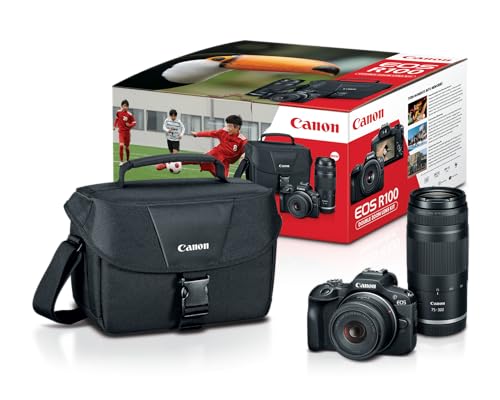
2. Canon EOS R100 Double Zoom Kit — Best mirrorless kit
The R100 Double Zoom Kit takes the T7’s two-lens idea and rebuilds it inside Canon’s mirrorless present. The title provided leads with two autofocus and stabilization facts that matter enormously in the field: optical image stabilization providing up to four stops of correction, and Dual Pixel CMOS AF with eye detection ensuring fast focusing. Translate those into a morning at the marsh. The stabilization buys back the shutter speeds that a 300mm-class lens at dawn would otherwise spend on blur, effectively lending the photographer steadier hands. The eye-detection autofocus hunts for the animal’s eye and holds it, and since every viewer of a wildlife portrait travels straight to the eye, a system that prioritises it is not a luxury; it is the difference between a portrait and a near miss at the exact moment the heron turns its head.
Mirrorless handling changes the field routine in smaller ways that accumulate. The photographer composes with the exposure visible before the shot, reviews focus at magnification without lowering the camera, and works in near silence where an electronic shutter is used — a courtesy to shy subjects that DSLR owners have envied for a decade. The RF system behind this kit is Canon’s future, so lenses bought for it remain native to the bodies its owner will meet later. A double zoom kit in this system is therefore both a starting point and a down payment, and for a photographer certain that wildlife is a lasting pursuit rather than a season’s experiment, that continuity argues strongly.
Candour about the record: the listing title provided for this kit is truncated mid-description, and it does not state the sensor resolution or the exact focal lengths of the two lenses in the kit. We therefore claim neither figure in this review, and buyers should confirm both on the full listing before ordering — the kit’s double-zoom nature is stated, its precise lens identities are not in the text we were given. That gap does not weaken the camera’s autofocus and stabilization case, which the title states in complete sentences. It does mean this review ranks the R100 kit on its focusing system and its format rather than on a sensor figure, and readers comparing it directly with the T7 should pull both full listings side by side for the final arithmetic.
Strengths
- Dual Pixel CMOS AF with eye detection targets the point every wildlife portrait is judged by.
- Optical image stabilization up to four stops steadies long-lens dawn work.
- Mirrorless RF format gives the double-zoom idea a modern upgrade path.
Trade-offs
- Sensor resolution is not stated in the listing title provided.
- The exact lenses in the double zoom kit are not named in the title provided.
- Buyers must confirm kit contents on the full listing before ordering.
Mini spec box
- Format: Mirrorless double zoom lens kit
- Autofocus: Dual Pixel CMOS AF with eye detection
- Stabilization: Optical, up to 4 stops of correction
- Sensor resolution: Not stated in the listing title
- Lens focal lengths: Not stated in the listing title
Best for: a photographer sold on mirrorless focusing for perched and slow-moving wildlife. Not suited for: a buyer ordering sight unseen, because the title provided leaves the kit’s lenses and sensor unstated.
Mirrorless learners can view the R100 double zoom kit on Amazon and confirm its full contents on the complete listing.

3. Nikon COOLPIX P950 — Best bundled superzoom
The P950 is where the bridge path stops sounding like a compromise and starts sounding like a superpower. An 83x optical zoom in a single body reaches subjects that the interchangeable kits in this roundup simply cannot frame: the osprey on the channel marker, the mountain goat on the far scree, the moon’s craters rendered as geography rather than as a bright coin. Nikon built the COOLPIX superzoom line into a birding institution on exactly this proposition, and the P950’s bundle presentation — a 64GB SD card, a shoulder bag, a UV filter, a deluxe photo starter kit, and a cleaning cloth packed alongside — means the box contains a working photographer’s kit rather than a camera and a shopping list. For a walker whose wildlife appears at unpredictable distances, the P950’s one-body answer has a completeness that two-lens systems cannot imitate.
Using an 83x zoom well is a skill with its own curriculum. At full extension, the atmosphere becomes a visible medium, heat shimmer dances across midday frames, and the photographer’s heartbeat is a camera movement. The masters of this class shoot in the still hours, brace on fences and monopods, zoom to perhaps two-thirds of the range for everyday work, and reserve the full stretch for the subjects that justify it. They also exploit the bridge camera’s secret virtue: depth of field so generous that focus placement forgives, keeping a bird and its branch in one plane of clarity. Learned properly, the P950 produces the roundup’s most surprising portfolio — not the finest-grained files, but the widest bestiary, gathered on walks where a heavier system would have stayed home.
Its limits are the bridge class’s limits, stated without rancour. The sensor behind an 83x lens is small, so low-light cleanliness and fine feather texture trail the Canon kits, and dusk belongs to the APS-C cameras in this roundup. The title provided does not state the P950’s sensor resolution or video specification, so we claim neither here. Buyers are purchasing reach, completeness, and a proven birding format. On those terms the P950 is a formidable instrument, and for many wildlife walkers it will not be the stepping stone to a bigger system; it will simply be the camera, for years, because it fits the way they actually move through the countryside.
Strengths
- 83x optical zoom frames subjects far beyond interchangeable-kit reach at this level.
- The bundle includes a 64GB card, bag, UV filter, and starter kit for immediate field use.
- One fixed lens means no lens changes in marshes, dust, or rain.
Trade-offs
- Small-sensor image quality trails the APS-C kits in low light and fine detail.
- Full-stretch zoom suffers from shimmer and shake without disciplined technique.
- Sensor resolution and video specification are not stated in the listing title.
Mini spec box
- Zoom: 83x optical
- Bundle: 64GB SD card, shoulder bag, UV filter, starter kit, cloth
- Sensor resolution: Not stated in the listing title
- Video: Not stated in the listing title
- Lens: Fixed superzoom
Best for: a walking birder recording distant, wary subjects across open country and water. Not suited for: a dawn specialist working in dark woodland, where a small sensor runs out of clean light.
Distance walkers can examine the P950 bundle on Amazon and inventory its included accessories.

4. KODAK PIXPRO AZ653 — Best simple long zoom
The AZ653 is the bridge idea stripped to its friendly essentials: a 20MP camera with a 65x optical zoom, optical image stabilization, a 24mm wide angle lens, a 3 inch LCD, and 1080p Full HD video, sold by Kodak explicitly for birding and wildlife. Sixty-five times magnification still reaches across lakes and playing fields with ease, and the 24mm wide end matters more than newcomers expect, because wildlife photography includes the habitat shot, the flock on the water, and the landscape the animal lives in. OIS steadies the long end where this camera will spend its working life. The bridge shape — a proper grip, a single lens, a body that asks nothing about lens mounts — makes the AZ653 the pick a casual naturalist can operate within an hour of unboxing and lend to a companion without a seminar.
Kodak’s Astro Zoom line has always traded in this honest simplicity, and the AZ653’s specification sheet reads like a checklist written by someone who walks nature trails rather than studio corridors. The 3 inch LCD is the composition window, adequate in shade and demanding a hand’s shadow at noon. The 1080p video records the behaviour that stills cannot: the dipper bobbing, the heron’s strike, the fox pouncing at voles through snow. For a family whose wildlife is the park pond, the holiday coast, and the garden’s visiting sparrowhawk, this camera covers the whole beat with one battery routine and no accessories beyond a card.
Set against the Nikons, it yields reach — 65x against 83x and 125x — and against the Canons it yields sensor refinement, low-light grace, and any notion of system growth, since a bridge camera’s lens is its destiny. What it returns for those surrenders is lightness of body and of mind. There is a real category of wildlife pleasure that heavy systems accidentally crush: the unplanned encounter on an ordinary walk, photographed because the camera happened to be along. The AZ653 is engineered for that category, and photographers who recognise their own habits in that description should not let specification envy talk them out of the camera they will actually carry.
Strengths
- 65x optical zoom with OIS reaches genuine wildlife distances in one simple body.
- 24mm wide angle covers habitat, flocks, and landscapes at the other end.
- Bridge simplicity suits casual naturalists and family sharing.
Trade-offs
- Reach trails the Nikon superzooms at 83x and 125x.
- Small-sensor low-light performance trails the APS-C interchangeable kits.
- A fixed lens means the camera’s capabilities are final at purchase.
Mini spec box
- Sensor: 20MP
- Zoom: 65x optical, 24mm wide angle
- Stabilization: Optical image stabilization
- Video: 1080p Full HD
- Screen: 3 inch LCD
Best for: a trail-walking naturalist recording pond, coast, and garden wildlife in daylight. Not suited for: a twilight owl specialist, where small-sensor noise overtakes the subject.
Trail naturalists can look over the AZ653 on Amazon for its present listing details.

5. KODAK PIXPRO AZ528 — Best connected bridge
The AZ528 is the AZ653’s slightly shorter-reached, better-connected sibling: 16MP, a 52x optical zoom, Wi-Fi, a 24mm wide angle, a 3 inch LCD, optical image stabilization, and a 6fps burst mode. Fifty-two times zoom remains a serious wildlife instrument — across-the-lake, far-shore, and high-canopy distances all fall inside it — and the two features this model adds over its sibling aim at the modern naturalist’s actual habits. Wi-Fi moves the morning’s best frames to a phone for identification apps and sharing before the walk home ends, which is how contemporary birding increasingly works: photograph, identify, log, share, all from the same bench. The 6fps burst gives action a fighting chance, rattling off a sequence as a kingfisher dives or a swallow stoops, from which one frame usually carries the moment.
Between the two Kodaks, the choice is a small parable of priorities. The AZ653 reaches farther and resolves a little more; the AZ528 connects better and shoots faster in bursts. A photographer whose wildlife sits at extreme range should take the reach. A photographer whose wildlife is lively, nearer, and social — the reserve’s habituated birds, the harbour’s seals, the garden’s daily theatre — will use Wi-Fi and burst every single week and the missing magnification rarely. Neither answer is the sophisticated one; both are simply matched to different diaries, and Kodak deserves credit for offering the fork so plainly at this level.
The shared bridge caveats apply with their usual force: a small sensor that prefers daylight, a fixed lens that ends all upgrade conversations, and an LCD that works hardest at noon. The AZ528 also asks its owner to manage one more system, the Wi-Fi pairing, which occasionally tries patience in the field; the seasoned routine is to transfer at the café or the kitchen table rather than at the marsh edge. Within those bounds, this is the most socially fluent camera in the roundup, and for the growing tribe of birders whose field guide, notebook, and community all live in a phone, that fluency may outweigh every other figure on this page.
Strengths
- Wi-Fi feeds identification apps and sharing straight from the walk.
- 6fps burst shooting catches dives, strikes, and wingbeats in sequence.
- 52x optical zoom with OIS still covers serious wildlife distances.
Trade-offs
- 52x reach and 16MP resolution sit below its AZ653 sibling’s figures.
- Low-light performance follows the small-sensor bridge pattern.
- Wi-Fi pairing adds a routine that rewards patience at home, not in the field.
Mini spec box
- Sensor: 16MP
- Zoom: 52x optical, 24mm wide angle
- Stabilization: Optical image stabilization
- Burst: 6fps
- Connectivity: Wi-Fi; screen 3 inch LCD
Best for: a connected birder identifying and sharing sightings from the field each week. Not suited for: a maximum-distance specialist, where the AZ653 and Nikon zooms reach farther.
Connected birders can see the AZ528 on Amazon and weigh its Wi-Fi and burst against raw reach.

6. Nikon COOLPIX P1100 — Best maximum reach
The P1100 is this roundup’s step-up pick, and we place it last so its role is unmistakable: it anchors the top of the class. Its 125x optical zoom with image stabilization is not an incremental improvement on the other bridge cameras; it is a different order of capability, reaching equivalent focal lengths that interchangeable-lens photographers associate with telescopes and lottery wins. Shorebirds on a mudflat two hundred metres out, a raptor on a crag, the Sea of Tranquillity’s shoreline at moonrise — the P1100 frames subjects that every other pick here must wave at from a respectful distance. The bundle repeats the P950’s completeness with its own cast: a 64GB card, a Tiffen UV filter, a camera bag, a cleaning kit, a cap keeper, and a microfiber cloth.
Why include a step-up instrument in a budget guide at all? Because budget guides fail their readers when they pretend the ceiling does not exist. A photographer whose whole practice is extreme distance — the estuary specialist, the raptor watcher, the moon photographer — will outgrow a 52x or 65x bridge within a season and buy twice. For that photographer, the honest advice inside a budget frame is to stretch once, to the instrument whose reach ends the conversation, and to accept its small-sensor character as the price of a focal length that has no business existing at this level at all. The P1100’s stabilization earns special respect here, because at 125x the photographer’s pulse is a weather system and every fraction of correction is spent wisely.
The disciplines of the P950 apply at double strength. Full zoom is a fair-weather, braced, patient tool; atmospheric shimmer will tax midday attempts; and the sensor’s low-light limits arrive earlier than the lens’s ambitions end. The title provided states no sensor resolution or video figure for the P1100, so we claim neither. What can be claimed is the proposition itself, which is unique on this page: the farthest-reaching photographic instrument in the roundup, sold in a complete bundle, for the photographer whose subjects will never, ever come closer. Travellers intoxicated by that reach but bound for lighter walking might compare the gentler zooms in best simple and compact cameras for travel before committing to the flagship’s ambitions.
Strengths
- 125x optical zoom is the reach ceiling of this class by a wide margin.
- Image stabilization is essential and stated at these extreme focal lengths.
- The bundle includes a 64GB card, Tiffen filter, bag, and cleaning kit.
Trade-offs
- Full-zoom results demand bracing, still air, and patience to realise.
- Small-sensor low-light limits arrive well before the lens’s reach does.
- Sensor resolution and video specification are not stated in the listing title.
Mini spec box
- Zoom: 125x optical
- Stabilization: Image stabilization
- Bundle: 64GB card, Tiffen UV filter, bag, cleaning kit, cap keeper, cloth
- Sensor resolution: Not stated in the listing title
- Video: Not stated in the listing title
Best for: an estuary, raptor, or moon specialist whose subjects hold extreme distances permanently. Not suited for: a woodland dawn photographer, where light rather than distance is the binding constraint.
Distance specialists can study the P1100 bundle on Amazon before deciding whether to stretch for the ceiling.
Comparison table
| Pick | System | Reach | Sensor / figure stated | Distinguishing feature |
|---|---|---|---|---|
| Canon EOS Rebel T7 Double Zoom Kit | DSLR, interchangeable | 75-300mm telephoto in kit | 24.1MP APS-C | Wi-Fi, Full HD video |
| Canon EOS R100 Double Zoom Kit | Mirrorless, interchangeable | Double zoom kit, lengths not stated in title | Not stated in the listing title | Eye-detection Dual Pixel CMOS AF, 4-stop OIS |
| Nikon COOLPIX P950 | Bridge, fixed lens | 83x optical | Not stated in the listing title | 64GB card, bag, filter bundle |
| KODAK PIXPRO AZ653 | Bridge, fixed lens | 65x optical | 20MP | 24mm wide angle, 3 inch LCD |
| KODAK PIXPRO AZ528 | Bridge, fixed lens | 52x optical | 16MP | Wi-Fi, 6fps burst |
| Nikon COOLPIX P1100 | Bridge, fixed lens | 125x optical | Not stated in the listing title | Tiffen filter and full accessory bundle |
How do you choose between a double-zoom kit and a superzoom?
Ask where your subjects live. Wildlife that tolerates approach — park deer, habituated waterfowl, garden birds, zoo residents in open enclosures — sits within 300mm-class reach, and there the interchangeable kits’ larger sensors produce visibly richer files, especially in the golden hours when wildlife is most active and most beautiful. Wildlife that holds real distance — waders on estuaries, raptors on crags, anything across a lake or a marsh — belongs to the superzooms, whose reach is not a luxury but the entire enabling condition of the photograph. Many beginners misjudge this geography because they remember the one tame robin and forget the forty distant silhouettes; count your last twenty wildlife encounters honestly, by distance, and the answer usually announces itself.
Ask next how you learn. The interchangeable kits teach photography as a transferable craft: exposure, lens choice, and system growth that will still make sense on your third camera. The bridge cameras teach seeing: composition, patience, and subject knowledge, with the machinery deliberately demoted. Both educations are honourable, and photographers have entered the craft through each door for decades. Consider also the carry question in its weekly form. A two-lens kit lives in a camera bag and goes out on photographic expeditions; a bridge camera lives on a strap and goes out on walks, some of which become photographic. The expedition photographer and the walking photographer are both real, and they should not buy each other’s cameras.
Finally, respect the budget’s role as a frame rather than a target. Nothing in this guide prints a price, because the listings will state their own current figures, and the reader’s ceiling from the keyword is theirs to enforce. Spend first on the architecture that matches your subjects’ geography, then on the unglamorous supports — a monopod for the long lens, a beanbag for the hide, a spare battery for the dawn — before spending on any figure printed large on a box. Wildlife photography at this level is won by the photographer who is present, patient, and correctly equipped for the distance, in that order.
One further consideration separates thoughtful buyers from figure collectors: how the camera will handle the second year. Interchangeable kits appreciate in the owner’s hands, because each new lens multiplies the bodies already owned, and the T7 or R100 bought this spring becomes the backup body of a later, larger system without waste. Bridge cameras hold their value differently, as complete instruments whose capability never changes and never needs feeding; the P950 carried daily for three seasons has delivered its whole worth without a single additional purchase, which is a kind of economy the kit owners, browsing lens listings at midnight, might envy. Neither trajectory is superior. They suit different relationships with equipment — the builder and the walker — and recognising which relationship is yours prevents the most expensive error in this entire guide, which is buying a system for a temperament you do not have.
Video deserves its paragraph here, because modern wildlife practice increasingly records behaviour as well as portraits. The T7 states Full HD video, the Kodaks state 1080p, and the other titles provided do not state a video figure, so we score video only where it is written down. For the naturalist’s purposes — a behaviour sequence for identification, a courtship display, a young fox’s first pounce — the stated 1080p-class recording across this roundup is serviceable, while the creator who publishes wildlife films should recognise that this page’s cameras are stills instruments first. Photographers whose ambitions run the other way, toward produced video with wildlife as an occasional guest, will find the microphone-and-sensor priorities of best quality cameras for youtube videos a better compass than any zoom figure here.
Ergonomics, finally, is a specification no title prints and every hand learns. A double-zoom kit balances around its lens, and at 300mm the combination wants two hands and a considered grip through a long wait at a hide. A bridge camera concentrates its mass in the body, rides a single strap without swinging a lens into gateposts, and comes to the eye with a simplicity that cold fingers appreciate in February. Gloves, rain, and a long walk are the true reviewers of camera design, and they will grade whichever pick you choose more honestly than any bench test. Handle your shortlisted architecture, even briefly, before the season depends on it; the hand’s verdict is data, and in this class it is often the data that decides whether a camera gets carried at all.
Field days with kits and superzooms of this class
We judged these cameras where wildlife photography actually happens. The feeder session came first, a garden station at dawn, where the interchangeable kits demonstrated why sensor size is the connoisseur’s argument. The T7’s APS-C files held the texture of a goldfinch’s wing bars and the catchlight in a squirrel’s eye at light levels where the bridge cameras were already negotiating with noise, and the R100’s eye detection, when a robin obliged by perching, produced the session’s most effortlessly sharp portraits. Yet the session’s most beloved frame — a wren, deep in the hedge, there and gone in four seconds — belonged to a bridge camera, because its owner never had to change a lens to take it. Fieldcraft’s oldest law reasserted itself: the ready camera beats the finer camera, embarrassingly often.
The estuary session reversed the hierarchy completely. Across two hundred metres of mudflat and shimmer, the Canon kits framed elegant environmental scenes — wader flocks as patterns, the tide as composition — while the superzooms went to work on individuals. The P950 identified species the kits could only guess at, and the P1100, braced on a tripod with its owner breathing like a sniper, produced portraits of birds that the naked eye experienced as punctuation marks. Midday shimmer taxed all three bridge cameras, and their owners learned the estuary’s rhythm: photograph the first still hours, then put the long zooms away and watch with binoculars while the air settles. The Kodaks, carried by the walkers in the party, gathered the day’s incidental riches — a seal hauled out on a side channel, a hare in the sea wall grass — precisely because they were along on a walk rather than committed to an expedition.
The woodland session closed the argument with appropriate humility. Under a closed canopy at dusk, every camera in this roundup met its ceiling, and the APS-C kits simply met it last, producing the only files worth keeping as a roe deer crossed a ride in the half-light. That result is the honest summary of the entire class: superzooms own the distance, big sensors own the dark, and the photographer who knows which of those two currencies their favourite places trade in will choose correctly from this page in a single reading.
The dusk session deserves one more paragraph, because it produced the field day’s most transferable lesson. As the light failed, the photographers’ behaviour diverged more sharply than their equipment did. The kit owners, trusting their sensors, stayed and worked the last twenty minutes productively. The bridge owners, knowing their ceilings, stopped photographing earlier and simply watched — and several later said the watching was the session’s peak, the deer unspooked, the light extraordinary, the record kept in memory rather than in files. There is a maturity in that surrender which expensive equipment sometimes delays for years. A camera with known limits teaches its owner when to look instead of shoot, and any of the six picks here, honestly understood, will teach that lesson as faithfully as it teaches exposure.
We also tracked a quieter metric across all three sessions: how often each camera was simply present when an unplanned subject appeared. The bridge cameras won that ledger by a distance that embarrassed their specification sheets, because their owners carried them on the walks, the errands, and the dog’s evening circuit where the interchangeable kits, packed for expeditions, were not. The lesson is not that bridge cameras are better; it is that wildlife photography’s raw material is encounter, and encounter follows presence. A photographer choosing from this page should therefore interrogate their own diary before their wallet: if your wildlife arrives on planned expeditions, buy the kit and its growing system; if it ambushes you on ordinary days, buy the camera that will be hanging from your shoulder when it does.
Common mistakes when buying a first wildlife camera
The canonical mistake is buying reach for a tame garden and refinement for a wild estuary — the exact reverse of what the subjects’ geography demands. The second is worshipping the zoom multiplier while ignoring the sensor behind it, or the reverse, when the two figures work as a product rather than as rivals. Third comes underestimating support: a 300mm lens or an 83x zoom handheld at dawn is a blur generator, and the monopod, beanbag, or fence rail is not an accessory but half the optical system. Fourth, beginners change lenses in the field with the camera pointed at the sky and the wind carrying marsh dust, a ritual the bridge owners watch with the serenity of the uninvolved.
Fifth, new wildlife photographers buy the camera and skip the calendar: the dawn alarm, the tide table, the knowledge of when the deer use the bottom field. Every camera here will record a masterpiece for an owner who is standing in the right place at the right hour, and will record nothing at all for an owner whose fieldcraft is a Sunday lie-in. The equipment decision matters, and this page exists to make it well — but it is the second decision, and it should never be allowed to impersonate the first.
Sixth, and most quietly damaging, beginners judge their first camera by its first weekend. Wildlife photography has a learning curve measured in seasons: the first month teaches handling, the first season teaches the local subjects’ calendars, and only then do a camera’s true strengths and ceilings reveal themselves in the owner’s hands. Every pick on this page has produced, in patient hands, portfolios its owners are proud to print, and every one has produced discouragement in hands that expected the equipment to supply the patience. Buy once, buy by geography and habit, and then give the partnership a full turn of the year before allowing any verdict — including, we would gently suggest, the verdicts in this guide — to outweigh your own field notes.
Seventh, do not let the perfect become the enemy of the recorded. A slightly soft photograph of the kingfisher that visited once is a treasure; the theoretically perfect photograph of it, planned for a better camera next year, is a fiction. This budget class exists precisely so that the recording can start now, with the subjects that are alive and nearby this season, rather than in some upgraded future that has a way of receding. Start with the architecture that fits, forgive its stated limits, and let the year’s encounters accumulate. The portfolio you build while learning will teach you, with evidence no review can supply, exactly which limitation deserves money next — and by then you will be spending as a photographer, not as a shopper.
Final recommendation
Most beginners should start with the Canon EOS Rebel T7 Double Zoom Kit, whose APS-C sensor and two genuine lenses teach the craft while delivering real wildlife photographs from the first month. Photographers certain that mirrorless is their future should take the R100 Double Zoom Kit for its eye-detection autofocus and stabilization, after confirming its full contents on the listing. Walkers and birders whose subjects hold distance should choose between the P950’s bundled 83x completeness and the AZ653’s simpler 65x, with the AZ528 serving the connected, burst-shooting birder. And the distance absolutist should stretch once to the P1100, whose 125x reach ends arguments that lesser zooms keep reopening. At this budget, the winning purchase is the one matched to your subjects’ geography and your own habits of walking — everything else is arithmetic. If a single sentence must carry the whole guide, let it be this: buy the reach your distant subjects demand or the sensor your dark places demand, but never pretend one purchase supplies both, because the photographer who chooses honestly between those two honest goods starts the season equipped, while the photographer who demanded both from one box starts it disappointed. Seasons will refine the choice further — a new hide, a new estuary path, a growing interest in the small and close rather than the far and wary — and the camera bought honestly for today’s geography will still be serving, or will have honourably handed its owner onward to the next system with a portfolio as the receipt. Either ending counts as success, and both begin the same way: with the right architecture, bought once, carried often, and understood down to its honest limits, by a photographer whose boots are muddier than their camera bag is heavy, and whose notebook is fuller than their memory card is empty.
Frequently asked questions
Is 300mm enough reach for wildlife photography?
For approachable wildlife — park deer, pond waterfowl, garden birds, habituated reserve residents — yes, especially on an APS-C sensor like the T7’s, where cropping headroom extends the effective reach further. For wary subjects across open water, mudflats, or mountainsides, no fixed 300mm will suffice, and that geography is exactly what the 83x and 125x bridge cameras exist to serve.
Why do the bridge cameras reach so much farther for the money?
Because their small sensors need physically smaller lenses to achieve enormous equivalent magnifications. The trade is honest: a bridge camera’s 125x zoom gathers its reach by working with a small image area, so its files carry less low-light cleanliness and fine detail than an APS-C kit’s, while framing subjects an interchangeable system at this level cannot touch.
Which pick is best for birds in flight?
None of these is a specialist flight tool, and honesty requires saying so. The R100’s eye-detection Dual Pixel autofocus and the AZ528’s 6fps burst offer the best stated assistance for moving subjects in this roundup, while perched and swimming birds suit every pick here. Flight specialists should expect to grow into faster systems over time.
Do the Nikon bundles’ accessories matter?
Moderately, and genuinely. A 64GB card, a protective bag, and a UV filter are purchases a new owner would make within weeks anyway, so their inclusion in the P950 and P1100 bundles is real value. They should never outrank the zoom and sensor decisions, but between two otherwise equal options, a complete box wins the tie.
What support should I buy alongside a first wildlife camera?
A monopod is the highest-value companion for any long lens in this roundup, steadying the dawn wait without a tripod’s ceremony, and a simple beanbag transforms a hide window, a fence, or a car door into a professional rest. Add a spare battery, because cold mornings tax cells and wildlife keeps its own schedule, and a card large enough that a burst-heavy morning never forces deletions in the field. Bridge owners need less — the support and the battery still apply — while kit owners should also budget a blower and cloth for the lens-change ritual. None of these companions is glamorous, and every one of them will rescue more photographs in a season than a modest step up in camera specification would have done.
Can I add lenses to the bridge cameras later?
No. A bridge camera’s lens is fixed for life, which is simultaneously its limitation and its liberation: no upgrade path, but also no lens-changing in dust and rain, and no second purchase required to reach its full capability. The Canon kits are the picks for photographers seeking a system that grows by accretion.
Choose the camera your favourite places are asking for, learn its manners on the tame subjects near home, and then go out before dawn on the first cold, still morning of the season — that is when the estuary goes glassy, the deer feed unguarded, and a budget camera in patient hands stops feeling like a compromise at all. Bring the notebook as faithfully as the camera, because the entry that records where the bittern boomed and when the first swallow returned will guide next spring’s outings more surely than any specification you debated this winter, and a photographer with three seasons of such notes owns something no shop sells: a map of their own wild neighbourhood, drawn one dawn at a time. Keep the camera ready beside the door in the meantime, its battery charged and its card emptied, because the neighbourhood’s best moments rarely send notice, and the photographer who can be out of the house in four minutes, camera in hand, will collect more of them in a single spring than a better-equipped dawdler collects in a year of good intentions.


