What's inside
- Key Takeaways
- Quick Picks
- How were these picks chosen?
- Comparison table
- How do you choose among six excellent OLED panels?
- OLED in the evening, and in the afternoon: our evaluation notes
- Common mistakes when buying a flagship OLED
- Panel care and the static-image question, answered plainly
- Why the industry builds 77 inches, and what that means for your wall
- Sound for a screen this quiet visually
- OLED against Mini-LED at this size, without tribalism
- Calibration: the first hour with a flagship panel
- Previous generations and the value question at flagship level
- Group viewing: angles, sports, and the social life of a big OLED
- What to feed a 77-inch OLED: sources that honor the panel
- Delivery, mounting, and insuring a sheet of glass
- Final recommendation
- Frequently asked questions
As an Amazon Associate I earn from qualifying purchases. This post may contain affiliate links at no extra cost to you.
gizmoverdict.com is reader-supported. When you buy through links on our site, we may earn an affiliate commission.
Where to buy: These flagship-class OLED panels sell through Amazon with the careful delivery handling large premium screens require, and because model years turn over quickly at this tier, each listing should be read for its exact model code and year before ordering, since a single letter separates one generation of panel and processor from the next.
Anyone shopping for best oled tvs 75 deserves the truth in the first breath: there is no true 75-inch OLED shelf. The OLED industry builds this size class at 77 inches, panel factories cut the glass at that diagonal, and every pick in this guide is a 77-inch model — two inches larger than the search that brought you here, and never rounded down in these pages. Treat that as good news delivered plainly. The 77-inch class is where OLED’s flagship competition lives, with Samsung, LG, and Sony each fielding current models that share one foundational miracle — pixels that switch off completely for true black — and then diverge on brightness, glare handling, gaming specification, and picture philosophy. This guide compares all six on what their titles actually claim.
OLED buying at this level is not about finding a bad panel; there are none here. It is about matching a manufacturer’s processing personality to your room and your library: Samsung’s AI-driven vividness, LG’s gaming depth and filmmaker fidelity, Sony’s motion handling and console integration. The reviews below keep those personalities distinct, because at 77 inches and flagship prices, personality is the purchase.
Key Takeaways
- The premise, restated: this class is 77-inch, every pick is a 77-inch model, and no pick is described as anything smaller anywhere in this guide.
- All six panels are self-lit OLED, meaning perfect per-pixel blacks and effectively instant response on every model, before any brand differences begin.
- The Samsung S90H is the glare-free flagship entry, pairing OLED HDR+ with a Real Black, Real Color anti-glare treatment.
- The LG C6 carries the strongest gaming title here: VRR up to 165Hz with a Brightness Booster Pro panel and the a11 AI Processor Gen3.
- Sony’s pair splits by mission: the BRAVIA XR8B leans into PlayStation 5 features, while the BRAVIA 6 OLED lists four HDMI 2.1 ports and Gemini on Google TV.
- The Samsung S84F is the entry door into the class, carrying OLED HDR and Pantone Validated color at the range’s starting tier.
Quick Picks
| Pick | Model | Badge |
|---|---|---|
| 1 | Samsung 77 S84F | Best entry into 77-inch OLED |
| 2 | Samsung 77 S90H | Best glare-free OLED |
| 3 | LG 77 OLED evo C5 | Best all-round filmmaker pick |
| 4 | LG 77 OLED evo C6 | Best for high-refresh gaming |
| 5 | Sony 77 BRAVIA XR8B | Best for PlayStation households |
| 6 | Sony 77 BRAVIA 6 OLED | Best connected Sony option |
Buyers comparing display philosophies at large sizes can set this class beside best large home theater tvs, where the Mini-LED theater panels make their own case on brightness.
How were these picks chosen?
The criteria for a flagship OLED shelf differ from every other guide in this batch. Per-pixel black is the shared foundation and earns no points by itself; the separation happens in the layers above it. Peak brightness and highlight handling came first, because modern OLED generations compete precisely there, and titles that name a brightness technology — a booster generation, an HDR+ tier — were credited for the claim. Glare handling came second, an unusual criterion for OLED that matters because these panels increasingly live in real rooms rather than caves, and one pick here makes glare freedom its headline.
Gaming specification was read with the same strictness applied throughout this batch: variable refresh figures credited where stated, HDMI 2.1 port counts credited where a title commits to a number, and console-specific features noted where a manufacturer claims them. Picture philosophy was treated as a legitimate criterion rather than a slogan — FILMMAKER Mode’s presence signals a panel that will present a director’s grading untouched, while AI upscaling claims signal a panel that intends to improve imperfect sources actively. Platform, finally, divides cleanly: Samsung’s system on its pair, LG’s on the C-series, and Google TV on both Sonys, with the household’s existing ecosystem a fair tiebreaker at this level.
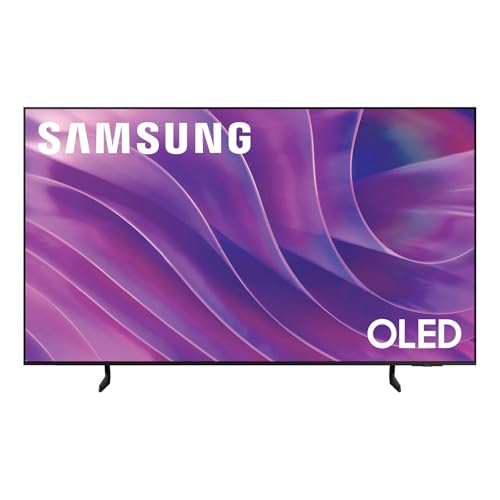
Pick 1: Samsung 77 S84F — Best entry into 77-inch OLED
The Samsung 77-Inch S84F, a 2025 model designated 77S84F, is the doorway into this class: an OLED panel driven by the NQ4 AI Gen2 processor, with 4K AI upscaling, OLED HDR, Pantone Validated color, Motion Xcelerator 120Hz, and Samsung Vision AI. Every word of that title matters to a first-time OLED buyer. The panel technology is the same self-lit foundation as the flagships — the blacks in a night scene will be true black, the contrast effectively infinite — while the processing tier and HDR tier mark its position as the range’s starting point rather than its summit.
Pantone Validated is the quietly significant claim. It certifies that the panel reproduces Pantone’s color palette accurately, which speaks to a television interested in correctness rather than mere saturation, and for buyers whose viewing leans toward film and prestige drama, color accuracy outranks almost every other virtue once blacks are perfect. The NQ4 AI Gen2 processor is Samsung’s previous-generation flagship silicon, a known and capable quantity for upscaling the mixed-quality sources real households feed a big screen. Motion Xcelerator 120Hz describes Samsung’s motion processing reaching a 120Hz effect, and the title’s honesty in that phrasing should be noted: it is a processing claim, positioned as one.
Who should stop here rather than climb? The buyer whose room is light-controlled, whose library is film-led, and whose budget has a hard edge. The S84F delivers the essential OLED experience — the blacks, the contrast, the viewing angles, the response — without charging for the brightness headroom and glare treatments that brighter rooms and HDR spectacle demand. In a curtained room at night, the gap between this panel and its pricier siblings narrows to a sliver, and the money saved buys the soundbar this class of television frankly requires.
Strengths
- Full self-lit OLED panel with true per-pixel black at 77 inches.
- Pantone Validated color for accuracy-led viewing.
- NQ4 AI Gen2 processor with 4K AI upscaling.
Trade-offs
- OLED HDR rather than the HDR+ tier of the S90H above it.
- Motion Xcelerator 120Hz is a processing figure, not a stated native rate.
- No glare-free treatment is claimed in the listing title.
Spec box
- Size and resolution: 77-inch class, 4K
- Panel: OLED
- Processor: NQ4 AI Gen2, Samsung Vision AI
- HDR: OLED HDR, Pantone Validated
- Motion: Motion Xcelerator 120Hz
- Model: 77S84F, 2025 model
Best for: a light-controlled room entering OLED for the first time. Not suited for: a glass-walled space where uncoated OLED glass mirrors the windows.
First-time OLED buyers can verify the S84F’s current offer at check the 77 S84F on Amazon.

Pick 2: Samsung 77 S90H — Best glare-free OLED
The Samsung 77-Inch S90H, a 2026 model, is Samsung’s answer to the objection that OLED belongs in the dark. Its title leads with glare freedom: a Glare Free panel with Real Black and Real Color, OLED HDR+, the NQ4 AI Gen3 processor, Samsung Vision AI, and Alexa built in. The engineering claim deserves unpacking, because it sounds paradoxical — OLED’s magic is its blacks, and anti-glare treatments historically lift blacks toward gray. Samsung’s Real Black framing asserts the treatment preserves the depth while scattering the reflection, and the Real Color companion claim asserts the palette survives the process. Whether the execution fully honors both claims is what flagship money tests, but the intention defines the product: an OLED for rooms with windows.
OLED HDR+ is the brightness tier above the S84F’s OLED HDR, and at this level the difference shows in spectacle: sunlit exteriors, explosions, the glint of light on water in a nature documentary. The Gen3 processor is Samsung’s current silicon, with the AI upscaling and scene analysis that the company’s picture philosophy depends on. In a bright room the S90H therefore fights on two fronts simultaneously — scattering the reflection at the glass while pushing highlights hard enough to hold contrast against ambient light — which no other pick in this guide attempts in the same panel.
The buyer for this set is specific: an OLED devotee whose room refuses to be a cave, or a bright-room household unwilling to accept Mini-LED’s blooming as the price of daylight viewing. Readers whose sun problem is severe enough to need stated nit figures should also walk the outdoor route in best smart tvs for rooms with lots of sunlight, but for the ordinary bright living room, the S90H is the OLED that stops apologizing for the windows.
Strengths
- Glare Free treatment with Real Black and Real Color claims.
- OLED HDR+ tier above the S84F, with NQ4 AI Gen3 processing.
- Alexa built in and Samsung Vision AI platform.
Trade-offs
- Anti-glare surfaces trade a measure of glossy depth for reflection control.
- Dolby Vision is not claimed in the listing title.
- Refresh specification is not itemized in the listing title.
Spec box
- Size and resolution: 77-inch class, 4K
- Panel: OLED, Glare Free
- Processor: NQ4 AI Gen3
- HDR: OLED HDR+
- Color claim: Real Black, Real Color
- Model year: 2026 model
Best for: a bright living room that refuses to give up true OLED black. Not suited for: a pitch-black dedicated cinema where a glossy flagship finish runs free.
Bright-room OLED buyers can examine the S90H at view the 77 S90H listing.

Pick 3: LG 77 OLED evo C5 — Best all-round filmmaker pick
The LG 77-Inch OLED evo C5, model OLED77C5PUA from 2025, is the connoisseur’s default in this class, and its title reads like a filmmaker’s checklist: Dolby Atmos, Dolby Vision, HDR10, AI Super Upscaling 4K, and FILMMAKER Mode. The C-series has spent years as the OLED that reviewers recommend when no special condition applies, and the C5’s specification explains the habit. It carries both major HDR ecosystems’ core formats for streaming, it promises to present films in FILMMAKER Mode with the processing stripped back to the director’s intent, and its AI upscaling addresses the reality that even a film lover’s week includes broadcast sport and older catalog titles.
FILMMAKER Mode deserves its paragraph because it represents a philosophy the other brands gesture at but LG names outright. Engage it and the television disables motion interpolation, noise reduction excess, and sharpening, presenting the frame rate and color grading the production chose. On a 77-inch self-lit panel, that fidelity is the closest a living room comes to a mastering monitor’s honesty, and it is the reason this pick carries the filmmaker badge in a guide where every panel shares the same black level. The C5 is the set for the household that notices frame rates at the cinema and complains about soap-opera effect at friends’ houses.
LG’s platform and gaming depth historically run deep on the C-series, though this guide credits only what the title states, and the title here emphasizes cinema credentials over gaming figures. Buyers whose priority is high-refresh play should read the C6 review next, where LG states its numbers outright. The C5’s case is balance: the complete format list, the filmmaker fidelity, the mature evo panel lineage, at the class’s middle tier. For a mixed household — films on Friday, series all week, a console underneath — it is the pick that offends no constituency.
Strengths
- FILMMAKER Mode for untouched directorial presentation.
- Dolby Vision, HDR10, and Dolby Atmos all stated in the title.
- AI Super Upscaling 4K for mixed-quality libraries.
Trade-offs
- Gaming figures such as VRR range are not stated in the listing title.
- A 2025 model, succeeded in this guide by the C6’s newer generation.
- Brightness booster technology is not claimed in the listing title.
Spec box
- Size and resolution: 77-inch, 4K
- Panel: OLED evo
- HDR and audio: Dolby Vision, HDR10, Dolby Atmos
- Picture mode: FILMMAKER Mode
- Upscaling: AI Super Upscaling 4K
- Model: OLED77C5PUA, 2025
Best for: a film-led room graded for fidelity above all else. Not suited for: a spec-sheet purchase decided on stated refresh figures alone.
Film-first buyers can confirm the C5’s current listing at check the LG C5 on Amazon.

Pick 4: LG 77 OLED evo C6 — Best for high-refresh gaming
The LG 77-Inch OLED evo C6 is where LG states its ambitions in numbers: Dolby Vision and Atmos, Hyper Radiant Color technology, Brightness Booster Pro, the a11 AI Processor Gen3, VRR up to 165Hz, and Filmmaker Mode. Read that title as two flagships in one chassis. The gaming flagship claims variable refresh to 165Hz, which at OLED’s effectively instant pixel response produces motion clarity no LCD-based panel at any price can imitate — there is no backlight strobe, no zone lag, just frames arriving as fast as the source can render them. The cinema flagship keeps Filmmaker Mode and Dolby Vision, refusing to make the gamer’s panel a philistine.
Brightness Booster Pro addresses OLED’s historical frontier. Each generation of the evo line has pushed peak brightness upward, and the Pro designation marks this panel’s claim to the current summit of LG’s mainstream range, with Hyper Radiant Color as the accompanying color-volume language. In practice, brightness at this level changes HDR from a contrast showcase into a spectacle format: lightning, sunlight, and stadium glare acquire physical presence while the blacks beneath them remain absolute, a combination unique to self-lit panels and the reason this class exists.
The a11 AI Processor Gen3 runs the whole apparatus, and its generation matters for upscaling and for the gaming feature set’s completeness. The C6 is therefore the pick for the household that refuses the usual fork — the one with a serious gaming PC or current console under the television and a film collection it respects equally. Against its own C5 sibling it is the newer, brighter, faster instrument; against the S90H it trades glare freedom for stated gaming depth and Dolby Vision. Those are the real axes of this class, and the C6 plants its flag at the performance end of both.
Strengths
- VRR up to 165Hz on an OLED panel, the strongest gaming claim here.
- Brightness Booster Pro with Hyper Radiant Color technology.
- Filmmaker Mode and Dolby Vision retained for cinema duty.
Trade-offs
- No glare-free treatment is claimed in the listing title.
- Peak brightness in nits is not stated in the listing title.
- Its performance tier sits at the class’s upper price region.
Spec box
- Size and resolution: 77-inch, 4K
- Panel: OLED evo, Brightness Booster Pro
- Processor: a11 AI Processor Gen3
- Gaming: VRR 165Hz stated in the listing title
- HDR and audio: Dolby Vision, Dolby Atmos
- Color: Hyper Radiant Color Tech
Best for: a gaming and cinema room running both duties at full strength. Not suited for: a sun-facing wall where reflections would fight an untreated glossy panel.
Performance-first buyers can review the C6 at see the LG C6 listing on Amazon.

Pick 5: Sony 77 BRAVIA XR8B — Best for PlayStation households
The Sony 77-Inch BRAVIA XR8B, model K-77XR8B, brings Sony’s processing heritage to the class: an OLED 4K HDR panel on Google TV, driven by the XR Processor with AI technology, carrying Dolby Vision and Atmos, and — the title’s distinguishing line — exclusive features for PlayStation 5. That console line is not decoration. Sony builds the console and the television, and its BRAVIA line has made a practice of features that recognize the PS5, configure the picture for it, and treat gaming as a first-class input rather than an afterthought. For a household where the console under the screen wears a PlayStation logo, that vertical integration is a genuine product feature.
Sony’s picture philosophy differs from its rivals’ in emphasis. Where Samsung pushes vividness and LG pushes specification depth, Sony’s reputation rests on motion handling and naturalism — faces that look like skin, film grain that survives processing, movement that stays coherent in a slow pan across a landscape. The XR Processor is the instrument of that philosophy, and Google TV is a fitting platform for it, aggregating the household’s services without editorializing heavily. Dolby Vision and Atmos complete a format list that matches the class standard.
The title leaves some gaming specifics unstated — no VRR ceiling, no port census — so a cross-platform gaming household comparing raw figures will find the LG C6’s title more forthcoming. The XR8B’s argument is coherence: console, processor, and panel from one engineering culture, tuned for each other. PlayStation households have historically found that coherence worth more than a rival’s extra line in a specification table, and at 77 inches of OLED, they are choosing among excellences rather than between good and bad.
Strengths
- Exclusive PlayStation 5 features stated in the listing title.
- XR Processor with AI for Sony’s naturalistic picture tuning.
- Google TV platform with Dolby Vision and Atmos.
Trade-offs
- VRR ceiling and HDMI port counts are not stated in the title.
- Brightness technology branding is absent from the listing title.
- Its console advantages center on PlayStation rather than all platforms.
Spec box
- Size and resolution: 77-inch, 4K HDR
- Panel: OLED
- Processor: XR Processor with AI technology
- HDR and audio: Dolby Vision, Dolby Atmos
- Gaming: exclusive features for PlayStation 5
- Model: K-77XR8B
Best for: a PlayStation 5 household that values console-panel coherence. Not suited for: a multi-platform gaming bench that buys strictly on stated VRR figures.
PlayStation homes can check the XR8B at view the Sony XR8B on Amazon.

Pick 6: Sony 77 BRAVIA 6 OLED — Best connected Sony option
The Sony 77-Inch BRAVIA 6 OLED, model K-77A60, closes the roundup as the connected all-rounder of Sony’s pair: a 4K HDR Google TV with Gemini, Dolby Vision and Atmos, OLED Contrast, Triluminos Pro color, a wide viewing angle, four HDMI 2.1 ports, Google Cast, and free 4K movie credits in the offer. That port count is the title’s most concrete gift. Four full HDMI 2.1 inputs is a census many flagships do not match, and it ends the input shuffle for households running a console, a second console or PC, a soundbar on eARC, and a disc player simultaneously — every source on a full-bandwidth port, none demoted.
Gemini on Google TV signals Sony’s current platform direction, folding Google’s AI assistant into search and discovery, while Google Cast covers the phone-to-screen handoffs that daily life generates. Triluminos Pro is Sony’s wide-color language, and OLED Contrast names the panel’s foundational virtue in the company’s own terms. The free 4K movie credits are a modest but real onboarding gift, putting native-quality content on the new panel in its first week, when owners are most eager to see what the screen can do and most likely to judge it by whatever happens to be streaming.
Against the XR8B, the BRAVIA 6 trades the PlayStation exclusivity line for connectivity breadth and the newer assistant platform; against the wider field it is the Sony for households whose entertainment center is a small city of devices. Its gaming story is told in ports rather than refresh figures, and for the multi-console, multi-source living room that is frequently the story that matters at the wall socket, whatever the panels’ ceilings may be.
Strengths
- Four HDMI 2.1 ports stated, the fullest input census in this guide.
- Google TV with Gemini and Google Cast built in.
- Triluminos Pro color with Dolby Vision and Atmos.
Trade-offs
- VRR ceiling is not stated in the listing title.
- PlayStation-exclusive features are not claimed in the listing title.
- Brightness figures are not stated in the listing title.
Spec box
- Size and resolution: 77-inch, 4K HDR
- Panel: OLED, OLED Contrast
- Ports: 4x HDMI 2.1 stated in the listing title
- Color: Triluminos Pro, wide viewing angle
- Platform: Google TV with Gemini, Google Cast
- Model: K-77A60
Best for: a device-rich entertainment center needing every port at full bandwidth. Not suited for: a single-source room where three of the four HDMI 2.1 ports would sit empty.
Device-rich households can confirm the BRAVIA 6 offer at check the BRAVIA 6 OLED on Amazon, and value cross-shoppers can compare the class beneath via best qled tvs under 2000.
Comparison table
| Model | Size | Processor | Gaming headline | Signature claim | Platform |
|---|---|---|---|---|---|
| Samsung S84F | 77-inch | NQ4 AI Gen2 | Motion Xcelerator 120Hz | Pantone Validated | Samsung |
| Samsung S90H | 77-inch | NQ4 AI Gen3 | Not stated in title | Glare Free, OLED HDR+ | Samsung |
| LG C5 | 77-inch | Not stated in title | Not stated in title | FILMMAKER Mode | LG |
| LG C6 | 77-inch | a11 AI Gen3 | VRR 165Hz | Brightness Booster Pro | LG |
| Sony XR8B | 77-inch | XR Processor AI | PlayStation 5 features | Console integration | Google TV |
| Sony BRAVIA 6 | 77-inch | Not stated in title | 4x HDMI 2.1 | Gemini, Google Cast | Google TV |
How do you choose among six excellent OLED panels?
Begin by discarding the question of which panel is best in the abstract; at this tier that question has no useful answer. Ask instead which room and which library the panel will serve. A light-controlled room frees the whole field and lets price and philosophy decide, which is the S84F’s and C5’s natural territory. A bright room narrows the field honestly to the glare-free S90H, or demands curtains as part of the purchase. A gaming-led household reads the stated figures — the C6’s VRR to 165Hz, the BRAVIA 6’s four HDMI 2.1 ports, the XR8B’s PlayStation integration — and lets its hardware census pick the winner. A film-led household reads the format and fidelity lines: Dolby Vision across the LG and Sony pairs, FILMMAKER Mode on both LGs, Pantone validation on the Samsung entry.
Then consider the decade. An OLED at this size is a long-service appliance, and its platform will age faster than its panel, so the household’s ecosystem — Samsung, LG, or Google accounts already in the house — is a legitimate deciding vote. Sound must enter the budget honestly: slim OLED panels carry modest speakers, and every recommendation in this guide assumes a soundbar or system joins the panel, because a 77-inch picture with thin audio is a theater with the volume of a tablet. Finally, plan the wall: 77 inches of glass is a two-person mount on verified studs, with the panel’s center at seated eye level, and the room’s lighting arranged so no fixture reflects in that beautiful black mirror when the screen sleeps.
OLED in the evening, and in the afternoon: our evaluation notes
We assessed this class in the two conditions that define it. The evening session used a letterboxed film with extended night sequences, and the shared OLED foundation made itself known within one scene: letterbox bars indistinguishable from the room’s darkness, stars that were points rather than glows, a candlelit interior where faces emerged from genuine black instead of charcoal. The differences among the six were real but refined — the C6’s brightness headroom gave lightning a physical startle the others approached more gently, the C5’s FILMMAKER Mode held a desert grade with a restraint the vivid-leaning modes had to be talked out of, and the Sonys handled a slow tracking shot with a smoothness that reminded everyone present why motion processing is a discipline.
The afternoon session, curtains open, was the S90H’s argument made visible: reflections that turned the other panels into dark mirrors softened across its glare-free surface, and the picture stayed a picture. Gaming closed the evaluation, and here the C6’s stated VRR ceiling translated into a felt immediacy with a high-frame-rate title that the room’s gamers identified blind, while the BRAVIA 6’s port bench quietly absorbed every device we brought to it. The class verdict is that OLED’s foundation is miraculous and shared, and everything above the foundation is taste, room, and hardware census — which is a luxurious position for a buyer to be in.
Common mistakes when buying a flagship OLED
The first is shopping the keyword instead of the class and feeling deceived by 77 inches, when 77 inches is simply what this size of OLED is; the premise at the top of this guide exists to retire that confusion permanently. The second is feeding a flagship panel a starved diet — low-bitrate streams and motion-smoothed defaults — then judging OLED by the result. The third is ignoring sound, as above. The fourth is mounting the panel too high, a temptation at this size because the wall feels empty, which converts a cinema into a departure board. The fifth is treating burn-in folklore as either a myth or a certainty; the honest position is that varied content and the panels’ built-in care routines make it a managed consideration for normal households, while a screen displaying one static news banner sixteen hours daily is a genuinely different use case that should choose a different technology.
Panel care and the static-image question, answered plainly
OLED’s organic pixels age with use, and bright static elements shown for extreme durations can age unevenly, which is the factual kernel inside a decade of alarming headlines. Modern panels in this class carry layered defenses — pixel refresh cycles that run in standby, logo dimming, pixel shifting — and the manufacturers’ guidance reduces to varied content and letting the panel run its maintenance rather than unplugging it at the wall. A household that watches films, series, sports, and games in rotation is operating well inside the technology’s design envelope. A household planning a lobby display or an all-day news monitor should hear this guide say plainly that OLED is the wrong tool for that job, and the Mini-LED classes elsewhere in this batch are the right ones.
Daily care is otherwise gentle. Keep the panel out of sustained direct sun, which is a heat and UV consideration for any television and one more reason the S90H’s glare engineering does not license mounting it in a sunbeam. Clean with a dry or barely damp microfiber, never pressure, never solvents. Let firmware update, since panel-care routines and gaming features both improve through the panel’s life. Treated this way, a 77-inch OLED is a decade-scale purchase, and its picture in year five will still do the thing that sold it in the store: turn a dark scene into a window cut into true black.
Why the industry builds 77 inches, and what that means for your wall
The 77-inch diagonal is not a marketing whim; it follows the economics of the glass sheets from which OLED panels are cut, which divide efficiently at this size. That is why every manufacturer in this guide converges on it, why the size below in OLED is a far smaller step, and why search terms built around a rounder number find no shelf waiting. For the buyer the practical consequence is pleasant: the class is standardized, competition within it is direct, and mounts, stands, and room planning all benefit from six models sharing one diagonal. Measure for 77 inches — roughly 68 inches wide — and every pick in this guide fits the same drawing.
Sound for a screen this quiet visually
There is a mismatch at the heart of every flagship OLED installation: a picture with literally infinite contrast paired, too often, with speakers constrained by a panel thin enough to hang like a picture frame. Dialogue sits recessed, scores lose their floor, and the room’s most expensive object sounds like its cheapest. The remedy is assumed throughout this guide and deserves its own direct statement: budget a soundbar or a speaker system into the purchase from the start, connect it over eARC so the television remote still runs the room, and place it so voices appear to issue from the screen rather than from beneath it. Dolby Atmos support across the LG and Sony pairs describes decoding that a capable bar or receiver can turn into height and width; Samsung’s models pass their audio through the same eARC handshake to whatever system the household chooses.
The pairing logic varies by pick without changing the conclusion. A PlayStation household on the XR8B will want a low-latency path for game audio. A BRAVIA 6 household with four devices on four ports needs an audio plan that survives input switching without a second remote. A film household on the C5 should let the bar budget grow before the panel budget climbs a tier, because at this level an evening’s experience gains more from real sound beneath a C5 than from a brighter panel above television speakers. None of the six sets is diminished by this advice; all six are completed by it.
OLED against Mini-LED at this size, without tribalism
Every buyer in this class has a friend urging the other technology, so the comparison deserves a calm paragraph. Mini-LED at 77-to-85 inches wins on sustained brightness, on price per inch, and on indifference to static imagery, and its best panels now dim finely enough that blooming is a minor tax rather than a headline flaw. OLED wins on per-pixel contrast, on viewing angle, on response time, and on the specific magic of a starfield or a night sea rendered in true black. Neither victory is total, which is why both technologies thrive. The deciding factors are the room’s light, the content’s darkness, and the household’s habits with static images — the same three factors this guide has used throughout, because they are the ones that survive contact with an actual living room.
Budget honesty completes the comparison. The OLED class concentrates its cost in the panel, while a Mini-LED budget spreads across size and brightness. A household that finds its room dark, its films darker, and its seating inside twelve feet is OLED’s intended customer, and should not let a brighter specification talk it out of the blacks it came for. A household with a sunlit wall and an all-day news habit should take the hint its room is giving and shop the glare and Mini-LED guides in this batch with a clear conscience.
Calibration: the first hour with a flagship panel
A flagship OLED rewards one careful hour at setup more than any other television class, because its ceiling is high enough that settings, not hardware, become the limiting factor. Begin with the accurate picture mode — FILMMAKER Mode on the LGs, the equivalent cinema modes elsewhere — and let it govern film and series for a week before adjusting anything, because the eye needs to relearn what correct looks like after years of showroom modes. Disable motion interpolation for film, then reintroduce the minimum setting only if a slow pan genuinely troubles you. Set the panel’s brightness by the room: OLED light controls in these menus govern overall output rather than a backlight, and a dark room wants a gentler setting than a bright one, with the S90H’s adaptive intelligence available to Samsung buyers who prefer the panel to arbitrate.
Gaming inputs deserve their own pass. Verify that the low-latency game mode engages on the port the console uses, confirm the variable refresh handshake in the console’s own display settings, and on the BRAVIA 6 assign the four HDMI 2.1 ports deliberately — consoles and PC on the fullest-featured inputs, the soundbar on eARC, the disc player wherever remains. Photograph every final settings screen. Flagship menus are deep, guests are curious, and firmware updates occasionally rearrange furniture; the photographs are the household’s restoration point, and they cost four minutes on the first evening.
Previous generations and the value question at flagship level
This roundup itself contains the class’s generational rhythm: a 2025 C5 beside a 2026-generation C6, a 2025 S84F beneath a 2026 S90H. Flagship OLED improves in increments — a brightness step, a processor generation, a gaming figure extended — rather than revolutions, which makes the previous model a rational purchase whenever its discount is real. The discipline is to compare on the axes this guide has used. If the older panel concedes brightness your room never needed and a VRR ceiling your console cannot reach, the concession is theoretical and the saving is not. If it concedes the glare treatment your windows demand, no discount repairs the mismatch.
The same logic disciplines the climb upward. Each tier in this class buys a named thing: the S90H buys glare freedom and the HDR+ tier, the C6 buys booster brightness and the 165Hz ceiling, the XR8B buys console kinship, the BRAVIA 6 buys ports. A buyer who can name the thing their money buys will climb exactly as far as their room requires and stop, which at flagship prices is the difference between a considered purchase and an anxious one. Read the titles as contracts, match them against the room, and let the generations compete on those terms alone.
Group viewing: angles, sports, and the social life of a big OLED
OLED’s viewing angle is the class’s quiet social advantage. LCD-based panels lose contrast and color as seats move off axis, which turns the end of a sectional into the cheap seats; a self-lit panel holds its picture across a wide arc, so a room full of people watching a final or a finale all see substantially the same image. At 77 inches that generosity compounds, because the screen is wide enough to serve a gathering without anyone sitting in another postcode. Sports benefit twice over: the angle holds for the standing viewer at the room’s edge, and the pixel response keeps fast motion free of the smearing that backlight scanning can introduce.
There is a hosting corollary worth planning for. A screen this size becomes the room’s hearth during events, so arrange seating in an arc rather than a row, keep a lamp behind the viewers rather than opposite the glass, and let the panel’s accurate mode — not its vivid showroom mode — govern the big game, because a crowd watches longer and tires less with a natural picture. The households that get the most from this class treat it as furniture for gatherings as much as equipment for films, and on that social measure the 77-inch OLED, holding its picture for every seat in the room, has no equal in this batch.
What to feed a 77-inch OLED: sources that honor the panel
A flagship panel is a magnifying glass for source quality, and the households happiest with this class are the ones that upgrade their sources alongside it. Physical discs remain the reference: a 4K Blu-ray delivers bitrates no stream matches, and on a self-lit panel the difference concentrates exactly where OLED shines, in the gradations inside darkness that compression loves to smear into bands. Premium streaming tiers are the practical second, and the free 4K movie credits bundled with the BRAVIA 6 gesture at the right instinct — put native-quality material on the screen during its first week, before a soft broadcast feed teaches the household to judge the panel by its worst input.
Settings on the source side matter as much as the panel’s. Consoles should be set to output their full range and to hand the television their variable refresh signal rather than a fixed one where the panel supports it; streaming boxes should be allowed to match frame rate and dynamic range to the content instead of converting everything to one format; and the television’s per-input picture modes should be tuned once per source, since the filmmaker settings that flatter a disc player are not the settings a console wants. This is an afternoon’s work spread across the first week, and it is the difference between owning a flagship panel and actually seeing one.
Delivery, mounting, and insuring a sheet of glass
A 77-inch OLED is among the most delicate objects a household will ever unbox: a large, thin sheet whose panel flexes if lifted carelessly. Keep it upright, lift from the base with two people, and never press on the screen surface during handling. Inspect the panel powered on before the mount is drilled, checking a dark scene and a bright one, because a flaw found while the delivery is fresh is a simple conversation and the same flaw found a month later is a warranty process. Wall mounting belongs on studs with a mount rated for the weight, and the panel’s thinness is an argument for a fixed slim mount rather than an articulating arm that invites leverage the glass never asked for.
Finally, treat the purchase administratively like the flagship it is. Register the warranty, keep the receipt with the serial photograph, and confirm whether the household’s insurance wants the set scheduled. None of this is pessimism; it is the ordinary respect owed to the most capable screen the house will own this decade, and it takes less time than the calibration hour that precedes it.
Final recommendation
The LG C6 is the performance summit: the brightest LG claim, the deepest stated gaming specification, and filmmaker fidelity in the same chassis. The LG C5 is the balanced filmmaker’s default, the Samsung S90H the bright room’s OLED, and the S84F the honest doorway into the class for light-controlled rooms. Sony’s pair divides by devotion: the XR8B for PlayStation households, the BRAVIA 6 for device-rich rooms that will use all four HDMI 2.1 ports. All six are 77-inch panels, all six deliver the true black that defines the technology, and the right choice is the one whose stated strengths match your room’s light, your library’s formats, and your hardware’s demands.
A last word on confidence, because flagship purchases invite second-guessing out of proportion to their risk. Every panel in this guide comes from the three manufacturers who define this technology, every one carries the self-lit foundation that makes OLED OLED, and the differences this guide has spent its length separating are refinements measured in particular rooms and particular scenes, not gaps between success and failure. A buyer who chooses by room, library, and hardware census cannot meaningfully lose here; they can only choose which excellence to live with, and that is the happiest problem in television buying.
So measure the wall for seventy-seven inches, decide whether your room’s light argues for the glare-free road, count the devices that will plug into the panel and the formats your library actually streams, and then commit without nostalgia for a diagonal that never existed. The six panels above will each honor that decision nightly, and the first time a night scene folds the screen into the darkness of the room itself, the number on the box will be the last thing anyone in the household is thinking about. What they will be thinking about, if the choice was made on the room’s evidence rather than the showroom’s lighting, is the scene in front of them — and whether to watch one more episode before bed, which is the only verdict any television in this class ultimately answers to. Choose the road, hang the panel with care, feed it the best sources the house can offer, and give it sound worthy of its silence — the rest, evening after evening, takes care of itself in the dark. And when visitors ask, as they will, what size the screen is, the household will answer seventy-seven inches with the small satisfaction of people who learned the class properly — from the premise up, through six flagships, to the panel now glowing, and not glowing, on their wall. That double nature — light where the image lives, absence where it does not — is what the household actually bought, and it will still be astonishing on the thousandth evening, long after every specification in this guide has been superseded by a newer generation’s claims, because true black does not date, does not dim with fashion, and does not need a successor’s permission to remain the finest foundation a moving image has ever had in a home, and the six roads to it in this guide all end at the same dark, perfect place each night, where the film begins, the room falls quiet, and the screen vanishes into the story it was bought to tell, scene after scene, season after season, exactly as its makers intended it to do from the very first frame onward, through every genre the household loves and every guest who leaves asking what kind of television that was.
Frequently asked questions
Why is there no true 75-inch OLED?
Because OLED panel production cuts this size class at 77 inches. Every model in this guide is a 77-inch television, and the class should be shopped as such; the two extra inches are a bonus, not a discrepancy.
Is OLED bright enough for a living room?
For most living rooms, yes, and current generations are far brighter than the class’s early years. The S90H adds a glare-free treatment for brighter spaces, while genuinely sun-blasted rooms should consider the anti-glare and outdoor routes covered elsewhere in this batch.
Which OLED here is best for gaming?
On stated figures, the LG C6, with VRR up to 165Hz. The Sony BRAVIA 6 counters with four HDMI 2.1 ports for multi-device setups, and the XR8B with PlayStation-specific features, so the household’s hardware should arbitrate.
Should I worry about burn-in?
With varied content, modern panel-care systems make it a managed consideration rather than an expectation. Static imagery displayed for extreme daily durations is the use case to avoid, and such rooms should choose Mini-LED instead.
Do these TVs support Dolby Vision?
The LG and Sony models state Dolby Vision in their titles. Samsung’s models build around their own HDR tiers — OLED HDR on the S84F and OLED HDR+ on the S90H — consistent with Samsung’s long-standing format position.
How long should an OLED at this level last?
With varied content and the panel’s own care routines running, a flagship OLED is a decade-scale appliance for normal household use. Its platform software will feel dated before its picture does, and an external streaming box is the inexpensive remedy when that day arrives, since the panel’s blacks and response do not age at software speed.
Is the difference between the C5 and C6 worth it?
It depends on which stated claims your household will use. The C6 adds Brightness Booster Pro, the a11 Gen3 processor, and a VRR ceiling of 165Hz to the C5’s filmmaker foundation. Dedicated gamers and bright-room film watchers gain real things; a dark-room film household may find the C5’s balance complete in itself.
What size room suits a 77-inch OLED?
Seating roughly eight to twelve feet from the screen suits this diagonal for film viewing, which covers most living rooms and dedicated spaces without rearrangement.
Buy the panel whose philosophy matches your evenings — the filmmaker’s restraint, the gamer’s speed, the bright room’s defiance, the console’s kinship — and a 77-inch OLED will repay the choice every night, in blacks so complete the screen disappears and only the film remains. That disappearance is the technology’s whole promise, pursued by six manufacturers’ flagships along six different roads — brightness, fidelity, speed, kinship, connectivity, restraint — and the household that chooses its road deliberately will find, on the first dark scene of the first evening, that the argument about size was settled correctly after all: seventy-seven inches of true black is not a compromise on the search that started this guide, it is the destination the search was always pointing toward, past the rounder number and into the class where OLED actually lives.


