What's inside
- Key Takeaways
- Quick Picks
- How Did We Choose These Six Around a Two-Inch Question?
- Why Has 48 Inches Become the Connoisseur’s Size?
- How Do the Six Compare Side by Side?
- How Should You Set Up a 48-Inch TV for Its Room?
- What Mistakes Do 48-Inch Buyers Make?
- How Does a 48-Inch OLED Behave at a Desk, Really?
- What About Longevity and Life in a Small Room?
- Final Recommendation
- Frequently Asked Questions
- Related Guides
As an Amazon Associate I earn from qualifying purchases. This post may contain affiliate links at no extra cost to you.
gizmoverdict.com is reader-supported. When you buy through links on our site, we may earn an affiliate commission.
Shopping guidance before anything else, because this size class invites confusion: measure your space in centimetres, not in class names. A television sold as 48-inch class and one sold as 50-inch class differ by a hand’s breadth of width, and the listings below include both — each labelled exactly, each time, so the set that arrives is the set the alcove was measured for.
The best 48inch TVs begin with a market truth worth stating in the first paragraph: the true 48-inch class has become an OLED preserve. Panel makers cut large OLED mother glass into this size for premium small screens, while the LCD industry has largely migrated its small-mainstream production to 50 inches and above. The result is a strange and rather wonderful category — a buyer shopping for a 48-inch television today is shopping, whether they know it or not, among some of the finest small panels ever made, from LG, Sony and Samsung’s OLED lines, with two 50-inch Mini LED step-up options standing nearby for buyers whose rooms or budgets argue a hand’s breadth larger.
Why does this size exist in a household’s plans at all? Because it is the largest screen that behaves like furniture in a small room and the smallest screen that behaves like cinema in a normal one. At 48 inches, a television fits the alcove, the bedroom wall, the second lounge, the serious desk and the small flat’s main wall without demanding the room reorganise around it — and in OLED form it does so with contrast that larger, cheaper sets cannot approach. The four true 48-inch picks below are all OLED for the structural reason the market dictates, and they divide by maker temperament: two LGs at different tiers, a Sony with its processing accent, and a Samsung carrying its current platform.
The two step-ups earn their places honestly and will be called what they are — 50-inch step-up options — at every mention in this guide. The TCL QM6K and the Hisense E7 bring Mini LED brightness and high-refresh gaming to buyers for whom OLED’s price or a bright room’s demands argue for LCD, at a size close enough to serve the same furniture. A guide that quietly passed a 50-inch set off as a 48 would be lying in its first duty; this one instead makes the two extra inches a stated, reasoned choice, and trusts the reader to measure.
Key Takeaways
- The true 48-inch class is now almost exclusively OLED — all four genuine 48-inch picks here are self-lit panels from LG, Sony and Samsung.
- Two picks are 50-inch step-up options, the TCL QM6K and Hisense E7, and are labelled as step-ups everywhere in this guide, never as 48-inch sets.
- At this size, OLED’s per-pixel contrast is the category’s defining luxury: a small screen with flagship blacks.
- The Sony BRAVIA 6 is the only true 48-inch pick whose listing states 4xHDMI 2.1 — a concrete detail for multi-console households.
- Mini LED step-ups answer the two honest OLED objections: bright rooms and price.
- Measure the furniture first; the difference between the classes is small enough to fit most spaces and large enough to matter in a fitted alcove.
Quick Picks
| Pick | Badge | Why it is here |
|---|---|---|
| LG C4 OLED evo 48-Inch | Best true 48-inch all-rounder | The proven C-series formula at 48 inches, with the Magic Remote and LG’s mature platform. |
| Sony BRAVIA 6 OLED 48-Inch | Best for consoles and film | Google TV with Gemini, Dolby Vision and a stated four HDMI 2.1 ports. |
| Samsung S85H OLED 48-Inch | Best current-platform OLED | Samsung’s 2026 Vision AI platform and NQ4 AI Gen2 processing at the true 48-inch size. |
| LG B5 OLED 48-Inch | Best value true OLED | The B-series route into genuine 48-inch OLED, on webOS, without the C-series premium. |
| TCL QM6K 50-Inch (step-up) | Best 50-inch step-up for gamers | A 144Hz Mini LED Google TV for buyers stepping up two inches for brightness and price logic. |
| Hisense E7 Cinema 50-Inch (step-up) | Best 50-inch step-up for bright rooms | A 144Hz Mini-LED Fire TV with Dolby Vision IQ for the larger, brighter version of this brief. |
How Did We Choose These Six Around a Two-Inch Question?
Authenticity came first: a pick could only be presented as a 48-inch television if its listing said 48 inches. That rule admitted exactly four sets, all OLED, which is not this guide’s preference imposed on the market but the market’s own composition reported faithfully. Rather than pad the list with mislabelled neighbours, we completed it with the two nearest honest alternatives — 50-inch Mini LED sets whose proximity in size and opposition in technology make them the genuine other side of this purchase — and bound ourselves to name their size correctly in every table, heading and sentence.
Within the true 48-inch four, selection weighed the things this size is bought for. Small-room cinema led: contrast, film formats, processing temperament. Gaming followed, because 48-inch OLEDs have quietly become a cult desk-and-console size, and the listings’ stated credentials — the Sony’s four HDMI 2.1 ports above all — were credited exactly as stated. Platform formed the third axis, spreading the pool across webOS, Google TV and Samsung’s system so the size’s buyers can choose their software household as well as their panel.
The step-ups were chosen to argue, not to fill. Both are Mini LED, both state native 144Hz panels, and they split the platform difference between Google TV and Fire TV. Between them they cover the two reasons a buyer measures a 48-inch space and buys 50 inches anyway: the room is brighter than OLED prefers, or the budget is firmer than OLED allows. Everything else in this guide — the comparisons, the setup advice, the mistakes — flows from keeping those two decisions, size and technology, separate and honestly labelled.
Why Has 48 Inches Become the Connoisseur’s Size?
The size’s history explains its present. Forty-eight inches descends from the panel industry’s cutting patterns, and for years it was an unglamorous LCD dimension — the spare-room set, the kitchen upgrade. OLED changed its meaning completely. When the large OLED makers began cutting 48-inch panels, the size inherited flagship technology at the moment of its arrival: perfect blacks, instant response, wide viewing angles, in a dimension a desk or a small wall could host. Gamers noticed first, adopting it as the largest screen that still behaves at a desk; film lovers in small rooms noticed next, because a 48-inch OLED at two metres delivers a more cinematic image than a 55-inch budget LCD at the same distance.
The economics reinforce the connoisseurship. A true 48-inch OLED costs more than a larger LCD, which inverts the usual size logic and filters the buyer pool to people purchasing picture quality deliberately. Nobody drifts into a 48-inch OLED by accident at a warehouse club; it is chosen, usually after measurement, usually by someone who knows exactly which wall and which evening it is for. This guide is written for that buyer — and for the neighbouring buyer, equally deliberate, who measures the same wall and chooses the 50-inch step-up for brightness or budget, with eyes open about the two inches and the technology trade they carry.
There is also a simple ergonomic truth under the fashion: rooms have been getting smaller in the cities where these sets sell best, and viewing distances have shrunk with them. A screen that fills the view at two metres does not need to be enormous; it needs to be excellent. Forty-eight inches at that distance is a large visual field by any historical standard, and OLED excellence at that field is a combination earlier television generations simply never offered at any price. The category is small because the niche is specific, not because the product is compromised.

LG C4 OLED evo 48-Inch — Best true 48-inch all-rounder
The C4 is the reference point of this entire category, the set against which the other three true 48-inch picks are implicitly measured. Its listing describes a 48-inch OLED evo with LG’s 4K processor, a flat screen with Magic Remote, AI-powered features and Alexa built in, in the C-series line that has defined mainstream OLED for years. At 48 inches the C formula — bright-for-OLED panel, complete gaming credentials in the range’s tradition, webOS maturity — compresses into the size that serves a small lounge, a serious bedroom or a wide desk with equal conviction.
What the C4 does best is refuse to specialise. Film nights get the OLED blacks and LG’s composed processing; gaming gets a panel whose response characteristics are the reason this size developed its cult; daytime gets enough brightness for a normal room, though not for a sunroom. The Magic Remote’s point-and-click habits suit the small-room reality that the television is also the room’s information screen, and webOS at this size feels proportionate — an interface scaled to a set that is a piece of furniture, not a monument.
As a 2024-line model, the C4 also carries a maturity argument: its platform has had its updates, its behaviours are documented by a large ownership base, and its place in LG’s range is understood — above the B-series in brightness and processing ambition, below the newest generations in headline features. Buyers who want the category’s centre of gravity, the true 48-inch OLED against which value and novelty both measure themselves, start here and require a reason to move.
- Panel: OLED evo, 48-inch class, 4K, flat screen
- Processor: LG 4K processor, per the listing title
- Control: Magic Remote included, per the listing title
- Platform: LG webOS with Alexa built in, per the listing title
- Model: OLED48C4PUA, 2024 line, per the listing title
Strengths
- The category’s benchmark: balanced brightness, processing and platform at the true size.
- A large ownership base means menus, settings and quirks are thoroughly documented.
- Equally at home as a small-room cinema screen or a large desk display.
Trade-offs
- Newer generations outgun it in headline brightness and processing features.
- Its all-round excellence means it is nobody’s specialist bargain.
- Bright-room buyers should still audition the Mini LED step-ups before committing.
Best for: a small main room or large bedroom wanting the definitive true 48-inch OLED experience. Not suited for: a glass-heavy sunroom lounge where even OLED’s best manners are outmatched by the architecture.

Sony BRAVIA 6 OLED 48-Inch — Best for consoles and film
Sony’s BRAVIA 6 is the most specifically credentialled pick in this guide, because its listing bothers to state a detail the others leave to specification tabs: four HDMI 2.1 ports. For the household this size attracts — a console or two, a streaming box, perhaps a PC, all in a small room — four full-bandwidth ports end the switch-box era entirely. The listing adds Dolby Vision and Atmos, OLED Contrast, Triluminos Pro, a wide viewing angle claim, Google Cast and free 4K movie credits, running Google TV with Gemini — Sony’s current interface generation.
The film case is Sony’s traditional one, stated in this guide’s earlier pages and holding at this size: processing that respects gradation, colour that aims at accuracy over applause. At 48 inches in a small room, that temperament is amplified, because the viewer sits close enough to see processing decisions. Banding, noise and over-eager sharpening are all near-field offences, and Sony’s restraint is a near-field virtue. The wide viewing angle the listing claims suits the small room’s other reality — seats scattered at angles a cinema would reject, all of them close.
Google TV with Gemini places it in the platform present: the broadest app shelf, casting native to Android households, and an assistant woven through the interface. Against the C4, the Sony argues ports and processing against LG’s maturity and remote; against the S85H, it argues Google’s openness against Samsung’s polish. It is the pick for the small room that is secretly an equipment rack — the den where everything plugs into the television and the television must be worthy of the trust.
- Panel: OLED, 48-inch class, 4K HDR
- Ports: 4xHDMI 2.1, per the listing title
- Colour: Triluminos Pro with OLED Contrast, per the listing title
- Formats: Dolby Vision and Dolby Atmos, per the listing title
- Platform: Google TV with Gemini and Google Cast, per the listing title
Strengths
- Four stated HDMI 2.1 ports make it the multi-device hub of the true 48-inch class.
- Sony’s gradation-first processing rewards the near-field viewing this size invites.
- Google TV with Gemini is the most current Google platform expression here.
Trade-offs
- Buyers with a single source will pay for ports they never populate.
- Its virtues are quiet; showroom comparisons understate it against brighter rivals.
- webOS loyalists will find Google TV’s busier home screen a change of religion.
Best for: a den or small lounge where consoles, a PC and a streamer all plug into one excellent small screen. Not suited for: a minimalist bedroom that wants one remote, one app row and no equipment ambitions whatsoever.

Samsung S85H OLED 48-Inch — Best current-platform OLED
The S85H is the newest-generation expression of the true 48-inch idea in this pool: a 2026 Samsung OLED whose listing names Samsung Vision AI, OLED HDR, the NQ4 AI Gen2 Processor, 4K AI Upscaling, an AI Sound Controller and Color Booster Pro, with Alexa built in. Where the C4 argues maturity, the S85H argues currency — the current platform, the current processing generation, and Samsung’s AI features applied to the connoisseur’s size, for buyers who keep a television a long time and want its software life to start as late as possible.
Color Booster Pro deserves its sentence, because colour volume at modest brightness is precisely where small OLEDs in real rooms live. A 48-inch set in a bedroom or study rarely runs at showroom output; it runs at evening levels, where a booster that holds saturation as brightness falls protects the picture’s character through the hours it is actually watched. The AI Sound Controller speaks to the same rooms: small spaces, near neighbours, dialogue that must stay intelligible at considerate volumes, adjusted by the set rather than by a hand permanently on the remote.
Within Samsung’s own range the S85H sits as the accessible OLED tier, and at 48 inches that positioning is sweet: the size already filters for deliberate buyers, and this pick serves the ones whose deliberation ends at a current, complete, sensibly-tiered set rather than at the flagship’s extra brightness. Against the B5 it argues platform and processing currency; against the C4, generation against establishment. The true 48-inch class is small enough that these temperamental differences are the real decision, and the S85H’s temperament is newness, worn lightly.
- Panel: OLED, 48-inch class, 4K, 2026 model
- Processor: NQ4 AI Gen2 Processor with 4K AI Upscaling, per the listing title
- Colour: Color Booster Pro with OLED HDR, per the listing title
- Audio: AI Sound Controller, per the listing title
- Platform: Samsung Smart TV with Samsung Vision AI; Alexa built in
Strengths
- The newest platform and processing generation among the true 48-inch picks.
- Colour and sound features aimed squarely at real small-room, evening-level viewing.
- Samsung’s ecosystem polish in the size that usually has to borrow other ranges’ hand-me-downs.
Trade-offs
- Flagship OLED brightness belongs to Samsung’s higher tiers, not to this accessible one.
- A new platform generation means a shorter public track record than the C4’s.
- Dolby Vision is absent from Samsung’s format list, a standing consideration for film collectors.
Best for: a long-term keeper purchase in a bedroom or study, where software currency compounds for years. Not suited for: a Dolby Vision disc collection’s main screen, where the format’s absence would be felt on every film night.

LG B5 OLED 48-Inch — Best value true OLED
The B5 answers the question every OLED guide must eventually face: how little can be spent without leaving the technology? LG’s B-series is the maker’s own answer — a genuine self-lit OLED panel on webOS, in this case a 48-inch 2025 model whose listing states OLED display, AI-powered features, 4K resolution and the B5 series name without embroidery. What the B-series traditionally concedes to the C-series is brightness headroom and a measure of processing ambition; what it refuses to concede is the panel’s fundamental character, the per-pixel blacks and angles that are the entire reason this size class exists.
That trade deserves respect rather than apology. In the rooms 48-inch sets actually serve — bedrooms, studies, small lounges with the curtains drawn for film — the B5’s brightness is rarely the binding constraint, while its price difference from the C4 is real money that can fund the soundbar, the mount or the console the room also wants. The honest caution is equally specific: in a bright room, or at a bright desk, the C-series headroom stops being a luxury and becomes the product, and buyers in those rooms should not let the B5’s value talk them out of the audition this guide keeps prescribing.
webOS parity with its pricier sibling matters more than it might appear, because it means the value route sacrifices nothing in daily interface life — same platform manners, same app shelf, same remote philosophy. The B5 is therefore the easiest recommendation in this guide to a defined buyer: the small, controlled room; the film-leaning evening; the budget held firmly. For that buyer it is not the cheap version of the right television. It is the right television, with the expensive headroom honestly identified as the thing their room never needed.
- Panel: OLED, 48-inch class, 4K, 2025 model
- Platform: webOS, per the listing title
- Features: AI-powered picture features, per the listing title
- Series position: B5 series — LG’s accessible OLED tier
- Best context: Light-controlled small rooms, where panel character outranks headroom
Strengths
- Genuine OLED panel character at the class’s most accessible position.
- Full webOS parity with the C4 — no interface sacrifice for choosing value.
- The money saved funds the mount, sound or sources the room also needs.
Trade-offs
- Brightness headroom trails the C-series, which bright rooms and desks will expose.
- Processing ambition is a tier down, visible mainly to keen eyes on difficult material.
- Its listing is the sparsest here, so specification homework matters more, not less.
Best for: a light-controlled bedroom or small lounge buying OLED character on a firm budget. Not suited for: a bright, south-facing desk setup where the C4’s headroom is the difference between comfort and squinting.

TCL QM6K 50-Inch (step-up) — Best 50-inch step-up for gamers
Now the honest neighbours. The TCL QM6K is a 50-inch step-up option — two inches beyond this guide’s title size, labelled as such here and everywhere — whose listing describes a QLED Mini LED 4K HDR Google TV at 144Hz, with high brightness, IMAX Enhanced, HDR10, Dolby Vision and Dolby Atmos, a voice remote and a premium gaming brief. A buyer steps up to it for three reasons that have nothing to do with deception: Mini LED brightness for a room OLED would struggle in, a 144Hz gaming panel the true 48-inch class matches only at higher prices, and TCL’s value arithmetic applied to both.
The step-up’s size cost should be priced honestly too. Two inches of diagonal adds a few centimetres of width — enough to matter in a fitted alcove or a cabinet with a fixed aperture, which is why this guide insists on the label — and usually not enough to matter on an open wall, where the QM6K simply reads as the same television slightly more so. Measure the aperture if you have one; if the space is open, the step-up’s real question is technological, not dimensional: whether Mini LED’s brightness and price serve your room better than OLED’s blacks serve it.
For gamers the argument sharpens. A stated 144Hz panel with Google TV’s ecosystem, Dolby Vision for film nights and Mini LED force for daytime sessions is a combination the true 48-inch pool assembles only across several more expensive sets. If the room is a games room first — bright, social, a console and a PC in rotation — the step-up is not a compromise at all but the correct specification, arrived at by measuring honestly and choosing deliberately. That is all this guide asks of any buyer, and the QM6K rewards it handsomely.
- Panel: QLED Mini LED, 50-inch class (step-up from 48), 4K HDR
- Refresh: 144Hz, per the listing title
- Formats: Dolby Vision, Dolby Atmos, HDR10, IMAX Enhanced, per the listing title
- Brightness: High Brightness positioning, per the listing title
- Platform: Google TV with voice remote
Strengths
- Mini LED brightness and a stated 144Hz panel serve bright gaming rooms OLED cannot.
- The full format set, Dolby Vision included, covers film nights without a gap.
- Value logic that makes the step-up cheaper than the true-size flagships it outshines by day.
Trade-offs
- It is 50 inches, not 48 — a fitted alcove measured for the smaller class may refuse it.
- Night-time blacks are Mini LED good, not OLED perfect, and film purists will know.
- Local dimming behaviour at desk distances deserves the usual home-trial check.
Best for: a bright games-and-film room whose wall is open and whose budget prefers muscle to finesse. Not suited for: a cabinet aperture cut precisely for a 48-inch class set, where two honest inches simply do not fit.
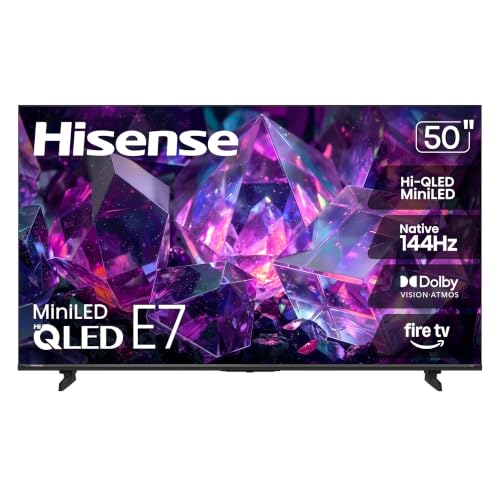
Hisense E7 Cinema 50-Inch (step-up) — Best 50-inch step-up for bright rooms
The Hisense E7 Cinema is the second 50-inch step-up option, and it differentiates itself from the TCL in platform and temperament: a Hi-QLED Mini-LED 4K Fire TV whose listing states a native 144Hz panel, AI Picture, Dolby Vision IQ and Atmos, full-array local dimming, MEMC and HDR10+ Adaptive, with Alexa+ aboard, in Hisense’s 2026 line. The Cinema in its series name is a fair summary of its pitch — a film-formatted, light-adaptive big-small screen — delivered through Amazon’s ecosystem rather than Google’s.
Dolby Vision IQ is the feature this step-up was born to carry in this guide, because IQ adapts the picture to the room’s ambient light, and the rooms that step up from OLED to Mini LED are stepping up precisely because of their light. Paired with HDR10+ Adaptive doing similar work for its format, the E7 is the most environment-aware pick in the entire pool — a set designed to be correct at noon and at nine without the owner conducting the transition manually. For a bright family room where the television is on across the whole day’s arc, that adaptivity is not a garnish; it is the product.
Fire TV divides households as it always does: Alexa households will find the E7 the most natural step-up to live with, while Google households will take the QM6K and lose nothing but the IQ badge. Either way, the E7 completes the guide’s argument — that the space beside the true 48-inch class is occupied by two genuinely different, genuinely labelled alternatives, and that a buyer who measures, reads the labels and chooses between OLED character and Mini LED adaptability has done this category exactly the justice it asks for.
- Panel: Hi-QLED Mini-LED, 50-inch class (step-up from 48), 4K UHD, 2026 model
- Refresh: Native 144Hz with MEMC, per the listing title
- Dimming: Full-array local dimming (FALD), per the listing title
- Formats: Dolby Vision IQ, Dolby Atmos, HDR10+ Adaptive, per the listing title
- Platform: Fire TV with Alexa+, per the listing title
Strengths
- Dolby Vision IQ and HDR10+ Adaptive make it the most light-aware set in the pool.
- A stated native 144Hz panel keeps sport and gaming smooth at the step-up size.
- Fire TV and Alexa+ suit Amazon households completely.
Trade-offs
- Fifty inches is fifty inches — the alcove rule from the QM6K section applies unchanged.
- Google-ecosystem households will prefer the TCL’s platform and lose the IQ feature.
- Its blacks, like all Mini LED, concede the night to the true 48-inch OLEDs.
Best for: a bright family room on the Amazon ecosystem, wanting one adaptive screen for the whole day. Not suited for: a dark, film-only den where its light-adaptive talents would never once be called upon.
How Do the Six Compare Side by Side?
| Pick | True size | Panel | Defining virtue |
|---|---|---|---|
| LG C4 OLED evo | 48-inch | OLED | The benchmark all-rounder |
| Sony BRAVIA 6 OLED | 48-inch | OLED | Stated 4xHDMI 2.1, film processing |
| Samsung S85H OLED | 48-inch | OLED | Newest platform generation |
| LG B5 OLED | 48-inch | OLED | OLED character at the value tier |
| TCL QM6K (step-up) | 50-inch step-up | Mini LED | 144Hz brightness for gamers |
| Hisense E7 (step-up) | 50-inch step-up | Mini LED | Light-adaptive formats on Fire TV |
The true-size column is the table’s conscience. Four rows answer the keyword exactly; two rows answer it approximately, with the approximation printed rather than hidden. Everything else — platform, processing, price logic — is a legitimate ground for choosing among all six, provided the size decision was made with a tape measure and open eyes. That is the whole ethics of this category in one small table.
How Should You Set Up a 48-Inch TV for Its Room?
Distance first, because this size rewards precision. At 48 inches, the immersive seat sits roughly one and a half to two metres away — closer than most living rooms arrange, which is why the size flourishes in bedrooms, studies and dens where the seat can be placed deliberately. If the set serves a desk, treat it with the monitor discipline of our desk guide: centre it, keep its top near eye level, and let the OLED picks’ viewing angles forgive the rest. On a wall, resist the mantelpiece instinct; a small screen mounted high reads as a picture frame that happens to move, and necks pay for the conceit.
Picture setup at this size has one peculiarity: you sit close enough to see everything, so the accurate modes earn their keep. Choose the filmmaker or cinema preset for film, disable motion interpolation for anything shot on film, and set gaming sources to the set’s game mode so the panel’s response — the quality this size is famous for among players — is not smothered by processing. On the step-ups, spend ten minutes with the local dimming settings using a dark scene and a bright subtitle; the difference between dimming levels is visible at this distance and the right setting is a personal, room-specific answer.
Sound completes the small-room picture. A 48-inch set’s speakers fire into a room where listeners sit near, which flatters dialogue and exposes thin bass at film moments. A compact soundbar fits this size’s furniture and fixes the bass without overwhelming the room — several picks carry features designed to cooperate with their makers’ bars. Plan the pairing at purchase if film matters; the size’s buyers are close enough to the screen to be close enough to its sound to judge it fairly, and most judge a small bar worth its shelf.
What Mistakes Do 48-Inch Buyers Make?
The category’s signature mistake is the mirror of this guide’s labelling discipline: buying a 50-inch set believing it to be a 48, because a search page, a hurried listing or a salesperson blurred the classes — then meeting the difference at a fitted alcove with a tape measure and a sinking feeling. Read the class in the listing title, measure the aperture in centimetres, and let no round number do the work of either. The second mistake runs the other way: refusing the step-ups on principle, then forcing an OLED into a sunlit room it was never meant for, when the honest answer was two inches away.
Third, buyers under-seat the size: placing a 48-inch set at a 65-inch room’s distance and concluding the category is underwhelming, when the geometry was simply never given its chance. This size is a near-field pleasure; respect its distances. Fourth, desk users forget the OLED care habits at exactly the size where OLED-as-monitor is most tempting — taskbars, static dashboards and all-day identical windows deserve the settings attention our flicker and desk guides describe. The panel will serve a desk beautifully, provided the desk returns the courtesy.
Finally, some buyers apologise for the size, as if choosing 48 inches were a confession of limited means or limited wall. The market’s own composition refutes the apology: this is the dimension the flagship panel makers chose for their most concentrated technology, bought by the buyers who measure first and deliberate longest. A well-chosen 48-inch OLED in a well-judged room is not a smaller television. It is a more exact one, and exactness has always been the connoisseur’s form of luxury.
How Does a 48-Inch OLED Behave at a Desk, Really?
Since this size keeps being adopted by desk users, it deserves a section of plain description rather than a cross-reference alone. Seated eighty to a hundred centimetres from a 48-inch 4K panel, the working experience is one of abundance with edges: documents sit at comfortable scale without aggressive zooming, a timeline or a spreadsheet finally shows its whole width, and the screen’s corners remain inside a natural glance rather than a head-turn — provided the desk is deep enough to hold that distance, which is the arrangement’s one non-negotiable. Shallow desks push the panel too close, and at too-close distances even OLED’s perfect angles cannot rescue the geometry.
The OLED character shows its desk virtues in the interface itself. Dark themes — editors, terminals, the evening side of every operating system — render with a depth no LCD at this size can imitate, and text against true black is the crispest reading experience the category offers. The care habits are the standing price: enable the panel’s maintenance features, let the set run its cycles, auto-hide persistent bars, and vary static content across the week. Owners who treat those habits as setup rather than as chores report the arrangement as the best screen decision they have made; owners who park one static window at full brightness for a working year are conducting an experiment this guide does not recommend joining.
The step-ups have a desk case of their own, and it should not be dismissed by OLED enthusiasm. A bright desk — the kind near a window, under a skylight, in a converted sunroom office — is Mini LED’s home turf, and the QM6K’s stated brightness and 144Hz panel make it a legitimate large-format work-and-play screen for exactly the rooms where the true 48-inch OLEDs would be fighting the architecture. The two-inch label matters at a desk too: a 50-inch step-up on a desk is a commitment of width that should be measured against the speakers and the lamp, not discovered against them.
What About Longevity and Life in a Small Room?
A television at this size tends to be kept, because it fits its room the way built-in furniture does, and kept televisions raise questions that bigger, more disposable sets avoid. Platform support is the first: the picks here run current or recent generations of webOS, Google TV and Samsung’s system, all of which receive years of updates, with the 2026 models holding the longest runway and the 2024-line C4 holding the deepest base of documented behaviour. Either end of that trade is defensible; what is not defensible is ignoring it, because a small room’s only screen will be asked to run services that have not been invented yet, on the strength of a platform chosen today.
The second longevity question is the room’s own future. A 48-inch set bought for a study becomes the bedroom set when the study is reorganised, then the kitchen’s large screen, then the guest room’s — a cascade of second lives that this size, uniquely, can serve without ever being absurd. The step-ups cascade nearly as well. Buyers should therefore weight build, mount compatibility and the maker’s service network a little higher than they would for a disposable large set, because the probability is high that someone in the household will still be watching this screen, in some room, a decade from now — and will judge today’s choice by how gracefully it aged into each of its lives.
Finally, the small room itself is a longevity factor for picture quality: it does not change. Large rooms get rearranged, extended, re-seated; the alcove, the study and the bedroom wall keep their geometry for years, which means a screen matched exactly to that geometry never goes out of fit. That is the deepest sense in which this category rewards its deliberate buyers — not just a television that suits the room on delivery day, but one whose suit was tailored to dimensions that will still be true when the platform is old, the remote is worn smooth, and the set has become, in the best sense, part of the house.
Final Recommendation
Within the true class, the LG C4 remains the centre of gravity — the pick to beat, balanced in every direction this size cares about. Take the Sony BRAVIA 6 when the room is an equipment hub or film processing leads, the Samsung S85H when the longest software life matters, and the LG B5 when the room is controlled and the budget is firm; each is a genuine 48-inch OLED arguing a different temperament, and none requires an excuse. Then, and only then, consider whether your room is one of the honest exceptions — bright, or gaming-led, or budgeted for muscle — that the two 50-inch step-up options exist to serve, the TCL QM6K for Google households and the Hisense E7 for Amazon ones.
Measure the wall, read the class in the title, and choose between OLED character at exactly 48 inches and Mini LED adaptability at a labelled 50 — because in this small, exacting category, the buyers who thrive are the ones who treat two inches as a decision rather than a rounding error, and are rewarded with the most precisely fitting screen in the house.
One more audience deserves direct address before the questions: the buyer furnishing a first small home, for whom this television is not the second screen but the only one, bought with money that has other claims on it. For that buyer the B5’s logic is at its strongest — genuine OLED character, a full platform, a size that suits the small main room exactly — and the step-ups present their honest alternative if the room is bright or the household games hard. What this guide would steer that buyer away from is the false economy of a larger, lesser panel bought because size felt like value: in a small room, at honest distances, the 48-inch OLED will look better every single evening than the bigger bargain ever will, and evenings are the currency a first home’s television is actually paid in.
And a closing observation for the measurers, since this category belongs to them: the difference between a room that feels designed and a room that feels accumulated is rarely the objects in it, but the fit of the largest one. A screen that matches its wall to the centimetre, chosen in full knowledge of its class and its alternatives, settles a room the way a frame settles a picture. The six sets above offer that settlement at four OLED temperaments and two labelled step-ups; the tape measure, as always in this guide, has the first vote, and the eye — given a week of evenings in the finished room — has the last.
Frequently Asked Questions
Is 48 inches big enough for a main living room?
It depends entirely on viewing distance. At around two metres — a small lounge, a flat’s main room, seating arranged deliberately — a 48-inch screen fills the view generously, and in OLED form out-pictures larger budget sets at the same distance. In a large room with the sofa three or more metres away, it will feel small no matter how fine the panel is, and the honest answer is a larger class altogether rather than a braver squint.
Why are all the true 48-inch TVs here OLED?
Because the market made them so. Panel production for this size has concentrated in OLED lines, while mainstream LCD production moved to 50 inches and above. This guide reports that composition rather than choosing it: the four genuine 48-inch listings in the pool are all OLED, and the nearest LCD alternatives are the two labelled 50-inch step-ups. A buyer determined to have LCD at exactly this size will find the current market largely uncooperative.
What is the actual size difference between 48 and 50 inches?
Two inches of diagonal translates to a few centimetres of width and a little over two centimetres of height — small enough to be invisible on an open wall, large enough to defeat a cabinet aperture or alcove cut for the smaller class. That asymmetry is the entire reason this guide labels the step-ups so insistently: the difference is trivial until the moment it is absolute, and only your tape measure knows which moment your room contains.
Can a 48-inch OLED serve as a computer monitor?
It is one of the size’s most popular second lives, particularly the LG models among desk users, because the pixel density at 4K is workable and the response characteristics suit play after hours. The desk disciplines apply: sensible brightness, the maker’s pixel-care features enabled, static elements varied, and a viewing distance a little deeper than a conventional monitor’s. Our dedicated desk guide covers the arrangement in full.
Which pick is best for gaming?
Among the true 48-inch sets, the Sony’s stated four HDMI 2.1 ports make it the hub choice for multi-console rooms, while the LG C4 carries the range’s all-round gaming reputation. If the room is bright or the budget prefers it, the TCL QM6K step-up counters with a stated 144Hz Mini LED panel at 50 inches. The right answer follows the room and the number of consoles, not a single specification.
Should I save money with the B5 or stretch to the C4?
Let the room arbitrate. In a light-controlled room used mostly for film, the B5’s concession — brightness headroom — is the one your room will never call on, and its saving is real. In a bright room, at a desk, or with a long mixed-use day, the C4’s headroom becomes the product itself and the stretch earns its return nightly. Both are genuine OLED; the question is purely how much light your room will ask the panel to fight.
It is worth recording, for buyers arriving from larger categories, how the priorities of this one rearrange themselves in practice. In the 65-inch world, the arguments run brightness, then size, then everything else; in the 48-inch world, the arguments run fit, then panel character, then the small print of ports and platforms — because at near distances the eye forgives nothing and the furniture forgives less. That rearrangement is why this guide spent its length on labelling, geometry and temperament rather than on the specification races that dominate bigger classes. A buyer who internalises the rearrangement will shop this size better than any ranking can shop it for them, and will recognise the moment a salesperson’s bigger-is-better reflex stops describing the room they actually live in.
The step-up question, finally, deserves its summary as a principle rather than as a verdict on two products: a labelled compromise is a choice, and an unlabelled one is a trap. Every category of technology has its version of the two inches — the size that is almost the size, the standard that is almost the standard — and the habit this guide has practised, of naming the difference every single time it appears, is the habit that keeps a buyer sovereign over all of them. Take the QM6K or the E7 with pride if their brightness and value suit the room; take the C4, the BRAVIA 6, the S85H or the B5 with pride if OLED character at the exact size is the room’s true requirement. Just never let a listing decide for you which of those purchases you made.
There is a small ritual this guide recommends for the evening any of these six is installed, because the size rewards ceremony more than most: dim the room to its real evening state, put on a film the household knows by heart, and sit in the real seats with the real drinks. A 48-inch OLED in a small room has a way of exceeding the memory of every larger, lesser screen the household has owned, and the step-ups have a way of filling a bright room with a confidence that ends the size debate on the spot. Either experience, arriving on the first night, tends to retire the question of whether the choice was right — and where it does not, the return window stands open with the tape measure’s evidence already gathered, which is exactly how a deliberate category like this one is supposed to conclude its purchases.
Guests, it turns out, are this size’s secret auditors. A visitor who has never thought about television classes will sit in the small room, watch ten minutes of anything, and say the thing owners of these sets hear with regularity: that the picture looks better than theirs at home, on a screen half the size of the one they are comparing it with. The remark contains the category’s whole thesis in lay terms — that at honest distances, character beats acreage — and it tends to send the guest home re-measuring their own wall with new suspicion about what their larger, duller panel has been costing them in every evening’s picture. Connoisseurship spreads exactly this way, one small perfect screen at a time, and the 48-inch class has been quietly winning converts by demonstration while the headline sizes won them by advertisement. None of which obliges any particular household to join it — the step-ups stand in this guide precisely because demonstration cuts both ways, and a bright, busy family room shown the E7’s adaptive confidence may convert its owner just as completely in the opposite direction. The guide’s loyalty is not to a panel technology but to the process: measure the room, read the class in the title, weigh character against brightness with the room’s own light as the witness, and then commit without nostalgia for the road not taken, because a well-matched screen makes its own case nightly and needs no defence from the person who chose it well. So measure once more, kindly and without hurry, the way you would measure for a piece of furniture you intend to keep for a decade — because that, in the end, is what a 48-inch television of this quality is: not an electronic passing through the room on its way to obsolescence, but a fitted part of the home, sized to its wall the way a good door is sized to its frame, and judged, finally, by how completely the room stops imagining any other screen in its place. When that quiet arrives — usually somewhere in the second week, when the household realises it has stopped discussing the television entirely — the category has delivered its whole promise, and the only remaining task is the pleasant one of watching, at the right distance, in the right light, on a screen that was chosen the way this guide has argued from its first paragraph: exactly, honestly, and by measure. Keep the tape measure in the drawer with the spare batteries, though — because the next room, the next wall and the next deliberate purchase are already out there waiting, and a household that has learned to buy this way, one honest class at a time, tends to find that every subsequent screen, speaker and appliance gets a little easier to choose, and a little harder to regret, than the one before it. That compounding confidence, earned one well-measured purchase at a time, is the quiet dividend of this exacting little category — and it begins, as everything in these pages has begun, with a tape measure, a title read carefully, and a room taken seriously on its own terms. Measure well, choose once, and watch for years.
Related Guides
The neighbouring questions are covered in our best 4k tvs that double as a monitor roundup if this size is headed for a desk, the best tvs for people sensitive to flicker guide if long sessions at close distance are part of the plan, and the best tvs for rooms with natural light coverage if the small room in question is also a bright one.


