What's inside
- Where to buy
- Key Takeaways
- Quick Picks
- How did we pick the best 300 dollar photography cameras?
- How do the best 300 dollar photography cameras compare side by side?
- What actually makes a camera at this tier better than a phone?
- Which matters more at this price: sensor size or zoom range?
- How should a beginner allocate a small budget beyond the camera itself?
- What settings should a new owner change on day one?
- How long should a camera at this tier realistically last?
- What should you check when a listing looks too good for the tier?
- How do raw files change what is possible at this tier?
- What photographs should a new camera owner practise first?
- How does weather and handling reality differ between these designs?
- When is the right time to add a second lens or a better compact?
- What mistakes do buyers at this tier make most often?
- Final Recommendation
- Frequently Asked Questions
- Related Guides
As an Amazon Associate I earn from qualifying purchases. This post may contain affiliate links at no extra cost to you.
gizmoverdict.com is reader-supported. When you buy through links on our site, we may earn an affiliate commission.
Where to buy
All six cameras below are sold through Amazon’s US store at the linked listings, and the configurations matter at this end of the market more than anywhere else: two listings are interchangeable-lens kits with a starter zoom in the box, one is a long-zoom travel compact, and the rest are fixed-lens cameras at descending levels of ambition. Check exactly what a listing includes — memory cards, cases and spare batteries are rarely in the box at this tier — before treating two offers as equivalent.
Searching for the best 300 dollar photography cameras means shopping at the most contested altitude in the camera market, the point where a dedicated camera must justify itself against the phone already in your pocket. Around this tier the honest answer is that a camera wins on specific grounds: a real optical zoom a phone cannot match, a larger sensor that holds together in dim rooms, interchangeable lenses that grow with the photographer, or simply controls that teach photography instead of hiding it. Any camera here that cannot name its ground does not belong on the list.
The six picks therefore spread deliberately across the tier’s shapes. Two Canons open the interchangeable-lens door — one mirrorless and current, one DSLR and deeply proven. A Panasonic travel zoom covers the holiday-and-family brief. Two Kodak models serve buyers who want the longest reach or the smallest commitment for the least money in relative terms, and a Panasonic 4K point-and-shoot rounds out the set for casual video-leaning shooters. Prices in this bracket drift with promotions, so treat the tier as a neighbourhood rather than a fence: a camera slightly above the line on a given week may still be the right buy, and one below it is not automatically a bargain.
Key Takeaways
- The Canon EOS R100 is the strongest photographic tool near this tier: a 24.1-megapixel APS-C sensor and the growing RF lens mount inside a genuinely compact kit.
- Canon’s Rebel T7 remains the patient teacher — an optical viewfinder, endless used lenses and battery life that embarrasses mirrorless rivals.
- Panasonic’s Lumix ZS99 answers the phone’s weakest point with a 30x optical zoom that reaches scenes no handset crop can touch.
- Kodak’s AZ405 trades sensor size for a 40x zoom and AA batteries, a combination that suits occasional, faraway subjects.
- The little Kodak FZ55 is the honest minimum: a pocketable 16-megapixel camera for buyers who want a separate device, not a hobby.
- At this tier, spend first on sensor and lens quality; headline megapixels and digital zoom figures are the least reliable numbers on any box.
Quick Picks
| Pick | Badge | Why it earns its place |
|---|---|---|
| Canon EOS R100 with RF-S 18-45mm kit lens | Best sensor and future at the tier | A current APS-C mirrorless camera with a 24.1MP sensor and RF mount — the only pick that grows into a serious system. |
| Canon EOS Rebel T7 with EF-S 18-55mm kit lens | The patient teacher | A proven DSLR with an optical viewfinder and access to decades of affordable EF lenses on the used market. |
| Panasonic Lumix ZS99 | Travel zoom champion | A pocketable compact with a 30x zoom reaching a 720mm equivalent — the anti-phone for holidays and school concerts. |
| Kodak PIXPRO AZ405 | Maximum reach, minimum fuss | A 40x bridge camera running on AA batteries, built for occasional faraway subjects and zero charging rituals. |
| Kodak PIXPRO FZ55 | The honest minimum | A slim 16MP pocket camera with a 5x zoom for buyers who simply want a separate, simple camera. |
| Panasonic 4K point-and-shoot (retail listing) | Casual 4K compact | A travel-aimed 4K compact from a retail listing — check the seller’s exact specification carefully before buying. |
How did we pick the best 300 dollar photography cameras?
We started from the photograph, not the brochure. Every camera here had to produce stills that visibly beat a competent phone in at least one common situation — a dim restaurant, a distant stage, a fast-moving child — because a dedicated camera that merely matches a handset is luggage. Sensor size carried the most weight in that judgement, followed by the honesty of the lens: optical zoom counted, digital zoom did not, and fixed apertures that collapse in low light were marked down hard.
Growth potential formed the second filter. Two picks accept interchangeable lenses, and for a buyer discovering photography that door matters more than any single feature, because a camera body is a three-year purchase while a lens collection is a decade-long one. The fixed-lens picks had to justify their closed design with reach, size or simplicity that a kit camera cannot offer.
Finally we discounted launch-era marketing claims to present-day reality. Several of these models have been on sale for years, which at this tier is a virtue — firmware is settled, weaknesses are documented, and the accessory shelves are full. We favoured cameras whose reputations were earned in owners’ hands over newer listings whose spec sheets promise the moon in suspiciously round numbers.
A note on the verdicts that follow: each verdict weighs the camera as a stills tool first, because the keyword asks about photography. Video capability is reported honestly where it exists — several picks record 4K in some form — but no camera here was promoted for video talents its stills work could not support.
We also considered the second-hand dimension, because at this tier many households will meet these cameras used before they meet them new. Models with long production runs and shared batteries — the T7 above all — are safer used purchases, since chargers, caps and grips circulate widely and any fault is documented somewhere by a previous owner. Conversely, a used compact with an unknown zoom mechanism deserves a discount for the risk, and a listing-verification habit matters as much second-hand as it does new. The verdicts above were written for new purchases, but none of them reverses in the used market; they merely sharpen.

Canon EOS R100 with RF-S 18-45mm kit lens — Best sensor and future at the tier
The R100 is the camera that makes this entire category feel respectable. Inside its small body sits the same class of 24.1-megapixel APS-C sensor Canon uses across its entry mirrorless line, which means raw files with genuine editing latitude, clean images at sensitivities that would shred a compact’s output, and autofocus that finds eyes rather than hunting across the frame. For a buyer whose reference point is a phone, the first evening spent reviewing R100 files at full size is usually the moment the purchase explains itself.
Canon positions the R100 as a first interchangeable-lens camera, and the compromises follow that brief honestly. The rear screen is fixed rather than articulating, the video mode records 4K with a crop and contrast-based focusing that suits static scenes better than moving ones, and the control layout leans on menus where pricier bodies offer dials. None of those choices hurt stills photography, which is the assignment here. The kit lens covers the everyday range from modest wide-angle to short portrait telephoto, focuses closely enough for tabletop work, and collapses small for travel.
The strategic argument is the mount. RF and RF-S lenses are where Canon’s development money now flows, so an R100 bought today can wear faster zooms, bright primes and long telephotos bought years later — and the body can be replaced while the glass stays. Owners outgrow this camera’s screen and controls long before they outgrow its sensor, which is exactly the right order for limitations to arrive in.
Ownership costs stay friendly. The battery is a common Canon pack shared with other models, third-party accessories are plentiful, and the camera charges and transfers over USB like a modern device should. For families it doubles as the good camera that also shoots respectable video of school events; for students it is a legitimate learning instrument with full manual control available the moment automatic modes start to feel like a ceiling.
One more consideration separates the R100 from everything else at the tier: how it behaves as the household’s second camera years from now. Owners who eventually step up to a larger Canon body keep the R100 as the light travel option, the camera lent to a teenager, the one that lives by the door for the dog’s best moments. Small, quiet and undemanding, it ages into usefulness rather than obsolescence. That long second life rarely appears in buying advice, yet it is how real households extract value from a first serious camera — not by selling it, but by demoting it gracefully into daily service.
- Sensor: APS-C CMOS, 24.1 megapixels
- Lens: RF-S 18-45mm f/4.5-6.3 IS STM kit zoom included
- Mount: Canon RF, accepts RF and RF-S lenses
- Video: 4K recording with crop, Full HD at higher rates
- Screen: fixed rear display, electronic viewfinder fitted
- Focus: Dual Pixel autofocus with eye detection for stills
Strengths
- Largest, most capable sensor in this roundup
- RF mount gives a genuine upgrade path for lenses
- Eye-detection autofocus flatters portraits of family and pets
Trade-offs
- Fixed screen frustrates low and high angle composing
- 4K video mode is cropped and best for static scenes
- Fewer direct dials than enthusiast bodies offer
Best for: first-time system buyers, photography students and families who want one camera that can grow for years.
Not suited for: vloggers needing a flip screen, or action shooters chasing fast continuous bursts.

Canon EOS Rebel T7 with EF-S 18-55mm kit lens — The patient teacher
The Rebel T7 is the oldest design in this guide and in some ways the most honest teacher. Its optical viewfinder shows the scene through the lens with no lag, no blackout tricks and no battery anxiety, and generations of photography students learned exposure on Rebels because the camera insists on the fundamentals: aperture, shutter speed and ISO presented without decoration. The 24.1-megapixel APS-C sensor remains genuinely capable in good and moderate light, producing files that print well and edit gracefully.
Battery endurance is the DSLR party trick that mirrorless still cannot match. Where the mirrorless picks sip power through an electronic viewfinder, the T7’s optical finder draws almost nothing, so a single charge covers days of holiday shooting rather than hours. The body is larger, certainly, yet the grip is deep and secure, the controls are glove-friendly, and the whole package tolerates the knocks of school bags and car boots with a shrug.
The EF lens ecosystem is the T7’s second life. Because Canon made EF and EF-S lenses for decades, the used market overflows with affordable primes, macro lenses and telephotos that mount directly, letting a student assemble a serious kit gradually for modest outlays. Against that, the specification shows its era: video stops at Full HD with contrast autofocus, the rear screen neither tilts nor responds to touch in the modern manner, and continuous shooting pace suits deliberate work rather than sport.
Buy the T7 with clear eyes and it rewards the clarity. It is the pick for someone who wants to learn photography as a craft, who values a viewfinder that shows the world rather than a picture of it, and who would rather spend future money on lenses than on replacing bodies. As a first camera for a teenager who will actually study the manual, it may be the wisest money in this entire guide.
The T7 also deserves credit as a video-adjacent stills tool for one specific job: photographing events where its silence about battery and its instant-on optical finder outperform mirrorless convenience. School plays, ceremonies and museum visits reward a camera that wakes instantly, focuses through a real finder and never asks to be charged at lunch. Its built-in Wi-Fi, modest as it is, moves a chosen frame to a phone for sharing without a computer. Buyers sometimes apologise for choosing a DSLR in a mirrorless decade; T7 owners who shoot regularly tend to stop apologising within the first month.
- Sensor: APS-C CMOS, 24.1 megapixels
- Lens: EF-S 18-55mm f/3.5-5.6 IS II kit zoom included
- Viewfinder: optical pentamirror, true through-lens view
- Video: Full HD recording, no 4K mode
- Mount: Canon EF/EF-S, vast new and used lens supply
- Battery: high shot count per charge by DSLR design
Strengths
- Optical viewfinder teaches composition without lag
- Used EF lenses make growing a kit inexpensive
- Battery life measured in days of shooting, not hours
Trade-offs
- No 4K video and modest video autofocus
- Fixed, non-touch rear screen feels dated
- Larger body than every mirrorless rival here
Best for: students and traditionalists who want to learn exposure properly and build a lens kit slowly.
Not suited for: video-first creators or travellers counting every gram of bag weight.

Panasonic Lumix ZS99 — Travel zoom champion
The ZS99 exists to solve the one problem phones still cannot: distance. Its 30x optical zoom spans from a 24mm-equivalent wide view out to a 720mm-equivalent telephoto, which turns a speck on a stage into a recognisable grandchild and a distant lighthouse into a composition. Optical reach of this kind is physics, not processing — the lens actually gathers the scene — so detail survives in a way that digital cropping on a handset never delivers. For travel and family duty, that single capability justifies carrying a second device.
Panasonic wraps the lens in a body that still fits a jacket pocket, with a tilting touchscreen for awkward angles, a small electronic viewfinder for bright-day framing, and stabilisation that keeps the long end usable at sane shutter speeds. The one-inch-class compromises of larger compacts do not apply here; the sensor is a smaller compact unit, and image quality in dim interiors reflects that. In daylight, at the zoo, on a boat or in the stands — the situations this camera is bought for — it performs exactly as owners hope.
Video earns a mention because the ZS99 records 4K and offers Panasonic’s 4K Photo modes that pull stills from video bursts, a genuinely handy trick for catching a dive, a swing or a candle being blown out. Controls include a proper mode dial and customisable ring, so the camera can grow from full-auto snapshots toward deliberate settings as its owner learns.
Set expectations correctly and the ZS99 delights: it is a daylight-and-distance specialist whose sensor concedes low-light contests to the Canons in this guide. Paired with a phone for evening restaurants, it covers the holiday brief more completely than any single device at the tier. Travellers who have returned home with unusable zoomed phone shots of the one moment that mattered are precisely its audience.
Practical travellers should note how the ZS99 handles the unglamorous parts of a trip. USB charging means a power bank refills it on a train; the lens retracts fully so it survives a coat pocket without a case; and Panasonic’s scene intelligence is conservative enough to trust on a once-a-decade holiday. The manual zoom ring around the lens barrel gives returning photographers a tactile control that touchscreens never replicate. Pack a mini tripod for dusk cityscapes and the little compact covers a European city break more completely than cameras several times its size that owners leave in the hotel safe.
- Zoom: 30x optical, 24-720mm equivalent range
- Sensor: compact-class sensor behind Leica-branded DC lens
- Video: 4K recording plus 4K Photo burst modes
- Screen: tilting touchscreen, small EVF fitted
- Stabilisation: optical system for long-zoom steadiness
- Body: pocketable travel-compact format
Strengths
- Genuine optical reach no phone at any price replicates
- Pocket size despite the long zoom range
- 4K Photo modes rescue fleeting moments as stills
Trade-offs
- Small sensor loses dim-light contests to APS-C picks
- Long end demands steady hands and decent light
- Fixed lens means the camera you buy is the camera you keep
Best for: travellers, parents in the back row and wildlife-park visitors who need reach in a pocket.
Not suited for: low-light event shooters or anyone planning to print very large.

Kodak PIXPRO AZ405 — Maximum reach, minimum fuss
The AZ405 belongs to the bridge-camera family: a body shaped like a small DSLR, a fixed lens with an enormous 40x zoom, and a philosophy of removing every obstacle between a casual owner and a distant subject. Its 20-megapixel sensor is compact-class, so the honest framing is reach over refinement — this camera photographs the heron across the lake, the moon rising over the harbour and the rider at the far end of the arena, subjects the other picks here either cannot frame or can only crop toward.
AA batteries are its quiet manifesto. Where every rival in this guide depends on proprietary packs and chargers, the AZ405 runs on the most available battery format on Earth, bought at any kiosk and swapped in seconds. For a camera that lives in a holiday home, a boat locker or a grandparent’s drawer and gets used six weekends a year, that convenience is not a compromise but the entire point. Optical stabilisation helps at the long end, and the electronic viewfinder gives a stable eye-level option in glare.
Limits deserve plain statement. Video is Full HD rather than 4K, autofocus is a contrast-based system that prefers unhurried subjects, and image quality in poor light trails the Canons by a visible margin. The zoom’s far end magnifies haze and handshake along with the subject, so the best results come on bright days with the camera braced.
Within its brief, though, the AZ405 is coherent in a way spec-sheet snobbery misses. It asks nothing of its owner — no lens changes, no charger management, no system commitment — and returns recognisable photographs of things far away. For bird feeders, school sports from the fence line and holiday excursions, that trade remains popular for good reason.
One social fact about the AZ405 is worth naming: it is the camera most often bought for someone else. Adult children buy it for parents who birdwatch from a porch; clubs buy it for recording matches from the sideline; it appears at holiday homes precisely because nobody’s precious system camera should. The generous grip, unambiguous buttons and a mode dial that can simply live on automatic respect that audience. When the resulting photographs — a recognisable eagle, a grandchild mid-swing, the moon over the lake — arrive in the family chat, the bridge camera has done the whole of its job.
- Zoom: 40x optical, 24mm wide-angle start
- Sensor: 20 megapixels, compact class
- Power: AA batteries, universally replaceable
- Video: 1080p Full HD recording
- Stabilisation: optical image stabilisation fitted
- Viewfinder: electronic eye-level finder plus rear screen
Strengths
- 40x reach frames subjects other picks cannot
- AA power ends charger and dead-battery anxiety
- Bridge body handles steadily with simple controls
Trade-offs
- Compact sensor limits low-light quality
- Autofocus pace suits calm subjects only
- Video specification stops at Full HD
Best for: occasional shooters, holiday homes and grandparents who want distant subjects without system complexity.
Not suited for: enthusiasts planning to edit raw files or shoot in dim venues.
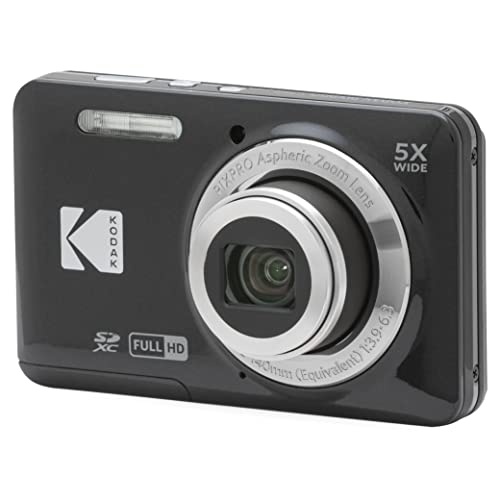
Kodak PIXPRO FZ55 — The honest minimum
The FZ55 makes no attempt to out-argue a flagship phone, and that honesty is its charm. It is a slim, light, genuinely pocketable 16-megapixel camera with a 5x optical zoom starting at a useful 28mm-equivalent wide angle, a rechargeable battery, and controls a child or a technophobe relative can master in one sitting. Its natural habitats are school trips, festivals where a phone battery must survive the day, workplaces that ban camera phones, and the hands of younger photographers whose first camera should be theirs alone.
Image quality sits at the level the hardware implies: bright outdoor scenes come back crisp and colourful, flash-lit indoor snapshots are serviceable, and dim scenes without flash ask more than the small sensor enjoys giving. Video records at Full HD, adequate for clips rather than productions. The zoom range is modest beside the ZS99 and AZ405 in this guide, yet even 5x optical reach plus a real flash gives it two honest advantages over a basic handset.
What the FZ55 really sells is separation. Photographs land on a memory card that belongs to the camera, the device can be lent without lending a life, and its price position in relative terms — the lowest rung of this roundup — means a loss or a drop is an annoyance rather than a disaster. Parents buying a first real camera and organisers equipping a group activity will recognise the logic immediately.
Treat it as a tool for daylight and good humour and it will not disappoint. Ask it to be a low-light instrument or a photographer’s growth platform and the brief exceeds the product; the Canons above exist for those ambitions. The FZ55’s virtue is knowing exactly what it is.
Schools and youth organisations form a quiet bulk of FZ55 ownership, and their reasoning is instructive for parents too. A class set of identical, simple cameras removes the hierarchy of whose phone is newest, keeps photography as the activity rather than the device, and produces a shared memory card of the trip that belongs to everyone. The camera’s limitations even teach: with modest zoom and no computational rescue, children learn to walk closer, wait for light and hold still — the three founding skills of photography, delivered by a device that costs less than the trip’s packed lunches.
- Sensor: 16 megapixels, compact class
- Zoom: 5x optical, 28mm wide-angle equivalent start
- Video: 1080p Full HD clips
- Body: slim pocket format, rechargeable battery
- Flash: built-in unit for indoor snapshots
- Controls: simplified automatic-first layout
Strengths
- Truly pocketable and simple enough for any age
- Separate device preserves phone battery and privacy
- Lowest commitment in the roundup in relative terms
Trade-offs
- Small sensor struggles once light fades
- Zoom range is modest beside bridge rivals
- No upgrade path beyond replacing the camera
Best for: children’s first cameras, school trips, festivals and phone-free workplaces.
Not suited for: enthusiasts, low-light shooters or anyone wanting to grow a system.

Panasonic 4K point-and-shoot (retail listing) — Casual 4K compact
This final pick requires a different kind of honesty, because it reaches the guide through a retail listing whose description emphasises 4K video and travel vlogging rather than a long-established model lineage. Cameras sold this way can be perfectly serviceable casual tools — a fixed-lens compact that records 4K clips, fits a coat pocket and asks little of its owner — but the burden of verification sits with the buyer in a way it does not for the named models above. Read the listing’s full specification, confirm the sensor and zoom claims in the detailed section rather than the headline, and weigh the seller’s returns policy as part of the product.
What such a camera offers, when the listing is accurate, is a simple proposition: better-than-phone zoom and a dedicated device for trips and family video diaries, with stills that serve sharing and small prints happily. Autofocus and stabilisation on listings of this kind are typically basic, low-light performance follows the small sensor, and long-term firmware support should be assumed minimal. None of that disqualifies it for a buyer whose alternative is no camera at all.
Our advice is procedural. Compare its confirmed specifications against the ZS99, which covers similar ground with a documented pedigree, and choose the listing camera only if its verified details or the day’s relative pricing make a clear case. Keep the packaging until the first memory card of real shooting has been reviewed at full size on a computer screen.
Included in this guide deliberately, it represents a large and real slice of how cameras are actually bought at this tier — by listing, not by lineage. Handled with a checklist and modest expectations, it can serve a casual shooter well; bought on headline claims alone, it is the riskiest purchase on this page.
Buyers who do choose this route should adopt a thirty-day discipline that converts a gamble into a decision. Shoot deliberately across the first month — daylight, indoors, zoom extremes, a moving subject, an evening scene — and review everything at full size on a computer rather than the rear screen. Listings of this kind reveal themselves quickly: honest ones produce consistent, pleasant files, while exaggerated ones show smeared detail and invented resolution. The returns window exists for exactly this audit, and using it calmly, with evidence, is not fussiness but the completion of the purchase.
- Type: fixed-lens compact, travel and vlogging positioning
- Video: 4K recording per listing description
- Stills: digital stills for sharing and small prints
- Body: pocketable point-and-shoot format
- Specification note: verify sensor and zoom in listing details
- Support: assume minimal firmware updates
Strengths
- Dedicated 4K-capable compact for casual travel use
- Simple point-and-shoot operation
- Pocket format encourages carrying it daily
Trade-offs
- Listing specifications require buyer verification
- Pedigree and support trail the named brands here
- Low-light ability limited by compact hardware
Best for: casual buyers who verify the listing carefully and want an easy travel compact.
Not suited for: anyone who needs documented specifications and long-term manufacturer support.
How do the best 300 dollar photography cameras compare side by side?
The table strips each pick down to its sensor class, its lens story and the weakness a buyer will meet first, because at this tier the differences are about design philosophy rather than specification decimals.
| Model | Sensor / Format | Headline capability | Watch out for |
|---|---|---|---|
| Canon EOS R100 kit | APS-C, 24.1MP | Interchangeable RF lenses, kit zoom included | Fixed screen, cropped 4K video |
| Canon EOS Rebel T7 kit | APS-C, 24.1MP | Optical viewfinder, EF lens ecosystem | No 4K, dated screen and video AF |
| Panasonic Lumix ZS99 | Compact class | 30x optical zoom in a pocket body | Low-light quality trails APS-C |
| Kodak PIXPRO AZ405 | Compact class, 20MP | 40x zoom, AA battery convenience | Full HD video ceiling, slow AF |
| Kodak PIXPRO FZ55 | Compact class, 16MP | Slimmest, simplest camera here | Modest zoom and dim-light ability |
| Panasonic 4K point-and-shoot | Compact class | 4K casual travel compact | Listing specs need verification |
What actually makes a camera at this tier better than a phone?
Three physical advantages survive every marketing argument. The first is sensor area: the APS-C chips in the two Canons gather far more light per photograph than a handset’s tiny sensor, which shows up as cleaner shadows, gentler highlight roll-off and files that tolerate editing. The second is the lens: a real zoom moves glass to change focal length, gathering the distant scene directly, while a phone crops and interpolates. The third is control — a mode dial, an exposure compensation button and a viewfinder held to the eye change how deliberately a person photographs, and deliberation is where improvement lives.
Against that, phones fight back with computation, stitching exposures and sharpening scenes in ways that flatter casual snapshots, especially at night. The honest summary is that a dedicated camera at this tier wins on reach, on printable quality in decent light, on battery independence and on learning the craft — and concedes the effortless night-mode snapshot. Buyers who understand that trade are almost never disappointed; buyers promised a phone-killer usually are.
Which matters more at this price: sensor size or zoom range?
It depends entirely on where your subjects live. Portraits of family at home, a child’s face across a room, food, pets and street scenes all reward sensor size, because the light is ordinary and the distances are short — that is R100 and T7 territory. Subjects that keep their distance — wildlife, sports from the stands, landmarks across water, performers on a stage — reward zoom, because a photograph you cannot frame does not exist regardless of sensor quality; that is ZS99 and AZ405 territory.
A useful exercise before buying is to scroll your phone’s gallery and classify the last fifty photographs by distance. Most people discover a clear pattern, and the pattern should choose the camera. Mixed galleries argue for the interchangeable-lens route, since a kit zoom covers the middle distances today and a telephoto can join it later — the only picks here whose answer can change after purchase.
How should a beginner allocate a small budget beyond the camera itself?
Reserve something for the unglamorous essentials, because at this tier they decide whether the camera gets used. A memory card of decent speed and capacity, a second battery for the mirrorless picks, a simple padded case and a wrist strap together cost a fraction of the body yet remove the three classic frustrations: a full card, a dead battery and a dropped camera. The AA-powered AZ405 shrugs off the battery line entirely, one of its underappreciated virtues.
After the essentials, spend on experiences before accessories: the train fare to somewhere photogenic teaches more than a filter set. When a second purchase does come, make it a lens for the system cameras — a bright prime transforms indoor photography more than any body upgrade at this level — or a compact tripod for the zoom compacts, whose long ends reward support. Avoid accessory bundles of dubious quality that pad listings; buy the named essentials separately and keep the change.
What settings should a new owner change on day one?
Start by choosing the largest JPEG quality, or raw plus JPEG on the Canons, so the files hold everything the sensor captured; storage is cheap and re-shooting a birthday is impossible. Set the autofocus to a single point or a small zone you control rather than the full automatic area, because cameras guess the wrong subject with confidence. Turn the digital zoom off entirely on the compacts — it only crops — and let the optical range define the framing.
Then learn one control properly each week. Aperture priority is the natural first home: the photographer chooses how much of the scene is sharp, the camera handles the arithmetic, and the relationship between aperture and background blur becomes physical knowledge within a month of family photographs. Add exposure compensation for snow, beaches and backlit faces, and the two controls together cover most of what separates a considered photograph from a snapshot at any price level.
How long should a camera at this tier realistically last?
Mechanically, every pick here should survive years of family use; shutters on the system cameras are rated far beyond casual volumes, and the fixed-lens models have few moving parts to fail. The realistic limit is ambition, not durability. An R100 owner discovers lenses; a T7 owner discovers the used market; both can grow for a decade without replacing the body. A compact owner’s ceiling arrives when their eye improves past the sensor, which for travel and family purposes may honestly never happen.
Protect the investment with boring habits: keep the camera dry, blow dust off the lens rather than wiping grit across it, store it out of a hot car, and update firmware occasionally on the system bodies. Resale values at this tier are modest, so the economics favour using the camera fully rather than preserving it — take it places a phone would stay pocketed, and it pays for itself in photographs that would otherwise not exist.
What should you check when a listing looks too good for the tier?
Verify the seller, the exact model designation and what the box contains, in that order. Grey-market and marketplace listings at this level sometimes substitute international variants, omit the kit lens implied by photographs, or pair a genuine body with a worthless accessory bundle presented as value. The Panasonic point-and-shoot pick in this guide is the standing example of why the detailed specification section matters more than a headline: confirm sensor, zoom type and video resolution in the fine print, and treat a generous returns window as part of the product you are buying.
Check warranty territory as well. A camera bought across regions may carry no local service support, which converts a small saving into a large risk if anything fails in the first year. None of this requires paranoia — it requires ten minutes of reading before the purchase rather than ten days of dispute after it.
How do raw files change what is possible at this tier?
Raw recording is the quiet divider between the system cameras and the compacts in this guide. A raw file keeps the sensor’s unprocessed data, so a beginner who underexposes a family portrait by a stop, or shoots under orange kitchen lighting, can recover a respectable photograph at the computer. The Canons offer it; the fixed-lens picks largely speak JPEG only, which means their in-camera decisions are final. For a buyer curious about editing — and editing is where modern photography skills compound — raw support is worth more than several headline features combined.
The cost is workflow: raw files are larger, need software to view at their best, and punish anyone who never intends to open an editor. A sensible household compromise is raw plus JPEG on the Canons, editing only the keepers while sharing the rest immediately. After six months, most owners discover their real preference from behaviour rather than theory, and set the camera accordingly. Either way, the option’s presence is what matters at purchase time, because it cannot be added later.
What photographs should a new camera owner practise first?
Begin with the window-light portrait: a family member beside a bright window on an overcast day produces flattering, professional-looking results with any pick in this guide and teaches how direction of light sculpts a face. Move next to the deliberate landscape — feet planted, horizon level, foreground object chosen — which exposes the difference between seeing a view and composing one. The third exercise is the hardest and most valuable: photograph one ordinary street or kitchen ten ways, changing position rather than settings, until the subject yields a frame that surprises you.
These exercises matter more than gear differences at this level, and saying so is not a platitude but the finding of every photography teacher alive. The camera’s job is to stay out of the way while the eye develops; each pick here was judged partly on how little it interrupts that process. A month of such practice will also tell the owner exactly which limitation to spend money on next, replacing guesswork with evidence.
How does weather and handling reality differ between these designs?
A camera’s brochure photograph never shows it being used with cold fingers at a windy viewpoint, yet handling decides real-world results at this tier more than sensor decimals do. The T7’s deep grip and chunky dials work with gloves and one hand; the R100 is secure but smaller, rewarding a wrist strap; the compacts demand two-handed respect at full zoom, where a gust or a shiver moves the frame by metres at the subject. Buyers in cold climates or on boats should weight these paragraphs as heavily as any specification table.
Weather resistance follows a similar honesty gradient. None of these cameras should be treated as waterproof, and only the system bodies tolerate a light drizzle with any confidence — and even then, the kit lenses are the weak point. A cheap rain cover or a clear bag has saved more holiday photographs than any sealing claim at this price. Salt air deserves a specific warning for the travel compacts: wipe the body with a barely damp cloth after beach days, extend and retract the zoom a few times indoors, and store the camera with a silica packet. Zoom mechanisms ingest grit silently and complain months later.
Carrying method quietly shapes image quality too. A camera around the neck is a camera that gets used at the decisive moment; a camera in a backpack photographs only the planned stops. The pocket compacts win this contest by default, which is a real argument for the ZS99 and FZ55 in households that already own a system camera: the second, smaller body often produces the trip’s favourite frames simply by being present. Judge the picks here as a household system, not as rivals in a vacuum, and combinations — Canon for occasions, compact for every day — start to make eminent sense.
When is the right time to add a second lens or a better compact?
The honest trigger is repetition: when the same limitation appears in your keeper photographs month after month — faces too small across a hall, rooms too dark for the kit zoom, subjects too distant for the compact — the limitation has identified the purchase. For R100 and T7 owners that usually means a fast prime for indoor life or a telephoto for the sideline; for compact owners it means admitting the household needs a system camera for occasions while the compact keeps its daily role. Buying in response to evidence feels slower than buying in response to advertising, and it is dramatically cheaper over a decade.
There is also a wrong time, and it is the first fortnight. New owners routinely misread their own learning curve as equipment failure, shopping for a fix to a problem that practice would dissolve. Give any pick here a season of regular use before judging it. The camera you understand deeply outperforms the theoretically better camera you are still fumbling with, every single weekend.
What mistakes do buyers at this tier make most often?
Chasing megapixels is the evergreen error. A 20-megapixel compact and a 24-megapixel APS-C camera are not separated by four units of anything meaningful; the sensor’s physical size decides how cleanly those pixels behave, especially indoors. Buyers who internalise that single idea stop being vulnerable to the loudest number on the box.
Believing digital zoom figures runs a close second. Digital zoom discards information and enlarges the remainder; it cannot be switched off retroactively in the edit. Every pick here was judged on optical reach alone, and owners should disable the digital extension on day one and frame honestly.
A third mistake is buying the camera and nothing else, then losing the first important occasion to a full card or a flat battery. The essentials list in the guide above is short and cheap; skipping it is the most expensive saving available at this tier.
Finally, many new owners shoot everything on full automatic for a year and conclude the camera is ordinary. The camera is fine; the mode is the ceiling. One month of aperture priority does more for a beginner’s photographs than any upgrade this guide could recommend.
A fifth mistake is subtler: leaving the camera on its widest, most automatic settings for video-call-style documentation of everything, then wondering why nothing looks like the samples that sold the camera. Those samples were composed. Slowing down for one deliberate frame per subject — checking the edges, waiting for the expression — is free, and it is the entire difference.
Sixth, owners of the zoom compacts often shoot everything at maximum extension because the capability exists. Telephoto compression flattens scenes and magnifies haze; many subjects photograph better from a few steps closer at a moderate focal length. The zoom is a tool for when you cannot move, not a substitute for moving.
Final Recommendation
If one pick must carry the category, it is the Canon EOS R100: the strongest sensor here, autofocus that flatters beginners, and a lens mount with a future — the camera a buyer is least likely to replace within two years. The Rebel T7 stands as the traditionalist alternative whose viewfinder and used-lens market still make a rational case, while the ZS99 owns the travel brief outright.
There is a temptation, reading any roundup at this level, to treat the decision as permanent and therefore agonising. It is neither. These are tools for making family photographs better than a phone can, and the cost of choosing the second-best pick for your household is a handful of frames across years of shooting — while the cost of another month of research is a month of photographs never taken. Decide this week, shoot next week.
Match the camera to your gallery’s distances and your household’s habits, buy the card and the spare battery with it, and the modest tier this guide covers will produce immodestly good family photographs for years. That, rather than any specification, is the verdict the category keeps delivering.
Above all, resist the paralysis this crowded tier encourages. Any camera on this page, bought and used weekly, will out-photograph a theoretically superior model left in a drawer — the best purchase is the one that gets carried, and every verdict above was written with that arithmetic in mind.
Frequently Asked Questions
Is a camera around this tier really better than a modern phone?
For reach, printable quality in good light, battery independence and learning photography, yes — the Canons’ sensors and the compacts’ optical zooms do things handsets physically cannot. For effortless night snapshots and instant sharing, the phone keeps its crown. Most owners end up using both, for different jobs. The deciding test is personal: look at the photographs you most wish were better. If they are distant, choose zoom; if they are dim, choose sensor; if they are simply unconsidered, choose whichever camera you will carry daily, and spend the difference on going somewhere worth photographing.
Which pick is best for photographing children and pets?
The R100, because its eye-detection autofocus holds moving faces better than anything else here and its sensor copes with indoor light. The T7 follows for patient, deliberate portraits, while the ZS99’s burst-based 4K Photo modes rescue fleeting outdoor moments. Keep expectations humane, though: no camera at this level freezes a sprinting toddler in a dark hall, and the photographer’s position — closer, lower, nearer the window — still decides more than the badge does.
Should I buy a DSLR like the T7 or go mirrorless with the R100?
Mirrorless is where development and new lenses now live, and the R100 is the safer long-term system. The T7 counters with an optical viewfinder many people simply prefer, extraordinary battery life and a mountain of inexpensive used lenses. Choose by which of those arguments sounds like your own voice. Neither answer embarrasses its buyer a year later, which is rarer in this market than it should be.
What does optical zoom mean, and why does digital zoom not count?
Optical zoom changes the lens’s focal length with glass, gathering the distant scene at full sensor resolution. Digital zoom crops the middle of the image and enlarges it, throwing information away. A 30x optical zoom and a 30x digital zoom share only a number. When a listing quotes a heroic zoom figure without separating the two kinds, assume the larger number is digital and shop by the smaller one.
Can these cameras shoot good video as well as stills?
Several record 4K in some form — the R100 with a crop, the ZS99 more flexibly — and all handle casual family video well. This guide ranked them as stills cameras first, because that is the question asked; a video-led buyer should read the per-pick notes on autofocus and screens before deciding.
Is it worth stretching slightly above the tier for a better model?
Sometimes. If the stretch buys a tilting touchscreen, a larger sensor or a meaningfully better lens mount position, it usually pays. If it buys only more megapixels or a longer digital zoom claim, keep the money for a spare battery, a card and a day out shooting. A practical rule: stretch only for a feature you can describe using in a specific photograph you already take regularly. Vague superiority evaporates in ownership; a tilting screen you needed at last month’s recital does not.
Related Guides
Continue with our neighbouring camera guides for the next step up and the next trip out. Best 24 megapixel digital cameras Best 4K bridge cameras Best 30x compact cameras for travel


