What's inside
- Key Takeaways
- Quick Picks
- How Did We Choose These Picks?
- What Does “Bang for Buck” Actually Measure in a Television?
- Where Does the Value Tier’s Ceiling Sit?
- How Should a Value Television Be Judged in the Room, Not on the Page?
- The Six Value Entries, Pick by Pick
- How Do the Six Compare Side by Side?
- What Mistakes Do Value-TV Buyers Keep Making?
- Final Recommendation
- Frequently Asked Questions
- Related Guides
As an Amazon Associate I earn from qualifying purchases. This post may contain affiliate links at no extra cost to you.
gizmoverdict.com is reader-supported. When you buy through links on our site, we may earn an affiliate commission.
Where to buy: the televisions below are sold on Amazon, and their names throughout this guide link to the listings, where the full title wording and the current terms can be checked at the moment of decision. Value shopping rewards timing as much as taste, so the listing — not any figure quoted second-hand or remembered from a sale long past — is where the final arithmetic belongs.
The best bang for buck TVs are not the cheapest televisions on the shelf, and this guide’s first job is to separate those two ideas before a single pick is named or a single table is built. Cheap is a price; value is a ratio — what the panel, the platform and the feature list deliver against the tier the set sells in, judged over the years the set will actually serve. Judged that way, the six entries below are the current sweet spots of the Amazon television shelf: five sets whose titles promise more screen, more colour technology or more platform polish than their tier usually contains, and one prose-only route describing what the next tier up actually buys, so the ceiling of the value argument stays honest.
A note on method, because value guides are where numbers go to be abused: this guide states no prices at all. Prices on this shelf move with sales seasons, coupons and stock, and a value verdict printed beside a stale figure misleads twice — once about the set, once about the market. Instead, each pick is judged qualitatively, on panel technology, size, platform and stated features per tier, in the language of “this is what the tier usually withholds”. The reader’s final step is the listing itself, where the live figure can be weighed against the qualitative case made here.
The shape of the list tells the market’s story. Three of the five linked sets are 55-inch 4K models — the size where the industry’s volume, and therefore its generosity, concentrates — and the other two are 43-inch sets, one 4K and one the shelf’s 1080p member, for rooms where the diagonal itself is the value decision. Two platforms divide the field, Fire TV and Roku TV, and one set is Amazon’s own Ember line, the platform owner selling the hardware outright.
Readers arriving with a number in mind — a budget carried over from a previous purchase or a sale advertisement — should translate it into the guide’s terms before proceeding. Budgets date quickly; tiers persist. The question “what is the attainable tier’s best television this season” survives price movements that make any printed figure a historical document, and it is the question the six entries below were chosen to answer. The number’s proper place is the final listing check, where it will either confirm the qualitative verdict or send the reader one tier down with the guide’s blessing and its labels intact.
Key Takeaways
- Value here is judged qualitatively — panel technology, size and platform per tier — with no stated prices anywhere, because shelf prices move faster than any guide can honestly print or any reader can rely on.
- The 55-inch 4K class is the value centre of the whole market: three of the five linked picks live there, where manufacturing volume buys the most generosity per tier for everyone.
- QLED colour at the value tier is the Roku Select’s headline; HDR10+ at the value tier is the Amazon Ember’s; the Insignia pair compete on size, platform and an unadorned simplicity.
- The Hisense H4 is the list’s 1080p member, included deliberately and labelled plainly as the smaller-room value play rather than disguised as a 4K set among 4K sets.
- The sixth entry is prose-only by deliberate design: the Mini-LED step-up route, described qualitatively so readers can see what the next tier buys before deciding the value tier is enough for their room.
- Every title here is short on gaming and cinema statistics; the value case rests on panel, platform and size, with finer performance questions routed to the documentation and the first evenings.
Quick Picks
| Pick | Badge | Why it made the list |
|---|---|---|
| INSIGNIA 55″ F50 Fire TV | Size-and-platform value | A 55-inch 4K UHD Fire TV from a house brand, the straightforward big-screen proposition of the value tier. |
| Roku 55″ Select Series QLED | QLED at the value tier | Roku’s own 55-inch set with a QLED panel and Bluetooth Headphone Mode, colour technology the tier usually withholds. |
| Amazon Ember 55″ 4-Series Fire TV | Platform owner’s hardware | Amazon’s own 4K line with HDR10+, Dolby Audio and the Ambient Experience, the ecosystem selling its native screen. |
| INSIGNIA 43″ F50 Fire TV | Second-room 4K | The F50 formula at 43 inches, 4K for the bedroom or study where 55 inches is furniture rather than fun. |
| Hisense 43″ H4 Roku TV (1080p) | The 1080p value play | A 43-inch Roku TV at the shelf’s entry position, labelled honestly as the smaller-room, smaller-resolution option. |
| Mini-LED step-up route | Prose-only: the next tier | What stepping up buys — dimming control and brightness headroom — described qualitatively, with no set named. |
How Did We Choose These Picks?
The method began with the tier, not the television. The value shelf was surveyed as a whole, and the question asked of every candidate was comparative: what does this title promise that its tier-mates, at the same size, usually do not? A QLED panel where the tier runs plain LED, an HDR format where the tier runs none, a headphone mode where the tier never thinks about shared rooms — those deltas, stated in the titles themselves, are the value evidence this guide ranks. Sets whose titles promised exactly what every neighbour promised were set aside, however competent, because a value guide that cannot name the surplus has nothing to say.
Size discipline shaped the second pass. The 55-inch class earned three places because that is where the market’s volume concentrates its generosity; the 43-inch class earned two because the second room is where value is most often actually purchased; and larger classes were excluded, not for lacking value but because their value story belongs to a different budget conversation. The 1080p Hisense was retained deliberately and labelled, because a value guide that hides its one lower-resolution member teaches readers to stop trusting its labels.
The prose-only sixth entry is a methodological choice worth explaining. Every value list implies a ceiling — the point where the reader should consider stepping up — and naming a specific step-up set would smuggle a sixth recommendation into a five-set argument while pretending otherwise. Describing the route instead, in qualitative terms, keeps the ceiling visible and the list honest. Readers who finish the guide suspecting the ceiling is their address will find the step-up shelf’s character sketched in that section and its full survey in the companion guides.
A final filter deserves recording, because it removed several plausible candidates: title candour about generation. Sets whose listings blurred their model year or dressed an older platform generation in current language were passed over, on the principle that a value purchase is a long ownership and its clock should start honestly. The five linked titles each let the reader place the set in its line’s timeline — by a printed year, a newest-model claim or a stable series identity — and that legibility is part of what is being bought.
What Does “Bang for Buck” Actually Measure in a Television?
Three ratios, in descending order of importance. The first is panel per tier: the display technology and size delivered relative to what the same tier usually ships. Quantum-dot colour, a stated HDR format, a larger diagonal than the tier’s habit — these are the numerator’s honest components, and every pick below earns its place on at least one of them. The second ratio is platform per tier: whether the smart system is a full citizen — current apps, voice search, casting manners — or a cut-down shell wearing a famous logo. All five linked sets here run full platforms, which is itself a finding about where the market’s floor now sits.
The third ratio is time. A value television is kept for years, migrating from main room to second room to student flat, and its value compounds or evaporates across that journey. Platform update habits, a retailer’s service channel, a brand’s documentation culture — none of these appear in a title, and the guide flags them as ownership considerations rather than pretending they were measured. The sets below were chosen so that their stated surpluses survive the first month and their platforms survive the following years; the rest is the reader’s room, doing its usual deciding.
What the ratio never includes is a single specification chased to absurdity. The value shelf’s characteristic trap is the set that spends its entire budget on one headline — a size, a format badge — and starves the panel, the speakers and the software to pay for it. The titles in this guide were read against that trap: each pick’s surplus sits on top of a complete, ordinary competence, and the sections below say plainly where a pick’s competence is merely ordinary.
A word about brands belongs in the measurement too, because value shoppers often treat the badge as either a guarantee or a tax. The evidence of this shelf is more interesting: a retailer brand, a platform brand, an ecosystem brand and two manufacturer brands all field credible entries, and the titles’ surpluses do not sort by badge prestige. The guide’s method — read the stated surplus, ignore the heraldry — is not a rhetorical stance but the only approach the shelf’s own evidence supports.
Where Does the Value Tier’s Ceiling Sit?
At the backlight. Everything in the linked list below renders its picture with a conventional LED arrangement whose virtues are size, colour and platform; the step the ceiling marks is to Mini-LED, where the backlight divides into many controlled zones and dark scenes acquire the depth this tier cannot state. That is the honest shape of the ladder: the value tier buys the panel’s front — its colour film, its resolution, its size — and the next tier buys its back, the light engine behind the glass.
Knowing the ceiling’s location lets a buyer decide the only question that matters: does the room exercise the difference? A bright room with mixed content and a household that watches with the lights on will exercise the value tier’s virtues daily and the step-up’s dimming rarely. A dark room with a film habit reverses the arithmetic. The prose-only pick below describes the step-up route in those terms, and the guide’s recommendation structure follows from it: buy the tier the room will use, and let the ceiling be information rather than temptation.
The ceiling also moves, and its motion is the value buyer’s ally. Dimming architectures that define the step-up today migrate downward with each product cycle — the QLED claim in this very guide was a step-up feature within recent memory. A household that buys the value tier well now is not exiled from the ceiling’s benefits forever; it is simply declining to pay the early-adopter rate for them, with the option to inherit them at the next replacement. Patience is a specification too, and this tier is where it pays best.
How Should a Value Television Be Judged in the Room, Not on the Page?
By the evening test, administered honestly. A value set’s virtues are all experiential — the interface’s speed at midnight, the colour’s behaviour under the room’s lamps, the remote’s manners in the dark — and none of them survive translation into a specification column. The practical ritual mirrors the one this programme recommends for gaming shelves: in the first evenings, use the set the way the household actually will, at the hours it actually will, and let the return window stay open until those evenings have voted. A television that pleases in its real life has passed the only value examination that matters.
Sound deserves a deliberate minute in that examination, because the value tier’s speakers are its most quietly rationed component. Play dialogue at the room’s real volume — the news, a drama’s quiet scene — and judge whether voices stay clear without strain. Two of this guide’s titles make audio claims of a kind, the Ember’s Dolby Audio and the Roku’s headphone mode, and they point at the two honest value-tier answers: adequate processing for the room, or a graceful exit to headphones. A set that fails the dialogue minute will tax every evening it serves, whatever its panel surplus.
Light is the other room truth. Value panels are rarely brightness champions, and their behaviour under the room’s worst lighting — the afternoon sun through the west window, the kitchen’s overhead glare — decides more satisfaction than any dark-room measurement. Judge the finalist in both the room’s brightest and darkest gaming and viewing hours before the settings are declared finished. The set that holds its own in both has earned the word value in the only currency the household spends: evenings.
The remote deserves a test of its own, trivial as it sounds. Every pick here ships a voice remote of some dialect, and the differences — button layout, the microphone’s reach from the sofa, whether the television wakes on voice — are lived with thousands of times. Spend one evening driving the set by voice alone and one by buttons alone; the household’s preference between those evenings is a genuine product difference that no title prints and no reviewer can decide on the reader’s behalf.
The Six Value Entries, Pick by Pick

INSIGNIA 55″ F50 Fire TV — Size-and-platform value
The F50’s title is the value tier’s plainest sentence: a 55-inch class F50 Series LED 4K UHD smart Fire TV with an Alexa voice remote, model NS-55F501NA26. Its value claim is the combination itself — the market’s favourite size, the full 4K resolution, a major platform, a voice remote in the box — assembled by a house brand whose retail footprint turns support into a store visit rather than a shipping saga. Nothing in the headline reaches for a technology badge, and that restraint is the proposition: the tier’s standard recipe, executed at the standard’s most useful size, without a surcharge for adjectives.
For the buyer, the F50 is the set against which fancier value claims should be tested. Any rival asking more of the budget should be made to name its surplus — a colour technology, an HDR format, a feature — in the title, the way this guide’s next two picks do. If the surplus cannot be named, the F50’s plainness wins. Fire TV supplies the streaming life, Alexa the voice layer, and the 55-inch panel the room presence that makes the purchase feel like an upgrade from whatever it replaces.
Its limits are the recipe’s limits. No HDR format is named, no colour technology is claimed, and fine performance questions — dimming behaviour, motion handling, gaming manners — are documentation territory. The F50 buyer is purchasing certainty about the basics and accepting homework about the refinements, which is the correct trade for a main-room set in a household that watches more than it tweaks.
There is a replacement-market wisdom to this pick as well. The 55-inch television is the one households replace most often — the main room’s screen, the one whose failure is an event — and a house-brand set at the class’s centre, bought without drama and supported without postage, fits that rhythm. Value, for the F50, includes the calm of the transaction itself.
Consider, finally, the household that has been burned by a feature-led purchase before: the set whose headline technology never survived contact with the family’s actual viewing. The F50 is the corrective temperament. It promises the size, the resolution and the platform, delivers exactly the evenings those three facts describe, and leaves the household’s appetite for adjectives to recover at its own pace. Some purchases are exciting; this one is restorative, and restorative is a value category of its own.
- Panel as titled: 55-inch class LED, 4K UHD
- Smart platform as titled: Fire TV, Alexa Voice Remote included
- HDR format: Not stated in the listing title — verify with the maker’s documentation
- Colour technology: Not stated in the listing title — verify with the maker’s documentation
- Refresh rate: Not stated in the listing title — verify with the maker’s documentation
Strengths
- The tier’s standard recipe at its most useful size, with no adjective surcharge.
- Fire TV and a voice remote cover the everyday interface completely.
- House-brand retail backing keeps service a local errand.
Trade-offs
- No HDR format or colour technology is named in the title.
- Picture refinements are entirely a documentation matter.
- The plainness that makes it honest also makes it unexciting to spec-sheet readers.
Best for: main-room replacements and first 4K purchases where the brief is a complete, calm television at the class’s centre. Check price on Amazon against the rivals’ named surpluses before deciding.
Not suited for: a purchase justified by a stated picture technology — this headline offers size, resolution and platform, and the technology argument belongs to the next two picks.

Roku 55″ Select Series QLED — QLED at the value tier
The Roku Select’s title names the value tier’s most welcome trespasser: QLED. A 55-inch Select Series smart TV, 2026, 4K (2160p), QLED, flat screen, voice remote, Wi-Fi and Bluetooth Headphone Mode, streaming live local news, sports and movies. Quantum-dot colour is the technology the tier above uses to justify itself, and Roku has carried it into its own value line — the surplus is stated in the headline, exactly where this guide’s method asks for it. Colour volume is the visible difference in everyday content: saturated sport, animation, game worlds and the general chroma of modern streaming all spend it.
The Bluetooth Headphone Mode, carried over from Roku’s smaller sets, is the second surplus and the more human one: private listening from the set’s own remote ecosystem, for the household where the main room is also someone’s study, bedroom or night-shift refuge. Together the two surpluses describe a set designed by a company that sells the interface and understands the rooms — colour for the picture, headphones for the schedule.
Roku’s platform is the third leg: the simplest interface in the guide, the one visiting relatives operate without instruction. The documentation questions are the tier’s usual — no HDR format is named beside the QLED claim, no refresh figure is printed — and the guide records them in the box. But on the evidence titles can provide, the Select is the value tier’s most articulate pick: it names its surplus twice.
Model-year wording marks this as the 2026 iteration, current-generation within its line. For a value buyer that freshness matters in one specific way: platform support horizons are measured from the model’s generation, and the newest value set in a line is the one whose software life runs longest into the ownership years the value calculation assumes.
Picture the room this set is quietly designed for: the family room where the games console, the sports afternoon and the film night rotate through one screen, and where the person holding the remote changes hourly. QLED colour flatters all three rotations without a settings pilgrimage between them, and the headphone mode absorbs the schedule collisions. The Select’s value is not a single specification but the absence of a weak hour in that rotation — a completeness that titles rarely advertise and households always notice.
- Panel as titled: 55-inch QLED, 4K (2160p)
- Smart platform as titled: Roku TV, Voice Remote included
- Audio as titled: Bluetooth Headphone Mode
- HDR format: Not stated in the listing title — verify with the maker’s documentation
- Refresh rate: Not stated in the listing title — verify with the maker’s documentation
Strengths
- QLED colour stated in the title, the tier’s clearest picture surplus.
- Bluetooth Headphone Mode solves the shared-room schedule problem natively.
- Roku’s interface is the one the whole household already understands.
Trade-offs
- No HDR format is named to partner the QLED claim.
- Motion and gaming behaviour are documentation questions, as across the tier.
- Roku’s ecosystem is a walled garden for households with sideloading habits.
Best for: colour-hungry mixed households that stream everything and share the room’s hours. Check price on Amazon with the QLED surplus in mind as the thing being paid for.
Not suited for: HDR-format completists — the title names the colour technology while leaving the format column for the documentation to fill.

Amazon Ember 55″ 4-Series Fire TV — Platform owner’s hardware
The Ember’s title is the platform owner introducing itself: an Amazon Ember 55-inch 4-Series with Fire TV, newest model, a 4K Ultra HD smart TV with an Alexa remote, HDR10+, a fast processor, Dolby Audio, the Ambient Experience, free and live TV, and shows found faster with Alexa+. Where Insignia is a retailer’s house brand, Ember is the ecosystem’s own hardware — the set Amazon designs to be Fire TV’s native home — and its title spends its words accordingly: the HDR10+ claim, the processor claim and the ambient features are ecosystem arguments as much as television ones.
HDR10+ is the picture surplus, the only stated HDR format among this guide’s 55-inch trio, and it matters for the streaming catalogue the set is built to serve, where that format is the house standard. The fast-processor claim addresses the value tier’s traditional irritation — interface lag — by naming responsiveness as a feature, and the Ambient Experience gives the switched-off or idle screen a second life as the room’s display, a small luxury the tier rarely includes. Dolby Audio completes a title that reads like a checklist of the complaints value buyers usually file.
The counterweight is commitment. An Ember is Fire TV all the way down, with Alexa+ as its voice future, and households centred on other ecosystems should weigh that gravity honestly. No colour technology is named, no refresh figure printed; the documentation carries those. But as the ecosystem’s own answer to the value question, the Ember is the most feature-articulate Fire TV pick in this guide, and its newest-model wording keeps the platform horizon long.
There is a strategic reading available too: when the platform owner sells the hardware, the software’s showcase features tend to arrive here first and fit best. Buyers that live inside the ecosystem are not merely purchasing a television but the reference implementation of their interface — a value argument about fit and finish that no specification column captures.
The Ember also reframes what a house line can be. Retailer brands compete on restraint; the platform owner’s brand competes on integration, and its title’s confidence — naming its processor, its ambient mode, its voice future — reads like a company describing the television it wishes the tier would become. Whether that ambition survives the documentation read is the buyer’s check to run, but the ambition itself is information: this is the pick for the household that wants its value set to feel designed rather than assembled.
- Panel as titled: 55-inch, 4K Ultra HD
- HDR/audio as titled: HDR10+, Dolby Audio
- Processing as titled: fast processor
- Smart platform as titled: Fire TV, Alexa Remote, Ambient Experience, Alexa+
- Colour technology: Not stated in the listing title — verify with the maker’s documentation
Strengths
- HDR10+ is stated, the 55-inch group’s only named HDR format.
- The fast-processor claim answers the value tier’s interface-lag complaint directly.
- Ambient Experience gives the idle screen a designed second life.
Trade-offs
- The ecosystem commitment is total; other platforms’ households start from zero.
- No colour technology is named beside the HDR claim.
- Newest-model wording means a shorter public track record than mature lines carry.
Best for: Amazon-centred households that stream from the ecosystem’s catalogue and value interface polish. Check price on Amazon as the ecosystem’s own entry in the tier.
Not suited for: a household standardised on Google or Roku accounts — the Ember’s virtues are ecosystem virtues, and they compound only inside it.

INSIGNIA 43″ F50 Fire TV — Second-room 4K
The smaller F50 carries its sibling’s recipe down a size: a 43-inch class F50 Series LED 4K UHD smart Fire TV with an Alexa voice remote, streaming live TV without cable. The value argument changes with the diagonal. At 43 inches the question is not the main room’s presence but the second room’s completeness — whether the bedroom, the study or the guest room gets a real 4K television with a full platform, or a hand-me-down compromise. The F50’s title answers with the whole recipe, uncut: same resolution claim, same platform, same remote, smaller glass.
That completeness is rarer than it sounds. Second-room sets are where makers quietly trim — a lesser platform generation, a resolution that needs decoding, a remote from a cheaper drawer — and the F50’s headline, read against its 55-inch sibling, trims nothing but inches. The cable-free live TV line suits the second room’s reality specifically: bedrooms and studies are where the antenna and the streaming apps replace the cable box, and the title says the set was specified with that in mind.
The tier’s usual silences apply — no HDR format, no colour technology, no refresh figure — and at 43 inches they matter less, because the second room’s viewing is closer, more casual and more forgiving of refinement gaps. What the room will not forgive is a hostile interface at midnight, and Fire TV’s familiarity is the pick’s real second-room credential.
Households building a multi-room pattern should note the family logic: two F50s, at 55 and 43 inches, give two rooms one interface, one remote language and one support channel. Standardisation is a value multiplier that never appears in a single set’s title, and the F50 pair is this guide’s clearest route to it.
The 43-inch size has one more constituency worth naming: the renter. Rooms that cannot be drilled, furniture that cannot be committed to a wall, tenancies measured in a year or two — a 43-inch complete television moves house without a van of its own and fits the next room’s unknown geometry more forgivingly than its larger sibling. Value for the mobile household includes portability of the whole arrangement, and the smaller F50 is the guide’s pick that prices that in.
- Panel as titled: 43-inch class LED, 4K UHD
- Smart platform as titled: Fire TV, Alexa Voice Remote included
- Streaming as titled: live TV without cable
- HDR format: Not stated in the listing title — verify with the maker’s documentation
- Colour technology: Not stated in the listing title — verify with the maker’s documentation
Strengths
- The full 4K and Fire TV recipe at the second room’s size, untrimmed.
- Cable-free live TV matches how bedrooms and studies actually watch.
- Pairs with the 55-inch F50 for a one-interface household.
Trade-offs
- No picture technology beyond the resolution is claimed.
- Forty-three inches will crowd a room that secretly measured for 55.
- The documentation carries every refinement question, as with its sibling.
Best for: bedrooms, studies and guest rooms that deserve a complete television rather than a retired one. Check price on Amazon alongside its larger sibling if a two-room pattern is forming.
Not suited for: the main room’s centrepiece — the diagonal, not the recipe, is the limit, and the 55-inch class exists for that wall.
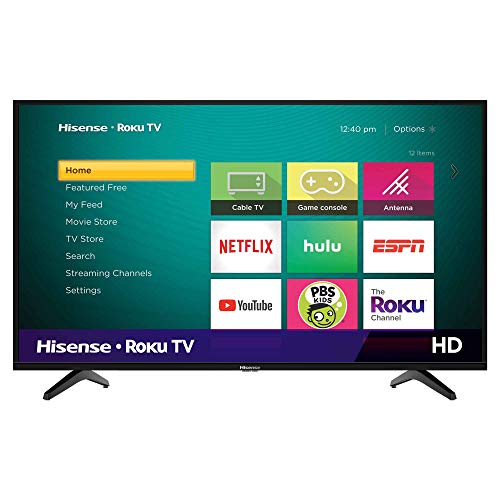
Hisense 43″ H4 Roku TV (1080p) — The 1080p value play
The H4 enters this guide with its label worn openly: it is the list’s 1080p member, a 43-inch class H4 Series LED Roku smart TV with Alexa compatibility, model 43H4F, a 2020 model. Its title is the sparsest here — no resolution figure printed, no HDR, no colour claim — and the guide’s honesty about it is twofold. First, the set is classified in the candidate pool as the shelf’s 1080p entry, and it is presented as exactly that: the smaller-room value play for households whose sources, distances and rooms make 4K’s premium hard to spend. Second, because the title itself does not print the resolution, the spec box routes that fact to the documentation like every other unstated figure in this programme.
The case for the H4 is the case for the honest floor. At 43 inches, in a bedroom or a small flat, at the distances those rooms impose, a 1080p panel showing 1080p-era sources — broadcast, older consoles, the bulk of streaming catalogues’ working resolution — is not a blurry compromise but a matched instrument. Roku’s platform supplies the complete modern interface, so the set’s daily life feels current even though its panel generation and its 2020 model year are the list’s oldest. Alexa compatibility covers the voice habit.
Its position at the foot of the linked list is a statement about trajectory rather than worth: the market’s centre has moved to 4K, and a buyer with a long ownership horizon should know the H4’s panel sits behind that centre. For the room it suits — the spare room, the first flat, the holiday place, the teenager’s den — that position is irrelevant beside its completeness as a Roku television at the shelf’s entry point.
There is a discipline the H4 teaches the whole guide: value is a room-relative quantity. Measured in the main room against 4K rivals, this set is the floor; measured in the rooms it was built for, it is the correct specification with nothing wasted. Buyers that learn to make the second measurement will make better purchases at every tier, including the tiers above this one.
Its longevity logic deserves a fair hearing too. A mature platform generation on a simple panel is a combination with few surprises left in it: the interface’s habits are documented by years of owners, the failure modes are known, and the set asks nothing experimental of its household. For a holiday place visited monthly or a relative’s room maintained from a distance, that predictability is worth more than a newer generation’s unproven polish.
- Panel as titled: 43-inch class LED
- Smart platform as titled: Roku TV (Roku Smart TV as titled)
- Voice as titled: Alexa compatibility
- Model year as titled: 2020 model (43H4F)
- Resolution: Not stated in the listing title — verify with the maker’s documentation (classified as the 1080p member of this shelf in the candidate pool)
Strengths
- A complete Roku television at the shelf’s entry position.
- The 43-inch size suits the small rooms where its resolution class is matched to the sources.
- Its label in this guide is honest, letting buyers choose it knowingly.
Trade-offs
- The 1080p class sits behind the market’s 4K centre for long ownership horizons.
- The 2020 model year is the oldest generation in the guide.
- The title states almost nothing beyond size, platform and voice compatibility.
Best for: spare rooms, first flats and holiday places where a complete Roku TV matters more than the resolution generation. Check price on Amazon as the shelf’s entry point, with the room’s distances honestly measured.
Not suited for: a main-room purchase with a decade in mind — the 4K centre of the market, three of which sit above it in this guide, is the longer-lived specification.
Mini-LED step-up route — Prose-only: the next tier
The sixth entry names no set, carries no link and exists to draw the value tier’s ceiling where it actually sits. Step above this list and the money buys backlight architecture: Mini-LED panels whose light is divided into many dimmed zones, and with them the dark-scene depth, highlight control and brightness headroom that the five linked sets’ titles never claim. The step also tends to buy stated refresh figures, fuller HDR format lists and the gaming vocabulary this tier mostly omits. Described qualitatively, as the pool’s discipline requires, that is the whole of the upgrade: light, controlled more finely, behind the same sizes of glass.
Who should take the step? The dark-room viewer, first — the household whose evenings are films and games in controlled light will exercise dimming control nightly, and for them the value tier’s ceiling is a real wall. The bright-room, mixed-content household should hesitate: their hours spend the value tier’s virtues — size, colour, platform — and rarely invoice the backlight. The step-up route is therefore not a recommendation but a diagnostic. Readers who recognised their room in the first description know where their research continues; readers in the second have this guide’s permission to stop climbing.
The route also disciplines the five linked picks retroactively. Each of them can now be read as a deliberate stopping point — the place where a buyer declined the backlight upgrade in favour of size, colour or platform per tier — and a stopping point chosen knowingly is the definition of value this guide opened with. The ceiling’s existence does not diminish the floor; it explains it.
A practical footnote completes the route’s honesty: stepping up is not only a panel decision but a settings apprenticeship. Dimming architectures reward calibration — zone behaviour, brightness balance, per-input tuning — and the household that will never open those menus will extract a fraction of the upgrade. The value tier’s sets, by contrast, are engineered to be right at their defaults for ordinary rooms. The ceiling is therefore also a temperament test, and passing it means recognising which kind of owner the household actually is.
- What the step buys: Mini-LED dimming architecture and brightness headroom, qualitatively
- What it usually adds: stated refresh figures and fuller HDR format lists
- What it does not change: size classes, platforms and interface habits
- Specific models: none named — this entry is prose-only by design
Strengths
- Keeps the value list honest by showing its ceiling instead of hiding it.
- Lets dark-room readers self-identify without a sixth sales pitch.
- Frames the five linked picks as chosen stopping points, not compromises.
Trade-offs
- No specific set is evaluated, so step-up shoppers start a new research pass.
- The qualitative description cannot rank the step-up shelf’s internal differences.
- Readers may over-apply the ceiling to rooms that would never exercise it.
Best for: readers who suspect their room is a dark-room case and want the upgrade’s shape before its names. The step-up shelf itself is surveyed in the companion guide to best mini led tvs.
Not suited for: bright, mixed-content rooms as a spending direction — the ceiling described here solves a darkness problem those rooms do not have.
How Do the Six Compare Side by Side?
| Pick | Size / class | Platform | Stated surplus over the tier |
|---|---|---|---|
| INSIGNIA 55″ F50 | 55-inch 4K LED | Fire TV | Complete recipe, house-brand support |
| Roku 55″ Select Series | 55-inch 4K QLED | Roku TV | QLED colour, Bluetooth Headphone Mode |
| Amazon Ember 55″ 4-Series | 55-inch 4K | Fire TV | HDR10+, fast processor, Ambient Experience |
| INSIGNIA 43″ F50 | 43-inch 4K LED | Fire TV | Untrimmed recipe at second-room size |
| Hisense 43″ H4 | 43-inch 1080p class | Roku TV | Complete platform at the entry position |
| Mini-LED step-up route | Next tier, prose-only | — | Dimming architecture, qualitatively described |
The table’s last column is the guide’s method made visible: each linked pick names a surplus, and the surpluses are all different — colour, format, completeness, position. That diversity is what a healthy value shelf looks like. Readers whose rooms match the smaller end of this list may also want the price-led view in best 55 inch tvs under 500 dollars, and cord-cutting households will find their platform-first angle in best tvs for cord cutting, where the free-content virtues several of these titles claim are the whole argument.
Read the platform column as a household census. Fire TV’s three appearances reflect where this tier’s volume lives; Roku’s two reflect where its interface loyalty lives; and the absent platforms are absent because their makers price their value lines elsewhere. A household already fluent in one platform should treat that fluency as part of the surplus column — an unlisted asset that travels with the buyer — and weigh it honestly against a rival’s stated colour or format claim.
What Mistakes Do Value-TV Buyers Keep Making?
The first mistake is shopping the adjective instead of the surplus. Every tier has its fashionable word — a colour technology one year, a format the next — and sets exist that wear the word on a panel that cannot cash it. The defence is the method of this guide: name the surplus in the title, in plain terms, or decline to pay for it. The second mistake is the opposite asceticism: buying the bare floor of the tier to save a step, and receiving a cut-down platform whose slowness taxes every evening for years. The five linked sets were chosen partly because none of them makes that cut.
The third mistake is size regret in both directions — the 43 bought for a room that measured for 55, the 55 shoehorned into a room whose seating sits a metre away. Value arithmetic cannot rescue a geometry error. The fourth mistake is forgetting the second room: a main-room upgrade makes the old set the bedroom’s problem or opportunity, and households that plan the cascade buy one television and improve two rooms. The fifth is chasing a printed figure from a stale guide — this one included — instead of the listing’s live terms; value is the most time-sensitive verdict in retail, and the check-price habit is its only honest citation.
A sixth mistake is subtler: assuming the value tier’s sets are interchangeable because their titles rhyme. This guide’s five linked titles share a vocabulary of size and platform, yet their surpluses diverge completely — colour here, format there, completeness elsewhere — and the divergence is the entire content of the choice. The buyer who reads the surpluses buys a television matched to a room; the buyer who reads only the shared words buys a lottery ticket with a remote.
Final Recommendation
For the main room, the Roku Select is this guide’s value champion: it names the tier’s clearest surplus — QLED colour — and adds the headphone courtesy, on the interface households find easiest. The Amazon Ember is the ecosystem alternative, its HDR10+ and processor claims answering the Fire TV household in its own language. The Insignia F50 at 55 inches is the calm baseline both must beat, and at 43 inches its sibling is the second room’s complete answer. The Hisense H4 holds the floor honestly for the rooms its class suits, and it deserves buyers that choose it for those rooms rather than apologising for it in them.
Above them all, unnamed, sits the Mini-LED ceiling — present in this guide so the value verdict can be trusted. Readers whose budgets stretch and whose rooms darken should climb; everyone else can stop here with confidence, because a value purchase made with the ceiling in view is not a compromise but a decision. The wider attainable shelf, including the gaming-leaning end of it, continues in best 60 inch 4k tvs for gaming under 1000 dollars — where the same qualitative discipline is applied to a faster class of panel and a larger class of room.
One last habit separates value buyers from bargain hunters, and it costs nothing at all: keep the documentation, the receipt and the first week’s settings notes together. The value of a television is realised across years of rooms, and the household that can hand the next room — or the next owner — a complete file has protected the purchase’s second half. The sets above were chosen to deserve that care; the care itself is the reader’s contribution to the ratio.
Frequently Asked Questions
Why does this guide print no prices?
Because value verdicts printed beside stale figures mislead. This shelf’s prices move with sales events, coupons and stock levels, sometimes weekly, so the guide judges the durable half of the ratio — panel technology, size, platform and stated features per tier — and leaves the live figure to the listing, where it can be checked at the moment of decision. The qualitative case tells the reader what a set is worth having; the listing tells them what it currently costs. A guide that printed the figure would be believed for a month and wrong for a year, and the value shelf’s readers deserve the durable half of the truth in print and the volatile half at the source.
Is a QLED panel worth choosing at this tier?
When the title states it plainly, as the Roku Select’s does, it is the tier’s most visible surplus: quantum-dot colour shows in saturated everyday content, not only in demonstration scenes. It does not by itself settle HDR format or motion questions, which remain documentation matters — but as a single named upgrade over the tier’s plain LED habit, colour is the one felt in every hour of viewing rather than in selected scenes. Buyers choosing between the Select and a plain-LED rival at the same size are really choosing whether their daily content is colourful enough to spend the difference daily.
Should a value buyer consider the 1080p Hisense seriously?
In its rooms, yes, and without embarrassment. A spare room, first flat or holiday place with 1080p-era sources and close seating distances is a matched environment for its class, and its Roku platform keeps the daily experience current. In a main room with a long horizon, the guide’s 4K picks are the better specification. The H4’s presence here, labelled, exists so that both decisions can be made knowingly rather than by accident.
When is stepping up to Mini-LED the right call?
When the room will exercise it: dark or controlled light, film and game content with demanding dark scenes, and an ownership horizon long enough to amortise the step. Bright, mixed-content rooms spend the value tier’s virtues instead and rarely invoice the backlight. The prose-only entry in this guide describes the step qualitatively so the decision can be made on the room’s evidence rather than on a sales ladder’s momentum.
How long should a value television be expected to serve?
Long enough that platform support matters as much as panel quality. These sets typically serve a main room for years and a second room for years more, so the current generation of a platform — the 2026 Roku, the newest-model Ember — carries a real value argument in its update horizon. Buy the generation as deliberately as the diagonal, and keep the box until the first month has passed.
Does screen size or panel technology matter more at this tier?
Size, until the room is satisfied; technology, after. A television one class too small for its seating will be regretted at every viewing, while a plain panel at the right size is forgiven nightly. Once the diagonal matches the room, the stated surpluses — the Roku’s QLED colour, the Ember’s HDR10+ — become the deciding column. The guide’s ordering reflects that sequence: geometry first, adjectives second, and the tape measure before the title. Renters and frequent movers may weight the sequence differently, since the right size in a temporary room is a moving target.
Related Guides
Value’s neighbouring territories: best android tvs for kodi applies the same qualitative discipline to the Android side of the platform map, and best 55 inch tvs under 500 dollars takes the price-led view of the size class at this guide’s centre and heart, for readers who think in budgets first.


