What's inside
- Key Takeaways
- Quick Picks: The Best Headsets for Guitar Use at a Glance
- How Did We Grade Headphones for a Job With No Microphones and No Radios?
- The Six Headphones in Detail
- How Do the Six Compare Side by Side?
- How Do You Build a Silent Practice Rig Around Any of These?
- What Should a Practice Session Sound Like When It Is Working?
- How Do Modelers and Interfaces Change the Headphone Question?
- What Does a Year of Practice Do to a Guitar Headphone?
- How Should a Player Choose Between the Two OneOdio Models?
- What Are the Common Mistakes When Buying Headphones for Guitar?
- Final Recommendation
- Frequently Asked Questions
- Related Guides
As an Amazon Associate I earn from qualifying purchases. This post may contain affiliate links at no extra cost to you.
gizmoverdict.com is reader-supported. When you buy through links on our site, we may earn an affiliate commission.
Where to buy: every headphone below is sold through Amazon, each name links to its own listing, and the listing is where you can check price on Amazon and confirm the plug and adapter arrangement against your amp or modeler before ordering.
The best headsets for guitar use — headphones, in the honest vocabulary this guide will use — are bought for one unglamorous reason: hearing yourself play without the room, the household or the neighbours having a vote. Silent practice through an amp’s headphone output, late-night work through a modeler, recording takes in a room that doubles as a bedroom — the job is the same. The guitar signal already exists at a socket. The headphone’s task is to plug into that socket and report the signal truthfully enough that the player can judge tone, timing and mistakes. Everything in this shortlist is wired, and that is not nostalgia: a cable carries the signal with no wireless latency to discuss, no battery to die mid-take, and no codec between the amp’s output and the player’s ears.
The tell in these titles, repeated like a refrain, is the plug. Guitar equipment speaks two sizes of jack: the small 3.5 mm of consumer audio and the 6.35 mm — the quarter-inch — of instruments and amplifiers. Two picks print both sizes outright in their titles. One names a quarter-inch adapter. One, from the studio tradition, terminates in an XLR connector and states its impedance at 55 ohms. Those connector details, unglamorous as they look, decide whether a headphone joins a guitar rig gracefully or arrives needing an adapter hunt before the first note. This guide grades them accordingly, alongside the monitoring character each title claims — studio, DJ, mixing, recording — because a guitar headphone is a monitoring tool first and a listening luxury second.
The six divide by temperament. Two OneOdio models bookend the list with the dual-jack formula, one aimed at DJ and monitoring breadth, one foldable for the travelling player. TASCAM and PreSonus arrive from the recording desk, where their makers build the interfaces and monitors guitars are recorded through. AKG’s K240 Studio brings the semi-open studio classic’s credentials — Varimotion diaphragms, a stated impedance, decades of session history implied by the name alone. And Fender, the only maker here that also builds the guitars and amps themselves, fields the FH1 as its studio monitoring entry, with a 45 mm driver figure as its title’s main technical word. Readers whose interest in headphones runs toward pure listening rather than practice will find the cluster companion on the best audiophile headsets for imaging a revealing contrast — same basic architecture, entirely different grading axes.
Key Takeaways
- Every pick is wired, so latency, batteries and codecs never enter the conversation — the cable is the whole signal path.
- Dual 3.5 mm and 6.35 mm plugs are printed in two titles, the single most guitar-relevant detail in the group.
- The AKG K240 Studio is the only pick stating its impedance — 55 ohms — and the only semi-open design; the rest lean closed or unstated.
- The PreSonus HD5 is the explicitly closed-back pick, the isolation choice for recording rooms and shared houses.
- The TASCAM TH-02 names guitar outright in its title and includes a 1/4 inch jack adapter in its proposition.
- Fender’s FH1 is the guitar maker’s own entry: a 45 mm studio monitoring headphone from the company that builds the amps.
Quick Picks: The Best Headsets for Guitar Use at a Glance
| Pick | Badge | Why it made the cut |
|---|---|---|
| OneOdio Wired DJ Hi-Res (dual jack) | The plug diplomat | 50 mm drivers and both 3.5 mm and 6.35 mm jacks in the title, aimed at keyboard, guitar and studio duty. |
| TASCAM TH-02 | The recording-desk staple | A professional studio monitor headphone that names guitar in its title and carries a 1/4 inch jack adapter. |
| PreSonus HD5 | The closed-back monitor | Closed-back over-ear monitoring from a recording-equipment maker, for takes that must not leak into the microphone. |
| AKG K240 Studio | The semi-open classic | Varimotion diaphragms, 55 ohms as titled and an XLR connector — the session tradition in headphone form. |
| Fender FH1 Studio Monitoring | The guitar maker’s own | A 45 mm professional studio monitoring headphone from Fender, voiced by the company behind the amps. |
| OneOdio A71 Hi-Res Wired | The folding traveller | Hi-Res wired studio design with a foldable body and both 3.5 mm and 6.35 mm jacks for PC and DJ work. |
How Did We Grade Headphones for a Job With No Microphones and No Radios?
On the evidence a guitar rig actually consumes: the plug, the monitoring intent, the wearing comfort across a practice session, and the honesty of what remains unstated. The plug came first because it is binary — a headphone either meets the amp’s quarter-inch output on the terms the title describes, through a dual jack or a named adapter, or the buyer starts shopping for adapters before playing a note. Two titles print both jack sizes; one prints the adapter; the studio models leave the arrangement to their documentation, and the spec boxes record each state of affairs exactly as found.
Monitoring intent came second. Guitar practice is an evaluative act: the player is listening for fret buzz, picking attack, the difference between two drive settings, the tail of a reverb. Headphones titled for studio monitoring, mixing and recording are claiming the flatter, more revealing presentation that evaluation wants, and the guide weighted those claims accordingly — while remembering that a title’s claim is a claim, attributed as such, and that DJ-leaning models trade a measure of neutrality for presence. Isolation was graded where stated: the closed-back HD5’s design keeps a click track or a loud practice tone out of a live microphone and out of a sleeping household’s awareness, while the semi-open K240 deliberately lets the room in, which some players prefer for singing along with their own practice or hearing an acoustic guitar’s body alongside its amplified signal.
What the guide refused to grade is what the titles do not contain: no isolation figures in decibels, no frequency-response curves, no impedance for five of the six. Where a figure would decide a purchase — the K240’s stated 55 ohms being the honourable exception — the spec box prints it; everywhere else the caution line stands, and the maker’s documentation is the assigned reading before money moves.
The Six Headphones in Detail

OneOdio Wired DJ Hi-Res (dual jack) — The plug diplomat
OneOdio’s first entry leads with the detail this keyword runs on: dual 3.5 mm and 6.35 mm jacks, printed in the title, serving a headphone described for PC, keyboard and guitar. That dual arrangement is more thoughtful than it first appears. The two plug sizes are not merely two doors into the same headphone; in this design family they let the headphone meet instruments and sources of both worlds without an adapter stack wobbling out of the amp’s faceplate — the small plug for the laptop and phone world, the large one for the amplifier and keyboard world the title names. A guitarist whose practice alternates between a real amp and a laptop full of lessons will feel that diplomacy every single day.
The 50 mm driver figure is the largest printed in this guide, and the Hi-Res designation plus the studio monitoring, recording, podcasting, mixing and DJ list sketch a generalist’s résumé: this headphone wants every job in the home studio, guitar included by name. For practice purposes the relevant translation is presence and stamina — a big-driver monitoring presentation that keeps a driven guitar tone’s body intact at the modest volumes sensible players practise at, in a wired design with nothing to charge. The DJ half of its identity suggests a build expecting to be handled, travelled with and cued on one ear, all of which transfer kindly to a practice room.
Its generality is the honest caveat. A headphone titled for six jobs is a specialist in none, and the player whose practice is purely evaluative — mixing their own recordings, judging mic placements — may prefer the PreSonus or AKG temperaments below. For the player whose guitar life is one room of many in a home studio, the OneOdio’s plug diplomacy and breadth make it the natural first chair, and its dual-jack title remains the single most useful sentence in this entire guide for a beginner assembling a rig.
Beginners deserve a specific word about this pick, because a first rig fails at its connections more often than at its sound. A new player assembling an amp, a laptop and a headphone from three different boxes discovers the plug mismatch at the exact moment motivation is highest, and motivation spent on adapter shopping is motivation taxed. A title that prints both jack sizes removes the commonest version of that tax entirely. Experienced players underrate such mercies because their adapter drawers are already full; the OneOdio’s dual-jack proposition is written for the drawer that is still empty, and for the practice habit that cannot afford a postponed first week.
- Plugs: dual 3.5 mm and 6.35 mm jacks, as titled
- Drivers: 50 mm, as titled
- Designation: Hi-Res, as titled
- Titled duties: studio monitoring, recording, podcasting, mixing, DJ; PC, keyboard and guitar named
- Form: wired, over-ear
- Impedance: Not stated in the listing title — verify with the maker’s documentation
Strengths
- Both jack sizes in the title ends the adapter question before it starts.
- The largest stated drivers in the group underwrite practice-volume body.
- Guitar is named outright among its intended instruments.
Trade-offs
- Six titled duties means a generalist’s balance rather than a monitor’s single-mindedness.
- No impedance is printed, so amp-output matching rests on documentation.
- DJ-bred presence can flatter a guitar tone that evaluation should hear plainly.
Best for: a home-studio player whose guitar shares the desk with keyboards, lessons and recording, all through one headphone. Not suited for: a purist mixing their own album, because the DJ-and-everything tuning serves presence across six jobs rather than neutrality in one.
TASCAM TH-02 — The recording-desk staple
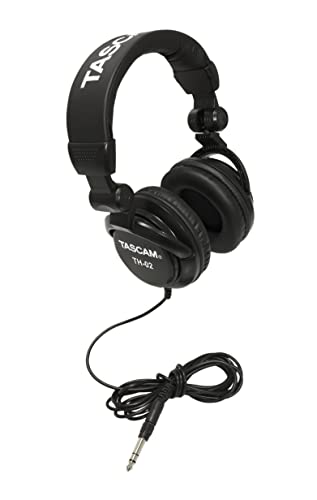
TASCAM’s name carries a particular weight for guitarists of a certain generation: this is the company whose home-recording machines taught bedrooms to be studios. The TH-02’s title is correspondingly workmanlike — professional studio monitor headphones, wired, over-ear, for recording, podcast, DJ, music and guitar — and it closes with the practical detail that matters at an amp: a 1/4 inch jack adapter, named in the title, which is the quarter-inch world of instrument outputs met on its own terms. Guitar is not an afterthought in that list; it is one of five named duties, printed by a maker whose customers record guitars for a living.
The monitor framing is the sound story. A studio monitor headphone from a recording company is built to be believed — to let a player hear a take’s buzz, a string’s ageing, a pick attack’s inconsistency — rather than to make every take sound finished. Practice through such a headphone is less flattering and more educational, and players who record themselves, even casually, benefit twice: the same ears that judge the practice judge the playback, with no translation between two different tunings. The TH-02 has been a staple recommendation in home-recording circles for years precisely because it performs that honest-monitor role at the tier where most home studios actually live.
Its plainness is the boundary. The title offers no driver figure, no impedance, no fold, no flourish — the spec box below is correspondingly full of the caution line — and shopping by printed numbers makes this the least decorated proposition in the six. The counter-argument is the maker’s identity and the adapter’s inclusion: what the title does print is exactly what a recording guitarist consumes. Judge it as the desk staple it presents itself as, and it is among the easiest recommendations on this page.
There is an economics to the staple that this guide notes plainly: home studios accumulate headphones the way kitchens accumulate knives, because every recording session with a guest, a second player or a student needs another pair on another head. A monitor staple at this tier is bought in multiples across a studio’s life, and consistency between those multiples — the same presentation on the engineer’s head and the player’s — removes a whole category of mix-translation arguments. The TH-02’s long presence in exactly that role is the market’s own review, written in repeat purchases rather than in applause.
- Form: wired, over-ear studio monitor headphones, as titled
- Adapter: 1/4 inch jack adapter, as titled
- Titled duties: recording, podcast, DJ, music and guitar
- Maker’s field: professional studio equipment
- Driver size: Not stated in the listing title — verify with the maker’s documentation
- Impedance: Not stated in the listing title — verify with the maker’s documentation
Strengths
- Guitar named in the title by a company built on recording them.
- The quarter-inch adapter is part of the proposition, not an accessory hunt.
- Monitor intent serves practice as evaluation, not flattery.
Trade-offs
- The title is nearly bare of figures, so spec-led shoppers must read documentation.
- An honest monitor presentation makes rough takes sound rough.
- No folding or travel features are claimed for the road.
Best for: a home recordist whose practice and recording happen at the same desk through the same ears. Not suited for: practice sessions expected to sound polished regardless of the playing, because a monitor’s honesty will report every uneven take faithfully.
PreSonus HD5 — The closed-back monitor
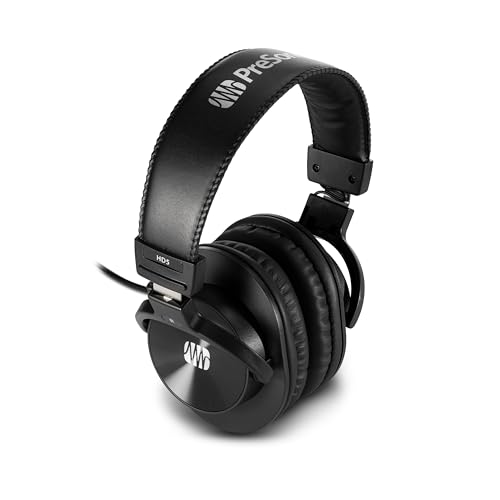
The HD5’s title makes one architectural claim the others mostly leave implicit: closed-back. For guitar work that single word solves two problems at once. In a recording room, a closed earcup keeps the backing track and the click out of the microphone that is capturing the guitar — bleed that ruins takes quietly and is discovered loudly at mixdown. In a shared house, it keeps a midnight practice session’s amplified tone inside the player’s head, where it belongs. PreSonus, like TASCAM, builds the recording chain itself — interfaces, monitors, mixers — and the HD5 is titled as that ecosystem’s headphone: professional monitoring, wired, over-ear, for studio recording, mixing and monitoring.
The monitoring intent deserves the emphasis this guide keeps giving it. A player evaluating amp settings, modeler presets or their own recorded takes is doing the same job as the mixing engineer this headphone also serves: comparing small differences honestly. Closed-back designs bring a particular character to that job — a more contained, in-the-room-with-the-amp sense of the sound, with the outside world demoted — and many players find that containment helps concentration during deliberate practice, the scales-and-exercises kind where attention is the whole curriculum.
Containment is also its limit, and the contrast with the semi-open AKG below is the guide’s cleanest illustration. A closed cup cannot let an acoustic guitar’s natural body blend with its amplified signal, and long sessions in warm rooms run warmer still. Players whose practice mixes unplugged and amplified sound, or who sing while they practise and like hearing themselves naturally, should read the K240’s section with care. For the recordist and the night owl, the HD5’s closed back is not a feature among others — it is the reason for the product, stated in its title’s first breath.
Drummers of the household will forgive a brief detour: the closed-back case generalises to any loud, timed practice — electronic drums, keyboards at midnight, a second guitarist in the next room — because the physics of bleed and disturbance are identical. A household with several musicians often standardises on the closed architecture for peace’s sake alone, and the HD5’s monitoring pedigree means the standardisation costs nothing in evaluative quality. One architecture, several instruments, no negotiations about whose practice the walls are currently broadcasting: that is a domestic achievement no specification table knows how to print.
- Architecture: closed-back, as titled
- Form: wired, over-ear studio recording headphones, as titled
- Titled duties: professional mixing and monitoring
- Maker’s field: recording equipment
- Driver size: Not stated in the listing title — verify with the maker’s documentation
- Plug arrangement: Not stated in the listing title — verify with the maker’s documentation
Strengths
- Closed-back design keeps practice sound out of live microphones and sleeping households.
- A recording maker’s monitoring intent suits tone and preset evaluation.
- Contained presentation concentrates deliberate, exercises-first practice.
Trade-offs
- No plug or adapter detail is printed, so rig matching needs the documentation.
- Closed cups run warm across long, warm-room sessions.
- An acoustic guitar’s unplugged body cannot blend in through sealed earcups.
Best for: a recordist tracking guitar in a room with a live microphone, and any player practising while the house sleeps. Not suited for: a singer-player who practises acoustically and amplified in the same breath, because the sealed earcups shut the unplugged guitar’s natural voice out of the mix.

AKG K240 Studio — The semi-open classic
The K240 is the headphone in this guide most likely to already be hanging in the reader’s imaginary studio — a design with decades of session history behind it, recognisable at a glance, and titled with a technician’s economy: semi-open studio headphones, Varimotion diaphragms, 55 ohms impedance, XLR connector, for mixing, mastering and production. Start with the two printed specifics nobody else in the six offers. The 55 ohm figure is the only stated impedance on the page, a moderate load that most amp headphone outputs and interfaces drive without strain. The XLR connector is the studio tradition made literal — a reminder that this headphone was born in rooms where cables are infrastructure, and guitarists should confirm the exact cable and adapter arrangement for their rig in the maker’s documentation, since an amp’s quarter-inch socket and an XLR termination meet only through the right intermediary.
Semi-open is the temperament. Halfway between the HD5’s sealed containment and a fully open design, the K240 lets a measure of the room in and a measure of the sound out — and for guitar practice that halfway house has a devoted logic. An acoustic or semi-hollow guitar’s own voice reaches the ears alongside its amplified signal, a singer hears themselves naturally enough to stay in tune with their own playing, and long sessions feel less like wearing a room of one’s own. Varimotion diaphragms, the titled driver technology, are AKG’s long-standing answer to reproducing both the pick attack’s transient and the low strings’ body within one driver.
The classic’s caveats are the classic’s age and openness. Sound leaks in both directions, so the sleeping-household and live-microphone cases belong to the PreSonus. And the connector arrangement demands the verification this guide keeps assigning. What the K240 offers in exchange is the deepest pedigree in the six and the most natural practice-room blend — the headphone for keeping the guitar, the room and the recording in one continuous experience.
Session veterans tell a recognisable story about this design: it is the headphone that was already there. Studios keep K240s the way they keep spare cables — as infrastructure, handed to whoever is playing today — and that infrastructural status is the deepest compliment the recording world pays any tool. A guitarist buying one is not experimenting; they are joining a standard. The semi-open blend that results — player hearing guitar, room and self in one picture — is the sound of countless records being made, and practising inside that picture has a way of teaching a player how their part will sit in a finished mix long before they ever mix one.
- Architecture: semi-open, as titled
- Drivers: Varimotion diaphragms, as titled
- Impedance: 55 ohms, as titled — the only stated figure in the group
- Connector: XLR, as titled — verify the cable/adapter route for your rig
- Titled duties: mixing, mastering, production
- Plug for amp output: Not stated in the listing title — verify with the maker’s documentation
Strengths
- The only stated impedance here, and a moderate one for amp outputs.
- Semi-open blend suits acoustic-electric practice and singing players.
- Decades of session pedigree stand behind the design’s reputation.
Trade-offs
- Sound leaks both ways, ruling out live-mic and sleeping-house duty.
- The XLR termination makes rig verification a genuine pre-purchase task.
- An older design carries none of the travel or folding concessions of rivals.
Best for: a player who practises acoustic and amplified guitar in the same session and values a natural room blend. Not suited for: tracking beside a live microphone, because the semi-open earcups will feed the backing track straight into the recording.

Fender FH1 Studio Monitoring — The guitar maker’s own
Every other maker in this guide builds headphones for the studio in general. Fender builds the guitars. The FH1’s title is spare — professional studio monitoring headphones, 45 mm, black — and its interest lies less in what it prints than in whose name is on the cup. A guitar company voicing a monitoring headphone brings an obvious hypothesis: that the people who design the amplifiers these headphones plug into have opinions about how a guitar should sound at the end of that cable, and have tuned accordingly. This guide records that as context rather than as a measured claim, because the title itself claims only professional studio monitoring intent and a driver size — but context is not nothing, and brand coherence has settled many a tie in this category.
The 45 mm figure sits between the OneOdio’s 50 mm headline and the unstated drivers of the TASCAM and PreSonus, and driver size alone decides little; what matters for practice is the monitoring intent the whole title is built around. Fender’s entry is the newest name in this six against several decades-old designs, which cuts both ways in the usual pattern: a fresh design unencumbered by legacy compromises, and a shorter public track record for a buyer to lean on. The documentation check matters here accordingly — plug arrangement, impedance and cable details are all unstated in the title, and the FH1 asks its buyer to do the same homework the TASCAM does, with less community literature to help.
For the Fender loyalist — the player whose amp, guitar and now headphones share a badge — the FH1 completes a rig with a coherence that has genuine daily pleasure in it, and ecosystem pride is a legitimate reason to choose among near-equals. For the badge-blind evaluator, it stands as a professionally-positioned monitoring headphone from a maker who understands the source instrument better than anyone else on this page. Either reading earns it a serious audition.
A word about voicing, carefully framed: this guide cannot measure the FH1’s tuning, and its title does not describe one. What can be said is that monitoring headphones from instrument makers occupy a distinct niche in players’ affections, because the maker’s reputation rides on the guitar sounding right — a company whose amplifiers define a genre’s clean and driven tones has more to lose from a headphone that misrepresents them than a generalist has. That reputational stake is a soft form of quality assurance, weaker than a specification and stronger than a slogan, and it is honestly the largest part of the FH1’s case until its track record grows.
- Positioning: professional studio monitoring headphones, as titled
- Drivers: 45 mm, as titled
- Finish: black, as titled
- Maker’s field: guitars and amplifiers
- Impedance: Not stated in the listing title — verify with the maker’s documentation
- Plug arrangement: Not stated in the listing title — verify with the maker’s documentation
Strengths
- A guitar maker’s own monitoring voicing, from the company behind the amps.
- A stated driver figure where several rivals print none.
- Rig coherence for players already inside the Fender ecosystem.
Trade-offs
- The shortest track record in the six, with less owner literature to consult.
- Plug and impedance details are unstated, assigning real pre-purchase homework.
- The title’s brevity leaves fit and cable questions entirely to documentation.
Best for: a Fender player assembling a coherent rig who values the maker’s own take on how its guitars should be monitored. Not suited for: a spec-led buyer who decides from printed figures, because this title prints the fewest in the group and rewards documentation reading instead.

OneOdio A71 Hi-Res Wired — The folding traveller
The second OneOdio closes the list by repeating the family formula with a traveller’s twist: Hi-Res wired over-ear studio headphones for DJ and mixing, a foldable design, and 3.5 mm/6.35 mm jacks connecting to PC and computer. The dual-jack sentence does the same diplomatic work as its sibling’s — the guitar amp’s quarter-inch world and the laptop’s small-socket world met by one headphone — and the fold changes the ownership geography. A headphone that folds goes in the gig bag, the teaching bag, the holiday luggage; it practises in hotel rooms and backstage corners where its fixed-shape rivals simply were not brought along.
That portability reframes the guitar case specifically. The travelling player — the teacher moving between students’ houses, the gigging musician warming up in green rooms, the student between home and lessons — is the player most dependent on headphone practice and least served by fragile or bulky gear. A foldable wired design with both plugs is a considered answer to that life, and the studio-and-DJ positioning keeps the monitoring intent that evaluative practice wants. Against its own sibling, the trade is emphasis: the first OneOdio leads with its 50 mm drivers and six named duties, the A71 with movement.
The cautions rhyme with its sibling’s. No impedance or driver figure is printed, so the documentation carries those answers, and a generalist’s balance serves the travelling all-rounder better than the mixdown purist. But as the pick most likely to actually be present at the moment practice becomes possible — the hotel, the waiting room, the spare half-hour — the A71 makes the argument that the best guitar headphone is frequently the one that got brought. Players assembling a listening-first rig can compare its philosophy against the open-back world surveyed in the best open back headsets guide, where portability is traded away for spaciousness entirely.
Teachers form this pick’s quiet constituency and deserve direct address. A guitar teacher’s day is a commute between rooms, each with a different amp, a different laptop, a different socket — and a headphone that folds flat, carries both plugs and asks nothing of any of those rooms is less an accessory than a uniform. Students benefit invisibly: the teacher who can demonstrate a tone silently, hand over the headphones and let the student hear exactly what was meant has a teaching tool that no amount of verbal description replaces. The A71’s specification sheet reads modestly; its working day reads like it was designed by someone who has lived that commute.
- Form: wired, over-ear, foldable design, as titled
- Plugs: 3.5 mm and 6.35 mm jacks, as titled
- Designation: Hi-Res, as titled
- Titled duties: studio recording, monitoring and mixing; DJ use named
- Driver size: Not stated in the listing title — verify with the maker’s documentation
- Impedance: Not stated in the listing title — verify with the maker’s documentation
Strengths
- Folding design makes it the only pick built to travel to the practice.
- Both jack sizes printed, covering amps and laptops without adapters.
- Studio and DJ positioning keeps monitoring intent inside a portable shape.
Trade-offs
- Folding hinges are moving parts that fixed designs do not ask you to trust.
- No driver or impedance figures are printed for spec-led comparison.
- A traveller’s balance serves portability before ultimate neutrality.
Best for: teachers, students and gigging players whose practice happens wherever the day leaves them. Not suited for: a fixed studio desk that never travels, because the folding mechanism’s whole purpose — and its moving parts — would serve a journey that never happens.
How Do the Six Compare Side by Side?
| Pick | Architecture as titled | Guitar connection evidence | Printed figures |
|---|---|---|---|
| OneOdio Wired DJ Hi-Res (dual jack) | Over-ear, wired | Dual 3.5 mm and 6.35 mm jacks | 50 mm drivers |
| TASCAM TH-02 | Over-ear studio monitor | 1/4 inch jack adapter named | None printed |
| PreSonus HD5 | Closed-back over-ear | Not stated in the title | None printed |
| AKG K240 Studio | Semi-open | XLR connector — verify route to amp | 55 ohms, Varimotion diaphragms |
| Fender FH1 Studio Monitoring | Studio monitoring | Not stated in the title | 45 mm drivers |
| OneOdio A71 Hi-Res Wired | Over-ear, foldable | 3.5 mm and 6.35 mm jacks | None printed |
The connection column is the table’s lesson: two titles solve the guitar plug outright, one names its adapter, one demands a documented route, and two leave the question to their listings. Everything else — architecture, pedigree, portability — is preference; the plug is physics, and physics gets verified first.
How Do You Build a Silent Practice Rig Around Any of These?
Start at the source, because the headphone is the last link. An amp’s headphone output, a modeler’s main out, an interface’s monitor socket — each presents the guitar differently, and the first setup task is learning your own source’s behaviour: its output level, whether plugging in mutes the speaker, whether a cabinet simulation is applied to the headphone feed. That last detail decides more practice satisfaction than any headphone choice, since a raw, un-simulated direct signal sounds harsh through honest monitors for reasons that are the source’s fault, not the headphone’s. Spend the first session in the source’s settings, not the shops. While there, label the cable’s route with the same finality — behind the desk, clear of chair castors, long enough to stand with the guitar without unplugging anything — because a practice rig that must be reassembled each time will, empirically, be practised on less, and the whole economics of silent practice rest on the session starting in under a minute.
Then set volume like a professional: start low, bring the guitar up to a level where an hour’s practice leaves your ears fresh, and treat that freshness as a hard budget. Headphone practice invites volume creep precisely because it feels private, and the monitoring headphones in this guide will faithfully deliver hearing damage at the same fidelity as everything else. Finally, build the ritual — same chair, same cable route, metronome and tuner within reach — because silent practice succeeds as a habit, and habits are built from furniture more than from equipment. The players who improve fastest through headphones are recognisable by the boring consistency of their setup, whichever of these six names is hanging on the stand.
What Should a Practice Session Sound Like When It Is Working?
Honest, present and a little unforgiving. Working practice audio exposes the picking hand’s timing against the metronome, the fretting hand’s stray strings, the exact moment a bend falls short of its target pitch. That exposure is the product being bought — a rehearsal room with perfect attendance and no tact. Seasoned teachers build entire methods on that tactlessness, setting students exercises whose faults cannot hide — muted-string drills, bend-to-pitch repetitions, alternate-picking ladders against a click — precisely because a monitoring headphone grades them instantly and without diplomacy. The student who practises through honest ears improves at the speed of the truth, which is the fastest speed available to anyone. None of that requires the most expensive name on this page — it requires the architecture that fits the room and the honesty that fits the purpose, both of which are available at several points in this six, which is precisely what makes the category a pleasure to grade. Players new to monitoring headphones sometimes mistake the exposure for bad sound and reach for a more flattering headphone, which is precisely backwards: the flattering headphone is charging you for compliments while the faults compound unobserved. The six titles here all lean, to different degrees, toward the honest side of that trade, which is why the guide’s grading rewarded monitoring intent over entertainment tuning at every step.
There is a place for pleasure in the same session, and it is the last ten minutes. Play something loved, at a kind volume, through the same honest chain, and notice how much better it sounds than it did a month ago. That delta — measured by your own ears, on your own instrument — is the only review of a guitar headphone that finally matters, and no guide, including this one, can write it for you.
How Do Modelers and Interfaces Change the Headphone Question?
They move the amplifier into software, and the headphone becomes the only physical witness. A modeler’s presets are voiced through whatever the player listens on, which means a preset built through a flattering headphone will betray its builder the first time it meets a stage or a studio monitor. Monitoring-titled headphones — most of this page — exist to prevent exactly that betrayal: build the preset through honest ears and it travels. Interface headphone outputs add a second consideration, output quality and level, which is where the one stated impedance in this guide earns a second mention: the K240’s 55 ohms sits comfortably in the range such outputs are designed around, while the five unstated models assign the matching question to their documentation, as this guide keeps noting because it keeps mattering.
The practical ritual follows from the physics. Build and judge presets at the same modest volume, through the same headphone, in the same room, and write the settings down; change one variable at a time or accept that you are decorating rather than deciding. Players who treat the headphone as part of the instrument — chosen once, verified once, then trusted — stop re-litigating their tone every session, and the hours that used to go to knob doubt go to the fretboard, where improvement actually lives.
What Does a Year of Practice Do to a Guitar Headphone?
It becomes furniture of the mind. The cable develops its familiar route across the desk, the pads take the shape of one player’s ears, and the sound stops being a product’s sound and becomes simply what the guitar sounds like — the reference against which every other listening arrangement is unconsciously judged. That familiarity is the real return on a monitoring headphone, and it argues for buying the architecture that suits the room correctly the first time, because a year of familiarity invested in the wrong architecture must eventually be written off. Players feel that write-off keenly when it comes — a new headphone makes a known guitar sound briefly foreign, and a week of recalibration follows — which is why this guide’s verdicts keep returning to the room, the microphone and the singing voice: get the architecture right and the familiarity compounds like interest. The same compounding explains the fierce loyalty certain of these designs inspire: an owner defending a decades-old model is often defending a decade of calibrated ears, and that defence is more rational than it sounds from outside. New buyers can borrow that rationality cheaply: choose the architecture the room demands, verify the plug the amp demands, and then commit — really commit, for a season at least — instead of auditioning a new candidate every month and recalibrating forever. A season of committed practice through one honest headphone will do more for a player’s tone than a year of equipment rotation, because tone, in the end, is mostly hands — and hands improve fastest when the mirror stops changing. Every maker on this page, from the studio institutions to the guitar company itself, is ultimately selling that mirror; the differences graded above are differences in its frame, its finish and the rooms it was built to hang in. Choose the frame that fits your room, hang it where practice happens, and then forget the mirror exists — forgetting it is the final stage of choosing well. The guitar, after all, was never waiting on the headphone; it was waiting on the hour, and the hour is now easier to keep than it has ever been. Keep it tonight, at a kind volume, and let the first honest session grade this whole page. Pages, like headphones, should be judged by what they make possible in the room where the work happens. In this room, what they make possible is practice at any hour the player can spare, and that is enough. Spare the hour, and the headphone — whichever of the six it is — will do the rest in silence. Silence, faithfully delivered, is the whole product. Buy accordingly, verify the plug once, and then play — tonight, tomorrow, and every hour the house allows. Cables and pads are the year’s mechanical story: pads compress and are replaced, cables are routed kindly or replaced sadly, and the wired designs in this guide at least promise that every wear part is a simple, standard thing rather than a battery sealed inside a countdown.
How Should a Player Choose Between the Two OneOdio Models?
By asking where the practice lives. The dual-jack DJ model anchors a room: its 50 mm drivers, its six named duties and its keyboard-and-guitar breadth describe a headphone that expects to serve a whole home studio from one hook beside the desk. The A71 packs a bag: same plug diplomacy, same Hi-Res wired family character, wrapped around a fold that exists for movement. A player with one room and many instruments belongs to the first; a player with many rooms and one instrument belongs to the second. Choosing the wrong sibling is the gentlest error available in this guide — the family resemblance is real — but the question of where practice lives deserves its thirty seconds of honesty before the order, because the answer also predicts which headphone will still be in daily use when the year turns.
Budget the decision in hours rather than in features. Count the week’s practice hours by location for one honest week — desk, sofa, lesson room, road — and let the larger pile choose the sibling. That arithmetic, unglamorous as it is, has settled more headphone purchases correctly than any comparison of driver diameters, and it generalises across this entire page: the HD5 belongs to the room with the microphone, the K240 to the room with the singing, the TASCAM to the desk where recording happens. Rooms first, products second — the titles were graded in that order throughout this guide, and readers who shop in that order rarely write to anyone about returns.
What Are the Common Mistakes When Buying Headphones for Guitar?
The first is buying wireless for a wired job, importing latency, batteries and codecs into a signal path that a cable perfects for pennies — every pick here is wired for that reason. The second is ignoring the plug: falling for a headphone whose connection to an amp’s quarter-inch output was never verified, then discovering the mismatch at the first practice. Third comes chasing isolation figures that no title here prints; isolation is graded by architecture in this guide — closed, semi-open, open — because invented decibels would be fiction. Fourth is blaming the headphone for a modeler’s missing cabinet simulation, a source setting that makes any honest monitor sound harsh. The fifth is practising too loudly for too long, the one mistake with permanent consequences, and the one no purchase can fix after the fact.
Final Recommendation
Let your practice setting choose. The recording player belongs with the TASCAM’s staple honesty or the PreSonus HD5’s closed-back discipline beside a live microphone. The acoustic-electric player who sings belongs with the K240’s semi-open blend and stated 55 ohms. The home-studio generalist and the travelling teacher belong with the two OneOdio models — dual jacks at the desk, a fold for the road. And the Fender player completes the rig with the maker’s own FH1, after the documentation homework its spare title assigns. One last habit separates the players who keep these headphones for a decade from those who replace them yearly: coil the cable loosely, hang the headphone on a hook rather than the amp’s handle, and let the pads dry between sessions. None of that appears in any title in this guide, and all of it decides whether the title’s promises are still being kept in year five. Equipment this simple rewards exactly the care it asks for — very little, given consistently. Verify the plug against your amp before any of them is ordered, keep the volume kind, and the reward is the oldest bargain in music: a practice room that is always open, entirely silent to everyone except the one person it exists for.
Frequently Asked Questions
Why is every pick wired — is wireless really worse for guitar?
For this job, the cable wins on the merits that matter: no wireless latency to discuss, no battery to fail mid-take, no codec reinterpreting the signal. The guitar already sits at a socket, so the usual freedom wireless buys — distance from the source — is worth little. All six titles are wired designs, and the guide treats that as the category’s settled wisdom rather than a limitation.
What plug does my amp actually need?
Most amp and modeler headphone outputs are quarter-inch (6.35 mm), which is why the dual-jack titles and the TASCAM’s named 1/4 inch adapter matter so much here. Check your own unit’s socket first, then match it against the title evidence in each spec box — and where a title is silent, the maker’s documentation decides before money does.
Closed-back or semi-open for practising at home?
It depends on the room’s other occupants — human and microphone. The closed-back HD5 protects sleeping households and live recordings. The semi-open K240 blends the guitar’s natural acoustic voice with its amplified signal and suits singer-players. Neither is better in the abstract; each is better in a specific room, and the room is yours to describe.
Does the AKG’s 55 ohm impedance matter with a guitar amp?
It is the only impedance printed in the six, and 55 ohms is a moderate load that typical amp headphone outputs and audio interfaces are built to drive. Its real value here is certainty: the K240 is the one pick whose electrical match can be assessed from the title alone, while the other five assign that check to their documentation.
Can these headphones double for recording podcasts or streaming?
Several titles name those duties — the first OneOdio lists podcasting, the TASCAM lists podcast work — as monitoring roles: hearing yourself and your material accurately while a separate microphone does the capturing. None of the six includes a microphone for speaking into, and readers building a voice setup can browse the neighbouring guide to the best headsets to record podcasts for the capture side of that desk.
Related Guides
Players who practise along with lessons and broadcasts can look at the best headsets for listening to tv, and those watching the budget while they build a rig will find the listening shelf surveyed in the guide to the best audiophile headsets under 100.
The monitoring habit crosses the rehearsal room, and our guide to the best headsets for drummers judges the isolation class drummers actually practise in.