What's inside
- Key Takeaways
- Quick Picks
- How We Chose These Picks
- How Do Truckers Hear Texts Without Touching the Phone?
- Why Do Trucker Headsets Quote Noise-Cancelling Percentages?
- What Does Dispatch Hear, and Why Does It Matter Commercially?
- How Should a Driver Choose Between Mono and Convertible Designs?
- What Happens to Text Messages When the Phone Is in the Bunk?
- Which of the Six Trucking Headsets Reads the Road Best?
- How Should You Set Up Message Reading Before Your First Trip?
- How Do Fleets Roll Headsets Out to Drivers Who Hate New Gear?
- What Should a Driver Check at the First Fuel Stop?
- What Mistakes Do Drivers Make Buying Headsets for Text and Calls?
- Why Does Talk Time Matter More Than Any Other Number Here?
- What Does a Headset Owe the Driver at the End of the Day?
- Final Recommendation
- Frequently Asked Questions
- Related Guides
As an Amazon Associate I earn from qualifying purchases. This post may contain affiliate links at no extra cost to you.
gizmoverdict.com is reader-supported. When you buy through links on our site, we may earn an affiliate commission.
Where to buy: All six headsets in this roundup link to verified listings from the table and the review headings. One shopping note specific to this category: several of these models convert between one-ear and two-ear wearing, and the conversion parts live in the box — check the contents against the listing before your first trip, not at a rest stop two states away.
The best truckers headsets with text capability answer a need that only makes sense from behind a wheel at hour nine. Dispatch sends an address change by message. A broker texts a dock number. Family checks in. Every one of those messages used to demand a choice between pulling over and breaking the law — or worse, breaking concentration — because reading a phone screen at highway speed is not a grey area in any safety manual ever written. A headset that announces messages aloud and reads them through the phone’s voice assistant turns the phone back into what it should be on the road: a voice you talk to, never a screen you look at.
Honesty about how that reading works matters, so here it is plainly. The headset itself does not read your texts; your phone’s voice assistant does — Siri, Google Assistant — summoned and heard through the headset. What the headset contributes is the chain that makes that safe and audible: a microphone clean enough for the assistant to understand you over cab noise, voice controls that trigger the assistant without a hand leaving the wheel, and an earpiece that delivers the spoken message intelligibly at highway volume. Where a model’s listing explicitly supports voice control, this guide says so. Where it does not, the guide claims only that the headset pairs with a phone whose assistant can do the reading — and judges the model on its call and comfort merits instead.
Underneath the text question sits the trucker headset’s older job description, unchanged for decades: outgoing voice that defeats a diesel cab, talk time that outlasts a driving day, and a build that survives being tossed on a dash, worn over a cap and sat on at least once. BlueParrott’s long dominance of this niche and Garmin’s and Rand McNally’s navigation-bred entries all answer that description differently, and the sections below weigh the text-and-voice story of each model against the cab fundamentals it must never sacrifice.
Key Takeaways
- Texts are read by your phone’s voice assistant through the headset — the headset’s job is voice control access and a microphone the assistant can understand.
- The B550-XT’s voice control is the most explicit hands-free command story in the guide, including assistant-triggered message reading.
- The Pro B450 pairs the strongest noise-cancelling claim here with voice control and the longest talk time quoted in the roundup.
- Convertible 2-in-1 designs — C400-XT, S650-XT, dēzl 200, ClearDryve 220 — give one ear for the road and two for the bunk.
- Noise-cancelling percentages are manufacturer figures for the microphone path: they describe what dispatch hears, not silence in your ear.
- Garmin’s dēzl 200 makes most sense inside a Garmin trucking ecosystem, where its navigation pairing is the point.
Quick Picks
| Pick | Badge | Why it is here |
|---|---|---|
| BlueParrott B550-XT | Best voice control for texts | Full voice command of calls and assistant, so messages are heard and answered without touching the phone. |
| BlueParrott Pro B450 | Best battery and cancelling claim | 45-hour talk time, ANC and voice control in the newest flagship for professional drivers. |
| BlueParrott S650-XT | Best stereo-to-mono flexibility | A 2-in-1 with ANC that drives in mono and rests in stereo, with 36 hours of talk. |
| BlueParrott C400-XT | Best convertible value | Switchable wearing styles and 24-hour talk time in the range’s adaptable workhorse. |
| Garmin dēzl Headset 200 | Best for Garmin truck GPS users | A 2-in-1 headset designed to live alongside Garmin’s trucking navigators. |
| Rand McNally ClearDryve 220 | Best rest-stop stereo | A navigation brand’s 2-in-1 that treats off-duty listening as seriously as calls. |
How We Chose These Picks
We began by confirming every listing in the table below, then put each model’s voice story on trial against the claims its own listing is willing to make. Voice control claims in this guide are made only where the manufacturer states them — the B550-XT and the Pro B450 carry them explicitly — while models without a stated voice-control feature are described accurately as Bluetooth headsets through which a phone’s assistant can work when triggered from the phone’s side or a multifunction button. That distinction is the spine of this category, and we refused to blur it even where marketing elsewhere blurs it cheerfully.
The cab fundamentals were judged next: microphone noise cancelling (the percentages quoted are the manufacturers’ own figures, reported as such), talk time against a legal driving day with margin, wearing security over caps and glasses, and durability cues from each brand’s fleet history. Convertible designs earned credit for solving the road/bunk split honestly — one ear open under way, two ears closed at rest — rather than forcing drivers to own two headsets. Price was read as a tier signal, since a professional driver’s headset is safety equipment with a communication hobby, not the reverse.
How Do Truckers Hear Texts Without Touching the Phone?
The chain has four links, and a good headset strengthens the two that headsets control. First, the phone receives the message and its notification reaches the headset as audio — an alert tone or spoken announcement, depending on the phone’s settings. Second, the driver summons the voice assistant by voice or by the headset’s control, on models with voice control doing so entirely hands-free. Third, the assistant reads the message aloud through the earpiece and offers a reply; the driver dictates, the assistant transcribes, and the exchange completes with eyes on the road throughout. Fourth — the link drivers underestimate — the microphone must capture that dictation accurately over cab noise, because an assistant that misunderstands “dock fourteen” as “dock forty” has not made anyone safer.
Setup decides whether this chain exists at all. The phone’s assistant must be enabled for lock-screen use, message announcements configured in the phone’s notification settings, and the headset paired as the audio route — a ten-minute parked task that pays out on every subsequent trip. Drivers should rehearse the exact phrases their assistant expects while stationary, because voice control vocabularies differ between platforms and fumbling for the right words at speed defeats the purpose. Models below with explicit voice control shorten that learning curve; the rest still deliver the reading half of the chain once the assistant is awake, which is why their sections describe the arrangement precisely rather than promising built-in text features they do not claim.
Why Do Trucker Headsets Quote Noise-Cancelling Percentages?
Open a truck headset listing and a number like 96% stares back. That figure describes the microphone’s suppression of background noise in the outgoing signal — the share of cab roar, engine note and wind that the system claims to strip before your voice reaches dispatch. It is a manufacturer figure, measured by the manufacturer’s method, and it should be read the way drivers read fuel-economy stickers: as a rough ranking signal between models, not as a laboratory constant of nature. What matters practically is that all the serious models in this guide cluster at the top of that scale, because a dispatcher who asks you to repeat a load number three times is spending your attention, and attention is the currency this whole category trades in.
Keep the microphone’s cancelling distinct from ear-side cancelling, because the guide contains both. Active noise cancelling at the ear — offered by the S650-XT and the Pro B450 — quiets the cab for the driver, easing listening fatigue across a long day. Microphone cancelling quiets the cab for the listener. A driver can need either or both, and the sections below never let one masquerade as the other. Hearing comfort also deserves a plain word: keep volumes at the lowest level that stays intelligible, take listening breaks on long hauls, and treat any headset as a tool to be used at sane levels — this guide makes no medical claims, only practical ones.

BlueParrott B550-XT — Best voice control for texts
The B550-XT is the headset this category’s keyword was invented for. BlueParrott built it around full voice control: calls can be answered and rejected by speaking, and the phone’s voice assistant can be summoned the same way, which is the exact mechanism that turns an incoming text into a spoken message and a dictated reply without a hand leaving the wheel. In a category full of headsets that merely carry the assistant’s voice, the B550-XT’s ability to wake and command that assistant by voice alone is the difference between a text feature that exists on paper and one a driver will actually use at mile 400.
The cab credentials underneath are BlueParrott’s standard issue, which is to say formidable: the listing cites 96% noise cancelling in the microphone path, an IP54 rating against the dust and splash of working life, and 24 hours of talk time — a full driving day with reserve. The over-ear single-cup design sits securely over a cap and keeps the other ear open to the road, as a driving headset should. It is not a stereo music machine and does not pretend to be; its stereo ambitions are deliberately subordinated to the one-ear discipline of the job. For the driver whose phone buzzes with dispatch all day, this remains the reference design.
Owner-operators who run the B550-XT tend to standardise their whole communication life around it, and the reason shows in the details dispatchers notice. Brokers report that B550-equipped drivers sound like they are calling from an office, which in freight is a competitive asset: the driver who sounds organised gets read as organised, and organised drivers get the benefit of every doubt about arrival times and paperwork. A headset that shapes how a driver’s business sounds to the people who assign loads is not an accessory; it is part of the firm’s storefront, and the B550-XT’s storefront is the most polished in this guide.
- Connection path: Bluetooth to phone
- Ear coupling: mono over-ear, second ear kept open
- Voice features: voice control including assistant access for message reading
- Endurance note: 24 hours talk time and IP54 rating per the listing
Strengths
- Truly hands-free text workflow through the phone’s assistant
- Microphone cancelling that dispatchers experience as a quiet cab
- Weather and dust resistance matched to real working days
Trade-offs
- Mono-only design gives rest-stop listening to its convertible rivals
- Voice features depend on the phone’s assistant being configured correctly
- Substantial over-ear build is more headset than some drivers want in summer
Best for: drivers whose dispatchers live in the messaging app. Not suited for: a driver who wants one headset to double as stereo entertainment at rest — the S650-XT below was designed for exactly that double life.
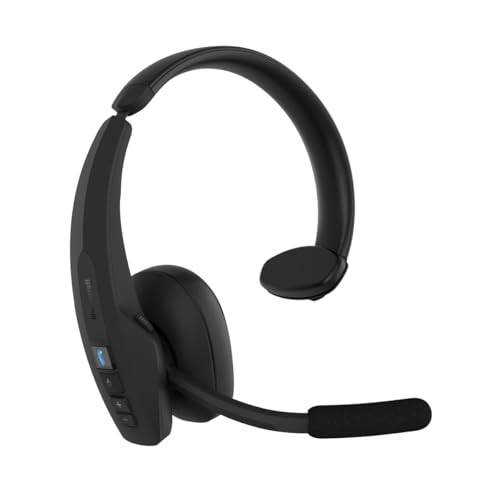
BlueParrott Pro B450 — Best battery and cancelling claim
The Pro B450 arrives wearing the biggest numbers in this guide: 98% noise cancelling claimed for its microphone, 45 hours of talk time, active noise cancelling for the driver’s own ear, and voice control in the feature set. Read as manufacturer figures rather than laboratory gospel, those numbers still describe a flagship intent — a headset built for the professional driver who measures a work week in thousands of miles and wants the headset purchase to disappear from conscious thought for as long as possible. Forty-five hours of talk time is most of a week’s driving between charges, which changes the charging ritual from nightly anxiety to an occasional errand.
Voice control places the B450 beside the B550-XT in this guide’s text workflow: the assistant can be reached and messages handled by voice, with the ANC-quieted ear making the assistant’s replies easier to follow against cab roar — a small synergy that matters at highway volume. The newer flagship also carries the newest-model caveats: the longest track record in this roundup belongs to its elders, and its price sits at the top of the range. Drivers whose current headset dies mid-week or whose cab is loud enough to defeat lesser microphones are the audience those numbers were written for, and for them the B450 makes a coherent, if premium, case.
The B450’s ear-side ANC deserves a paragraph of its own, because it changes the end of the day as much as the calls during it. A driver who has listened against cab roar for ten hours arrives tired in a way that has little to do with the driving; subtract a share of that roar and the same driver arrives with measurably more left. Fleet safety managers have begun to talk about listening fatigue in the same breath as seat comfort and cab ergonomics, and headsets with genuine ear-side cancelling are where that conversation becomes a purchase. The B450 is priced like a flagship because, on this dimension, it is one.
- Link to the handset: Bluetooth
- On the head: professional over-ear driving design
- Voice features: voice control for hands-free assistant use
- Endurance note: 45 hours talk time per the listing; ANC for the wearer
Strengths
- Longest talk time quoted here — charging becomes a weekly non-event
- Strongest microphone cancelling claim in the roundup
- Ear-side ANC eases listening fatigue on loud, long hauls
Trade-offs
- Flagship pricing against proven, cheaper BlueParrott elders
- Shorter field history than the B550-XT’s years of fleet service
- Feature richness rewards an owner who reads the manual once
Best for: high-mileage professionals who want the longest leash and the newest tech. Not suited for: a driver on a tight budget whose routes are quieter — the C400-XT covers the fundamentals for less.

BlueParrott S650-XT — Best stereo-to-mono flexibility
A driver’s day has two acoustic halves that want opposite headsets. Under way: one ear open, calls dominant, the road’s soundtrack unfiltered. At rest: two ears, music or a podcast or a film, the world politely closed out. The S650-XT’s 2-in-1 design answers both halves with one device — a mono driving configuration that converts to stereo listening, with active noise cancelling for the parked hours and 36 hours of talk time in the listing’s figures. For drivers who live out of the cab for days, retiring a second pair of headphones from the kit bag is a genuine quality-of-life upgrade.
Its text story should be stated with this guide’s usual precision: the S650-XT is a Bluetooth headset through which a phone assistant can read and reply to messages once summoned, but this guide credits built-in voice control only where a listing states it, and the S650-XT’s headline talents lie elsewhere — in its conversion design, its ANC and its endurance. The microphone carries BlueParrott’s customary cancelling claim of 96%, so dispatch hears the usual quiet-cab effect. Buy it as the best two-lives headset in the roundup and its text handling, assistant-mediated like most of the field, will serve perfectly well; buy the B550-XT if voice command is the whole point.
There is a ritual the S650-XT enables that its owners describe with real affection: the conversion at the rest stop. Wheels stop, the second earpiece comes out, the world narrows to music or a film, and the cab becomes a room of one’s own. That ritual marks the boundary between work and rest more cleanly than any logbook entry, and drivers who live out for weeks say the boundary is what makes the life sustainable. Equipment that understands the whole day — not just the driving hours — earns a loyalty that spec sheets cannot manufacture, and the S650-XT’s design brief clearly understood it.
- Radio: Bluetooth pairing with the phone
- Wearing arrangement: convertible mono driving / stereo listening 2-in-1
- Endurance note: 36 hours talk time per the listing
- Cancelling note: ANC for the wearer; 96% mic cancelling claimed
Strengths
- One headset covers the driving day and the bunk evening
- ANC makes rest-stop listening a genuine retreat
- Talk time spans multi-day trips without charger discipline
Trade-offs
- Voice-control story is assistant-dependent rather than built-in
- Conversion parts are small objects to keep track of in a cab
- More headset to carry than a pure mono design
Best for: long-haul drivers who pack light and rest in the cab. Not suited for: a day-cab driver home every night, whose stereo needs are already met by the home they return to.

BlueParrott C400-XT — Best convertible value
The C400-XT is the adaptable member of the BlueParrott family: a convertible headset whose wearing styles switch between over-the-head and behind-the-neck arrangements, in mono or with the second ear brought in, so the same device fits the driver who wears a cap, the driver who wears glasses, and the driver whose preference changes with the season. That adaptability, plus the family’s 96% microphone cancelling claim and 24 hours of talk time, has made it the value anchor of professional driving headsets — the one fleet buyers and owner-operators reach for when the flagship money feels better spent on fuel.
On the text question, the C400-XT’s position mirrors the S650-XT’s: it is a capable Bluetooth partner for a phone whose assistant reads messages aloud, and its microphone gives that assistant clean dictation to work with, but this guide does not credit it with the B550-XT’s built-in voice-control suite. What it offers instead is the family’s core promise at the range’s friendlier tier — dispatch-grade outgoing voice, all-day endurance, wearing flexibility — in a package that has served enough drivers, for enough years, that its failure modes are known and rare. Sometimes the mature product at the right price is the recommendation, and in this roundup that sentence belongs to the C400-XT.
The C400-XT’s convertibility solves a problem the other picks mostly ignore: the driver whose head changes. Caps in winter, bare head in summer, glasses for night driving, a headset that must coexist with all of it — the C400’s switchable wearing styles absorb those variations instead of fighting them. Behind-the-neck wearing in particular rescues drivers whose caps defeat every headband in the category. It is an unglamorous superpower, and like most unglamorous superpowers in professional equipment, it is the one that decides whether the device is worn on the difficult days, which are precisely the days it is needed.
- Pairing: standard Bluetooth to the driver’s phone
- Fit system: convertible wearing styles, mono or dual-ear use
- Endurance note: 24 hours talk time per the listing
- Cancelling note: 96% microphone noise cancelling claimed by the maker
Strengths
- Wearing flexibility solves fit problems other models cannot
- Professional-grade microphone performance at a mid-range tier
- Long service record across the driving community
Trade-offs
- No built-in voice-control suite of the B550-XT’s kind
- No active noise cancelling for the driver’s ear
- Convertible design asks a few minutes of initial configuration
Best for: owner-operators who want BlueParrott’s microphone without flagship pricing. Not suited for: a driver set on fully voice-commanded text handling — that requirement points straight at the B550-XT or B450.

Garmin dēzl Headset 200 — Best for Garmin truck GPS users
Garmin approaches the truck cab from the dashboard outward. The dēzl Headset 200 is a 2-in-1 premium trucking headset from the company whose navigators already sit on half the dashboards in the industry, and its natural home is that ecosystem: a headset designed to work in the orbit of Garmin’s truck GPS units, so navigation prompts, calls and the driver’s audio life share one device and one charging habit. The 2-in-1 wearing follows the category’s sensible pattern — single-ear discipline on the move, fuller listening at rest — executed with the polish of a company that has thought about cabs professionally for decades.
Drivers outside the Garmin world should weigh the proposition differently: as a standalone Bluetooth headset the dēzl 200 is a credible premium option, but its distinctive value concentrates where a dēzl navigator already lives, and its text-and-assistant handling follows the phone-mediated pattern described in this guide’s introduction rather than a stated built-in voice-control suite. Its single-ear sibling, the dēzl 110, exists for drivers who want the ecosystem in mono-only form. For the Garmin-loyal cab, though, the 200 completes a system rather than adding a gadget, and systems — one brand, one support line, one set of habits — have a real operational value that spec sheets underrate.
The ecosystem argument deserves its strongest form here. A driver running a dēzl navigator already trusts Garmin with the two most consequential information streams of the day — where to go and when to stop. Adding the headset from the same house means navigation prompts arrive in the same ear, with the same volume logic, supported by the same company when something misbehaves at a truck stop at midnight. Fragmented gear fragments accountability; when the prompt is missed, each maker blames the other’s half. The dēzl 200’s premium buys a single throat to choke, and professional drivers, who think in exactly those terms about everything else on the truck, recognise the value instantly.
- Connection path: Bluetooth; designed around Garmin dēzl navigation
- Ear coupling: 2-in-1 premium trucking design
- Ecosystem note: value peaks alongside a Garmin truck navigator
- Family note: dēzl 110 is the single-ear sibling in the same line
Strengths
- Navigation and communication unified for Garmin-equipped cabs
- Premium build from a brand with deep trucking credibility
- 2-in-1 wearing covers road and rest in one device
Trade-offs
- Distinctive value fades without a Garmin navigator on the dash
- Text handling is assistant-mediated, not a stated voice-control suite
- Premium tier pricing against BlueParrott’s fleet-proven range
Best for: drivers already navigating with Garmin dēzl hardware. Not suited for: a cab loyal to another navigation platform, where the BlueParrott picks spend the same money on microphone pedigree.

Rand McNally ClearDryve 220 — Best rest-stop stereo
Rand McNally’s name has guided trucks since long before Bluetooth, and the ClearDryve 220 carries that heritage into the headset era with a 2-in-1 design that takes the rest half of a driver’s day unusually seriously. The pitch is a headset that works the driving hours in single-ear form and then converts for proper stereo listening — music, audiobooks, the ballgame — with the noise cancellation and all-day comfort the listing emphasises. For drivers whose cab is also their living room, that second shift matters more than spec-sheet one-upmanship, and the ClearDryve’s tuning shows it was designed by people who understood the bunk as well as the wheel.
Call quality sits comfortably in the professional tier, with noise cancellation in the microphone path keeping dispatch conversations clean, and battery life described by the maker in long-haul terms. Its message handling, stated plainly under this guide’s rules, is the phone-assistant pattern: pair it, configure announcements on the phone, and texts arrive as audio — there is no listing-stated voice-control suite here of the B550-XT’s kind, so summoning the assistant may involve the headset’s controls or the phone’s own wake methods rather than pure voice command. Drivers who prize that last refinement know which sections to revisit. Drivers who want one respected name across navigation heritage and headset, with evenings that sound genuinely good, have found their pick.
Rand McNally’s heritage shows in a place spec sheets do not reach: the ClearDryve treats the driver’s evening as part of the job’s design problem. A workforce that sleeps in cabs needs its rest to be restorative, and restorative rest in a truck stop parking lot is an audio problem — neighbouring reefers, lot noise, the general hum of a working yard. A headset that converts to stereo and seals the evening in is, functionally, part of the sleeper berth’s equipment. Buyers comparing this model against pure communication tools should price that function honestly: it replaces a second device and improves the hours the logbook calls rest, which the next day’s driving quietly depends on.
- Wireless route: Bluetooth
- Configuration: 2-in-1 — mono for driving, stereo for rest
- Focus note: off-duty listening treated as a first-class duty
- Voice note: message reading runs through the phone’s assistant
Strengths
- Stereo mode makes rest hours sound like leisure, not leftovers
- Navigation-brand ergonomics shaped by professional driving
- Microphone cancelling keeps work calls respectably clean
Trade-offs
- No stated built-in voice control for fully hands-free text commands
- Microphone pedigree is strong but BlueParrott owns this guide’s top tier
- 2-in-1 conversion shares the category’s small-parts bookkeeping
Best for: drivers who live in the cab and want evenings to sound like home. Not suited for: a text-heavy dispatcher relationship, where the B550-XT’s voice control earns its premium daily.
What Does Dispatch Hear, and Why Does It Matter Commercially?
Every call a driver makes is a small audition. Dispatchers, brokers and customers form judgements from audio quality with the ruthlessness of people who make fifty such calls a day: the driver who sounds clear and close gets the straightforward loads and the patient hearing; the driver who sounds like they are calling from inside a cement mixer gets the repeats, the doubts and the shorter leash. None of this is fair, and all of it is real. The microphone cancelling that dominates this category’s marketing exists because the commercial value of sounding organised, at highway speed, is measurable in the quality of work a driver is offered.
That is the frame in which to read the percentages and the brand pedigrees in this guide. BlueParrott’s decades in truck fleets were not spent chasing audiophile virtues; they were spent making drivers sound like the professionals they are, to listeners who allocate money on the basis of that sound. A buyer choosing between the picks here is choosing, in part, how their working voice will be graded by people who never see their face. It is worth choosing deliberately, and worth the professional tier’s price when the voice is, economically speaking, the driver’s shopfront window.
How Should a Driver Choose Between Mono and Convertible Designs?
Start with the honest shape of the working week. A day-cab driver home every night needs the road half of the equation only: one ear open, calls answered, texts heard, and the evening’s stereo life supplied by a home that already has speakers. The mono specialists — B550-XT above all — serve that week without carrying a gram of rest equipment. A long-haul driver whose cab is a residence needs both halves, and the convertibles exist for them: S650-XT with its ANC evenings, C400-XT with its wearing flexibility, the dēzl 200 and ClearDryve 220 with their own takes on the double life.
The mistake is buying the other week’s headset. Day drivers who buy convertibles carry parts they never assemble and pay for stereo they never hear; long-haul drivers who buy pure mono discover, somewhere in the second week out, that rest without real audio is rest in name only. Neither error is about quality — every pick here is a serious tool — they are errors of biography. Write down where you actually sleep before ordering, and let that single fact rank the table. This guide’s badges were assigned with biographies in mind, and the verdicts will steer you right if you bring yours to the reading.
What Happens to Text Messages When the Phone Is in the Bunk?
Bluetooth range inside a cab is generous but not infinite, and the geometry of a sleeper cab creates the category’s most practical failure: the phone charging in the bunk, the driver in the seat, a bulkhead and a curtain between them, and a message alert that arrives broken or not at all. The professional habit is to give the phone a driving position — a mount or a pocket within a few feet of the driver’s ear, with line of sight where possible — and to test the alert chain from the seat before the trip, not during it. Headsets in this guide are built for vehicles, but no radio negotiates with physics on your behalf.
The same geometry governs call quality on the move. A phone buried under paperwork in a door pocket asks its Bluetooth link and its microphone-assisting software to work through clutter for no benefit. Keep the phone high, clear and close, and every pick here performs as its section promises; bury it, and even the flagship’s voice control will occasionally fumble the assistant’s replies. Equipment this good deserves the small courtesy of a sensible phone position — it is the cheapest performance upgrade in the entire article, costing exactly one decision.
Which of the Six Trucking Headsets Reads the Road Best?
| Headset | Wearing | Voice control | Defining trait |
|---|---|---|---|
| BlueParrott B550-XT | Mono over-ear | Built in — assistant by voice | Fullest hands-free text workflow |
| BlueParrott Pro B450 | Over-ear | Built in | 45-hour talk, strongest claims |
| BlueParrott S650-XT | Convertible 2-in-1 | Assistant-mediated | ANC plus stereo at rest |
| BlueParrott C400-XT | Convertible styles | Assistant-mediated | Value with pro microphone |
| Garmin dēzl 200 | 2-in-1 | Assistant-mediated | Garmin navigation ecosystem |
| Rand McNally ClearDryve 220 | 2-in-1 | Assistant-mediated | Rest-stop stereo quality |
The voice control column is this guide in miniature, and it is deliberately blunt. Two models state the feature that makes text handling fully hands-free; four models deliver excellent cab audio through which a phone assistant can still read and take replies once awake. Neither group is mis-sold here, and a driver who understands which group they are buying will be satisfied with either. A driver who buys an assistant-mediated model expecting B550-XT behaviour has been failed by somebody’s copywriting — this table exists so that it is never ours.
How Should You Set Up Message Reading Before Your First Trip?
Do all of this parked, engine off, with a coffee — never rolling. Pair the headset, then open the phone’s assistant settings and enable use while the phone is locked, because a locked phone is the only kind a driving phone should be. In notification settings, turn on spoken announcements or the equivalent for your messaging apps, and send yourself test texts from a second phone or a scheduled message: hear the alert, summon the assistant the way your model allows, listen to the reading, dictate a reply, and confirm the reply arrives correctly punctuated and addressed. Repeat with the cab’s fan and radio at working levels.
Then rehearse the failure modes while they are still free. What happens when two messages land at once? When the assistant mishears a street name — do you catch it in the read-back before sending? Set the habit of always listening to the assistant’s confirmation before approving a reply, the same discipline as reading back a load number to dispatch. Finally, set volumes at the lowest level that stays clear over road noise and keep them there; a headset shouting to beat the highway is a headache scheduled for hour six. Ten parked minutes of this rehearsal buys a feature you can trust at speed, which is the only kind worth having.
How Do Fleets Roll Headsets Out to Drivers Who Hate New Gear?
Drivers are connoisseurs of equipment that wastes their time, and a headset rollout that ignores that fact will find the devices in gloveboxes by the second week. The rollouts that work share a pattern visible in the best fleets: drivers are offered a choice between two approved models rather than a mandate of one, the assistant and announcement setup is done with the driver at issue — parked, unhurried, tested with a real message — and the first week’s faults are collected without argument and fixed visibly. A driver who chose the headset, watched it read a text aloud before the wheels turned, and saw a complaint answered owns the device in a way no issue slip can compel.
Standardising on the BlueParrott family simplifies that programme, since the models share control logic and a support story, while the Garmin and Rand McNally picks serve fleets already standardised on those dashboards. What fleets should not do is buy on the cancelling percentage alone and skip the setup ritual: an unconfigured voice-control headset is just a headset, and the text feature that justified the purchase will be discovered by nobody. The technology in this guide is mature; the difference between fleets that benefit and fleets that store it in gloveboxes is ten minutes of parked setup per driver.
What Should a Driver Check at the First Fuel Stop?
The first stop of the first trip with a new headset is a natural audit point, and five checks fit inside a fuel and coffee stop. Confirm the battery’s real drain against the gauge’s promise, because the week’s charging plan depends on honest numbers. Replay the day’s calls mentally for the repeats you were asked for — each one is microphone data. Check the ear’s verdict: any hotspot at hour three is a fitting problem to solve tonight with the alternate wearing style or cushion, not a character flaw to endure for a month. Confirm the phone’s position kept the alert chain intact through the day’s messages. And confirm the assistant understood your dictation in real cab noise, because that, more than any listening test, is the text feature’s true report card.
Failures found at the first stop are cheap; the same failures found in week six are returns battles and resentments. Every model in this guide has passed these checks in thousands of cabs, but individual fit and individual phones keep the audit necessary. Treat the first trip as the headset’s probation and it will either earn its place or reveal itself while the receipt is still warm — the two outcomes a buyer actually wants, delivered early.
What Mistakes Do Drivers Make Buying Headsets for Text and Calls?
Believing the headset reads texts by itself is the founding misunderstanding. The assistant on the phone does the reading; the headset is the microphone, speaker and — on two models here — the voice remote. Drivers who skip the phone-side configuration conclude the feature is broken, when it was never switched on. Configure the chain, test it parked, and the same purchase suddenly works as advertised.
Second, chasing the biggest noise-cancelling percentage as if it were a measured constant. Those figures are manufacturer claims about the microphone path; they rank models roughly and promise nothing absolute. Third, buying stereo-first headsets for driving: two sealed ears at highway speed trade away the road awareness this category exists to protect, which is why every pick here is mono under way, convertible at most. Fourth, ignoring talk time arithmetic — a headset that dies before the driving day does will be left in the bunk, and a headset left in the bunk receives no texts at all. Match the battery to the longest legal day, with margin for the phone calls of the evening.
Why Does Talk Time Matter More Than Any Other Number Here?
A trucker’s day is not an office day with wheels. It runs to the legal limit, starts before dawn in a cold cab, and ends wherever the hours expire — and through all of it the headset is the driver’s telephone, message reader, navigation voice and evening entertainment in the convertible cases. A battery that surrenders at hour nine does not merely end the calls; it ends the text chain, the prompts and the driver’s connection to dispatch at exactly the point of the day when fatigue makes communication most valuable. That is why this guide quotes talk time in every section and ranks the B450’s 45 hours as a headline rather than a footnote.
The arithmetic buyers should perform is personal: longest legal day, plus the evening’s calls, plus a margin for the day the charger is forgotten — then compare the result against the table. Most drivers land comfortably inside even the 24-hour models’ envelope, which is why those models remain recommendable; drivers who team-drive, slip-seat or run irregular schedules should buy the margin the flagship sells. Battery anxiety in a cab is a distraction, and distraction is the one cargo no driver is paid to carry.
What Does a Headset Owe the Driver at the End of the Day?
Comfort, in the end, is a safety specification wearing casual clothes. A driver whose ear aches from hour four is a driver whose attention is being taxed by equipment, and attention is the entire job. The picks here were filtered for the long day as much as for the loud one: cushions that distribute pressure, wearing styles that can be changed when one arrangement tires, weights that a neck forgets. None of that photographs well or headlines a listing, and all of it decides whether the headset is still being worn — correctly, willingly — in the trip’s final hour, when the messages it exists to read may matter most.
So the final buying advice is embarrassingly physical: if you can, wear the finalist for an hour before committing, over your actual cap, with your actual glasses, in your actual seat. The cab will tell you things no review can, and this guide’s role is to make sure the model you trial is one whose electronics deserve the cab’s verdict. Every pick above has earned that trial. The one that passes it in your cab, with your phone, under your hat, is the right headset — whatever the percentages say.
Final Recommendation
For the driver whose working day genuinely runs through text messages, the B550-XT remains the recommendation with the fewest asterisks: voice control that reaches the assistant, a microphone dispatch will thank you for, and weather resistance for the life the headset will actually lead. The Pro B450 is its modern flagship alternative when battery endurance and ear-side cancelling justify the premium. Around those two, the convertibles divide the remaining honours — S650-XT for ANC rest, C400-XT for value, dēzl 200 for Garmin cabs, ClearDryve 220 for stereo evenings. Set up the assistant chain before the wheels turn, and whichever you choose will keep your eyes where they belong: on the road that is paying for everything.
One more honest note about the phrase in this article’s keyword. “With text” describes a workflow, not a component — no headset in this guide, or anywhere, contains a texting engine. What the best of them contain is everything the workflow needs from the hardware side: a microphone an assistant can understand at speed, controls that keep hands on the wheel, and an earpiece that makes a spoken message effortless to follow. Judge any future model by those three duties and marketing language loses its power to confuse the purchase.
And a word for the driver shopping on a fleet’s behalf as well as their own: buy the same model for the truck you drive as the fleet issues, if the choice is yours to align. Shared chargers, shared habits and a support conversation that starts from common ground are worth more across a year than the marginal advantage of a personally preferred rival. Fleets standardise for reasons that look bureaucratic from outside and feel like mercy at a truck stop when a colleague’s spare cable saves your shift.
Keep the charging cable where the truck sleeps, not where you do. The headset’s home should be the cab’s own routine — the same hook, the same cable, the same end-of-day motion — because a routine tied to the vehicle survives schedule changes, team driving and the occasional night in a motel that breaks every habit tied to a bunk or a bag.
Drivers who run the same route weekly learn one more thing worth passing on: set the assistant’s announcement behaviour per app, not globally. Dispatch and family deserve spoken interruption; the group chat with forty memes a day does not. Ten minutes of notification triage, done once, is the difference between a text feature that serves the driver and one the driver disables by the second week — and a disabled feature helps no one, whatever the headset cost.
That triage has a safety dividend beyond convenience. A driver who trusts the announcements — who knows that what interrupts is worth interrupting for — keeps the feature on through the whole trip, which means the one message that truly matters, the dock change or the family emergency, arrives through the same trusted channel instead of a silenced phone. Selectivity, set up once in a parking lot, is what makes the whole hands-free text idea trustworthy enough to use at speed.
Finally, remember that the headset is one link in a chain that includes the phone plan, the signal along your route and the apps dispatch chooses to use. Dead zones will interrupt the cleverest assistant, and no purchase in this guide repeals geography. What the right headset guarantees is narrower and more valuable: wherever the phone works, your hands and eyes stay free, your voice arrives clearly, and every message the road sends you is one you can hear without ever looking down.
Buy it before the busy season, set it up on a quiet Sunday, and let the first working week be an audition rather than an emergency. Equipment adopted calmly gets configured properly, worn consistently and judged fairly — and in this category, proper configuration is half the product.
The same calm adoption serves the gift-buyer and the fleet manager alike: a headset presented with its setup already done — paired, configured, tested with one real message — is a working tool from the first mile, while a sealed box is a project. In a profession measured in miles and hours, projects are what rest stops are for; tools are what the road deserves, every single mile of it.
Frequently Asked Questions
Does the headset itself read my text messages?
No — your phone’s voice assistant does the reading and replying. The headset provides the speaker, the noise-cancelling microphone for dictation, and on models with voice control like the B550-XT and Pro B450, a hands-free way to summon the assistant. The phone’s settings must enable announcements and locked-phone assistant use.
Can I reply to a text completely hands-free?
With a voice-control model and a properly configured assistant, yes: hear the message, dictate the reply, confirm by voice. With assistant-mediated models, the reading works the same once the assistant is awake, but waking it may involve a button press rather than voice alone.
What do the 96% and 98% noise-cancelling figures mean?
They are manufacturer claims about how much background noise the microphone system removes from what your caller hears — not silence at your own ear. Treat them as rough rankings between models. Ear-side quiet is a separate feature, active noise cancelling, offered by the S650-XT and Pro B450.
Is one ear covered legal for truck drivers?
Single-ear headsets are designed to keep one ear open to the road, and hands-free phone use is widely required rather than merely allowed — but rules differ by jurisdiction and employer. Check your local regulations and company policy; this guide describes the equipment, not the law where you drive.
How long should a trucker headset’s battery last?
Longer than your longest driving day, with margin. The picks here quote from 24 to 45 hours of talk time, so even the shortest covers a full day plus evening calls. Judge by talk time, charge on rest days, and remember capacity fades slowly over years.
Can I hear navigation prompts through these headsets too?
Yes — phone navigation audio routes through the headset like any other phone audio, which many drivers prefer to a speaker fighting the cab. Garmin’s dēzl 200 is designed with its own navigators in mind, while the phone-app user gets prompts through any pick here once the phone is the audio source.
Do these headsets work with flip phones or fleet-issued basic phones?
They pair over standard Bluetooth, so most phones with Bluetooth audio support will connect for calls. The assistant-driven text features, however, depend on a smartphone’s voice assistant — a basic phone removes the reading half of the chain no matter which headset carries the call.
Safe travels, and clear signals, to every driver who reads this far — may your messages always arrive as voices, your dispatchers always hear you the first time, and your headset always outlast the day it was bought for, and many days after, across many states and seasons of hard work ahead daily, always.
Related Guides
Drivers who also take calls off the road may find our mono Bluetooth headset roundup worth reading for lighter-duty options, and our USB call center headset guide covers the dispatcher’s side of the conversation. Desk-phone fleets are handled in the telephone headset guide. The other profession that lives or dies by a clear microphone is compared in the best aviation headsets with noise canceling.


