What's inside
- Key Takeaways
- Quick Picks
- How Did We Choose These Picks?
- What Can a Budget Headset Honestly Do for Sound?
- How Can You Get the Most From a Budget Headset?
- What Mistakes Do Budget Buyers Make?
- What Exactly Are You Trading Away at This Price?
- Which Budget Philosophy Fits Your Games?
- How Does the Budget Tier Handle Music, Film and Everything Between Games?
- What Should You Do in the First Week With a Budget Pick?
- Why Do So Many Budget Headsets Sound Worse Than These Six?
- A Word for Parents, Partners and Other Gift-Buyers
- How Should You Think About Upgrading From Here?
- The Honest Ceiling, Restated as a Buying Rule
- What About Glasses, Big Heads and Other Fit Realities?
- A Note on Sales, Seasons and the Tier’s Wandering Prices
- Final Recommendation
- Frequently Asked Questions
- Related Guides
As an Amazon Associate I earn from qualifying purchases. This post may contain affiliate links at no extra cost to you.
gizmoverdict.com is reader-supported. When you buy through links on our site, we may earn an affiliate commission.
Where to buy: All six picks link to listings verified in this site’s product pool, and all six belong to the budget tier this guide is about — the class of headsets positioned under the 100 mark. In keeping with this site’s rules, no product prices are printed here; check the current figure on the listing, because the budget tier is exactly where prices like to wander.
The phrase best audiophile headsets under 100 contains a productive tension, and this guide begins by refusing to pretend otherwise. True audiophile headphones — the open-back Sennheisers and their peers — live mostly above this budget, and the headsets below it are gaming products, with gaming priorities. But inside the budget tier there is a real spectrum, and at its top sit headsets whose makers cared about the same things audiophiles care about: driver control, honest tuning, a midrange that respects voices, treble that informs instead of stabbing. This guide hunts those. Call them audiophile-leaning, call them the thinking player’s budget picks — what matters is that each one spends its limited money on sound before spectacle.
So the trade-offs must be printed as plainly as the virtues. At this tier you will not get planar drivers, genuine open-back staging, condenser microphones or exotic materials. You will get dynamic drivers of varying discipline, closed backs, serviceable booms and plastic where the flagships use aluminium — though two picks here, the HyperX models, smuggle metal frames into the budget and deserve credit for it. What you should demand, and what this guide demanded on your behalf, is that nothing at this price be actively dishonest: no bass tuned to swallow the game, no treble spike faking detail, no surround badge — every surround feature mentioned below is virtual software processing — impersonating hardware.
Read the six as a ladder of philosophies. The Cloud Alpha spends its budget on a clever driver and a metal frame. The BlackShark V2 X spends its on lightness and competitive clarity. The G432 spends its on a USB path that rescues noisy PCs. The Kraken spends its on comfort and simplicity. The Cloud II spends its on a USB sound card and a decade of refinement. And the Cloud III, the tier’s ceiling, spends its on modern manners across every machine you own. One of those philosophies is yours; the rest of this guide exists to help you recognise it.
Key Takeaways
- Under the 100 mark, audiophile means priorities, not pedigree: controlled bass, honest mids and treble that respects long sessions.
- The HyperX Cloud Alpha’s dual-chamber drivers give the budget tier its most grown-up sound signature.
- Every surround feature at this price is virtual software processing — buy the stereo underneath it, never the badge.
- The Logitech G432’s USB adapter is the budget fix for a noisy motherboard jack.
- The Cloud II and Cloud III sit at the tier’s ceiling and behave like headsets from the class above it.
Quick Picks
| Pick | Badge | Why it is here |
|---|---|---|
| HyperX Cloud Alpha | Best sound in the tier | Dual-chamber drivers keep bass in its own room, away from the midrange. |
| Razer BlackShark V2 X | Best for competitive clarity | A featherweight frame and a forward, cue-friendly tune for ranked play. |
| Logitech G432 | Best budget USB | USB conversion for noisy PCs, plus a flip-to-mute mic that cannot be fumbled. |
| Razer Kraken | Best simple comfort pick | Cooling-gel cushions and a retractable mic in a headset anyone can operate. |
| HyperX Cloud II | Best USB sound-card value | The classic card-based package, still the tier’s most complete PC instrument. |
| HyperX Cloud III | The tier’s ceiling | Modern connections, clean tuning and a detachable mic at the top of the budget. |
How Did We Choose These Picks?
Eligibility was positioning, not a price snapshot: each pick had to belong to the budget class by design — a model the market understands as an under-100 headset — because a flagship photographed during a sale is not a budget product and does not behave like one across a year of ownership. Survivors were judged on the audiophile virtues in budget translation: bass that stays in its lane, a midrange that keeps dialogue and callouts human, treble without the cheap spike that fakes excitement and guarantees fatigue. Microphones were graded as part of the sound, comfort as part of the tuning — a seal that breaks is a frequency response that changes — and build by whether the frame and cable seemed likely to survive the second year, which is where budget headsets traditionally go to die.
We also penalised theatre. Lights, app suites and surround badges all cost money that a budget headset does not have; picks that spent on them had to prove the sound had not paid the bill. Several famous names failed that audit and are not here. The six that remain each made one clear promise and kept it.
What Can a Budget Headset Honestly Do for Sound?
More than the price suggests, because the expensive parts of great sound are partly knowledge rather than materials. A driver does not need exotic metallurgy to be well behaved; it needs a designer who chose control over spectacle, and damping and earcup geometry that cost thought more than money. That is why the Cloud Alpha’s dual-chamber idea matters at this tier: by giving the bass its own acoustic space, the design stops the commonest budget sin — low-end bleed fogging the midrange — with engineering instead of expenditure. The result is a headset that plays a crowded scene with a composure its price has no right to, and it is the template for what this guide means by audiophile-leaning.
What the budget cannot buy is equally definite. Soundstage stays modest: these are closed backs in small cups, and no tuning conjures the open air of an audiophile headphone. Resolution has a ceiling — the finest textures, the last layer of a reverb tail, belong to the tier above. Microphones are competent rather than beautiful. This guide’s picks were chosen to press against those ceilings intelligently rather than to deny they exist, and each pick’s trade-off list names the ceiling it presses hardest. Read those lists as the real reviews; the strengths are what you enjoy, the trade-offs are what you live with.

HyperX Cloud Alpha — Best sound in the tier
The Cloud Alpha is the budget tier’s most interesting engineering story. Its drivers divide the acoustic labour between two chambers, letting the low frequencies work in their own space instead of flooding the chamber where voices and cues live. Play a scene that breaks lesser budget headsets — an engine idling under dialogue, an explosion under a callout — and the Alpha keeps the layers filed separately with a calm that feels imported from a higher price class. It is the single most audiophile idea in this guide, executed at a budget address, and it earns the Alpha the top spot for any player whose first priority is the sound itself.
The supporting cast respects the headline. An aluminium frame at this tier is a statement of intent about year three, the cable and microphone both detach so the two most fragile parts are the two most replaceable, and the wired 3.5mm connection makes the Alpha a citizen of every platform without adapters or ecosystems. Its microphone is honest mid-pack — clear, serviceable, nobody’s broadcast debut — and there is no USB path, no processing, no surround of any flavour; the sound is the sound, which purists will file under virtue and feature-hunters under absence. For the player this guide was written for, the Alpha is the answer that needs the fewest apologies.
Comfort deserves its sentence: the Cloud fit is a known quantity, memory foam over a forgiving clamp, and the Alpha wears it as well as any member of the family. Long sessions stay long.
- Dual-chamber drivers separating bass from mids and highs
- Wired 3.5mm connection for PC, consoles and mobile
- Aluminium frame — rare metal at this tier
- Detachable microphone and detachable cable
- Memory foam earcups in the Cloud family’s proven fit
Strengths
- Dual-chamber design delivers the tier’s most composed sound
- Aluminium frame and detachable parts promise a long life
- Plays with every platform through a simple 3.5mm lead
Trade-offs
- No USB path or processing of any kind
- Microphone is serviceable rather than special
- Soundstage is tidy, not vast — physics keeps its fee
Best for: sound-first players on a budget, especially those moving up from a bundled or ageing headset.
Not suited for: players who need USB features, wireless freedom, or a microphone that flatters them.

Razer BlackShark V2 X — Best for competitive clarity
The BlackShark V2 X begins from a competitive truth: in a ranked match, the headset’s job is not to be beautiful, it is to be early. Its TriForce Titanium drivers are tuned to keep the cue frequencies — footsteps, swaps, reloads, the small metallic vocabulary of danger — clean and forward, and its featherweight build, around 240 grams, removes the other enemy of long ranked sessions, which is the headset itself. Hours into a session, when heavier rivals have become a negotiation, the V2 X is still simply there, isolating passively, presenting its tidy soundstage, letting your attention stay where the rank is decided.
The fixed HyperClear cardioid microphone is better than the tier requires — focused on your voice, dismissive of the room — and its fixedness is the honest trade: it does not detach, so the headset stays a headset, on the desk and in the bag. There is no USB processing and no surround suite; the clarity is native, which competitive players should count as the design’s integrity rather than its poverty. Against the Alpha it concedes tonal richness and that dual-chamber composure in cinematic scenes; against everything else here it wins the specific war it enlisted for. If your library is a ladder and your sessions are long, this is the budget weapon drawn for you.
One caution for the spectacle-minded: the V2 X looks and feels like a tool, plainly finished and proud of it. Players who want their headset to decorate the desk should look at the Kraken; players who want it to win rounds should stay right here.
- TriForce Titanium 50mm drivers, wired by 3.5mm
- Featherweight build at around 240 grams
- HyperClear cardioid microphone on a fixed boom
- Noise-isolating earcups in a closed design
- Works across PC, PlayStation, Switch and mobile
Strengths
- Cue-forward tuning that serves ranked play honestly
- Featherweight build disappears across long sessions
- A cardioid microphone above the tier’s standard
Trade-offs
- Fixed microphone never detaches for travel or media use
- Cinematic richness trails the Cloud Alpha
- Plain, tool-like finish will not dress up a desk
Best for: competitive players who grind long sessions and value early information over lush presentation.
Not suited for: story-first players chasing atmosphere, and anyone who needs a detachable mic.
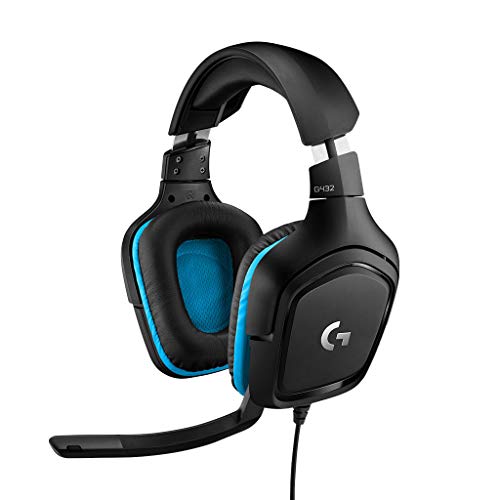
Logitech G432 — Best budget USB
The G432 owns a specific rescue mission: the player whose PC sounds broken. Fed by a motherboard jack full of hiss and graphics-card whine, even a good headset sounds cheap; the G432’s USB adapter moves the conversion out of that noise and hands the player a quiet background and Logitech’s DTS Headphone:X 2.0 processing — virtual surround, as this guide insists on calling it, a switchable widening rather than a set of extra speakers. At this tier, that rescue is worth more than any single refinement of the drivers, because noise is the flaw you hear in every second of every game, while resolution is the virtue you hear in the best seconds.
The rest of the package is sensibly judged. The 50mm drivers play warm and full, flattering games and keeping chat intelligible; the flip-to-mute boom makes muting a physical gesture nobody fumbles mid-match; the 3.5mm lead gives the headset a second life on controllers and laptops. The build is honest budget plastic and the software shallower than the premium Logitech tier, and neither fact should surprise or deter the buyer this pick addresses. As the first serious headset for a young player or the rescue package for a noisy PC, the G432 is the easiest money in this guide to spend well.
A note for gift-buyers, repeated from long experience with this model class: the flip-to-mute gesture survives teenagers, the USB adapter survives their PC’s front panel, and the headset’s warmth forgives the compressed audio of streamed video between matches. It is the budget pick most likely to still be in service at the next upgrade cycle.
- USB adapter with DTS Headphone:X 2.0 virtual surround
- 3.5mm connection for consoles and other devices
- 50mm drivers with a warm, full budget tune
- Flip-to-mute microphone on a parking boom
- Lightweight frame for long casual sessions
Strengths
- USB conversion silences a noisy PC at a starter price
- Flip-to-mute is the tier’s most foolproof mic control
- Warm, forgiving sound across games, chat and video
Trade-offs
- Budget plastics ask for kind treatment
- Surround is a switchable effect, not the reason to buy
- Less tonal composure than the Cloud Alpha in busy scenes
Best for: players with noisy PC audio, first-time buyers, and anyone gifting a headset that must simply work.
Not suited for: purists who want the tier’s best native stereo and no processing — the Alpha awaits.
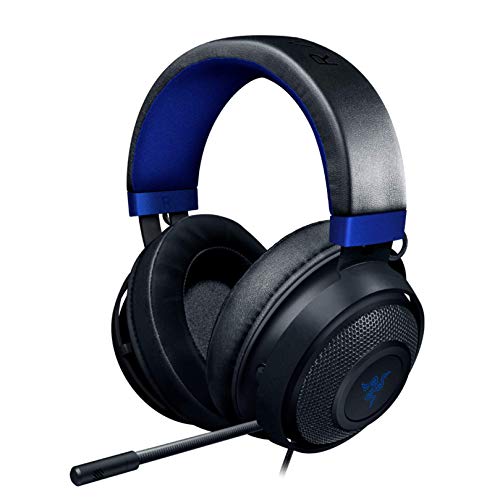
Razer Kraken — Best simple comfort pick
The Kraken is the budget tier’s populist: a headset designed to be liked in the first minute and operated by anyone in the second. Its cooling-gel cushions answer the complaint every long session eventually files — hot ears — and its retractable microphone performs the neatest disappearing act in this guide, sliding into the earcup until the headset is just headphones, then sliding out when the squad assembles. For shared households, younger players and anyone whose headset migrates between a desk, a couch and a bag, that simplicity is not a lack of features; it is the feature.
Sonically the Kraken makes the populist’s bargain and makes it openly: a fuller, bass-generous tune that flatters explosions, engines and soundtrack swells, at some cost to the forensic separation the Alpha and BlackShark chase. Dialogue stays intelligible and the presentation never turns harsh, but a crowded competitive scene is rendered as an experience rather than a diagram. Audiophile-leaning players will rank it fourth in this guide for exactly that reason, and a great many other players will rank it first for exactly the same reason. Both rankings are honest; the guide’s job is to make sure you know which player you are before the box is open.
Build splits the difference between its stablemates: an aluminium frame under the styling gives it more spine than the G432, while the whole remains light enough for the couch sessions it was born for. It is the budget pick with the fewest instructions and the broadest smile.
- Wired 3.5mm connection across PC, consoles and mobile
- Cooling-gel infused ear cushions for long sessions
- Retractable noise-isolating microphone
- Lightweight aluminium frame beneath the styling
- A fuller, bass-generous tune aimed at fun first
Strengths
- Cooling-gel cushions solve the hot-ear problem properly
- Retractable mic makes it the tier’s best traveller
- Friendly, full-bodied sound that flatters big games
Trade-offs
- Bass generosity costs competitive separation
- No USB path or processing on board
- Tuning aims at fun, and purists will hear the aim
Best for: casual and household players who want comfort, simplicity and a headset that moves between rooms.
Not suited for: ranked cue-hunters and sound-first purists, both better served above it in this list.

HyperX Cloud II — Best USB sound-card value
Judged as a budget purchase today, the Cloud II is the tier’s most complete PC instrument, because its money sits in a place no rival here matches: the USB sound card. Through the card you get clean conversion away from motherboard noise, inline controls at your hand, and virtual 7.1 surround — software processing, switchable, enjoyable in epics and best disabled in ranked play — wrapped around a stereo foundation that was always this design’s real strength. The 53mm drivers play with a composure that embarrasses newer budget rivals, the aluminium frame has outlived a generation of plastic competitors, and the whole package carries the confidence of a design that has been debugged by years of production and millions of desks.
The dual citizenship remains the thing to understand: off the card, by 3.5mm, the Cloud II is a simpler, still-pleasant headset for controllers and travel. Buyers should know which citizen they are using, because the processed PC version is the one this recommendation describes. At the tier’s ceiling, the Cloud II’s case against the newer Cloud III is character: the card, the controls, the theatre of a small command pod on the cable. The III is tidier and more modern; the II is the fuller instrument. Either way, HyperX owns the top of this budget, and the II’s longevity in the market is the market agreeing.
For the player whose PC is the whole world and whose budget is the whole budget, this is the pick that feels least like a compromise — a complete audio station that happens to cost what a mere headset costs elsewhere.
- USB sound card with virtual 7.1 surround and inline controls
- 53mm drivers in a closed-back aluminium-framed design
- Detachable microphone; memory foam earpads
- 3.5mm mode for controllers and laptops without the card
- A design refined across years of production
Strengths
- USB sound card delivers conversion, controls and processing in one
- Proven drivers and an aluminium frame with a long service record
- Two personalities: full PC instrument, simple console traveller
Trade-offs
- Virtual surround remains a taste, not a triumph
- The card and cable add desk furniture
- Its analogue self is merely good, where its USB self is excellent
Best for: PC-centred players who want the most complete budget instrument, card and all.
Not suited for: minimalists who want one cable and no pod — the Cloud III is their HyperX.
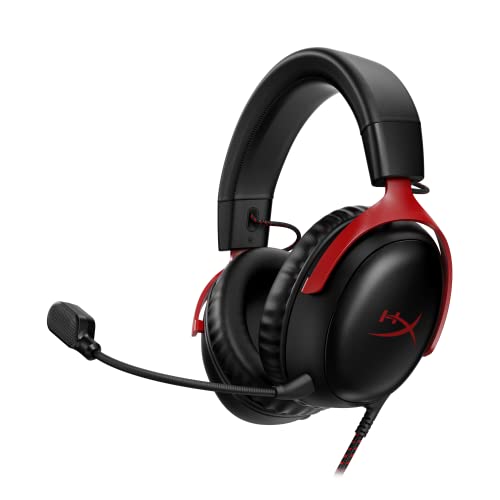
HyperX Cloud III — The tier’s ceiling
The Cloud III closes this guide because it defines where the budget tier ends: the point at which a headset stops apologising. Its connections cover the modern household in the box — USB-C for the new, USB-A for the established, 3.5mm for everything with a jack — its conversion over USB is clean, and its 53mm drivers carry the most disciplined tune HyperX has put at this level: bass that behaves, a midrange that hosts voices properly, treble with its spikes filed off in the factory rather than in your evenings. Of the six picks here, it is the one that sounds most like the class above, and the one whose audiophile-leaning credentials need the least argument.
The detachable 10mm microphone, with its glanceable mute LED, keeps the same grown-up standard, and off the head the III converts to anonymous travel headphones in seconds. What it refuses to sell you is theatre: no surround suite, no app residency, no lights. Players who read that refusal as absence should buy the Cloud II and its card; players who read it as the budget spent entirely on the sound and the build are reading this guide correctly. As the ceiling pick, the III is also the tier’s best longevity bet — the headset a budget buyer keeps through the next PC, the next console and the next two game generations.
That is the honest summit of under-100: not an audiophile headphone in disguise, but a headset with audiophile priorities, built to be the last budget headset you buy before the question stops being about money.
- USB-C and USB-A leads plus 3.5mm — every modern port covered
- 53mm drivers with a clean, low-fatigue tune
- Detachable 10mm microphone with an LED mute indicator
- Memory foam earcups and a durable frame
- No battery and no required software
Strengths
- The most disciplined tuning at the tier’s ceiling
- Every modern connection in the box, no adapters to buy
- Detachable mic with a mute LED ends the eternal guessing
Trade-offs
- No processing features for players who enjoy them
- Soundstage remains a budget closed-back soundstage
- It costs the tier’s ceiling because it is the tier’s ceiling
Best for: budget buyers who want one headset to keep for years, across every machine they own.
Not suited for: feature collectors, and players whose whole budget must also cover this month’s games.
How Can You Get the Most From a Budget Headset?
Start with fit, because at this tier fit is the cheapest upgrade in audio. Seat the cups evenly, centre the headband, and if you wear glasses, choose the frame style that breaks the seal least — a broken seal steals bass and no equaliser buys it back honestly. Then clean up the source: if your PC offers a rear jack, use it over the front panel; if your headset has a USB path, prefer it, because the quiet background is worth more than any setting. Set your game to its headphone or stereo mode rather than a speaker mix, disable any second layer of spatial processing so one algorithm at a time shapes the sound, and set volume by the quiet cues — if a footstep is clear, the explosion needs no help.
Give a new budget headset a week before judging it, playing your ordinary rotation. Pads settle, ears recalibrate from whatever came before, and the tuning that seemed merely polite on day one often reveals itself as the one you can live inside. Most returns in this tier are divorces filed during the honeymoon, by ears still married to a worse headset’s habits.
What Mistakes Do Budget Buyers Make?
The classic is buying the badge: paying for a surround logo, a light ring or an app suite with money that should have bought driver discipline, then hearing the bill in every busy scene. The second is judging in a loud shop or a thirty-second clip, where boosted bass always wins and fatigue has no time to testify. The third is ignoring the microphone until the squad complains — at this tier the spread between a clear boom and a muddy one is the difference between being heard and being tolerated. Fourth, buyers chase a flagship on sale into a budget it does not belong to, inheriting flagship appetites for sources, pads and parts at budget planning. Buy the product designed for the tier; it was engineered for your evenings, not for a discount event.
Finally, do not let a budget headset’s price talk you into treating it carelessly. The picks here reward the small kindnesses — coiled cables, a hook instead of a monitor perch, pads wiped down — with years of service, and punish the opposite with the early death that gives the tier its reputation. The reputation is mostly a handling statistic.
What Exactly Are You Trading Away at This Price?
It helps to itemise the surrender, because each item on the list is a place where your expectations should be set before the box opens rather than after. First, staging: every pick here is a closed-back headset in compact cups, so the sound lives inside a modest, tidy space rather than spreading into the room-like openness of an audiophile headphone. Games still image correctly — left is left, a cue behind you reads as behind — but the sense of a world extending past your shoulders belongs to the tier above, and no setting in this guide’s six will counterfeit it convincingly. Players who mostly play competitive or dialogue-driven games will never miss it; explorers of vast open worlds will feel the ceiling exactly there.
Second, the last layer of resolution. Budget drivers reproduce the event faithfully and the texture approximately: you hear the rain, but not quite every drop’s separate surface; the string section swells, but the bow-hair detail that makes audiophiles close their eyes is smoothed away. In gameplay terms this costs nothing competitive and something atmospheric, which is why this guide keeps steering by genre. Third, the microphone ceiling: every boom here is a good servant and none is a broadcast instrument, so creators should hear the tier’s limit plainly and budget accordingly if their voice is their product.
Fourth, materials and their long shadow. Plastic frames flex where aluminium shrugs, fixed cables fray where detachable ones get replaced, and thin pads compress into a different tuning by year two. The guide mitigated this where the market allowed — note how many picks carry metal frames or detachable parts for a budget shelf — but the mitigation is not abolition. Set against the surrender, record what the tier keeps: honest tuning is fully available here, comfort is fully available, platform manners are fully available, and silence from a USB path is fully available. The budget buys the substance and rents the splendour, and for most players’ actual evenings, that is the correct way around.
Which Budget Philosophy Fits Your Games?
Match the pick to the library and the decision mostly makes itself. The ranked player’s library is an information contest, and the BlackShark V2 X was built as their instrument — light enough to forget, forward enough to warn, isolating enough to hold a noisy room at bay. The story player’s library is a cinema, and the Cloud Alpha’s composure — its refusal to let an explosion evict the dialogue — serves that cinema best, with the Cloud III as the same philosophy in modern dress for players whose machines multiply. The household player’s library is shared, interrupted and mobile, and the Kraken’s gel cushions and vanishing microphone were drawn around exactly that life.
The PC-rescue player’s library is whatever their noisy motherboard currently lets them hear, which is why the G432 and Cloud II, the two USB paths in this guide, punch so far above their station for that buyer: they do not merely improve the sound, they remove a corruption from it. And the patient player’s library is time itself — the buyer who keeps gear for five years and amortises ruthlessly — for whom the Cloud III’s build, connections and restraint make it the cheapest headset in this guide per year of service, whatever the shelf prices say on any given week. Notice that none of these matches asks which headset is best in the abstract. At this tier, best is a relationship between a design’s one clear promise and a life that needs exactly that promise kept.
How Does the Budget Tier Handle Music, Film and Everything Between Games?
A headset bought for games will spend a third of its life doing other work, and the audiophile-leaning picks justify themselves there too. The Cloud Alpha and Cloud III, with their disciplined balances, are the two you would hand a music lover without a disclaimer: albums keep their shape, voices sit where the mix put them, and the bass behaves like a section of the band rather than a special effect. The Kraken plays the populist again — films feel enormous, action soundtracks thrill, and dialogue occasionally has to assert itself against the spectacle, which many film fans will happily accept as the price of the enormous. The BlackShark V2 X is the specialist off duty: perfectly listenable, clearly tuned for another job, the headset equivalent of a sprinter at a garden party.
The G432 and Cloud II add their USB personalities to the second job. On a laptop with a mediocre jack — which is most laptops — either one upgrades films, calls and music by the same quiet-background mechanism that rescues games, and the Cloud II’s card makes it a small travelling audio station for players whose second screen is a hotel television. The lesson generalises beyond these six: at the budget tier, the headset that treats all audio honestly will serve the whole desk, while the one tuned as a one-game trick will spend its non-gaming hours being forgiven. Buy the honest one and the forgiveness budget stays unspent for years.
What Should You Do in the First Week With a Budget Pick?
Three small ceremonies turn a budget purchase into a settled one. First, the fit ceremony: wear the headset for one full, ordinary session before forming any verdict, adjusting the headband in small increments and noting where pressure gathers, because budget pads and clamps settle noticeably across the first days and a headset judged in minute ten is being judged in its stiffest hour. Second, the voice ceremony: record yourself in your squad’s actual application, at your real distance, and play it back on the worst speakers available; adjust the boom’s position before touching any level, since at this tier geometry fixes more voices than gain ever will. Third, the comparison ceremony, a week in: ten minutes back on your old headset, same game, same scene. The contrast is the receipt for your money — the layer of the mix you had been missing, the hiss that used to be weather — and it settles buyer’s remorse more honestly than any review, including this one.
Then adopt the two habits that decide whether a budget headset becomes a five-year companion or a one-year statistic. Coil the cable loosely and store the headset on a hook rather than draped over a monitor, where heat and gravity work on the pads. And keep the box’s spare parts — the adapter, the spare lead, the mic windscreen you were tempted to bin — in one labelled place. Budget gear fails at small parts far more often than at drivers, and the owner who kept the small parts owns a repairable product while everyone else owns a countdown.
Why Do So Many Budget Headsets Sound Worse Than These Six?
Because the budget is usually spent in the wrong order. The typical failed budget headset buys its appearance first — the aggressive shell, the lighting, the box full of logos — then its feature list, then, with whatever remains, a driver and a tuning session. The six picks here reverse the order to varying degrees, and the reversal is audible in the first busy scene. Consider what the Alpha’s money bought instead of lights: a second chamber and the engineering time to voice it. Consider what the BlackShark’s bought: titanium-coated drivers and a weight budget enforced like a racing rule. Consider what the Cloud II’s bought: an entire sound card. In each case the unglamorous purchase is the one you hear every second, and the glamorous one is the one you would have seen in photographs. The market’s failure mode is not cheapness; it is photography.
The second failure is tuning for the demo. A headset auditioned for ninety seconds in a loud shop needs to shout to be noticed, so budget models are voiced with a bass hump and a treble spike that read as excitement through noise and fatigue. The picks here were voiced for the third hour in a quiet room, which is where their owners actually live. That is the deepest sense in which this guide uses the word audiophile: not a price, not a pedigree, but a decision about which listener the tuning serves — the one in the shop, or the one in the chair. Everything else in this guide is commentary on that decision.
A Word for Parents, Partners and Other Gift-Buyers
If you are buying from this guide for someone else, the decision simplifies kindly. For a competitive teenager, the BlackShark V2 X or the G432 — the first for clarity and lightness, the second for the flip-to-mute certainty and the USB rescue of a family PC. For a partner who games on the couch beside you, the Kraken, whose cushions and retractable mic were designed for shared rooms and shared furniture. For the player whose setup you cannot inventory — unknown PC, unknown consoles, unknown everything — the Cloud III, because its box contains every connection the modern household can present and its tuning flatters every genre it will meet. And for the player who talks about sound the way other people talk about football, the Cloud Alpha, which will give them something genuinely interesting to talk about.
Wrap any of them with the same advice this guide gives its direct readers: a week before judging, a hook instead of a monitor perch, and the small parts kept. A budget headset given with good habits outlasts a flagship given without them, and the recipient will credit your judgement every quiet, clear evening it delivers.
How Should You Think About Upgrading From Here?
Every pick in this guide is also a diagnostic instrument: a season with one will tell you exactly what your next headset, whenever its budget arrives, should buy. The Alpha owner who finds themselves wishing for width has learned they are a staging listener, bound for open-back country. The BlackShark owner who starts noticing the thinness of a score has learned their tastes are widening past pure competition. The Cloud II owner who never touches the card’s surround has learned they are a purist with a pod. This is the budget tier’s hidden curriculum, and it is why buying honestly at this level is not a compromise but an education — the cheap headset, well chosen, is the cheapest way to discover what your ears actually value before real money is committed to serving it.
When the upgrade day comes, keep the budget pick. A household with a spare, known-good headset is a household immune to the dead-headset weekend, and several of these six make superb second instruments — the Kraken for the couch, the G432 for the spare PC, the Alpha for the listening chair. The tier’s final virtue is that its best products retire upward into usefulness rather than downward into a drawer. Buy the one whose promise matches your evenings now, learn what it teaches, and let it graduate with honours when its successor arrives.
The Honest Ceiling, Restated as a Buying Rule
If this guide’s argument had to fit on the box the manufacturers forgot to print, it would read: at this price, buy the headset whose maker spent on the driver, the tuning and the frame, in that order, and let every other feature be a bonus you did not pay for. The six picks above are the current market’s clearest keepers of that rule, each in its own dialect — chambered, featherweight, USB-rescued, gel-cooled, card-carrying, ceiling-setting. A buyer who follows the rule will occasionally miss a fashionable extra and will never, in this guide’s experience, miss the sound.
What About Glasses, Big Heads and Other Fit Realities?
Fit is where budget headsets most often lose owners they had already won on sound, so the realities deserve a section rather than a footnote. Glasses wearers should favour the softer, deeper cushions — the Kraken’s gel-infused pads and the Cloud family’s memory foam both forgive frames better than the firmer budget foams — and should audition with their actual glasses, since a seal broken on one side quietly deletes that side’s bass. Larger heads should note the BlackShark V2 X’s light touch and the Cloud models’ generous range, and should treat any headset that reaches its adjustment limit on day one as a returned headset, because a frame at full stretch clamps at full force. Smaller heads and younger players, conversely, should beware the opposite failure: a headset that cannot clamp gently enough slides during play, and the Kraken and G432’s lighter builds behave best there.
The unifying rule is that a budget headset must disappear faster than a flagship, not slower — its owner has less patience budget as well as less money budget. Give any pick here the two-hour test in your own chair before the returns window closes, and believe the result over every word in this guide, including the praise. A headset that fits your head will sound like the review promised; one that does not will sound like a different, worse product that happens to share the name.
Heat is the last fit reality, and the one summer exposes. Closed backs trap warmth by design, and the tier’s answers are the Kraken’s cooling gel, the Cloud pads’ breathability-by-foam-choice, and the simple discipline of a five-minute break each hour — which your eyes and your squad’s late-game performance will also thank you for. Budget for the break, not the air conditioning.
A Note on Sales, Seasons and the Tier’s Wandering Prices
Budget audio lives in a permanent sale season, and the wise buyer treats that as weather rather than news. Models in this class drift up and down across the year — a headset positioned at the tier’s ceiling in spring may sit comfortably mid-tier by the autumn sales, and a mid-tier staple may be discounted into giant-killer territory for a weekend. This guide’s response to that weather is structural: it certifies the class a product was designed for, prints no prices that would stale, and ranks by sound and build, which do not drift. Your response should be the matching one: choose the pick by the arguments above, then let the season’s weather decide the week you buy it, not the model you buy. The player who reverses that order — model by discount, arguments afterwards — owns a drawer of almost-right headsets.
One seasonal caution deserves print: the deepest discounts in this category often attach to models being replaced, which is sometimes a bargain and sometimes a parts-and-pads orphan in the making. The six picks here are established designs with living ecosystems, chosen partly so that a pad, a cable or a boom remains findable in year three. A discount on a living design is a gift; the same discount on a dying one is a deposit on a future replacement.
There is one more audience this guide should address directly, because the search phrase brings them here in numbers: the music listener who games occasionally, wondering whether a gaming headset at this price can serve as their only headphone. The answer, from the audiophile side of the fence, is a qualified yes — and the qualification is the tuning honesty this guide has been auditing all along. The Cloud Alpha and Cloud III will play an album straight, without the gaming accent that makes music sound like a trailer for itself, and their microphones unplug or idle politely when the listening starts. The specialists — BlackShark for cues, Kraken for spectacle — will serve the occasional gamer better than the occasional listener. So the dual citizen should buy from the top of this list, the single-purpose gamer from wherever their genre points, and both should recognise that the overlap between the two audiences is exactly the territory this guide was written to map.
And the reverse traveller — the gamer wondering whether this tier can be a doorway into caring about sound at all — should know that it can, and that the doorway is load-bearing. Ears trained by an honest budget headset do not unlearn; they start hearing the mix in films, the room in recordings, the difference between loud and clear. That education, delivered nightly by a product that cost less than the games it plays, may be the best value proposition in this entire guide.
So spend the budget the way the six makers above spent theirs: on the sound, the frame and the fit, and let the badges go to buyers who photograph their desks more than they listen to their games. Your ears, which attend every session and appear in none of the photographs, will know exactly what you did — and they will repay the decision nightly, in quiet scenes, clear callouts and scores that finally sound like the composers meant them to.
One last encouragement for the hesitant: nobody in this guide’s six will embarrass you in front of a flagship owner. These are the headsets experienced players recommend to their own families, because the arguments for them survive the only test that matters — a year of ordinary evenings, in an ordinary chair, with the games you actually love.
Bring that standard — a year of evenings, honestly audited — to the choice in front of you now, and the tier stops looking like a compromise at all. It looks like what it is: the most contested, most inventive shelf in gaming audio, where every maker knows the buyer can count, and the six above are the ones whose arithmetic adds up.
Pick the arithmetic that matches your life, plug in, and play something with a quiet opening scene. The tier will introduce itself properly from there — quietly at first, the way all the best-sounding things in this hobby have always introduced themselves to the listeners patient enough to notice them, trust them, and eventually refuse to play through anything that treats their ears with less respect than these six affordable, honest, carefully voiced headsets do every single ordinary, unremarkable, wonderful evening of play.
Final Recommendation
Take the Cloud Alpha for the tier’s best native sound, the BlackShark V2 X for ranked clarity at featherweight, the G432 to rescue a noisy PC, and the Kraken for the household that values comfort and simplicity. Take the Cloud II for the complete card-based instrument and the Cloud III for the ceiling — the budget headset you keep. Whichever you choose, choose it knowing that under this mark you are not buying the absence of compromise; you are buying the right to pick which compromises are yours — and that, chosen well, turns out to be most of what the expensive seats were selling all along.
Frequently Asked Questions
Can a headset under 100 really sound audiophile?
Not in pedigree — the open-back staging, planar speed and condenser voices live above this tier — but genuinely in priorities. The picks here were chosen for controlled bass, honest midrange and fatigue-free treble, which are the audiophile virtues in budget translation. The Cloud Alpha’s dual-chamber composure is the clearest example of the idea bought cheaply and well.
Are the prices of these headsets printed anywhere in this guide?
No. This site does not print static product prices, because they change too often to print honestly. The guide certifies the tier — each pick is a model positioned in the under-100 class by design — and the listing itself carries the current figure. Check it there before you decide, especially in this tier, where prices wander the most.
Is virtual surround worth paying for at this price?
It is worth having, not worth paying a premium for. On the Cloud II and G432 it arrives as part of a USB path that earns its money on clean conversion; the surround itself is software processing you can also get from a platform setting. Judge both headsets on their stereo sound and their silence, and treat the widening as a free extra with an off switch you will use often.
Which pick is best for a noisy gaming household?
All six are closed-back and isolate passively to a useful degree. The BlackShark V2 X and Kraken press their cups closest to that brief, while the Cloud models balance isolation with long-session comfort. None offers active noise cancelling at this tier — that technology begins above the budget, which is one of the honest ceilings this guide promised to name.
How long should a budget headset last?
Years, if you buy the replaceable parts and treat the cable kindly. The HyperX picks’ aluminium frames and detachable cables and booms are the tier’s best longevity signals; the G432 and V2 X ask for gentler handling in exchange for their prices. Budget headsets mostly die at joints and cables, not drivers — buy the joints you can replace.
Should I buy a used flagship instead of a new budget pick?
Sometimes — a used audiophile headphone can out-sound this whole guide — but budget for pads, a cable and the microphone it does not have, and remember it was not designed for your squad. The picks here are complete, warranted and voiced for games tonight. The used flagship is a project; these are appliances. Both are legitimate, and they are not the same purchase.
Related Guides
Continue with best 7.1 sound cards for desktop processing options, best 3d sound cards for a deeper look at spatial hardware, and best 5.1 sound cards pc if your desk also runs speakers.


