What's inside
- Key Takeaways
- Quick Picks: The Best Bluetooth Headsets for Exercise at a Glance
- How Did We Grade Gear That Gets Sweated On for a Living?
- The Six Headsets in Detail
- How Do the Six Compare Side by Side?
- What Do IP Ratings Mean at the Side of a Rainy Road?
- How Should You Test Fit Before the Returns Window Closes?
- How Does Music Survive a Workout, Physically and Psychologically?
- What Does a Season of Ownership Do to Exercise Gear?
- Which Sports Bend the Shortlist Hardest?
- What Are the Common Mistakes When Buying Exercise Headphones?
- Final Recommendation
- Frequently Asked Questions
- Related Guides
As an Amazon Associate I earn from qualifying purchases. This post may contain affiliate links at no extra cost to you.
gizmoverdict.com is reader-supported. When you buy through links on our site, we may earn an affiliate commission.
Where to buy: the six exercise headsets below are sold through Amazon, each name links to its listing, and the listing page is where you can check price on Amazon and confirm the fit style and charging details before a training block depends on them.
The best bluetooth headsets for exercise are graded by a harsher examiner than any desk headphone ever faces: gravity, sweat and weather, applied simultaneously, at pace. A workout earbud has three jobs that pull against one another. It must stay seated while the body does violent, repetitive things. It must survive the water that bodies and skies produce. And it must still sound like music at the end of the session rather than like a radio left in the rain. This shortlist grades all three jobs from what each listing title actually claims — IP ratings and playtimes exactly as titled, fit mechanisms as described, and no waterproofing or endurance figure upgraded beyond the words on the page.
The six divide by how they hold on. Three are true-wireless earbuds, led by JLab’s Go Sport+ as the straightforward sport bud of the group. Two add earhooks to the formula — the Soundcore Sport X20 with rotatable, extendable hooks and the strongest waterproof rating in the set, and the Ordtop with the longest playtime claim here. The Boean takes a lighter, simpler route at 16 claimed hours. The HAOYUYAN closes the earbud family with the second-largest battery claim. And then there is the outlier that reorganises the whole comparison: a bone-conduction headset that sits outside the ear entirely, labelled open-ear throughout this guide, trading isolation away in exchange for total awareness of the world the athlete is moving through.
Two honesty rules govern everything below. First, IP ratings are printed exactly as titled — IP68, IPX8, IPX7, IP54 all appear — and the guide does not convert them into swimming promises or depth figures the titles never state; what each rating means in practice is explained qualitatively, and the maker’s documentation remains the authority for immersion questions. Second, the bone-conduction pick is never credited with isolation it cannot provide: open-ear means the traffic, the trail and the gym stay audible, and that is presented as the design’s purpose, not its failure. Readers whose Bluetooth needs are calls rather than kilometres will find the sibling survey of the best bluetooth headsets for calls and music in the same cluster, where microphones replace waterproofing as the main event.
Key Takeaways
- The Soundcore Sport X20 carries the strongest titled waterproofing — IP68 — plus rotatable, extendable ear hooks and a 48-hour playtime claim.
- The Ordtop pairs the group’s longest earbud playtime claim, 70 hours, with an IPX8 rating and four ENC microphones for calls.
- The bone-conduction pick is open-ear by design: nothing enters the ear canal, situational awareness is total, and isolation is zero — labelled as such throughout.
- The JLab Go Sport+ title states no IP rating and no playtime figure, so its spec box carries the caution line where rivals print numbers.
- The Boean’s 16-hour claim is the smallest here by a wide margin — a deliberate light-and-simple trade against the marathon models.
- The HAOYUYAN claims 80 hours of playtime with an LED power display, the largest battery figure among the sealed earbuds.
Quick Picks: The Best Bluetooth Headsets for Exercise at a Glance
| Pick | Badge | Why it made the cut |
|---|---|---|
| JLab Go Sport+ | The straightforward sport bud | True wireless workout earbuds from a known audio brand, with clear-calling positioning and a graphite finish. |
| Soundcore Sport X20 by Anker | The sealed flagship | Adjustable ear hooks, IP68 as titled, noise-cancelling positioning and a 48-hour playtime claim. |
| Ordtop Sport Earbuds (earhooks) | The endurance hook | 70-hour playtime claim, IPX8 rating, Bluetooth 5.4 and USB-C fast charging for heavy training weeks. |
| Boean Bluetooth Headphones | The light minimalist | IPX7 as titled and a simple 16-hour proposition for runners who charge often and carry little. |
| Bone Conduction Headphones (open-ear) | The awareness design | Open-ear bone conduction with IP54 and a secure-fit claim — the world stays audible by design. |
| HAOYUYAN Sports Bluetooth Headphones | The battery maximalist | 80-hour playtime claim, LED power display and IPX7 in an unbranded value design. |
How Did We Grade Gear That Gets Sweated On for a Living?
On the three jobs, in the order athletes lose patience with them: retention, survival, sound. Retention evidence came from the fit mechanisms each title names — earhooks on two models, a secure-fit claim on the bone-conduction design, and plain true-wireless form on the rest, where the ear itself does the holding and the guide says so. Survival evidence is the IP column, reported verbatim: IP68 on the Soundcore, IPX8 on the Ordtop, IPX7 on the Boean and the HAOYUYAN, IP54 on the open-ear model, and silence from the JLab title, which the spec box records honestly rather than papering over. An IP figure is a laboratory rating quoted by the listing; this guide treats higher numbers as stronger stated protection without converting any of them into promises about pools, showers or monsoons.
Endurance was graded comparatively from the playtime claims — 16, 48, 70 and 80 hours, with two titles silent — remembering that such figures typically blend the buds’ own charge with the case’s reserves, a convention the listings do not itemise and this guide does not invent. Sound grading stayed the most qualitative of the three, because the titles offer positioning rather than data: deep bass claims on two models, noise-cancelling on two others, clear calling on the JLab, balanced audio on the bone-conduction design. Each is reported as its listing’s framing.
A final filter asked whether the pick’s story matched an actual training life — the dawn runner, the gym-floor lifter, the cyclist who must hear the road, the swimmer-adjacent triathlete reading ratings hopefully. The sections below argue each pick against the life it fits, and name the life it does not, because an exercise headset chosen for the wrong sport fails no matter how impressive its numbers look in a table.
The Six Headsets in Detail

JLab Go Sport+ — The straightforward sport bud
The Go Sport+ title is the shortest in this guide and, in its way, the most confident: true wireless workout earbuds, Bluetooth sport earbuds, clear calling, graphite. No rating is quoted, no playtime headline waves for attention. JLab is a known quantity in budget audio, and the proposition here is the unadorned one — a sport-shaped true-wireless bud from a maker whose business is exactly this shelf, in a graphite finish that suits gym kit. The clear-calling phrase gives it a second shift beyond training: the commute, the school run, the call taken on the walk home, all from the same small case.
That restraint cuts both ways, and this guide will not pretend otherwise. Where rivals print IPX8 and 70 hours, the JLab title prints nothing, and the spec box below therefore carries the caution line in two places where numbers would ordinarily sit. A buyer for whom a stated waterproof rating is a purchasing requirement — the outdoor runner in all weathers, the triathlete — should treat that silence as information and look to the Soundcore or the Ordtop. Training that lives indoors, where the weather is a gym’s air conditioning, makes a known brand’s straightforward bud — verified on the listing page for the details its title omits — the proportionate purchase.
Fit is the unanswerable question for every sealed bud in this guide, and it is doubly so where the title names no hook or wing: the Go Sport+ relies on the earbud form itself, which suits many ears beautifully and some not at all. The returns window is the fitting room, and a first session should be a real session — movement, sweat, an hour of it — rather than a sofa audition. Judged on its titled evidence, the JLab is the group’s honest baseline: the sport bud without a headline, bought on brand and simplicity.
There is a case for the baseline that experienced athletes recognise immediately: gear that asks nothing. The Go Sport+ does not demand a charging schedule be memorised, an app be maintained or a rating be interpreted — it asks to be worn, trained in and put back in its case. Beginners building a training habit are exactly the people most likely to be defeated by fussy equipment, and a first pair of sport buds that simply works every morning protects the habit itself, which is worth more than any specification in this guide. Habits outlive headphones; buy the pair that gets out of the habit’s way.
- Form: true wireless earbuds, as titled
- Positioning: workout and sport earbuds, clear calling, as titled
- Finish: graphite, as titled
- Water resistance: Not stated in the listing title — verify with the maker’s documentation
- Playtime: Not stated in the listing title — verify with the maker’s documentation
- Fit hardware: Not stated in the listing title — verify with the maker’s documentation
Strengths
- A known audio brand’s straightforward sport design, without headline inflation.
- Clear-calling positioning gives the buds a second shift beyond training.
- Graphite finish and true-wireless form keep the kit bag simple.
Trade-offs
- No IP rating in the title, so weatherproof expectations must be verified or forgone.
- No playtime figure in the title, leaving endurance ungraded on paper.
- No hook or wing is named, so retention rests on ear fit alone.
Best for: gym-based training and everyday carry, where a known brand’s simple sport bud covers workouts and calls alike. Not suited for: an all-weather outdoor runner who treats a printed waterproof rating as a requirement, because this title prints none to rely on.

Soundcore Sport X20 by Anker — The sealed flagship
The Sport X20’s title reads like an engineering brief answered line by line. Fit: rotatable and extendable ear hooks, the most deliberate retention system in this guide, adjustable because ears differ and a hook that can be tuned stays a hook that works in month six. Survival: IP68, the strongest rating printed anywhere in the six, accompanied by the words waterproof, sweatproof and dustproof — the listing’s own trio. Endurance: 48 hours of playtime as claimed. Sound: noise-cancelling positioning and deep bass, the combination gym music actually asks for, since the gym’s own soundtrack is the enemy and bass is what survives a treadmill’s rhythm.
Anker’s Soundcore line brings a maker’s infrastructure behind those claims — documentation, support, a case ecosystem — which matters in a category where unbranded rivals ask the buyer to carry the verification load alone. The noise-cancelling phrase is the listing’s framing, as throughout this guide, and in an earbud it describes electronic help against the gym’s ambient roar; how much help is a question for a real gym floor, not a title page. What the title does establish is intent: this is the pick designed for the loudest, wettest, most violent training in the group, and priced by its listing as the flagship of the six.
The hooks are its honest trade. A hook that secures a bud through burpees and sprints also adds a step to every insertion and a shape that some glasses wearers find crowded behind the ear. Athletes whose training is gentle — yoga, walking, easy cycling — are paying for retention engineering they will never test. For the athlete whose training is neither gentle nor dry, the X20 is the most complete titled proposition on this page, and the one this guide would hand to a runner training through a wet winter.
The extendable part of the hook design deserves emphasis, because it addresses the failure mode of fixed hooks: ears sit at different heights and angles, and a hook of one fixed geometry fits the average ear that nobody actually owns. Adjustment converts a gamble into a fitting, and a fitting done once, patiently, at home, tends to hold for the product’s life. Athletes who have abandoned hook models in the past for soreness behind the ear are often victims of fixed geometry rather than of hooks as an idea — this is the pick that retries the idea with the missing variable restored.
- Fit: rotatable and extendable ear hooks, as titled
- Water resistance: IP68 waterproof, sweatproof, dustproof, as titled
- Playtime claim: 48 hours, the listing’s own figure
- Sound positioning: noise-cancelling, deep bass, the listing’s framing
- Intended use: gym and fitness, as titled
- Colour: black, as titled
Strengths
- Adjustable hooks answer the retention question more thoroughly than any rival here.
- IP68 is the strongest stated protection in the group, sweat and dust included.
- A major maker’s line stands behind the claims with real documentation.
Trade-offs
- Hooks add an insertion ritual and can crowd glasses arms behind the ear.
- The 48-hour claim trails the marathon models’ 70 and 80 hours.
- Flagship positioning means the listing’s tier sits above the value picks.
Best for: high-movement, high-sweat training in all weathers, where retention and sealing are tested every single session. Not suited for: gentle, glasses-wearing walkers, because the adjustable hook hardware crowds the space behind the ear that spectacle arms already occupy.

Ordtop Sport Earbuds (earhooks) — The endurance hook
The Ordtop builds its case on the two numbers endurance athletes actually plan around: 70 hours of claimed playtime and an IPX8 waterproof rating, wrapped around earhooks, Bluetooth 5.4, USB-C fast charging and an LED display. Read together, those details describe a training partner for heavy weeks — the marathon block, the two-a-day stretch — where the case comes home exhausted less often than the athlete does. The IPX8 figure is the listing’s own rating, the strongest waterproof-specific designation in the set alongside the Soundcore’s broader IP68, and it is reported here exactly as titled, without conversion into swimming promises the title never makes.
Four ENC microphones are the call story — ENC being the environmental noise-cancelling vocabulary of this tier, the listing’s claim for clearer calls from noisy places — and deep bass repeats the gym-music formula. The LED display and USB-C fast charging are the ownership details that separate a modern design from a merely cheap one: charge visible at a glance, topped up quickly through the same connector as everything else in a modern kit bag. For an unbranded model, the title is unusually complete, and the verification burden it leaves is correspondingly lighter than the JLab’s silence or the HAOYUYAN’s shorter story.
The hooks place it in direct competition with the Soundcore, and the honest comparison is this: the Ordtop claims more hours and a newer Bluetooth generation, the Soundcore claims the broader IP68 dust-and-water package and a famous maker’s infrastructure. Athletes who charge rarely and train wet will lean one way; athletes who value support networks will lean the other. Either way, the Ordtop is no one’s booby prize — it is the endurance specialist of the six, and heavy training weeks are its home ground.
Training camps and travel weeks are where the Ordtop’s arithmetic turns from impressive to decisive. A camp takes an athlete away from their charger geography — the familiar socket, the usual cable — and a 70-hour claim with fast USB-C top-ups means the earbuds are the one device in the bag that never needs negotiating for. The LED display removes the guesswork that otherwise leads to a silent second hour of the long run. Gear that removes small anxieties from big weeks earns its place in the bag in a way that gym-only equipment, however excellent, never has to.
- Fit: earhooks, as titled
- Water resistance: IPX8 waterproof, as titled
- Playtime claim: 70 hours, the listing’s own figure
- Bluetooth: 5.4, as titled; USB-C fast charging named
- Microphones: 4 ENC microphones, the listing’s claim
- Display: LED display, as titled
Strengths
- The longest earbud playtime claim here, built for heavy training weeks.
- IPX8 is a top-tier stated waterproof rating, reported exactly as titled.
- USB-C fast charging and a charge display modernise the ownership details.
Trade-offs
- An unbranded listing leaves support and longevity to be taken on trust.
- Hook fit remains personal; the returns window is the fitting room.
- The ENC call claim is the listing’s framing, untested by any title page.
Best for: endurance athletes stacking long weeks who charge their kit as rarely as their schedule allows. Not suited for: dependence on a famous maker’s warranty network, because this unbranded listing offers no such institution behind its impressive figures.

Boean Bluetooth Headphones — The light minimalist
Sixteen hours. In a guide where rivals claim 48, 70 and 80, the Boean’s playtime figure looks like a misprint, and it is better understood as a philosophy: a light, simple Bluetooth 5.3 design with HD stereo sound positioning and an IPX7 waterproof rating, for the runner whose sessions are measured in single hours and whose charger lives where they do. Not every athlete is training for an ultra. The lunchtime runner, the three-mornings-a-week jogger, the gym member whose bag goes home nightly — for them, a 16-hour claim covers the week with room to spare, and the simplicity that produces the small number also produces a small, uncomplicated product.
The title carries one curiosity that deserves a raised eyebrow rather than a headline: an AI music generation phrase, the listing’s own wording, which this guide records without endorsing as a training feature of any proven value. The substantive claims are the rating and the form. IPX7 as titled places its stated water protection respectably mid-group — above the bone-conduction model’s IP54, below the two flagship ratings — and the running-and-workout positioning is printed plainly. In a category addicted to escalation, the Boean is the reminder that matching the tool to the actual training load is a form of wisdom, and that the lightest claim set here may belong to the happiest owner if their week is genuinely light.
Its boundary is equally plain. A training block that grows — and training blocks have a way of growing — will outrun a 16-hour claim and a minimalist feature set together, and the athlete who graduates to marathon weeks will graduate to the Ordtop’s tier in the same season. Buy the Boean for the athlete you are, with eyes open about the athlete you might become; at its tier, even a planned obsolescence of that kind is a rational purchase.
There is also an environmental honesty to the minimalist position that this guide notes without preaching. A smaller battery, charged gently and often, in a simple product with little to break, can serve a light trainer for years — and the athlete who buys exactly the capacity their week consumes is not under-equipped but correctly equipped. The Boean’s restraint is a standing rebuke to the arms race in its own table, and the runner who recognises their own week in its 16 hours should buy it without a flicker of embarrassment.
- Playtime claim: 16 hours, the listing’s own figure
- Water resistance: IPX7 waterproof, as titled
- Bluetooth: 5.3, as titled
- Sound positioning: HD stereo sound, as titled
- Titled use: running headphones for workout and sports
- Fit hardware: Not stated in the listing title — verify with the maker’s documentation
Strengths
- A honestly modest claim set matched to light, regular training loads.
- IPX7 stated protection covers rain and sweat without flagship pricing logic.
- Simplicity itself: little to configure, little to go wrong.
Trade-offs
- The 16-hour claim is a fraction of the marathon models’ figures.
- No hook or fit hardware is named, so retention rests on the ear alone.
- Growing training loads will outgrow it faster than any rival here.
Best for: regular short-session runners and gym members who charge nightly and train in single hours. Not suited for: an athlete entering a marathon block, because a 16-hour claim and a minimalist fit will be outrun by the training within a month.
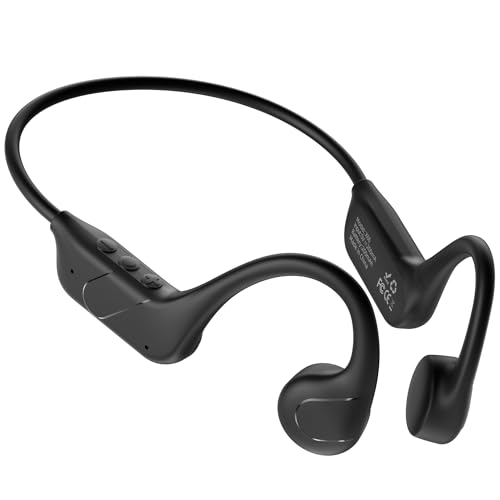
Bone Conduction Headphones (open-ear) — The awareness design
Label it first and label it plainly, as this guide does at every appearance: this is an open-ear bone-conduction headset. Nothing seals the ear, nothing enters the canal; the drivers rest against the cheekbones and conduct sound through the bone, leaving the ear itself completely open to the world. The consequence must be stated as a design truth rather than discovered as a disappointment — there is no isolation here, none, and there never can be from this architecture. Traffic stays audible. Trail partners stay audible. The gym’s music competes with yours. For the athlete whose safety or sociability depends on exactly that awareness, those are not limitations; they are the entire reason the product exists.
The title’s claims fit the philosophy coherently: Bluetooth 6.0, a microphone for calls, balanced audio positioning, reduced sound leakage — the maker’s acknowledgment that open designs owe the people nearby some courtesy — an IP54 waterproof rating, and a secure-fit claim for running, workout and cycling. IP54 is the modest rating of the group, splash-level protection as titled, and it suits the design’s natural habitats: roads, trails and tracks, where the water involved is rain and sweat rather than immersion. Cyclists in particular will recognise the proposition, since the neighbouring guide to the best headsets for racing bicycle grades this same awareness-first architecture on its own terms.
Music through bone conduction is a different pleasure — present and clear at moderate volume, with a physical tactility some runners love — and it should not be bought expecting the sealed bass of the earbud family, because an open system cannot pressurise the ear. Buy it as what it is: the safest ears-open way to carry music and calls through traffic and trail, from a design honest enough to print balanced audio rather than deep bass in its own title.
Parents of young children form an audience for this design that its title never mentions, and their use case is the purest form of the awareness argument: a run with a child in a jogging stroller, or a workout in a house where a sleeping baby must be heard, demands ears that stay open as a condition of the session happening at all. The bone-conduction headset is frequently the only music delivery system such athletes can use with a clear conscience, and the reduced-leakage claim in its title shows the maker understands the domestic version of the courtesy problem. Awareness, in this household, is not a compromise — it is the admission ticket.
- Architecture: bone conduction, open-ear — no canal seal, no isolation by design
- Bluetooth: 6.0, as titled
- Water resistance: IP54 waterproof, as titled
- Sound positioning: balanced audio, reduced sound leakage, as titled
- Microphone: included, as titled
- Titled use: running, workout and cycling, with a secure-fit claim
Strengths
- Total situational awareness: traffic, partners and announcements stay audible.
- Nothing in the canal means no ear fatigue or hygiene battles on long runs.
- A secure-fit claim aimed at running and cycling, its natural sports.
Trade-offs
- Zero isolation: gym noise and traffic compete with the music by design.
- IP54 is the group’s most modest stated water protection.
- Open conduction cannot deliver sealed-earbud bass weight.
Best for: road runners and cyclists whose safety depends on hearing the world their route passes through. Not suited for: a loud commercial gym session, because an open-ear design admits the room’s soundtrack in full, permanently.

HAOYUYAN Sports Bluetooth Headphones — The battery maximalist
The HAOYUYAN closes the earbud family with the largest playtime claim among the sealed designs: 80 hours, with an LED power display to keep the figure accountable, an IPX7 waterproof rating, and a noise-cancelling headset positioning in an unbranded black design for workout and running. The display matters more than its size suggests. Marathon battery claims live or die by the owner’s ability to trust them, and a visible percentage turns a headline into a plan — the athlete can see, on Sunday night, whether the week ahead is covered.
IPX7 as titled matches the Boean’s stated protection and sits a rung below the two flagship ratings, which frames the HAOYUYAN’s bargain precisely: it trades the top waterproof tier for the top battery tier, at the value end of the shelf. The noise-cancelling phrase is the listing’s framing, as throughout this guide, and in an unbranded earbud it should be read as positioning rather than as a measured capability. What is measurable from the title is the shape of the offer — endurance first, display included, protection respectable — and for the athlete whose training weeks are long and whose charging opportunities are few, that shape may fit better than the Soundcore’s sealing or the Ordtop’s hooks.
The cautions are the unbranded family’s usual ones, stated once more without apology: support, documentation depth and long-term durability rest on the listing rather than on an institution, and fit hardware goes unnamed in the title, so retention rests on the earbud form and the returns window. Within those bounds, the HAOYUYAN is the maximalist’s answer — the biggest number in the sealed-bud group, wearing it honestly on a display.
Shift workers are the HAOYUYAN’s natural constituency, though its title speaks only of workouts. A nurse, a warehouse picker, a security guard training at hours when the world sleeps — their charging opportunities arrive irregularly and their training happens in fragments across the week. A battery counted in weeks, with its state displayed rather than guessed, fits a life whose schedule refuses to be a schedule. The marathon claim stops being a headline for such owners and becomes infrastructure: the one device that is always ready at 4 a.m., asking nothing.
- Playtime claim: 80 hours, the listing’s own figure
- Display: LED power display, as titled
- Water resistance: IPX7 waterproof, as titled
- Positioning: noise canceling headset, the listing’s framing
- Titled use: workout and running
- Fit hardware: Not stated in the listing title — verify with the maker’s documentation
Strengths
- The largest playtime claim among the sealed earbuds, with a display to verify it.
- IPX7 stated protection covers the weather most training actually meets.
- Value-tier positioning makes the marathon claim unusually accessible.
Trade-offs
- Unbranded support and documentation are thinner than the famous lines’.
- No fit hardware is named, leaving retention to ear shape alone.
- The noise-cancelling phrase is positioning, not a measured figure.
Best for: long-week trainers who charge rarely and like their remaining battery visible at a glance. Not suited for: an athlete whose ears reject plain earbud forms, because no hook or wing is titled to rescue a poor fit.
How Do the Six Compare Side by Side?
| Pick | Fit as titled | Water rating as titled | Playtime claim |
|---|---|---|---|
| JLab Go Sport+ | True wireless buds | Not stated in the title | Not stated in the title |
| Soundcore Sport X20 by Anker | Rotatable, extendable ear hooks | IP68 | 48 hours |
| Ordtop Sport Earbuds (earhooks) | Earhooks | IPX8 | 70 hours |
| Boean Bluetooth Headphones | Not stated in the title | IPX7 | 16 hours |
| Bone Conduction Headphones (open-ear) | Open-ear conduction, secure fit claimed | IP54 | Not stated in the title |
| HAOYUYAN Sports Bluetooth Headphones | Not stated in the title | IPX7 | 80 hours |
Two columns do the deciding. The rating column separates the all-weather athletes from the gym-bound, and the fit column separates ears that hold buds from ears that demand hooks. The open-ear row plays a different sport entirely — readers weighing that architecture against sealed buds can explore its wider family in the guide to the best affordable bone conduction headsets.
What Do IP Ratings Mean at the Side of a Rainy Road?
Less than the marketing hopes and more than nothing. The IP code in these titles is a laboratory classification quoted by each listing: the X in IPX7 or IPX8 marks dust as untested in that designation, while the final digit grades water exposure under controlled conditions; IP68, the Soundcore’s rating, grades both dust and water. What the code does not do is promise performance in your specific storm, pool or shower, because real water arrives with movement, soap, heat and time attached. This guide’s rule — ratings exactly as titled, never converted into immersion promises — is the honest middle path between ignoring the numbers and worshipping them. For training purposes the practical reading is simple: the higher stated ratings describe gear built to shrug off sweat and rain with margin to spare, IP54 describes splash-level protection suited to the open-ear design’s road life, and an unstated rating describes a question to carry to the maker’s documentation, not a defect to assume.
Sweat deserves its own sentence, because it is the water exercise gear actually dies of — salty, corrosive and applied daily. A rinse-and-dry habit after wet sessions, whatever the rating, is the cheapest longevity measure in this entire guide, and the athletes who keep earbuds for years are recognisable by that thirty-second ritual at the kit bag.
How Should You Test Fit Before the Returns Window Closes?
With the workout itself, not with a walk around the kitchen. Put the buds or the headset through the most violent session in your week — the interval run, the plyometric circuit, the heavy lifting day with its bracing and straining — because retention failures hide from gentle use and announce themselves exactly when a session peaks. Shake tests on a sofa are theatre; a bud that survives burpees has earned its place. Test the second hour as well as the second minute: pressure points and hook fatigue are time-based failures, and the long run is where they file their reports.
Test the controls with wet hands and the case with tired ones, since that is the state both will actually be used in. And if the fit fails, believe it quickly. Ears are anatomy, not attitude — a hook that suits your training partner may saw at yours, and the returns window exists precisely so that anatomy can vote without penalty. The athlete who uses it ends up with the right gear; the athlete who endures a bad fit ends up training in silence by March. Keep a note of the verdict either way — which model, which size of tip or hook setting, what failed or held — because exercise gear is replaced on a cycle, and the athlete with a fit logbook buys the successor in minutes while everyone else repeats the whole audition from memory.
How Does Music Survive a Workout, Physically and Psychologically?
Physically, workout music fights three enemies: the body’s own noise, the room’s noise and the wind. Sealed buds answer with isolation, and the noise-cancelling claims on the Soundcore and HAOYUYAN titles answer further with electronics — the listings’ framing, as ever, for help whose size only a real session can measure. Hooks and seals answer the body’s noise by staying put, because a bud that shifts with every stride turns the bass line into a tide going in and out. The open-ear design declines the whole fight and changes the venue: music becomes a layer over the world rather than a replacement for it, quieter in effect and, for many runners, more sustainable across a long run precisely because it asks less of the ears.
Psychologically, the playlist is pacing equipment. Athletes build sessions around tempo, and a headset that drops a bud at the interval’s peak or dies at kilometre thirty is not an inconvenience but a sabotaged workout. That is the practical core beneath this guide’s obsession with retention hardware and honest battery claims: the music is load-bearing. Choose the pick whose failure modes your sport can tolerate — a bud that might shift during yoga is a shrug, during a downhill mile it is a hazard — and the psychology takes care of itself. That tolerance test generalises beyond fit: a battery that fades during a podcast walk is a shrug, during a century ride it is a silence with fifty kilometres left in it, and a rating that shrugs off a drizzle is a different product from one asked to survive a coastal storm. Grade every claim against your worst session, not your average one, and the shortlist sorts itself with unusual honesty. Worst-session grading is also the fairest way to read the open-ear pick, whose worst session — a deafening gym at peak hour — is genuinely bad, and whose best session — a dawn road, empty but for birdsong and one distant car it lets you hear — no sealed rival can offer at any price. Symmetry demands the same honesty toward the sealed flagship: its worst session is a group ride where its isolation becomes a liability, and its best — a storm-soaked solo tempo run — is a small private concert in the rain. Every pick on this page owns one session it was born for; the buyer’s task is simply to know which session is theirs. Coaches have a version of the same wisdom — train the session in front of you — and it transfers to equipment intact: buy for the session in front of you, the one already in your calendar, rather than for an imagined athlete with an imagined route. The imagined athlete can buy their own headset when they arrive; your calendar, your weather and your ears are the only brief that matters at this checkout, and every title above was graded against exactly that brief. Hold that brief in one hand and the listing in the other, and the six-way choice that opened this guide resolves into the one or two names it was always going to be. Between those finalists, let the hardest session cast the deciding vote, and let the returns window ratify it under real sweat, real weather and real miles. A headset chosen that way stops being a purchase and becomes part of the training itself — measured, tested and kept for the same reasons the training is. That is the standard every pick on this page was held to, from the flagship’s hooks to the minimalist’s modest sixteen hours, and it is the standard your own sessions will apply whether you plan for it or not. Plan for it, and the first session becomes a confirmation instead of an audition. Confirmation, repeated across a season, is what athletes in every other discipline call being ready — equipment included, excuses excluded. Choose once, choose against your real calendar, and then go training; the road and the gym will grade the rest. Their grading is the only one that was ever going to count. Everything on this page is preparation for it. Preparation, done honestly and in advance, is most of what separates a good season from a frustrating one.
What Does a Season of Ownership Do to Exercise Gear?
Salt, ultraviolet and repetition, in that order. Sweat dries into the seams and charging contacts, which is why the rinse-and-dry ritual from the ratings section matters more than any single IP figure: a weekly wipe of the contacts prevents the slow charging failures that owners misdiagnose as battery death. Cases live hard lives in gym bags, crushed under bottles and shoes, and a case that still latches in month nine is a quiet quality signal no title can print. Earbud tips compress and tear; hooks flex and eventually hold less faithfully — the Soundcore’s adjustability buys back some of that ageing, which is part of its flagship case.
Batteries age on their own calendar, and the marathon claims in this guide should be read as first-year figures: a 70-hour claim that becomes 55 in year two still serves the same training week, which is an argument for buying capacity with headroom rather than capacity that exactly meets today’s load. The athlete who plans for the second season at the checkout — headroom in the battery, adjustability in the fit, a rating with margin over the weather they actually meet — is the athlete still training with the same gear when the next version of this guide is written.
Which Sports Bend the Shortlist Hardest?
Running bends it toward retention and awareness: stride impact is relentless, and the road’s dangers arrive from behind, which is why the hook models and the open-ear design dominate the runner’s reading of this page. Lifting bends it toward seal and bass, in a room whose soundtrack the lifter did not choose — the sealed, noise-cancelling-positioned buds earn their keep there, and hooks matter less in a sport whose violence is vertical and brief. Cycling bends it hardest of all toward the open ear, because wind noise punishes sealed buds at speed while traffic awareness becomes non-negotiable; the bone-conduction pick was practically designed by that sentence. Swimming bends the list to breaking point and beyond it — no title here claims the sport, Bluetooth itself falters in water, and the honest advice is that this keyword’s shelf ends at the pool’s edge, whatever the ratings tempt a reader to hope.
Team and class-based training adds a social wrinkle the titles cannot grade: a wearer who must hear a coach, a partner or a class instructor is an open-ear wearer for those hours regardless of their solo preference, and several athletes in this guide’s audience will end up owning two architectures — sealed for solo work, open for the social hours. That is not indecision; it is the category’s honest shape, and the modest tiers of several picks here make the two-device answer more attainable than flagship pricing ever allowed. The same logic extends to seasons: a sealed pair for the winter’s indoor block and an open pair for the summer’s roads is a rotation many road athletes arrive at by their second year, and the guide’s per-pick verdicts are written to remain useful when read that way — as a wardrobe decision rather than a duel to the death between six boxes.
Should I rinse earbuds after every session?
After wet or heavy sessions, yes — a brief rinse where the maker’s documentation permits it, and a thorough dry always. Sweat is saline, saline corrodes contacts, and corroded contacts present as mysterious charging failures months later. The thirty seconds at the kit bag is the highest-value maintenance in this entire category, ahead of any case, cable or accessory purchase.
What Are the Common Mistakes When Buying Exercise Headphones?
The first is expecting isolation from the bone-conduction design — buying open-ear and then complaining that the world is audible, when audibility is the product. The second is reading an IP rating as a swimming licence; no title in this guide makes that promise, and immersion questions belong to the makers’ documentation. Third comes buying the biggest playtime claim for a training life that charges nightly, paying in bulk and price for weeks of capacity that serve three-day weeks. Fourth is ignoring fit hardware: ears that have ejected every bud they have met will not be converted by a specification sheet, and the hook models exist for those ears. The fifth is forgetting the call shift entirely — several of these titles claim microphone features for the commute and the cooldown call, and leaving them untested until the important call repeats the oldest mistake in this whole category of guides.
Final Recommendation
Match the architecture to the sport before matching the numbers to the budget. Road runners and cyclists should start with the open-ear bone-conduction pick, whose awareness is a safety feature no sealed bud can imitate. Athletes whose training is loud, wet and violent should start with the Soundcore X20’s hooks and IP68, or the Ordtop where the longest weeks demand its 70-hour claim and IPX8. Gym-bound trainers with nightly charging can choose the JLab’s simplicity or the Boean’s minimalism with a clear conscience, and the HAOYUYAN waits for the long-week athlete who counts battery in weeks and likes the count displayed. One more discipline before the order: write down your week’s actual shape — the sessions, their lengths, their weather, their company — and read the chosen title against it word by word. A mismatch caught on paper costs a moment; the same mismatch caught at kilometre twenty costs the session, and sessions are the currency this entire category is denominated in. The titles in this guide were written to survive that reading, which is why the guide keeps insisting on it. Whichever name you land on, put it through your hardest session inside the returns window, rinse it, dry it, and let your own training — not a table — cast the final vote.
Frequently Asked Questions
Can I swim with the IPX8 or IP68 picks?
This guide does not promise it, because no title here does. The ratings are quoted exactly as titled — IPX8 for the Ordtop, IP68 for the Soundcore — and they describe laboratory water resistance, not a swimming endorsement. Immersion, depth and duration questions belong to each maker’s documentation, which is the only authority that can answer for a specific pool session.
Why does the bone-conduction pick get recommended if it cannot block noise?
Because blocking noise is not its job. It is open-ear by design, labelled as such throughout this guide, and its value is total awareness — traffic, partners, announcements — for road and trail athletes whose safety runs on hearing. In a loud gym it will lose to every sealed rival here, and its section says so plainly.
Are the playtime figures — 48, 70, 80 hours — for the buds alone?
The titles do not itemise, and this guide does not invent the split. Such claims in this category typically describe the buds’ charge combined with the case’s reserves across a training week. What can be compared honestly is the relative order: the HAOYUYAN and Ordtop claim marathon legs, the Soundcore a solid week, the Boean a light week, and two titles make no claim at all.
Which pick suits a runner who also takes calls on the move?
The Ordtop names four ENC microphones for exactly that second shift, the JLab leads with clear calling, and the bone-conduction model includes a microphone while keeping the road audible — arguably the safest arrangement for a call taken mid-route. All such claims are their listings’ framing; a test call during the first week, inside the returns window, settles the question for your voice and your streets.
What if earbuds simply will not stay in my ears?
Buy the hooks. The Soundcore’s rotatable, extendable hooks and the Ordtop’s earhooks exist for your anatomy, and the bone-conduction headset sidesteps the canal altogether. A sealed bud with no fit hardware, however impressive its figures, is a donation to the pavement for ears shaped like yours.
Related Guides
Outdoor workers and gardeners whose exercise is a working day can browse the best bluetooth headsets for mowing, and value hunters will find the wider shelf surveyed in the guide to the best affordable bluetooth headsets.


