Our Top Picks



What's inside
- Why a discontinued handheld makes charger shopping unusually difficult
- The original PSP-100 specification is the reference for everything else
- One adapter family serves the PSP-1000, PSP-2000, and PSP-3000
- The PSP Go is the exception, and its connector proves it
- Charging through USB works, within narrow and often misunderstood limits
- Car chargers earn their place on long drives, with one fuse-shaped caveat
- The battery is half the charging story, and it ages on its own schedule
- Where third-party adapters fail, and how the failures announce themselves
- A calm buying workflow, from socket check to first charge
- Troubleshooting the complaints that send owners shopping in the first place
- Choosing by model: the short version for each owner
- Check prices on Amazon
- Travelling with a PSP kit without inviting power problems
As an Amazon Associate I earn from qualifying purchases. This post may contain affiliate links at no extra cost to you.
Why a discontinued handheld makes charger shopping unusually difficult
Most modern gadgets forgive a careless charger purchase. Plug in almost any recent phone brick and the device negotiates a safe voltage, throttles itself if the supply runs short, and reports the problem on screen if something is badly wrong. The PlayStation Portable offers none of that protection by negotiation. It belongs to an earlier generation of portable electronics, one in which the wall adapter was a fixed-voltage power supply and the console simply trusted whatever arrived at its socket. That single design fact explains nearly every difficulty buyers face today, and it is the reason this guide spends so much time on labels, polarity, and current ratings rather than on brand names.
Sony stopped manufacturing the PSP family years ago, and the original AC adapters stopped flowing through ordinary retail channels with it. What remains is a patchwork: new old stock that surfaces in small quantities, used original adapters of unknown history, and a large population of third-party replacements built to widely varying standards. Two adapters can look identical in a product photograph, carry the same printed rating, and behave completely differently once connected, because one regulates its output tightly under load while the other drifts, ripples, or sags. With a current-production phone, the phone itself would reject or compensate for much of that misbehaviour. With a PSP, the console absorbs it.
Scarcity also distorts how listings are written. Sellers know that owners search by model number, by adapter code, and by half-remembered specifications, so titles accumulate keywords that blur important distinctions. An adapter described as suitable for the whole PSP family may in fact fit only the barrel-socket models and be useless for a PSP Go. A cable described as a charger may be a data cable that charges only under narrow conditions through USB. A power supply with the right voltage on its label may have the wrong polarity at its plug, a detail that matters enormously and appears nowhere in a headline. Reading past the title, into the specification block and the physical connector, is the core skill this guide tries to teach.
There is also the age of the consoles themselves to consider. A PSP-1000 bought at launch is now roughly two decades old. Its battery has endured hundreds of charge cycles and long periods in drawers, its charge socket has accepted thousands of insertions, and its internal power circuitry has aged alongside everything else. A replacement charger does not meet a new machine; it meets an old one whose tolerances have narrowed. That is why the safest buying strategy is conservative: match the original specification closely, favour adapters with documented protection features, and treat any bargain that cannot state its output plainly as a risk rather than a saving.
The original PSP-100 specification is the reference for everything else
Every buying decision in this guide traces back to one artifact: the original adapter supplied with the early PSP models, commonly identified as the PSP-100. According to manufacturer specification sheets, that adapter takes mains input and delivers a regulated direct-current output of 5 volts at up to 2 amps, for a total available power of 10 watts, through a barrel-style plug that seats in the round charging socket at the base of the console. Those three numbers, voltage, current capacity, and connector form, define compatibility. A replacement that matches all three starts from a position of safety. A replacement that departs from any one of them needs a specific, understood reason.
Voltage is the strictest of the three. The PSP expects 5 volts, not approximately 5 volts, and a supply that delivers substantially more can damage the console’s power circuitry in ways that no later correction can undo. This is where the PSP differs sharply from USB Power Delivery devices, which begin at 5 volts and step up only after a digital handshake. The barrel socket has no handshake. Whatever voltage the adapter produces is what the console receives, immediately and continuously. A universal adapter with a voltage selector dial is therefore a hazard in careless hands: set one notch too high and a working handheld becomes a repair project. Fixed-output 5-volt adapters remove that entire category of accident, which is why they are the sensible default for most owners.
Current works differently, and the distinction confuses many buyers. The 2-amp figure is a capacity, not a forced delivery. The console draws what it needs, up to that ceiling, and a replacement rated slightly above 2 amps at exactly 5 volts will not push extra current into the machine. Where trouble begins is the opposite direction. An under-rated supply, perhaps a 5-volt 500-milliamp adapter borrowed from some other gadget, will be asked for more than it can give. Its voltage will sag under the load, its casing will grow hot, and the PSP may charge erratically, refuse to run from the adapter, or cycle its charging light. Matching or modestly exceeding the original current capacity, at the correct voltage, is the safe side of the line.
How to read an adapter label without guessing
The label on a mains adapter compresses a great deal of information into a small space, and learning to parse it takes only a minute. Look first for the word OUTPUT, followed by a voltage and current pair such as 5V and 2A, sometimes written with the direct-current symbol of a solid line over a dashed line. Input figures, which describe the mains side and often span 100 to 240 volts, tell you where in the world the adapter can be plugged in; they say nothing about what the console receives. Model numbers, manufacturing dates, and importer names fill the remaining space. The output line is the one that decides compatibility, and any adapter whose label omits it, prints it illegibly, or buries it under marketing stickers should be passed over.
Certification marks appear on the same label and deserve a glance rather than blind trust. Recognised marks indicate that a sample of the design was evaluated by a testing laboratory against a safety standard covering insulation, temperature, and fault behaviour. Marks should be crisp, correctly drawn, and accompanied by identifying numbers or a certifier name that can be checked. A label crowded with distorted logos, misspelled standard names, or marks that dissolve into blurry printing at close inspection is telling you something about the care taken everywhere else in the product. Genuine certification does not guarantee excellent regulation, but its absence, or its clumsy imitation, is a reliable warning sign.
Checking barrel polarity before the first connection
Polarity is the specification buyers most often overlook, because two barrel plugs can be physically identical while wired in opposite senses. On the PSP’s charging arrangement, the centre contact of the barrel carries the positive side of the supply and the outer sleeve carries the negative. Adapter labels conventionally show this as a small diagram: a dot representing the centre pin, a C-shaped arc representing the sleeve, with plus and minus signs attached. Before connecting any unfamiliar adapter, find that diagram and confirm it shows centre-positive wiring. If the diagram shows centre-negative, or if there is no diagram at all, do not experiment by plugging in and watching what happens. A reversed supply can destroy components faster than a user can react.
Owners with access to a basic multimeter can verify polarity directly, and for a valuable or sentimental console the check is worth the small effort. With the adapter powered and its plug disconnected from the console, touching the meter probes to the centre contact and outer sleeve should read close to positive 5 volts in the correct orientation; a negative reading reveals reversed wiring. The same measurement exposes adapters whose unloaded output sits far from 5 volts. None of this requires electronics expertise, only patience, and it converts a gamble into a measurement. Readers who keep several legacy consoles often adopt this as a standing habit for every newly arrived power supply, whatever its label claims.
Physical fit matters alongside electrical fit. The barrel must seat fully and stay seated without rocking, because a loose connection interrupts charging, generates small arcs at the contact surfaces, and wears the console’s socket. A plug that requires force is equally suspect; dimensions vary slightly among generic barrels, and forcing an oversized plug can crack the socket surround on an ageing plastic shell. The correct plug slides in with mild, even resistance and supports the cable’s weight without drooping out of alignment. If a replacement feels wrong in the hand, that tactile evidence deserves respect even when the printed specifications look right.
One adapter family serves the PSP-1000, PSP-2000, and PSP-3000
Newcomers to the platform often assume that each PSP revision needs its own charger, because the three main models look and feel so different. The original PSP-1000 is thick and heavy, with a reassuring density that later models abandoned. The PSP-2000, marketed in many regions as the Slim and Lite, cut the weight and thickness dramatically, redesigned the battery compartment, and refined several internal components. The PSP-3000 kept the slim shell, improved the screen’s colour response and contrast, and added a built-in microphone. Against that list of changes, it is natural to expect three charging standards. The reality is simpler and more convenient: all three models charge through the same barrel socket, at the same 5-volt 2-amp specification, using the same adapter family descended from the PSP-100.
The differences between the generations live elsewhere, principally in the battery bay. Because the slim models have a shallower compartment, they use a thinner, lower-capacity pack, while the original model accommodates a thicker, higher-capacity one. The charging socket, the expected input voltage, and the console’s internal charge management remained consistent across the line, which is precisely why a single well-chosen replacement adapter can serve a household with two or three different PSP revisions. Owners restoring a mixed collection do not need a drawer of near-identical bricks, one per model. They need one or two correct adapters, clearly labelled, plus an understanding of which battery belongs in which machine.
That shared standard also simplifies second-hand buying. When a used console is sold with an adapter included, the relevant question is not which model the adapter was originally boxed with, but whether its output line still reads 5 volts and 2 amps, whether its polarity diagram shows centre-positive, and whether its plug and cable remain sound. An original adapter from a PSP-1000 bundle is a perfectly good charger for a PSP-3000, provided time has not damaged it. Conversely, a shiny new adapter marketed for the PSP-3000 alone offers no advantage over any other correct 5-volt supply. Marketing segmentation is not electrical difference, and buyers who grasp that distinction stop paying premiums for labels.
A word of caution belongs here about regional variants and imported consoles. The PSP was sold worldwide, and adapters in original bundles carried the mains plug and input rating appropriate to their market. The console side, the 5-volt barrel connection, stayed the same, but the wall side did not. An imported adapter with a foreign plug forced into a travel converter adds a failure point and sometimes a loose, wobbling connection at the wall. For daily use, a locally pinned replacement adapter built to the same output specification is safer and tidier than a chain of plug converters, even if the imported original still works. Keep the original as a spare or as part of a complete boxed set; charge day to day from the adapter that fits local sockets properly.
The PSP Go is the exception, and its connector proves it
Every generalisation about PSP charging collapses at the PSP Go. Released as a smaller, download-only reimagining of the platform, the Go discarded the barrel socket entirely. In its place sits a flat, proprietary multifunction connector, identified as the PSP-N100 type, which combines charging, data transfer, and accessory connections in a single port. The Go’s adapter therefore terminates in that flat connector rather than a round barrel, and no barrel adapter, however perfect its voltage, can physically connect to the machine. Attempts to force compatibility through improvised adapters stack risk on risk and should be avoided.
This split creates the most common purchasing mistake in the whole category. A buyer searches for a PSP charger, sees a listing whose photograph shows a barrel plug, and orders it for a Go, or the reverse. The mistake is understandable because sellers photograph cables poorly and title listings broadly, but it is entirely preventable with a ten-second check: look at the socket on the console itself. Round socket, barrel adapter. Flat wide socket, PSP-N100 connector. If a listing does not state clearly which connector it provides, or shows a cable end that matches neither, move on. Clarity about the connector is the minimum competence a seller in this category should demonstrate.
Go owners face a thinner market than owners of the main line. Fewer Gos were sold, fewer spare adapters were made, and the proprietary connector gives third-party manufacturers a smaller, more specialised target. That scarcity makes careful label reading even more important, not less. The electrical expectation remains a regulated 5-volt supply, delivered through the correct proprietary plug, and the same warnings about regulation quality, heat, and counterfeit labelling apply with full force. Go owners should also take particular care with the port itself: replacement cables are harder to source than barrel cables, so inserting and removing the connector straight, without levering it sideways, preserves a part that is genuinely difficult to replace.
The Go also illustrates a broader lesson about proprietary charging. When a connector belongs to one product line only, the accessory market lives and dies with that line. Barrel connectors, by contrast, are a long-established generic form, which is one reason main-line PSP owners still enjoy a wide choice of supplies. Neither approach was unreasonable when the consoles were current, but two decades later the generic connector has aged more gracefully. Buyers choosing between a used Go and a used slim model, with all else equal, may reasonably count charging convenience among the slim model’s quiet advantages.
Charging through USB works, within narrow and often misunderstood limits
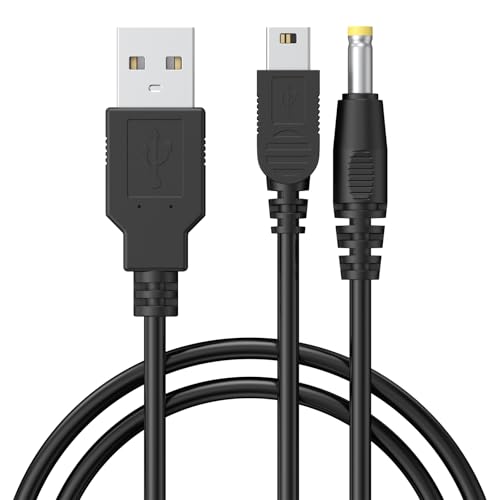
Alongside the barrel socket, the slim PSP models offer a second, slower route to a charged battery: charging over a USB connection. The feature appeals because USB cables are everywhere and because it promises top-ups from a laptop, a desktop, or a powered hub when the wall adapter is elsewhere. It does work, but only under conditions that surprise owners who expect phone-like behaviour. Understanding those conditions turns USB charging from a source of confusion into a useful, if limited, tool.
The first condition lives in the console’s settings. On models that support the feature, USB charging must be switched on in the system settings menu before the console will draw charge through its USB port; with the setting off, a connected cable transfers data but returns no meaningful charge. The second condition concerns the console’s state. USB charging is intended for a machine that is switched on and connected in USB mode, or in the states the firmware specifies, rather than a completely dormant device in every circumstance. Owners who connect a cable to a fully discharged, switched-off unit and return to find it still flat have usually met one of these two conditions, not a faulty cable.
Current is the deeper limitation. A standard USB data port of the PSP’s era supplies far less current than the 2 amps available from the wall adapter; the baseline USB specification for a conventional port sits at 500 milliamps, a quarter of the wall supply’s capacity, and the console’s USB charging draws within that modest envelope. Arithmetic does the rest. Charging that takes a couple of hours from the wall stretches far longer over USB, and the gap widens if the console is doing anything energy-hungry at the same time. Anyone comparing charging routes should keep that four-to-one difference in mind, because it explains nearly every disappointing USB charging story. Readers who also charge modern devices from shared bricks will recognise the same principle at work in guides to best 2 port usb chargers, where splitting a limited supply between devices slows everything attached to it.
Playing while charging over USB exposes the limit most starkly. A demanding game, with the screen bright, the disc drive active on models that have one, and wireless features enabled, can consume energy at a rate close to or beyond what the USB connection supplies. The battery indicator then holds steady at best, or creeps downward despite the cable, which owners often misread as a broken port. The wall adapter, with its 2-amp headroom, covers gameplay and charging simultaneously; the USB route generally cannot. The sensible division of labour is to treat USB charging as a maintenance tool, useful for slow top-ups at a desk while the console idles or transfers files, and to treat the barrel adapter as the real charger for empty batteries and long sessions.
Cable quality quietly influences USB results as well. A long, thin data cable adds electrical resistance, drops a little voltage along its length, and leaves the console with less than the port intended to give. Short, sound cables perform measurably better in this marginal application than the longest cable in the drawer. Powered hubs vary too: some ports deliver only the baseline current, others offer dedicated charging current beyond it, and the console’s behaviour will follow whatever the port actually provides. None of these variables changes the headline conclusion. USB charging on a PSP is a convenience with a low ceiling, and planning around that ceiling, rather than hoping a particular cable will defeat it, leads to far less frustration.
Car chargers earn their place on long drives, with one fuse-shaped caveat
A 12-volt car adapter extends PSP play to road trips, and for families mid-journey that is no small thing. The principle is straightforward: the adapter takes the vehicle’s nominal 12-volt supply, converts it down to the regulated 5 volts the console expects, and delivers it through the familiar barrel plug. A good car adapter therefore faces two jobs at once. It must perform the same clean voltage conversion as a wall adapter, and it must cope with an electrical environment far less stable than a house. Vehicle voltage is nominal rather than exact. It dips during engine starting, rises with alternator behaviour, and carries transients from other loads switching around the cabin.
The fuse is the detail that separates a considered car adapter from a careless one. A fused adapter carries a small replaceable fuse, usually housed in the plug body that enters the accessory socket, rated to break the circuit if current rises beyond a safe level. That fuse protects both the console and the vehicle wiring from a fault inside the adapter itself. When shopping, treat the presence of a stated fuse rating as a basic competence signal, and learn how the fuse is accessed before the adapter is needed on a motorway at night. A fuse that cannot be replaced without tools or disassembly is better than none, but a simple twist-open plug housing is the practical ideal.
Voltage sag deserves equal attention. A weak vehicle battery, a corroded accessory socket, or a chain of socket splitters feeding several devices can drag the supply down, and a poorly designed adapter passes that instability straight through to its output. Symptoms include the console resetting when the engine starts, charging that pauses over bumps as the plug shifts, and adapters that run hot in a sun-baked cabin. Mitigations are mundane but effective: plug the adapter directly into the socket rather than through a splitter, avoid charging during the actual moment of engine cranking, and remove the adapter when parked for long periods, since many accessory sockets remain live and a connected adapter draws a small standby current. None of this makes car charging risky in itself; it makes it a context where build quality shows.
Heat is the final car-specific concern. A cabin parked in summer sun reaches temperatures that stress both adapter electronics and the console’s lithium battery, and charging a hot battery ages it faster than charging a cool one. Sensible practice is to charge while driving with ventilation running, keep the console out of direct sun on the dashboard, and let an overheated cabin cool before expecting efficient charging. Used with that modest care, a fused car adapter is a genuinely useful accessory, and for owners whose PSP earns its keep entertaining passengers, it may be the second adapter worth buying after a dependable wall unit. Households standardising their in-car kit for several gadgets may also find the load-sharing discussion in best 4 port chargers relevant, though the PSP itself should always feed from its own correct 5-volt barrel supply rather than a shared USB port.
The battery is half the charging story, and it ages on its own schedule
Owners frequently blame a charger for behaviour that belongs to the battery. Two official packs dominate the main PSP line. The PSP-110, rated at 1800 milliamp-hours, is the thick pack supplied with the PSP-1000. The PSP-S110, rated at 1200 milliamp-hours, is the slimmer pack fitted to the PSP-2000 and PSP-3000, sized for their shallower battery bays. Capacity figures describe how much charge a healthy pack holds when new; they are not promises about a pack that has spent fifteen years cycling and sitting. A slim console that shuts down after an hour may have a perfectly good charger and a thoroughly tired PSP-S110, and replacing the adapter will do nothing for it.
Physical cross-fitting tempts many owners, so the boundaries deserve stating plainly. The thick PSP-110 does not belong in a slim console’s bay, even if a modified cover appears to close over it, because pressure on the pack and the compartment is a poor bargain. The slim PSP-S110 can fit the original model with the appropriate cover arrangement in some configurations, but its lower capacity shortens runtime in a machine built around the larger pack. The clean rule is to match pack to model: 1800 milliamp-hours for the 1000, 1200 milliamp-hours for the 2000 and 3000. When a replacement pack is described with a capacity wildly beyond the original figures for the same physical size, treat the claim sceptically. Energy density improves slowly, and a thin pack promising double the original capacity is usually promising arithmetic rather than chemistry.
Swollen packs and the safety routine for old lithium cells
Ageing lithium-ion packs sometimes announce their decline physically, by swelling. Gas generated by internal degradation inflates the cell, the flat faces of the pack bow outward, the battery cover stops sitting flush, and in advanced cases the pack becomes difficult to remove or insert. A swollen PSP pack is not a curiosity to be nursed along; it is a retired pack. Stop charging it, do not puncture or compress it, keep it away from heat, and route it to a battery recycling or hazardous-waste collection point rather than household rubbish. Continuing to charge a visibly swollen pack with any adapter, original or replacement, is the single most dangerous habit in retro handheld ownership.
Less dramatic ageing still calls for observation. Warning signs include a pack that grows noticeably warm during ordinary charging, runtime that collapses suddenly rather than declining gradually, a console that reports a full charge implausibly quickly and then empties just as fast, and any cracking, leaking, or chemical smell around the battery bay. Any of these should pause charging until the pack is inspected or replaced. Storage habits influence how quickly these problems arrive. Packs stored fully charged in hot places degrade fastest; packs stored around half charge in cool, dry conditions last longest. Owners reviving a console after years in a drawer should charge it attended, on a hard surface, for the first few cycles, watching for heat or swelling before trusting it with unattended overnight charging.
Replacement packs from third parties vary as widely as replacement adapters, and the same label literacy applies. A credible pack states its model correspondence, its nominal voltage, and its capacity in milliamp-hours, and carries recognisable safety markings. A pack that arrives unlabelled, suspiciously light, or in packaging that avoids stating any specification has not earned a place next to a charger and a console the owner cares about. It is also worth remembering that a new pack and a new adapter should not be introduced simultaneously when troubleshooting. Change one variable, observe the console over a full charge and discharge, then change the other if needed. That discipline identifies the faulty component instead of multiplying unknowns.
Where third-party adapters fail, and how the failures announce themselves
Third-party adapters are not a category to avoid; for a discontinued console, they are often the only realistic option. They are, however, a category to buy with open eyes, because the difference between a competent replacement and a poor one lies in engineering that product photographs cannot show. The central component is the regulation circuit, which converts mains power to a steady 5 volts. A well-designed supply holds its output close to 5 volts as the console’s demand changes, filters out electrical noise, and stays within a comfortable temperature while doing so. A cheap supply cuts corners in exactly those places.
Poor regulation shows up as ripple and drift. Ripple is a small, rapid fluctuation riding on the output voltage, the residue of incomplete conversion, and consoles exposed to it may behave oddly: audio hum through headphones, unstable behaviour during charging, or a charge indicator that flickers. Drift is slower and simpler: output that starts near 5 volts and wanders as the adapter warms. Either fault stresses the console’s own power circuitry, which must absorb what the adapter failed to smooth. Owners cannot see ripple without instruments, but they can observe its cousins: interference patterns, unexplained resets during charge-and-play use, and adapters whose performance visibly degrades as they heat up.
Heat is the most accessible diagnostic of all. Every adapter warms during use; conversion is never perfectly efficient, and a large share of the lost energy leaves as heat. Warm is normal. Too hot to hold comfortably, hot enough to smell of warmed plastic, or hot in one sharp localised spot suggests undersized components working beyond their comfortable range. Such an adapter should be retired, not rationed to short sessions, because thermal stress accumulates in the components most likely to fail. Similarly, an adapter that causes the console to drop power, reboot, or lose its charging state when a game loads a demanding scene is confessing that it cannot sustain its rated output. Believe the confession.
Overcurrent protection is the feature most worth paying for, and manufacturer specification sheets for better replacements state it explicitly. A protected adapter monitors its output and shuts down, or limits current, if a short circuit or fault draws more than the design allows, rather than cooking itself and whatever it is attached to. Short-circuit protection, over-temperature protection, and over-voltage protection belong to the same family of quiet safeguards. They never appear in a feature photograph and they do nothing on a good day. On a bad day, they are the entire difference between a blown fuse or a shut-down adapter and a damaged console. When two adapters match on voltage, current, and connector, and only one documents its protections, that documentation is a rational reason to choose it. The same priority ordering applies to modern charging more broadly, as the discussion of certified high-output bricks in best 100w chargers shows: headline wattage impresses, protection engineering protects.
Recognising a counterfeit before it reaches the console
Counterfeit adapters imitate the appearance of original or reputable units while omitting the substance, and a handful of checks catch most of them. Weight is the oldest tell. Transformers, filtering components, and heatsinking have mass, so an adapter that feels implausibly light for its size is probably missing components its casing implies. Printing is the second tell: blurred label text, misspelled words, logos that are almost but not quite the right shape, and specification blocks that contradict themselves all signal a factory unconcerned with accuracy. Seams and screws tell a third part of the story. Uneven moulding, gaps that flex under thumb pressure, and casings that creak suggest thin plastic and hurried assembly.
Electrical behaviour completes the picture for owners willing to measure. A multimeter reading far from 5 volts at no load, or an output that collapses when the console begins charging, contradicts the label regardless of how convincing the printing looks. A cable that is stiff, kinked from new, or terminated in a barrel plug with rough, off-centre metalwork predicts connection trouble. None of these checks requires opening the adapter, which should never be attempted: mains adapters contain components that can retain a dangerous charge even after unplugging. External inspection and output measurement are as far as owner investigation should go. Anything that fails those checks goes back to the seller or into electronic waste, not into a drawer of maybes beside the console.
Price itself is evidence, though not proof. A replacement adapter involves a transformer or switching supply, regulation and protection circuitry, a cable, a connector, a tested casing, and compliance work; there is a floor below which those things cannot honestly be assembled. A listing priced far beneath every comparable option is not automatically counterfeit, but it has volunteered for extra scrutiny. Apply the label, weight, and printing checks with particular care, and be ready to walk away. With irreplaceable hardware at the other end of the cable, the cheapest adapter is often the most expensive decision available. Owners building a small, dependable charging kit for several legacy and modern devices alike will find the vetting mindset in best 6 port usb fast chargers familiar, even though the PSP itself must always keep its own dedicated barrel supply.
A calm buying workflow, from socket check to first charge
Knowledge only helps if it is applied in the right order, so it is worth setting out the sequence that experienced retro handheld owners follow when a PSP needs a new charger. The sequence begins with the console, not the shop. Identify the exact model from the label in the battery compartment or the system information screen, and look directly at the charging socket. That single observation divides the world in two: barrel models on one side, the PSP Go and its PSP-N100 connector on the other. Every subsequent filter depends on getting this first step right, and it costs nothing but a minute of attention.
Next, inspect the battery before spending anything on power. Remove the pack, lay it on a flat surface, and look along its faces for bowing. Check that the cover sits flush, that the contacts are clean, and that nothing smells sharp or chemical. A swollen or damaged pack changes the shopping list entirely: the pack is replaced first, and charging experiments wait until a sound pack is fitted. If the pack looks healthy, note its model and capacity, PSP-110 at 1800 milliamp-hours or PSP-S110 at 1200 milliamp-hours, because runtime expectations later will be judged against those figures. A charger cannot be evaluated fairly while paired with a battery of unknown condition.
Only then does the adapter itself come under review, and the label does most of the work. Confirm the output line reads 5 volts, confirm the current rating is 2 amps or a little above, confirm the polarity diagram shows centre-positive for a barrel model, and confirm that certification marks are present and legibly printed. Check that the plug in the photographs is genuinely the connector the listing describes, and read the text for the protection features that matter: overcurrent, short-circuit, and over-temperature protection, stated in words rather than implied by adjectives. Listings that answer all of these points plainly are rare enough to be valuable. Listings that dodge them with lifestyle photographs and superlatives have answered a question too, just not the one a buyer wants answered.
The first charge with a new adapter deserves supervision, whatever the adapter’s pedigree. Charge on a hard, clear surface, not on bedding or a sofa cushion where heat lingers. Note the time, feel the adapter casing after twenty minutes, and confirm the console’s charging indicator behaves steadily rather than flickering or cycling. A healthy arrangement is boring: moderate warmth, a steady light, a battery percentage or charge state that progresses predictably. Anything dramatic, including unusual heat, noise, smell, or a console that resets, ends the session. Unplug, let everything cool, and diagnose before trying again. That supervised first hour is cheap insurance, and it establishes the baseline against which every later charge can be compared.
Finally, label the adapter once it has earned trust. A small piece of tape marked with the console’s name prevents the most mundane accident in multi-device households: the wrong 5-volt-looking supply, belonging to some other gadget with a different polarity or current character, being grabbed in a hurry. Keep the PSP adapter with the PSP, store the cable loosely coiled rather than tightly wound around the brick, and keep the whole kit away from radiators and sunny windowsills. Chargers die from heat, crushing, and cable strain far more often than from electronic old age, and storage habits decide how soon a good replacement needs replacing.
Troubleshooting the complaints that send owners shopping in the first place
Many replacement purchases begin with a symptom, and matching symptom to cause prevents buying the wrong cure. Consider the console that charges only when its cable is held at an angle. That behaviour points to mechanical wear, either a loosened socket, a damaged plug, or a cable whose internal conductors have fractured near a strain relief. A new adapter with a fresh plug and cable may cure it completely, but if the console’s own socket is the worn part, the new plug will inherit the same precarious connection. Testing with a known-good adapter, borrowed or already owned for another PSP, separates the two causes before money moves.
The console that shows a charging light but gains no charge over hours presents a different puzzle. Possible causes queue up in an order worth checking: a deeply aged pack that can no longer accept a meaningful charge, a USB connection being mistaken for wall charging with its far lower current, an adapter whose output collapses under load despite a healthy unloaded reading, or a settings state that has paused charging. Swapping one element at a time resolves it. Charge from the wall adapter rather than USB. Try the suspect adapter on a second console if one exists. Fit a known sound pack. Each test eliminates a suspect, and the pattern of results usually names the culprit without any specialised equipment beyond, perhaps, the multimeter mentioned earlier.
Short runtime after a full charge, by contrast, almost never indicts the charger. It is the signature of a battery whose capacity has faded, and the correct comparison is against the pack’s original rating: a PSP-S110 that once delivered several hours and now delivers one has aged, regardless of which adapter filled it. Owners sometimes chase this problem through two or three charger purchases, because chargers are cheaper and easier to buy than confidence in a diagnosis. Resist the chase. If the adapter holds 5 volts, stays reasonably cool, and fills a known-good pack in the expected time, it is doing its whole job, and attention belongs on the pack.
Intermittent power during gameplay on adapter power, without the battery fitted or with it exhausted, points back at current capacity. Demanding scenes draw peaks of power, and a supply that cannot sustain its rating sags at exactly those moments. The fix is an adapter that genuinely delivers the full 2 amps, which returns the discussion to label honesty and protection engineering. It is also a reminder that charge-only impressions mislead: an adapter can appear adequate while topping up an idle console and fail only when asked to run the machine at full tilt. Evaluating a replacement under real gameplay load, briefly and attended, is therefore part of a fair assessment.
Choosing by model: the short version for each owner
For a PSP-1000 owner, the recommendation is the most straightforward in this guide. Buy a fixed-output adapter rated at 5 volts and 2 amps with a centre-positive barrel plug, documented overcurrent protection, and legible certification. Pair it with a sound PSP-110 pack or a credible equivalent at 1800 milliamp-hours, and expect the thick original model to reward that pairing with the longest runtime the platform offers. The 1000’s appetite is the largest of the three main models, so the full current rating matters most here; do not settle for an under-rated supply borrowed from a smaller gadget.
For PSP-2000 and PSP-3000 owners, the same adapter specification applies unchanged, because the slim models share the charging standard completely. The differences sit in expectations and accessories. Runtime should be judged against the PSP-S110’s 1200 milliamp-hours, not against the original model’s larger pack, and USB charging is available as a slow desk-side supplement once enabled in settings, provided nobody expects it to sustain demanding play. Slim-model owners restoring a console should budget attention for the battery cover and pack fit, since the shallow bay tolerates swollen or ill-fitting packs even less gracefully than the original model does.
For a PSP Go owner, everything begins and ends with the PSP-N100 connector. The adapter must terminate in that proprietary plug, deliver a regulated 5 volts, and come from a seller who describes the connector accurately and prints a readable specification. Barrel adapters, however excellent, are simply not part of this conversation. Because Go charging accessories are scarcer, buying one well-documented adapter and handling its connector gently is better economics than cycling through vague listings. Treat the cable as the fragile half of the system and store it without sharp bends near the plug.
For collectors holding several models, consolidation is the reward for the shared standard. One or two verified barrel adapters cover the 1000, 2000, and 3000 between them, clearly labelled and stored with the consoles, plus one correct Go adapter kept apart so it is never confused with the rest. Add a fused car adapter if the consoles travel, keep a short sound USB cable for desk top-ups on the slim models, and the whole collection’s power needs are met without a tangle of anonymous bricks. Consolidation also concentrates quality: money that might have spread across five doubtful adapters buys two good ones, and every console benefits.
Whichever model sits on the desk, the principles do not move. Voltage must match exactly. Current capacity must meet the original 2-amp figure. Polarity must be confirmed, not assumed. The battery must be sound enough to deserve charging, and the first sign of swelling ends its service. Protection features and honest labelling separate the adapters worth owning from the adapters worth returning. None of these rules requires specialist knowledge, and together they convert a confusing, scarcity-driven market into a series of checks any careful owner can perform in minutes.
Some readers will arrive at this guide with a working original adapter and a simple wish for a spare. That is the easiest position of all. Photograph the original label, match its output figures exactly in the replacement, keep the original as the reference standard for polarity and plug fit, and relegate the new adapter to travel duty until it has proven itself over several supervised charges. Spares bought calmly, before the original fails, are always better purchases than emergency replacements ordered at midnight for a console that must work by morning.
Others will arrive with a console bought bare, no charger included, perhaps at a market or through a private sale. For them, the workflow in this guide is the whole path: identify the model, inspect the socket and the pack, buy to the PSP-100 specification, supervise the first charge, and judge the result over a full cycle rather than the first five minutes. A bare console is not a risky console. It is simply a console whose power supply must be chosen deliberately, and deliberate choices, in this small corner of electronics, are reliably rewarded.
Check prices on Amazon
Live listings for the shortlist in this guide are pulled from Amazon below, so prices and availability are always current at the moment you look.


Travelling with a PSP kit without inviting power problems
Travel rearranges every charging assumption. Hotel sockets hide behind furniture, airport outlets are contested, and the adapter that behaves perfectly at home meets foreign mains, loose wall plates, and long evenings in unfamiliar rooms. The PSP’s saving grace is that its requirement never changes: 5 volts at the barrel, wherever in the world the wall side happens to be. A replacement adapter with a wide input range, plainly printed as spanning 100 to 240 volts, covers most destinations with nothing more than a passive plug-shape adapter for the wall side, because the conversion the console cares about happens inside the brick itself. What travellers should avoid is stacking solutions: a voltage converter feeding a plug adapter feeding the charger adds heat, looseness, and failure points to solve a problem a wide-input adapter does not have.
Packing discipline matters as much as electrical discipline. Coil the charger cable loosely and secure it with a soft tie rather than wrapping it tightly around the adapter body, since the conductors near the barrel plug fatigue first and a cable that fails mid-trip is difficult to replace for a discontinued console. Keep the adapter in hand luggage rather than checked baggage, both because the console usually travels there too and because a charger in the cabin can rescue a flat battery during a long layover. If the battery is removable and a spare pack travels along, carry the spare in a small case or with its contacts covered, so loose metal objects in a bag cannot bridge the terminals. These are small habits, borrowed from how photographers and field technicians have carried proprietary power kits for decades, and they suit the PSP precisely because its accessories can no longer be replaced from a high-street shelf.
One last travel habit deserves emphasis: charge before the journey rather than during its most chaotic moments. A console filled calmly at home, from its verified adapter, starts the trip with a known-good battery state, and any top-up on the road becomes a supplement instead of a rescue. That ordering turns travel charging from a gamble on unfamiliar sockets into a minor convenience, which is exactly the status it should hold.
Guides like this one are published with support from affiliate arrangements: when a reader follows retailer links in an article and completes a purchase, the publication may receive a commission that helps cover its research work, without adding to the price the reader pays. That support never alters the specifications recommended here, which follow the console manufacturer’s published requirements and the safety considerations set out above.
Twenty years after the first PSP slid into a coat pocket, the machines endure because owners keep making small, correct decisions on their behalf, and choosing a charger that matches the original 5-volt specification, respects an ageing battery, and plugs into the right socket is the decision that quietly keeps every other evening of play possible.
Related guides
- Best 3rd Party MacBook Chargers: 96W-Class Alternatives, the 100W Cable Rule, and the Apple Benchmark
- Best Chargers for Google Pixel 6 Pro: Six Bricks Judged on Output, Ports and Negotiation Language
- Best Fast Charge Qi Wireless Chargers: Qi2 at 15W and Qi2.2 at 25W
- Best 12 Volt Battery Chargers: Smart Picks From 1 Amp to 15 Amp