What's inside
- Key Takeaways
- Quick Picks: The Best Headsets for Racing Bicycle Groups
- How Were These Six Judged for the Paceline?
- What Does an Intercom Actually Change About Group Riding?
- The Six Systems, From Featherweight to Full Helmet
- How Should a Group Choose One System for Everyone?
- How Do the Six Compare on Stated Range and Route?
- What Mistakes Do Riding Groups Make When Buying Intercoms?
- Field Notes: The First Month on the Group Channel
- How Do You Keep Volume and Attention in Their Proper Places?
- What Should Riders Practise Before the First Group Ride on Radios?
- Final Recommendation
- Frequently Asked Questions
- Related Guides
As an Amazon Associate I earn from qualifying purchases. This post may contain affiliate links at no extra cost to you.
gizmoverdict.com is reader-supported. When you buy through links on our site, we may earn an affiliate commission.
Where to buy: the six products below are Amazon listings, and each name in this guide links to its listing so that pack contents, sizes and stated ranges can be checked against your helmet, your group and your typical ride before an order is placed.
Riders searching for the best headsets for racing bicycle quickly discover that the shelf speaks a different language from the rest of the headset world. These are intercoms first and headphones second: small radios that let a paceline talk — the rider at the front calling the pace, a warning passed back down the line, the dropped rider asking the group to ease — at speeds and in wind where shouting fails. This guide judges the six picks on what their titles state: intercom range and group size exactly as titled, weight where a listing prints it, water resistance where a rating is given, and the mounting route each product takes, from helmet-attached units to the one pick that is a helmet in its own right.
Two disciplines govern everything below. First, figures: where a title states a range — 1000 metres on one pick, 520 metres on another — it is reported as that listing’s stated figure, the maker’s own number under the maker’s own test conditions, and open-road reality will differ with terrain, weather and how many riders and bodies stand between two units. Where a title states no range at all, the spec box carries the caution line instead of an estimate borrowed from a sibling product. Second, safety: this guide makes no safety promises for any product here. Awareness of the road is the rider’s own discipline, maintained by volume choices and riding habits; the listings’ noise-cancelling claims describe microphone behaviour for the intercom, and are reported as such, never as a promise about what the rider will or will not hear.
The racing context sharpens every choice. A training group stretches over hundreds of metres on a climb and compresses at a café stop; a headset that serves the social ride may be outranged by the serious one. Weight matters at racing speeds in a way it never does at a desk — one pick here prints its weight in grams in the title, proudly, and it is right to. And the whole apparatus must survive weather that would end a phone call, which is why the water-resistance ratings in these titles are read as carefully as the ranges.
Key Takeaways
- Stated intercom ranges divide the field: the J-TREK BH03 claims 1000m and 8-way group communication, the Bluetooth 6.0 intercom claims 520m and 2-way, and three titles state no range at all.
- The Sena R1 is the helmet-integrated route — the communication system is built into a smart cycling helmet, sized medium in this listing.
- The Sena BiKom 20 leads on stated weight: 20 grams, printed in its title, in a dual pack.
- IPX5 water resistance appears in two titles — the G-WEI and the Bluetooth 6.0 intercom — and in no others here.
- Two packs serve a pair of riders out of one box: the BiKom 20 dual pack, the J-TREK dual pack and the G-WEI 2 pack.
Quick Picks: The Best Headsets for Racing Bicycle Groups
| Pick | Badge | Why it made the cut |
|---|---|---|
| Sena BiKom 20 (dual pack) | The 20-gram featherweight | Sena’s cycling communication system titled at only 20 grams, sold as a dual pack for a pair of riders. |
| J-TREK BH03 Helmet Headphone | The 8-way group radio | A Bluetooth 5.4 helmet headphone claiming 8-way group communication over a stated 1000m range, with noise cancelling and a dual pack. |
| Sena R1 Smart Cycling Helmet | The helmet-integrated route | Sena’s smart cycling helmet in ice blue, medium — the headset and the helmet are one product. |
| G-WEI Bicycle Intercom (2 pack) | The rotating-mic pair pack | A two-pack bicycle intercom system on Bluetooth 6.0 with IPX5 waterproofing, a noise-cancelling rotating microphone and 10 hours stated playtime. |
| Bluetooth 6.0 Bicycle Intercom | The 520m two-way | A two-way bicycle intercom with a stated 520m range, IPX5 water resistance, a noise-cancelling mic and an AI voice assistant as titled. |
| Supertooth Roamee Hands-Free Kit | The minimal hands-free kit | Supertooth’s Bluetooth hands-free kit for bikers, the simplest proposition on this shelf. |
How Were These Six Judged for the Paceline?
Range and group size came first, read strictly as titled, because they define the largest group and the longest line a system can serve. A two-way intercom is a conversation between a pair; an eight-way system is a peloton’s nervous system, and confusing the two at purchase time strands a group the first time it stretches. Where titles were silent on range, that silence was preserved — three of these six listings ask the buyer to consult the maker’s documentation for the figure, and the verdicts treat that homework as part of the product’s true cost.
The mounting route came second. Helmet-attached units ask what helmet the rider already owns and how the unit sits on it; the helmet-integrated R1 asks a different question entirely — whether the rider is ready to choose helmet and intercom in a single purchase, in a stated size. Weight came third, because grams printed in a title are a maker’s confession of priorities, and at racing effort a rider feels equipment weight through the neck across four hours in a way no desk worker ever will. Water resistance closed the judging, because a racing calendar does not cancel for rain and neither, therefore, can the intercom.
Everything else in the titles was reported rather than ranked: Bluetooth generations, playtime where stated, microphone arrangements where described. Riders whose two-wheeled life also includes an engine should compare the neighbouring best motorcycle headsets, and those who want music without an intercom at all will find the best bicycle speakers a different and simpler shelf.
What Does an Intercom Actually Change About Group Riding?
It lowers the group’s volume and raises its information. Without radios, a paceline communicates in shouts and gestures — effective for the rider directly behind, lost by the fifth wheel, and hopeless into a headwind at effort. With an intercom, the front rider’s call about a pothole, a car behind or a pace change arrives at the back of the group in the same second it leaves the front, in a conversational voice. Rotations get smoother because the instruction to rotate can be given rather than signalled; a rider in trouble can say so early, quietly, instead of drifting off the back in silence and being discovered missing at the next junction.
The social geometry changes too. Conversation at endurance pace — the long, easy miles where cycling friendships are actually built — becomes possible between riders who are not side by side, which on narrow roads is most of the group most of the time. Coaches use the same channel differently: instructions delivered during an interval, in the athlete’s ear at the moment of effort, rather than reconstructed at the roadside afterwards. None of this requires any claim about safety, and this guide makes none; it requires only that voices travel the length of the group, which is precisely the figure — range, as titled — that this category is bought on.
The Six Systems, From Featherweight to Full Helmet

Sena BiKom 20 (dual pack) — The 20-gram featherweight
Sena titles the BiKom 20 as its ultimate cycling communication system and then prints the number that justifies the headline: lightweight, weighing only 20 grams. Twenty grams is the weight of a mouthful of water; hung on a helmet, it is below the threshold where a rider’s neck keeps accounts. For racing use that is the correct obsession. A paceline rider already carries a helmet’s grams through every acceleration and head check, and an intercom that adds a fifth of a typical unit’s mass respects the arithmetic of a four-hour ride in a way heavier systems must argue around.
The dual pack format completes the proposition for its natural buyer: a pair — training partners, a couple, a coach and one athlete — equipped from a single box with matched units. What the title does not state is equally part of the record here: no range figure, no group-size figure, no water rating is printed, so the spec box carries the caution line and the buyer’s homework is explicit. Sena’s name carries the cycling-intercom lineage, and the maker’s documentation will state the system’s reach; this guide’s discipline is to let the documentation, not the brand’s reputation, supply the number.
- System: cycling communication system, dual pack as titled
- Weight: 20 grams, stated in the title
- Colours named: white/black
- Intercom range: Not stated in the listing title — verify with the maker’s documentation
- Group size: Not stated in the listing title — verify with the maker’s documentation
- Water resistance: Not stated in the listing title — verify with the maker’s documentation
Strengths
- A stated 20-gram weight is the lightest claim in this guide by design.
- Dual pack equips a riding pair with matched units from one purchase.
- A specialist cycling-communications maker stands behind the system.
Trade-offs
- Range and group size must be researched beyond the title before a group commits.
- No water-resistance rating is printed for a weather-exposed product.
- Pairs are served in one box; larger groups must plan multiples deliberately.
Best for: a racing pair or coach-and-athlete duo for whom helmet weight is the first criterion. Not suited for: group planning that requires a stated range figure, because the title declines to print one. Its Amazon listing and the maker’s documentation together supply the reach and group figures.
Featherweight design also changes where the unit can live. A device this light can sit on a helmet without altering how the helmet balances, which matters more than it sounds: riders reject helmet electronics as often for a subtle list to one side as for any technical failing. The BiKom’s wager is that the best intercom is the one the rider forgets between calls, and its title spends its whole budget of words making exactly that argument — a system, a weight, a pair — and trusting the rider to value the forgetting.
Training partners should think about what a permanent pair channel does to a season. Two riders who can talk through every interval block stop negotiating effort with gestures and start coaching each other in real time — cadence reminders at the exact pedal stroke they matter, pacing calls calibrated to the rider behind rather than the plan on paper. That density of communication is the dual pack’s hidden specification, and it compounds across months in a way a range figure never captures. The pair that talks trains as a unit; the BiKom’s box contains, in effect, a shared nervous system for two.

J-TREK BH03 Helmet Headphone — The 8-way group radio
The BH03’s title is the most specification-forward in this guide: a Bluetooth 5.4 helmet headphone, an 8-way group cycling communication system with a stated 1000m range, noise cancelling, a microphone, and a dual pack — with skiing and climbing named alongside biking as its territories. Read the figures with the guide’s standing rule: 1000 metres and eight riders are this listing’s stated claims, the numbers against which a group should plan with a margin, because a paceline strung out on a climb, with bodies and terrain between units, is not the open field in which such figures are typically measured.
Eight-way is the clause that reorganises a club run. A group of six to eight is the natural size of a fast training ride, and an intercom that holds the whole group in one conversation lets the ride be led from the front and swept from the back simultaneously — the two conversations every group ride actually consists of. The helmet-headphone form keeps the system on the helmet the rider already owns, and the dual pack means the first two riders are equipped by this box while the rest of the group joins unit by unit. Noise cancelling in the title describes the microphone’s treatment of wind and road noise for the listeners at the other end; it is reported as the listing’s claim, in those terms.
- System: 8-way group cycling communication, as titled
- Stated range: 1000m, the listing’s figure
- Bluetooth: version 5.4, per the title
- Microphone: noise cancelling cycling headset with mic, as titled
- Pack: dual pack
- Also named for: skiing and climbing
- Water resistance: Not stated in the listing title — verify with the maker’s documentation
Strengths
- The largest stated group size and the longest stated range in this guide.
- A dual pack starts the group’s equipment from one box.
- Winter and vertical sports are named, widening the unit’s working year.
Trade-offs
- The stated figures are the maker’s claims, to be planned around with margin.
- No water rating is printed despite the outdoor brief.
- Full value requires the whole group on compatible units, a coordination cost.
Best for: a club training group of up to eight that wants one conversation spanning the whole line. Not suited for: a solo rider, because an 8-way group system with a dual pack is equipment for a peloton rather than a person. The Amazon listing sets out the pack contents and pairing method for the group organiser.
The group organiser’s perspective is the right lens for this pick, because intercoms are networked goods: the first unit bought is nearly useless, the second creates a conversation, and each additional unit makes every existing one more valuable. A dual pack is therefore not packaging generosity but ignition — the smallest purchase that proves the system on a real ride. Groups evaluating the BH03 should appoint their two most patient riders as the pilot pair, let them learn the pairing ritual at café pace, and only then equip the line.
The skiing and climbing clauses in the title are more than marketing breadth; they describe the unit’s intended winters. A cycling group that also skis together can carry one system across both seasons’ helmets, and the pairing habits learned on summer roads transfer whole to the chairlift. Multi-sport riders should still confirm the mounting arrangement for each helmet family they own, because a system that fits the road helmet elegantly may meet a ski helmet’s different shell with less grace — a fit question the listing’s photographs and the maker’s documentation answer better than any title can.

Sena R1 Smart Cycling Helmet — The helmet-integrated route
Route label, stated plainly as the pool requires: the R1 is a helmet — Sena’s smart cycling helmet, in ice blue, size medium in this listing — and the communication system is built into it rather than attached to a helmet the rider already owns. That single fact reorganises the purchase. There is no mounting question, no unit to transfer between a training helmet and a racing helmet, no adhesive or clamp to audit before a ride; the rider chooses one object that is both the protection and the intercom, sized to their head, in the colour named.
The title states almost nothing beyond that identity — no range, no group size, no weight, no rating — and this guide’s spec box reflects the silence faithfully with caution lines. What can be reasoned from the route itself is the integration dividend: electronics designed into a helmet sit where the maker intended, balanced as the maker balanced them, and the rider’s setup ritual shrinks to charging one object. The counterweight is equally structural: helmet and intercom now share a lifespan and a fate, so a crash replacement or an outgrown size retires both at once, and a rider with a beloved existing helmet is being asked to retire it early. Buyers should read the maker’s documentation for the intercom specification this listing’s title omits, and should treat the size in the title — medium — as a hard fact of this particular listing.
- Product: smart cycling helmet with integrated communication, as titled
- Colour and size as titled: ice blue, medium
- Mounting: none — the system is built into the helmet
- Intercom range: Not stated in the listing title — verify with the maker’s documentation
- Group size: Not stated in the listing title — verify with the maker’s documentation
- Weight: Not stated in the listing title — verify with the maker’s documentation
Strengths
- Integration removes mounting, transfer and balance questions entirely.
- One object to charge, store and remember simplifies the pre-ride ritual.
- A specialist maker’s helmet and intercom are designed as one system.
Trade-offs
- Helmet and electronics share one lifespan and one replacement event.
- This listing’s size is medium; other sizes are other listings.
- The title omits every intercom figure a group planner needs.
Best for: a rider due a new helmet anyway, with communication built in rather than bolted on externally. Not suited for: a rider committed to an existing helmet, because the R1 replaces the helmet rather than equipping it. Read the Amazon listing and the maker’s documentation for the intercom specification before relying on it for group duty.
There is a ritual elegance to the integrated route that commuters and regular trainers feel first: the helmet comes off its hook already complete, and the ride’s technology is either on your head or it is nowhere. Riders who split their week between two helmets — a vented racing lid and a warmer training one — should notice that the R1 asks to become the one helmet, and judge whether their riding life is single-helmet shaped. If it is, integration is not a compromise at all; it is the tidiest answer on this page.
Gift buyers appear often in this product’s story and should be warned kindly: a helmet is the most size-specific purchase in cycling, and an integrated helmet doubles the stakes of a wrong guess, because the electronics cannot be moved to the right size afterwards. Buy the R1 with its rider present, or with their current helmet’s size label photographed, and treat the medium in this listing as a fact to match rather than a detail to hope past. A correctly sized R1 is a delight of a present; a nearly-right one is an expensive lesson in why helmets are fitted, not approximated.
G-WEI Bicycle Intercom (2 pack) — The rotating-mic pair pack
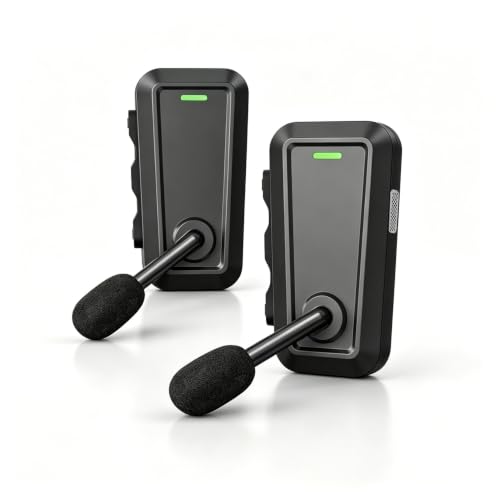
The G-WEI’s title assembles the practical rider’s checklist in one breath: a bicycle-to-bicycle intercom in a two pack, Bluetooth 6.0, IPX5 waterproof, a noise-cancelling rotating microphone, and 10 hours of playtime. The rotating microphone is the detail with a daily life attached to it. A mic boom that rotates can be swung to the rider’s mouth when the conversation matters and moved aside for a drink, a gel or a conversation at the café — the small mechanical courtesy that decides whether a headset is worn for the whole ride or abandoned at the first stop. The IPX5 rating, one of only two water ratings in this guide, speaks to rain and road spray, the weather a racing calendar actually contains.
Range is the title’s silence, and it matters here because the two-pack format invites pair riding over distance — a breakaway duo, a coach shadowing an athlete — where the separation figure is the product. This guide therefore sends the buyer to the maker’s documentation for the number and declines to guess it, while noting what is stated: 10 hours of playtime covers the longest training day most riders will ever schedule, with the understanding that intercom talk and standby draw differently and real endurance follows the group’s chattiness. Bluetooth 6.0 in the title is the current-generation radio claim, reported as such.
- System: bicycle-to-bicycle intercom, 2 pack as titled
- Bluetooth: version 6.0, per the title
- Water resistance: IPX5 waterproof, as titled
- Microphone: noise-cancelling rotating microphone
- Playtime: 10 hours, as titled
- Intercom range: Not stated in the listing title — verify with the maker’s documentation
- Group size beyond the pair: Not stated in the listing title — verify with the maker’s documentation
Strengths
- A rotating microphone adapts to drinking, eating and café stops without removal.
- IPX5 rating certifies the unit for rain and spray as titled.
- Two-pack format and 10 stated hours fit the long pair ride.
Trade-offs
- The range figure essential to pair riding is absent from the title.
- Group expansion beyond two is not described in the title.
- Playtime is a single figure for a duty cycle that varies with talk.
Best for: a riding pair who train through weather and want a mic that moves out of the way at stops. Not suited for: a group organiser planning around a known range, because the title publishes no range to plan with. The Amazon listing and maker documentation carry the reach figures to confirm before a duo relies on them.
Pair riding has its own communication etiquette that this hardware serves well: with only two on the channel, conversation can be continuous and low-key — pace calls, route decisions, the long talk that makes a five-hour ride pass like two. The rotating mic supports that etiquette physically, present when speaking, absent when not, and the two-pack’s completeness means both riders share the same battery rhythm and the same controls, so neither becomes the pair’s reluctant technician. Simplicity between two people is a design achievement, and it is this pick’s.
Weather deserves a final practical word on this pick, because an IPX5 title invites a confidence that should be aimed precisely. Rain on a ride is the rating’s home ground; the hose at the wash station and the dropped unit in a puddle are outside its promise, and riders who clean kit enthusiastically should treat the intercom as electronics first and waterproof second. Within its stated terms, though, the G-WEI removes the oldest anxiety of helmet radios — the first black cloud of the day — and a pair that rides through winter will feel that removal weekly.

Bluetooth 6.0 Bicycle Intercom — The 520m two-way
This unbranded intercom states its terms with a completeness the bigger names here declined to match: a Bluetooth 6.0 bicycle-to-bicycle intercom system, two-way, with a stated 520m range, IPX5 water resistance, a noise-cancelling microphone and an AI voice assistant, aimed at cycling, skiing and outdoor activities. Two-way and 520 metres define its honest envelope — a pair of riders, separated by up to the stated figure under the maker’s conditions — and for the enormous population of riders whose group is exactly two, that envelope is not a limitation but a fit.
The figure deserves the guide’s customary framing: 520m is the listing’s claim, and a pair riding single file on a winding climb should expect the practical reach to be shorter than the headline, as with every radio in this guide. What distinguishes this pick is that the claim exists at all, in print, where a buyer can weigh it — alongside the IPX5 rating that certifies it for the same weather the G-WEI faces. The AI voice assistant clause describes phone-side assistance reached through the unit, a convenience for calls and commands at stops; it is reported as titled and plays no part in the intercom judgement. The absence of a brand name in the title is also reported plainly: support and documentation rest with the seller, and the listing page is where a buyer verifies who stands behind the product.
- System: 2-way bicycle-to-bicycle intercom, as titled
- Stated range: 520m, the listing’s figure
- Bluetooth: version 6.0, per the title
- Water resistance: IPX5, as titled
- Microphone: noise-cancelling mic
- Extras as titled: AI voice assistant
- Maker and support details: Not stated in the listing title — verify with the maker’s documentation
Strengths
- A stated range and an IPX5 rating give planners two hard facts to work with.
- Two-way focus matches the pair riding that dominates real training life.
- Current-generation Bluetooth is claimed in the title.
Trade-offs
- Two-way means the conversation stops at two riders by design.
- The unbranded title leaves maker support to be verified on the listing.
- The stated range is a maker’s figure, subject to terrain and conditions.
Best for: a dedicated riding pair, where a published range and a water rating matter and group features do not. Not suited for: a training group of three or more, because the titled system is two-way only. Its Amazon listing carries the seller information and pairing details that the title omits.
There is a clarity to buying exactly the network size you ride. Group systems tempt buyers with capacity they will use twice a year, at the price of pairing complexity paid weekly; a two-way unit pairs once, simply, and serves the duo on every ride. Couples and training partners evaluating this pick should test it at their real separation — the long climb where one rides ahead — rather than across a car park, because that climb, repeated weekly, is the product’s true workplace and the only test whose verdict matters.
The voice-assistant clause, read carefully, belongs to the stopped moments rather than the moving ones: returning a call from the café, asking the phone for the time to the next town, the small administrative acts of a ride that otherwise demand a screen and two hands. Riders should set their own house rules about which of those acts belong at stops only — the assistant makes them possible, not automatically wise — and this guide notes the feature’s existence in the title without dressing it in any promise the listing itself does not make.

Supertooth Roamee Hands-Free Kit — The minimal hands-free kit
The Roamee’s title is the shortest in this guide — a Bluetooth hands-free kit for bikers, from Supertooth — and this guide treats that brevity as the product’s honest self-description. It is not presented by its maker as a group intercom system with stated ranges and rider counts; it is a hands-free kit, the class of device that puts a phone call, and phone-borne audio, into a rider’s ear without hands. Judged inside a racing-intercom guide, it is the outlier by design, included because a real population of riders wants exactly that and no more: solo miles, a phone within reach of their voice, and none of the group apparatus.
Everything a group planner needs to know is therefore in the caution lines: range, group size, water rating and playtime are all unstated in the title, and a buyer needing any of them must consult the maker’s documentation before expecting intercom duty from this kit. What the title does support is narrower and still useful — a named maker with a long history in hands-free Bluetooth, a product aimed at bikers specifically rather than adapted from a car kit, and a proposition simple enough to need no further adjectives. Solo riders, commuters on bicycles and anyone whose group is a peloton of one should read the Roamee as the guide’s minimalist answer, priced and expected accordingly.
- Product: Bluetooth hands-free kit for bikers, as titled
- Maker: Supertooth, named in the title
- Intercom range: Not stated in the listing title — verify with the maker’s documentation
- Group communication: Not stated in the listing title — verify with the maker’s documentation
- Water resistance: Not stated in the listing title — verify with the maker’s documentation
- Playtime: Not stated in the listing title — verify with the maker’s documentation
Strengths
- A named hands-free specialist maker stands behind a simple proposition.
- Biker-specific aim rather than a general kit adapted to the handlebar.
- No group features to configure, pay for or misunderstand.
Trade-offs
- No intercom figures of any kind are stated in the title.
- Group riders will find nothing here to build a paceline network on.
- Every practical specification requires the maker’s documentation.
Best for: solo riding, with phone hands-free carried on the bike and nothing further added. Not suited for: group intercom duty, because the title states no intercom range or group capability whatsoever. The Amazon listing and maker documentation are essential reading for this pick, more than for any other here.
Minimalism has one more virtue worth recording: a device that does less invites less fiddling. The rider whose entire interaction is answer, talk, end — with the phone doing the rest — spends the ride riding, which is a legitimate ambition that the group systems, for all their power, tax with pairing rituals and channel manners. The Roamee closes this guide as the reminder that the best headset for a racing bicycle is sometimes the one that barely aspires to be an intercom at all.
Commuter racers — the riders whose racing bicycle is also their transport — may find this pick the most honest fit of all. Their rides are solo, their calls are family and work, their groups exist only on Sunday. A hands-free kit serves the six solo days without pretending to be Sunday equipment, and a rider honest about that ratio will spend less and configure nothing. The guide’s group systems are better machines for a peloton; the Roamee is the better machine for a life in which the peloton is the exception.
How Should a Group Choose One System for Everyone?
By the largest ride the group actually takes, not the largest it imagines. Count the riders on the biggest regular training run, measure the group’s honest spread on a climb rather than its café compression, and let those two numbers — heads and metres — strike the candidates whose titles cannot cover them. The eight-way J-TREK covers the club run on its stated figures; the two-way systems cover the pair; and a mixed fleet is the outcome to avoid, because intercom brands and models generally converse only within their own systems, a compatibility fact each maker’s documentation will confirm for its line.
Then appoint the group’s realist to discount every stated range by the group’s terrain. Radios are measured kindly by their makers; hills, bodies and weather spend range freely. A system whose titled figure barely covers the group’s measured spread will fail on the first wet climb, while one with figure to spare will simply work, and the difference between those outcomes is worth more than any feature in any title in this guide. Buy the spare range, standardise the fleet, and write the pairing ritual on the club’s shared note before the first ride depends on it.
How Do the Six Compare on Stated Range and Route?
| Pick | Route | Stated range | Group as titled | Water rating in title |
|---|---|---|---|---|
| Sena BiKom 20 | Helmet-attached, dual pack | Not stated | Dual pack | Not stated |
| J-TREK BH03 | Helmet headphone, dual pack | 1000m | 8-way | Not stated |
| Sena R1 | Helmet-integrated | Not stated | Not stated | Not stated |
| G-WEI Intercom | Helmet unit, 2 pack | Not stated | 2 pack | IPX5 |
| Bluetooth 6.0 Intercom | Helmet unit | 520m | 2-way | IPX5 |
| Supertooth Roamee | Hands-free kit | Not stated | Not stated | Not stated |
The table’s empty cells are its most honest feature. Two stated ranges, one stated group size, two water ratings — and the rest entrusted to makers’ documentation, which is where a serious group organiser will spend an evening before spending a club’s money. A guide that filled those cells by inference would be inventing the very figures a paceline’s safety of communication depends on being real, and this one declines.
What Mistakes Do Riding Groups Make When Buying Intercoms?
The first is buying individually. Intercoms are a network purchase disguised as a personal one, and a group whose members each arrive with a different system has bought six paperweights that cannot speak to each other. The organiser’s unglamorous work — one system, one fleet order, one pairing ritual — is what converts individual enthusiasm into a working channel, and groups that skip it rediscover the fact at the first roundabout, in shouting range of each other and radio silence.
The second mistake is believing the range figure at face value and planning a group at its edge. Stated ranges are the maker’s numbers from the maker’s conditions; a group strung across a wooded climb lives in different conditions entirely. Plan at a fraction of the titled figure, be pleasantly unsurprised when the system copes, and remember that a dropped connection at the back of a group is usually a geometry problem — distance, terrain, bodies — rather than a defect demanding a return.
The third is neglecting the charging and pairing ritual until the morning of the big ride. Intercoms that live in kit bags arrive at the start line in whatever state the last ride left them. Groups that thrive on these systems share two dull habits: units charged the night before as part of the bike check, and a thirty-second channel confirmation at the meet point before wheels roll. The technology in this guide is good enough to disappear; those two habits are what let it.
Field Notes: The First Month on the Group Channel
Week one is novelty, and it sounds like it: too much talking, every observation broadcast, the channel treated as a toy. Experienced groups let the novelty burn off without scolding, because week two is when the real register emerges — short, useful, spaced. Pace calls. A name and a warning. The occasional joke at the climb’s expense. Riders discover that an intercom rewards brevity the way a newsroom rewards a clean sentence, and the group’s strongest rider is rarely its best broadcaster; that honour goes to whoever says the necessary thing half a second before it is necessary.
By the month’s end the channel has a culture, and cultures differ by group in ways no specification predicts. Race teams run it like a pit wall — terse, hierarchical, numbers first. Touring friends run it like a pub table that happens to be moving at thirty kilometres an hour. Both are correct uses of the same equipment, and a new member learns the culture by listening for a ride before speaking much, exactly as they once learned the group’s gestures. The headsets in this guide are, in that sense, social equipment wearing radio clothing.
The month also grades the purchase honestly. The system that paired without ceremony every Saturday is loved; the one that demanded a ritual is tolerated; the one that dropped the back rider on the same climb twice is being replaced, whatever its title claimed. Range as titled starts the conversation — lived range, in the group’s own terrain, finishes it — and riders shopping for their group should weight the stated figures in this guide as the opening bid in that longer negotiation.
How Do You Keep Volume and Attention in Their Proper Places?
By treating the intercom as a conversation, not a broadcast. Set the volume at the meet point, at conversational level, and resist raising it as speed and wind rise — the urge to turn up is constant and its satisfaction is cumulative, leaving riders shouting into each other’s ears by the ride’s end and strangely tired in a way that has nothing to do with legs. Groups with a volume agreement — set once, touched rarely — finish rides with the channel still feeling like speech rather than weather.
Attention follows the same discipline. The channel exists for the group’s business: pace, hazards, decisions, and the social thread that binds a long ride. Riders who keep transmissions short and necessary find the group still listening in hour four; riders who narrate find themselves, by hour two, talking to an audience that has quietly turned itself down. No product in this guide can enforce that etiquette, and none of their titles promises to — it is the riders’ own craft, practised on whatever system the group standardised, and it is worth more than any figure printed on any box here.
What Should Riders Practise Before the First Group Ride on Radios?
Practise the pairing at home, in kit, with gloves on if the season uses them. Every control that will be touched at thirty kilometres an hour should first be touched at zero, in the driveway, until the fingers know the shapes. Then run one short ride with the channel deliberately over-used — narrate, test the spread on the familiar climb, find the exact brow or wood where the link thins — so the group’s mental map of its own system’s real range is drawn from experience rather than from a title’s figure. That map, once drawn, governs every later ride’s expectations.
Agree the channel’s house rules in the same session: who leads the conversation, how a rider signals they are dropping, what silence means. Groups that write those three agreements down — on the club note, beside the pairing ritual — skip the misunderstandings that sour first impressions of good equipment. The radios in this guide will carry whatever culture the group gives them; an hour of practice is how the group gives them a good one.
Final Recommendation
Let the group’s size and spread choose, and let the titles’ own figures arbitrate. A club that rides eight strong should start with the J-TREK BH03, the only pick whose title states both an eight-way group and a four-figure range — planned, as always, with margin. Pairs have the richest choice: the Sena BiKom 20 where twenty stated grams make weight the argument, the G-WEI where a rotating microphone and an IPX5 rating serve weather and café stops, and the Bluetooth 6.0 intercom where a stated 520m and a water rating are wanted in print. The Sena R1 answers the rider whose helmet is due for replacement and who wants the system built in, and the Supertooth Roamee serves the solo rider whose needs end at hands-free. Whichever system the group adopts, adopt it together, charge it the night before, and keep the channel short and kind — because an intercom’s real specification is the quality of the conversation it carries up the line, and a group that talks well rides, in every sense that matters, as one.
Frequently Asked Questions
How far apart can riders be before the intercom drops?
That depends on the system and the terrain, and the only figures this guide reports are the titles’ own: 1000m stated for the J-TREK BH03 and 520m for the Bluetooth 6.0 intercom, each the maker’s claim under the maker’s conditions. Three titles state no range, and their makers’ documentation is the authority. Plan any group at a comfortable fraction of the stated figure.
How do riders charge and store helmet intercoms sensibly?
Treat the intercom as part of the helmet’s own routine rather than as a separate gadget with a separate life. The helmet comes off, the unit goes on charge beside it, and both are ready together for the next ride — that single habit prevents the flat-at-the-start-line failure more reliably than any battery figure in this guide. Riders with the helmet-integrated R1 have the simplest version of the ritual, since helmet and electronics share one hook and one cable. Groups should also agree where charged spare units live, because a borrowed unit that has not been charged since spring is a silence waiting to happen.
Can riders from different brands talk to each other?
Generally, intercom systems converse within their own maker’s ecosystem, and cross-brand group riding should never be assumed. Each maker’s documentation states its system’s compatibility. This is why this guide insists a group standardise on one system: the fleet decision is the compatibility decision.
What happens when a rider drops out of range mid-ride?
The honest answer is procedural rather than technical: the group notices, because the channel’s silence from one member is itself information, and the group’s agreed habit — ease the pace, regroup at the next junction — takes over. Riders should agree that habit before it is needed, since a dropped link on a climb is a normal event in radio riding, not an emergency. Systems differ in how gracefully they reconnect when the rider returns to range, a behaviour worth testing on the pilot rides described earlier in this guide and worth weighing alongside the stated figures when a group chooses its standard.
What does the Sena R1’s helmet route mean in practice?
It means the communication system is built into a cycling helmet — this listing is the ice blue, size medium — rather than clipped to a helmet you own. There is nothing to mount or transfer, and the helmet and electronics are replaced together. Fit and size therefore matter twice over, and the intercom figures must be read in the maker’s documentation, since the title omits them.
What does an IPX5 rating cover on a ride?
IPX5, as titled on the G-WEI and the Bluetooth 6.0 intercom, describes tested resistance to water jets — in riding terms, rain and road spray are its territory, while immersion is not. It is a rating about the unit’s survival of weather, stated here exactly as the listings state it, and it makes no promise about anything else.
Do these headsets block out traffic noise?
The noise-cancelling claims in these titles describe the microphones — how the rider’s voice is cleaned of wind and road noise for the other riders — and this guide reports them in those terms only. Nothing here is sold or described as hearing protection, and no product in this guide promises anything about what a rider will hear of the road; awareness remains the rider’s own responsibility and habit.
How many units should a group buy first?
Start with the pack that matches the smallest real ride — the dual and two packs here exist for that purpose — and let two reliable riders prove the system, the pairing ritual and the practical range on home terrain. Expand to the full group once the pilot pair can teach the ritual in a minute. Buying for the whole club before the pilot is how groups end up with a box of unpaired units and a story they tell at cafés.
Does an intercom replace hand signals on a group ride?
No, and riders should treat the two as parallel systems rather than substitutes. Signals are visible to every road user around the group, including riders without radios and drivers behind; the intercom reaches only the group’s own channel. Experienced groups keep both disciplines alive — the call on the radio and the gesture on the road — and this guide’s products should be understood as adding a voice layer to a visual language that predates them and will outlast any battery. Nothing in any title here claims otherwise, and no rider should let a working radio retire a working signal habit.
Related Guides
Riders speccing the rest of the cockpit can compare the best bicycle speakers for the music-without-intercom route, motorised two-wheelers are covered by the best motorcycle headsets, and anyone whose other riding is the indoor kind — coached sessions on a trainer — will recognise the second-listener pattern in our best headsets and microphones for coaching.