Our Top Picks



What's inside
- What the Syma X5C actually asks from a battery
- Capacity choices between 500 and 750 milliamp-hours
- The JST connector and why polarity deserves respect
- X5C, X5C-1, and the wider X5 family differences
- Real flight time and what shortens it
- Charging safely, singly and in parallel
- Storage voltage and putting packs away properly
- Swelling, deep discharge, and other warning signs
- Reading labels, weights, and dimensions like an auditor
- How many spare packs make a sensible rotation
- Wiring, soldering, and when to leave repairs alone
- Disposing of retired packs responsibly
- Troubleshooting short flights and sudden cut-offs
- Choosing where to buy and what to ask first
- A pre-flight and post-flight battery ritual
- Understanding internal resistance in plain language
- The bundled USB charger under scrutiny
- Matching packs to flying style and venue
- Cold mornings, warm pockets, and seasonal flying
- Camera versions and the extra electrical load
- Teaching younger flyers the battery rules
- When the aircraft, not the pack, eats the charge
- Building a small charging station that stays safe
- Cost thinking across a pack’s whole life
- A note on batch variation between identical listings
- Check prices on Amazon
- Disclosure
As an Amazon Associate I earn from qualifying purchases. This post may contain affiliate links at no extra cost to you.
What the Syma X5C actually asks from a battery
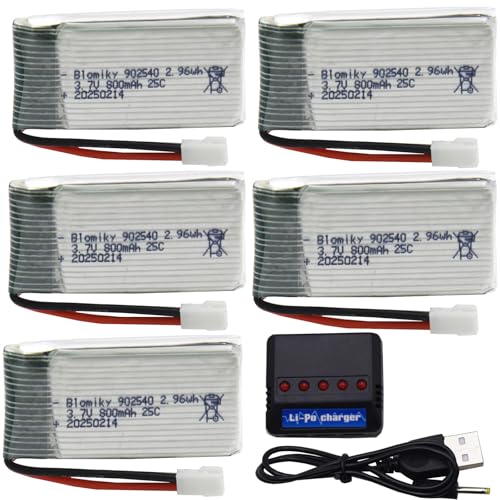
The Syma X5C is a small quadcopter built around a single-cell lithium polymer pack, usually described as 1S, with a nominal voltage of 3.7 volts and a fully charged ceiling of 4.2 volts. That single cell drives four brushed motors, a camera board on camera-equipped versions, and a receiver that expects voltage to sag gracefully rather than collapse suddenly. Published specifications for the original pack centre on 500 milliamp-hours, a figure that balances airframe weight against a flight lasting several minutes. Anything fitted later must respect the same electrical envelope, because the motors, wiring loom, and low-voltage behaviour were all designed around one cell rather than two.
Physical fit matters as much as electrical fit. The battery bay under the fuselage accepts a slim rectangular pouch with rounded expectations about thickness, and a pack that is even two millimetres too thick will strain the retaining door or press against the board above it. Length matters too, since excess length pushes the connector wires into a tight bend. Weight shifts the centre of gravity: a heavier pack mounted slightly rearward changes pitch trim, and the transmitter trims can only compensate within a narrow band before the craft drifts persistently in calm indoor air.
Our research draws on manufacturer specifications, airframe manuals, and charger documentation rather than anecdote, and those sources agree on the starting point: match voltage first, connector second, dimensions third, and only then chase capacity. Readers comparing the wider aircraft market can place this little quadcopter in context through best affordable drones with cameras, where camera drones of many sizes are organised by purpose. The X5C sits at the modest end of that spectrum, which is precisely why its battery choices stay simple, cheap in construction, and unforgiving of careless substitutions.
Capacity choices between 500 and 750 milliamp-hours
Replacement packs for this airframe commonly appear at 500, 600, 650, 700, and 750 milliamp-hours. Capacity describes how much charge the pouch can hold, not how violently it can deliver current, and the relationship between capacity and flight duration is not perfectly linear. A 750 milliamp-hour pack carries fifty percent more nominal charge than the original 500, yet it also adds mass that the motors must lift, so real endurance gains land noticeably below fifty percent. Published specifications show the pattern clearly across small quadcopters: each capacity step buys a smaller increment of airborne time than the step before it.
Discharge capability, expressed as a C rating, describes how quickly stored energy can leave the cell relative to its capacity. A 20C pack rated at 600 milliamp-hours can theoretically deliver twelve amps continuously, far beyond what four small brushed motors draw together in level flight. Aggressive climbing, repeated flips, and wind fighting raise demand in bursts, and a pack with inadequate discharge headroom sags under those bursts, triggering early low-voltage warnings. Chasing an enormous C figure brings no benefit here, because the limiting factor becomes connector and wire resistance rather than cell chemistry.
Honest labelling deserves a full paragraph of scepticism. A pouch physically identical in volume to a 500 milliamp-hour cell cannot contain 1,200 milliamp-hours of the same chemistry, because energy density for consumer lithium polymer changes slowly and within known bounds. Sellers printing spectacular numbers on physically tiny packs rely on buyers never weighing or measuring anything. A kitchen scale tells the truth quickly: genuine capacity steps add visible grams. Comparing a candidate pack weight against the original pack weight, gram for gram, exposes fantasy labels before any flight risks a crash caused by sudden voltage collapse.
The JST connector and why polarity deserves respect
Most X5C packs terminate in a small two-pin JST connector, the red-and-black wired plug that pushes into the airframe socket with a gentle friction fit. JST is a manufacturer name that has become a generic label for several miniature connector families, so visual similarity alone does not guarantee compatibility. Pin spacing, housing width, and latch shape differ between variants sold for toys, receiver packs, and micro helicopters. Forcing a near-fit housing splits plastic, bends pins, and creates an intermittent connection that can cut motor power mid-flight without any warning beyond a flicker.
Polarity is the second trap. Convention places positive on the red wire and negative on black, yet some packs intended for other brands arrive with wires reversed inside an identical housing. Plugging a reversed pack into the X5C can destroy the receiver board instantly, before any fuse or protection reacts. A multimeter check takes seconds: set the meter to direct-current volts, touch probes to the exposed contacts carefully without shorting them, and confirm that the reading is positive when the red probe meets the red wire side. That habit, repeated for every unfamiliar pack, prevents the most expensive mistake in this entire topic.
Connector wear accumulates quietly. Each insertion cycle scrapes plating, and a socket flown for several seasons may grip loosely enough that vibration interrupts contact during flips. Wiggle behaviour on the ground, motors stuttering when the airframe is tapped gently, points toward contact trouble rather than cell failure. Replacement leads and pre-wired sockets exist for soldering repairs, though anyone uncomfortable with a soldering iron should hand that job to a hobby shop. Heat near a lithium pouch demands discipline, shielding, and a workspace cleared of flammable material.
X5C, X5C-1, and the wider X5 family differences
Syma reused the X5 name across several revisions, and battery compatibility follows the airframe revision rather than the marketing name alone. The original X5C and the later X5C-1 share the same basic battery bay and single-cell arrangement, which is why packs marketed for either usually interchange without drama. Differences between those two revisions concentrated on camera behaviour, transmitter details, and minor board changes rather than power architecture. Owners should still compare bay dimensions against a listing, because production runs varied and third-party shells sometimes copied the name while altering internal clearances by small but decisive margins.
The broader family complicates matters. Variants such as the X5A, X5SW, and X5HW introduced different fuselage mouldings, camera systems, and in some cases altered battery doors or connector routing. A pack that slides beautifully into an X5C may sit at an angle inside a related model, pinching wires against a moulded rib. Altitude-hold versions also draw current differently, since barometric correction makes constant small throttle adjustments that change average consumption across a flight. Treating every X5-branded aircraft as electrically identical is the shortcut that produces most compatibility complaints.
Explorers and later spin-offs moved further away, with larger frames and different packs entirely, so a listing claiming universal fit across a dozen Syma models deserves suspicion. The reliable method is boring and effective: measure your bay with calipers or a ruler, photograph the connector beside a coin for scale, note the wire colours and their order, and compare all three against the listing photographs and stated dimensions. Five minutes of measurement beats a return shipment, and it also builds the record you need when a seller disputes that their pack was ever described as fitting your revision.
Real flight time and what shortens it
Calm indoor hovering on a healthy 500 milliamp-hour pack typically yields roughly five to seven minutes before the lights signal low voltage, while a 650 or 750 pack stretches that window by a couple of minutes under equally gentle conditions. Wind changes everything outdoors, because the craft spends energy simply holding position against gusts, and a flight that felt generous in a hall can shrink by a third in a breezy field. Camera recording adds a modest constant draw, and aggressive sport flying with repeated flips converts stored charge into heat and noise at a far faster rate than sightseeing flight ever will.
Temperature quietly rewrites the arithmetic. Lithium polymer chemistry slows in cold air, internal resistance rises, and voltage under load dips earlier even though the stored charge remains present. A pack flown at five degrees Celsius may trigger warnings minutes sooner than the identical pack at twenty degrees, then recover apparent health once warmed indoors. Keeping spare packs in an inside pocket before a winter session is standard practice among experienced flyers for exactly this reason. Conversely, packs left in a hot car suffer accelerated ageing, losing capacity permanently while gaining internal resistance that no later kindness can reverse.
Propeller condition and motor health also tax the battery invisibly. A bent propeller wastes thrust, a hair-wrapped motor shaft adds friction, and both force the flight controller to demand more current for the same climb. Owners blaming a new pack for disappointing endurance sometimes discover that cleaning motor shafts and replacing a nicked propeller restored the missing minute. Diagnosis should therefore move from airframe to battery and back again, changing one variable at a time and timing each flight with a phone stopwatch rather than trusting impressions formed while concentrating on flying.
Charging safely, singly and in parallel
The simple USB chargers supplied with toy-grade quadcopters charge one cell through the same JST lead, terminating near 4.2 volts and drawing modest current from a computer port or phone adapter. They work, but they reveal nothing about cell health and they charge slowly. A proper hobby charger with a single-cell lithium programme offers controlled current, a visible voltage readout, and termination you can verify. Setting charge current near the pack capacity, the familiar 1C guideline, means roughly 0.6 amps for a 600 milliamp-hour pack, balancing speed against heat and longevity in a way that suits these small pouches well.
Parallel charging boards tempt owners with six slots and one charger, connecting several same-voltage packs so they charge as a single larger cell. The method is legitimate when packs start at similar voltages, share the same cell count, and connect through a fused board in the correct sequence: main leads first where the design requires them, balance or charge leads following the maker instructions exactly. A deeply discharged pack should never be paralleled with full ones, because current rushes between packs through thin leads. Guidance collected under best affordable lipo chargers covers charger features in depth for readers upgrading from the bundled USB lead.
Supervision rules do not soften because the packs are small. Charge on a non-flammable surface, away from curtains and paper, with the pack visible and the charger ventilation unobstructed. A lithium charging bag adds containment if a cell vents, though it does not make unattended charging acceptable. Warmth during charging should stay mild; a pouch that becomes genuinely hot, hisses, smells sweet and chemical, or begins swelling must be disconnected if that can be done safely, moved away from combustibles with tongs or a gloved hand, and retired. Small size reduces total energy, never the need for respect.
Storage voltage and putting packs away properly
A single lithium polymer cell rests best for long periods near 3.8 volts, roughly forty to sixty percent of its charge, rather than brimmed at 4.2 or emptied toward 3.0. Storing fully charged accelerates electrolyte breakdown and capacity fade, while storing empty risks the voltage drifting below the point where a normal charger will accept the pack at all. Many hobby chargers include a storage programme that raises or lowers a cell toward that middle voltage automatically. The bundled toy charger offers no such programme, so owners flying irregularly can approximate storage charge by flying a full pack briefly or charging an empty one partway, checking voltage with a small cell checker.
Calendar ageing continues even when cycles stop. A pack stored correctly at moderate room temperature still loses a few percent of capacity each year, and one stored full in a warm drawer can lose far more in a single summer. Cool, dry, and stable beats cold in this context: a garage cycling between frost and heat stresses pouches more than a steady indoor cupboard. Refrigeration advice circulates in older hobby lore, but condensation risks and modern guidance have largely retired that practice for consumer packs. A labelled box, terminals protected from contact with loose metal, and a note of the storage date form a sensible household system.
Reviving packs after a break deserves method rather than optimism. Measure each pack voltage before charging; a cell sitting below about 3.0 volts after rest has either self-discharged unusually or suffered internal damage, and forcing charge into it invites trouble. Healthy packs get a gentle first cycle, a short hover rather than a full-throttle session, and a check for unusual warmth or swelling afterwards. Capacity returning after one mild cycle is normal, because chemistry that sat idle needs a little exercise. Capacity that keeps falling across three careful cycles is a retirement signal, not a challenge to try harder.
Swelling, deep discharge, and other warning signs
A swollen pouch has generated gas internally, usually through electrolyte decomposition following overcharge, deep discharge, physical damage, or plain old age. The pack feels pillowy rather than firm, the wrapper wrinkles change shape, and the battery door may suddenly fit tightly where it once closed easily. There is no safe procedure that reverses swelling, no pin trick that releases gas without creating a fire path, and no flight short enough to justify using a puffed pack one last time. Retirement is the only correct response, and it should happen the day swelling is noticed rather than after a few more hopeful cycles.
Deep discharge harms cells invisibly before swelling ever appears. Flying until the motors will barely turn, then leaving the pack connected while the airframe lights fade, drags voltage into territory where copper dissolution and internal shorts become possible. The X5C warning lights exist to land the craft while reserve remains, and treating that warning as a suggestion converts a healthy pack into a suspect one across a handful of flights. Landing promptly also protects the airframe, because a quadcopter that loses power at altitude falls onto arms, motor mounts, and camera lenses that cost more than the battery being sacrificed.
Physical damage follows its own rule: any pack involved in a hard crash gets inspected before its next charge. Look for creased corners, torn wrapper, exposed foil, bent connector pins, and wires nicked where they exit the pouch. A damaged pack may behave normally for several cycles before failing during charging, which is when energy input and internal faults combine most dangerously. Isolating a suspect pack in a metal container with a lid, stored away from other batteries, buys safe thinking time. Curiosity about whether it still works is not a reason to connect it to anything.
Reading labels, weights, and dimensions like an auditor
Every claim on a battery label can be cross-checked with three household tools: a ruler, a kitchen scale, and a multimeter. Dimensions should match the listing within a millimetre or two, weight should rise sensibly with stated capacity, and resting voltage after a full charge should sit near 4.2 volts without exceeding it. A pack arriving at 4.35 volts has met a careless charger somewhere; one arriving stone dead below 3.0 volts has sat neglected or failed internally. Either arrival state justifies a return conversation before the pack ever flies, because first impressions from lithium cells tend to predict their whole service life.
Wrapper quality tells its own story. Legitimate packs carry crisp printing, a readable capacity and voltage statement, a polarity-consistent lead arrangement, and heat-shrink or foil wrapping applied evenly without trapped folds over the cell edges. Blurry type, misspelled warnings, capacity figures that change between the listing title and the physical label, and leads emerging from the wrong end all signal a supply chain nobody audited. None of these flaws proves a cell is dangerous in isolation, yet together they describe a product whose internal quality control probably matches its exterior, and buyers carry the risk either way.
Record keeping turns single purchases into useful knowledge. Note the purchase date, stated capacity, measured weight, and first-flight duration for each pack, marking packs with a small numbered sticker so flight notes attach to a specific physical unit. After twenty cycles the notes reveal which brand batch aged gracefully and which faded early, information worth more than any listing claim. Owners of several small aircraft often adapt the same ledger habit across their fleet, and the charging-safety material at best 18650 chargers shows how cylindrical-cell owners track a different format with similar discipline.
How many spare packs make a sensible rotation
One original pack turns every outing into a short appointment: a few minutes of flying followed by a long charge. Three to five packs transform the rhythm, letting a pilot fly a rotation while earlier packs cool and later ones wait charged. Rest between discharge and recharge matters, because a pouch still warm from flight accepts charge less kindly than one that has sat for fifteen minutes returning to ambient temperature. Numbering packs and flying them in order spreads cycles evenly, preventing the quiet outcome where one favourite pack accumulates three times the wear of its siblings and fails first without warning.
Cooling and inspection fit naturally into the rotation pause. While pack two flies, pack one rests where the pilot can glance at it, feeling for residual heat and looking for early swelling against a flat surface. A pack that rocks slightly on a table because its faces have bowed outward is announcing retirement, and catching that announcement on the ground is the entire point of the ritual. Flight-line habits like these cost nothing, require no instruments, and prevent most of the incidents that later get described as sudden, even though the evidence had been developing visibly for weeks.
Rotation also clarifies purchasing. Instead of buying the largest advertised capacity in a single exotic pack, many owners do better with several ordinary 600 or 650 milliamp-hour packs from a consistent source, each verified on arrival. Consistency simplifies charging, because packs of equal capacity and similar age behave predictably on a parallel board, and it simplifies diagnosis, because a short flight on one numbered unit stands out against its siblings. The fleet approach treats batteries as consumables with managed lives rather than mysterious talismans whose moods must be endured.
Wiring, soldering, and when to leave repairs alone
Replacement leads seem like an easy rescue for a pack whose connector cracked, yet soldering beside a lithium pouch concentrates several hazards in one small workspace. The iron must never bridge the two terminals, the leads must never be cut simultaneously with conductive snips, and heat conducted along the wire can damage the seal where tabs exit the pouch. Anyone attempting the repair works on one wire at a time, insulates the finished joint before starting the second, and keeps the pack on a ceramic tile rather than a wooden bench. Confidence should be earned on scrap wire first, not discovered mid-repair.
Airframe-side repairs carry lower chemical risk but equal electrical risk. A replacement socket soldered with reversed polarity will destroy the next healthy pack plugged into it, which makes post-repair meter checks mandatory rather than optional. Photographing the original wiring before desoldering anything preserves the colour order that memory will otherwise invent confidently and wrongly. Heat-shrink tubing over every joint prevents the slow short circuit that begins when a bare strand vibrates against a neighbouring pad during flight, a failure mode that can present as random resets or one motor stopping in a hover.
Some damage simply ends the conversation. Torn pouch foil, a creased cell corner, a lead torn out by its root, or electrolyte smell at a seal all belong to disposal, not repair. Hobby shops sometimes accept the role of honest broker here, inspecting a pack and delivering the verdict an owner does not want to hear. Accepting that verdict gracefully is part of the hobby’s safety culture. The money saved by resurrecting a questionable toy battery is small, the potential cost is not, and every experienced flyer carries a story illustrating exactly that asymmetry.
Disposing of retired packs responsibly
Retired lithium packs should be discharged slowly and safely before recycling where local guidance requires it, using a charger discharge programme or a purpose-built discharger, never by shorting terminals or puncturing the pouch. Some owners use a low-wattage bulb load designed for the voltage, monitored until the pack reaches a low but controlled endpoint, then tape every terminal before transport. Salt-water soaking advice persists online despite corroding terminals unpredictably and creating disposal problems of its own, and current battery-recycling organisations generally advise against it. Local household-hazardous-waste rules outrank any forum tradition, so check the collection route in your area first.
Transport to a collection point deserves the same care as storage. Each pack goes into its own small plastic bag or has its connector capped and taped, preventing contact between terminals of different packs inside a shared box. Swollen packs travel in a rigid container, ideally with some sand or non-flammable padding, and collection staff should be told plainly that a damaged lithium pack is inside. Honesty at the counter protects the workers who will handle the container next, and facilities that accept damaged batteries have procedures ready precisely because people disclose rather than conceal.
Keeping retired packs indefinitely in a drawer is the worst option masquerading as caution. Ageing cells continue changing internally, forgotten swollen packs press against whatever shares the drawer, and the household loses track of which units were suspect. A scheduled clear-out tied to the start of each flying season keeps the inventory honest. Packs leaving service get crossed off the ledger with a reason recorded, closing the loop that began when their arrival weight and first flight were written down with such optimism months or years earlier.
Troubleshooting short flights and sudden cut-offs
Methodical troubleshooting separates battery faults from airframe faults with one borrowed variable: a known healthy pack. If the healthy pack restores normal duration, the suspect pack has lost capacity or gained resistance, and further airframe work is wasted effort. If both packs cut early, attention shifts to motors, propellers, binding shafts, and a battery door pressing on wires. Swapping one component at a time sounds slow, yet it converges on the cause faster than replacing three parts at once and learning nothing about which one mattered when behaviour improves.
Voltage sag under load explains the most confusing symptom, a pack that measures 4.1 volts at rest yet triggers warnings within a minute of takeoff. Resting voltage reports charge state; loaded voltage reports health. Internal resistance rises with age and abuse, and under motor demand that resistance consumes voltage inside the cell, leaving less for the aircraft. Small voltage checkers that beep during a hover, connected only where the airframe design permits, reveal sag directly. Without instruments, the pattern itself is diagnostic: early warnings that vanish after landing, with the pack recovering indicated charge, point squarely at resistance rather than emptiness.
Intermittent cut-offs have a different signature. Power vanishing completely and returning when the craft is handled suggests connector fretting, a cracked solder joint, or a protection-less lead fracturing inside its insulation near the plug. Flexing the lead gently while the motors run at low throttle on the ground, rotors removed for safety, can reproduce the fault without a crash. Any test-bench running of motors should happen with propellers off, because a sudden contact restoration at throttle can jump the airframe off the bench. Diagnosis ends when the faulty segment is identified physically, not when a wiggle merely correlates with the symptom once.
Choosing where to buy and what to ask first
Listings that publish exact dimensions, weight, connector type, and discharge rating in plain text have already answered the questions a careful buyer would ask, and that transparency correlates strongly with receiving the pack described. Listings built from adjectives, compatibility claims spanning dozens of unrelated models, and photographs showing a different connector from the one described are asking buyers to gamble. Before ordering, ask the seller to confirm pin polarity order and pack thickness in millimetres; a seller who answers precisely probably stocks a consistent product, while evasive answers are themselves useful information delivered free of charge.
Batch consistency matters when building a rotation. Ordering all packs for a set from one listing at one time raises the chance they share a production batch, age together, and behave similarly on parallel equipment. Mixing capacities and ages across a parallel board is where careful owners become careless, because the board hides individual differences behind an averaged voltage. Keep parallel groups homogeneous, label arrivals by month, and let outliers live as single-charged packs. These organisational details sound fussy until the first incident report elsewhere describes exactly the shortcut that caused it.
Finally, remember that the aircraft itself remains a light, forgiving trainer whose charm lies in simplicity. Battery decisions should preserve that simplicity rather than import racing-drone complexity into a toy-grade frame. A modest capacity increase, a verified connector, a decent charger, and disciplined storage will extract everything the design can give. Media cards for camera variants follow a similar philosophy of verified fit over headline numbers, a parallel explored in best dji drone sd cards for a different aircraft family. Sensible consumables, honestly labelled, quietly support the flying that owners actually bought the little quadcopter to enjoy.
A pre-flight and post-flight battery ritual
Rituals compress experience into habit, and a ninety-second battery ritual protects both aircraft and packs. Before flight: confirm the pack voltage or recent charge, inspect both faces for flatness, check the connector for looseness, seat the pack fully, and verify the door closes without force. After flight: note the duration, feel the pack temperature, set it aside to cool in view, and only then begin charging or storage preparation. Written as a list the ritual sounds solemn; practised for a month it becomes as automatic as checking that the transmitter batteries are switched on before wondering why nothing responds.
Seasonal rituals extend the same thinking. At the start of a flying season, cycle each stored pack gently, compare flight times against the ledger, retire the laggards, and refresh storage voltage on the survivors. Mid-season, clean connectors, inspect leads where they bend at the housing, and confirm the charger still terminates at the correct voltage against a meter reading. End of season, bring every pack to storage charge before the box closes. Owners who fly year-round indoors can tie the same checks to calendar quarters instead, because cycle counts alone miss the calendar ageing that idle months produce.
Teaching the ritual to a new flyer, especially a younger one, transfers the hobby’s safety culture more effectively than any warning label. Let them hold a swollen retired pack beside a healthy one, feel the difference, and explain why one flies and the other gets recycled. Show them the meter confirming polarity and let them perform the check under supervision. Skills practised on an inexpensive trainer scale upward to every larger aircraft they may own later, which is why getting the small habits right on this small quadcopter carries weight far beyond its modest battery bay.
Understanding internal resistance in plain language
Internal resistance is the opposition a cell presents to its own energy leaving, and it rises steadily as a lithium polymer pack ages, is overheated, or is repeatedly drained to exhaustion. Fresh small packs for this airframe show low resistance and hold voltage confidently under the combined draw of four motors. An aged pack with doubled resistance still displays a reassuring 4.2 volts on a meter at rest, because no current is flowing to expose the weakness. The deception collapses at takeoff, when demand arrives and voltage sags through the resistance inside the pouch instead of reaching the motors.
Some hobby chargers report an approximate resistance figure for the cell connected, measured by applying a brief load and observing the voltage response. Absolute accuracy matters less than trend: record the reading for each numbered pack every couple of months and watch for one unit climbing away from its siblings. A pack whose resistance jumps suddenly after a crash or a hot car afternoon has announced internal change even if its wrapper looks perfect. That announcement, combined with shortened flights, closes the diagnostic case more firmly than either observation alone ever could.
Resistance also explains why mixed-age parallel charging disappoints. Packs connected together share voltage, yet the healthier cell accepts and delivers current more readily, so the group behaves unevenly despite appearing unified at the terminals. Keeping rotation groups close in age and cycle count preserves the predictability that makes parallel equipment worthwhile. When one member diverges, demote it to single charging and solo flights, watch it across a few cycles, and retire it if the gap widens. Electricity rewards owners who notice divergence early and penalises those who average it away.
The bundled USB charger under scrutiny
The little USB charging lead packed with the aircraft deserves neither contempt nor blind trust. Its virtues are simplicity and a gentle charge rate that small cells tolerate well, and for a single-pack owner it may serve adequately for seasons. Its limits are information and verification: no display confirms terminal voltage, no adjustment accommodates different capacities, and termination behaviour varies between production batches. Owners relying on it can add one inexpensive safeguard, a small plug-in voltage checker used after charging, confirming that packs finish near 4.2 volts rather than meaningfully above or below that ceiling.
Charge time offers a rough health signal through this simple lead. A 600 milliamp-hour pack that historically needed about an hour from the warning point and suddenly finishes in twenty minutes has not become efficient; it has lost capacity, so less energy fills it. Conversely, a pack that never finishes, with the indicator still showing activity long past its usual duration, may be leaking charge internally as fast as the lead supplies it. Either change justifies removing the pack from service until a proper charger or a hobby shop can examine it with instruments the bundled lead lacks.
Power source choice influences this charger more than owners expect. A tired computer port, a hub shared with several devices, or a bargain wall adapter with optimistic labelling can each deliver less current than the lead requests, stretching sessions and confusing timing-based judgements. Dedicate one known adapter to the flying kit, label it, and keep the arrangement constant so that timing comparisons stay meaningful across months. Consistency in the charging corner of the workbench is a theme that recurs throughout battery care, because variables held steady turn vague impressions into usable evidence.
Matching packs to flying style and venue
Indoor flying in a hall or living room rewards the lightest standard pack, because the aircraft feels nimble, crashes carry less energy, and the gentle throttle work typical of confined spaces stretches even a 500 milliamp-hour cell respectably. Pilots practising orientation drills and slow circuits indoors gain little from maximum capacity; they gain from responsiveness and from several light packs that keep the rotation moving. The original capacity exists for a reason, and venue is where that reason becomes obvious to anyone who has flown both weights back to back.
Outdoor sightseeing reverses the preference. Wind resistance work, higher throttle averages, and the wish to climb for a wider camera view all argue for the 650 or 750 milliamp-hour options, accepting slightly softer agility in exchange for minutes that matter when the craft is a hundred feet away and needs reserve to come home against a breeze. Reserve thinking is the mark of an outdoor flyer: landing with charge remaining is not waste but insurance, and packs repeatedly landed empty age faster, compounding the very shortage the pilot was trying to escape.
Flips and sport flying occupy a third niche where discharge behaviour outranks raw capacity. A mid-size pack with healthy low resistance often outperforms a larger tired one through repeated acrobatics, holding voltage during each burst instead of sagging into warnings mid-routine. Pilots who enjoy that style should track which numbered packs recover voltage briskly after a flip sequence and reserve those for sport sessions. Sorting a small fleet by temperament sounds indulgent until you realise commercial operators do exactly the same with far larger aircraft and call it professional fleet management.
Cold mornings, warm pockets, and seasonal flying
Winter flying compresses several lessons into a single cold battery. Chemistry slows, resistance climbs, and a pack that flew six minutes in September may manage barely four in January despite identical handling. Warming packs to room temperature before flight, carrying spares in an inside pocket, and opening the session with a gentle hover that lets the working pack generate mild internal warmth all recover part of the deficit. What never helps is charging a cold-soaked pack immediately at full rate; let it reach room temperature first, because lithium cells accept charge reluctantly and unevenly when chilled.
Summer imposes the mirror discipline. Packs should travel in shade, rest between flight and charging until their warmth fades, and never bake on a dashboard while the pilot visits a shop. Heat accelerates every ageing reaction inside the pouch, and a single August afternoon of neglect can cost more capacity than fifty careful cycles. Airframes benefit too, since motor magnets and plastic mounts share the same hostile environment, yet the battery remains the component whose decline is permanent, cumulative, and entirely preventable with a shaded box and a little patience.
Transitional seasons catch owners out with condensation and complacency. A cold aircraft brought into a warm hall gathers moisture on boards and connectors, so a short acclimatisation pause before fitting a pack protects contacts from a film of water. Spring also tempts pilots to resurrect last year’s packs without the revival checks described earlier, because the sun is shining and enthusiasm outruns method. Spend the first session of any season on verification flights close to the ground, and the rest of the season inherits the confidence those dull minutes purchased.
Camera versions and the extra electrical load
Camera-equipped X5C variants draw a small continuous current for the camera board and, on Wi-Fi derivatives in the wider family, a transmitter that adds meaningfully to the load. Owners comparing flight times with a friend flying the non-camera version should account for that difference before condemning a pack. Recording also writes heat into the airframe near the battery bay, modest but real, which is another reason the post-flight cooling pause matters on camera models. Removing the camera where the design permits it, for a pure flying session, returns both weight and current to the endurance budget.
Memory cards and recording settings interact with power in subtler ways. A nearly full or ageing card can make the camera board work harder during writes, and corrupted cards provoke repeated write attempts that show up as mysterious warmth. Formatting cards in the camera at sensible intervals and retiring cards that produce file errors keeps that variable quiet. None of this rivals motor demand, yet troubleshooting that ignores the camera entirely occasionally chases a battery fault that actually lives in a misbehaving card drawing steady current from the moment the pack connects.
The camera also changes crash consequences for the battery. A nose-heavy impact drives the airframe forward while the pack tries to continue travelling, straining its leads and the bay door. After any camera-first crash, inspect the pack seating and connector even if the aircraft still powers up, because a partially unseated connector can arc microscopically under vibration and pit its contacts across later flights. Small inspections after small crashes prevent the confusing intermittent faults that owners later describe as the aircraft developing a personality, when in truth it developed a damaged contact surface.
Teaching younger flyers the battery rules
This aircraft often serves as a first quadcopter for younger pilots, which makes its battery an ideal teaching tool precisely because the stakes are modest and the principles are universal. Three rules cover most of the safety landscape in language a ten-year-old can hold: charge where an adult can see, land when the lights complain, and show an adult any pack that feels puffy or hot. Framing rules positively, as the habits real pilots keep, works better than a lecture on chemistry, and children who learn to number packs and log flights absorb record-keeping as part of the fun rather than as homework.
Supervision should focus on the charging corner rather than the flying field, because the field failures are usually broken plastic while the charging failures involve chemistry. Agree on one charging location on a clear, hard surface, keep the charger and packs there rather than migrating to bedrooms, and make the lithium bag part of the normal kit from the first day. Habits formed around a toy transfer intact to the larger aircraft many young flyers will own within a few years, when the same disciplines protect considerably more expensive and energetic equipment.
Letting a younger pilot perform the arrival checks on a new pack, weighing it, measuring it, and checking polarity with a meter under supervision, converts abstract caution into competence. They will remember the pack that failed the scale test long after forgetting a paragraph of warnings. The aircraft’s modest price is its pedagogical gift: mistakes cost little, lessons cost less, and the pilot who graduates from it carries a fully formed battery culture into every corner of the hobby they explore next.
When the aircraft, not the pack, eats the charge
Brushed motors wear, and their decline often masquerades as battery failure. Brushes erode, commutators foul with carbon dust, and a motor that once spun freely begins demanding extra current for ordinary thrust while running hotter than its three siblings. Compare motor temperatures by fingertip after a gentle hover, rotors stopped, and treat one notably hotter unit as a suspect. A pinion slipping on its shaft produces a similar appetite with an audible whine, while a cracked arm flexing in flight wastes energy through vibration that no battery can compensate for.
Propeller selection after replacements also matters. Substitute propellers with a different pitch or diameter from the originals change the load curve the motors see, and a pack judged against factory endurance figures will disappoint through no fault of its own. Keep one set of original-specification propellers as a reference standard for diagnostic flights. If endurance returns with the reference set fitted, the substitute propellers have explained themselves, and the battery ledger should record the episode so the same suspicion is not investigated twice next season.
Even the transmitter plays a small role in perceived endurance. A pilot fighting a drifting trim makes constant corrections, each correction a throttle or attitude demand that consumes charge in aggregate. Centring the aircraft mechanically, adjusting the battery position for balance, and confirming trims sit near neutral before blaming consumption gives the pack a fair trial. Fair trials are the theme of all good troubleshooting: hold the environment constant, change one variable, and let timed flights deliver the verdict.
Building a small charging station that stays safe
A dedicated charging corner need not be elaborate: a ceramic tile or metal tray on a clear bench, the charger, a small fan of labelled leads, the ledger, and a container for retired packs awaiting collection. Keeping that geography fixed means every pack in the household follows the same path from aircraft to rest to charge to storage, and deviations become visible because they look wrong. Visitors and family members learn the geography too, which quietly prevents the classic incident of a helpful relative plugging a pack into an unfamiliar charger with unknown settings.
Cable management inside the station prevents the slow damage nobody notices. Leads should hang without tight bends at the connector, parallel boards should sit flat rather than dangling by their cables, and no lead should cross a hot charger vent. Label the parallel board with the cell count it serves, in marker, on its face, because boards for different configurations look deceptively alike in a drawer. A station that can be photographed and recreated after being packed away for travel is a station whose safety does not depend on memory.
Review the station whenever the fleet changes. A new charger, a different pack size joining the rotation, or a second aircraft type in the household each introduce mismatched assumptions that deserve five minutes of reorganisation. The review habit scales from this little quadcopter to any battery-powered pursuit, and owners who practise it rarely feature in incident reports. Safety, examined closely, is mostly tidiness plus attention, repeated on ordinary days when nothing seems likely to go wrong.
Cost thinking across a pack’s whole life
Judging packs by purchase price alone misprices them, because the honest unit is cost per successful flight delivered before retirement. A pack that costs slightly more yet survives two hundred careful cycles outearns a bargain unit retired after sixty swollen flights, even before counting the crash risk carried through its declining final weeks. The ledger makes this arithmetic possible: purchase date, cycle estimate, and retirement reason convert impressions into a per-flight figure that should guide the next order far more than listing adjectives or a seller’s enthusiasm ever will.
Charger investment follows the same lifetime logic. A proper hobby charger serves every pack the household will ever own for this aircraft and likely the next one too, verifies health the bundled lead cannot see, and manages storage charge automatically. Spread across several seasons, its cost per flight becomes trivial while its information keeps paying. Owners deciding where a limited budget works hardest should usually fund the charger before funding exotic capacity, because measurement protects every subsequent purchase, whereas one premium pack remains a single consumable with an unknown lifespan.
Retirement timing is the final economic lever, and it pulls in the safety direction as well. Retiring a pack at the first trustworthy signs of decline preserves the aircraft it powers, avoids the mid-air cut-off that breaks arms and camera mounts, and keeps charging sessions boring. The cheapest flight is the one that ends with everything intact, and the most expensive battery is the one whose failure takes an airframe with it. That arithmetic, once seen clearly, settles most arguments about squeezing one more month from a tired pouch.
A note on batch variation between identical listings
Even honest packs vary slightly between production batches, because cell grading sorts output into bands and assembly tolerances stack in small ways. Two packs bought months apart from the same listing may differ by a few percent in capacity and a gram in weight without either being defective. Owners building a parallel set should therefore buy together where possible, and owners replacing one member of an older set should expect the newcomer to outlast its ageing partners rather than match them exactly.
Check prices on Amazon
Live listings for the shortlist in this guide are pulled from Amazon below, so prices and availability are always current at the moment you look.

Disclosure
This guide was prepared from published manufacturer documentation and established lithium polymer handling practice, and this site may receive an affiliate commission through outbound links, which does not shape the technical guidance, measurements, or safety thresholds described above. Readers should follow the battery maker instructions and local disposal rules wherever those sources are stricter than general advice offered here.
For owners of this cheerful little quadcopter, the kindest battery is simply an honest 3.7 volt pack, charged gently, stored half full, and retired the moment its pouch begins to pillow.