What's inside
- Key Takeaways
- Quick Picks: Box Cameras for Improv Positions and Smart Houses for the Whole Garden
- How We Chose These Picks
- Where Do Hummingbirds Actually Nest, and What Does That Mean for a Camera?
- How Close Can a Camera Sit to a Hummingbird Nest, and How Should It Get There?
- What Does a Feeder Camera Teach You That a Nest Camera Cannot?
- How Do You Prepare a Garden Across a Whole Year for One Small Nest?
- What Happens at the Nest at Night, and Should You Watch It?
- How Do You Share a Nest Watch Without Turning It Into a Spectacle?
- The Six Nest Cameras Compared on Power, Picture and Intended Tenant
- Why Does Garden WiFi Decide Whether Any of This Works?
- What Should You Do With a Season of Footage When the Young Have Fledged?
- Which Mistakes End a Hummingbird Watch Before It Begins?
- How Should a Household Choose Between the Adaptable Camera and the Smart House?
- What Does the First Week of Watching Teach That No Listing Can?
- Final Recommendation
- Frequently Asked Questions
- Related Guides
As an Amazon Associate I earn from qualifying purchases. This post may contain affiliate links at no extra cost to you.
gizmoverdict.com is reader-supported. When you buy through links on our site, we may earn an affiliate commission.
Where nest cameras get ordered: every camera and smart bird house below is sold through Amazon, and each name links to its listing so you can check power options, card slots and mounting hardware against your own garden before the nesting season arrives.
Finding the best live nest cameras for filming hummingbird nesting starts with an admission that shapes this whole guide: hummingbirds do not read the product descriptions. A hummingbird nest is a walnut-sized cup of plant fibre and spider silk, lashed to a slender branch, a porch string light, a wind chime or the crook of a rose bush — almost never inside a standard nest box of the kind most bird cameras are built for. So the honest way to rank this category is not to pretend the birds will move into the products, but to judge each camera on the qualities that decide hummingbird success anyway: how flexibly it can be mounted near an unconventional nest site, how well it handles close-range subjects, whether it captures snapshots and alerts when a tiny bird arrives, and how its power arrangement survives a nesting cycle that runs for weeks within a few feet of your window.
The six picks divide into two families. Two are WIWACAM box cameras — compact WiFi cameras designed to install inside or onto bird houses and feeders, whose small size and close working distances make them the most adaptable to improvised hummingbird positions. Four are complete smart bird houses with cameras inside — Birdfy, KinetCam and a solar nest box design — which serve the many gardeners whose hummingbirds will not use them this year but whose robins, wrens, bluebirds and swallows will, and whose hummingbird footage will come from feeders and flowers while the houses host their intended tenants. This guide says plainly, per pick, which family you are buying and what that means for a hummingbird specifically.
One more rule governed the ranking: no pick is credited with species identification or any other cleverness its own listing does not claim. Where a title states bird identification, the review says so and names it as the maker’s claim; where it does not, the camera is judged on its optics, power and mounting, which are the things that will actually decide whether your footage exists.
Key Takeaways
- Hummingbirds nest on branches and porch fixtures, not in boxes — mounting flexibility and close-range performance outrank box features for this keyword.
- The two WIWACAM box cameras are the most adaptable picks for improvised positions near a real hummingbird nest.
- The smart bird houses serve cavity nesters superbly and film hummingbirds at feeders; buy them with both jobs in mind.
- Solar and battery power matter because a nesting cycle runs for weeks and a cable run to a branch is rarely practical.
- Snapshot resolution and video resolution are different numbers in these listings — the WIWACAM’s 4K snapshots and 2K video are a good example.
- Whatever you mount, install before the season and keep distance during it; a camera that disturbs the nest films nothing for long.
Quick Picks: Box Cameras for Improv Positions and Smart Houses for the Whole Garden
| Pick | Badge | Why it made the cut |
|---|---|---|
| WIWACAM WiFi Bird Box Camera 4K | Most adaptable for hummingbirds | A compact box camera with 4K snapshots, 2K video, night mode and a microSD slot, small enough to position near odd nest sites. |
| WIWACAM WiFi Bird Box Camera (WLAN) | Second WIWACAM route | The WLAN variant with live video to phone and recording, fitting most bird boxes, houses and feeders. |
| Birdfy Smart Bird House (solar) | Solar smart house | A solar-powered house with 1080 HD live video, night vision and automatic detection alerts for cavity nesters. |
| Birdfy Bird House with Camera (2K) | Sharpest smart house | A metal-clad house with 2K video, night vision and a 5200mAh battery, built for bluebirds, wrens and their neighbours. |
| KinetCam Bird House with Camera (cedar) | Cedar house, isolated camera bay | A cedar bluebird house whose camera sits in an isolated bay, solar powered with app control and night vision. |
| Birdhouse Camera Solar (1080P/2K) | Value solar nest box | A solar nest box with 1080P/2K live view over 2.4G WiFi, aimed at general garden nesting watching. |
How We Chose These Picks
We screened the nest-camera market against the hummingbird problem first and the general garden second. Cameras were credited for compactness, for stated snapshot and video quality, for night capability, for local recording options such as a card slot, and for power arrangements — solar, battery or wired — that can live outdoors for a full nesting cycle without weekly attention. Complete smart houses were included deliberately and labelled honestly: they are the right purchase for a garden that wants nesting footage of the species that use boxes, and a feeder-side hummingbird camera role, and pretending otherwise in either direction would ill serve the reader.
We also held a hard line on claims. A listing that states bird identification gets credited with the claim, attributed to the maker; a listing that does not is never decorated with it in these pages. Hummingbird-specific identification, in particular, is claimed by none of these titles, and no review below pretends otherwise.
Where Do Hummingbirds Actually Nest, and What Does That Mean for a Camera?
A female hummingbird builds alone, and she builds small: a cup perhaps two inches across, elastic with spider silk so it stretches as the chicks grow, camouflaged outside with lichen flakes until it reads as a knot on the branch rather than a nest at all. Favourite sites are slender horizontal branches, the fork of a shrub, and — in gardens — the sheltered oddities humans provide: a porch hook, a string of lights, a hanging plant’s support, the top of a wind chime. She returns to good sites across years, and a garden that hosted a nest last spring is a garden to prepare before this one.
For the camera buyer this geography is the whole brief. The winning position is usually not a box on a pole but a small camera on an arm, a clamp or a nearby post, a respectful distance from a branch the bird has already chosen, framed before she commits and left strictly alone afterwards. That is why the compact WIWACAM units lead this ranking for hummingbird purposes: they are cameras first and housing accessories second, small enough to live in improvised positions. The smart houses answer the garden’s other half — the cavity nesters who will raise three broods within camera range while the hummingbird performs at the feeder in the same frame of garden life.
Timing is the ethical half of the technique. Cameras go up before the season, feeders establish the garden in the birds’ mental map, and once a nest is active the equipment is finished being adjusted — no repositioning for a better angle, no visits to check the card. Choose cameras with remote viewing and alerts, as every pick here offers in some form, precisely so that the technology removes the human from the nest’s neighbourhood rather than adding a recurring one.

WIWACAM WiFi Bird Box Camera 4K — Most adaptable for hummingbirds
This WIWACAM is the pick this guide would hand to a gardener who has already found the branch. It is a WiFi bird box camera designed for birdhouses, and its listing specifies the combination that matters for improvised work: 4K HD snapshots with 2K video, live video to a phone, easy installation, a night mode, and a microSD card slot. Read the snapshot and video figures as the division of labour they are — the stills carry the detail, a returning mother’s portrait in full resolution, while the video carries the story at a resolution any phone displays beautifully. For a hummingbird nest on a rose arch or a porch beam, the camera’s compact box-camera form is the point: it mounts where a whole bird house never could.
The microSD slot deserves its paragraph, because remote nests and garden WiFi are not always friends. Local recording means a weak signal costs you the live view for an afternoon, not the footage itself — the card keeps the record, and the day’s arrivals can be reviewed when the connection recovers. In a nesting cycle measured in weeks, that resilience is worth more than any headline resolution figure, and it is absent from several dearer ways of watching wildlife.
The species named in its title — robins, wrens, tree swallows — are the box tenants it was designed around, and this guide will not re-badge it as a hummingbird product. Its hummingbird case rests on size, closeness and adaptability, which happen to be exactly what the bird’s nesting habits demand. Position it near the chosen site before the season, frame generously, and let the snapshots do the rest.
- Snapshots, as listed: 4K HD snapshots
- Video, as listed: 2K video, live video to phone
- Recording, as listed: microSD card slot
- Night capability, as listed: Night mode
- Design fit, as listed: Designed for birdhouse and birdhouses; robins, wrens, tree swallows named
Strengths
- Compact form mounts in improvised positions a full bird house cannot reach
- Card recording keeps footage safe through garden WiFi’s weak patches
- High-resolution snapshots carry the portrait detail of a tiny subject
Trade-offs
- Video resolution sits below the snapshot figure — know which you value
- Designed around box tenants, so hummingbird use is an adaptation
- Close positioning demands pre-season installation discipline
Best for: gardeners who know their hummingbirds’ favoured branch and can pre-position a small camera. Not suited for: anyone wanting a complete house-and-camera habitat in a single product.
See the WIWACAM 4K listing on Amazon to check its mounting and card details.

WIWACAM WiFi Bird Box Camera (WLAN) — Second WIWACAM route
The second WIWACAM in the ranking is the same idea in its WLAN variant: a WiFi bird box camera with 4K HD, live video to the phone, recording capability and a night mode, described as installing easily to most bird boxes, houses, feeders and nesting setups, with robins, wrens and tree swallows named as its intended audience. For the hummingbird gardener, its interest is identical in kind to its sibling’s — a small, close-range, remotely viewed camera that can live on a feeder mount or beside an improvised nest position — with the purchase decision between the two resting on the current listings’ details and which variant’s package suits the intended mount.
That feeder mention in its title is worth dwelling on, because for most gardens the feeder is where hummingbird filming actually happens daily. A camera that serves a nesting box in spring and a feeder mount through the summer earns its keep across the whole season, and hummingbird footage from a feeder — the hover, the tongue, the aerial fencing with a rival — is some of the most watchable material a garden camera produces. A WIWACAM positioned for the nesting attempt in April can be re-aimed at the feeder in June without apology; that flexibility is the family’s real product.
As with its sibling, honesty about intent applies: this is a box camera for cavity nesters, adapted by size and mounting to hummingbird improvisation. Gardeners whose plots centre on bluebirds and wrens are its home audience, and hummingbird hopefuls should choose it, as with the 4K model, for its adaptability rather than for any promise printed on the box.
- Imaging, as listed: 4K HD WLAN camera
- Viewing, as listed: Live video to phone
- Recording, as listed: Recording capability stated
- Night capability, as listed: Night mode
- Fit, as listed: Installs to most bird boxes, houses, feeders and nesting setups
Strengths
- Feeder compatibility gives it a second career after nesting season
- Same compact adaptability as the other WIWACAM for odd positions
- Live phone viewing keeps the observer away from the nest
Trade-offs
- Listing states less recording detail than its sibling — verify the card arrangements
- Intended species are box nesters, not hummingbirds
- Two similar WIWACAM variants require a careful listing comparison
Best for: gardens wanting one small camera to serve box, feeder and improvised nest duty across a season. Not suited for: households wanting the smart-house features — solar power and automatic alerts — built into the same purchase.
Compare the WIWACAM WLAN listing on Amazon against its sibling before choosing.
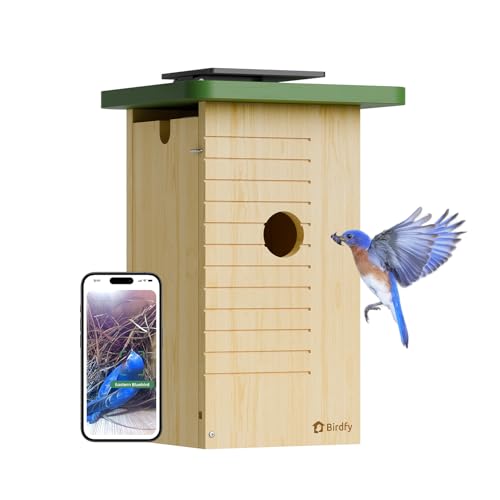
Birdfy Smart Bird House (solar) — Solar smart house
With the Birdfy house the ranking changes species strategy, and says so: this is a complete smart bird house with a camera, solar powered, offering 1080 HD live video and night vision, automatic detection with notifications, and — as the listing claims — lifetime bird identification included free. For the cavity nesters that adopt it, that is a complete nesting channel: the bird arrives, the camera notices, the phone in the kitchen lights up, and the season’s story tells itself in clips. Solar power is the enabling detail, because a house on a pole or a fence line rarely has a socket, and a nesting cycle does not pause for battery anxiety.
Its hummingbird role is the feeder-adjacent one described in this guide’s framing: the house anchors a watched corner of the garden, its camera covers the comings and goings of that corner, and hummingbirds working the flowers and feeder nearby enter its world as guests rather than tenants. A gardener whose heart is set on hummingbirds specifically should weight the WIWACAM picks higher; a gardener who loves the whole cast, and wants the garden’s nesting story on their phone with the least infrastructure, is this product’s natural owner.
The identification claim deserves the guide’s standard treatment: it is the maker’s stated feature, listed as lifetime and free, and it applies to the birds the house hosts. It is not a promise about hummingbirds at a branch across the garden, and this review does not extend it there. Judged on what it is — a solar, self-alerting nesting house with a live camera — it is a polished piece of garden equipment.
- Power, as listed: Solar powered
- Video, as listed: 1080 HD live video and night vision
- Alerts, as listed: Auto detect and notify
- Identification, as listed: Lifetime bird ID free (maker’s claim)
- Form, as listed: Smart bird house with camera, for outdoors
Strengths
- Solar power frees placement from sockets and battery routines
- Automatic detection turns nesting events into phone alerts
- Complete house-plus-camera habitat for cavity nesters
Trade-offs
- Hummingbirds will not nest in it — its role for them is feeder-side
- 1080 video trails the 2K smart house below in fine detail
- Identification is a maker’s claim scoped to the house’s visitors
Best for: gardeners wanting a self-powered nesting channel for box-using species. Not suited for: a sole-purpose hummingbird nest watch on a known branch.
Open the Birdfy solar house listing on Amazon to review its current package.

Birdfy Bird House with Camera (2K) — Sharpest smart house
The second Birdfy house sharpens the formula: a metal-clad bird house with the camera inside, 2K HD video with night vision, automatic detection and notifications, a 5200mAh battery, and — again as the maker’s stated claim — lifetime free AI bird identification. The listing names its intended tenants with unusual precision: bluebird, finch, swallow, wren and chickadee. That roster is a fair map of the birds a North American garden can actually host in a box, and the 2K resolution serves them well, because identification and enjoyment both live in feather detail at the entrance hole and inside the nest.
Metal cladding is a durability decision worth crediting: a wooden house weathers charmingly and then simply weathers, while a clad house holds its shape, its entrance dimensions and its camera alignment through seasons of rain and sun. The battery capacity stated in the title gives the house a power reserve for dull weeks, and the detection alerts keep the owner present for the moments that matter — the first inspection visit, the first egg’s aftermath, the fledging morning that lasts ninety seconds and rewards only those already watching.
For hummingbirds, the same honest framing as its sibling applies, with one addition: a 2K camera in a well-placed house covers its surroundings at the feeder and flowers with the crispest video in the smart-house group, so the hummingbirds a garden actually hosts daily will be filmed by it often — at the feeder, not the nest. Buy it as the garden’s nesting headquarters and enjoy the hummingbirds as its most glamorous visitors.
- Video, as listed: 2K HD with night vision
- Build, as listed: Metal-clad bird house with camera inside
- Battery, as listed: 5200mAh battery
- Alerts and ID, as listed: Auto detect and notify; lifetime free AI bird ID (maker’s claim)
- Named species, as listed: Bluebird, finch, swallow, wren, chickadee
Strengths
- 2K video is the sharpest in the smart-house group
- Metal cladding protects the house and camera alignment across seasons
- Named-species focus matches real cavity-nesting gardens
Trade-offs
- Battery power needs more attention than the solar sibling
- Not a hummingbird nest solution — a garden headquarters instead
- Premium feature set is wasted on a garden without box-nesting species
Best for: committed bird gardens wanting the sharpest hosted-nest footage. Not suited for: hummingbird-only watchers with no cavity nesters to host.
See the Birdfy 2K house listing on Amazon for its full specification and contents.

KinetCam Bird House with Camera (cedar) — Cedar house, isolated camera bay
The KinetCam house makes a design argument the others do not: its camera lives in an isolated camera bay within a cedar bird house, solar powered, with 1080P HD video, night vision, automatic detection, app control and Wi-Fi. The isolated bay is a thoughtful answer to a real problem — in many smart houses the camera’s warmth, wiring and occasional service needs intrude on the nesting chamber, while here the electronics are architecturally separated from the birds’ room, which can only help occupancy by the bluebirds the listing names as its intended tenants. Cedar, meanwhile, is the traditional house material for good reasons: it weathers gracefully, insulates gently, and smells like a bird house rather than a gadget.
For the garden’s wider story, the KinetCam covers the same ground as the Birdfy pair — a hosted nesting channel with alerts and app viewing — in a more traditional wooden form that many gardeners will prefer on a fence line. Its hummingbird relationship is the familiar feeder-side one, and its solar power suits the same socket-free placement. Where it particularly earns consideration is the household that wants the technology present but visually quiet: a cedar house reads as garden furniture, and the camera’s bay keeps even the maintenance of it out of the birds’ space.
Check the app and detection details on the listing against your expectations, since its title states the features more briefly than the Birdfy models state theirs. As a physical object for hosting nesting birds under discreet observation, it is arguably the most considered design in the set.
- Build, as listed: Cedar bird house with isolated camera bay
- Power, as listed: Solar powered
- Video, as listed: 1080P HD with night vision
- Features, as listed: Auto detect, app control, Wi-Fi
- Named fit, as listed: Bluebird house with camera
Strengths
- Isolated camera bay keeps electronics apart from the nesting chamber
- Cedar construction suits traditional gardens visually
- Solar power and app control cover the essentials without fuss
Trade-offs
- 1080P video trails the 2K Birdfy for feather detail
- Feature detail in the listing is briefer than its rivals’
- Hosts cavity nesters; hummingbirds remain feeder guests
Best for: traditional gardens wanting discreet, well-separated camera housing for bluebirds. Not suited for: detail hunters who want the highest video resolution available.
Review the KinetCam cedar house listing on Amazon before ordering.

Birdhouse Camera Solar (1080P/2K) — Value solar nest box
The final pick is the straightforward solar nest box: a solar-powered smart nest box offering 1080P/2K HD live view over 2.4G WiFi, with night vision and real-time bird watching and hatching coverage, positioned in its listing as an outdoor garden bird nest and a gift for bird lovers. Its virtues are the democratic ones — solar power with no cable, a live view on the phone, night capability for the dawn chorus hours, and a specification stated in the dual-resolution style common to this class, where the buyer should read the listing carefully to see which figure belongs to snapshots and which to video.
As a first nest camera it has a clear logic: it puts a watched nest in the garden for the least organisational effort, and a household discovering whether nesting footage becomes a family ritual or a forgotten app is wise to discover it here rather than at the top of the range. The 2.4G WiFi detail is worth noting practically — it is the band with the best through-wall reach to a garden, and the one these cameras standardise on, so a buyer’s home network arrangement should be confirmed before any nest camera is ordered, this one included.
Its hummingbird position is the group’s standard one: a hosted box for the species that use boxes, a camera in the garden for everything else. As a gift — its listing’s own framing — it is well judged, because it gives the recipient a complete, solar, self-contained start rather than a component to build around.
- Power, as listed: Solar powered
- Video, as listed: 1080P/2K HD live view
- Connection, as listed: 2.4G WiFi live view
- Night capability, as listed: Night vision
- Purpose, as listed: Real-time bird watching and hatching; outdoor garden bird nest
Strengths
- Solar and self-contained — the simplest route to a watched nest
- Live view and night vision cover the essential ritual
- Gift-friendly completeness for a first-time bird watcher
Trade-offs
- Dual-resolution listing needs careful reading before purchase
- Feature depth trails the Birdfy and KinetCam houses
- Standard box format — hummingbirds will visit, not nest
Best for: first nest-camera households and gift buyers wanting solar simplicity. Not suited for: enthusiasts who will immediately want the sharpest video and richest alerts.
Check the solar nest box listing on Amazon for its current details.
How Close Can a Camera Sit to a Hummingbird Nest, and How Should It Get There?
The governing principle is that the bird must never experience the camera as an event. Equipment is installed before the season or, at the latest, before the bird commits to the site — never as a response to discovering an active nest, because a new object appearing beside a nest under construction can end the tenancy on the spot. Distance follows the same logic: frame from farther away with the camera’s resolution doing the work, rather than crowding the branch for a tighter shot. The WIWACAM’s high-resolution snapshots exist partly for this courtesy, letting a respectful distance still produce a portrait worth keeping.
Practically, the successful hummingbird setups share a shape: the camera rides on something that already exists — a trellis, a post, a shepherd’s hook, the porch structure itself — aimed at the site from a few feet away, powered without a trailing cable crossing the bird’s flight path, and tested on an empty branch for a week so its framing, focus and alert behaviour are known quantities before the first strand of spider silk appears. When the bird chooses a different branch, as she may, the camera stays where it is for the season; a garden with feeders and flowers will give it other subjects, and the discipline of not chasing is what makes the garden trustworthy next year.
What Does a Feeder Camera Teach You That a Nest Camera Cannot?
Behaviour, in a word. The nest shows the cycle — building, eggs, feeding, fledging — in one fixed frame of extraordinary tenderness and very little variety of action. The feeder shows the society: the dominant male’s patrol pattern, the females’ timing around it, the juveniles’ first clumsy hovers, the exact flowers and perches the garden’s hummingbirds prefer, all in close, repeated, well-lit encounters that a camera can be positioned for without any ethical negotiation at all. Gardeners who film both consistently report the feeder footage as the season’s most watched and the nest footage as its most treasured, which is a fair summary of what each is for.
There is a practical dividend too: the feeder is where a new camera should be commissioned. Focus habits, alert sensitivity, WiFi strength at the garden’s far corner, the sun’s path across the frame at the hours the birds are busiest — all of it can be learned at a feeder in May without any nest depending on the lesson. The picks in this ranking that serve feeders as well as boxes, the WIWACAM pair especially, let one camera run that apprenticeship and then take up its nesting position already understood.
How Do You Prepare a Garden Across a Whole Year for One Small Nest?
The hummingbird camera season is won in the months when no camera is running. It begins with the garden’s hospitality: the feeder hung in the same place each year so returning birds find their landmark, the flowers sequenced so something tubular and nectar-rich is blooming from arrival to departure, and a shallow water source with a dripper or mister, which hummingbirds use with an enthusiasm that surprises everyone who installs one. A garden that feeds and waters reliably becomes an address in the birds’ geography, and addresses are what nesting females choose between — the nest goes where the territory already works.
Then comes the infrastructure of watching, installed in the quiet months: the post or arm that will carry a WIWACAM near last year’s site, the smart house mounted and weathered so it smells of outdoors rather than of packaging when the scouts arrive, the WiFi tested at the garden’s far corners on a wet day when foliage is thick, because that is the connection the nesting season will actually get. Every pick in this ranking rewards that preparation differently — the solar houses need their panels’ sun mapped across the day, the battery Birdfy needs its charging rhythm understood, the WIWACAMs need their framing rehearsed on an empty branch — but all of them punish improvisation in April equally.
Keep a garden notebook across the years, even a single page per season: where the nest was, which camera position worked, when the first egg appeared and when the young left, which flowers the female visited between building trips. That page is the difference between a household that watches hummingbirds and a household that knows them, and it turns each year’s camera purchase from a guess into the next entry in a documented project.
What Happens at the Nest at Night, and Should You Watch It?
Night at a hummingbird nest is a study in energy economics. The female sits through the dark in a state bordering on torpor on cold nights, her metabolism throttled down to survive until dawn’s first feeding, and the nest’s drama — such as it is — is her stillness. The night modes and night vision across these picks let a watcher witness that stillness and, more usefully, the dawn departure and the first feed of the day, which are among the most intimate sequences a garden camera can record. Infrared illumination of the kind these cameras use is invisible to the birds, so the watching itself is not a disturbance — the disturbance risk lives entirely in the human visits the technology exists to replace.
For the hosted houses, night footage carries an additional, practical charge: it is when predators make their attempts, and a season’s night recordings teach a gardener where next year’s house should hang, how deep its entrance tunnel should be, and whether the pole needs a baffle. That is unglamorous knowledge and it saves more nests than any camera feature. Watch the nights in summary rather than in vigil — the alerts and the morning review exist so the household sleeps while the garden’s story continues — and let the footage accumulate into the understanding that makes each season’s setup wiser than the last.
How Do You Share a Nest Watch Without Turning It Into a Spectacle?
The households that get the most from these cameras tend to share them in widening, gentle circles. The live view on a kitchen tablet during breakfast. The snapshot sent to a grandparent who kept feeders for forty years and can no longer keep a garden. The fledging clip, ninety seconds long, that becomes the family’s small annual film. Several of the systems here make that sharing a matter of an app invitation, and the discipline worth keeping is about the nest rather than the technology: share the watching freely, share the location never, and let no audience — however loving — become a reason to approach, adjust or perform at the nest itself.
There is also a citizen-science direction for the season’s records, for households inclined that way: nesting attempts, dates and outcomes are exactly the observations that local bird organisations and seasonal surveys collect, and a camera’s dated footage turns a family’s impressions into data with timestamps. The notebook habit described earlier makes that contribution effortless. Whether or not the records travel, they anchor the garden’s memory — and a child who watched a hummingbird raise two chicks from a walnut of spider silk, live from the kitchen table, carries a standard for what a garden is for into every garden they ever keep.
The Six Nest Cameras Compared on Power, Picture and Intended Tenant
| Camera / house | Picture as listed | Power as listed | Honest hummingbird role |
|---|---|---|---|
| WIWACAM Bird Box Camera 4K | 4K snapshots, 2K video | microSD recording; see listing for power | Improvised close position near a chosen nest site |
| WIWACAM Bird Box Camera (WLAN) | 4K HD, live video | See listing | Box, feeder and nest duty across the season |
| Birdfy Smart Bird House (solar) | 1080 HD live video | Solar powered | Garden headquarters; hummingbirds at the feeder |
| Birdfy Bird House (2K) | 2K HD video | 5200mAh battery | Sharpest hosted-nest footage; feeder visitors in 2K |
| KinetCam Bird House (cedar) | 1080P HD video | Solar powered | Discreet cedar hosting for bluebirds |
| Birdhouse Camera Solar | 1080P/2K HD live view | Solar powered | Simple first watched nest for the garden |
Why Does Garden WiFi Decide Whether Any of This Works?
Every pick in this ranking speaks WiFi, and the garden is where home WiFi goes to be humbled: brick walls, wet foliage, a router chosen for the house’s centre rather than its fence line. The practical work is unglamorous and decisive. Stand where the camera will live, phone in hand, and measure what the connection actually is at that spot in the rain-season’s growth, not what it was in the showroom of February. The 2.4G band that these cameras standardise on reaches farthest through garden obstacles, which is a genuine virtue, but reach and speed are different things, and a marginal signal delivers its live view in stutters that make a hovering bird into a slideshow.
The defences are layered, and the ranking quietly contains several of them. Local recording — the WIWACAM’s microSD slot is the clearest example — means the footage survives the connection’s bad days even when the live view does not. A thoughtfully placed outdoor access point or a mesh node near the garden window transforms every camera in this guide at once and is often the best money in the whole setup, ahead of any camera upgrade. And the smart houses’ event-based alerts are kinder to a weak connection than a permanently open live stream, sending small notifications reliably where a continuous broadcast would choke. Judge your garden’s signal before judging cameras, because the finest optics in this ranking report through the same air as the humblest.
What Should You Do With a Season of Footage When the Young Have Fledged?
Curate it ruthlessly and soon, while the season’s story is still legible to you. A nesting cycle generates hundreds of clips of an empty nest for every minute of arrival, feeding and first flight, and the archive that survives is the edited one: the building sequence, the first egg, the hatching, the feedings growing frantic, the fledging morning. An hour of curation in the week after fledging produces the twenty minutes your household will actually rewatch for years; leave it a year and the same task faces a hard drive of undifferentiated timestamps and a memory already softening at the edges.
The off-season is also the equipment’s maintenance window, and these cameras ask for little: housings cleaned, the smart houses’ chambers cleared of old nesting material as their makers direct, solar panels wiped, batteries brought to their storage state, mounts checked for the creep and tilt that a season of weather applies. Store the WIWACAMs with their cards backed up and their firmware noted. Then walk the garden once with next year in mind — the branch that hosted, the feeder that ruled, the corner the camera never covered — and write the notebook page while the evidence is still standing in front of you. The season ends; the project, done properly, merely pauses.
Which Mistakes End a Hummingbird Watch Before It Begins?
The fatal one is disturbance dressed as enthusiasm: discovering a nest and immediately arriving with a camera, a ladder and an audience. A hummingbird’s tolerance is real but it is spent once, and the correct response to a found nest is to withdraw, enjoy it through binoculars this season, and install for next year — she rewards known gardens by returning to them. The second mistake is the mid-season adjustment, the small repositioning for a better angle that reads to the bird as the world changing around her eggs. Cameras for this work are set like traps in the old photographic sense: placed early, framed generously, and thereafter only watched.
Equipment mistakes follow. A camera whose battery dies in week two of a five-week cycle trains its owner to visit, charge and disturb on a schedule — which is why solar and generous battery arrangements run through this ranking like a theme. A camera aimed into the afternoon sun produces a season of silhouettes. And a camera bought for identification promises its listing never made produces a disappointed owner standing in a garden full of successfully filmed birds, which is the saddest outcome in this entire guide and the easiest to prevent: read what the title claims, want what the camera does, and let the hummingbirds supply the wonder themselves.
How Should a Household Choose Between the Adaptable Camera and the Smart House?
Ask which bird you are actually serving, and let the answer spend the money. A household with a documented hummingbird site — last year’s nest, a returning female, a branch with history — has a specific, filmable appointment, and the adaptable WIWACAM cameras are the only picks that can keep it; buying a smart house for that household buys a wonderful film of somebody else’s family. A household with a general bird garden and no known hummingbird site has the opposite appointment: the smart houses will certainly host tenants, certainly send alerts, certainly fill a phone with a season of nesting — and their hummingbird footage at the feeder will be a genuine dividend rather than a consolation.
The two-purchase answer deserves its honest mention, sequenced rather than simultaneous. Start where your certainty is: the known hummingbird site justifies the WIWACAM first, the proven box-nesting garden justifies the house first. Add the other when the first has earned its place, and the garden ends with both stories running — the hosted broods in the house on the fence, the walnut of silk on the rose arch under its own small camera — which is, not coincidentally, the garden this entire category of products is dreaming about. Buy in the order your birds dictate, and neither purchase will ever feel like the wrong one.
What Does the First Week of Watching Teach That No Listing Can?
That the camera’s frame and the bird’s world are different sizes. The first week with any of these systems recalibrates its owner: the nest that looked centred is at the frame’s edge because the bird’s flight path, not the nest’s silhouette, is the picture; the alerts that fired forty times a day were the feeder’s shadow crossing at noon; the night mode’s reach ends a foot sooner than the branch you wanted. None of this is failure — it is the ordinary tuition of wildlife filming, payable only in attention, and it is why this guide keeps returning to installation timing: a camera commissioned at a feeder in the quiet weeks arrives at nesting season already fluent, its owner already taught.
The week also teaches the household its own rhythm of watching. Some families live in the live view; others discover they prefer the morning review, coffee in hand, scrolling the night’s arrivals like a newspaper. The systems here serve both temperaments — live video to the phone for the first, recorded events and card archives for the second — and knowing your temperament is worth as much as any specification when choosing between them. Buy for the watcher you are, position for the bird you hope for, and the season will do the rest.
Final Recommendation
Decide which hummingbird story your garden can honestly tell this year. If you know the branch — the returning female, the favoured arch, the porch corner she used last spring — the WIWACAM cameras are the tools, installed early and left alone, with the 4K model the first choice for its snapshots and card recording. If your garden’s nesting story belongs to the box tenants, buy the smart house that fits your taste — Birdfy’s solar all-rounder, its sharper 2K sibling, KinetCam’s cedar discretion, or the simple solar box — and let the hummingbirds star as the feeder’s daily visitors in the same frame of garden life. Either way, set the camera before the season, keep your distance during it, and the smallest bird in your garden will give you footage no larger subject can match for sheer improbable grace.
Frequently Asked Questions
Will a hummingbird ever use a smart bird house?
Essentially no — hummingbirds build open cup nests, and the reasons are written into the bird’s own design: she needs to land, turn and depart in a hover, feed her young from above the cup’s rim, and let the elastic nest stretch as they grow, none of which a cavity’s entrance hole permits. Occasional photographs of hummingbirds investigating a box or a porch fixture circulate every spring and are worth enjoying as curiosity rather than planning around; the bird investigating your wind chime is telling you where she would accept a camera, which is the more useful message. on branches and fixtures rather than occupying cavities or boxes, which is why this guide frames the smart houses as garden headquarters whose hummingbird role is at the feeder, and the compact WIWACAM cameras as the adaptable picks for a real nest site.
When should I install a camera for hummingbird nesting?
Before the season begins in your region, and in position long enough that the equipment becomes part of the garden’s furniture in the birds’ judgement. Installing beside an active nest risks abandonment; the returning nature of hummingbirds makes last year’s known site this year’s best-planned camera position.
Do any of these cameras identify hummingbirds by species?
None of the listings in this ranking claims hummingbird identification. Two Birdfy houses state bird identification features for their hosted birds, presented in the reviews as the maker’s claim; the other picks make no identification claim and are judged on optics, power and mounting.
Is solar power reliable enough for a full nesting cycle?
For the solar picks here, that is precisely their design brief, and it is worth matching the claim to your own garden’s light before relying on it: a panel that catches the morning and loses the afternoon behind the house will still carry a modest camera through most cycles, but the household that checks the panel’s sun in the installation week — and shifts the house a metre if the shadow map demands it — is the household that never has to think about power again until the young have flown. — a house on a fence line has no socket, and the nesting cycle cannot pause for charging. Placement still matters: a solar panel in permanent shade undermines any of them, so site the house where its panel sees real daylight.
Can I watch from inside the house without disturbing anything?
Yes — that is the design centre of every pick here. There is a quiet pleasure in how completely the arrangement inverts the old naturalist’s hardship: instead of hours motionless in a hide, the household gets the nest as a presence in the room, glanced at while cooking, checked by a child before school, shared with a parent on another continent in the time it takes to send a link. The birds lose nothing by the exchange, provided the installation discipline in this guide is kept, and the watchers gain a season-long companionship with a family of hummingbirds that no amount of garden sitting could have delivered at this intimacy. Live video to a phone or tablet, automatic alerts on the smart houses, and recorded archives on the card-equipped cameras all exist so the observer’s chair can be a kitchen chair. The chain has one weak link to check: the WiFi path from the garden position back to the house, covered in this guide’s section on garden connections. Test that path before the season, strengthen it if it stutters, and your watching becomes entirely armchair work — the nest experiences a quiet garden, and you experience all of it.
How long does a hummingbird nesting cycle last, for battery planning?
From building to fledging, allow roughly five to six weeks in which the camera must simply keep working — construction days, an incubation period of stillness, then an increasingly frantic feeding period ending in a fledging that can complete in a single morning. That duration is the practical argument running through this ranking for solar power, generous batteries and local recording: any arrangement needing weekly human attention will eventually schedule that attention onto the one morning it should not happen.
What if the hummingbirds choose a completely different spot?
Leave the camera where it is for the season and enjoy the garden’s other subjects; then move the setup in the off-season toward the new evidence. Chasing an active nest with equipment is the one error this guide asks you not to make, and a returning bird next year will likely reuse a successful site — which your patience will have kept safe.
Related Guides
More garden wildlife technology from our team: best bird feeder cameras, best wildlife cameras for gardens and best outdoor wifi cameras.
Small ceremonies deserve the same attentiveness as small birds, and our guide to the best polaroid cameras for wedding guest books brings it to the celebration table.
A camera that watches a nest all season is running the same vigil as the systems in our guide to the best ip cameras for warehouse, at warehouse scale.
Close focus is a discipline before it is a specification, and our guide to the best nikon cameras for microscopy teaches it at bench scale.
Dawn light in a garden asks the same sensor questions as stage light, and our guide to the best nikon cameras for concert photography answers them for the concert hall.
Related guides
- Best 1080p IP Cameras: PoE Domes, Turrets, Bullets and a PTZ That Earn Their Cable
- Best 43 1080p TVs: Why 43 Inches Went 4K — and Where True Full HD Survives
- Best Doorbell Cameras No Subscription: Local Storage Picks, and the Ring/Blink Truth
- Best AC Powered Wireless Security Cameras: Wi-Fi Data, Mains Power, Zero Sleep


