What's inside
- Where to buy
- Key Takeaways
- Quick Picks
- How Did We Shortlist TVs for Florida Specifically?
- Why Does Florida Defeat Ordinary Outdoor TVs?
- How Do You Host Game Day Outdoors in Florida Without Missing a Play?
- How Do You Live With Salt Air, Heat and Storm Season?
- How Do You Mount a Television Poolside Without Regretting It?
- How Should You Set the Picture for Florida Daylight?
- How Does a Pool Cage Change the Calculation?
- Which Florida Screen Fits Which Florida Yard?
- What Mistakes Do Florida Buyers Keep Making?
- What Does Florida Do to a Screen Across Five Years?
- What Should You Check on the Day the TV Arrives?
- Final Recommendation
- Frequently Asked Questions
- Related Guides
As an Amazon Associate I earn from qualifying purchases. This post may contain affiliate links at no extra cost to you.
gizmoverdict.com is reader-supported. When you buy through links on our site, we may earn an affiliate commission.
Where to buy
All six screens in this Florida-focused guide come from Amazon’s US store, through the verified listings named in each review, and the links here lead to those listings. Buy the listing, not the silhouette: outdoor ranges reuse cabinet designs across brightness classes, and the difference between a shade set and a full-sun set is written in the listing’s nit figure, not visible in the photograph.
The best outdoor tvs for florida face a climate that treats ordinary outdoor televisions the way the ocean treats a sandcastle. Florida is not one exposure but four at once: subtropical sun strong enough to defeat all but the brightest panels, humidity that hangs in the air for months, rain that arrives sideways in summer storms, and — anywhere near the coast — salt air that corrodes unprotected metal and electronics with patient enthusiasm. A screen that thrives on a shaded porch in Ohio can be a grey, washed-out rectangle by noon in Tampa and a corrosion case by its second year in Jacksonville Beach.
So this guide grades on Florida’s terms. Brightness comes first, because the state’s default condition is full sun and the 2,000-nit class exists precisely for it. Sealing comes second, with every pick here carrying an IP56 or IP65 rating against the rain and the humidity-driven grime. Then come the subtler Florida questions: how a set behaves in heat that radiates off a pool deck, how its finish and cabinet stand up to salt air, and whether its smart platform covers the storm-season news, sports and streaming a Florida household actually watches. The six screens below were chosen as Florida answers, and they are a completely separate set from our general weatherproof guide — no pick is borrowed between the two.
Key Takeaways
- Full sun is Florida’s default: three of the six picks are 2,000-nit screens built to stay readable in unshaded yards, and that class is the starting point, not the upgrade.
- Every pick here is sealed to IP56 or IP65, because Florida rain does not fall politely downward and summer humidity tests cabinets daily.
- SYLVOX owns the full-sun conversation in this guide, in both standard and QLED form at 55 inches and in a 65-inch version for big pool decks.
- Salt air is the coastal tax: mounting hardware, finishes and a sensible rinse routine matter as much as the panel for homes near the water.
- Covered lanais play by gentler rules — the 1,000-nit picks and the compact Titan 32 serve them well without paying for brightness they will never use.
Quick Picks
| Pick | Badge | Why it earns its place |
|---|---|---|
| SYLVOX 55-inch Full Sun 2000-nit | Best All-Round Florida Pick | 2,000 nits of full-sun brightness with an IP56 seal and Dolby Atmos support, aimed at yards and poolsides. |
| SYLVOX QLED 55-inch Full Sun | Best Full-Sun Colour | The same 2,000-nit full-sun brief answered with a QLED panel for richer colour in brutal light. |
| SYLVOX 65-inch Full Sun | Best for Big Pool Decks | Full-sun brightness at 65 inches, so large Florida yards get a screen that matches their scale and their sky. |
| 55-inch IP65 Outdoor Google TV | Strongest Seal in Florida | IP65 dust-tight sealing with Google TV and a voice-assistant remote for covered patios and poolside walls. |
| Titan S100 QLED 32-inch | Best for Lanais and Outdoor Kitchens | A compact IP65 QLED for the covered corners of Florida outdoor life, from lanai seating to the grill station. |
| SYLVOX 55-inch 1000-nit | Best for Covered Patios | 1,000 nits with Dolby Vision and Atmos for the screened, shaded Florida spaces that never see direct sun. |
How Did We Shortlist TVs for Florida Specifically?
We began with the sun. Florida’s latitude and clear-sky hours mean an unshaded screen fights light that would defeat the 700- and 1,000-nit classes for much of the day, so the full-sun 2,000-nit models anchor this guide rather than decorate its top end. Listings had to state their brightness plainly; any screen coy about its nit figure was set aside, however glossy its photographs. Next came the seal: IP56 as the floor, because Florida’s summer storms drive rain horizontally and the state’s humidity keeps cabinets damp long after the sky clears.
Then we graded the Florida intangibles that listings only hint at. Heat radiating off pavers punishes electronics mounted low over a deck, so thermal design language and the brand’s outdoor pedigree counted. Salt air punished the careless in a slower way, so we favoured established outdoor ranges with proper cabinet finishes and thought about the mounting hardware as part of the product. Finally we checked the viewing life: Google TV dominates this set of picks because its sports and streaming coverage suits households that gather outside for games, hurricane-season news briefings and evening films in equal measure. Readers in gentler climates — or with deeply shaded yards — may find the broader set in our guide to best weatherproof tvs is the better shopping list; this one is deliberately Florida-hard.
One filter deserves to be stated as plainly as the others: accessories were excluded, however Florida-proof their marketing sounded. Covers, enclosures and lift cabinets all appeared in the search results for these keywords, and all can play a supporting role in an installation — but none of them is a television, and a Florida buyer deserves a guide that ranks screens, not storage furniture. Every pick above is a purpose-built outdoor TV whose own listing states the brightness and the seal this climate demands, in numbers a buyer can check before money changes hands.
Why Does Florida Defeat Ordinary Outdoor TVs?
Consider the four-front war. First, light: Florida sun is not merely bright but sustained, and it arrives at an angle that fills unshaded yards for most of the day. A panel that is merely adequate in a northern summer is outclassed by February in Fort Myers. Second, water in all its forms — convective downpours that test every seal at once, and a humidity baseline that keeps the air inside any imperfectly sealed cabinet damp enough to condense on cool electronics at dawn. Third, heat: a dark cabinet on a sunlit wall above a reflective pool deck lives in the harshest thermal pocket in American domestic life, and sustained heat is what ages panels and power supplies fastest.
Fourth, and most specific to the state, salt. Coastal air carries chloride that creeps into connectors, frets at finishes and corrodes ordinary mounting hardware until a bracket that looked fine in spring is stained and weakened by autumn. None of these four is exotic; what makes Florida hard is that they arrive together, all year, with no winter truce. The correct response is not fear but specification: brightness for the sun, sealing for the water, thermal honesty for the heat, and marine-minded hardware and care for the salt. The picks below were graded against all four fronts, and the guide sections after them explain how to hold each line once the screen is on the wall. For the reflection physics that underlies the brightness fight, our indoor companion on best no glare tvs is worth a read as well.
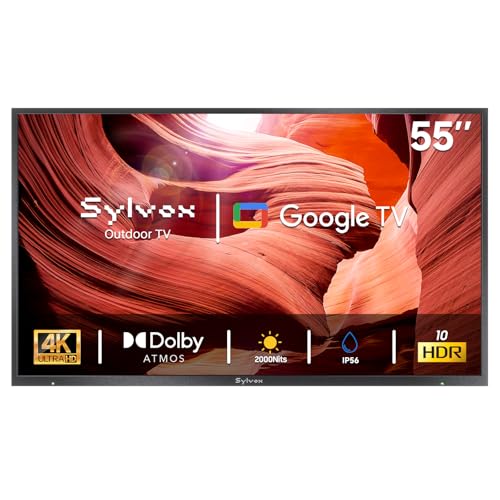
SYLVOX 55-inch Full Sun 2000-nit — Best All-Round Florida Pick
This is the screen the Florida brief was written for. The listing states 2,000 nits — the full-sun class, double the brightness of the partial-sun models — with 4K UHD resolution, an IP56 seal, Dolby Atmos support and SYLVOX’s Pool Pro 3.0 series engineering behind it. In an unshaded yard at one in the afternoon, that brightness is not a luxury specification; it is the entire difference between a television and a mirror. Sports stay legible, score graphics stay crisp, and the picture keeps enough contrast to be worth gathering around, which is the whole point of mounting a screen by a Florida pool.
The 55-inch size is the Florida sweet spot for most homes: large enough for a group spread between pool and patio, modest enough to mount on the wall of a typical lanai or pool house without structural drama. The IP56 rating handles the state’s horizontal rain and the spray environment of a pool deck, while the Pool Pro positioning tells you the brand engineered this series for exactly the yard, poolside and even commercial settings its listing names. Atmos support gives the audio a growth path — open-air sound dissipates fast, and a compatible soundbar under this screen turns game day into an event rather than a squint-and-listen exercise.
Google TV runs the software side, which suits Florida viewing habits: live sports, weather coverage that becomes essential viewing in storm season, and the full streaming bench for evening films once the heat breaks. A word on placement discipline even for a full-sun set: full-sun rated means the picture survives direct light, not that placement stops mattering. Angle the screen so the worst reflection hour does not sit squarely on the main seating, keep it clear of the direct blast of pool equipment, and the SYLVOX will do the rest. For the majority of Florida homes with an open yard, this is the default answer, and the QLED sibling below exists only for those who want its colour on top.
One more Florida-specific virtue deserves naming: this model’s positioning explicitly includes business use, and that tells you something about its intended duty cycle. A screen a maker is willing to pitch at restaurants and pool bars is a screen built to run long hours in heat without complaint — exactly the duty a Florida home imposes when the television goes on for the morning news and stays on, through the match, until the evening film. Domestic buyers benefit from commercial-grade stamina whether or not they ever think of it in those terms, and in this climate stamina is not a luxury specification.
- Panel: 55-inch 4K UHD
- Brightness: 2,000 nits, full-sun class
- Sealing: IP56 waterproof rating
- Audio: Dolby Atmos support
- Series: Pool Pro 3.0, positioned for yard, poolside and business use
Strengths
- 2,000 nits is the correct answer to unshaded Florida sun, stated plainly in the listing.
- Pool Pro engineering is purpose-built for poolside duty rather than adapted to it.
- Google TV covers the sports, news and streaming mix Florida households live on.
Trade-offs
- Full-sun brightness is wasted money under a deep lanai roof — the 1,000-nit pick below exists for those homes.
- IP56 is strong, though the IP65 picks in this guide seal tighter still.
- Built-in sound still benefits from a soundbar for big gatherings in open air.
Best for: unshaded yards and pool decks anywhere in Florida that need a screen readable at midday. Not suited for: deeply covered patios paying for brightness they will never switch on.
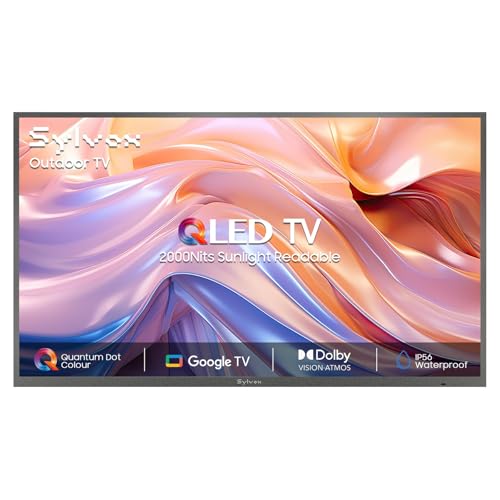
SYLVOX QLED 55-inch Full Sun — Best Full-Sun Colour
Brightness gets a picture visible in full sun; colour decides whether it is worth watching. The QLED version of SYLVOX’s full-sun 55 pairs the same 2,000-nit, IP56, sunlight-readable brief with a quantum-dot panel, and the difference shows exactly where Florida viewing is hardest. In brutal light, ordinary panels do not just dim — their colours collapse toward pastel, so a football field looks like faded felt and skin tones go waxy. QLED’s colour volume resists that collapse, holding saturated greens, reds and blues at high brightness, which is why this set is the connoisseur’s version of the pick above rather than a mere trim level.
Everything else about the proposition matches its sibling: 4K QLED resolution, the Pool Pro QLED 3.0 series positioning for poolside, backyard and business use, and Google TV — here badged as Google OS in the listing — running the services. That parity is the point. SYLVOX is offering one full-sun platform in two panel flavours, so the choice between them is a pure picture-quality decision with no ecosystem penalty either way. Households that watch a lot of sport will feel the QLED advantage in jerseys and turf; film lovers will feel it in the saturated palettes that Florida’s own light seems to dare a screen to reproduce.
Positioning advice mirrors the standard model: the rating invites open placement, but a slight downward tilt and a thought for the reflection path still repay the effort, and coastal owners should pair either SYLVOX with stainless mounting hardware and the rinse routine described later in this guide. If your yard is unshaded and your standards are high, this is the Florida screen that asks the fewest apologies — the one where visitors stop commenting on the conditions and start commenting on the match. It is also the natural centrepiece for the viewing parties Floridians throw around the events in our guide to best tvs for viewing sports, played outdoors at full Florida volume.
It is also worth saying who should skip this set, because its excellence is specific. If your viewing is mostly evening films under a roof, the QLED’s daylight colour muscle sits idle while the Deck Pro’s Dolby Vision does the work you actually value; if your yard is small, its 55 inches at full-sun brightness can feel like a floodlight with a streaming service attached. The QLED earns its premium in one scenario — open Florida sun, daytime viewing, high standards — and in that scenario it earns it completely, which is a more useful kind of praise than being told it is simply the best at everything.
- Panel: 55-inch 4K QLED
- Brightness: 2,000 nits, full-sun class, sunlight readable
- Sealing: IP56 waterproof rating
- Platform: Google TV / Google OS smart platform
- Series: Pool Pro QLED 3.0, for poolside, backyard and business
Strengths
- QLED colour volume holds saturation where full sun bleaches ordinary panels.
- Matches the standard full-sun pick specification for specification elsewhere.
- The strongest all-round picture available for an unshaded Florida yard in this guide.
Trade-offs
- It is the premium route to full-sun viewing; shaded homes should not pay it.
- Like its sibling, it rewards a soundbar for gatherings spread across a yard.
- QLED’s advantage shrinks after dark, when every good panel looks rich.
Best for: unshaded Florida yards where picture quality, not just legibility, is the standard. Not suited for: covered lanais, where its brightness and colour muscle go largely unused.

SYLVOX 65-inch Full Sun — Best for Big Pool Decks
Some Florida properties are not a yard with a pool in it; they are a resort that happens to have a mortgage. For those — the long pool decks, the outdoor kitchens under pergolas at the far end, the seating that spreads across thirty feet of pavers — a 55-inch screen reads like a postage stamp, and this 65-inch full-sun SYLVOX is the proportionate answer. It carries the same essential Florida specification as its smaller siblings: 2,000 nits of full-sun brightness, 4K UHD, an IP56 seal, Dolby Atmos support and Pool Pro 3.0 engineering, scaled to a panel that holds a crowd’s attention from the deep end to the grill.
Scale brings duties. A 65-inch outdoor screen is a significant object in Florida weather — wind load in a thunderstorm is a real engineering consideration, not a figure of speech — so the mount must anchor to structure with outdoor-rated, corrosion-resistant hardware, and coastal homes should treat stainless fixings as mandatory rather than aspirational. The reward for that diligence is a viewing experience no smaller set can imitate: evening films with genuine presence, sports that a dozen people can follow from the water, and a screen whose brightness does not merely survive the Florida afternoon but seems indifferent to it.
The platform is Google TV, consistent with the rest of the SYLVOX full-sun family, which keeps multi-screen Florida homes simple: one interface by the pool, whatever its size. Plan the audio with the same ambition as the picture — a screen this size in a space this open deserves the soundbar conversation from day one, because dialogue that has to cross a pool needs help that built-in speakers, however willing, cannot fully give. Judged as the flagship of this guide’s full-sun fleet, the 65 is exactly that: the pick for Floridians whose outdoor room is their biggest room.
There is also a rental and event dimension to a screen like this in Florida, where outdoor rooms are often the property’s headline feature. A 65-inch full-sun panel that can run a ballgame at noon, a film at nine and the weather radar at midnight — without anyone once suggesting the party move indoors — changes how a house is used and, frankly, how it is valued by the people who gather in it. That is a large claim for a television, but Florida is the one state where the outdoor room genuinely rivals the indoor one for hours lived, and this set is specified like it knows that.
- Panel: 65-inch 4K UHD
- Brightness: 2,000 nits, full-sun class
- Sealing: IP56 waterproof rating
- Audio: Dolby Atmos support
- Series: Pool Pro 3.0, for yard, poolside and business use
Strengths
- Full-sun brightness at a size that finally matches large Florida pool decks.
- The Pool Pro brief covers the wind, spray and heat of genuine outdoor scale.
- One platform across the SYLVOX family keeps a big property’s screens consistent.
Trade-offs
- Mounting is a structural project — budget for proper hardware and possibly help.
- It will overwhelm a modest lanai in both size and presence.
- Open-air audio at this scale really does require external speakers to match.
Best for: large pool decks and resort-scale Florida yards with seating spread wide. Not suited for: compact patios, or any wall that cannot offer structural anchoring.

55-inch IP65 Outdoor Google TV — Strongest Seal in Florida
Where the SYLVOX fleet leads on brightness, this 55-inch Google TV leads on the seal: IP65, the dust-tight grade, wrapped around a 4K UHD panel with 1,000 nits and a voice-assistant remote. In Florida terms, dust-tight is not about desert sand — it is about the fine, constant particulate of coastal life: salt crystals, pollen, pool-deck grit and the general airborne broth of a subtropical yard, all of which work their way into lesser cabinets across a few seasons. An IP65 cabinet simply declines the whole category of problem, and pairs that refusal with water-jet resistance for the storm season.
The 1,000-nit figure places it in the covered-to-partial class, and its listing is candid about the geography: kitchen, poolside, covered patio. That makes it the natural partner to the full-sun picks rather than their rival — the screen for the covered half of a Florida outdoor plan, or for homes whose yards are shaded by the mature oaks and palms that older Florida neighbourhoods are rich in. Dolby sound support and Google TV with voice assistance cover the entertainment side completely, and voice control is a genuinely poolside feature: nobody wants to fish a remote out from under a towel with wet hands to change a channel.
Because the listing presents the set without a big brand badge, apply the usual diligence: confirm the seller’s support arrangements, register the set on arrival, and keep the stated specifications. What the specification itself promises — the tightest seal in this guide, a proper smart platform, covered-patio brightness — is precisely what a large class of Florida homes needs, neither over-bought for sun they do not get nor under-sealed for weather they certainly do. In a guide full of screens shouting about the sun, this one makes its case in a quieter, very Floridian way: the storms are coming either way, and it is the best-sealed answer here.
There is a budgeting elegance to this pick that Florida’s covered-patio majority should appreciate. The state’s housing stock is full of homes whose outdoor life happens almost entirely under roof — the lanai is the living room, the yard is for the dog — and for those homes the full-sun fleet’s premium buys a capability that will literally never be exercised. This set redirects that money into the property that covered Florida spaces actually test, which is the seal, and into a platform the whole household already knows how to drive. Buying the exposure you have, rather than the exposure in the advertisement, is the most Florida-literate decision a shopper can make.
- Panel: 55-inch 4K UHD
- Brightness: 1,000 nits, covered and partial-sun class
- Sealing: IP65, dust-tight and water-jet resistant
- Platform: Google TV with voice-assistant remote
- Audio: Dolby sound support, per the listing
Strengths
- IP65 is the strongest seal in this Florida guide — dust-tight, storm-ready.
- Voice-assistant control suits wet-handed poolside operation perfectly.
- Honest covered-patio positioning saves shaded homes from over-buying brightness.
Trade-offs
- 1,000 nits will not hold an unshaded midday picture — that is the 2,000-nit class’s job.
- An unbranded listing means support runs through the seller; register promptly.
- Google TV’s content-forward home screen is not to every taste.
Best for: covered patios, shaded yards and poolside walls where sealing matters more than sun-fighting. Not suited for: fully exposed positions in direct all-day sun.

Titan S100 QLED 32-inch — Best for Lanais and Outdoor Kitchens
Florida outdoor life has small rooms too: the lanai corner with two chairs, the outdoor kitchen where the cook wants the game on, the screened porch off the primary suite. The Titan S100 QLED at 32 inches is built for those addresses, and it brings credentials out of proportion to its size — an IP65 dust-tight seal, a QLED panel with HDR10+, and Tizen running the software. It is, in effect, the covered-patio formula of its 43-inch sibling in our general weatherproof guide, distilled to the size that fits between a grill station and a door frame.
Small screens outdoors have a physics advantage worth naming: at the close distances of a lanai chair or a bar stool, a 32-inch 4K QLED looks dense and rich, and its modest glass area catches fewer reflections than a big panel would in the same spot. The QLED colour volume keeps food shows, nature footage and sport looking saturated in the bright ambient light of a screened room, and HDR10+ gives evening films proper tone mapping once the sun is down and the lanai becomes the best seat in the house.
Tizen will suit Samsung households immediately and everyone else after an afternoon. The honest limits are size and brightness class: this is a covered-space set, and a 32-inch screen cannot serve a pool deck’s far chairs. But Florida homes are full of covered corners that host more daily life than the big yard does — morning coffee, the news at the grill, a film on the porch — and for those corners the Titan is not a compromise at all. It is the right-sized, best-sealed, colour-rich answer, and its compact cabinet also makes it the easiest install in this guide by a wide margin.
The Titan also makes a quietly strong second-screen argument. Many Florida homes end up with two outdoor viewing points — the main deck screen and the place the cook, the early riser or the teenager actually sits — and a compact, tightly sealed QLED is the natural second citizen: same covered-patio philosophy as the big screens, no duplicated expense in brightness it cannot use, and a cabinet small enough to mount where a 55-inch set would require carpentry. Homes planning a pair should note the platform difference — Tizen here, Google TV on most of the fleet — and decide whether one remote logic across both screens matters more than this set’s size advantage.
- Panel: 32-inch 4K UHD QLED with HDR10+
- Sealing: IP65, dust-tight and water-jet resistant
- Platform: Tizen OS
- Positioning in the listing: covered patio outdoor TV
- Colour: quantum-dot panel for wide colour volume
Strengths
- IP65 sealing and QLED colour in a size that fits lanais and outdoor kitchens.
- Close-range viewing makes its 4K panel look especially dense and detailed.
- The lightest, simplest installation in this entire Florida guide.
Trade-offs
- Thirty-two inches cannot serve a crowd spread across a pool deck.
- Its covered-patio brief excludes exposed, full-sun mounting points.
- Tizen is a second ecosystem for households standardised on Google TV.
Best for: lanais, screened porches and outdoor kitchens where viewers sit close. Not suited for: open pool decks or any seating plan measured in tens of feet.

SYLVOX 55-inch 1000-nit — Best for Covered Patios
Not every Florida screen fights the sun. The state’s signature space is arguably the screened, roofed lanai — bright with ambient light, rich in humidity, but never struck by direct sun — and this SYLVOX Deck Pro model is specified for exactly that room: 1,000 nits, an IP56 seal, 4K UHD with HDR10, anti-glare treatment, and Dolby Vision with Atmos, a pairing its brighter siblings do not all claim. Dolby Vision matters most after dark, and Florida’s outdoor life peaks after dark in summer, when the heat breaks and the lanai fills. Vision’s per-scene tone mapping gives those evening films a refinement that daylight specifications never mention.
The anti-glare panel is the daylight half of the same thought. A lanai’s enemy is not direct sun but bounce — light off the pool, off pale pavers, off the screen enclosure’s bright frame — and a matte, anti-glare surface is the correct weapon, often worth more than raw nits in this specific architecture. Google TV runs the services, and the Deck Pro 3.0 positioning confirms the partial-sun, backyard brief. In other words, this is the SYLVOX family’s shade specialist, engineered by the same outdoor-first brand as the full-sun fleet but honest about a different assignment.
Choose it when your exposure audit says covered, and do not let full-sun envy talk you upward: brightness you never use is money that could have bought the soundbar, the better mount or the outdoor kitchen’s Titan above. Conversely, do not let this set’s polish talk you into mounting it in the open — 1,000 nits in unshaded Florida sun is a disappointment scheduled in advance. Within its brief, though, it is arguably the most refined viewing experience in this guide, because covered Florida spaces get its full specification with none of the compromises that noon imposes. Homes building a shaded retreat rather than a sun deck will also find kindred thinking in our roundup of best large tvs for bright room, where ambient light is fought with the same tools indoors.
One more consideration tips many lanai buyers toward this model: the screened enclosure’s light is bright but diffuse, and diffuse light is where anti-glare panels quietly out-perform brighter glossy ones, because there is no single reflection to dodge — the whole yard is the reflection. Under a cage or a roof, the Deck Pro’s matte discipline keeps the picture composed from every chair, including the awkward side seats that glossy screens sacrifice. Judge it from the worst chair in your lanai rather than the best, and this set’s case tends to make itself.
- Panel: 55-inch 4K UHD with HDR10 and anti-glare treatment
- Brightness: 1,000 nits, partial-sun class
- Sealing: IP56 waterproof rating
- Video and audio: Dolby Vision and Dolby Atmos
- Series: Deck Pro 3.0, for partial sun and backyard use
Strengths
- Dolby Vision makes it the evening-film specialist of this Florida fleet.
- Anti-glare treatment is the right weapon for a bright, screened lanai.
- IP56 sealing handles Florida humidity and storm drift under cover.
Trade-offs
- It is a covered-space set; unshaded placement wastes it and disappoints you.
- Full-sun shoppers get more for their conditions from the Pool Pro models.
- Its refinement shows most after dark, which not every household prioritises.
Best for: screened lanais and covered patios where evenings run long and ambient light bounces. Not suited for: any position the sun strikes directly for hours.
How Do You Host Game Day Outdoors in Florida Without Missing a Play?
Florida’s outdoor calendar is a sports calendar — college football Saturdays, spring training, golf from the state’s own tournaments, and the long baseball summer — and hosting it outside exposes the gap between a screen that is merely bright and a setup that is genuinely thought through. Start with the stream: outdoor Wi-Fi is the silent failure of most game days, because a router’s signal that scrolls a phone happily at the pool’s edge may not sustain a 4K broadcast when twenty guests’ phones join the network. Test the actual stream at the actual hour before the first gathering, and treat a mesh node near the lanai as standard Florida equipment rather than an extravagance.
Then choreograph the light. The worst reflection hour moves across the season, so the seating — not the screen — is often the adjustable variable: swing the loungers, angle the outdoor sofa, let the umbrella do tactical work for the two hours when the sun’s mirror sits in the water. Sound follows the same logic: a soundbar’s dialogue-forward mode will serve a crowd better than raw volume, and the cook at the grill deserves a Bluetooth speaker carrying the commentary more than the far chairs need more decibels. None of this is about the television alone, and that is the point — in Florida the screen is the anchor of an outdoor room, and the room is the product. The full-sun picks above give that room a picture that never has to apologise for the sky, which is why they anchor this guide.
How Do You Live With Salt Air, Heat and Storm Season?
Coastal ownership is a routine, not a purchase. Salt film accumulates invisibly on cabinets, mounts and connectors, so give the installation a gentle fresh-water wipe-down on a regular rhythm — a soft cloth, barely damp, no detergents on the screen, no hose at pressure — and inspect the mounting hardware each spring for the first freckles of corrosion. Stainless or properly coated hardware is not an upgrade near the water; it is the baseline, and replacing a corroded bracket is far cheaper than replacing the television it eventually drops. Inland homes can relax the salt routine but not the inspection: Florida grit and pollen are abrasive in their own right.
Heat management is mostly placement wisdom already covered in the picks: keep the cabinet’s air paths clear, never recess a set into a sealed box above an outdoor fireplace or grill, and remember that a wall above pale pavers receives reflected heat as well as light. Storm season adds one more discipline — know your set’s exposure honestly before the first named storm, because a screen rated and mounted for its position can simply be left alone, which is the entire point. The households that scramble to unmount televisions in September are, without exception, the households that mounted an indoor or under-rated set in June. Buy to the Florida brief and storm season becomes a viewing season: the weather coverage, after all, is very good television.
How Do You Mount a Television Poolside Without Regretting It?
Poolside mounting is a study in splash geometry. Every pool has a splash zone — the arc of water that leaves the surface when someone cannonballs, when the kids play, when the cleaner is lifted out dripping — and the television should live above and beyond it, not merely out of the direct line. Height helps twice: it lifts the cabinet out of the splash arc and puts the screen above the worst of the reflected glare off the water for seated viewers. Tilt the panel gently downward toward the loungers and you have also improved the reflection path at midday, when the sun’s mirror image in the pool is at its most theatrical.
The wall itself needs interrogating. Pool houses and lanai walls in Florida are often stucco over block, which anchors beautifully with the right masonry fixings — and terribly with the wrong ones. Use the hardware the mount maker specifies for your wall type, in stainless or properly coated finishes, and torque it like you mean it: a television over pavers beside water is the worst possible combination of weight, weather and consequence. Route power through a covered, weather-rated outdoor outlet, keep the cable run out of the splash zone, and give every descending cable a drip loop so storm water sheds before it reaches a port. Finish with a viewing test from the actual loungers and the shallow-end steps, because poolside seating is lower and wetter than patio chairs, and the screen should be angled for the audience that exists, not the one in the brochure.
How Should You Set the Picture for Florida Daylight?
Outdoor picture settings are a different discipline from the living room’s. Start with the brightest accurate picture mode the set offers for daytime — the mode that drives the panel at its rated output without crushing blacks into a grey soup — and save the gentler cinema mode for after dark, because a single setting asked to serve both noon and midnight will serve neither. Backlight and brightness controls do the heavy lifting in daylight; contrast should be set so that white clothing and pool water keep texture instead of clipping into a blank glare, which is the signature failure of an overdriven panel in sun.
Motion settings deserve a Florida word too, because so much poolside viewing is sport. Fast ball movement across a bright screen exposes every weakness in motion processing, so use the set’s sport or smooth-motion mode for games and switch it off for films, whose cadence it will soap-opera into strangeness. Finally, revisit the settings twice a year. Florida’s light in June and December is not the same light — the sun’s angle drops, the worst reflection hour moves, and the seating migrates toward the sun or away from it. A ten-minute seasonal adjustment is the difference between a screen that always seems slightly wrong and one that always seems to have been installed by someone who understood the yard.
How Does a Pool Cage Change the Calculation?
Much of Florida’s outdoor viewing happens inside a screen enclosure — the pool cage — and that structure quietly rewrites the television brief. The mesh knocks the edge off direct sun, which is why so many caged pools can live happily with the 1,000-nit class; but the same mesh does nothing about humidity, little about wind-driven rain at its edges, and nothing at all about the chlorine-rich atmosphere that hovers over a treated pool. In specification terms, a pool cage relaxes the brightness requirement by roughly one class and leaves the sealing requirement exactly where Florida put it. Buyers inside a cage should therefore shop this guide from the seal downward: IP65 and IP56 models first, brightness second.
The cage also changes reflections. Its frame and mesh throw a patterned ambient light that glossy screens pick up as a distracting shimmer, which is another argument for the anti-glare Deck Pro pick or the matte discipline of tilting and seating placement. And it changes audio: a cage is a semi-enclosed volume, so sound behaves better inside one than in an open yard — dialogue carries, a soundbar works less hard, and the neighbours hear less of your film. Floridians often assume the cage makes their space “basically indoors” for electronics. For light, halfway; for weather, not at all — and the picks in this guide were graded on that distinction.
Which Florida Screen Fits Which Florida Yard?
| Pick | Size | Brightness | Seal | Platform | Florida home it suits |
|---|---|---|---|---|---|
| SYLVOX 55-inch Full Sun | 55″ | 2,000 nits | IP56 | Google TV | The typical unshaded yard and pool wall |
| SYLVOX QLED 55-inch Full Sun | 55″ | 2,000 nits | IP56 | Google TV | Open yards where colour quality is non-negotiable |
| SYLVOX 65-inch Full Sun | 65″ | 2,000 nits | IP56 | Google TV | Resort-scale decks with seating spread wide |
| 55-inch IP65 Outdoor Google TV | 55″ | 1,000 nits | IP65 | Google TV | Shaded yards and covered poolside walls |
| Titan S100 QLED 32-inch | 32″ | Covered-space class | IP65 | Tizen | Lanais, porches and outdoor kitchens |
| SYLVOX 55-inch 1000-nit | 55″ | 1,000 nits | IP56 | Google TV | Screened lanais and evening-focused patios |
The table’s logic is exposure, then size, then taste. Unshaded homes choose among the three 2,000-nit SYLVOX models by colour standards and deck scale. Covered homes choose between the best seal (the IP65 Google TV), the small-room specialist (the Titan) and the evening-film connoisseur’s set (the Deck Pro with Dolby Vision). No row of this table is a consolation prize; each is the correct answer to a real Florida floor plan, and the wrong answers come only from mismatching the row to the roof line.
What Mistakes Do Florida Buyers Keep Making?
The state’s signature mistake is under-buying brightness out of optimism — standing in a yard at nine in the morning, judging it pleasant, and forgetting what that wall looks like at one. Judge exposure at the worst hour, in the worst month, or the 2,000-nit class will be purchased eventually anyway, after the first set disappoints. The second mistake is coastal hardware: indoor brackets and ordinary screws in salt air are a countdown, and the failure mode is a television on pavers. Stainless fixings and a spring inspection are the entire cost of never telling that story.
Then come the installation errors with a Florida accent. Mounting low over a pool deck puts a set in the splash zone and the reflected-heat pocket at once. Recessing a cabinet into a sealed feature wall rebuilds an oven in the state that least forgives ovens. Aiming a sprinkler or a pool’s water feature at the screen tests a rating daily that was designed for weather, not for plumbing. And the paperwork mistake repeats here too: failing to register the set or keep its stated specifications, in the state most likely to test a weatherproofing warranty. Every one of these is a planning error, not a product failure — which is good news, because planning is free.
What Does Florida Do to a Screen Across Five Years?
Year one is the honeymoon: any decent outdoor set looks invincible. The Florida test is cumulative. Across five years, an under-specified screen accumulates small defeats — a polariser tired by heat it was never built for, so the picture takes on a permanent milkiness at the edges; connector corrosion that turns an occasional flicker into a weekly one; a bracket freckled with rust that stains the stucco beneath it; backlight output faded just enough that the noon picture, marginal at purchase, becomes a rumour. None of these arrive as a dramatic failure. They arrive as a slow lowering of the whole experience, which is why Florida buyers should purchase for year five, not month one.
The correctly specified set ages differently because each Florida weapon met its countermeasure at purchase: full-sun brightness with headroom to spare for the panel’s gentle natural fade, a dust-tight or strongly sealed cabinet keeping the damp broth outside, thermal design that treats a pool-deck summer as a normal Tuesday, and hardware that still looks like hardware after five springs of inspection. That is the real content of this guide’s price ladder. The difference between the shade-class set and the full-sun fleet is not a feature list — it is five years of Florida, answered in advance.
What Should You Check on the Day the TV Arrives?
Florida installations reward a commissioning ritual. First, before the mount is finalised, power the set at the wall and check the picture at the worst hour of light, not the kindest — if the noon test fails, it is far better to learn that while repositioning is still a conversation rather than a construction project. Second, run the platform update and sign in to every service on day one, while the ladder is out and the patience is fresh; a television that needs a password typed with a remote in August should not also need its first software update then. Third, photograph the rear panel connections and the mount hardware, and store those photographs with the registration confirmation — in a state where a warranty conversation may one day involve weather, documentation is a feature.
Then set the two picture personalities the Florida day demands: a daylight mode driven at the panel’s confident best for the sun hours, and an evening mode with gentler brightness and proper film cadence for the hours when the lanai becomes the house’s favourite room. Show the household how to switch between them, because the best-configured television in Florida is useless if only one person knows where the setting lives. Finish by walking the yard at night and looking at the screen from the street side: a well-aimed set serves its own seating and keeps its glare to itself, which is simply good manners in a neighbourhood where everyone lives outdoors.
Final Recommendation
Start with the roof line, because in Florida the roof line is destiny. No roof: take the SYLVOX full-sun fleet — the standard 55 for most yards, the QLED 55 when colour is the standard, the 65 when the deck is a destination. Roof: take the seal and the subtlety — the IP65 Google TV for covered poolside walls, the little Titan for the lanai’s close quarters, the Deck Pro SYLVOX when evenings are the main event and Dolby Vision will be fed properly. Match the screen to the sun it will actually meet and the storms it will certainly meet, and a Florida outdoor TV stops being a gamble against the climate and becomes what it should have been all along: the most-used room of a Florida house, finally given its picture.
Frequently Asked Questions
Do I really need 2,000 nits in Florida?
Only if the sun reaches the screen — but in Florida, it usually does. Unshaded yards and pool walls spend much of the day in direct light, and that is precisely the condition the 2,000-nit class was built for. Covered lanais and shaded patios genuinely do not need it, which is why half this guide sits at 1,000 nits without apology.
How do I protect an outdoor TV from salt air?
Specify for it and then maintain for it: a properly sealed set, stainless or coated mounting hardware, and a gentle fresh-water wipe of cabinet and bracket on a regular rhythm near the coast. Salt damage is slow and cumulative, which means the routine beats the rescue — five minutes monthly outperforms any heroic cleaning after a year of neglect.
Should I bring the TV inside during a hurricane?
A genuinely outdoor-rated set, correctly mounted to structure in its stated exposure class, is designed to be left in place — that is the product’s purpose. What you should do before a storm is clear loose objects from the yard, confirm the mount is sound, and cut power if you evacuate. Households that feel the need to unmount are usually households whose set was never Florida-rated to begin with.
Is a screened lanai considered full shade?
Functionally, yes for brightness purposes: the screen and roof block direct sun, so the 1,000-nit class and anti-glare treatments handle the ambient light comfortably. But a lanai is not indoor conditions — humidity, pollen and storm drift all pass a screen enclosure, so the sealing requirement stays Florida-grade even when the brightness requirement relaxes.
Can one of these TVs run all day in Florida heat?
These are purpose-built outdoor designs, and heat tolerance is part of that brief — but placement still matters. Keep air moving around the cabinet, avoid sealed recesses and heat traps above grills or fire features, and a set will handle the Florida summer as a matter of routine. The failures come from installations that rebuild an oven around a product designed to breathe.
What size should a Florida pool TV be?
Measure from the farthest lounger, not the wall. Most pool decks are served honestly by 55 inches, which is why three of this guide’s six picks live there; genuinely large decks with seating spread across them justify the 65-inch full-sun model; and the close quarters of a lanai or outdoor kitchen are better served by the 32-inch Titan than by a big screen mounted too close. When in doubt, tape the outline on the wall and live with it for a day — Florida light will tell you more than any size chart.
Do outdoor TVs need a cover in Florida?
A properly rated set does not need one for weather protection, and a cover should never substitute for a rating. What a breathable cover can do in Florida is keep the worst of the pollen, salt film and pool-deck grit off the screen between uses, which reduces cleaning — a convenience, not a defence. If you use one, let the set cool and dry first; sealing a damp television inside fabric recreates the humidity trap the cabinet was built to refuse.
Related Guides
Readers outside the full-sun belt should compare the broader fleet in best weatherproof tvs, and anyone furnishing the yard’s audio end of the experience will find the weatherproof listening options in best bose outdoor speakers.
Efficiency is a climate strategy too; our guide to the best energy smart small tvs shows how the smallest smart screens cut the draw.
The living-room counterpart to all this weather armour is the big indoor panel, and our guide to the best 75 samsung tvs covers the current Samsung ladder.


