What's inside
- Key Takeaways
- Quick Picks
- How Did We Choose These Six for the Road?
- Why Does 12-Volt Native Power Matter So Much?
- How Do the Six Compare Side by Side?
- How Should You Install and Power an RV TV Properly?
- What Mistakes Do RV TV Buyers Make?
- How Much Power Does an Evening of Television Really Cost?
- Which Size Belongs in Which Rig?
- What Does Sound Do in a Space This Small?
- How Should You Care for a Television That Travels?
- Final Recommendation
- Frequently Asked Questions
- Related Guides
As an Amazon Associate I earn from qualifying purchases. This post may contain affiliate links at no extra cost to you.
gizmoverdict.com is reader-supported. When you buy through links on our site, we may earn an affiliate commission.
Before the picks, a shopping habit worth adopting for this category: read the power line of any listing twice. In RV television, the difference between a set that runs happily off your house batteries and one that quietly demands shore power is a single phrase in the title — 12V, AC/DC, a voltage range — and it matters more than every picture specification below it combined.
The best AC DC RV TVs exist because a recreational vehicle is not a small house. Its electrical system is a negotiation between a battery bank that must last the night, a converter that hums when the hookup is live, solar panels that give generously at noon and nothing at midnight, and appliances that all take turns. A television that only understands a wall socket forces that negotiation to include an inverter every time it is switched on, with the inverter’s own losses and fan joining the evening. A television built for 12-volt DC life plugs into the vehicle’s native current, sips rather than gulps, and keeps working at the boondocking site where the hookup does not exist.
The six sets below span the real shape of the RV market. At the top sits a 43-inch Jensen built specifically for RV installation, the largest screen here. Two SYLVOX models bring wide-voltage protection and built-in DVD players, features that sound nostalgic until you are parked beyond the reach of any signal worth streaming. A 32-inch continu.us and a 24-inch Supersonic cover the mid-size and kitchen roles, and a 22-inch Free Signal Transit serves the smallest rigs. Resolutions are honest RV resolutions — mostly 1080p, one 720p — because at RV viewing distances, in RV-sized rooms, power discipline outranks pixel counts.
Set expectations accordingly and this category delights. These are not living-room flagships shrunk; they are appliances designed around vibration, voltage swings, tight cabinets and battery budgets. Judged by those standards — the standards of the road — several of them are excellent. Judged by home-theatre standards they were never built to meet, they would look ordinary, and this guide will judge them by the road’s standards throughout, while telling you plainly where each one sits on picture quality so nobody is surprised at the first campsite.
Key Takeaways
- Native 12-volt operation is the whole point: it skips the inverter, saves battery, and keeps the television alive off-grid.
- The SYLVOX sets state wide voltage protection from 9 to 32 volts, which speaks directly to the voltage swings of a working RV electrical system.
- Built-in DVD players, offered by three picks here, are a serious feature beyond signal range — a library that never buffers.
- The Jensen is the big-screen exception at 43 inches and 1080p, for larger rigs with the cabinet and battery to support it.
- Resolution tops out at 1080p in this pool and one pick is 720p; at RV distances that is a reasonable trade, made knowingly.
- Mount and vibration thinking matters as much as picture thinking — these sets live on roads, not in dens.
Quick Picks
| Pick | Badge | Why it earns its place |
|---|---|---|
| Jensen JTV4325DCS 43-Inch 12V | Best for large rigs | A 43-inch 1080p smart set built for 12V RV life, with LAN and optical audio in the listing. |
| SYLVOX 32-Inch Smart RV TV (DVD) | Best all-round RV set | 12/24V Google TV with a DVD player, anti-vibration design and 9–32V protection stated. |
| SYLVOX 22-Inch 12V TV (DVD) | Best for small rigs | A compact Google TV with DVD aboard, sold for RV, camper, boat and coastal home alike. |
| continu.us 32-Inch 12V RV Smart TV | Best streaming-first 32 | Android TV with Chromecast and Google Assistant for rigs that usually have a signal. |
| Free Signal Transit 22-Inch 12V | Best simple off-grid set | An AC/DC LED set with HDMI and USB, aimed at RVs, campers, boats and off-grid use. |
| Supersonic SC-2426SDVD 24-Inch | Best with full tuner flexibility | ATSC and NTSC, three HDMI ports, DVD aboard and a DC car cord in the listing. |
How Did We Choose These Six for the Road?
Power architecture came first, because it is the category. Every pick runs natively on vehicle DC power — 12 volts, or in the SYLVOX cases a stated range spanning 12 and 24 — and every pick also accepts AC for the shore-power hours, which is what AC/DC on the keyword promises. Sets that merely tolerate an inverter were not eligible; the guide is about televisions that speak the vehicle’s electrical language without a translator.
Second came roadworthiness as the listings describe it: anti-vibration design where stated, voltage protection where stated, mounting compatibility where stated. We credited claims in proportion to their specificity — a stated 9-to-32-volt protection range says more than a vague ruggedness adjective — and the reviews below attribute every such claim to its listing rather than adopting it as our own measurement. Third came the RV programme diet: broadcast tuners for over-the-air stations at the campsite, DVD for the dead zones, streaming for the hookup sites, in proportions that vary by pick and by traveller.
Picture quality was judged on a curve the category itself sets. A 1080p panel at 32 inches, viewed from a dinette two metres away, is a sharp picture by any honest standard; the same resolution at 43 inches in a large fifth-wheel remains entirely watchable. The single 720p pick is labelled as such wherever it appears, because a buyer choosing it for a bedroom nook deserves the fact without varnish — and at 32 inches across a small RV bedroom, many will accept the trade for its streaming completeness. Nobody in this guide pretends these sets out-resolve a home flagship, and nobody needs them to.
Why Does 12-Volt Native Power Matter So Much?
Run the electricity both ways and the answer appears. A household television on an inverter draws from the battery through a conversion that wastes a share of the energy as heat, adds the inverter’s own standby appetite, and often adds a fan’s worth of noise to a small cabin at night. A native 12-volt set draws the vehicle’s current directly, at an efficiency the conversion cannot match, and it keeps working through the situations RV life actually contains: the quiet hours at a campground with generator rules, the third overcast day on solar, the lunch stop where a programme finishes over sandwiches with the engine off.
Voltage behaviour is the second half of the argument. An RV’s nominal 12 volts is a polite fiction; the system swings with charging, with loads, with the converter’s mood. Equipment built for the vehicle expects the swing. The SYLVOX listings state protection across 9 to 32 volts, which is a designed tolerance for exactly this reality, and the Jensen’s RV-specific design brief points the same direction. A household set, by contrast, expects its power tidy and complains — sometimes permanently — when a vehicle’s untidiness arrives through an adapter. Buying the vehicle-rated set is buying the tolerance, and on the road the tolerance is the product.
There is also a wiring simplicity that owners come to love. A 12-volt set can be fed from the same fused DC circuits as the lights and the fans, switched with them, and understood by any RV technician in any small town. The installation stops being an electrical project and becomes an appliance swap. For full-timers especially, that maintainability — the sense that every system aboard can be serviced by the road’s own infrastructure — is worth more than a spec-sheet victory in a category the vehicle never asked about.

Jensen JTV4325DCS 43-Inch 12V — Best for large rigs
Jensen is one of the names RV manufacturers themselves install, and the JTV4325DCS shows why the brand owns that niche: a 43-inch Full HD smart LED television designed from the start for 12-volt RV life. Its listing names Wi-Fi, HDMI, USB, LAN and RF connections, optical audio output, a 3000:1 contrast figure, 220 nits of brightness and VESA mount compatibility. Read that list as an integrator’s checklist — this is a set meant to be built into a large rig’s entertainment wall, wired to its network, its antenna and its sound system, and then to disappear into the vehicle’s life.
The size is the headline and the caveat in one. Forty-three inches transforms a big fifth-wheel or Class A lounge, giving the main living space a genuine focal screen rather than a compromise monitor. It also asks honest questions of the installation: the cabinet or wall must take it, the mount must hold it through road vibration, and the battery bank must feed the largest panel in this guide through an evening. Jensen’s 220-nit brightness figure, stated in the listing, is modest by household standards and entirely typical of the power-conscious RV class — in a shaded RV interior, which most are by design, it is sufficient; in a sun-blasted toy hauler with the ramp down, it will work harder.
The LAN port deserves its sentence, because wired networking in an RV sounds eccentric until the campground Wi-Fi collapses at eight in the evening and the rig’s own router, fed by a roof antenna or a cellular modem, becomes the household’s real internet. A set that can plug into that router rather than beg the park’s access point is a set designed by people who have actually camped. Paired with the optical output for a soundbar, the Jensen is the closest this guide comes to a home system that happens to run on vehicle power — for the rigs that can host it.
- Panel: LED, 43-inch class, Full HD 1080p
- Power: 12V RV television, per the listing title
- Connections named: Wi-Fi, HDMI, USB, LAN, RF and optical audio, per the listing title
- Picture figures: 3000:1 contrast and 220 nits, per the listing title
- Mounting: VESA mount compatible, per the listing title
Strengths
- The largest screen in the guide, from the RV industry’s own installation brand.
- LAN and optical audio make it a true hub for a well-equipped rig’s entertainment system.
- Designed-for-RV power and mounting brief, rather than a household set with an adapter.
Trade-offs
- Its size and appetite demand a large rig’s cabinet, mount and battery bank.
- The stated brightness is RV-class modest; very bright interiors will notice.
- No DVD player aboard, so dead-zone viewing depends on downloads and the tuner.
Best for: a Class A or large fifth-wheel lounge being fitted out as the household’s main screen. Not suited for: a compact camper van where a 43-inch panel would dominate the single living wall and drain a small battery bank by bedtime.
SYLVOX 32-Inch Smart RV TV (DVD) — Best all-round RV set
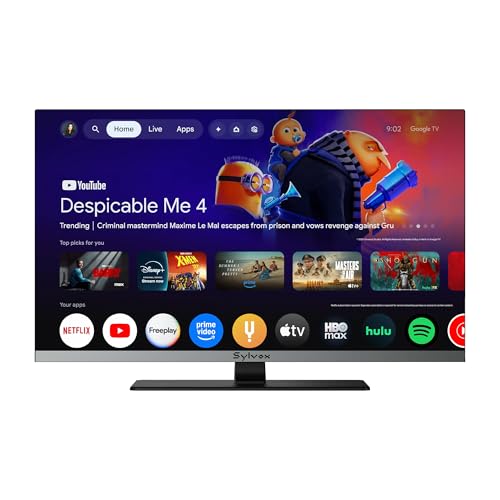
If one pick in this guide reads like a checklist written by full-timers, it is this SYLVOX. The listing describes a 32-inch 1080p Google TV for 12 and 24 volts, with a built-in DVD player, an anti-vibration design, wide voltage protection from 9 to 32 volts and ultra-narrow bezels, in the maker’s Limo Series for 2026. Nearly every phrase answers a known road complaint: the voltage range answers the electrical swings, the anti-vibration design answers the corrugated miles, the DVD answers the dead zones, and Google TV answers the hookup nights with the full streaming catalogue.
The 32-inch size is the RV sweet spot for a main set in mid-size rigs — large enough across a travel trailer’s living area, small enough for its power and its cabinets. Full HD at this size, viewed at RV distances, is sharp in the way that matters and frugal in the way that matters more. The 12/24-volt span widens its world beyond RVs to boats, trucks and larger vehicles with 24-volt systems, and the stated protection range means the set expects the electrical untidiness those worlds share.
Google TV is the right platform for the mixed RV diet, because it treats streaming services, broadcast and local media as citizens of one home screen, and because its download options — app by app, service by service — support the load-up-before-the-dead-zone habit this guide recommends later. As an all-rounder it lacks only the Jensen’s scale and wired-networking brief. For the majority of rigs, which are mid-size and mixed-use, this is the pick the guide would install first and defend longest.
- Panel: 32-inch class, 1080p Full HD
- Power: 12V/24V with wide voltage protection from 9 to 32 volts, per the listing title
- Design: Anti-vibration design with ultra-narrow bezels, per the listing title
- Media: Built-in DVD player, per the listing title
- Platform: Google TV, Limo Series 2026, per the listing title
Strengths
- The most complete road brief in the guide: voltage tolerance, vibration design and DVD in one set.
- Google TV covers the streaming half of RV life with the broadest app shelf here.
- The 32-inch 1080p combination balances picture, power and cabinet fit for mid-size rigs.
Trade-offs
- Buyers wanting a wired LAN connection will find the Jensen’s brief more complete.
- DVD is moving-part hardware in a vibrating vehicle; treat it as a bonus, not a foundation.
- Its all-round excellence leaves big-rig owners still looking up at the 43-inch option.
Best for: a mid-size travel trailer or motorhome that mixes hookup sites with off-grid nights. Not suited for: a minimalist teardrop trailer where even 32 inches has no honest wall to live on.

SYLVOX 22-Inch 12V TV (DVD) — Best for small rigs
The smaller SYLVOX takes the same road philosophy down to 22 inches, and its listing casts the widest lifestyle net in the guide: a 1080p smart television with a built-in DVD player, Google OS, ATSC and NTSC tuners, Wi-Fi, Bluetooth, HDMI and USB, AC/DC powered, sold for RVs, campers, boats and coastal homes in the maker’s Marine Series. That breadth is honest rather than vague — the small, power-flexible, tuner-equipped set is a genuinely multi-world appliance, as at home in a boat cabin or a kitchen as in a camper’s bedroom nook.
At 22 inches, the set is a personal screen: the bedroom television in a larger rig, the only television in a small one, the galley screen on a boat. Full HD resolution at this size is dense and crisp at the short distances small spaces impose. The DVD player scales down gracefully too — in a small rig, shelf space for a separate player does not exist, and a drive inside the television is the difference between carrying a film library and leaving it home. Bluetooth, named in the listing, earns its keep at this size as well, feeding a small speaker or headphones in a space where the set’s own audio competes with weather and road noise.
Choose it where space is the first constraint and versatility the second. It will not anchor a lounge, and it is not meant to; it is the set that makes small-rig evenings complete — news over dinner at the tiny table, a film in the bunk, the weather before a travel day — without asking the vehicle to reorganise itself around a screen. In a category that often equates bigger with better, this pick is the guide’s reminder that the road rewards fit.
- Panel: 22-inch class, 1080p
- Power: 12V with AC/DC operation, per the listing title
- Tuners: ATSC and NTSC, per the listing title
- Media: Built-in DVD player; Wi-Fi, Bluetooth, HDMI and USB named
- Series: Marine Series, sold for RV, camper, boat and coastal home use
Strengths
- A complete entertainment system — tuner, streaming, DVD, Bluetooth — in a 22-inch footprint.
- Full HD at this size is genuinely crisp at small-space distances.
- Its multi-world brief suits rigs, boats and small homes with one purchase.
Trade-offs
- Twenty-two inches is a personal screen; a family lounge will outgrow it immediately.
- Built-in audio at this size is for news and dialogue, not for film nights.
- Voltage protection range is not stated in this listing as it is on the 32-inch model.
Best for: a camper van, a small trailer’s bedroom or a boat cabin needing one complete small screen. Not suited for: a large rig’s main lounge, where its virtues of compactness become the whole family’s constraint.

continu.us 32-Inch 12V RV Smart TV — Best streaming-first 32
The continu.us takes the opposite bet from the DVD picks: that your RV life mostly happens within reach of a signal, and that the television’s job is to stream beautifully when it does. Its listing describes a 32-inch 12V RV smart TV on Android TV, with Google Assistant, Chromecast and free streaming apps — and 720p HD resolution, stated plainly. That last figure is this pick’s defining honesty test, and the review will meet it head-on: at 32 inches, 720p is a visible step below the 1080p sets around it, most noticeable in fine detail and text-like content, least noticeable in ordinary programmes viewed across an RV living space.
What the resolution buys is the rest of the package’s completeness at its position in the market. Android TV with Chromecast is arguably the most convenient casting arrangement in this guide — any phone in the rig can throw a video, a photo set or a downloaded programme onto the screen without a remote negotiation — and Google Assistant handles the voice side. For rigs that live on hookups, campground Wi-Fi and a good cellular plan, where the evening genuinely is streaming, this set covers the actual use case with the least friction of any pick here.
The judgement is therefore conditional in a way the DVD picks are not. If your travels keep a signal, the continu.us is a rational, likeable main set whose resolution you will rarely think about. If your travels chase the empty map — national forest sites, desert boondocking, the far side of mountain ranges — its streaming-first design leaves the dead-zone evenings to downloads you remembered to make, and the SYLVOX picks’ disc drives will look wiser with every mile. Know your map, and this pick sorts itself.
- Panel: 32-inch class, 720p HD, per the listing title
- Power: 12V RV television, per the listing title
- Platform: Android TV with Google Assistant, per the listing title
- Casting: Chromecast built in, per the listing title
- Content: Free streaming apps named in the listing title
Strengths
- Chromecast makes it the easiest screen in the guide for phones to feed.
- Android TV covers the mainstream streaming services hookup travellers actually use.
- A full-size 32-inch main screen for rigs whose lives are lived on signal.
Trade-offs
- The 720p panel is the lowest resolution in the guide and detail-seekers will see it.
- No DVD aboard, so off-grid evenings depend entirely on downloads and broadcast.
- Its value case collapses for travellers whose favourite sites have no signal.
Best for: a hookup-oriented travel trailer whose evenings are streamed and whose phones do the choosing. Not suited for: a boondocking rig that spends its nights beyond coverage, where a disc library is the reliable programme guide.

Free Signal Transit 22-Inch 12V — Best simple off-grid set
The Transit is the guide’s argument for simplicity. Its listing describes a 22-inch LED flat screen for RV use, AC/DC powered, with HD resolution, HDMI and USB inputs, aimed at RVs, campers, boats and off-grid applications. There is no smart platform headline, no voice assistant, no app catalogue — and for a certain kind of traveller that absence is the feature list. A simple set boots fast, draws modestly, presents no accounts to maintain, and connects to the antenna, the media stick or the USB drive of recordings you already own.
USB deserves emphasis at this size and philosophy. A drive loaded at home with films, series and the children’s favourites turns the Transit into an offline cinema with no moving parts, no discs to scratch in a drawer over corrugated roads, and no signal required. HDMI accepts whatever smarter box you favour — a streaming stick on hookup nights, a laptop, a game console in a larger rig’s second space. The set is a screen in the old, honourable sense: it displays what you bring it, reliably, on the vehicle’s own current.
Off-grid and simplicity-minded buyers should still note the trade plainly: anything smart must be added, and the panel’s HD resolution is stated without a figure this review will not embellish. But judged by the standards of a solar-and-battery weekend, a screen that asks little, sips power and shows the antenna’s weather and the drive’s film library without ceremony is not a stripped product. It is a correctly specified one, and the Transit has quietly served exactly that brief for years of model life.
- Panel: 22-inch LED flat screen, HD resolution, per the listing title
- Power: AC/DC powered, 12-volt class, per the listing title
- Inputs: HDMI and USB named in the listing title
- Intended use: RVs, campers, boats and off-grid applications, per the listing title
- Platform: No smart platform stated in the listing — bring your own source
Strengths
- The simplest, lowest-demand set here — ideal for small battery and solar setups.
- USB playback makes it an offline screen with no moving parts to fail on the road.
- HDMI leaves the smart question open to whatever stick or box you already own.
Trade-offs
- No built-in streaming platform, tuner claims or DVD — sources are your responsibility.
- Resolution is stated only as HD in the listing, the vaguest picture brief here.
- Households wanting one remote and one home screen will find it too plain.
Best for: a small off-grid camper or boat where power discipline and simplicity outrank apps. Not suited for: a family that wants the television itself to run Netflix the moment the hookup connects.

Supersonic SC-2426SDVD 24-Inch — Best with full tuner flexibility
Supersonic’s 24-inch set is the maximalist of the small screens: a smart LED HDTV at 1080p with a built-in DVD player, both ATSC and NTSC tuner systems, three HDMI inputs, Wi-Fi, USB, multi-language on-screen display, AC/DC compatibility and a DC car cord included in the listing. Unpack that slowly, because each item answers a distinct road scenario. The dual tuner systems matter to travellers who cross between broadcast standards’ territories and older park cable systems. Three HDMI ports matter to the rig that carries a streaming stick, a console and a laptop. The included car cord matters the day the set moves between vehicles.
The 24-inch size sits in the useful gap between personal and shared: big enough for a small family’s dinette viewing, small enough for a bedroom bulkhead or a kitchen counter in a larger rig — the listing itself names home, kitchen and RV camper among its habitats, and the set’s flexibility genuinely spans them. Wi-Fi smart features cover the streaming nights, the DVD covers the silent ones, and the tuners cover everything the air offers at each new site, which in much of the countryside is a surprising amount of free programming.
Against the 22-inch SYLVOX, its closest rival, the Supersonic trades the Google platform polish for hardware generosity — more ports, both tuner systems, the cord in the box. Against the Transit it is the everything answer where the Transit is the simple one. Travellers who collect sources the way they collect campsites will feel understood by this set; minimalists will find it busy. The guide’s sympathy is with the collectors here, because on the road, the port you did not bring is the one the evening eventually asks for.
- Panel: 24-inch LED, 1080p, per the listing title
- Tuners: ATSC and NTSC systems, per the listing title
- Inputs: Three HDMI plus USB, per the listing title
- Media: Built-in DVD player and Wi-Fi smart features, per the listing title
- Power: AC/DC compatible with DC car cord included, per the listing title
Strengths
- The most complete connection and tuner brief of any small set in the guide.
- DVD, streaming and dual broadcast systems cover every evening the road offers.
- The included DC cord makes vehicle fitting a same-day job rather than a parts hunt.
Trade-offs
- Its smart platform is less polished than the Google TV sets for app breadth.
- Twenty-four inches still reads as a secondary screen in a large lounge.
- The feature abundance means a busier menu system for simple tastes.
Best for: a gadget-carrying traveller whose rig hosts several sources and crosses broadcast territories. Not suited for: a one-source minimalist who wants the television to disappear into a single remote and a single home screen.
How Do the Six Compare Side by Side?
| Pick | Size and resolution | Dead-zone answer | Character |
|---|---|---|---|
| Jensen JTV4325DCS | 43-inch, 1080p | Tuner and downloads | The installed-system flagship |
| SYLVOX 32 (DVD) | 32-inch, 1080p | Built-in DVD | The complete road all-rounder |
| SYLVOX 22 (DVD) | 22-inch, 1080p | Built-in DVD | The small-rig complete set |
| continu.us 32 | 32-inch, 720p | Downloads only | The streaming-first set |
| Free Signal Transit 22 | 22-inch, HD | USB library | The simple off-grid screen |
| Supersonic 24 | 24-inch, 1080p | Built-in DVD | The connection maximalist |
The dead-zone column is the table’s honest centre. Every RV traveller eventually parks beyond the signal, and what the television does that night separates the road-designed sets from the road-tolerated ones. Three picks carry their own library on disc, one carries it on USB, and two rely on preparation. None of those answers is wrong, but they belong to different travel styles, and the table exists so the style chooses the set rather than the showroom doing it.
How Should You Install and Power an RV TV Properly?
Start with the mount, because the road will test it before the picture matters. Use a locking or firmly damped mount rated for the set’s weight, fixed into structure — a stud, a reinforced cabinet panel — rather than into decorative wallboard alone. Jensen’s listing names VESA compatibility, and the pattern language is universal: match the pattern, use the correct bolts, and add a strap or a travel latch if the mount articulates, because a swinging television on a mountain descent is a hazard with a screen. Leave ventilation room behind the panel; RV cabinets trap heat in summer in a way living rooms never do.
Wire the power as the vehicle intends. Feed a 12-volt set from a fused DC circuit sized for its draw, with the fuse accessible, and keep the run short and tidy. If the set will also use AC on shore power, let the vehicle’s own systems handle the changeover rather than improvising adapters. Test the full cycle before the first trip: battery only, converter charging, solar at noon, inverter off, inverter on — because the evening a set misbehaves electrically is always the evening farthest from help. The SYLVOX sets’ stated voltage protection buys forgiveness here, but good wiring is still the foundation.
Finish with the antenna and the library. A roof antenna aligned at each site, a channel scan saved per location where the set allows it, and a media routine — downloads refreshed on hookup nights, the disc wallet or USB drive audited before long off-grid stretches — turn the television from a hope into a system. The road rewards preparation in exact proportion to how far it takes you from alternatives, and entertainment is simply one more system aboard that obeys the rule.
What Mistakes Do RV TV Buyers Make?
The foundational mistake is buying a household television and an inverter and calling it an RV setup. It works, in the way a generator on the roof would work — noisily, wastefully, and with a failure list that grows by the season. The second mistake is the reverse snobbery: assuming an RV set’s modest brightness and resolution figures mean a miserable picture, then over-buying size to compensate and draining the battery bank to feed it. Judge these sets at RV distances in RV interiors, which is where their numbers were chosen to make sense.
Mounting mistakes fill repair shops: screws into paneling alone, mounts without travel locks, cables left to chafe through insulation across ten thousand miles of vibration. Every one of them is preventable in the installation hour and expensive afterward. A fourth mistake is neglecting the dead-zone plan until the first silent evening, when the family discovers the streaming set has nothing to say beyond the ridge. The disc wallet, the loaded USB drive and the refreshed downloads are not nostalgia; they are provisioning, and provisioning is the road’s first commandment.
Finally, buyers forget that an RV television is also a household appliance in a moving household: it will be cleaned with the wrong spray, bumped by a flying cupboard item, and asked to work in a cold-soaked cabin in November and a heat-soaked one in August. Sets designed for the vehicle — anti-vibration where stated, voltage-tolerant where stated, built by makers who sell to the industry — exist precisely because the environment is the specification. Buy for the environment first and the picture second, and the picture will take care of itself at the distances the environment allows.
How Much Power Does an Evening of Television Really Cost?
Think in evenings rather than watts and the budgeting becomes intuitive. An evening’s viewing — news at dinner, a film, the weather before bed — runs perhaps four hours. A native DC set in the 22-to-32-inch classes draws modestly through those hours, a fraction of what the same evening costs through a household set and an inverter once conversion losses and standby appetite join the bill. The 43-inch Jensen asks more, as its size promises, which is why its section pairs it with the larger battery banks of larger rigs. The exact figures belong to each set’s documentation, and buyers planning around a small solar array should read them there; the structural point survives every model, which is that the native-DC architecture is the efficiency, and it compounds across a season of evenings.
The hidden draws deserve naming because they ambush the unprepared. A streaming set left connected to a router that itself never sleeps, a USB drive’s light glowing all night, a television whose standby mode keeps its network stack awake for instant-on convenience — each is small, and together they tax the bank that a boondocking morning depends on for the furnace fan and the water pump. The road discipline is simple: know your set’s standby behaviour from its manual, switch the entertainment circuit off at the panel when the evening ends if your rig allows it, and let the simple sets’ plainness — the Transit asks almost nothing at rest — count as the feature it is.
Solar households should also note the happy arithmetic of daytime. A panel-fed system at noon often runs a surplus, and a television used for a midday match or a rainy-afternoon film is spending the day’s most abundant electricity rather than the night’s scarcest. Travellers who shift some viewing into the bright hours — a pattern families with children fall into naturally — find the entertainment budget nearly stops arguing with the battery monitor, whichever of these six sets they chose.
Which Size Belongs in Which Rig?
Let the room, not the catalogue, assign the size. The van and the small trailer, where the screen lives within two metres of every seat and wall space is measured in hand-spans, belong to the 22-inch picks — the SYLVOX for completeness, the Transit for austerity — with the 24-inch Supersonic as the stretch option where a bulkhead allows it. At those distances the picture is large in the visual field, the power draw is the gentlest in the guide, and the set can share its wall with the life of the cabin instead of evicting it.
The mid-size trailer and motorhome, the category’s centre of gravity, is 32-inch country. Two to three metres of viewing distance, a dinette or a pair of swivel chairs, a cabinet run that accepts the width without surgery — the SYLVOX 32 and the continu.us were both specified for exactly this geometry, and the choice between them is the signal-versus-library question their reviews describe. Bedroom sets in these rigs step down a class, which is where a second, smaller pick from this guide often joins the first.
The large fifth-wheel and the Class A justify the Jensen’s 43 inches because their lounges reproduce a small apartment’s geometry: three metres or more to the screen, seating for guests, a wall that reads as empty without a substantial panel. Even there, measure the cabinet twice and think about the travel day — the largest set is the largest mass on the mount when the road turns rough. Size in an RV is never only a viewing decision; it is a structural and electrical one wearing a viewing decision’s clothes, and the rigs that get it right tend to be the ones whose owners measured the room before they fell for the screen.
What Does Sound Do in a Space This Small?
RV audio obeys different physics than living-room audio, and the picks divide interestingly once you listen for it. The cabin is small, the seats are close, and the competing noises — rain on a fibreglass roof, the air conditioner’s cycle, a neighbour’s generator at a rest stop — are intimate rather than distant. Dialogue clarity at low volume is therefore the whole game, because the evening’s volume ceiling is set by sleeping children two metres away and thin walls between sites. A set whose speakers voice speech cleanly at a murmur is worth more aboard than a set with theatrical bass it can never deploy.
This is where the secondary features in the listings stop looking secondary. The Jensen’s optical output lets a compact soundbar take over film duty in a large rig while the set’s own speakers handle the news. The small SYLVOX’s Bluetooth feeds a portable speaker placed at the dinette, closer to the listeners than any television speaker can be, or a pair of headphones for the night-owl’s late match. Even the Supersonic’s and SYLVOX sets’ disc playback benefits, because a film’s dialogue through a well-placed small speaker survives cabin noise that swallows a rear-firing television driver whole.
The practical advice is to plan the audio as part of the installation rather than as a later complaint: decide at fitting time whether the set speaks for itself, speaks through a bar, or speaks through Bluetooth, and wire or pair accordingly while the cabinets are open. Retrofitting audio into a finished RV interior means surface cables and compromises; building it in means the evening simply sounds right from the first site onward, at the low, considerate volumes that are the road’s true reference level.
How Should You Care for a Television That Travels?
A travelling television ages by miles as well as by hours, and a little protocol extends its life considerably. Before each travel day, the set should be secured — mount locked, articulating arm latched, nothing left resting against the screen — and the remote and any loose source boxes stowed where they cannot become projectiles or point-loads against the panel. In storage, especially winter storage, the set prefers the cabin’s climate moderated where possible and a thorough drying before power returns; condensation inside a cold-soaked vehicle is hard on every electronic aboard, televisions included.
Dust is the road’s other slow enemy, arriving through vents and open windows at every dusty site. A soft dry cloth on the screen, never a household spray applied directly, and an occasional gentle vacuum of the vents with the set off, keep both picture and cooling honest. The disc-drive picks earn one specific caution: treat the drive as the mechanical device it is, avoid playing discs on the move over rough roads, and keep the wallet’s discs clean, because a scratched library in a bouncing drawer is the dead-zone plan quietly expiring.
None of this is burdensome — it folds into the travel-day checklist RV owners already keep, between the antenna crank and the cupboard latches — and it is the difference between a set that serves one season and a set that becomes part of the rig’s furniture across years of sites. The makers in this guide build for the environment; the owner’s half of the bargain is simply not to make the environment worse than the design assumed.
Final Recommendation
Most rigs should start with the SYLVOX 32: it is the most complete expression of what this category is for, tolerant of the vehicle’s electricity, ready for the dead zones, and modern on the hookup nights. Large rigs with a real entertainment wall should step up to the Jensen and wire it like the system it is. Small rigs should choose between the SYLVOX 22’s completeness and the Transit’s simplicity by temperament, collectors of sources should take the Supersonic, and the streaming-devoted with reliable signal can choose the continu.us with open eyes about its resolution.
Whichever set you bolt in, judge it at the end of a travel day rather than in the driveway — dust on the windscreen, batteries at their evening level, the site quiet around you — because an RV television that earns that hour has earned the only review the road recognises.
Full-timers, finally, should read this guide with a slightly different weighting than weekend travellers, because a television that is the household’s only screen accumulates duties the holiday set never meets: the morning news ritual, the work-adjacent second display in a pinch, the video call with family on the big screen at Christmas, the thousand small evenings that constitute a life rather than a trip. For that duty the all-round completeness of the SYLVOX 32, or the Jensen’s system scale in a large rig, repays its priority — while the simpler sets shine brightest exactly where full-timers rarely live, in the occasional, deliberately unplugged weekend. Neither weighting is a correction of the other; they are the same road read at different lengths of stay, and the picks were chosen to cover both readings without forcing either traveller into the other’s television.
Frequently Asked Questions
Can I just use a household TV with an inverter instead?
You can, and many people do, but it costs you at every step: conversion losses on every watt, inverter standby draw and fan noise, and a household set exposed to vehicle voltage behaviour it was not designed around. Native 12-volt sets exist to remove exactly those costs. If your rig already has a large inverter that runs all evening for other reasons, the penalty shrinks; if the inverter would run only for the television, the native set is the rational purchase.
Is 1080p enough in an RV, or will I miss 4K?
At RV viewing distances, 1080p is genuinely sufficient for the overwhelming majority of viewing — the geometry of small rooms means the screen subtends a modest angle, and broadcast and disc sources are largely HD anyway. The honest exception is the largest rigs with the Jensen’s 43 inches viewed closely, where a keen eye can want more. The category’s makers have collectively decided that power discipline outranks the extra pixels, and on the road that decision is correct.
Why do so many RV TVs still include DVD players?
Because the map still has holes in it. A disc library works at every site on earth, needs no signal, no account and no data allowance, and asks only shelf space. For travellers whose favourite places are the unconnected ones, the built-in drive is not a retro flourish but the main programme source. Streaming households can ignore the drive entirely; it harms nothing by riding along.
What does voltage protection actually protect against?
An RV’s electrical system does not hold a laboratory-steady 12 volts. Charging raises it, heavy loads sag it, and converters and solar controllers each add their own behaviour. A stated protection range, such as the 9-to-32-volt span in the SYLVOX 32’s listing, means the set is designed to operate safely across that untidiness rather than being damaged or shut down by it. It is insurance written into the power supply, aimed at the vehicle’s real electrical life.
How do I watch broadcast TV at a campsite?
With the roof or portable antenna raised and a channel scan run at each new site — the picks here carry ATSC tuners for over-the-air broadcasts, and the Supersonic adds NTSC for older park cable systems. What you receive depends on the site’s distance from transmitters, and in much of the countryside the answer is a respectable handful of channels. It costs nothing, needs no signal bars of the cellular kind, and pairs naturally with the disc or USB library for the evenings the air offers little.
Can these TVs run from a portable power station?
Yes, and it is one of the quiet pleasures of the category: a native DC set can often be fed from a power station’s 12-volt output directly, or from its AC side where the set accepts it, without the conversion chain a household television demands. Check the set’s stated input against the station’s outputs, mind the total energy budget for an evening, and the arrangement serves vans, tents-with-ambitions and backup home use alike — which is why several listings here court boat and off-grid buyers in the same breath as RVers.
There is a temptation, reading a guide like this in a driveway in March, to treat the television as a winter project in isolation. Resist the sequencing error: the set, the mount, the circuit, the antenna and the library are one purchase wearing five hats, and the travellers who fit them together in one planned weekend start their season with a finished system, while the travellers who fit them piecemeal spend the season’s first three trips finishing it at picnic tables. The six picks above were chosen to make that single weekend sufficient — each arrives with its power story settled, its sources planned and its place in the vehicle’s electrical life already argued for in its review. What remains is only the pleasant part: the first evening, at the first site, when the day’s miles are done and the screen lights the cabin exactly as the driveway imagined it would. That evening is a modest ceremony, but every RVer recognises it: chairs out, awning up if the weather is kind, something simple cooking, and the little screen doing its unglamorous, essential work of making a vehicle feel like a home that happens to have wheels. Choose the set that serves that ceremony with the least fuss and the fewest watts, and the category has given you everything it has to give — which, measured across a season of such evenings, turns out to be a great deal more than a specification sheet can hold. And when the season ends and the rig is winterised, the same set waits patiently in the cold cabin for the first spring weekend, asking nothing, holding its settings, ready to resume the ceremony at the turn of a fused switch — a small, durable loyalty that household electronics, pampered by their sockets, are never required to learn and vehicle electronics earn the hard way, one mile and one voltage swing at a time, in the company of the people who chose the road on purpose. If this guide leaves a single instruction behind, let it be that one: buy the television the vehicle would have chosen for itself, wire it the way the vehicle prefers, and spend the saved complexity on the journey the whole apparatus exists to serve — because no traveller ever came home telling stories about a power supply, but a great many have told stories about the night the film played, the storm passed, and the little screen in the cabin made the whole wide, dark campsite feel like the best room in the world. That is the whole promise of the AC/DC category when it is chosen well: not a smaller version of home, but a version of home that can go anywhere the wheels can, powered by the vehicle itself, asking nothing of the grid and giving the evening back to the people who drove all day to earn it. Bolt it in well, wire it once, and let it be the least dramatic appliance aboard for the next decade of sites.
Related Guides
Travellers fitting out a rig may also want our best smart tvs with ethernet and web browser guide for the hookup nights when a wired connection to the rig’s router beats park Wi-Fi, the best 48inch tvs roundup for the largest rigs considering a household-class screen, and the best tvs for rooms with natural light coverage for the sun-drenched interiors a panoramic RV window creates.


