What's inside
- Where to buy
- Key Takeaways
- Quick Picks
- How Did We Choose DSLRs for Landscape Work?
- Why Does Landscape Photography Still Suit the DSLR?
- Which Full-Frame Canon and Nikon Bodies Anchor the Genre?
- How Large Do You Print, and How Far Do You Walk?
- Why Do Landscape Photographers Keep Faith With Pentax?
- How Do the Six Compare for the Landscape?
- What Else Decides a Landscape Kit: Glass, Tripod, and Filters?
- What Mistakes Do Landscape Buyers Make With DSLRs?
- How Should You Work a Landscape Scene Once You Are Standing in It?
- What Should a Second-Hand Buyer Check on These Bodies?
- What About Night Skies, the Landscape That Happens After Dark?
- Final Recommendation
- Frequently Asked Questions
- Related Guides
As an Amazon Associate I earn from qualifying purchases. This post may contain affiliate links at no extra cost to you.
gizmoverdict.com is reader-supported. When you buy through links on our site, we may earn an affiliate commission.
Where to buy
The best dslr cameras for landscapes are bought by photographers who have made a deliberate peace with the present tense of camera design. The mirrorless era won the headlines years ago, and yet the landscape — the slowest, most tripod-bound, most resolution-hungry discipline in photography — remains the genre where a great DSLR’s virtues read like a specification written for the job: an optical viewfinder that never sleeps or drains, battery life measured in days of shooting rather than hours, mature lens catalogues whose wide angles and tilt-shifts circulate at honest prices, and sensors whose files have been the benchmark of travel and nature printing for a decade. The six bodies below span three systems — Canon’s EF line, Nikon’s FX line, and Pentax’s K mount in both its full-frame and APS-C flagships — and every figure quoted for them comes from a verified listing title, with silences recorded as silences.
Read the picks as a landscape photographer actually shops: by mount first, because the lenses you already own or intend to own will outlive any body; by sensor second, because resolution and low-light headroom decide how large a dawn can be printed; and by weather sealing third, because landscape work happens at the coast in horizontal rain and on ridges in sleet, and a camera that must be sheltered is a camera that misses the light breaking. Keep one further question in reserve for the end of each pick section, the question that has settled more landscape purchases than any specification: if this body were the one in the bag on the best morning of next year, would anything about it stand between you and the photograph — and where the honest answer is nothing, you have found your camera. Two of these bodies are Pentax flagships whose maker builds weather resistance and in-body stabilisation into its identity; two are the Canon full-frame bodies that defined professional landscape work for a generation; one is Nikon’s high-resolution FX statement, whose listing title is so terse that this guide will describe it with unusual care.
Key Takeaways
- Three mounts divide the six: Canon EF (5D Mark IV, 6D Mark II), Nikon F in FX format (D850), and Pentax K (K-1 Mark II, K-1, K-3 Mark III) — for landscape work, the mount is the purchase and the body is its current custodian.
- Only one listing title states a resolution outright — the 5D Mark IV’s 30.4 Megapixel sensor — so the other bodies’ figures are recorded as not stated in their titles rather than borrowed from launch coverage.
- The Pentax K-3 Mark III’s title is the most forthcoming here: 12fps, a touch screen, weather resistant magnesium alloy construction, in-body 5-axis shake reduction, and a 1.05x optical viewfinder with 100% field of view.
- Both Pentax K-1 bodies are full-frame flagships of a system famous among landscape shooters for sealing and stabilisation; the Mark II listing here is the limited silver edition bundled with the BG-6 battery grip.
- Every pick is a body — lenses are separate purchases in all six cases, which suits landscape work, where the wide zoom and the tripod matter as much as the camera between them, and where a kit assembled slowly around a chosen mount tends to outlast, and out-photograph, any single season’s fashionable all-in-one alternative bought in a hurry.
Quick Picks
| Pick | Badge | Why it earns its place |
|---|---|---|
| Canon EOS 5D Mark IV Body | The professional standard | A 30.4MP full-frame body whose trusted files defined a full decade of printed landscapes across every continent and climate. |
| Nikon D850 Body | The resolution flagship | Nikon’s FX-format statement body, bought by serious landscape shooters for its celebrated high-resolution sensor above all else, always and everywhere its owners carry it in search of first light. |
| Pentax K-1 Mark II Silver with Grip | The weatherproof limited edition | Pentax’s full-frame flagship in limited silver, with the BG-6 grip already in the listing for long cold dawns. |
| Pentax K-1 Body | The original full-frame Pentax | The first-generation K-1, a full-frame body with a devoted landscape following across mountains and coasts. |
| Pentax K-3 Mark III Body | The APS-C flagship with the great finder | Weather-sealed magnesium, in-body stabilisation, and a remarkable 1.05x viewfinder per its title, built for long composing in rough country. |
| Canon EOS 6D Mark II Body | The lighter full-frame Canon | Full-frame files in a smaller, kinder-to-the-back body, with Wi-Fi named in its listing for the evening transfer ritual. |
How Did We Choose DSLRs for Landscape Work?
We chose the way landscape photographers choose: slowly, and by system. First, each body had to be a credible landscape instrument on its verified listing — full-frame where the title claims it, weather resistance where the title claims that, and no figure repeated that the title does not contain. Second, the set had to represent the three living DSLR landscape systems honestly, because a buyer reading this guide is usually choosing a mount for a decade, not a body for a season. Third, we weighted the virtues landscape work actually spends: resolution for print, sealing for weather, stabilisation and finder quality for the hours spent composing, and the depth of each mount’s wide-angle catalogue, new and used.
Video was deliberately weighted last — several of these bodies record it, one title says so, and landscape photographers will care exactly as much as they should, which is a little. What we would not do is import the mirrorless era’s spec-sheet habits into a DSLR guide: burst rates and autofocus point counts decide almost nothing at f/11 on a tripod at dawn, and a guide that ranked these bodies by them would be grading fish by their climbing. The figures that matter here are the ones the titles state, plus the design facts of each model line that a decade of landscape use has settled.
Why Does Landscape Photography Still Suit the DSLR?
Because the landscape is the one genre whose working method the DSLR’s design assumed all along. The landscape photographer composes slowly, often with the camera on a tripod and the light arriving on geological time; autofocus speed is irrelevant, burst depth is a rumour, and the viewfinder is used for minutes at a time to study a frame rather than for split seconds to follow one. An optical finder serves that method perfectly — it shows the scene itself, not a screen’s interpretation of it, it works in cold that dims electronics, and it sips no power while you wait an hour for a cloud to move. Battery economy compounds the point on multi-day trips away from sockets, where a DSLR’s frugality is the difference between shooting the last dawn and watching it.
The second reason is glass. Landscape lenses — the wide zooms, the fast wide primes for night skies, the tilt-shift lenses that keep a cathedral and its foreground in one plane of focus — exist in depth for the EF, F, and K mounts, and the second-hand market in all three is a landscape photographer’s endowment. A body bought into one of these systems inherits that endowment immediately. The third reason is the files themselves: the full-frame sensors in this guide belong to the generation that professional landscape printing standardised on, with colour and tonal behaviour that printers, editors, and stock libraries know intimately. None of this argues that mirrorless is worse; it argues that for this one slow genre, the older design’s compromises land where landscape photographers were never standing.
Cost gravity deserves naming too, and honest guides should name it plainly. Because the market’s attention moved on, the DSLR landscape ecosystem — bodies like these six, and the professional glass in front of them — now trades at levels that would have been unthinkable when these were current flagships. A photographer assembling a landscape kit today is, in effect, buying the previous decade’s professional standard at this decade’s enthusiast budget, and the land, which never read the launch coverage, photographs exactly as beautifully as it did then.
Which Full-Frame Canon and Nikon Bodies Anchor the Genre?

Canon EOS 5D Mark IV Body — The professional standard
The 5D Mark IV’s listing states the essentials with a professional’s economy: body only, full-frame, a 30.4 Megapixel CMOS sensor, 4K video, EF mount. That sensor figure is the landscape headline — thirty megapixels is the resolution class that prints a dawn at exhibition size with room to crop a horizon level, and the 5D line’s files are famous among landscape printers for colour that behaves: skies that grade smoothly from zenith to horizon, foliage that holds its greens apart, and highlights that roll off rather than clip when a bright cloud edge meets a dark hillside. A generation of professional landscape, travel, and wedding work ran on this body, and the EF catalogue behind it — wide zooms, tilt-shifts, and fast primes in every state of newness and use — remains the deepest single landscape lens library in this guide.
There is a workflow virtue to add that spec sheets never mention: familiarity at scale. Because so much professional work ran through this body, every lab, editor, and workshop tutor knows its files — how its colour grades, where its highlights surrender, what its noise looks like when a dusk exposure is lifted. A landscape photographer joining that ecosystem inherits a decade of other people’s calibration, which is a real, if quiet, form of image quality.
As a field instrument the Mark IV asks little and gives steadily. Its weather sealing suits coastal and mountain work within reason, its battery economy belongs to the DSLR era’s frugal school, and its handling is the distilled preference of working photographers — every control where a gloved hand expects it. The 4K video in the title is a bonus few landscape shooters will use weekly, but it covers the occasional motion brief without a second body. What the title does not state — dynamic range figures, sealing grades — this guide leaves unstated, because the body’s landscape reputation rests on a decade of printed evidence rather than on any number a listing could print.
Buy the 5D Mark IV as the Canon landscape standard it is: for EF glass owned or intended, for files that printers trust, and for a body whose limitations the whole profession has already mapped. Its age in the line is, for this genre, a feature — the second-hand market in bodies and lenses is deep, the failure modes are known, and the landscape, which changes on geological time, does not require this year’s autofocus to photograph it well.
- Sensor: full-frame, 30.4 Megapixel CMOS, as stated in the listing
- Mount: Canon EF (body only — lens required)
- Video: 4K, named in the title
- Sealing and dynamic range figures: the title omits them — consult the maker’s documentation
- Role: the professional Canon landscape standard
Strengths
- Thirty-megapixel full-frame files with colour behaviour landscape printers trust.
- The EF mount’s landscape catalogue — wide zooms and tilt-shifts, new and used — is unmatched here.
- Frugal DSLR battery economy suits multi-day work away from power.
Trade-offs
- Body only, so the wide-lens budget applies in full from the first day.
- An older generation’s live-view and video manners trail the mirrorless era’s ease.
- Its title leaves sealing and range figures unstated for the buyer to confirm.
Best for: Canon-system landscape photographers who print large and shoot far from sockets.
Not suited for: video-led creators, for whom this body’s stills-first design is the wrong centre of gravity.

Nikon D850 Body — The resolution flagship
The D850’s listing title is the tersest in this guide — Nikon D850 FX-Format Digital SLR Camera Body — and the discipline this guide applies everywhere matters most exactly here. FX-format is Nikon’s name for full frame; that much the title states. The sensor’s resolution, the figure this body is famous for across the landscape world, is not in the title, and so it is not quoted here: the spec box records the silence, and the listing page is where the number lives. What can be said on the evidence of the model’s settled reputation is the role it plays — the D850 is the high-resolution statement of Nikon’s DSLR line, the body landscape photographers bought when the file itself was the product: maximum detail for maximum prints, with the dynamic range behaviour that dawn and dusk, the genre’s defining light, demand above all other virtues.
That role shapes its landscape case completely. A body of this class is bought to be mounted on a tripod in serious weather at unsociable hours, fed with the F-mount’s best wide glass, and trusted to return files that survive being printed at the size of a wall. Nikon’s F catalogue behind it is the second great landscape endowment in this guide, and the D850’s generation of Nikon colour — cooler, crisper, beloved of mountain and desert shooters — is a genuine aesthetic fork against Canon’s warmth that photographers choose between the way painters choose palettes.
The honest cautions are the class’s own: this is a body-only purchase at the serious end of DSLR landscape work, its weight and its appetite for the best glass are professional commitments, and its listing tells you almost nothing — a buyer should read the full listing and Nikon’s documentation for the figures that justify the class. Judged as what it verifiably is — Nikon’s FX flagship-class DSLR body — it is the Nikon landscape answer, and for F-mount shooters it is not a close decision.
A word about the discipline a body of this class imposes, because it is the hidden curriculum of high-resolution landscape work: files this detailed audit the photographer’s technique without mercy. Tripod rigidity, mirror and shutter shock management, focus placed with intent rather than hope — weaknesses that a lesser sensor forgives become visible at full magnification, and the first season with a flagship body is famously a season of improved habits. Buyers should welcome that audit rather than fear it; it is the sound of the whole kit rising to the file’s standard.
- Format: FX-format (Nikon full frame) DSLR body, per the listing
- Resolution: the title gives no figure — the listing page carries it
- Mount: Nikon F (body only — lens required)
- Video and sealing figures: not stated in the listing title
- Role: Nikon’s high-resolution landscape flagship class
Strengths
- The flagship-class full-frame file quality Nikon’s landscape line is built around.
- The F-mount wide-angle catalogue, new and used, stands behind it in depth.
- Professional build and battery economy for serious field work.
Trade-offs
- The listing title states almost nothing — read the full listing before relying on any figure.
- Body only, at a class that expects serious glass in front of it.
- Weight and size are professional commitments on long approaches.
Best for: Nikon-system landscape photographers whose prints and clients demand the flagship file.
Not suited for: casual travel shooters, whose needs the lighter bodies here serve at a fraction of the commitment.
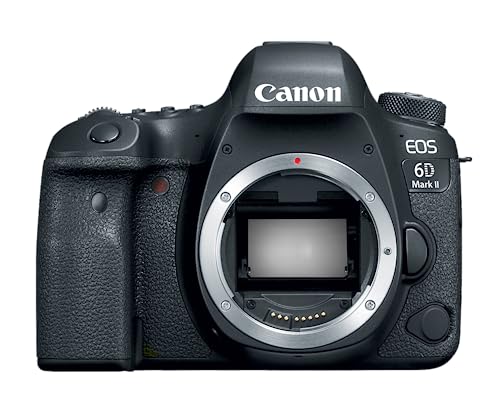
Canon EOS 6D Mark II Body — The lighter full-frame Canon
The 6D Mark II’s listing adds one word to the usual body-only formula that landscape travellers will appreciate: Wi-Fi enabled. That small connectivity note serves the modern landscape workflow more than it first appears — transferring a dawn’s keeper to a phone for the day’s post, or tethering a composition check to a larger screen at a workshop, are real field habits now. Beneath it sits the 6D line’s established proposition: full-frame Canon files in a body meaningfully smaller and lighter than the 5D line, built for the photographer who walks to the viewpoint rather than parking beside it. Its sensor resolution is not stated in the listing title and is recorded as such below; the class is full-frame, and the files it produces have carried a generation of travel-landscape work.
For landscape purposes the 6D Mark II is the Canon route chosen by the feet — and routes chosen by the feet have a way of producing the photographs, because they end at viewpoints the roadside never reaches, at hours when the light is doing its best work and the crowds are still asleep in the valley below. Multi-day treks, alpine approaches, and travel where the camera competes with water and shelter for pack weight — in all of these, the smaller full-frame body earns its place without surrendering the format’s light gathering or the EF mount’s lens endowment. It shares the 5D’s system completely: the same wide zooms, the same tilt-shifts, the same second-hand ocean. What it concedes sits in the professional margins — build heft, control depth, and the flagship’s margins of sealing — which many landscape shooters, who work slowly and shelter their gear by habit, will never spend.
Read it, then, as the guide’s Canon for walkers: the full-frame landscape file without the professional body’s weight, from the same mount, at the friendlier end of the commitment. Photographers who print at the largest sizes or work in the worst weather as a profession should step to the 5D Mark IV; photographers whose landscapes are earned on foot will understand exactly what the 6D Mark II is for, the first time the pack goes on at 4 a.m.
Its Wi-Fi, mentioned once in its listing and once in this guide’s takeaways, earns a final field note: the walking photographer’s evening ritual now includes the bothy transfer — the day’s best frame sent to a phone for the message home and the location note pinned while the memory is fresh. It is a small, modern grace on an older design, and on a long trek it is used more than any other electronic feature the body owns.
- Format: full-frame DSLR body (Canon EF mount)
- Connectivity: Wi-Fi enabled, as stated in the listing
- Resolution: absent from the title; Nikon’s documentation states it
- What ships: body only — lens required
- Role: the lighter full-frame Canon for travel and trekking landscapes
Strengths
- Full-frame files in the smaller, lighter body — the walker’s Canon.
- Shares the entire EF landscape lens catalogue with the 5D Mark IV.
- Wi-Fi suits the transfer-and-share habits of modern field work.
Trade-offs
- Concedes the 5D line’s professional margins of build and sealing.
- The title states no resolution or video figures for the buyer to lean on.
- Body only: the wide lens budget still applies in full.
Best for: travelling and trekking landscape photographers inside the Canon system.
Not suited for: professionals whose weather and print sizes demand the 5D class outright.
How Large Do You Print, and How Far Do You Walk?
Two questions sort these six bodies faster than any specification. The first is print size, because resolution only matters at the wall: a file destined for a portfolio book or a modest framed print is fully served by every sensor in this guide, while a file destined for a metre-wide exhibition print rewards the flagship class — the D850’s tier, the 5D Mark IV’s stated thirty megapixels — and the tripod discipline that makes those megapixels real rather than theoretical. Photographers who sell prints should buy for the largest honest print they actually make, not the largest they can imagine, because the difference funds the wide lens that will appear in every frame.
The second question is distance. A landscape practice built on roadside viewpoints and short walks can carry any body here without thinking about it. A practice built on approaches — the bothy, the ridge camp, the multi-day traverse — weighs the kit in grams and hours, and there the K-3 Mark III’s lighter system and the 6D Mark II’s smaller body stop being compromises and become the enabling equipment. The landscape does not grade your effort, only your presence: the camera that is with you at the far dawn beats the flagship that stayed in the valley, every single time the light breaks.
Why Do Landscape Photographers Keep Faith With Pentax?
Pentax is the smallest system in this guide and, among landscape photographers, quite possibly the most loved — a combination that stops being paradoxical the moment you shoot with one in bad weather. The brand built its identity on the outdoors: sealing treated as a headline feature rather than a footnote, in-body stabilisation that steadies any lens ever mounted, and viewfinders specified like instruments. The three bodies below — two full-frame K-1 generations and the APS-C K-3 Mark III flagship — express that identity at three levels, and their listings are unusually forthcoming about it. If Canon and Nikon are the landscape establishment, Pentax is its field station: smaller, weather-beaten, and fiercely fit for purpose.

Pentax K-1 Mark II Silver with Grip — The weatherproof limited edition
This listing pairs Pentax’s full-frame flagship line with its BG-6 battery grip, in the limited silver edition of the K-1 Mark II body. Read the components as a landscape photographer would. The K-1 line is Pentax’s full-frame statement — the body around which the system’s wide-angle and landscape reputation is built, with the brand’s signature in-body stabilisation steadying every lens and its sealing philosophy aimed squarely at photographers who shoot in the weather other systems shelter from. The Mark II generation refined that flagship; the limited silver finish makes this example a collector’s object as well as a tool; and the included grip extends battery endurance and improves vertical handling, both of which a long dawn on a tripod quietly rewards.
The resolution and sealing figures are not stated in the listing title, and the spec box records that rather than borrowing them. What the guide can say on design evidence is that the K-1 line’s landscape virtues are the Pentax virtues at full-frame scale: stabilisation in the body rather than the lens, so the decades of K-mount glass — including the manual-focus primes landscape shooters hoard — all shoot steadied; a finder and control layout built for gloved, deliberate work; and files whose colour rendering has a devoted following among mountain and forest photographers.
Buy this listing for the combination it uniquely offers: the flagship Pentax landscape body, in its limited finish, with the grip already in the box — one purchase that completes the body half of a serious K-mount landscape kit. Collectors should note the edition; working photographers should note the grip; both should note that limited finishes do not wait, and that the standard black body covers the same ground when this one is gone.
The grip deserves its own practical sentence, because landscape photographers underestimate it until they have used one through a winter: the BG-6 doubles the power reserve for multi-day cold work, gives the vertical frame — the orientation of waterfalls, gorges, and half of all mountain portraits — a proper shutter position and balance, and turns the flagship into a two-handed instrument when the wind is arguing. On this listing it is not an accessory decision deferred; it is in the box, which is exactly where a landscape photographer wants it.
- Body: Pentax K-1 Mark II, limited silver edition, per the listing
- Included: BG-6 battery grip, named in the title
- Format: full-frame flagship of the K-mount system (the K-1 line)
- Resolution and sealing grade: neither figure appears in the title — see the listing page
- Stabilisation: in-body, the K-1 line’s design signature
Strengths
- The flagship Pentax landscape body with its grip included — endurance and vertical handling solved in the box.
- In-body stabilisation steadies the whole K-mount back catalogue, not just modern lenses.
- Limited silver edition carries collector appeal alongside working capability.
Trade-offs
- The title omits the figures spec shoppers want; confirm them on the listing page.
- The K-mount’s modern lens catalogue is smaller than Canon’s or Nikon’s.
- A limited edition rewards buying when found rather than deliberating at leisure.
Best for: K-mount landscape photographers wanting the flagship body, gripped and finished, in one purchase.
Not suited for: a landscape shooter who needs a vast modern lens catalogue more than weather-first design.

Pentax K-1 Body — The original full-frame Pentax
The original K-1’s listing is plain — full frame DSLR camera, body only — and the plainness suits a body whose reputation was made entirely in the field. When Pentax finally built a full-frame DSLR, it built it as a landscape instrument first: the K-1 arrived with the brand’s in-body stabilisation, its weather-sealed philosophy, and a set of field-friendly ideas — including illumination for working in the dark and a screen arrangement designed for tripod work — that read like a landscape photographer’s letter to a manufacturer, answered. Its sensor resolution is not stated in the listing title and is recorded as such below; its format is stated, and full-frame Pentax files from this body have printed landscapes for a decade.
Against its Mark II sibling above, the original K-1’s case is value and sufficiency. The generational refinements of the Mark II are real but incremental for tripod work, where the landscape is shot at base sensitivity, manually focused, one frame at a time — conditions under which the original body’s file and handling remain thoroughly professional. It is worth adding that landscape photography is almost alone in how gently it ages a camera: no burst punishment, no autofocus marathon, just dawns and dusks at a tripod’s pace, which is why a first-generation flagship like this one remains a working tool long after action bodies of its year have retired. A landscape photographer entering the K system on a budget that must also stretch to wide glass will find the arithmetic persuasive: the savings live in the body, the image lives in the lens and the light, and the K-1’s file has never been the weak point of anyone’s dawn.
It is also the natural second body for a K-1 Mark II owner — same mount, same batteries-and-grip ecosystem in spirit, same colour signature across a two-body field kit. Newcomers should buy it knowingly: the K system rewards commitment with character, and its modern catalogue is the smallest here, but for the landscape discipline specifically, the lenses that matter exist, the sealing is genuine, and the original K-1 remains what it was launched as — a full-frame landscape camera with its priorities in the right order.
- Format: full-frame DSLR body, as stated in the listing
- Mount: Pentax K (body only — lens required)
- Resolution: not among the title’s claims — check the full listing
- Stabilisation: in-body, the K-1 design’s signature
- Role: the first-generation full-frame Pentax landscape body
Strengths
- Full-frame Pentax landscape virtues — sealing philosophy and in-body stabilisation — at the generation’s friendlier cost.
- Tripod-first design details suit the genre’s working method unusually well.
- Shares the K-mount catalogue and colour signature with the Mark II.
Trade-offs
- The earlier generation concedes the Mark II’s refinements in processing and high-sensitivity work.
- The listing title is minimal; confirm every figure on the listing page.
- The K system’s modern lens depth trails the Canon and Nikon catalogues.
Best for: landscape photographers entering full-frame Pentax, or K-1 II owners wanting a matched second body.
Not suited for: a Pentax shooter chasing the newest processing generation.

Pentax K-3 Mark III Body — The APS-C flagship with the great finder
The K-3 Mark III’s listing is the most generous in this guide, and it deserves quoting in spirit: a flagship APS-C body in black, 12fps, a touch screen LCD, weather resistant magnesium alloy construction, in-body 5-axis shake reduction, and a 1.05x optical viewfinder with 100% field of view. For landscape work, two of those claims matter above the rest. The viewfinder is the first: a 1.05x magnification finder in an APS-C body is a statement of intent — a big, bright, honest window for composing, of a quality crop-sensor cameras rarely offer, and landscape composition is precisely the discipline that spends its life looking through it. The weather resistant magnesium body is the second: this is a camera built to be rained on at a ridge cairn while its owner waits for the light, and to shrug.
The APS-C format writes its usual bargain in landscape terms. The crop narrows wide lenses — a wide zoom on this body frames tighter than on the full-frame picks — which landscape shooters feel at the wide end where every millimetre is scenery. In exchange, the smaller sensor’s lenses are lighter, the whole kit walks further, and telephoto details — the light striking one distant peak — frame tighter for free. The in-body 5-axis stabilisation, stated in the title, steadies handheld work at blue hour and every K-mount lens ever made. The 12fps figure, also stated, is a sports specification moonlighting in a landscape guide; it costs the landscape photographer nothing and will delight the same owner at a wildlife hide.
Choose the K-3 Mark III as the APS-C landscape flagship it declares itself to be: for the finder, for the sealing, for a kit that climbs further on less weight, and for Pentax loyalists whose lens bags are already K-mount. Full-frame romantics will always glance at the K-1 bodies above; photographers who measure a camera by the dawns it survives per kilogram will understand why this one has a cult.
One more of its stated figures deserves a landscape translation: the touch screen, easily dismissed as a consumer garnish, is in the field a gloved photographer’s friend for reviewing focus at full magnification and for working menus at a tripod without disturbing the composition. Small mercies compound at 5 a.m. in sleet, and this body’s title reads, on close inspection, like a list of exactly such mercies.
- Format: APS-C flagship body, per the listing
- Viewfinder: 1.05x optical, 100% field of view, as stated in the title
- Construction: weather resistant magnesium alloy, per the title
- Stabilisation: in-body 5-axis shake reduction, per the title
- Also stated: 12fps continuous shooting, touch screen LCD
Strengths
- The finest optical finder in this guide relative to its format — a composer’s instrument.
- Weather resistant magnesium build and in-body stabilisation, both stated in the title.
- A lighter total kit than any full-frame pick here, for approaches measured in hours.
Trade-offs
- The crop narrows wide lenses, the one tax landscape work feels most.
- Resolution is not among the title’s many stated figures — confirm it on the listing page.
- Full-frame ultimate print sizes sit beyond its sensor class.
Best for: Pentax landscape photographers who walk far and compose carefully in bad weather.
Not suited for: ultra-wide specialists, whose lenses this sensor will keep politely narrowing.
How Do the Six Compare for the Landscape?
| Camera | Mount and format | Stated in the title | Landscape role |
|---|---|---|---|
| Canon EOS 5D Mark IV | EF, full frame | 30.4MP sensor, 4K video | Professional standard |
| Nikon D850 | F, FX full frame | Format only | Resolution flagship class |
| Pentax K-1 Mark II Silver | K, full frame | Limited edition, BG-6 grip included | Weather-first flagship, gripped |
| Pentax K-1 | K, full frame | Full frame, body only | Original full-frame Pentax |
| Pentax K-3 Mark III | K, APS-C | 12fps, sealing, 5-axis SR, 1.05x finder | APS-C flagship, walker’s kit |
| Canon EOS 6D Mark II | EF, full frame | Wi-Fi enabled | Lighter full-frame Canon |
The stated column tells the guide’s methodological story at a glance: one title recites a specification sheet, one offers a single resolution, and four say almost nothing — which is why this guide grades these bodies by system, format, and settled design reputation, and sends the figure-hunter to the listing pages where figures belong. For landscape work, that order of priorities is not a compromise. It is how the genre has always bought its tools.
What Else Decides a Landscape Kit: Glass, Tripod, and Filters?
Every body in this guide arrives lensless, and the landscape photographer’s budget should be planned as a kit from the first day. The wide zoom is the founding lens — the range that covers dawn at the coast and noon in the forest — and each mount here offers it at several levels of ambition, with the used market deepening all three. A fast wide prime joins for night skies, where aperture is exposure and the stars do not wait. The tripod is not an accessory in this genre but the second camera: a rigid, tall-enough support with a head that levels precisely, because the landscape method is long exposures at small apertures, and a tripod that trembles in ridge wind taxes every file the sensor makes.
Filters complete the classical kit. A polariser deepens skies and strips reflections from wet rock and foliage, and no software convincingly imitates it; graduated neutral density still balances a bright sky against a dark foreground in a single honest exposure for photographers who prefer the field to the desk; and a plain protective filter earns its place on any lens that works at the coast in blown sand. Budgeted in that order — body, wide zoom, tripod, filters, then the special lenses — a landscape kit built around any of these six bodies will out-photograph a flagship body bought alone, every dawn of the year.
What Mistakes Do Landscape Buyers Make With DSLRs?
The first is buying resolution as a substitute for light. A landscape file is made by the dawn, the weather, and the photographer’s patience in roughly that order; the sensor merely records the result, and a modest body in great light out-prints a flagship in flat light every time. The second mistake is neglecting the mount decision — buying a body because its listing charmed, then discovering the wide lens the work needs is dear, scarce, or nonexistent in that system. The third is under-buying the tripod, the genre’s classic false economy, paid for in softened files blamed on innocent lenses.
The fourth mistake is a reading one, and this guide’s tables exist to prevent it: assuming a figure that the listing never stated. Two of these six titles are nearly bare, and a buyer who fills their silences with launch-day memories may be remembering a different region’s configuration or a sibling model entirely. Read the full listing for the body in front of you, confirm the figures that decide the purchase, and let the cameras be judged — as this guide has judged them — on what can be verified plus what a decade of field use has settled.
How Should You Work a Landscape Scene Once You Are Standing in It?
Arrive before the light and walk the scene without the camera first: find the foreground that gives the frame its floor — the rock, the pool, the line of frost — and the position where that foreground and the distance compose rather than collide. Set the tripod at that position, level it, and compose at the height the scene asks for, which is usually lower than standing height and almost never exactly there. Expose for the highlights and let the shadows be what the dawn says they are; the full-frame files in this guide hold shadow detail generously, and a blown sky has never yet been recovered by optimism.
Then work slowly and in series. Shoot the frame you came for, then the variations the light offers as it changes — the genre’s secret is that the best frame of a dawn is rarely the first or the planned one, but the one the cloud made at minute twelve. Check focus at full magnification on the camera’s screen, because a landscape file’s sharpness is its whole argument and the time to discover softness is while the light remains. Leave with the scene exactly as you found it, and log the position and the conditions in a notebook; landscapes are appointments, and the photographer who keeps them returns to the same hill in better light with a better photograph already half-made.
Build the return visit into the method from the start. Almost no great landscape frame was made on a first acquaintance with a place; the first visit teaches the geography, the second teaches the light, and the third — with the composition already solved and the season chosen — is where the keeper usually lives. A DSLR kit, bought once and kept for years, is the natural instrument of that patience, which is perhaps the deepest reason this older design and this oldest genre fit each other so well.
What Should a Second-Hand Buyer Check on These Bodies?
Several of these bodies will be bought used as often as new, and the DSLR’s mechanical honesty makes the used market a landscape institution — provided the checks are done. Shutter count is the odometer: ask for it, and weigh it against the body’s class, since a professional body with a high count may still be the safer buy over a neglected amateur one. Inspect the sensor with a stopped-down frame against a bright sky, where dust and worse announce themselves; check the mirror box and mount for the bright wear of a hard life; and work every dial, because landscape bodies live outdoors and weather finds the controls first.
Buy the lens with even more care, since it will outlive the body in your kit: hold it to the light for fungus and haze, work the focus and aperture rings for grit, and mount it to confirm the coupling is true. From a reputable dealer, most of these checks come with a warranty that makes the used route nearly riskless; from a private seller, they are the price of the saving. Either way, the depth of the EF, F, and K used markets is one of the strongest practical arguments in this entire guide — a landscape kit of professional quality can be assembled around any of these bodies at a cost the mirrorless era’s newer mounts rarely permit.
What About Night Skies, the Landscape That Happens After Dark?
A growing share of landscape work now happens after the landscape has gone to bed: the Milky Way over the bothy, star trails above the reservoir, the aurora that rearranges a winter trip’s priorities at midnight. Night work reorders this guide’s virtues in instructive ways. The optical finder goes dark and live view takes over the composing; battery economy stops being a convenience and becomes the session itself, since a cold night of long exposures is the hardest shift a battery works all year — and there the DSLR’s frugality, again, is a working advantage that mirrorless bodies concede. Fast wide primes matter more than any body feature, which returns the decision, as always in this genre, to the mount and its glass.
Within the six, the full-frame bodies hold the obvious edge for the night, gathering the light the genre runs on, and the Pentax bodies add their system’s famous party trick of using stabilisation-era hardware to track the sky’s slow motion for long-exposure star work — a maker feature landscape shooters should read about in the documentation, since no listing title here states it. The honest summary is that any of these bodies, behind a fast wide lens on a rigid tripod, in a dark place in the small hours, will bring home the galaxy; the genre rewards the photographer’s willingness to be cold and awake far more than it rewards any specification in this guide.
Final Recommendation
Choose the mount as the marriage and the body as its current chapter. Canon shooters take the 5D Mark IV for professional landscape standard work, or the 6D Mark II when the viewpoint is earned on foot. Nikon shooters take the D850, having read its full listing for the figures its title withholds. Pentax shooters — and photographers tempted by weather-first design — take the K-1 Mark II listing for the flagship body with its grip, the original K-1 for the same virtues at the earlier generation’s cost, or the K-3 Mark III when the kit must climb further on less weight behind that remarkable finder. Whichever body you choose, spend the next money on the wide lens and the tripod before anything else, and then spend the only currency landscape photography truly accepts: dawns, in quantity, in weather, with the camera level and the notebook open — because the land keeps its best light for the photographers who are already standing in it, and any of these six bodies, honestly bought and patiently used, will be ready when it comes. Buy it before the season turns, learn its finder and its files on the hills you already know, and let the first great morning find you practised rather than merely equipped: the landscape has been rehearsing its light for four billion years, and it is not the camera’s readiness that will be tested out there — it is yours.
Frequently Asked Questions
Is a DSLR still a sensible buy for landscape photography?
Yes — landscape is the genre where the DSLR’s design compromises matter least and its virtues matter most: optical finders that sip no power, days of battery economy, deep wide-lens catalogues in the EF, F, and K mounts, and full-frame files the printing world knows intimately. Buy it knowingly, as a system decision, and it will serve for years — most landscape DSLRs are retired by their owners’ changing ambitions, not by any failure of the land to keep providing subjects worthy of them.
Which of these bodies has the highest resolution?
Only one listing title states a resolution — the 5D Mark IV’s 30.4 Megapixel sensor — so this guide does not publish a resolution league table built on borrowed figures. The D850’s class is Nikon’s high-resolution flagship tier, and the exact figure, like the Pentax bodies’ figures, is confirmed on its listing page before purchase.
Why do three of the six picks come from Pentax, the smallest system here?
Because landscape work is where Pentax’s design priorities — weather resistance, in-body stabilisation for every lens, and serious viewfinders — are worth the most, and because its verified listings in this round were strong. The K system’s modern catalogue is smaller than Canon’s or Nikon’s, which the pick sections state plainly.
Does in-body stabilisation matter on a tripod?
Less on the tripod, where it should rest, and a great deal everywhere around the tripod: the blue-hour handheld frame, the scouting shot, the walk between positions. The Pentax bodies’ in-body systems also steady the whole back catalogue of K-mount lenses, which is a landscape inheritance no lens-based system matches.
What lens should a landscape buyer budget for first?
A wide zoom in the body’s mount — it is the founding landscape lens, covering the great majority of scenes. Follow with the tripod before any second lens, then a fast wide prime if night skies call, and filters as the classical kit describes. Every body in this guide is sold without a lens, so this budget is part of every pick’s real price.
Can these DSLRs handle bad weather at the coast?
The Pentax bodies are built around that brief, with weather resistance stated in the K-3 Mark III’s title outright; the Canon and Nikon professional bodies carry their lines’ established sealing. No camera is waterproof, however — covers, cloths, and sense remain part of the kit, and salt spray should be wiped from any body the same evening.
Related Guides
Complete the slow photographer’s kit before the season turns: compare our guide to wide-angle lenses for landscape work, choose support from our roundup of travel tripods that stay rigid in wind, or browse our guide to cameras for night-sky and astrophotography for the hours after the landscape itself has gone dark and the sky takes over the show.
Related guides
- Best Basic Phones Camera Buyers Can Trust: Flip Phones and Simple Handsets That Still Take a Photograph
- Best Sony Full Frame Cameras for Astrophotography: Sensitivity vs Resolution
- Best Affordable Android Tablets: Five True Android Slates and One Fire OS Specialist, Clearly Labelled
- Best 400 FPS High Speed Cameras: The Honest Truth About Burst Slow Motion


