What's inside
- Key Takeaways
- Quick Picks
- How Did We Choose the Best Bluetooth Headsets for Making Phone Calls?
- What Actually Decides Call Quality in a Single Earpiece?
- How Do the Six Earpieces Compare on Case, Fit and Endurance?
- How Do You Get the Best Call Quality From an Earpiece?
- What Mistakes Do Buyers Make With Calling Earpieces?
- Final Recommendation
- How Does the Charging Case Change the Endurance Maths?
- Who Are These Earpieces Actually For?
- How Do Hooks, Buds, and Glasses Decide Comfort?
- What About Pairing, Switching, and the Two-Phone Life?
- When Should You Replace a Calling Earpiece?
- Why Not Just Use the Car’s System or the Phone’s Speaker?
- What Does Your Voice Sound Like From the Other Side?
- Should You Own Two Earpieces?
- How Do You Run the First-Week Test That This Class Demands?
- Frequently Asked Questions
- Related Guides
As an Amazon Associate I earn from qualifying purchases. This post may contain affiliate links at no extra cost to you.
gizmoverdict.com is reader-supported. When you buy through links on our site, we may earn an affiliate commission.
Where to buy: The six headsets below each link to their Amazon listing. Read the box contents closely — in this class the charging case is half the product, and its capacity, display, and cable type differ more between picks than the earpieces themselves do, which is why the reviews below spend as long on cases and controls as on the devices that sit in them.
This site already has a guide to mono Bluetooth headsets, organised by form: what the devices are. This guide is organised by the job instead — the best bluetooth headsets for making phone calls, judged on what a calling day actually demands. That means three axes the form-first guide treats lightly. Call quality first: whether your voice reaches the other person clearly from a car, a warehouse aisle, or a windy pavement. Talk time second: not the number on the box, but whether the earpiece and its charging case together outlast your real pattern of calls. And wearing comfort third, measured across a workday, because an earpiece that is brilliant for twenty minutes and unbearable by lunch is a failed tool for anyone whose calls are their job.
Every pick here is a single-ear Bluetooth earpiece with a charging case or a serious battery claim, and every pick is an unbranded or small-brand listing — that is the honest state of this class on Amazon, and this guide will not dress it up. There are no famous names to hide behind, so the judging has to be stricter: what is verifiable in the listing, what the case does, how the controls behave, and how the earpiece fits. One calibration before we start: talk-time figures in this class are seller claims measured under ideal conditions — low volume, close phone, fresh battery — and your day will return less. Read them as relative hints about which designs prioritise endurance, never as promises, and lean on the charging case, which is where real-world stamina actually lives.
Key Takeaways
- This guide ranks by use, not form: call quality, talk time across the earpiece-plus-case system, and all-day wearing comfort. The site’s mono Bluetooth guide covers the same device family from the hardware angle; this one covers the calling day.
- Talk-time numbers are seller claims under ideal conditions. The charging case’s capacity is the more honest endurance figure, because it decides how many real days pass between wall charges.
- Every pick is an unbranded or small-brand listing. Judge the box contents, the case, the controls, and the fit — there is no brand support network to fall back on, and this guide invents none.
- A mute button is the professional’s control. For anyone taking work calls in uncontrolled places, muting by touch without looking at the phone is the feature that saves reputations.
- Fit style divides the class: over-ear hooks stay put through a moving workday; in-ear buds disappear but depend on your ear suiting them. Comfort over eight hours, not eight minutes, is the test.
- Multipoint — two devices connected at once — matters if your calls arrive on a work phone and a personal phone, or a phone and a laptop, in the same long day of moving between vehicles, sites, desks, and the occasional quiet corner where the real conversations happen.
Quick Picks
| Pick | Badge | Why it earns its seat |
|---|---|---|
| HEIBAS Bluetooth Earpiece with Charging Case | Best all-round calling pick | A work earpiece with a mute button and a substantial charging case, balanced across all three of this guide’s axes. |
| New Bee Bluetooth Earpiece | Best proven budget staple | One of the longest-selling earpieces in the class, with a simple design and endurance claims suited to drivers and callers. |
| EKVANBEL Bluetooth Earpiece | Best case capacity | A large-capacity charging case and dual-microphone design for callers who measure charging in weeks. |
| Bluetooth Earpiece V6.1 with LED Display | Best battery visibility (generic listing) | An LED battery display on the case ends the guessing — an unbranded listing bought on that practical virtue. |
| Atheewon Bluetooth Earpiece | Best modern Bluetooth version | A Bluetooth 5.4 earpiece with balanced call-time claims for callers who want current connection manners. |
| NVAHVA Single Earbud Bluetooth Earpiece | Best low-profile fit | A small in-ear bud design for callers who want the earpiece to disappear rather than announce itself. |
How Did We Choose the Best Bluetooth Headsets for Making Phone Calls?
We weighted the three axes in the order a calling professional feels them. Call quality came first, which in this class means microphone arrangement and placement: an earpiece carries its microphone at the ear, far from the mouth, so the designs that compensate — dual microphones, processing aimed at voice, a shape that aims the pickup toward the face — earned their places over designs that merely promised hours. Talk time came second, judged as a system: the earpiece’s own endurance plus what its case can give back, because a caller between charges lives on the case, not on the earpiece’s first charge. Comfort came third and was judged on wearing architecture — hook versus bud, weight, and whether the design expects to be worn for a shift or a stroll.
Two honesty filters ran over the whole shortlist. Every endurance figure was demoted to a seller claim, stated once here and applied in each review, so no pick was ranked by a number nobody can verify. And every pick’s brand status was recorded as it is: unbranded or small-brand listings, assessed on their contents and design, with no invented heritage, no invented laboratories, and no invented test results. In a class without famous names, that discipline is not a courtesy — it is the entire difference between a guide and a catalogue.
What Actually Decides Call Quality in a Single Earpiece?
Geometry is against the earpiece from birth. A boom headset parks its microphone beside the mouth; an earpiece’s microphone sits at the ear, roughly a hand’s length from the sound it wants, in a world full of competing noise. Everything in this class is compensation for that handicap. Dual-microphone designs compare what two pickup points hear and use the difference to favour the voice arriving from the direction of the face. Processing then trims the steady noises — engine hum, air conditioning, road wash — that sit underneath speech. Better earpieces do both; the claims vocabulary (“AI”, “ENC”, and their cousins) is each seller’s name for that same two-part trick, and the words themselves tell you nothing comparative.
What you can control matters more than what the listing promises. Keep the phone within a few metres and out of a metal toolbox, a deep bag, or the far side of your body, because Bluetooth weakens through obstacles and the audio thins before it drops. Speak at a normal level; shouting into an ear-level microphone distorts and invites the processing to make poor decisions. In wind, turn your body so the earpiece is on the sheltered side — a ten-degree decision that outperforms any software. And test the earpiece where your calls actually happen, in the first week, with a listener who will tell you the truth: this class rewards verification more than any other in the cluster, because its claims are the least standardised and its physics the most demanding.
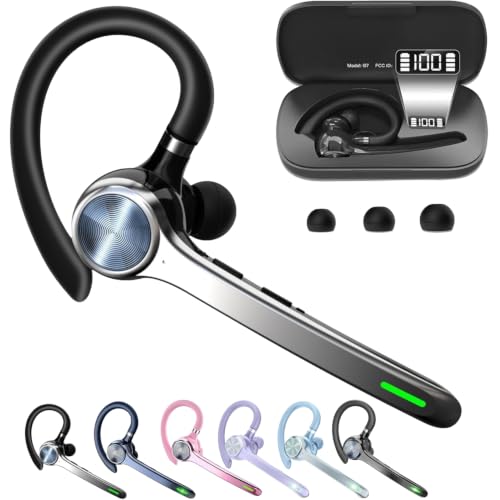
HEIBAS Bluetooth Earpiece with Charging Case — Best All-Round Calling Pick
The HEIBAS earns the top seat by refusing to be extreme about anything. Its seller-quoted playtime is long — the listing speaks in days of standby-style endurance with a 500mAh charging case behind the earpiece — and, read with this guide’s standing discount on seller figures, that still describes a system built to be charged occasionally rather than nightly. More decisive for a work caller is the mute button: a physical control on the earpiece that silences you without a glance at the phone. For the delivery driver confirming an address, the site worker taking the supervisor’s call beside a running machine, the parent negotiating a school call from a supermarket car park, that button is the difference between a professional call and an overheard one.
The wearing design follows the class’s work pattern: a single earpiece with an ear hook’s security, sized to stay in place through a moving day rather than to disappear. Its microphone arrangement is aimed at hands-free calling clarity in the environments the listing names — work and driving among them — and the honest test remains the one this guide keeps prescribing: your noisiest real location, a patient listener, three questions. As an unbranded-class product it carries no support mythology, so judge the box, the case, and that first week. On the evidence of its design balance — case, mute, fit, endurance — it is the pick that asks the fewest apologies of the six.
- Connection: Bluetooth to phone
- Wearing style: single-ear earpiece with ear hook
- Microphone: hands-free calling microphone with mute button on the earpiece
- Charging case: 500mAh capacity per the listing
- Endurance: long playtime claimed by the seller under ideal conditions
- Brand status: small-brand/unbranded class listing — no maker support network claimed
Strengths
- The physical mute button is the control work callers actually need, present and findable by touch.
- A substantial charging case turns endurance into a system rather than a single charge’s promise.
- The hook-secured fit suits moving workdays where an earbud would work loose.
Trade-offs
- Seller endurance figures will not survive contact with a loud, high-volume calling day intact.
- The hook style is visible and businesslike rather than discreet.
- Support and spares are marketplace-grade, as with every pick in this class.
Best for: working callers who want one balanced earpiece for calls all day. Not suited for: buyers who want a famous brand’s support, or the most invisible fit possible.

New Bee Bluetooth Earpiece — Best Proven Budget Staple
The New Bee has been selling in this class for years, which in a category of mayfly listings is itself a credential: designs that fail callers do not get reordered by drivers for half a decade. It is a Bluetooth 5.0 single-ear earpiece in the classic over-ear pattern, with seller-quoted endurance of up to 24 hours of talk and a standby figure quoted in weeks — both to be read as ideal-condition claims, and both large enough that even a heavily discounted real-world version covers a calling day with room. Its design has the simplicity of a tool that was finished long ago: answer, volume, charge, repeat.
That maturity is the pick’s argument and its limit. The New Bee will not offer the newest Bluetooth version or the cleverest case; what it offers is a known quantity at a staple price, the earpiece that dispatchers and drivers recommend to each other because it has simply kept working. For a buyer equipping themselves for the first time, or keeping a spare in the glovebox and the work bag, that proven-ness is worth more than a spec sheet’s novelties. Buy it as what it is — the class’s old reliable — and verify it with the standard test call in your own noisiest place, because even old reliables must pass your cab, your yard, your street.
- Connection: Bluetooth 5.0 to phone
- Wearing style: single-ear earpiece, classic over-ear pattern
- Microphone: hands-free calling microphone
- Talk time: seller-quoted up to 24 hours under ideal conditions
- Standby: seller-quoted at 60 days under ideal conditions
- Brand status: small-brand listing with a long sales history in this class
Strengths
- Years of continuous sale in a disposable category signal a design that works for callers.
- Simple controls and a familiar pattern make it the easiest first earpiece to live with.
- Endurance claims, even discounted, comfortably cover a day of calls.
Trade-offs
- An older Bluetooth version lacks the newest connection refinements of later picks.
- The charging arrangement is basic compared with the big-case picks.
- Its design is dated in appearance, which matters to some buyers more than it should.
Best for: first-time buyers and anyone wanting a proven spare. Not suited for: buyers who want the latest Bluetooth version or a high-capacity case system.

EKVANBEL Bluetooth Earpiece — Best Case Capacity
The EKVANBEL’s argument is a number attached to the right component: a 1000mAh charging case, the largest case story in this guide, feeding an earpiece whose seller-quoted talk time runs to 96 hours of system endurance under ideal conditions. Apply the standing discount and the shape of the offer survives: this is the pick for callers who want charging to be a rare event — the long-route driver, the field worker whose van is the office, the traveller whose hotel rooms have one reachable socket and four devices competing for it. The case is the battery; the earpiece just spends it.
Around that case sits a dual-microphone design — the arrangement this guide’s call-quality section identified as the serious compensation for an ear-level microphone — on Bluetooth 5.3, in a single-ear hands-free format. The combination is coherent: endurance for the week, microphone effort for the call. Its costs are the physical ones: a bigger case is a bigger pocket commitment, and a caller who charges nightly at a tidy desk gains nothing from capacity they never use. Choose the EKVANBEL when your life is measured in days between wall sockets; choose a smaller system when it is measured in hours between desk charges, and do not pay for stamina you will never spend.
- Connection: Bluetooth 5.3 to phone
- Wearing style: single-ear hands-free earpiece
- Microphone: dual-microphone design for call clarity
- Charging case: 1000mAh capacity per the listing
- Endurance: seller-quoted up to 96 hours of system talk time under ideal conditions
- Brand status: small-brand/unbranded class listing — no maker support network claimed
Strengths
- The largest charging case here makes wall charging a rare event for heavy callers.
- Dual microphones give its call quality the strongest physical starting point in the class.
- A modern Bluetooth version keeps its connection manners current.
Trade-offs
- The big case is a real pocket and bag commitment compared with slimmer rivals.
- The headline endurance is a system figure under ideal conditions, not a single-charge promise.
- Nightly chargers will never use the capacity they are paying for.
Best for: multi-day callers and field workers far from wall sockets. Not suited for: tidy-desk users who charge nightly and travel light.

Bluetooth Earpiece V6.1 with LED Display — Best Battery Visibility (Generic Listing)
This earpiece is sold under a description rather than a name, and this review follows the class rule for such listings: judge the design, credit no heritage. The design’s headline is information — an LED battery display on the charging case that tells you, in numbers, what every other case makes you guess. Anyone who has opened a case before an important call to discover a dead earpiece and three ambiguous blinking lights understands that this is not a gimmick. Battery anxiety is a real cost in a calling tool, and a display is the direct cure: you know on Monday whether Friday’s calls are covered.
Beneath the display, the listing offers the modern checklist: a recent Bluetooth version in the 6.1 generation per the seller, dual-device multipoint pairing for the two-phone life, a noise-cancelling microphone, and a seller-quoted playtime figure in the hundreds of hours for the earpiece-plus-case system under ideal conditions — a claim to be filed, as ever, under marketing arithmetic rather than measurement. What can be verified is the display, the multipoint behaviour, and the fit, and those three verifiables are a respectable basis for a purchase. For the caller whose specific dread is the silently empty case, this generic listing solves the exact problem the branded world mostly ignores.
- Connection: Bluetooth (seller-listed 6.1 generation) with dual-device multipoint
- Wearing style: single-ear earpiece
- Microphone: noise-cancelling microphone
- Charging case: LED battery display
- Endurance: long playtime claimed by the seller for the earpiece-plus-case system under ideal conditions
- Brand status: GENERIC listing — sold under a descriptive title, no brand name; no heritage or support network claimed
Strengths
- The LED display replaces battery guesswork with a number, which heavy callers feel daily.
- Multipoint pairing serves the work-phone-plus-personal-phone pattern in one earpiece.
- Its verifiable features — display, pairing, fit — are exactly the ones a buyer can test in week one.
Trade-offs
- As a generic listing, support, spares, and longevity are unknowns to be weighed against price.
- The system’s endurance headline is seller arithmetic and should not drive the decision.
- Bluetooth version claims on generic listings deserve a sceptical eye and a pairing test on arrival.
Best for: callers who hate battery surprises and carry two phones. Not suited for: buyers who need a named maker’s warranty path.

Atheewon Bluetooth Earpiece — Best Modern Bluetooth Version
The Atheewon’s pitch is currency and balance. Its Bluetooth is version 5.4 per the listing — the current generation among these picks — which buys the modern connection manners: efficient pairing, stable links, and modest power behaviour. Its seller-quoted call time of around 20 hours, with a standby figure quoted in the hundreds of hours, is the least inflated-looking endurance story in this guide; discounted for real conditions, it still describes an earpiece that covers a heavy calling day and asks for its charge on a civilised schedule rather than a desperate one. For buyers tired of class-leading claims, a moderate claim from a current design is its own kind of credibility.
The earpiece is a hands-free calling design with a noise-cancelling microphone, aimed at the business-and-driving pattern that defines this class. Nothing about it chases a superlative, and that is the point of its seat in this list: it is the pick for the caller who wants the newest connection standard and honest proportions, and who charges often enough that case theatrics are unnecessary. Verify it the standard way — your noise, your listener, your full day of wear — and expect a tool that behaves like the current generation of a mature idea: unremarkable in the ways that let you forget it, which is what a calling earpiece is for.
- Connection: Bluetooth 5.4 to phone
- Wearing style: single-ear hands-free earpiece
- Microphone: noise-cancelling microphone
- Call time: seller-quoted at 20 hours under ideal conditions
- Standby: seller-quoted at 180 hours under ideal conditions
- Brand status: small-brand listing — no maker support network claimed
Strengths
- The current Bluetooth generation gives it the most modern pairing and power behaviour here.
- Its endurance claims are comparatively moderate, which suits buyers allergic to inflated figures.
- A balanced, no-drama design fits callers who charge on a regular schedule.
Trade-offs
- No headline charging-case capacity, so multi-day no-socket work belongs to other picks.
- Small-brand support applies, as throughout this class.
- Callers wanting a physical mute as the centrepiece should compare the HEIBAS first.
Best for: regular chargers who want current Bluetooth and balanced claims. Not suited for: multi-day field callers who live out of a charging case.

NVAHVA Single Earbud Bluetooth Earpiece — Best Low-Profile Fit
Every other pick in this guide wears its purpose on the outside; the NVAHVA takes the opposite bet. It is a single in-ear bud — a low-profile earpiece that sits in the ear like one side of a pair of earbuds, with no hook and no boom, for callers whose work punishes visible hardware: the client-facing professional between meetings, the retail or hospitality worker whose calls come from a phone in a pocket, the anyone who has ever felt a hook-style earpiece announce “I am on call” to a room they were trying to blend into. Its seller-quoted endurance is the most modest here, around ten hours, and the design trades the hook’s security for discretion with open eyes.
That trade defines its honest limits. An in-ear bud’s microphone is the furthest of all from the mouth, so its call clarity leans hardest on processing and on the caller’s environment behaving; a windy street will tax it more than the dual-microphone pick. Its fit is also the most personal in the guide — buds suit the ears they suit, and no listing can promise yours are among them, which makes the return window this pick’s best friend. Choose the NVAHVA when disappearing matters more than dominating a noisy call, and when your calling happens in civilised noise. In the right life, its invisibility is not a compromise at all; it is the entire feature.
- Connection: Bluetooth to phone and other devices per the listing
- Wearing style: single in-ear bud, low profile, no hook
- Microphone: built-in hands-free microphone
- Endurance: seller-quoted around 10 hours under ideal conditions
- Compatibility named: iPhone and Android phones
- Brand status: small-brand listing — no maker support network claimed
Strengths
- The most discreet wearing design here, for callers whose work rewards invisibility.
- No hook or boom to catch on collars, hats, or seatbelts.
- A simple, light bud is easy to carry as a second earpiece in a bag or pocket.
Trade-offs
- The ear-level microphone faces the hardest call-quality physics in the guide.
- Bud fit is deeply personal; ears it does not suit will reject it within an hour.
- The modest endurance suits a calling day, not a calling week.
Best for: client-facing callers who need discretion in moderate noise. Not suited for: windy, loud workplaces, or ears that have never tolerated buds.
How Do the Six Earpieces Compare on Case, Fit and Endurance?
| Earpiece | Fit style | Endurance story | Deciding trait |
|---|---|---|---|
| HEIBAS | Ear hook | 500mAh case system | Physical mute button, all-round balance |
| New Bee | Over-ear classic | Long talk claim, basic charging | Proven staple of the class |
| EKVANBEL | Earpiece with case | 1000mAh case system | Case capacity and dual microphones |
| Bluetooth Earpiece V6.1 | Earpiece with case | Case system with LED display | Battery visibility and multipoint (generic) |
| Atheewon | Earpiece | Moderate call-time claim | Current Bluetooth 5.4 |
| NVAHVA | In-ear bud | Modest single-charge claim | Low-profile discretion |
Read the endurance column as systems, not numbers: a case you can refill the earpiece from beats a headline figure you cannot verify, every week of the working year. Then choose the fit your ears and your job can live with, because the best earpiece in this table is the one still in your ear at the day’s last call. Note also what the table cannot show: the mute button’s placement, the case’s feel in a pocket, the hook’s negotiation with your glasses. Those are first-week discoveries, and this guide’s test protocol exists to make them while the exchange is still easy — the table narrows the field to six honest candidates, and your own week picks the winner among them.
How Do You Get the Best Call Quality From an Earpiece?
Four habits, all free. Keep the phone close and unburied — in a chest pocket, on the dash, in the same room — because an earpiece at the edge of its range spends its quality budget on staying connected. Keep the earpiece’s microphone path unobstructed: scarves, collars, and long hair over the earpiece muffle the pickup in ways no processing fully repairs. Speak normally and let the near-field design work; the shouting that a bad line tempts you into is the enemy of every noise-cancelling system in this class. And charge the case before it is empty, on a rhythm — the same day each week, the same cable by the door — because the earpiece that dies mid-call was almost always killed by a routine, not a battery.
Add one verification to the habits: a monthly test call. Call a familiar person from your most common calling place and ask the only question that matters — do I sound like myself, clearly? Earpieces age quietly: a microphone port furred with pocket lint, a battery that has lost its enthusiasm, a fit that has loosened as a tip wore down. A monthly ten-second check catches all three while they are still small, and a wipe of the microphone opening with a dry cloth is the entire maintenance schedule most of these devices will ever ask for.
What Mistakes Do Buyers Make With Calling Earpieces?
There is a sixth mistake, gentler than the rest: treating the earpiece as set-and-forget and never cleaning it. A microphone opening slowly furred with lint and a tip slowly glazed with the week’s work will degrade your voice by degrees too small to notice day to day and large enough, by the quarter’s end, for callers to start asking you to repeat yourself. The dry-cloth wipe described in the care section takes ten seconds; schedule it with the case’s weekly charge and the problem simply never assembles itself.
The founding mistake is believing the biggest hour-count. Talk-time claims in this class are ideal-condition figures, and the buyer who chooses by them is choosing by marketing; choose by case capacity, fit, and controls, which are real. The second mistake is forgetting the caller’s side of the call — buying on wearing comfort alone, then discovering the microphone makes you sound like a weather report from inside a tunnel. Test with a listener. Third, buyers lose the earpiece: a device this small needs a home — the case, always, in the same pocket — and the case needs a charging rhythm, or the system fails socially before it fails electrically. Fourth, drivers buy stereo earbuds for calling and inherit the both-ears problem the driving guide in this cluster exists to prevent. Fifth, professionals skip the mute button and pay for it in one overheard sentence. Every one of these is avoidable in the first week, which is when this class should be judged — in your ear, in your noise, on your calls.
Final Recommendation
One consideration deserves the final word before the shortlist, because it outlives every model in it: your callers cannot see your office, your vehicle, or your circumstances. They can only hear them, compressed into the few seconds in which they decide whether you are easy to deal with. The earpiece is the whole of that evidence. A caller who reaches a clear, calm voice trusts the delivery, the diagnosis, the quote; a caller who reaches a muffled struggle discounts all three before you have said anything of substance. That is why a class of inexpensive, unbranded devices deserves this much care in the choosing — the stakes were never the price of the earpiece, but the sound of the business it speaks for, repeated at every call, every day.
Start with the HEIBAS if your calls are your work and you want the balanced system — case, mute, hook, endurance — without a superlative to babysit. Take the EKVANBEL when days pass between wall sockets, and the LED-display earpiece when not knowing the battery state is the specific anxiety you are buying your way out of. The New Bee remains the class’s sensible first purchase and spare; the Atheewon is the current-generation all-rounder for regular chargers; the NVAHVA is for callers whose first requirement is to disappear. Whichever you choose, run the test call in your own noise during the return window and keep the case charged like a ritual. A phone call is a promise that your voice will arrive as you sent it — in this class of small, unbranded, hard-working devices, the right pick keeps that promise quietly, all day, one ear at a time.
How Does the Charging Case Change the Endurance Maths?
An earpiece’s own battery is a shift; its case is the week. That is the arithmetic this class runs on, and it is why this guide keeps redirecting your attention from the earpiece’s headline hours to the case’s capacity. A case stores several earpiece charges and dispenses them in the minutes while the earpiece sits inside — often fast enough that a coffee break restores a morning of calls. The practical consequence is that two earpieces with identical single-charge endurance live completely different lives: the one with a small case is a nightly-charging device with a safety net, and the one with a large case is a weekly-charging system that forgives travel, forgetfulness, and the charger left in another vehicle.
Judge a case on three things beyond capacity. Its display or indicator honesty — the LED-display pick exists because guessing is a cost. Its pocket manners — a case that is a pleasure to carry gets carried, and a carried case is a charged earpiece. And its cable standard, because a case that shares your phone’s cable is one less cord in the bag and one less excuse at a hotel desk. None of these appear in the hour-counts that dominate listings, and all three decide whether the endurance you bought is the endurance you experience. When two picks in this guide look similar, the case is usually the tiebreaker, and it should be.
Who Are These Earpieces Actually For?
The class’s centre of gravity is the person whose phone calls are work but whose workplace is not a desk. The delivery and service driver, whose calls are addresses, gates, and customers, and whose hands are spoken for. The field technician, whose calls are diagnoses talked through with a colleague while both hands are inside the problem. The sales representative, whose car is an office and whose calls are the product. The tradesperson on a site where a phone in the hand is a phone dropped off a ladder. For all of them, the earpiece’s virtues are the same trio this guide ranks by: a voice that arrives clearly, a battery system that outlasts the route, and a fit that survives the day.
At the edges sit two more constituencies the picks serve deliberately. The home-based caller — the parent or carer whose calls happen amid a household — values the mute button and the single open ear above everything, and should shop the HEIBAS pattern first. The discreet professional values disappearance, takes calls in shared and client spaces, and is the NVAHVA’s reason to exist. Naming your constituency before you shop is worth more in this class than in any other in the cluster, because the picks diverge by life pattern rather than by quality tier: there is no ladder here, only a map, and the right earpiece is the one drawn for your day.
How Do Hooks, Buds, and Glasses Decide Comfort?
Comfort in an earpiece is an argument between three contact points, and your ears cast the votes. A hook design spreads its hold over the top of the ear and stays put through movement, at the cost of presence — you know it is there, and so does everyone else. A bud design concentrates everything in the ear canal and concha: invisible when it fits, intolerable when it does not, and wholly dependent on tip size. Between them sit the soft-loop and rotating designs that most of this class actually uses, adjustable enough to fit many ears and forgettable enough for a shift. The only honest test is duration. Wear the candidate through your longest calling day in the first week, with your glasses if you wear them — a hook and a spectacle arm negotiate for the same real estate above the ear, and some negotiations fail by hour four — and believe what your ear reports at the end of that day over anything a listing, or this guide, says about comfort in the abstract.
Weight whispers rather than shouts in this class, because all six picks are light; what varies is where the light sits. A design that hangs its mass on the hook feels different from one that plugs it into the canal, and ears that ache from one often accept the other happily. This is why experienced callers own the return window like a fitting appointment and why a second earpiece, in the other style, is a common and rational purchase for people whose income arrives by phone. The cost of the wrong fit is not the price of the earpiece; it is the calls taken on a handset, at arm’s length, in noise, because the earpiece is sitting in its case being comfortable at nobody.
What About Pairing, Switching, and the Two-Phone Life?
Pairing is this class’s first impression and its most common support question, so buy with your device pattern in mind. A single-phone caller needs nothing exotic: every pick here pairs once and reconnects on waking, and the daily experience is identical across the list. The two-phone caller — work and personal, or phone and laptop — should distinguish between earpieces that can be paired with two devices but listen to one at a time, which is most of them, and true multipoint, which holds both connections live and follows the ringing one. The LED-display pick carries multipoint as a headline for a reason: for the two-phone life it is the difference between a system and a ritual.
Whichever you choose, set the arrangement up deliberately on day one. Pair in the order you value the devices, learn which button answers on which connection, and make one test call per device before the earpiece’s first working day. Most “my earpiece ignores my work phone” stories are setup stories, told a week too late. And keep the phone-side housekeeping in view: an operating-system update that resets Bluetooth permissions will present as an earpiece fault, in this class more than any other, because the earpiece is the part you can see. The troubleshooting order — phone’s Bluetooth list first, earpiece second — saves a return a month somewhere in this class’s readership, and it might as well be yours.
When Should You Replace a Calling Earpiece?
An earpiece is a consumable with a long fuse. Its battery will fade across a couple of years of daily cycles, its microphone opening will accumulate the pocket’s archaeology despite your wiping, and its fit will loosen as tips and hooks age. The replacement signals are specific: talk time that no longer covers your day on a system that once did, callers reporting a muffled or distant voice that a clean microphone opening does not fix, a hook that no longer holds its shape. Any one of them, confirmed over a week rather than a bad afternoon, means the tool has given its service. In a class priced like this one, replacement is not a failure of the purchase; it is the purchase completing its design life, and the caller who replaces promptly sounds professional for exactly as long as the caller who nurses a dying earpiece sounds apologetic.
That lifecycle is also the final argument for this guide’s way of choosing. A famous name would not change the battery’s chemistry or the lint’s ambitions; what changes your experience is choosing the right fit, case, and controls for your calling life, verifying them in the first week, and replacing the tool when its week-long evidence says so. Small, unbranded, and honestly bought, these earpieces carry an outsized share of the working world’s conversations. Choose yours like the professional instrument it is, and it will repay the compliment daily.
Why Not Just Use the Car’s System or the Phone’s Speaker?
Because of where the microphones live. A car’s built-in microphone sits in the headliner, metres of cabin away from your voice, sharing air with the road noise the cabin cannot exclude; a phone on speaker is a microphone and a loudspeaker having an argument in the same small box, with echo as the referee. Both are fine for a two-minute call in a parked car. Across a working day of calls, both tax the listener in the currency that matters — repetition, strain, and the slow impression that you are hard to reach. An earpiece moves the microphone to your ear and the speaker into it, which is not a marginal improvement but a different conversation: quieter voice, clearer words, private both ways.
The privacy half deserves its sentence. Speaker and car systems broadcast your caller to whoever shares the space — passengers, colleagues, the next pump at the fuel station. An earpiece keeps the incoming half of the call yours alone, and lets you keep your own voice at a level that does not announce your business. For anyone whose calls involve customers, prices, addresses, or people, that discretion is not a luxury feature. It is the professional baseline, and it is the reason this class exists alongside the perfectly functional speakers already built into every car and phone you own.
What Does Your Voice Sound Like From the Other Side?
Spend a moment in your caller’s chair, because that is where this class is ultimately judged. A good earpiece call sounds like a person in a quiet room: words effortless, background present but ignorable, no sense of weather or machinery between you. A poor one sounds like a report from inside the event — the caller’s brain spends its budget subtracting your environment, and arrives at your actual sentence tired. The difference is rarely dramatic in a ten-second test and always dramatic across a ten-minute call, which is why this guide’s prescribed test uses a real conversation with a listener whose honesty you trust, and why call quality was weighted first among its three axes.
There is a reputational compounding to this that heavy callers understand instinctively. The driver, technician, or representative who always sounds clear becomes, in their customers’ minds, the reliable one; the one who always sounds like a tunnel becomes the one whose calls get postponed. No earpiece in this guide can make a business competent, but the wrong one can make a competent business sound otherwise, several times a day, to exactly the people it can least afford to impress badly. That asymmetry — small device, daily repetition, professional stakes — is the whole case for choosing carefully in a class that the market treats as a commodity.
Should You Own Two Earpieces?
For people whose income arrives by phone, the two-earpiece strategy is quietly common and entirely rational: one in use, one in its case charged, so that a loss, a failure, or a flat battery is an inconvenience of seconds rather than a day of handset calls. The class’s prices make the spare a modest line item — the New Bee’s seat in this guide is partly as the designated spare, proven and inexpensive — and the case system makes rotation easy: swap at the charger, alternate weekly, and both units age at half speed. The same logic gives the two-style household its answer to the comfort question: a hook earpiece for the moving days and the bud for the client-facing ones is not indecision, it is a wardrobe.
What the strategy asks is only a little administration: both earpieces paired to the phone before they are needed, both cases on the same charging rhythm, and a rule about which pocket is home. Callers who run their voice equipment this way stop having earpiece stories — the flat battery on the big call, the unit left in the other vehicle — and in a working life, the absence of equipment stories is the highest grade any tool can earn. Start with one pick from this guide, verified in your own noise; add the spare when the first has proven itself, and you will have built, for very little money, the most reliable calling setup in this entire cluster.
How Do You Run the First-Week Test That This Class Demands?
Because every pick here is unbranded or small-brand, the return window is part of the product, and the test should be run like it matters. Day one: pair the earpiece, charge the case fully, and make a ten-minute call from your most common calling place to a listener who knows your voice. Ask three questions — do I sound clear, how much of my surroundings can you identify, do I sound like myself — and write the answers down, because memory edits them by day three. Midweek: wear the earpiece through your longest calling day and note the hour your ear first objects, the state of the battery at day’s end, and whether the case went back into the same pocket every time without being thought about. End of week: make the same ten-minute call from your noisiest regular place — the yard, the street, the vehicle at speed — and compare the listener’s answers with day one’s.
An earpiece that passes all three checkpoints has told you everything a listing cannot: its microphone survives your noise, its fit survives your day, and its battery system survives your routine. One that fails any checkpoint should be exchanged for a different style from this guide rather than merely returned in disgust, because in this class failure is usually a mismatch, not a defect — the bud that your ear rejects has a hook-shaped sibling that it will accept. Run the test and the class’s honesty problem solves itself: you stop believing claims, including this guide’s, and start believing your own week.
Frequently Asked Questions
How is this guide different from the mono Bluetooth headset guide?
That guide organises the same device family by form and hardware. This one organises it by the calling job: call quality for the listener, talk time across the earpiece-and-case system, and comfort across a working day. If you are choosing a device, read the form guide; if you are choosing for a life of calls, you are in the right place.
Can I trust the talk-time numbers on these listings?
Treat them as best-case claims under each seller’s ideal conditions, not as measurements of your day. Volume, distance from the phone, and call mix all reduce them. The more dependable endurance evidence is the charging case’s capacity and your own first week of use — which is why this guide ranks systems, not headline hours.
Are unbranded earpieces a risky buy?
They are a different buy rather than a reckless one. This entire class is unbranded or small-brand, so the discipline is to verify quickly: test call quality in your real noise, confirm the case and controls behave as listed, and check the fit across a full day, all inside the return window. Bought that way, they are the class’s normal, sensible purchase. The risk that remains is longevity — a unit that fades in year two rather than year four — and the class’s prices are set with that shorter horizon in view, which is why this guide judges cost against the calling life you will actually get, not against a theoretical decade.
Will one of these work with both my work phone and my personal phone?
Any of them will pair with either phone; the multipoint pick — the LED-display earpiece — stays connected to two devices at once and switches between them, which is the version of the feature that two-phone callers actually want. With the others, expect to switch pairing when you switch phones.
Is a single earpiece safe and legal for driving calls?
Single-ear use is the pattern that hands-free and ear-coverage rules in many jurisdictions are written around, unlike covering both ears. Rules vary and carriers add their own policies, so check yours. The driving guide in this cluster covers the road-specific picks and the legal framing in full.
How do I stop my earpiece falling out during a working day?
Choose the fit architecture that matches your movement: a hook design for physical, moving work; a bud for sedentary discretion — and use the ear tip size that seals without pain, since a bud that works loose is usually a tip one size off. If an earpiece will not stay put through your real day in the return window, believe it and exchange the style, not just the unit.
Can I use one of these for computer meetings as well?
Yes, in the way any Bluetooth audio device can: pair it with the computer and select it in the meeting software. Be aware that an earpiece is voiced and fitted for phone calls on the move, and that a desk worker in long meetings will usually be better served by the office headsets in this cluster’s noisy-office guide. For occasional meetings from the road or the site, an earpiece here is perfectly serviceable.
What should I do first when callers say I sound muffled?
Check the physical things before the settings: clean the microphone opening with a dry cloth, confirm nothing — hair, collar, scarf — is covering the earpiece, and move the phone closer and out of bags or toolboxes. Then make a fresh test call. Most muffled reports in this class are lint, cloth, or distance, in that order, and all three are free to fix.
Related Guides
For the road-specific version of this class, with its cab-tested picks and legal framing, read best driving headsets; for desk-based wireless calling, compare best bluetooth headsets for noisy office; and for wired call quality, see best call center headsets noise cancelling.
The same call quality questions follow you into the cab, where best driving headsets applies the single-ear rule.


