What's inside
- Key Takeaways
- Quick Picks
- How Did We Choose the Best Driving Headsets for This Guide?
- What Does the Law Actually Say About Headsets and Driving?
- How Do the Six Picks Compare for Life in the Cab?
- How Do You Get Dispatch to Hear You Clearly?
- What Mistakes Do Drivers Make With Headsets?
- Final Recommendation
- Why Does Cab Noise Defeat Cheap Microphones So Completely?
- How Should You Charge a Headset in a Working Truck?
- What About Dispatch Apps, ELDs, and a Second Phone?
- How Do You Fit a Headset Around Glasses, Caps, and Long Days?
- What Should a Small Fleet Look for When Issuing Headsets?
- How Do You Test a Headset in Your Own Cab?
- How Do You Look After a Headset That Lives in a Truck?
- What Changes for Team Drivers and Co-Drivers?
- Does This Guide Apply to Car Commuters Too?
- Frequently Asked Questions
- Related Guides
As an Amazon Associate I earn from qualifying purchases. This post may contain affiliate links at no extra cost to you.
gizmoverdict.com is reader-supported. When you buy through links on our site, we may earn an affiliate commission.
Where to buy: Each linked pick below goes directly to its Amazon listing for the best driving headsets in this class. Check the box contents for the charging cable type and any included case, and confirm the headset is the single-ear or open-ear version described here — several of these model names also appear on stereo variants that do not belong in a cab.
Every headset in this guide obeys one rule before any other is considered: one ear only, or no ear coverage at all. Covering both ears while driving is illegal in many jurisdictions and unsafe in all of them, because the sounds a driver needs — a siren, a horn, a tyre letting go, a strange noise from the load — arrive through the ears that a stereo headset would seal. So the best driving headsets are a deliberately narrow class: single-ear Bluetooth headsets with microphones built to defeat cab noise, and one open-ear bone-conduction outlier that covers nothing at all. If a listing tries to sell you a plush stereo headset for the road, it is selling you a liability with good bass.
Within that narrow class, the fight is against the cab itself. A truck cab at highway speed is one of the loudest workplaces in this entire cluster of guides: engine, tyres, wind, and refrigeration units all competing with your voice. The person on the other end — dispatch, a customer, family — should hear you, not the motorway. That is why these headsets put their money in the microphone and the boom that carries it, and why the wearing design aims at twelve-hour days: a headset a driver removes by noon has failed, however heroic its specifications look at breakfast.
One honesty note belongs up front. Several listings in this class quote noise-cancellation percentages for their microphones. Those percentages are seller marketing numbers produced under each seller’s own conditions; there is no shared test standard that makes one brand’s figure comparable to another’s, and this guide does not rank by them. Judge these headsets by boom design, talk time, durability ratings, and fit — the things you can verify — and treat any percentage as decoration.
Key Takeaways
- Single-ear or open-ear only. Both ears covered behind the wheel is illegal in many places and unsafe everywhere; every pick here keeps at least one ear fully on the road.
- The microphone is the product. Cab noise is the enemy and your dispatcher is the audience, so boom placement and noise-cancelling microphone design outrank every other feature.
- Talk time claims are seller figures under ideal conditions. Even discounted, the picks here are built to outlast a driving day — what matters more is a charging routine in the cab that never lets the battery become the story.
- Seller noise-cancellation percentages are not comparable between brands. There is no shared standard behind them, so this guide flags them once and never ranks by them.
- Controls must work by touch alone at highway speed: a big mute button and a simple answer control are safety-relevant features, not conveniences.
- The bone-conduction pick covers neither ear and suits drivers who want maximum awareness; the boom-microphone picks suit drivers whose callers need maximum clarity. Choose which end of the call matters more to your work.
Quick Picks
| Pick | Badge | Why it earns its seat |
|---|---|---|
| BlueParrott B350-XT | Best all-round trucker pick | The lightweight benchmark of the class, with a serious noise-cancelling boom and an IP54 rating for cab life. |
| BlueParrott B450-XT | Best padded comfort | The cushioned sibling for drivers who wear a headset nearly the whole shift and feel every gram by evening. |
| LEVN Bluetooth Headset | Best endurance claim | Sold on a long working-time figure with a mute button and AI-labelled microphone processing for noisy cabs. |
| Sarevile Trucker Bluetooth Headset | Best value workhorse | A straightforward single-ear trucker headset with an upgraded microphone, without paying for a famous name. |
| SHOKZ OpenComm2 | Best awareness-first design | Bone conduction leaves both ears completely open — nothing in or on the ear — for drivers who prize hearing the road. |
| Philips Trucker Bluetooth Headset | Best instant-mute design | A trucker headset from a household name, built around an instant mute button and a noise-cancelling microphone. |
How Did We Choose the Best Driving Headsets for This Guide?
The first filter was legal and physical, not technical: single-ear or open-ear designs only, because a driving guide that recommends sealing both of a driver’s ears would be recommending something unlawful in much of the country and unwise in the rest of it. The second filter was the microphone. Cab noise is low, constant, and loud — the exact profile that defeats cheap microphones — so every pick had to be designed around a noise-cancelling boom or, in the bone-conduction case, a noise-cancelling microphone system paired with a wearing style that leaves the road audible.
Then we weighed the working day. Talk time had to plausibly cover a shift with margin, with the caveat stated in the takeaways: seller figures are best-case, so we favoured headsets whose claims were large enough to survive a realistic discount. Controls had to be operable by touch, because a driver cannot look at a headset. Durability mattered — a cab is dust, vibration, temperature swings, and the occasional drop onto tarmac — so a stated ingress rating counted for real. Finally, we kept one deliberate outlier: the OpenComm2, because some drivers’ priority is hearing everything around the truck, and a guide that only ranked boom headsets would fail them.
What Does the Law Actually Say About Headsets and Driving?
The rules vary by state and country, and this guide is not legal advice — but the pattern is consistent enough to design by. Many jurisdictions prohibit covering both ears while driving, whether with headphones or headsets, while permitting a single earpiece for communication. Some places restrict any head-worn audio for certain licence classes or commercial operations, and fleets often impose their own stricter policies on top of the law. Hands-free laws add the second layer: in much of the country, the call itself must be hands-free, which is precisely the job these headsets exist to do.
The safe engineering conclusion, and the one this guide follows, is that a single-ear or open-ear headset with hands-free controls is the design that complies with the widest range of rules a driver will cross — important for anyone whose route crosses state lines before lunch. Check your own state’s current rules and your carrier’s policy, because both can be stricter than the general pattern, and neither this guide nor a product listing can certify your compliance. What no reading of the rules supports is a stereo headset on a moving vehicle. That option is excluded here on purpose. The same caution applies to any audio that demands your eyes or your hands — a call you must look at to manage has already failed the hands-free idea, whatever the headset itself is capable of, which is why this guide keeps returning to big physical controls and mute buttons that work by touch alone.

BlueParrott B350-XT — Best All-Round Trucker Pick
BlueParrott built its name in truck cabs, and the B350-XT is the model that did much of the building. It is a single-ear, over-the-head Bluetooth headset whose entire design brief is the sentence: the dispatcher should hear the driver, not the highway. The boom is long and positionable, bringing the noise-cancelling microphone close to the mouth where the physics of near-voice advantage works, and the headset is light enough that wearing it from the first check to the last drop is a realistic expectation rather than a marketing one. Its listing quotes a cancellation percentage for the microphone; as this guide has already flagged, that figure is the seller’s own number under the seller’s own conditions, so the pick rests on the boom design and the model’s long cab service, not on the arithmetic.
The IP54 rating is the other half of its working credential: protection against dust and splashing water, which translates to a headset indifferent to a dusty yard, a drizzling loading dock, and the general grit of freight life. Talk time is quoted by the seller at a full day’s span, and the honest reading is that it covers a driving shift with room to spare when charged nightly. For a driver choosing one headset to standardise on — or a small fleet choosing one model to issue — the B350-XT is the class benchmark against which the rest of this list is measured.
- Connection: Bluetooth to phone
- Wearing style: single-ear over-the-head, lightweight
- Microphone: noise-cancelling boom microphone (seller quotes a cancellation percentage; no shared standard — see intro)
- Durability: IP54-rated against dust and splashes per the listing
- Talk time: seller-quoted at 24 hours under the seller’s conditions
Strengths
- A boom and microphone designed specifically for cab noise, from the maker whose reputation was built in this exact seat.
- The IP54 rating suits yards, docks, and weather rather than a climate-controlled office.
- Light enough for genuine all-shift wear, which is when a headset’s microphone quality actually gets used.
Trade-offs
- It is a single-purpose tool: the mono, voice-first design is not a music headset for rest breaks.
- The benchmark name carries a benchmark price next to the value picks in this guide.
- Like all boom headsets, its clarity depends on the driver keeping the boom positioned — it cannot fix a microphone worn at the chin.
Best for: professional drivers who want the proven cab standard. Not suited for: drivers who want stereo media, or anyone whose work is not actually in a vehicle.

BlueParrott B450-XT — Best Padded Comfort
The B450-XT answers the complaint that ends more headset careers than any electronic failure: by hour nine, it hurts. BlueParrott’s padded sibling to the 350 wraps the same cab-first philosophy — single ear, serious noise-cancelling boom, voice-first controls — in a larger, cushioned wearing design with a padded headband and a plusher ear cushion. The extra material is not decoration. Pressure distributed over a wider, softer contact is the difference between a headset forgotten and a headset resented, and resentment leads to removal, and removal leads to a driver holding a phone, which is the outcome every rule in this category exists to prevent.
Its seller-quoted talk time matches its sibling’s full-day span, and it carries the same caveat about seller figures and the same note about the cancellation percentage in its listing — the maker’s number, not a standardised measurement. Choose between the two BlueParrotts on your head, not on the spec sheet: drivers who run hot or wear glasses often prefer the lighter 350, while drivers who log the longest shifts and have always found headsets pinchy tend to land on the 450 and stay there. In a guide full of close calls, this is the closest: same philosophy, different padding, decided by a fitting rather than a feature list.
- Connection: Bluetooth to phone
- Wearing style: single-ear over-the-head with padded headband and cushion
- Microphone: noise-cancelling boom microphone (seller percentage claim — no shared standard)
- Talk time: seller-quoted at 24 hours under the seller’s conditions
- Focus: long-shift wearing comfort
Strengths
- The padded design directly targets the end-of-shift discomfort that makes drivers abandon headsets.
- It keeps the cab-proven boom and microphone philosophy of its lighter sibling.
- A fuller cushion also steadies the headset over rough road surfaces where a light frame can wander.
Trade-offs
- More padding means more warmth, which some drivers in hot climates will feel by midday.
- It is the bulkier object to store in a crowded cab when not worn.
- The comfort premium only pays back on genuinely long shifts; short-hop drivers may never notice it.
Best for: long-haul drivers who wear a headset most of the day. Not suited for: drivers who run hot, or short-shift work where the lighter pick is plenty.
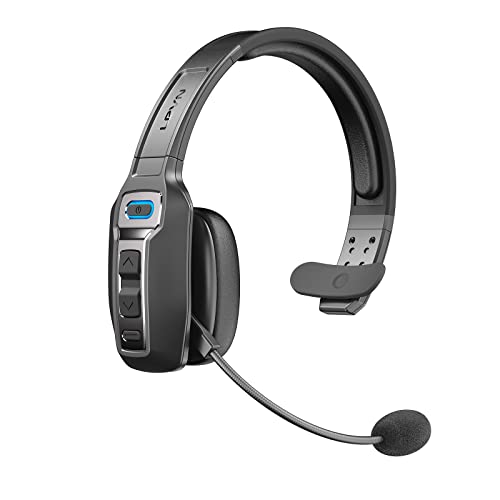
LEVN Bluetooth Headset — Best Endurance Claim
The LEVN’s headline is stamina: a working-time figure quoted by the seller at 65 hours, which — even after the discount this guide applies to all seller battery claims — describes a headset that can forget its charger for days at a time. For drivers whose cab is also their office and whose charging discipline is honestly described as “whenever,” that forgiveness is a working feature. The headset pairs it with the class essentials: a noise-cancelling microphone with AI-labelled processing, a physical mute button, and a single-ear on-ear wearing style that keeps the road in the other ear.
Judge the LEVN as the endurance-and-value expression of the trucker pattern rather than as a BlueParrott rival. Its microphone processing is described in the listing’s own terms, its brand support is that of a smaller seller, and its virtues are the ones you can verify in the first week: does it stay comfortable, does dispatch hear you clearly, does the battery behave as promised across your real routes. Drivers running multi-day trips without a reliable nightly charge are its natural constituency, and for them a headset that treats charging as a weekly event solves the most common failure in this category — the flat battery at the exact moment dispatch calls.
- Connection: Bluetooth to phone
- Wearing style: single-ear on-ear
- Microphone: noise-cancelling microphone with AI-labelled processing and mute button
- Working time: seller-quoted at 65 hours under the seller’s conditions
- Intended use: truck and car driving calls
Strengths
- Endurance in this class forgives irregular charging across multi-day routes.
- A physical mute button keeps the most-used control findable by touch.
- The single-ear on-ear fit is quick to put on for short hops between stops.
Trade-offs
- The headline battery figure is a seller claim; real endurance will vary with volume and call mix.
- Smaller-brand support and spares are thinner than the benchmark maker’s.
- On-ear pressure is a personal fit question on the very longest days.
Best for: multi-day drivers with unreliable charging routines. Not suited for: buyers who want the deepest fleet support, or who dislike on-ear pressure.

Sarevile Trucker Bluetooth Headset — Best Value Workhorse
The Sarevile is the straightforward expression of the class: a single-ear Bluetooth trucker headset with an upgraded noise-cancelling microphone, a mute function, and no famous name inflating the proposition. Its Bluetooth is version 5.2 per the listing, its wearing style is on-ear, and its design intent is a working headset for drivers who measure value in clear calls per week rather than in brand story. In a category where the benchmark name is genuinely good, the value pick has to be honest about what it is: the same legal, single-ear, boom-microphone pattern, executed without the heritage.
That makes it a sensible choice for specific buyers: the owner-operator equipping a second cab or a spare, the driver new to headsets who wants to learn whether the boom life suits them before paying benchmark money, the small fleet that needs headsets on heads this month across several trucks. Its microphone is described by its seller as AI noise cancelling, which this guide reads as the listing’s term for its processing; the verification that matters is a test call from your own cab at highway speed, which any buyer should run in the return window. Pass that test and the Sarevile is exactly what a workhorse should be — unglamorous, adequate everywhere, and priced like a tool.
- Connection: Bluetooth 5.2 to phone
- Wearing style: single-ear on-ear
- Microphone: noise-cancelling microphone with mute function
- Intended use: driving calls for truckers and commuters
- Position: value pick without a premium brand name
Strengths
- It delivers the class essentials — single ear, boom microphone, mute — at a workhorse price.
- A sensible first headset for drivers testing whether the trucker pattern fits their work.
- Simple controls suit gloved or hurried use better than touch-sensitive panels.
Trade-offs
- Brand support, spares, and long-term durability are less proven than the benchmark picks.
- Microphone processing claims are the seller’s own and should be verified with a real cab test call.
- No ingress rating is headlined, so dusty-yard buyers should note the difference from the IP54 pick.
Best for: value-focused drivers and spare-headset duty. Not suited for: fleets wanting a proven support programme, or the dustiest working environments.

SHOKZ OpenComm2 — Best Awareness-First Design
The OpenComm2 is the outlier this guide promised, and its difference is anatomical: bone conduction. Nothing enters your ear and nothing covers it. The headset rests on the cheekbones and delivers sound through vibration, leaving both ear canals completely open to the road — horns, sirens, the trailer’s complaints, the yard worker’s shout. For drivers whose awareness is the priority, or whose ears simply cannot tolerate an earpiece across a long shift, this is not a compromise design; it is the point. SHOKZ built its name on this wearing style, and the OpenComm2 is its communication-focused model, with a noise-cancelling boom microphone and a mute button aimed at calls and meetings.
The trade-offs are the honest mirror of the design. An open ear hears the road, which means the road also reaches your listening: at highway volume you may raise the volume to follow a soft caller, and your caller’s clarity depends on the boom microphone doing heavy work against a cab you are deliberately not shut off from. Battery endurance is also in a different class from the big trucker headsets — this is a charge-it-regularly device, sized for workdays rather than multi-day routes. Choose it when hearing everything is the requirement and call convenience is the bonus; choose a boom-and-cup pick when the call itself is the job. Both are legitimate readings of a driver’s day, and this guide refuses to pretend one cancels the other.
- Connection: Bluetooth to phone and computer
- Wearing style: open-ear bone conduction — nothing in or on the ear
- Microphone: noise-cancelling boom microphone with mute button
- Intended use: calls and meetings with full environmental awareness
- Fit note: rests on the cheekbones; compatible with most glasses
Strengths
- Both ears stay completely open, the maximum-awareness design in this guide and the gentlest on the ears themselves.
- No earpiece pressure or heat across a long shift, and nothing to dislodge when climbing in and out of the cab.
- It doubles naturally as an office and meeting headset off the road.
Trade-offs
- Open listening means cab noise competes with your caller at highway speed.
- Battery endurance is workday-scale, not multi-day, so the charging routine matters more.
- Bone conduction is a different sensation that some wearers love and others never warm to — the return window is your friend.
Best for: awareness-first drivers and anyone whose ears reject earpieces. Not suited for: the loudest cabs where the call itself must dominate, or multi-day routes without charging.

Philips Trucker Bluetooth Headset — Best Instant-Mute Design
Philips arriving in the trucker class brings a household name to a category of specialists and small brands, and its headset is built around the control drivers actually use most: an instant mute button, placed for the moment the cab fills with a sound the caller does not need — the air horn, the yard radio, the co-driver’s story. Around that button sits the established pattern: a single-ear trucker wearing style, a noise-cancelling microphone with AI-labelled processing in the listing’s terms, and battery life the seller describes as long, with the usual instruction from this guide to read endurance claims as best-case figures.
The Philips suits the driver who wants the trucker pattern without betting on a small brand, and who values the mute as a first-class feature rather than a menu item. Its support story is a large maker’s, which matters at replacement time. It does not displace the BlueParrott benchmark on cab heritage, and it does not chase the LEVN on endurance claims; its ground is the middle — a recognisable name, a mute-forward design, and the single-ear legality and awareness this whole guide is built on. For a driver equipping one cab and wanting the purchase to feel ordinary in the best way, that middle ground is a perfectly rational place to land.
- Connection: Bluetooth to phone
- Wearing style: single-ear trucker headset
- Microphone: noise-cancelling microphone with instant mute button
- Battery: long life claimed by the seller under the seller’s conditions
- Maker: Philips
Strengths
- The instant mute is treated as the headline control, which matches how drivers actually use a headset.
- A major maker’s support and availability stand behind the purchase.
- The design sticks to the single-ear pattern without stereo temptation.
Trade-offs
- It lacks the deep cab-specific heritage and ingress-rating headline of the benchmark pick.
- Endurance and cancellation descriptions are seller claims to be verified in your own cab.
- Drivers wanting maximum battery forgiveness should compare the endurance pick first.
Best for: drivers who want a major-brand trucker headset with a mute-first design. Not suited for: the dustiest yards needing a stated ingress rating, or multi-day no-charge routes.
How Do the Six Picks Compare for Life in the Cab?
| Headset | Wearing design | Ears covered | Deciding trait |
|---|---|---|---|
| BlueParrott B350-XT | Over-head boom headset | One | Cab benchmark with IP54 rating |
| BlueParrott B450-XT | Over-head boom headset, padded | One | Long-shift comfort |
| LEVN Bluetooth Headset | On-ear single | One | Endurance claim for irregular chargers |
| Sarevile Trucker Headset | On-ear single | One | Value workhorse |
| SHOKZ OpenComm2 | Bone conduction | None | Maximum road awareness |
| Philips Trucker Headset | Single-ear trucker | One | Instant mute, major brand |
Every row leaves at least one ear — and in the SHOKZ row, both ears — open to the road. Choose within the table by your day’s shape: hours worn, dust endured, charging opportunities, and whether your calls or your surroundings deserve the headset’s first loyalty. Note what the table does not contain, because the absence is the guide’s spine: no stereo row, no earbud row, no percentage-ranked row. The class is narrow because the job is narrow — a driver, a road that must stay audible, and a voice that must arrive clean — and every pick here was admitted only after it respected all three terms of that bargain.
How Do You Get Dispatch to Hear You Clearly?
Start with the boom, because in a cab the boom is destiny. Bring the microphone to the corner of your mouth and keep it there; a boom that has drifted to chin level turns your voice into one more noise the processing must guess at. Speak at a conversational level. Shouting into a noise-cancelling microphone does not make you clearer — it distorts, and the processing, tuned for a near voice at normal level, handles a calm voice best. When the road gets loud — a climb, a rough surface, a passing truck — the professional move is a half-second pause rather than a volume war. Dispatch would rather wait a breath than ask you to repeat a load number twice.
Then manage the cab’s contribution. A window cracked at highway speed is a wind tunnel aimed at your microphone; close it for the call. The fan on its highest setting is a steady roar the microphone must subtract; one notch down during a call is a courtesy your caller can hear. Keep the headset’s connection honest too: pair it to the phone you actually take calls on, keep that phone charged and within the cab’s front area, and test the whole arrangement with a real call before the route, not during it. Finally, learn your mute button by touch and use it without ceremony — for the cough, the toll booth, the yard conversation. A driver whose callers hear a clean, calm voice sounds like a driver who has the load under control, which is not a small thing in this industry.
What Mistakes Do Drivers Make With Headsets?
One more deserves its own mention because it masquerades as thrift: buying a headset with no mute button, or one whose mute is buried in a touch gesture, to save a small amount of money. In a cab, mute is not a media control; it is the boundary between the call and everything else in your working life — the sneeze, the toll conversation, the words meant for the yard and not the customer. A driver who cannot mute by touch, instantly, will eventually broadcast something, and the saving will look very small from inside that moment.
The dangerous mistake is the stereo temptation: wearing a consumer stereo headset or two earbuds because they were already in the cab. It is illegal in many jurisdictions, it seals away the sounds driving depends on, and no call is worth it — every pick in this guide exists so that temptation has a legal answer. The second mistake is believing a cancellation percentage and skipping the test call; seller percentages are not a standard, and your cab is the only laboratory that counts. Third, drivers let the charging routine slide until the headset dies during the one call that mattered, when a cable by the bunk or a base on the dash would have prevented it. Fourth, boom neglect — wearing the microphone wherever it lands — quietly cancels the benefit of every headset here. Fifth, buyers purchase for the truck they wish they drove: the long-haul padded pick for a local route, the featherweight for a twelve-hour day. Match the headset to the shift you actually work.
Final Recommendation
A word about buying once. A driving headset is worn more hours in a month than most tools a driver owns, used in the least forgiving acoustic environment in this cluster, and trusted at the moments — a changed delivery window, a family call, a problem at a dock — when clarity is not a luxury. That argues for buying the pick that fits your shift properly the first time rather than the cheapest object that resembles it, and for treating the return-window test as part of the purchase rather than an optional extra. The price difference between the value pick and the benchmark is real, but it is paid once; the difference in daily irritation is paid every single shift, in small instalments of discomfort and repeated sentences, until the headset is replaced or abandoned.
Standardise on the benchmark if your living is made in a cab: the B350-XT for most drivers, the B450-XT when the shift is long and comfort is the battle you keep losing. Choose the LEVN when your routes outrun your charging opportunities, the Sarevile when value and simplicity are the brief, and the Philips when a major name and a mute-first design settle the question. Take the OpenComm2 when hearing the road is not negotiable — it is the only pick that gives the road both ears and still puts a proper boom microphone in front of your voice. Whichever you choose, place the boom like you mean it and charge it like a routine, not a rescue. The road will provide the noise; a good driving headset makes sure it never reaches the people who trust your voice.
Why Does Cab Noise Defeat Cheap Microphones So Completely?
A truck cab is an acoustically hostile room that moves. The noise is not one sound but a layered floor of them: the engine’s low drone, tyre roar that rises with speed and road surface, wind finding every seal, and the intermittent punctuation of air brakes, indicators, and the load shifting. A cheap microphone hears all of it at roughly the same level as a voice spoken from arm’s length, because that is where a phone in a cradle sits. The result is the call every dispatcher dreads, where the driver is technically audible and practically unintelligible, and every load number needs repeating.
The headsets in this guide attack the problem with distance before electronics. A boom microphone a few centimetres from the mouth receives the voice many times louder than the cab’s noise floor, simply because sound weakens rapidly with distance. Directional pickup and processing then work on a signal that is already winning. This is why the boom’s length and stiffness matter more than any processing label: a short or floppy boom surrenders the distance advantage that makes the processing useful. When you test a headset in your own cab — and you should, at highway speed, with a listener who will tell you the truth — what you are really testing is whether its geometry survives your cab’s noise floor. The headsets that pass that test earn their place on a dashboard; the ones that fail it were never going to be saved by a percentage on a box.
How Should You Charge a Headset in a Working Truck?
More driving headsets are defeated by charging than by any electronic fault, so treat the routine as part of the equipment. The reliable pattern is a fixed home for the charger: a cable that lives in the cab, routed once and left alone, plugged into the same power source every night, with the headset going onto it as part of the shutdown ritual — paperwork, curtains, headset on charge. Rituals survive tiredness; intentions do not. Drivers on multi-day routes should add a second opportunity: a charge during the longest break of the day, which tops up even a heavily used headset while the driver eats, and turns the battery from a countdown into a background fact.
Match the routine to the pick. The standard trucker headsets here are built around a nightly rhythm and reward it with a full day’s talk time. The endurance pick exists for drivers whose rhythm is genuinely irregular — slip-seat operations, team driving, unpredictable layovers — where a headset may change cabs or sleep in a bag. The bone-conduction pick, with workday-scale endurance, demands the most disciplined routine of the six and repays it with the lightest wearing experience. Whichever you choose, buy the spare cable when you buy the headset and keep it in the cab; a charging cable is a five-gram insurance policy against the most common failure in the category, and the middle of a route is the wrong place to discover you needed it.
What About Dispatch Apps, ELDs, and a Second Phone?
The modern cab runs on software: dispatch platforms, electronic logging, navigation with traffic, and a personal phone beside the work one. A Bluetooth headset lives in the middle of that ecosystem, and its manners there matter. The basics are that the headset pairs to a phone, and the phone decides which app gets the audio — so the headset that behaves best is the one that pairs quickly, holds its connection, and answers with a single physical press that works the same way in every app. Where a driver carries two phones, a headset that can stay connected to both, or that re-pairs fast enough not to matter, saves daily friction; where the fleet issues one phone, simplicity wins and any pick here will serve.
Set expectations about what the headset cannot do. It will not make a badly designed dispatch app route its audio sensibly, and it will not fix a phone whose Bluetooth stack drops devices after an update. The troubleshooting order that works in cabs is the unglamorous one: confirm the headset is the phone’s chosen audio device, confirm the app is using the phone’s call audio rather than the speaker, and keep the phone itself charged and in the front of the cab where its radio can see the headset without a metal bulkhead of freight paperwork in between. Drivers who standardise that little checklist stop having headset problems and start having only traffic problems, which is the correct distribution of misery for the job.
How Do You Fit a Headset Around Glasses, Caps, and Long Days?
The cab wardrobe complicates fitting in ways office guides never meet. Glasses arms pass exactly where over-head headsets clamp, and a cushion that presses an arm into the temple will end the experiment by the second fuel stop; drivers who wear glasses should favour lighter clamping or the padded designs that spread pressure, and should test with their glasses on, at hour three, not minute three. Caps and beanies change the geometry again — a headband worn over a cap sits higher and looser, and some drivers run the band behind the head or choose the on-ear picks partly because they coexist with headwear more gracefully. Long hair, ponytails, and the general archaeology of a working cab all argue for the same test: wear the candidate for a full shift in your real gear before the return window closes.
Heat is the other fitter. A cab in summer is a greenhouse with a steering wheel, and an ear cushion that felt plush in an air-conditioned shop can become a small sauna by noon. The on-ear picks breathe better; the bone-conduction pick, touching no ear at all, wins the category outright for hot cabs, which is one more reason it belongs in this guide despite its different call character. Fit is not a soft topic in a driving guide. A headset that comes off at noon is a headset whose microphone, battery, and legality all stop mattering at noon, and the driver is back to a phone in the hand — the exact failure every rule and every pick here is organised against.
What Should a Small Fleet Look for When Issuing Headsets?
A carrier issuing headsets is buying a policy outcome — hands-free, one-ear, professional-sounding calls — as much as a product. Standardise on one model so that training is one conversation, spares are one box, and a driver swapping trucks meets the same controls. The benchmark picks exist for this: a model with a durability rating, a support channel, and a boom that survives being thrown on a dashboard daily. Issue the charging cable with the headset and a spare per truck, write the boom-position and mute habits into the same short briefing that covers the rest of the cab technology, and record which driver has which unit so a failure is a swap, not an investigation.
Set the policy layer explicitly rather than letting it grow by accident: headsets are for communication, one ear only, media at rest stops. That clarity protects the driver as much as the company, because a driver stopped with the right equipment and a written policy is in a different conversation from a driver improvising. Fleets that treat headsets as issued safety-adjacent equipment — like the high-visibility vest, present, maintained, and unremarkable — get the compliance and the call quality together. Fleets that leave drivers to buy whatever the truck stop sells get six different answers to the same question, and the question will eventually be asked by someone with a clipboard.
How Do You Test a Headset in Your Own Cab?
Do not test it in the car park. The only honest trial is your truck, your route, your noise floor. Make three calls. The first at idle with the engine and auxiliaries running, which tests whether the microphone keeps your voice forward against the standing rumble. The second at your normal cruising speed on your normal surface, which is the condition your callers will actually meet. The third during the loudest routine moment of your day — a climb, a rough stretch, the refrigeration unit cycling — because a headset that only works in the easy minutes is a fair-weather tool. On each call, have your listener grade the same three things: can they follow you without effort, how much of the cab can they identify, and do you sound like yourself?
Then test the wearing, which takes longer and matters as much. Wear the headset for a full working day in your real gear — glasses, cap, whatever the day involves — and note the hour you first become conscious of it. Note whether the boom stays where you set it over rough road, whether the controls answer by touch with your eyes where they belong, and whether the battery ends the day with the margin your routine needs. A headset that passes the calls and the day has earned its purchase. One that fails either should go back inside the return window, because both failures only deepen with mileage. This test is the driver’s version of the model check in the desk-phone guides: five honest minutes of verification now, against months of daily irritation later.
How Do You Look After a Headset That Lives in a Truck?
A cab is a hard home: dust in summer, condensation in winter, vibration always. Give the headset a fixed resting place — a hook or a spot on the dash where it lands the same way every time — because most cab headset damage is not electronic but gravitational: sat on, stepped on, or closed in a door. Keep the boom’s pivot exercised gently rather than forced, wipe the cushion when you wipe the dash, and coil the charging cable loosely instead of winding it tight around anything. The ingress-rated pick forgives more of this life than the others, but no rating forgives a headset stored under a water bottle that sweats all day in the sun.
Battery care is the quiet half of longevity. A lithium battery in a cab lives through temperature swings that office equipment never meets, so avoid leaving the headset on a sun-baked dashboard in summer or against a freezing windscreen in winter when you can help it, and do not let it sit flat for weeks — a stored headset should be charged occasionally rather than abandoned empty. None of this asks for ceremony; it asks for the same habits a good driver already applies to the truck itself. Equipment that is parked properly, kept clean, and charged on a routine tends to be there on the morning it is needed, which is the only review that ultimately counts.
What Changes for Team Drivers and Co-Drivers?
Team driving rearranges the headset question, because the cab contains a second person whose sleep is a safety input. A single-ear headset keeps calls in one ear and out of the bunk, which is the first courtesy and a practical one — a rested co-driver is worth more than any feature in this guide. The sleeper’s rest also argues for the mute habit and a calm speaking voice at night, and against any temptation toward speakerphone, which in a team cab is not a convenience but a small act of sabotage. Bone conduction has a particular team virtue here: with nothing in the ear and no cup leakage, the resting driver’s environment stays closest to silent while the driving driver’s calls stay private.
Hygiene follows the same logic as shared desks, with the volume turned up: a headset that changes heads at every swap should have its cushion wiped as part of the changeover ritual, and drivers who run as a fixed team often solve it permanently by carrying personal headsets — the cost of one extra unit against months of shared cushions is an easy calculation. Fleets running slip-seat operations should write that choice into the issue policy rather than leaving it to the cab’s improvisation. The principle running through this whole guide holds in the team cab too: the headset is part of how the work is done safely and considerately, and the details that look small — one ear, a mute, a wiped cushion — are the ones the work actually runs on.
Does This Guide Apply to Car Commuters Too?
Mostly, yes, with the emphasis shifted. A car cab is quieter than a truck cab, the shifts are shorter, and the legal frame is the same one-ear pattern in the places that regulate it. What transfers completely is the microphone logic: a boom near the mouth will make you sound clearer to everyone you call than any earbud or car microphone, and on a long commute that clarity is the difference between a conversation and a shouting match with the road. What transfers less is the endurance and durability brief — a commuter who charges nightly at home and never sees a dusty yard can happily choose the lighter or more awareness-focused picks without paying for ingress ratings and multi-day stamina.
The commuter’s distinctive temptation is the car’s own system: the built-in Bluetooth that came with the vehicle. It is genuinely convenient and genuinely mediocre at microphones, because the car’s microphone lives in the headliner, far from your mouth, in a cabin it must share with the road. A single-ear headset beats it on every call that matters, at the price of wearing something. Many commuters land on a hybrid life — the car’s system for the two-minute calls, the headset for the long ones — and that is a reasonable settlement, provided the headset is the single-ear kind and the habit of reaching for it is formed before the motorway, not during it.
Frequently Asked Questions
Is it legal to wear a headset while driving?
Rules vary by state and country, and many jurisdictions prohibit covering both ears while allowing a single earpiece for hands-free communication. Commercial drivers may also face federal, state, and carrier rules on phone use. Every pick here is single-ear or open-ear by design, but check your own jurisdiction and your carrier’s policy — this guide describes products, not your legal position.
Why do listings quote such high noise-cancellation percentages?
Because percentages sell. Each figure comes from the seller’s own test conditions, and there is no shared standard making one brand’s percentage comparable with another’s. This guide flags those claims once and ranks on boom design, fit, talk time, and durability instead — the things a test call in your own cab can verify.
Will a trucker headset work in a car as well?
Yes. These are Bluetooth headsets that pair with a phone; the trucker design brief — loud cabin, long wear, big controls — transfers directly to any vehicle. Car commuters with long drives often prefer them to earbuds for exactly the microphone quality that truckers buy them for.
How long will the battery really last?
Less than the seller’s best-case figure and, for the picks here, still enough for a full driving day or more when charged on a routine. Volume, call mix, and distance from the phone all move the number. The practical answer is a charging habit — nightly for the standard picks, less often for the endurance pick — rather than faith in any headline figure. Track your own usage for the first week: note the battery state at each day’s end, and you will know your real margin long before a low battery can surprise you on a route.
Is bone conduction loud enough for a truck cab?
It depends on the cab and the call. The OpenComm2 leaves your ears open by design, so road noise competes with your caller; in a moderate cab it works well, and in the loudest cabs a boom headset with a covered ear will serve the call better. It is the awareness champion of this guide, not the isolation champion, and it should be chosen on that basis.
Can I listen to music or podcasts with a driving headset?
You can, in one ear, and many drivers do — with the standing reminder that your attention and your open ear belong to the road, and that local rules on audio while driving still apply. If media matters as much as calls, keep it in the single ear at modest volume, or save the stereo listening for the rest break, where it belongs.
Which ear should the headset go on?
Whichever you prefer — most of these headsets can be worn on either side by rotating the boom — but think about your cab. Many drivers keep the headset on the window side so the open ear faces the cab’s centre and any passenger or co-driver, while others do the opposite to keep the open ear toward the window and the road’s sounds. Try both during your test day; comfort over a shift usually settles the argument.
What if my company provides a headset already?
Use it as your baseline and test it honestly with the three-call method in this guide. If dispatch hears you clearly and the fit survives your shift, the issued headset is doing its job and your own money is better spent on a spare cable and a second cushion. If it fails the calls or the wearing test, you now have specific evidence — not a preference, a measurement — for a conversation with the fleet manager or for buying your own from the picks here where policy allows.
Related Guides
For phone-call earpieces beyond the cab and the office alike, see best bluetooth headsets for making phone calls; for desk-based wireless calling, compare best bluetooth headsets for noisy office; and for the wired floor, read best call center headsets noise cancelling.
Back at a desk, the DECT route to two ears is covered by best cordless phone dual earpiece headsets.


