What's inside
- Key Takeaways
- Quick Picks
- How Did We Choose These Picks?
- Why Choose a Non-OLED TV on Purpose?
- How Do the Six Compare?
- How Should You Set Up a Non-OLED TV for Bright Rooms and Dark Evenings?
- What Are the Most Common Mistakes When Buying a Non-OLED TV?
- How Does Backlight Technology Actually Differ Across This Category?
- What Does a Bright Room Really Demand From a Television?
- How Should Gamers and Sports Fans Read This Category?
- How Long Will a Non-OLED TV Serve, and What Ages First?
- How Do You Audition a Non-OLED Set in Its First Week?
- What Is the Honest Case Against This Category?
- How Do You Decide Your Size in This Category?
- What Should Second-Room Buyers Steal From This Guide?
- How Do You Keep the Whole Purchase in Proportion?
- Final Recommendation
- Frequently Asked Questions
- Related Guides
As an Amazon Associate I earn from qualifying purchases. This post may contain affiliate links at no extra cost to you.
gizmoverdict.com is reader-supported. When you buy through links on our site, we may earn an affiliate commission.
Where to buy: each television below links to its Amazon listing, where you can verify the size, the backlight description and the smart platform before you check price on Amazon, because in this category the platform and the panel deserve equal scrutiny.
The best non oled tvs begin with a preference that deserves respect rather than apology. OLED panels own the darkest blacks in television, and a large part of the market has looked at that fact and chosen otherwise, for reasons that are not ignorance: brightness that stands up to a sunlit room, screen sizes that grow generous without the price turning theatrical, and complete freedom from burn-in anxiety for households whose screens carry news tickers, sports score bars, game interfaces and paused menus for hours every day. A non-OLED television is not a compromise purchased by people who could not afford better. For bright rooms and static-heavy viewing, it is frequently the correct engineering answer, and this guide treats it that way.
One piece of vocabulary must be settled before the picks, plainly and once. QLED is a marketing name. It describes an LED-backlit LCD television whose colour is enhanced by a quantum-dot layer; it is not a separate emissive technology, and its letters are arranged to sit suggestively near OLED’s without sharing its mechanism. Every QLED set below is an LCD panel lit from behind, differing from its rivals in backlight quality, dimming control and processing, not in kind. Knowing that does not diminish these televisions at all. It simply arms the buyer to compare backlights and dimming, the things that actually separate them, instead of comparing badges.
Six sets span the territory. Samsung’s QN70H brings Mini-LED flagship manners at 65 inches. INSIGNIA’s QF stretches to 75 inches on a value brief. Toshiba’s M450 serves the 43-inch room, Roku’s own Select QLED takes 65 inches on the calmest platform, and two Hisense QD4 models close the list at 32 and 40 inches while staging the guide’s most instructive comparison: the same QD4 family running two different smart platforms, VIDAA and Roku, which turns out to be a real buying axis rather than a footnote.
Key Takeaways
- Choosing non-OLED is a legitimate preference built on brightness, size value and zero burn-in anxiety, not a compromise.
- QLED is a marketing name for quantum-dot LED/LCD; compare backlights and dimming, not badges.
- Mini-LED backlighting is the high end of this category, narrowing the contrast gap to OLED more each generation.
- The two Hisense QD4 picks differ chiefly by platform, VIDAA against Roku, and that difference should drive the choice between them.
- Static-heavy households, news, sport and gaming interfaces, are the viewers non-OLED engineering serves best.
Quick Picks
| Pick | Badge | Why it earns its place |
|---|---|---|
| Samsung 65-Inch QN70H Neo QLED Mini-LED | Best overall non-OLED | Mini-LED backlighting and Samsung’s processing make the strongest all-round case for the LCD route at 65 inches. |
| INSIGNIA 75-Inch QF QLED Fire TV | Best big-screen value | Seventy-five inches of QLED colour on Fire TV at the tier where size usually demands far more money. |
| TOSHIBA 43-Inch M450 QLED Fire TV | Best compact option | A 43-inch QLED 4K set for the room where a giant screen cannot go, with Fire TV completeness. |
| Roku 65-Inch Select Series QLED | Best platform simplicity | Roku’s own 65-inch QLED pairs a friendly picture with the interface every household member can drive. |
| Hisense 32-Inch QD4 QLED VIDAA TV | Best small Hisense, VIDAA route | The QD4 family’s smaller set on Hisense’s own VIDAA platform, with game and sports modes at 32 inches. |
| Hisense 40-Inch QD4SR QLED Roku TV | Best small Hisense, Roku route | The QD4 idea at 40 inches in Full HD with full-array backlighting and the Roku platform instead. |
How Did We Choose These Picks?
The selection began by taking the category’s own virtues seriously rather than grading every set against an OLED benchmark it never claimed to meet. Brightness and backlight quality led: a non-OLED set earns its wall by filling a bright room with a composed picture and by dimming intelligently when the room darkens, so Mini-LED and full-array designs were favoured and their dimming behaviour described honestly. Colour followed, with quantum-dot layers across the list providing the wide, saturated palette the QLED name advertises, judged as the LCD enhancement it is.
Freedom from static-image anxiety was treated as a feature with real household value, not as a debating point. Every pick can carry a news channel through an election night, a sports channel through a tournament, or a game interface through a long campaign without the owner performing the small protective rituals emissive panels ask for. For many homes that freedom is worth more than the last shade of black, and the guide’s ranking reflects the belief.
Platform spread completed the picture, deliberately and instructively. Samsung’s system, Fire TV twice, Roku twice and VIDAA once give every household an entry point, and the two Hisense sets were included as a pair precisely so the platform question could be examined on near-identical hardware. Size spread from 32 to 75 inches mirrors the category’s democratic character: non-OLED is where the big screen and the small room are both served without ceremony.
Why Choose a Non-OLED TV on Purpose?
Brightness is the first honest reason. A modern Mini-LED LCD can sustain a bright, composed picture in a sunlit living room at a level an OLED, protecting its pixels, will not attempt, and most living rooms are sunlit for a large share of their viewing hours. Sport on a Saturday afternoon, a cooking programme in a bright kitchen-family room, a film with the curtains open because the day is beautiful: these are not edge cases, they are the median television experience, and they flatter this category’s engineering.
Static content is the second reason, and it is the one owners mention most after a year. News tickers, score bars, channel logos, game HUDs, a paused screen while dinner interrupts: emissive panels ask their owners to manage these, gently but perpetually. LCD panels ask nothing. The household that leaves a news channel running as the room’s background, or whose children pause games and wander off, lives measurably more peacefully with the sets in this guide, and peace is a product feature even if no box prints it.
Size economics complete the case. At the largest sizes, the price ladder of LCD stays climbable long after the emissive ladder has turned vertical, which is how a 75-inch INSIGNIA can appear in a value position in this guide. For the household whose room genuinely seats viewers three metres away, the non-OLED route is not the cheaper imitation of the dream. It is the only route by which the dream fits the room at all.

Samsung 65-Inch QN70H Neo QLED Mini-LED — Best overall non-OLED
The QN70H is the strongest argument this category can make, built from Samsung’s Neo QLED line: a 65-inch 4K panel lit by Quantum Mini LEDs, with the listing naming Samsung Vision AI features, full colour volume with quantum dot, and the company’s current AI processing. Translated from the badge language into the terms this guide established, it is an LCD with a dense, finely controlled Mini-LED backlight and a serious processor, and in the room it behaves like it: bright enough to shrug off a sunlit afternoon, controlled enough in the evening that dark scenes hold together with a discipline that would have been flagship science a few years ago.
Its position in this guide is the connoisseur’s non-OLED, the set for the buyer who auditioned emissive panels, understood them, and chose this instead for a bright room and a static-heavy life. Samsung’s platform and processing polish carry the daily experience, upscaling broadcast sport and older streams with the brand’s characteristic tidiness. Against the emissive alternative it concedes the absolute black floor and wins on brightness headroom, size-for-money and indifference to tickers and HUDs. Against its LCD rivals here it simply out-engineers them, which is what its tier promises. If one television must represent the proposition that non-OLED is a destination rather than a detour, the QN70H is the representative this guide would send.
- Panel: 65-inch Neo QLED 4K with Quantum Mini LED backlight as listed
- Processing: Samsung AI processing with Vision AI features as listed
- Colour: 100% colour volume with quantum dot as listed
- Platform: Samsung smart platform with Alexa built in as listed
- Role: the category’s flagship all-rounder
Strengths
- Mini-LED dimming delivers the finest contrast available without emissive pixels.
- Brightness headroom owns bright rooms and afternoon sport.
- Total indifference to static content suits news and gaming households.
Trade-offs
- The black floor, however disciplined, is a backlight’s and not a pixel’s.
- Its tier is the highest in this guide by a clear margin.
- Viewing angles narrow sooner than on emissive panels.
Best for: bright main rooms and mixed, static-heavy viewing at a flagship standard. Not suited for: dark-room purists who measure televisions by their blackest scene alone.

INSIGNIA 75-Inch QF QLED Fire TV — Best big-screen value
The QF at 75 inches is the size argument made flesh. Its listing names a QLED 4K UHD panel on Fire TV with an Alexa voice remote, and the proposition is disarmingly simple: a genuinely enormous quantum-dot LCD screen, with the full streaming platform a household needs, at the kind of tier that makes a 75-inch wall a decision rather than a fantasy. In a big room, size is not vanity; it is the difference between a television and a presence, between squinting at a formation and reading it, between a film watched and a film attended.
The tier’s compromises are the familiar ones and they are stated here as plainly as in its smaller sibling’s guide entry elsewhere in this cluster. Backlight control is mainstream rather than Mini-LED artistry, so the darkest scenes will show the backlight’s handwriting around bright objects, and processing of weak sources is workmanlike. At 75 inches those traits are more visible, not less, which is why this pick is recommended with its eyes open: for the bright, social, big-room life of sport, family films and shared spectacle, its scale overwhelms its caveats; for a dedicated dark cinema corner, the QN70H’s discipline is worth more than the QF’s extra diagonal. Choose by room, as this guide keeps insisting, and the big INSIGNIA becomes one of the easiest recommendations here.
- Panel: 75-inch QLED 4K UHD as listed
- Platform: Fire TV with Alexa voice remote as listed
- Colour: QLED quantum-dot colour
- Role: maximum size per unit of budget in this guide
- Room: needs a wall and a seating distance to match
Strengths
- Seventy-five inches transforms big-room sport and family films.
- Fire TV breadth covers subscriptions and free channels.
- Value at this size is the pick’s entire, honest argument.
Trade-offs
- Backlight finesse trails the Mini-LED flagship clearly.
- Demands a large room, a strong mount and two careful installers.
- Weak sources are exposed by the sheer scale of the image.
Best for: big, bright, social rooms wanting the largest screen the budget can honestly carry. Not suited for: small rooms or dedicated dark cinema corners.
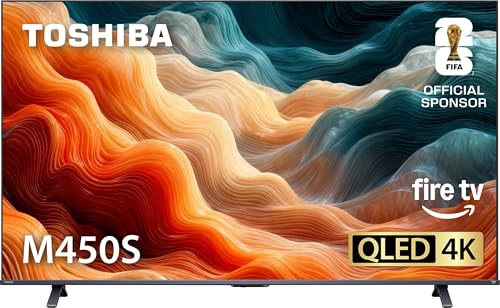
TOSHIBA 43-Inch M450 QLED Fire TV — Best compact option
Toshiba’s M450 answers the question the giants cannot: what does this category offer the room that measures its wall in centimetres? Its listing names a 43-inch QLED 4K UHD panel on Fire TV with an Alexa voice remote and cable-free live TV streaming, which packages the non-OLED proposition, bright quantum-dot colour, no static anxiety, a complete platform, at the size of a bedroom, a kitchen-diner or a first flat’s only wall. At 43 inches, 4K resolution is genuinely luxurious, rendering streamed films with a fineness the larger value sets cannot match per inch.
The M450’s virtues are proportion and completeness rather than theatre. Its backlight is a mainstream design, so it will not duel the QN70H on a night scene, but in the rooms it is built for, nearer, brighter and more casual, its picture is lively and its platform identical in breadth to sets three times its presence. Toshiba’s television heritage shows in a product that feels assembled by people who have made small sets for decades. For the buyer whose brief is a real television, with the real services, in a real small room, without the compromises of the bargain basement, the M450 is the guide’s tidy answer.
- Panel: 43-inch QLED 4K UHD as listed
- Platform: Fire TV with Alexa voice remote as listed
- Content: live TV streaming without cable as listed
- Role: the complete small-room non-OLED
- Fit: bedrooms, kitchen-diners and first flats
Strengths
- 4K QLED fineness at a genuinely room-friendly size.
- Fire TV completeness in a compact cabinet.
- Bright colour suits the near, bright rooms it serves.
Trade-offs
- Mainstream backlight, not a dark-scene duellist.
- 43 inches will not carry a large room’s film night.
- Sound is sized to the cabinet and benefits from help.
Best for: small rooms wanting a complete, bright, no-fuss QLED television. Not suited for: main rooms with distant seating.

Roku 65-Inch Select Series QLED — Best platform simplicity
Roku’s Select Series at 65 inches scales the maker’s philosophy to the main room: a 4K QLED panel, the listing naming a voice remote, Wi-Fi and Bluetooth headphone mode, wrapped around the interface that remains the industry’s benchmark for getting out of the viewer’s way. In a non-OLED guide its presence makes a specific point. Many households choosing this category are choosing freedom from fuss in every dimension, no burn-in rituals, no platform labyrinth, no settings archaeology, and the big Select is that philosophy at full size: a bright, friendly picture that the whole family, including its least technical member, can summon a film on in seconds.
Panel honesty applies here as everywhere in this guide. The Select’s backlight and processing are mainstream, a clear step below the QN70H’s Mini-LED discipline in dark scenes and bright-room punch alike, and its QLED badge describes the same quantum-dot LCD arrangement the introduction explained. What it returns is serenity at scale and private listening for the late film, two qualities whose value compounds nightly. Households that measure a television by how rarely they think about it will find this the most restful 65 inches in the guide, and restfulness, in a family room, is not a consolation prize.
- Panel: 65-inch 4K QLED as listed
- Platform: Roku TV, the maker’s own interface
- Remote: voice remote as listed
- Listening: Bluetooth headphone mode as listed
- Role: the serene big screen
Strengths
- The calmest, fairest interface at a full 65 inches.
- Private listening suits late films in shared houses.
- QLED colour keeps the picture lively in ordinary light.
Trade-offs
- Backlight control is mainstream rather than Mini-LED class.
- Picture enthusiasts will want more processing headroom.
- Fewer flagship features than the Samsung across the aisle.
Best for: families wanting a big, bright, entirely unstressful television. Not suited for: viewers who audition dark scenes with a critical eye.

Hisense 32-Inch QD4 QLED VIDAA TV — Best small Hisense, VIDAA route
The first of the guide’s Hisense pair is a 32-inch HD television from the QD4 family, its listing naming Hi-QLED colour, DTS Virtual:X audio, Alexa compatibility, a Game Mode and an AI Sports Mode, all running on VIDAA, Hisense’s own smart platform. VIDAA is the point of this pick’s existence in the guide. It is a fast, light platform that Hisense controls end to end, and on a small set in a bedroom, a kitchen or a student room it offers a responsive, uncluttered route to the major services without the advertising weight some rival systems carry. Buyers who value speed and simplicity in a small screen, and who are content within VIDAA’s app catalogue, will find this little set remarkably frictionless.
The hardware around the platform is sensibly matched to its rooms. HD resolution at 32 inches follows the logic this cluster’s small-screen guide established, that at these sizes and distances platform and sound outrank pixels, and the QD4’s quantum-dot colour gives streamed content a saturation plain HD panels lack. Game Mode and the sports mode acknowledge the two duties small sets actually perform. The fork against its sibling is explicit and should be decided consciously: this set bets on Hisense’s own platform, the QD4SR below bets on Roku’s, and the better bet is the one whose apps and habits match your household’s, because the panels are close cousins and the platforms are the daily difference.
- Panel: 32-inch Hi-QLED HD as listed
- Platform: VIDAA, Hisense’s own smart system
- Audio: DTS Virtual:X as listed
- Modes: Game Mode and AI Sports Mode as listed
- Compatibility: works with Alexa as listed
Strengths
- VIDAA is quick, light and refreshingly uncluttered.
- Quantum-dot colour lifts HD content at this size.
- Game and sports modes suit a small set’s real duties.
Trade-offs
- VIDAA’s app catalogue is narrower than Roku’s or Fire TV’s.
- HD resolution is a ceiling sharp eyes will notice up close.
- 32 inches serves personal and small-room viewing only.
Best for: small rooms wanting a fast, simple Hisense on its maker’s own platform. Not suited for: households whose essential app lives outside VIDAA’s catalogue.

Hisense 40-Inch QD4SR QLED Roku TV — Best small Hisense, Roku route
The QD4SR takes the same Hisense QD4 idea and changes two variables at once, which is what makes the pair so instructive. Size rises to 40 inches and resolution to Full HD, its listing naming a full-array LED backlight and a slim-bezel design, while the platform becomes Roku, with Dolby Audio and Alexa compatibility alongside. Full-array backlighting at this size and tier is a genuine distinction, giving the panel a more even, better-controlled foundation than the edge-lit designs common in small sets, and Roku gives the household the deepest, calmest app catalogue in the small-screen world.
Read against its VIDAA sibling, the QD4SR is the choice for the household that wants Hisense’s value and colour with the platform certainty of Roku, plus a size step that carries a small living room rather than only a bedroom. Read on its own merits, it is arguably the most complete small television in this guide: a 40-inch Full HD quantum-dot panel with a proper backlight and the interface nobody has to learn. If the guide’s platform lecture has a valedictorian, it is this set, demonstrating that at the smaller sizes the winning specification is the one you touch every day. Buyers torn between the two Hisense models should list their three essential services, check them against VIDAA, and let that single page of homework decide, because everything else between the siblings is a matter of inches.
- Panel: 40-inch Hi-QLED FHD as listed
- Backlight: full-array LED as listed
- Platform: Roku TV
- Audio: Dolby Audio as listed
- Design: slim bezel as listed
Strengths
- Full-array backlight is a real distinction at this size.
- Roku brings the deepest, calmest app catalogue.
- 40 inches bridges bedroom and small living room gracefully.
Trade-offs
- Full HD rather than 4K, a fair trade at this size and tier.
- Less platform speed theatre than its VIDAA sibling’s lightness.
- Still a small-room set, not a main-room flagship.
Best for: buyers wanting Hisense value with Roku certainty at a versatile 40 inches. Not suited for: 4K specification hunters or large-room buyers.
How Do the Six Compare?
| Pick | Backlight route | Platform | Defining strength |
|---|---|---|---|
| Samsung 65-Inch QN70H Neo QLED Mini-LED | Mini-LED | Samsung | Finest LCD contrast here |
| INSIGNIA 75-Inch QF QLED Fire TV | Mainstream LED | Fire TV | Size per unit of budget |
| TOSHIBA 43-Inch M450 QLED Fire TV | Mainstream LED | Fire TV | Compact completeness |
| Roku 65-Inch Select Series QLED | Mainstream LED | Roku | Interface serenity at scale |
| Hisense 32-Inch QD4 QLED VIDAA TV | LED, quantum-dot colour | VIDAA | Platform lightness |
| Hisense 40-Inch QD4SR QLED Roku TV | Full-array LED | Roku | Small-set completeness |
Every row is the same species, an LED-backlit LCD with quantum-dot colour where the badge says QLED, and the table’s honesty about that is the guide’s parting gift to its readers. What separates the rows is backlight ambition, platform philosophy and size, which are exactly the axes worth paying for in this category.
How Should You Set Up a Non-OLED TV for Bright Rooms and Dark Evenings?
One television, two lighting regimes, and the settings should acknowledge both. For daylight, the backlight can run generously and the set’s dynamic or standard preset will keep colours assertive against the room; for the evening, a movie preset with the backlight lowered and local dimming given its head will recover the contrast this category is accused of lacking. Many households save the two as separate presets or lean on the set’s ambient sensing, and either habit beats a single compromise setting that is too dim at noon and too glaring at midnight.
Static-content freedom should be enjoyed, not tested. LCD panels do not need the protective rituals of emissive ones, yet any screen appreciates a screen saver over a weekend’s pause and a brightness that suits the room rather than the showroom. News households can leave the ticker running with a clear conscience, gamers can leave the HUD where the game puts it, and that clear conscience, renewed daily, is the ownership experience this category sells.
Viewing position completes the setup, because LCD contrast and colour are at their best within a central cone. Seat the main viewers squarely, keep the panel near eye level, and angle a wall-mounted set toward the sofa rather than the room’s geometry. Side seats will still enjoy a perfectly watchable picture, particularly on the larger sets, but the hero seat should be placed where the panel’s engineering can do its finest work.
What Are the Most Common Mistakes When Buying a Non-OLED TV?
The first mistake is badge shopping: paying for the word QLED as if it were a technology apart, rather than comparing the backlight, the dimming and the processor that actually determine the picture. The second is its mirror image, dismissing every LCD as a relic while the household’s bright room and ticker habits quietly make it the right tool. Both errors come from comparing categories instead of rooms.
The third mistake is neglecting the platform at the smaller sizes, where the interface is half the product; the Hisense pair exists in this guide to make that error impossible to commit innocently. The fourth is buying the largest screen the wall accepts and seating viewers inside the distance where its mainstream backlight and processing show their seams; size must be matched to distance and source quality. The fifth is forgetting sound, because bright, social rooms are loud rooms, and a big picture with small speakers will be shouted over by its own household. Room, backlight, platform, sound: the order is not glamorous, and it is correct.
How Does Backlight Technology Actually Differ Across This Category?
Since the introduction established that every pick here is an LCD lit from behind, the backlight is where the honest differences live, and it deserves a full explanation. The simplest designs light the panel from its edges, guiding light across the screen with a plate; they are slim and inexpensive, and their weakness is control, because the whole picture shares a small number of light sources. Full-array designs place LEDs across the panel’s entire back, and local dimming divides those LEDs into zones that brighten and darken with the scene. The Hisense QD4SR’s full-array listing is therefore a meaningful line in a small set’s specification, the foundation of more even brightness and better-behaved dark scenes than edge lighting usually manages.
Mini-LED, the QN70H’s route, is the same idea pursued to an extreme: far smaller LEDs, in far greater numbers, forming far more dimming zones, each zone small enough to cradle a highlight without flooding its dark neighbourhood. The result, at its best, approaches the contrast behaviour of emissive panels while retaining the LCD virtues of brightness and static indifference. Zone counts are quoted competitively and should be read as a rough ranking within a brand rather than a cross-brand currency, because the dimming algorithm conducting the zones matters as much as their number. A well-conducted hundred zones will embarrass a neglected thousand, which is why this guide describes behaviour, the halo around a candle, the grey of a night sky, rather than reciting tallies.
Quantum dots, the layer the QLED name celebrates, work on colour rather than light control. Blue backlight passes through a film of microscopic crystals that convert portions of it into highly pure reds and greens, widening the palette the panel can show and keeping colours saturated at high brightness where older LCDs washed out. It is a real and valuable technology, present in some form across most of this list. It is simply not a panel type, and the buyer who understands that can finally read a specification sheet the way an engineer would: light source, dimming, colour layer, processor, in that order.
What Does a Bright Room Really Demand From a Television?
More than brightness alone, which is the showroom’s simplification. A bright room attacks a picture from three directions: it washes the screen with ambient light that lifts blacks, it reflects in the surface, and it forces the viewer’s eyes to adapt to a high overall level against which the television must hold its own. Sustained brightness, the level a panel can hold across a whole scene rather than in a brief highlight, is the specification that answers the first and third attacks, and it is the quiet reason this category’s better sets feel composed at noon while lesser panels, however heroic their peak figures, look tired by lunch.
Surface finish answers the second attack, and it connects this guide to the cluster’s no-glare entry. None of the six here is a factory matte art panel, so their defence against a window’s reflection is placement and brightness rather than diffusion. The practical household can still win the fight: position the set so windows sit behind the seating, prefer the brighter picks for the brightest walls, and remember that a mid-tier Mini-LED in a thoughtfully arranged room will outperform a flagship hung opposite a wall of glass. Room craft is a specification the buyer supplies, and in this category it is worth a full tier of hardware.
Evening reverses the examination, which is why this guide refuses to crown any set on daylight alone. When the room dims, backlight behaviour takes over the verdict, blooming and black levels return to the agenda, and the household discovers whether its bright-room champion has a second talent. The QN70H was chosen as standard-bearer partly because it passes both examinations with the same composure, and buyers whose rooms live both lives should weight that dual competence above any single spectacular number.
How Should Gamers and Sports Fans Read This Category?
Gamers arrive at non-OLED for the HUD reason and stay for the brightness. A bright, punchy LCD in a lit room is a fine gaming surface, and the features that matter are the ones the listings name: game modes that cut processing delay, variable refresh support where offered, and the Hisense QD4’s explicit Game Mode as a small-set example of the species. What this category does not promise is a universal specification, because refresh and response vary model by model in LCD just as they do elsewhere, and the serious player should read the individual listing’s gaming lines with the same care given to the panel’s.
Sports fans are this category’s natural constituency. Their content is bright, fast and logo-laden, their viewing hours include the sunlit afternoon, and their screens carry a score bar with the persistence of furniture. An LCD’s indifference to that score bar, season after season, is worth more to them than any laboratory black level, and the category’s brightness keeps a sunlit pitch vivid when an emissive panel would be husbanding itself. The cluster’s dedicated sports guide goes deeper into native refresh and uniformity; within this guide, the point is simpler: if your television’s life is fixtures, news and games in a real living room, you are not settling for these sets. You are the person they were engineered for.
How Long Will a Non-OLED TV Serve, and What Ages First?
The panel itself is the durable part of the proposition. LCD backlights fade gradually and evenly over many years rather than failing by pattern, and the absence of burn-in means the picture a household calibrates in year one is recognisably the picture of year eight, a little dimmer at the extremes and otherwise itself. For buyers who keep televisions long, that predictability is a financial feature: the set’s decline is a slope, not a cliff, and it can be planned around rather than feared.
What ages first is the smart platform, as it does in every category. Apps grow heavier, services change their requirements, and a set’s interface slows from sprightly to patient across a five-year span. The defence is architectural rather than hopeful: every pick here either sits on a platform with a large installed base, which services keep supporting, or carries the HDMI capacity to accept a streaming stick that renews the set’s intelligence for the price of a family takeaway. Roku and Fire TV sets are particularly well placed in that ecology, and even the VIDAA Hisense can be renewed through its ports when its native apps eventually tire.
Care is the briefest chapter in this category’s manual, which is itself a recommendation. Dust the vents, keep the screen’s cleaning to a soft cloth, give the backlight a brightness suited to the room rather than a permanent maximum, and the television will repay the minimalism. Households migrating from emissive panels often report a small, unexpected relief at this shortness of the care list, one more entry in the ledger of freedoms that makes this category a preference rather than a fallback.
How Do You Audition a Non-OLED Set in Its First Week?
Test the two rooms the set must serve. By day, with the room at its brightest, play the household’s ordinary content and judge whether faces, pitches and presentations hold their composure without the backlight straining at its ceiling. By night, dim the room and run the darkness examination this cluster uses everywhere: a night scene with small bright lights, which will show the backlight’s dimming manners, its halos and its black floor in a single frame, and a subtitled passage, where blooming announces itself around the text. A set that passes both examinations has nothing left to prove.
Then test the life around the picture. Leave the household’s news channel or game interface on screen in the ordinary way, not as a torture test but as a confirmation of the freedom you bought, and enjoy the absence of anxiety as a measurable product benefit. Have every member of the household find their programme unaided, because the platform verdict is a census, not an opinion. Check the side seats, where LCD viewing angles make their one honest concession, and rearrange a chair if the room’s favourite corner sits outside the panel’s best cone. All of this fits inside a return window, and all of it is worth more than another hour of specification comparison.
What Is the Honest Case Against This Category?
A guide that only prosecutes one side deserves suspicion, so the counterarguments deserve their paragraph in full strength. In a dark room, on a demanding film, an emissive panel’s black is not a little better than the best backlight’s; it is categorically different, an absence rather than a dimming, and viewers who build their viewing around that experience will feel the difference in every night scene. Viewing angles follow the same pattern: an LCD’s contrast and colour are finest in a central cone and concede ground to the side seats that an emissive panel serves without thinking. Processing at the very summit, the interpretive artistry with poor sources, also has emissive flagships among its champions.
None of that is hidden anywhere in this guide, and none of it overturns the guide’s thesis, because the thesis was never that LCD beats emissive at its own game. The thesis is that most rooms, most content and most households are playing a different game, of daylight and tickers and size and serenity, and that in that game these six sets are not the consolation bracket. A buyer who has read both cases and still chooses the dark-room summit should follow the cluster’s movie guide toward its OLED pick with this guide’s blessing. A buyer who recognises their own living room in these pages should choose here without a flicker of the feeling that they settled.
How Do You Decide Your Size in This Category?
Non-OLED’s size ladder is its friendliest feature, and it should be climbed by distance rather than by ambition. Measure from the screen’s wall to the main seat’s eyes. At roughly two metres, the 43 and 50-inch class, represented here by the Toshiba, fills the view pleasantly for mixed content; at two and a half to three metres the 65-inch pair, Samsung and Roku, come into their inheritance; beyond three metres, or in a room that hosts a crowd, the INSIGNIA’s 75 inches stops being extravagance and becomes eyesight. The two Hisense sets serve the rooms at the near end of the tape, the bedroom and the small flat, where their platforms and prices make more sense than any giant could.
Resolution interacts with size in the familiar way, and this list embodies the full spread: 4K on the four larger sets, Full HD on the 40-inch Hisense and HD on the 32-inch, each matched to the distances its size implies. The buyer who keeps the tape measure’s verdict will rarely go wrong, because the category’s breadth means there is a correctly sized answer at every distance, and the wrong answers are almost always a size bought for the showroom’s sightlines instead of the sofa’s.
What Should Second-Room Buyers Steal From This Guide?
Not every screen in a house is the main event, and this category’s smaller picks are quietly the best second-room televisions in the whole cluster. A bedroom, a kitchen or a home office asks for brightness against morning light, a platform that starts instantly, sound that carries dialogue across a room’s chores, and a panel that can sit on a paused screen or a news channel all day without a whisper of anxiety. The Toshiba at 43 inches, the Roku-flavoured Hisense at 40 and its VIDAA sibling at 32 divide those duties by size and platform with an exactness that looks accidental and is not.
The second-room lens also clarifies the main-room decision by contrast. When the bedroom set is this capable, the main set is free to specialise: the QN70H’s discipline for the household that watches films in a bright room’s evening, the INSIGNIA’s scale for the household whose sport and family nights fill a wall. Houses that buy their screens as a system, each room’s duties named before any model is chosen, end up with no television that is almost right, and this category’s breadth is what makes that system affordable to assemble in a single generation of purchases.
How Do You Keep the Whole Purchase in Proportion?
End the analysis where every television purchase should end, with the household’s actual week projected onto the screen. Count the hours of daylight viewing against the hours of darkness, the static channels against the films, the solo mornings against the family evenings, and the proportions of that honest census will point at a pick in this guide more reliably than any benchmark. A household that is seventy percent brightness, tickers and shared sport should not spend its money chasing the thirty percent’s blackest frame; a household with the opposite census should walk toward the emissive pick in the movie guide and be glad the choice exists.
Budget follows the census. The money saved by choosing this category’s value rungs is real money, and it buys the soundbar, the mount, the electrician’s tidy socket and the streaming subscriptions that decide how the television is actually experienced. A slightly humbler panel in a finished room will be loved longer than a flagship glowing in an unfinished one, and the households that understand that ordering are the ones still praising their televisions, in any category, five years after the unboxing photographs have faded.
Final Recommendation
Take the Samsung QN70H as this category’s standard-bearer if the budget allows, because its Mini-LED discipline shows how far the LCD route has come. Choose the INSIGNIA 75-inch when the room is big and bright and the viewing is social, the Roku Select when serenity at 65 inches matters more than shadow heroics, the Toshiba when the room is small and the brief is completeness, and between the two Hisense QD4 sets let your app list arbitrate, VIDAA’s lightness against Roku’s depth, on hardware that will serve either answer happily. Buy the backlight and the platform, ignore the badge poetry, arrange the room’s light and the seating with the same care you gave the shortlist, and enjoy never thinking about a ticker again, through a decade of bright afternoons, long tournaments and paused dinners on a screen that simply takes your household’s habits as it finds them.
Frequently Asked Questions
What should I check on the listing before ordering?
Confirm the backlight description in the maker’s own words, the exact size class, the platform and its app catalogue, the number and type of HDMI ports for your consoles and soundbar, and the stand’s width against your furniture. Listings in this category lean heavily on badge language, so the discipline of reading past the QLED banner to the engineering lines beneath it is the single most protective habit a buyer can practise, and it takes less than five minutes per model.
Is QLED the same kind of technology as OLED?
No. QLED is a marketing name for an LED-backlit LCD television with a quantum-dot colour layer. OLED pixels emit their own light and switch off individually. Both can make excellent pictures; they do it by different mechanisms with different strengths.
Can a non-OLED TV really match OLED for movies?
The best Mini-LED sets narrow the gap impressively in dark scenes while beating OLED for sustained brightness in lit rooms. In a pitch-black room an OLED still owns the deepest blacks; in the mixed lighting most homes actually use, the difference shrinks to a preference. The practical test is your own last ten films: recall the rooms they were watched in, the lamps that were burning and the people who were talking, and you will know which side of that preference your household honestly lives on.
Do I need to worry about burn-in with these TVs?
No. LCD panels do not carry OLED’s burn-in risk from static images, which is a central reason news, sports and gaming households choose this category. Ordinary sense still applies: no screen loves being paused forever, but no protective rituals are required. That freedom extends to the household’s least careful members, which in practice means the television survives children, guests and grandparents without a briefing, a small mercy that owners consistently rank among the purchase’s best features once the novelty of the picture itself has worn into familiarity.
Which Hisense QD4 should I choose, VIDAA or Roku?
List your essential streaming services first. If they all live happily in VIDAA’s catalogue and you value its speed and lightness, take the 32-inch QD4. If you want Roku’s deeper catalogue and calmer interface, plus a larger Full HD panel, take the 40-inch QD4SR. Do not let the decision drift into a general debate about the platforms’ reputations, because the two systems will both be updated, both will gain and lose features, and the only durable fact is whether the services your household opens every night are present, prominent and pleasant on the one you bring home.
Is a bigger, cheaper QLED better than a smaller Mini-LED?
It depends on the room and the light. A big bright social room rewards the 75-inch value pick’s scale; a smaller or darker room rewards the Mini-LED set’s control. Match the television to the seating distance and the room’s brightness before comparing badges. If the household is split, with one viewer chasing spectacle and another chasing shadow detail, the tiebreaker is the calendar: count the big shared events against the solitary film nights across a typical month, and let the majority of evenings, rather than the loudest opinion, choose the screen.
What does Mini-LED actually add over a regular LED backlight?
Control. A Mini-LED backlight uses far more, far smaller lights divided into many more dimming zones, so bright objects can shine without lifting the darkness around them. On the QN70H that translates into the finest contrast and the cleanest night scenes available from an LCD in this guide, at a tier that reflects the engineering involved. The difference announces itself most clearly in the scenes this category was once teased about: a candlelit interior, a night street, a starfield, where a mainstream backlight glows greyly around the action and a Mini-LED set keeps its composure close enough to the emissive standard that most viewers, in most rooms, stop keeping score.
Is now a good time to buy into this category?
Yes, because the category is in a mature phase: Mini-LED control improves yearly without revolutionising, platforms are stable, and the size ladder is fully populated from bedroom to ballroom, so a buyer today is purchasing refinement rather than experiment.
Does a non-OLED TV suit a home cinema corner?
It can, provided the corner’s ambitions are stated honestly. A Mini-LED set like the QN70H, in a dimmed room with the seating inside its best viewing cone and a soundbar doing the audio work, delivers a film experience that satisfies all but the most committed black-level connoisseurs. What it will not do is reproduce an emissive panel’s absolute darkness, and a household building a dedicated, blacked-out cinema should weigh that single fact above every other in this guide and choose accordingly.
How long before a smart platform feels old?
Typically several years of graceful service before apps begin to outgrow the hardware, varying by platform and by how heavily the household leans on it. The practical answer is built into every pick here: mainstream platforms age slowly, and an inexpensive streaming stick on an HDMI port renews any of these sets when its native interface eventually tires.
Are non-OLED TVs better for gaming?
They are better for one specific gaming anxiety: static HUD elements over very long sessions carry no burn-in concern. Refresh and response vary by model in both categories, so judge a gaming set by its listed game features rather than by its panel family. Bright-room gaming is the other quiet advantage, because a lit room is where most consoles actually live, and a panel that holds its colour and contrast against daylight serves the afternoon session better than one husbanding its brightness for the evening.
Related Guides
The rest of this cluster of television guides looks at screens through other lenses, for other rooms, other budgets and other kinds of light, and a household furnishing several rooms at once will find the six answers fit together like a set: the best no glare tvs, the best hd tvs for sports, the best bathroom tvs, the best dorm and small apartment tvs and the best tvs for streaming movies.


