What's inside
- Where to buy
- Key Takeaways
- Quick Picks
- How We Chose These Picks
- Inkjet or Dye Sublimation: Which Technology Belongs on Your Fridge Door?
- What Makes a Sticker Printer Different From a Photo Printer With Sticker Paper?
- How Do the Running Costs Compare Across a Year of Ordinary Family Printing?
- Which Machine Suits Which Member of the Household?
- Photo Paper or Sticker Sheet: Where Each Pick Earns Its Shelf Space
- How Should You Store Prints and Stickers So They Still Look Right Next Year?
- What About the Kodak Dock Plus and Other Names Your Search Will Suggest?
- Glossy, Lustre or Matte: Which Photo Paper Should Live in the Drawer?
- How Do You Get Phone Photographs That Deserve Printing?
- What Should the First Month With a Photo or Sticker Printer Look Like?
- Which Habits Ruin Photo Prints and Stickers Most Reliably?
- Final Recommendation
- Frequently Asked Questions
- Related Guides
As an Amazon Associate I earn from qualifying purchases. This post may contain affiliate links at no extra cost to you.
gizmoverdict.com is reader-supported. When you buy through links on our site, we may earn an affiliate commission.
Where to buy
Six machines carry buy links in this guide, each traced to a verified US Amazon listing, and two further names — Canon’s SELPHY CP1500 and the Kodak Dock Plus — are discussed in the buying guide further down without links, because the search we ran while preparing this guide returned no clean listing for either and a recommendation should never pretend otherwise. When you open a linked listing, confirm the consumables story before the hardware story: with photo and sticker printers, the paper and ink packs a machine eats over a year matter more than the box it arrived in, and listings are where the pack sizes and compatibility lines live.
The best printers for photos and stickers are really two families sharing one shopping list, and confusing them is the most common way this purchase goes wrong. Photo printers are judged on the print itself — colour depth, gradient smoothness, the way a face survives enlargement. Sticker machines are judged on the object — a finished, cut, peelable thing that comes out of the slot ready to use. Some households need the first, some need the second, and a cheerful minority need both, which is why this guide keeps the families separate in the reviews even while it houses them under one roof.
The line-up reflects that split honestly. A six-colour wide-format Epson and a Canon MegaTank cover the serious photo end at two different running-cost philosophies. Two dye-sublimation portables from HP and Liene cover the instant 4×6 world where the print is a keepsake made in a minute. And the Liene PixCut S1 stands alone as the machine that prints a sticker and then cuts it out, a genuinely different species that should never be mistaken for a photo printer with ambitions. Read the guide with your dominant project in mind and the six sort themselves quickly.
Key Takeaways
- Epson’s Expression Photo HD XP-15000 is the enthusiast’s photo machine here: six inks, borderless output up to 13 x 19 inches, and colour that rewards good files.
- Canon’s PIXMA G6020 MegaTank prints photographs at tank-ink running costs, the combination family archivists print hundreds of pages with.
- HP’s Sprocket Studio Plus uses dye sublimation for true 4×6 photo prints from a phone, with the laminated finish that process is loved for.
- The Liene PixCut S1 is the only pick that finishes the job — it prints a sticker in dye-sub colour and then cuts it to shape automatically.
- Liene’s M100 is the portable party route, a 4×6 dye-sub printer sold with a generous stack of paper and cartridges in the box.
- Canon’s SELPHY CP1500 and the Kodak Dock Plus are covered as unlinked honourable mentions, because no clean listing for either had surfaced when we last checked.
Quick Picks
| Pick | Badge | Why it is here |
|---|---|---|
| Epson Expression Photo HD XP-15000 | Best Overall | Six-ink photo quality stretched across sheets up to 13 x 19 inches. |
| Canon PIXMA G6020 | Best Ink Value | MegaTank refills make big family photo projects financially painless. |
| HP Sprocket Studio Plus | Best Instant 4×6 | Dye-sublimation prints from the phone, finished and dry in about a minute. |
| Liene PixCut S1 | Best for Stickers | Prints in colour, then cuts the sticker out — the whole craft in one pass. |
| Liene M100 4×6 Photo Printer | Best Portable Photo | A phone-driven 4×6 dye-sub machine bundled with a serious pile of paper. |
| Canon SELPHY CP1500 | Honourable Mention | The beloved compact dye-sub, covered here as an unlinked mention. |
How We Chose These Picks
Photo quality was judged the way photographs are actually judged: skin tones first, because every printer flatters a landscape and only honest ones flatter a face; gradients second, because skies and studio backdrops band on weak ink sets; and shadow detail third, because family photos live in dim rooms and winter light. Sticker performance was judged as object-making — colour that survives on the sticker’s own media, cutting accuracy where cutting exists, and the peel-and-stick practicality of the finished thing. Running costs were weighed per finished print rather than per cartridge, because dye-sub packs, ink bottles and cartridges all hide their true price in different units.
Listing integrity shaped the final six as much as print quality did. Two respected names in this category could not be linked honestly on the evidence of our latest listing check, and rather than quietly substituting lookalikes, the guide covers them openly in the buying-guide section as the prose-only mentions they are. Everything that does carry a link traces to a verified listing in our pool, with the model’s role kept exactly as its maker defines it — most importantly the PixCut S1, whose printing-and-cutting identity is its own category and is never blurred into the photo printers around it.
Inkjet or Dye Sublimation: Which Technology Belongs on Your Fridge Door?
The two technologies in this guide make photographs by opposite philosophies, and the finished prints feel different in the hand. Inkjet sprays microscopic droplets onto coated paper; at its best — the six-ink Epson, the Canon tank machine — it delivers resolution and colour range that reward large prints and close looking. Dye sublimation heats dye into the paper in continuous tones and finishes with a clear laminate layer, which is why dye-sub prints emerge dry, glossy, fingerprint-resistant and faintly magical at 4×6 inches, and why the process essentially stops at small sizes: the paper and ribbon are manufactured as matched sets, and 4×6 is the size the whole ecosystem agreed on.
Choose by destination. A photograph destined for a frame at 8×10 or larger belongs to inkjet, full stop, and the XP-15000 exists for exactly that ambition. A photograph destined for a wallet, a fridge, a party guest’s pocket or a scrapbook page tonight belongs to dye-sub, where the laminate shrug-off-ability matters more than resolution nobody will inspect. Stickers split the vote: inkjet on sticker paper serves the design-and-cut workflow, while the PixCut S1’s dye-sub route serves the finished-object workflow. Neither technology is the future of the other; they are tools that happen to share a shopping aisle.
There is also a difference in how the two fail, and knowing it prevents misdiagnosis. An inkjet having a bad day bands, streaks or shifts colour as a nozzle sulks — visible, diagnosable, usually curable with a cleaning cycle and a test page. A dye-sub machine having a bad day usually is not; its failures arrive as paper jams or a ribbon tear, mechanical rather than chromatic, because the matched consumables leave so little to chance. Buyers who dread colour troubleshooting often find dye-sub’s narrower but sturdier world restful, while buyers who love coaxing a perfect print from settings and profiles find inkjet’s wider world the entire hobby. Choose the failure style you would rather live with, and you have usually chosen the technology correctly.
What Makes a Sticker Printer Different From a Photo Printer With Sticker Paper?
Everything after the colour dries. A photo printer’s responsibility ends at a beautiful rectangular sheet; turning that sheet into a sticker requires the separate liturgy of cutting — by machine, by punch, by patient scissors — and the alignment, waste and time that liturgy involves. A dedicated sticker maker folds the cutting into the same pass as the printing, using its own registration and a small blade, and hands you an object. The PixCut S1 in this guide is the exemplar: dye-sublimation colour at 300 dpi, then an automatic cut along the design’s contour, guided by the app that laid the design out.
The trade is creative freedom. The print-then-cut route through a full inkjet accepts any sticker paper, any size up to the sheet, any design software, and pairs with cutting machines many crafters already own. The integrated route accepts its own media ecosystem and its own app, and in exchange removes every intermediate step between idea and finished sticker. Households making occasional stickers as part of larger crafts belong on the first route; anyone whose sticker-making is the main event — labels, gifts, journaling, small-batch products — should weigh the second route’s beautiful simplicity seriously.
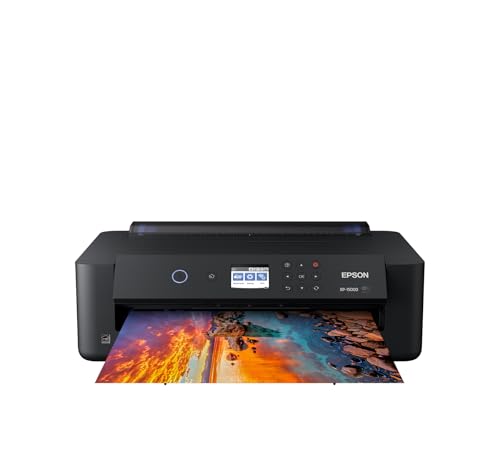
Epson Expression Photo HD XP-15000 — Best Overall
Every guide like this has a machine that makes the others look like compromises, and here it is the wide Epson. Six inks — including the red and grey that extend colour range and smooth monochrome transitions — print borderless from snapshot sizes up to 13 x 19 inches, at a deliberate photo pace of up to 9.2 pages per minute that tells you exactly what the machine prioritises. Photographs from good files have the quality that makes people ask which lab printed them: gradients that melt rather than step, reds that hold detail instead of blowing into orange, and black-and-white output with the patience that the grey ink buys.
For the sticker half of this guide’s title, the XP-15000 plays the role of the serious sheet printer: full-size sticker sheets in rich colour, cut afterwards by whatever tool your craft already owns, with the wide format meaning a single sheet can carry a whole product set or one glorious oversized design. Automatic two-sided printing handles the household’s documents without fuss. The costs of admission are the familiar enthusiast tolls — individual cartridges that a heavy photo habit will cycle through, a footprint that claims real desk, and a feed that prefers its media one thoughtful sheet at a time at the rear for heavy stock. Owners who print photographs as a hobby’s centre, rather than as an errand, consistently judge those tolls worth paying.
It also rewards skill, which not every buyer wants to hear. Feed it a well-exposed file on the correct paper profile and it produces the best print in this guide by a clear margin; feed it a muddy phone shot on the wrong setting and it will reproduce the mud faithfully at large size. That honesty is what separates an enthusiast machine from an appliance, and it is why this Epson, rather than the friendlier machines below, carries the top badge for readers who care about photographs first.
Paper choice is where its owners spend their happy hours. The rear feed opens the door to heavyweight photo papers and fine matte stocks that a cassette-only machine would refuse, and each paper’s profile becomes a small recipe the studio learns once and reuses for years. A household that prints one great photograph a week will find the XP-15000’s talents exactly matched to the ritual; a household that prints forty snapshots a day will find its cartridge appetite the story instead, and should read the Canon review below with both eyes open.
- Type: six-ink wide-format inkjet photo printer
- Borderless printing up to 13 x 19 in
- Print speeds up to 9.2 ppm in photo duty
- Automatic two-sided printing for documents
- Rear feed for heavy and specialty media
Strengths
- Colour range and gradient handling clearly ahead of the four-ink machines.
- Wide format turns one sticker sheet into a whole product layout.
- Monochrome prints benefit visibly from the dedicated grey ink.
Trade-offs
- Cartridge running costs follow photo volume upward without mercy.
- Large footprint for a home desk.
- Demands decent files and correct profiles to show its advantage.
Best for: photography-led households printing enlargements and premium sticker sheets.
Not suited for: casual users whose photos live on phones and never reach a frame.

Canon PIXMA G6020 — Best Ink Value
The G6020 answers the question family photographers actually ask, which is not how beautiful one print can be but how beautiful three hundred can afford to be. Canon’s MegaTank system replaces cartridges with refillable reservoirs and bottled ink, and the psychological effect on a household’s printing is immediate: the shoebox of unscanned family photos gets scanned and printed, the school projects come out in colour without a budget meeting, and the photo wall stops being a plan and becomes a weekend. As an all-in-one it also scans and copies, which closes the digitise-the-archive loop inside a single machine.
Print quality sits a clear step below the six-ink Epson and a clear step above what its running costs suggest — four inks, honestly driven, producing photographs that families frame happily and only photographers critique. Borderless photo printing covers the standard sizes, mobile printing works with the voice-assistant conveniences its listing mentions, and the machine’s whole demeanour is that of a appliance built for throughput rather than ceremony. For sticker work it is the volume sheet printer of this guide: full-colour sheets at tank prices, ready for the cutting machine, with none of the per-sheet guilt that rations creativity on cartridge machines.
The compromises are the tank family’s usual ones. The printer is slower to reward impatience, its four inks show their ceiling in dramatic gradients, and the initial setup — filling tanks, priming the system — asks for one careful afternoon. Households printing photographs by the album rather than by the masterpiece will find every one of those trades acceptable by the second bottle of ink, which is to say, much later than they expected to need it.
There is a quieter virtue worth recording: predictability across a long session. A tank machine mid-album does not fade as a cartridge weakens, because the reservoir system feeds from a visible, generous supply, and the fiftieth print of the afternoon matches the fifth in a way that makes batch projects — the reunion book, the year-in-photos wall — genuinely plannable. For families, that consistency across volume is worth more than the last increment of gradient quality, and it is the reason this Canon, rather than a prettier cartridge machine, holds the value badge in a guide where photographs are counted by the hundred.
- Type: refillable-tank all-in-one, print, copy and scan
- MegaTank bottled ink refills
- Borderless photo printing at standard sizes
- Mobile printing and voice-assistant compatibility
- Flatbed scanner for photo archives
Strengths
- Running costs that turn photo printing from rationed to routine.
- Scanner included, so the archive project lives in one machine.
- Honest four-ink quality that satisfies family framing standards.
Trade-offs
- Gradient subtlety trails the six-ink Epson noticeably.
- Setup afternoon required to fill and prime the tanks.
- Photo pace is steady rather than brisk on best settings.
Best for: families printing photographs and sticker sheets in genuine quantity.
Not suited for: enlargement perfectionists, who will see the four-ink ceiling.

HP Sprocket Studio Plus — Best Instant 4×6
HP’s entry in the dye-sub world understands the assignment precisely: a photograph on a phone is a rumour, and this machine turns it into a 4×6 fact in about a minute, dry to the touch and finished with the protective laminate that dye sublimation lays down as its final pass. The Studio Plus connects over Wi-Fi, works through HP’s editing app where collages, borders and captions live, and ships in its listing bundle with a starter set of sheets and a cartridge — the consumables arriving as matched paper-and-ribbon packs, as the technology requires.
Judge it inside its category and it shines. The prints are true photographs in miniature — continuous tone, no visible dots, a gloss that shrugs off the fingerprints of a passed-around party print. Colour leans pleasing rather than forensic, which for faces at parties is the correct leaning. Judge it outside its category and the limits are structural: 4×6 is the ceiling as well as the size, the per-print cost of matched consumable packs is the highest in this guide, and there is no path to a bigger print because the technology’s media simply does not come bigger in this class. The Sprocket Studio Plus is not a small version of the Epson; it is a different pleasure entirely, the pleasure of the print existing now, in a hand, at the event where the photograph was taken.
For sticker purposes, honesty applies: its output is a finished photo card, not an adhesive sticker, and buyers wanting peelable results should look at the PixCut below or at inkjet sticker paper. What the HP does supply to craft projects is the photo element — the picture for the scrapbook page, the journal spread, the gift tag with a face on it — produced at the speed of the occasion itself.
Ownership rhythm is worth one more paragraph, because dye-sub economics surprise buyers who think in cartridges. Each matched pack contains exactly the ribbon a set number of sheets requires, so a print never half-finishes for want of one colour, and the cost of the next print is always known to the penny before it starts. Households that print socially find that predictability calming: the pack is the budget, the stack of finished prints is the receipt, and there is no equivalent of the inkjet owner’s late-night discovery that cyan had opinions of its own.
- Type: dye-sublimation 4×6 photo printer
- Wi-Fi printing from phones via the HP app
- Prints emerge dry with a protective finish
- Bundled starter sheets and cartridge in this listing
- Compact body for home and event use
Strengths
- True continuous-tone photographs, ready in about a minute.
- Laminated finish tolerates handling, wallets and fridge doors.
- App editing makes collages and captioned prints effortless.
Trade-offs
- 4×6 inches is a hard ceiling set by the media system.
- Matched consumable packs carry the class’s highest per-print cost.
- Output is a photo card, not an adhesive sticker.
Best for: parties, scrapbooks and anyone who wants the print in hand immediately.
Not suited for: enlargements, or sticker projects needing an adhesive back.

Liene PixCut S1 — Best for Stickers
Here is the machine this guide’s second half exists for, and it must be described precisely because its category is young enough to be misunderstood: the PixCut S1 is a sticker printer and cutting machine in one body. It prints a design in thermal dye-sublimation colour at 300 dpi — the same continuous-tone process as the photo portables, applied to sticker media — and then, in the same session, cuts the design out along its contour with the precision its listing describes as AI-guided auto-cutting. What comes out is not a sheet awaiting further work. It is a finished sticker.
The workflow is the product. Designs are composed in Liene’s app, where the cut line is part of the design rather than a separate negotiation with a second machine, and the output suits the objects stickers actually become: laptop and bottle decorations, custom labels, gift seals, journal pieces, small-batch product branding. Dye-sub colour on the sticker face gives a smooth, photographic finish quite different from inkjet-on-matte-paper, glossier and more manufactured in feel. The constraints are the ecosystem’s own — media comes from Liene’s system, design lives in its app, and sheet-size ambitions beyond its format belong to the inkjet route. Within those rails, no machine in this guide removes more steps between an idea and a sticker on a water bottle.
It should not be bought as a photo printer that happens to cut, and this guide does not present it as one. Its photo output is sticker-sized and sticker-purposed; the household that wants framed photographs should buy the machines above or below it and let the PixCut reign over its own kingdom, which is the kingdom of the finished, peelable, oddly satisfying object.
Consider who feels the difference most. A teacher labelling a classroom, a parent personalising party favours, a seller whose product is a sheet of custom designs — each previously faced the same fork between a craft cutter’s learning curve and a pair of scissors’ inaccuracy. The PixCut dissolves that fork. Its compromises are real but they are the compromises of a specialist: it will not print your holiday photographs for the wall, and it does not want to. Specialists that know their borders this clearly tend to be excellent inside them, and the flood of small, perfect, ready-to-peel objects this machine produces is the evidence.
- Type: dye-sublimation sticker printer with integrated cutting
- 300 dpi continuous-tone colour printing
- Automatic contour cutting after printing
- App-based design with cut lines built in
- Media and workflow supplied by the Liene ecosystem
Strengths
- The only pick that delivers a finished sticker, not a sheet.
- Dye-sub finish looks manufactured rather than homemade.
- Design-to-object workflow removes the second machine entirely.
Trade-offs
- Media and app ecosystem are a closed garden by design.
- Format ceiling is set by the sticker system, not by ambition.
- Not a substitute for a general photo printer.
Best for: sticker-first makers — labels, gifts, journaling and small product runs.
Not suited for: framed photographs or oversized print-then-cut craft sheets.

Liene M100 4×6 Photo Printer — Best Portable Photo
The M100 takes the same dye-sublimation heart as the HP and packages it for movement: a portable 4×6 photo printer driven over Wi-Fi from a phone, sold in this listing with a hundred sheets and three cartridges, a bundle sized like the manufacturer expects you to actually print rather than admire the box. That bundle is the review in miniature. Dye-sub machines live or die on consumable supply, and a printer that arrives with a serious stack of matched paper and ribbon invites the behaviour the category exists for — printing at the birthday, the reunion, the holiday table, while the moment is still in the room.
Print character matches the technology’s strengths: continuous-tone colour, a protective final layer, output that tolerates being passed hand to hand and pinned to a board without the fragility of a fresh inkjet sheet. Liene’s app handles the layout and light editing, and the machine’s portability — it is built to travel between rooms and houses rather than to anchor a desk — makes it the natural family printer for households whose photographs are social objects. Against the HP it trades brand familiarity for bundle generosity and an equally honest 4×6 ceiling; against the inkjets it trades size and economy for immediacy and finish. Choosing between the two dye-sub portables is mostly a matter of which ecosystem’s app and consumable packs you prefer to live with, and the M100 makes its case with the fullest box.
Sticker expectations should be set as with the HP: the output is a photo card, ready for albums, frames and fridges, not an adhesive-backed sticker. Crafters use it as the photo ingredient in mixed projects, and for that ingredient role its consistency — every print the same size, the same finish, the same readiness — is exactly what a project drawer wants.
The travel case deserves a sentence of its own, because portability claims are cheap and this one is structural: the M100 is built to be carried to the occasion rather than installed beside a desk, and its Wi-Fi phone workflow means the entire darkroom is the phone already in your pocket. Grandparents’ houses, rented halls and holiday cottages all become print studios for an afternoon. Machines that must be present to be useful should be judged on presence, and by that standard this little Liene outperforms photo printers with far longer specification lists that spent the party at home.
- Type: portable dye-sublimation 4×6 photo printer
- Wi-Fi phone printing through the Liene app
- Bundle includes 100 sheets and 3 cartridges
- Prints finish dry with a protective layer
- Compact, travel-friendly body
Strengths
- The generous bundle removes the consumable hunt for months.
- Portability makes it the printer that is present at the event.
- Consistent, handled-friendly finish on every print.
Trade-offs
- Same 4×6 ceiling as every dye-sub portable here.
- Per-print consumable cost exceeds inkjet at volume.
- Photo cards only — no adhesive sticker output.
Best for: families and hosts who print socially, at the occasion itself.
Not suited for: enlargements or true sticker production.
Canon SELPHY CP1500 — Honourable Mention
The SELPHY CP1500 is the compact dye-sublimation printer against which the two linked portables above are inevitably measured: Canon’s long-running SELPHY line distilled into a small, battery-capable 4×6 machine with a screen of its own, a devoted following among scrapbookers, and print quality that has made it the default recommendation in its class for years. It belongs in any honest conversation about photo printing at this size, which is why it is here in full sentences rather than omitted.
It is not linked, and the reason deserves the same plainness: our Amazon search for this guide returned no clean listing for the CP1500 that we could verify and stand behind, and this guide links only what it has verified. Readers who find the SELPHY through Canon or another retailer selling genuine stock will be buying a machine this guide respects — judge it directly against the HP Sprocket Studio Plus and the Liene M100 on app preference, battery needs and consumable pack pricing in your region. The same courtesy applies to the Kodak Dock Plus, discussed in the buying guide below: another respected 4×6 dye-sub route, another name the listings we examined could not furnish with a clean listing, and another machine to research through its maker’s channels rather than through a link we could not verify.
A practical note for readers who do source one: verify the consumable packs with the same care as the machine itself. Dye-sub printers and their paper-and-ribbon packs are matched systems, regional pack names vary, and a bargain pack that does not match the model is a paperweight with good marketing. Buy the first packs from the same trusted channel as the printer, confirm the fit in person, and only then go hunting for value elsewhere.
- Type: compact dye-sublimation 4×6 photo printer
- Covered without a purchase link in this guide
- Reason: no clean Amazon listing was available as of our latest check
- Optional battery operation is the line’s signature convenience
- Compare directly with the HP and Liene portables if sourced elsewhere
Strengths
- A proven class benchmark with a loyal scrapbooking following.
- On-device screen reduces dependence on a phone app.
- Battery capability makes it the most mobile concept here.
Trade-offs
- No verified listing turned up in our pre-publication checks, so no link and no listing check from us.
- Consumable pack pricing varies sharply by region and seller.
- Still bound by the dye-sub class’s 4×6 ceiling.
Best for: readers who can source genuine stock through Canon or a trusted retailer.
Not suited for: anyone who needs a verified buy link from this page today.
How Do the Running Costs Compare Across a Year of Ordinary Family Printing?
Imagine the median household this guide serves: a few dozen photographs a month in busy seasons, a school project here, a sticker phase there, one album-scale project a year. Through the Canon G6020, that year sips from bottles bought so rarely that the purchase becomes a diary event rather than a budget line. Through the XP-15000, the same year cycles cartridge sets at a rhythm proportional to ambition — acceptable while the prints are the point, painful when they are merely errands. Through either dye-sub portable, the year consumes matched packs whose cost per photograph is the highest here and the most predictable, a trade many families accept gladly because the prints are events rather than documents.
The PixCut S1 sits outside this arithmetic entirely, since its consumables produce a different object. Comparing its cost per finished sticker with an inkjet’s cost per sheet is comparing a bakery’s loaf with a bag of flour: the sheet is an ingredient, the sticker is a product. Households should budget it as the finished-object machine it is, and judge the inkjets on sheets, the dye-subs on photographs, and the PixCut on stickers — three currencies that only look interchangeable in a shopping basket.
One cost hides across all six: the failed print. Wrong settings, wrong paper, a compressed file printed large — each technology wastes its own consumable when the user errs, and the cheapest machine to run is reliably the one whose owner spent one afternoon learning its settings. That afternoon is the best-value accessory in this entire category, and it is free.
Which Machine Suits Which Member of the Household?
The grandparent test sorts this line-up faster than any specification. For the grandparent who wants photographs of grandchildren without a computer science degree, the dye-sub portables win outright: a phone, an app, a finished print in a minute, and the HP and Liene divide that honour by bundle and brand. For the teenager building a sticker-flanked laptop identity, the PixCut S1 is the only machine speaking their language natively. For the parent running the family’s archive — scanning the shoeboxes, printing the albums, producing the school-fair posters — the G6020’s tank and scanner are the household infrastructure pick. And for the household’s one serious photographer, the XP-15000 is the machine that will be thanked at every enlargement.
Notice that a four-person household can legitimately contain all four needs, which is why so many homes end up owning two machines from this guide’s families: typically one inkjet for the archive and the art, one portable or sticker machine for the immediacy. The pairing is not extravagance; it is the recognition that a photograph for a frame and a sticker for a bottle were never the same purchase wearing two hats.
Photo Paper or Sticker Sheet: Where Each Pick Earns Its Shelf Space
| Pick | Technology | Output | Cutting | Home territory |
|---|---|---|---|---|
| Epson Expression Photo HD XP-15000 | 6-ink inkjet | Photos and sheets to 13 x 19 in | Separate tool needed | Enlargements and premium sheets |
| Canon PIXMA G6020 | 4-ink tank inkjet | Photos and sheets, standard sizes | Separate tool needed | High-volume family printing |
| HP Sprocket Studio Plus | Dye sublimation | 4×6 photo cards | None | Instant prints at events |
| Liene PixCut S1 | Dye sub plus blade | Finished stickers | Built in, automatic | Labels, gifts and sticker products |
| Liene M100 | Dye sublimation | 4×6 photo cards | None | Portable social printing |
| Canon SELPHY CP1500 | Dye sublimation | 4×6 photo cards | None | Benchmark portable, unlinked here |
The table’s honest message is that only one row finishes a sticker and only two rows print a photograph worth framing large, and no row does both. Buyers who accept that division shop happily; buyers who demand one machine transcend it end up disappointed by physics. The sensible household architectures are an inkjet plus scissors-or-cutter for the craft route, a dye-sub portable for the social route, or the PixCut standing alone where finished stickers are the whole point.
How Should You Store Prints and Stickers So They Still Look Right Next Year?
A print’s enemies after production are light, heat, humidity and touch, in roughly that order, and each machine family in this guide hands its output a different starting resilience. Dye-sub prints arrive pre-defended by their laminate layer and tolerate albums, wallets and fridge doors with a shrug. Inkjet photographs on good paper are tougher than their reputation but still prefer sleeves, frames behind glass and drawers over windowsills. Stickers live or die by their destination: an inkjet sticker on a notebook indoors may look fresh for years, while the same sticker on a sun-beaten bottle is being edited by weather from the first afternoon, which is a media choice to make at design time rather than a printer fault to discover later.
The storage habits themselves cost almost nothing. Keep unprinted media sealed in its packaging until the day of the run, because photo paper and sticker stock both drink room humidity and feed worse for it. Keep finished prints out of direct sun as a default rather than a special occasion. Handle fresh output by its edges for the first hour of its life. None of this requires equipment; it requires only the recognition that printing is the middle of a photograph’s story, and the household’s habits write the ending.
What About the Kodak Dock Plus and Other Names Your Search Will Suggest?
Researching this category honestly means naming the machines that are not linked here and explaining why, because your own searches will surface them within minutes. The Kodak Dock Plus is the clearest case: a well-known 4×6 dye-sublimation dock printer, a genuine current product with its own following, and a machine the Amazon search behind this guide simply did not return a clean listing for. It is therefore discussed the same way as the SELPHY CP1500 above — as an honourable mention to pursue through the maker’s own channels, judged against the HP and Liene portables on dock-versus-portable preference and on the consumable packs available where you live. What this guide will not do is attach a buy link it could not verify and let the commission decide the recommendation.
The same principle explains several other absences a knowledgeable reader might notice. Instant cameras with printers inside them are cameras first and were judged a different purchase. The large professional photo printers sit in a different guide’s territory, where 17-inch pigment machines belong. And the ultra-cheap no-name sticker printers that flood marketplace searches failed the test this guide applies to everything: a listing and a maker we could verify, with a consumables story a buyer can actually plan around. Absence from this page is information, and we would rather print the reason than pad the list.
Glossy, Lustre or Matte: Which Photo Paper Should Live in the Drawer?
Paper is the silent half of every photograph in this guide, and the three finishes divide the work by temperament. Glossy is the extrovert that dye-sub produces by default and inkjets produce on command: deepest blacks, sharpest apparent detail, and a surface that fingerprints if you look at it with intent. It is the right finish for the print that will live behind glass or in an album sleeve, where its drama is protected. Lustre — the semi-matte finish professionals default to — keeps most of glossy’s depth while forgiving handling, and it is the finish family photographs should choose when the print will be passed around a table before it is framed. Matte is the contemplative option: softer contrast, no reflections from any angle, a natural partner for black-and-white and for the watercolour-adjacent images that glossy would shout over.
Two practical rules govern the drawer. First, match the paper to the printer’s profile list rather than to the paper’s marketing, because a profiled mid-priced paper will outprint an unprofiled luxury sheet on every inkjet here. Second, standardise. A household that keeps one glossy and one matte it knows deeply — settings memorised, results predictable — produces better photographs than a household with nine experimental papers and no settled habits. The machines reward consistency because their drivers were tuned around it; variety is for the paper maker’s catalogue, not for your Saturday afternoon.
Sticker media has its own drawer logic. Keep one matte and one glossy inkjet sticker paper whose behaviour through your cutter you have already learned, and treat every new brand as a probationer that earns shelf space with a test sheet. The PixCut’s owners are spared this drawer entirely — the ecosystem carries its own media — which is either a liberation or a limitation depending on how much of the hobby for you is the choosing itself.
How Do You Get Phone Photographs That Deserve Printing?
Most disappointing prints are disappointing photographs wearing a printer as an alibi, and the fixes live in the phone rather than the machine. Clean the lens — the single highest-yield act in mobile photography, since a pocket-filmed lens softens every shot before the sensor sees it. Favour light from a window over light from a ceiling fixture, and tap to expose for the face rather than the room. Turn off aggressive beauty filters for any photograph destined for paper, because skin smoothed into porcelain on screen prints as plastic at 4×6 and worse at 13×19. Finally, edit once, lightly: a small lift in brightness compensates for the fact that prints reflect light while screens emit it, which is why screen-perfect files so often print a shade darker than expected on every machine in this guide.
For sticker-bound images, two extra habits pay. Design or crop with the cut line already in mind, leaving breathing room between the subject and the edge the blade or scissors will follow. And boost saturation a touch beyond screen taste — sticker media and dye-sub both render a fraction softer than a backlit display, and the small exaggeration on file becomes honesty on the finished object.
What Should the First Month With a Photo or Sticker Printer Look Like?
Week one belongs to calibration disguised as play. Print the same three photographs — a face, a landscape with sky, a dark indoor scene — on every paper you own, label the backs in pencil, and pin them where daylight reaches them. That small gallery teaches you more about your machine’s colour character than a month of random printing, and it becomes the reference set every future disappointment is diagnosed against. Sticker owners should run the equivalent ritual: one design printed and cut repeatedly while settings are nudged, until the finished objects match closely enough that a stranger could not sort them by batch.
Weeks two and three are for volume with a purpose — the album backlog, the sticker drawer restock, the gift prints owed since last year — because a machine’s habits only reveal themselves across a real workload: how it behaves at sheet thirty, how its app feels on the fifth evening, how the consumable supply actually depletes against its promises. Keep a notebook page, literal or digital, of what each project consumed and what surprised you. By week four, print the photograph you bought the machine for, at the largest size and the best setting, and judge the whole purchase by that sheet alone. If it makes you grin, the machine was right; the preceding weeks were simply the tuition for learning to ask it properly.
One scheduling habit separates owners who keep printing from owners whose machines become furniture: put the printer where the photographs are discussed, not where they are stored. A dye-sub on the kitchen counter prints weekly; the same machine in a study cupboard prints at Christmas. Accessibility is a specification no listing prints, and it decides more photographs than resolution ever will.
Which Habits Ruin Photo Prints and Stickers Most Reliably?
Printing a low-resolution file large is the eternal champion: a messaging-app-compressed photograph carries a fraction of the original data, and no printer setting can invent the missing detail, so always print from the original file rather than the chat copy. Second comes the wrong paper setting, which starves or floods a sheet and then gets blamed on the machine. Third is impatience with dye-sub and inkjet alike — handling prints by the image area in their first minutes, stacking them warm, or cutting a sticker sheet before its surface has settled.
Storage sins complete the list. Finished photographs stored against adhesive album pages, stickers stored in a hot car, dye-sub packs stored opened in a humid room — each quietly taxes output that was perfect when it left the machine. The printers in this guide are the beginning of a print’s life, and the habits around them decide how long that life stays worth looking at.
Final Recommendation
Decide which noun you are really buying — photograph or sticker — and the guide resolves itself. For photographs that will be framed, enlarged and kept, the Epson XP-15000 is the enthusiast’s answer and the Canon G6020 is the family’s, one optimising the single print and the other the three-hundredth. For photographs as social objects, printed in the moment and handed over warm, the HP Sprocket Studio Plus and the Liene M100 divide the honours between brand polish and bundle generosity. For stickers as finished objects, the Liene PixCut S1 stands alone in this line-up, printing and cutting in one gesture. And if your heart was set on the Canon SELPHY CP1500 or the Kodak Dock Plus, buy either with our respect through a channel that sells genuine stock — just know why no link here carries their names. The best print is the one that exists, in the right hands, at the right size; choose the machine whose definition of that sentence matches yours.
And keep one humble habit whichever name you choose: print something every week, even a single photograph or a lone sticker, because ink systems stay healthy in use and households stay photographic in rhythm. A printer exercised weekly is a printer that works on the day it matters — the birthday, the deadline, the visit — and that reliability, compounded over years of small prints, is the real product every machine in this guide is selling.
Frequently Asked Questions
Can a photo printer make real stickers?
It can print the sheet; it cannot finish the sticker. An inkjet printing on adhesive sticker paper produces a sheet that still needs cutting by hand, punch or a separate cutting machine. The Liene PixCut S1 is the exception in this guide because printing and cutting live in the same body and the same pass.
Why do dye-sublimation prints feel different from inkjet prints?
Because the process ends by sealing the image under a clear protective layer. The result is dry instantly, glossy, resistant to fingerprints and splashes, and limited to the small sizes the matched paper-and-ribbon packs are made in — 4×6 inches throughout this class.
Which pick is cheapest to run for hundreds of family photos?
The Canon PIXMA G6020, by a wide margin. Its bottled MegaTank ink makes the per-print cost a fraction of cartridge inkjet or dye-sub pack pricing, which is why it is the archive-and-album machine in this line-up despite the six-ink Epson beating it on ultimate quality.
Why are the Canon SELPHY CP1500 and Kodak Dock Plus not linked?
Both are real, current products that this guide respects, but the listings available when we checked most recently included no clean listing for either that we could verify. They are covered as honourable mentions so readers can pursue them through their makers’ channels with full information, rather than through an unverified link.
What size photograph can each type of machine print?
The XP-15000 prints up to 13 x 19 inches, the G6020 covers the standard photo sizes, and every dye-sublimation machine here — HP, both Lienes in their photo roles, and the SELPHY — works at 4×6 inches, the size its consumable system is built around.
Is the PixCut S1 a good photo printer?
It is a sticker maker that prints in photographic colour, which is a different job. Its output is sticker-sized and sticker-purposed, finished by its own cutter. Households wanting framed photographs should choose one of the photo machines and let the PixCut do the work it was designed for.
How long do prints from these machines last on display?
Longevity depends more on the wall than the printer: any print in direct sun fades on a schedule, while the same print in a shaded frame can look right for many years. Dye-sublimation’s laminate gives its small prints a head start against handling and humidity, pigment-free inkjet prints reward glass and shade, and every family in this guide outlasts the phone-storage alternative of never printing at all — the only archive format with a perfect record of being lost.
Related Guides
The neighbouring shelves repay a visit: our guide to printers for Cricut print-then-cut crafting covers the sheet-and-cutter workflow in depth, the round-up of printers for running a small craft business follows the money when prints become products, and the comparison of printers for watercolour and art reproduction explores the pigment end of the photo world.
Related guides
- Best 1440p 165Hz Monitors: One Native 165Hz Pick, Three 180Hz Upgrades, an Overclock Headline and a 160Hz Ultrawide
- Best 13×19 Professional Printers
- Best 3rd Party MacBook Chargers: 96W-Class Alternatives, the 100W Cable Rule, and the Apple Benchmark
- Best Built PC: Six Prebuilt Gaming PCs Judged on Parts, Power and Upgrades


