What's inside
- Where to buy
- Key Takeaways
- Quick Picks
- How did we rank a field with one surname?
- Which running watch matches the runner you are today?
- How do the six compare at a glance?
- What actually matters in a running watch, kilometre after kilometre?
- How do you train with suggested workouts without becoming their servant?
- What mistakes do runners make when buying a running watch?
- How long will a running watch stay relevant?
- How do battery and GPS behaviour play out across a real training week?
- What does a marathon block demand that a 10K block does not?
- How do you upgrade within the family without losing your running history?
- What should you do in the first month with a new running watch?
- How do running watches cope with the rest of a training life?
- What separates a good race-day watch from a good training watch?
- Can a running watch make you faster, honestly?
- Should you buy now or wait for the next Forerunner cycle?
- A last word on straps, screens and winter running
- What if you run only twice a week?
- Final Recommendation
- Frequently Asked Questions
- Related Guides
As an Amazon Associate I earn from qualifying purchases. This post may contain affiliate links at no extra cost to you.
gizmoverdict.com is reader-supported. When you buy through links on our site, we may earn an affiliate commission.
Where to buy
Order running watches from the listings checked for this guide, and read the variant selector like a start-line official: on the Forerunner pages especially, colour, case size and the plain-versus-Music edition sit one click apart, and it is painfully easy to basket the non-Music 165 when the Music was the whole point. Check the edition name in the cart against the review you just read, and if you run with a chest strap or a foot pod, confirm the accessory pairing on the listing rather than assuming a family resemblance covers it.
The best running smartwatches share a surname, and this guide will not apologise for that. Walk into any start pen from a parkrun to a big-city marathon and count the wrists: Garmin’s Forerunner line owns this sport in a way no rival currently matches, because runners buy on training structure, button reliability and battery honesty, and this family has spent two decades compounding those virtues. So the six below are five Forerunners and one rugged Garmin cousin, and the real contest is internal — which rung of the ladder matches the runner you are now, and which rung merely flatters the runner you were in 2019.
That ladder has a logic worth learning before the reviews. The bottom rung teaches pacing and consistency. The middle rungs add recovery intelligence and music. The top rung adds maps and the deepest metric set Garmin sells in a watch this light. One pair on the ladder — the Forerunner 165 and the Forerunner 165 Music — differs by exactly one capability, and we will keep returning to that pair because it isolates the music question cleanly: everything else about the two watches, case, screen, training features and coaching, is the same watch wearing two names. Price is not discussed here, but the structure of the choice is: you are deciding whether your phone can stay home.
Key Takeaways
- All six picks are Garmins, because the running-watch market honestly is: five Forerunners plus the rugged Instinct E for trail-minded runners.
- The Forerunner 165 and 165 Music are the same 43mm watch in every training respect — the Music edition alone adds onboard music storage for phone-free listening.
- The Forerunner 55 is the beginner’s instrument: GPS pace, distance and suggested structure without the analysis layers that overwhelm new runners.
- Stepping to the 265 buys advanced training metrics and recovery insights; stepping to the 965 buys maps and the fullest metric set in the lightest big case here.
- Buttons matter at kilometre nine: every watch in this guide can be operated with sweaty hands without relying on a wet touchscreen.
- No watch here measures your fitness to a clinical standard — training readiness and recovery figures are algorithmic estimates, best used as trends across a training block.
Quick Picks
| Watch | Badge | Why it is here |
|---|---|---|
| Garmin Forerunner 165 | Best for most runners | A 43mm AMOLED trainer with GPS, Garmin Coach and daily suggested workouts at the ladder’s sweet spot. |
| Garmin Forerunner 165 Music | Best for phone-free runs | The identical 165 recipe plus music on the wrist, so the phone can stay in a drawer. |
| Garmin Forerunner 265 | Best for improvers | A 46mm step up to advanced training metrics and deeper recovery insight, with music included. |
| Garmin Forerunner 965 | Best for marathoners | Maps, the fullest metric set and music in a 47mm flagship built for big training weeks. |
| Garmin Forerunner 55 | Best for beginners | The honest starter watch: GPS running essentials and coaching prompts, nothing to drown in. |
| Garmin Instinct E | Best for trails | A rugged 45mm case with sports apps and navigation features for runners who leave the pavement. |
How did we rank a field with one surname?
By the questions runners ask in order. First: does the watch capture the run faithfully — GPS for distance, pace and speed, as every listing here states — and present it in a form you can act on at a glance mid-stride? Second: does it help you decide what to do tomorrow? That is where Garmin Coach plans and daily suggested workouts earn their keep, and where the tiers separate, because the upper models layer advanced training metrics and recovery insights over the same foundation. Third: can you work it at kilometre nine with wet hands and a tired brain? Touchscreens are lovely in the shop; buttons are lovely in the rain, and every pick here keeps physical controls at the centre of the experience.
We refused two temptations while ranking. The first was inventing accuracy verdicts: no listing here publishes GPS error margins, and neither do we, because a watch’s satellite performance varies with sky, buildings and tree cover in ways a review cannot honestly freeze into a number. The second was treating the metric count as a score. A beginner does not become faster because a watch offers forty graphs instead of fourteen; often the reverse, since attention is a training resource too. Each review below therefore names the runner the watch serves, not just the features it carries.
Which running watch matches the runner you are today?

Garmin Forerunner 165 — Best for most runners
If one watch in this guide deserves the default recommendation, it is this one. The 43mm case sits in the size class that suits the widest range of wrists, the AMOLED screen brought the entry Forerunner up to modern brightness standards, and the listing’s own summary — essential training and recovery features, built-in GPS for distance, pace and speed, Garmin Coach and daily suggested workouts — describes a complete training companion rather than a cut-down teaser. For the enormous middle of the running population, the club runner, the parkrun regular, the man or woman building toward a first half marathon, this is the whole requirement list ticked in one watch.
Daily suggested workouts are the feature that quietly changes behaviour. Instead of a static plan pinned to a fridge, the watch reads your recent training and sleep and proposes today’s session — an easy thirty, a threshold effort, a rest day delivered without guilt. Follow the suggestions for a month and most recreational runners discover they were running their easy days too hard and their hard days too scared; the watch’s real product is that calibration. Garmin Coach sits alongside for goal-based plans when a race date enters the picture, adapting as your fitness and your life collide, which they will.
What the 165 does not do is store music, and that absence is the entire reason its twin exists two reviews below. It also stops short of the advanced training metrics of the 265 — the deeper analysis of training load balance and long-term readiness trends. Neither gap matters to the runner who carries a phone in a belt and trains by the suggested workouts. Both gaps matter to specific runners, and the reviews below exist to identify them honestly rather than to upsell by default.
- Case: 43mm, black as listed
- Positioning: built-in GPS for distance, pace and speed
- Coaching: Garmin Coach plus daily suggested workouts
- Focus: essential training and recovery features per the listing
- Music: none onboard — see the 165 Music if that matters
Strengths
- The complete core recipe — GPS, coaching, recovery basics — in the friendliest case size of the range.
- Suggested workouts that teach pacing discipline better than any static plan for most recreational runners.
- Button-led operation that stays reliable through rain, sweat and winter gloves.
Trade-offs
- No music storage; phone-free runners must step to the Music edition or a higher rung.
- Training analysis stops at the essentials — data-hungry improvers will outgrow it.
- No onboard maps, so unfamiliar routes are followed by breadcrumb or by phone.
Best for: the majority of runners, from committed beginners to half-marathon improvers who carry a phone. Not suited for: phone-free music listeners, or athletes who train by advanced load metrics.

Garmin Forerunner 165 Music — Best for phone-free runs
Here is the cleanest comparison in this entire guide, so let us state it with unusual precision: the Forerunner 165 Music is the Forerunner 165 with music on the wrist, and nothing else of consequence changes. Same 43mm case — this listing wears turquoise — same GPS for distance, pace and speed, same essential training and recovery features, same Garmin Coach. The listing’s phrase is “Music On Your Wrist”, and those four words are the complete difference between the two product pages. Any review that dresses this pair up as different watches is inventing; they are one watch and a question.
The question is whether your phone joins your runs. If it lives in a belt or an armband anyway — for safety, for photos, for the group chat at the café — the plain 165 serves you identically and the music premium buys a feature you will never open. If your favourite runs are the ones where the phone stays on the kitchen counter, where a podcast carries you through a long Sunday hour and no notification can reach you, then onboard music is not a luxury; it is the mechanism that makes the phone-free run possible, paired with Bluetooth earbuds the watch drives directly.
There is a middle case worth naming: the runner who mostly carries a phone but races without one. Race-day is exactly when music licensing, start-line nerves and a familiar playlist matter, and when a dropped phone is a catastrophe rather than an inconvenience. That runner should also choose the Music. Everyone else should save the difference and put it toward shoes, which wear out on a schedule no watch can extend.
- Case: 43mm, turquoise as listed
- The difference: onboard music storage and playback — the only one
- Positioning: built-in GPS for distance, pace and speed
- Coaching: Garmin Coach plus essential training and recovery features
- Everything else: identical to the standard Forerunner 165
Strengths
- Genuine phone-free running: music and podcasts from the wrist to your earbuds.
- Keeps the 165’s friendly size, screen and coaching while adding the one feature.
- Race-day insurance for runners who leave the phone in the bag-drop tent.
Trade-offs
- You pay a premium for a single capability — wasted entirely if the phone always comes along.
- Music management means curating playlists or downloads in advance; it is not streaming from thin air without preparation.
- Still no maps and no advanced metrics — the step to the 265 remains a separate decision.
Best for: runners whose best kilometres happen with the phone left behind. Not suited for: belt-and-armband phone carriers, who should buy the standard 165 and better shoes.

Garmin Forerunner 265 — Best for improvers
The 265 is where the Forerunner line stops describing your running and starts analysing it. The listing’s language shifts accordingly: advanced training metrics and recovery insights, in a 46mm black and powder grey case, with music on the wrist included as standard. The runner this watch serves has graduated from “am I training enough?” to harder questions — am I training in balance, is my hard work actually landing, and why did the same session feel easy in March and brutal in May? The 265 exists to give those questions structured, trend-based answers.
Recovery insight is the soul of the upgrade. Where the 165 tells you a workout’s benefit and a rest interval, the 265 builds a longer memory: how your training load distributes across intensities, how sleep and strain accumulate across a block, whether your readiness for a key session is genuinely high or merely hoped so. These are estimates — sophisticated ones, built from heart patterns, sleep and load history, but estimates — and their proper use is arbitration. When your ambition says go and the trend says the last ten days say otherwise, the watch gives the conservative voice some evidence to speak with.
The 46mm case buys screen room that data-dense fields appreciate, and the AMOLED display keeps those fields legible at a glance. Music rides along, so the phone question is settled at this rung. What the 265 does not add is maps; navigation remains a lighter affair than the 965’s full cartography. Improvers running familiar loops will never notice. Improvers whose long runs explore should read the next review before deciding which absence they can live with.
- Case: 46mm, black/powder gray as listed
- Analysis: advanced training metrics and recovery insights per the listing
- Music: included onboard
- Coaching: Garmin Coach plus daily suggested workouts
- Navigation: no full maps — that is the 965’s territory
Strengths
- Training-load and recovery trends that help improvers avoid the classic boom-and-bust cycle.
- Music included, closing the phone question without a separate edition decision.
- A larger, brighter canvas for the denser data fields this tier unlocks.
Trade-offs
- The analysis only pays if you wear it consistently, including nights — part-time wearers get part-time insight.
- No onboard maps for exploratory long runs.
- More metrics than a newer runner can use; the 165 is the kinder teacher early on.
Best for: runners chasing personal bests across a structured season, who review their training weekly. Not suited for: casual runners, or explorers who navigate by watch — see the 965.

Garmin Forerunner 965 — Best for marathoners
The flagship earns its flag with one word the listing repeats: maps. Full onboard cartography changes what a running watch is for. On the 965, in its 47mm black and powder grey case, you can load a course in an unfamiliar city, glance down at a junction and know — not infer from a breadcrumb line, know — which fork the route takes. For marathoners training through travel, for trail runners stitching together ridge paths, for anyone whose long run is also an exploration, that certainty is worth more than any single metric the watch also carries.
And it carries all of them: the listing promises advanced training metrics and recovery insights at the same depth as the 265, music on the wrist, Garmin Coach and daily suggested workouts. The 965 is therefore not a specialist’s trade but the complete stack — the analysis of the improver’s watch plus the navigation of an explorer’s, in the largest case here, worn by runners who have decided that the watch is a primary training tool rather than an accessory. Marathon training is the natural home for that decision: twenty-week blocks, hundred-kilometre months, key sessions that deserve readiness arbitration and long runs that deserve real maps.
The honest costs are size and commitment. A 47mm case on a slight wrist is a presence, and the flagship’s depth is wasted on three-runs-a-week fitness maintenance — not morally wasted, just economically, since the 165 delivers that life completely. Battery endurance in GPS use is the flagship class’s traditional strength in this family, but we quote no hours the listing does not state; what can be said is that the 965 is built for the longest training weeks in this guide and its owners are not the ones asking about mid-race charging.
- Case: 47mm, black/powder gray as listed
- Navigation: full onboard maps — the flagship’s defining feature
- Analysis: advanced training metrics and recovery insights
- Music: included onboard
- Coaching: Garmin Coach plus daily suggested workouts
Strengths
- Real maps for courses, cities and trails — the only pick here that navigates properly.
- The full metric and recovery stack with nothing held back for a higher tier.
- Built for marathon and ultra training volumes without feeling fragile or toy-like.
Trade-offs
- The largest case here; small wrists should try before committing.
- Depth that casual runners pay for and never open.
- Maps need courses loaded or areas explored deliberately — the feature rewards planners.
Best for: marathoners, ultra trainees and travelling runners who navigate from the wrist. Not suited for: beginners, small wrists, or anyone whose routes never change.

Garmin Forerunner 55 — Best for beginners
The shortest listing in this guide belongs to the watch with the clearest conscience. “Garmin Forerunner 55 GPS Running Smartwatch, Black” — that is the whole api_title, and the restraint is the review. The 55 does the foundational things: GPS-tracked runs with pace and distance you can trust as your reference, daily suggested workouts scaled to a developing runner, and coaching support aimed at the couch-to-5K and first-10K journeys where consistency matters more than analysis. It predates the AMOLED era in this family, wearing a simpler transflective screen that sips power and reads beautifully in direct sun — still a legitimate preference for outdoor use, not merely an economy.
Beginners drown in metrics more often than they drown in miles. A new runner handed forty graphs learns to ignore all forty, including the three that mattered. The 55’s poverty is pedagogical: it shows pace, it suggests tomorrow, it celebrates the streak. Runners who start here and stay often graduate to a 165 or 265 in their second year with a genuine understanding of what the extra analysis is for, because they felt its absence in specific situations rather than buying it on spec.
Set expectations plainly. There is no music, no maps, no touchscreen gloss, and the smartwatch side is minimal. The case is light to the point of forgettability, which beginners — who are also deciding whether they even like running — tend to appreciate at 6 a.m. If the sport does not stick, the 55 is the smallest financial footprint in this guide to have learned that with. If it does stick, the upgrade path is the rest of this page.
- Case: compact and light, black as listed
- Positioning: GPS running watch — pace and distance fundamentals
- Coaching: daily suggested workouts for developing runners
- Display: simple sunlight-readable screen, not AMOLED
- Music and maps: neither — deliberately
Strengths
- The kindest learning curve in the guide: nothing to configure wrong, nothing to obsess over.
- Sunlight-readable display and a light case that disappears on the run.
- The smallest commitment for a runner still deciding whether running is their sport.
Trade-offs
- Ambitious improvers will outgrow its analysis within a season or two.
- No music storage for phone-free runs.
- An older design language beside the AMOLED models — functional, not sleek.
Best for: new runners, returning runners, and anyone who wants pace, distance and a plan prompt. Not suited for: music-first runners, data analysts, or trail navigators.
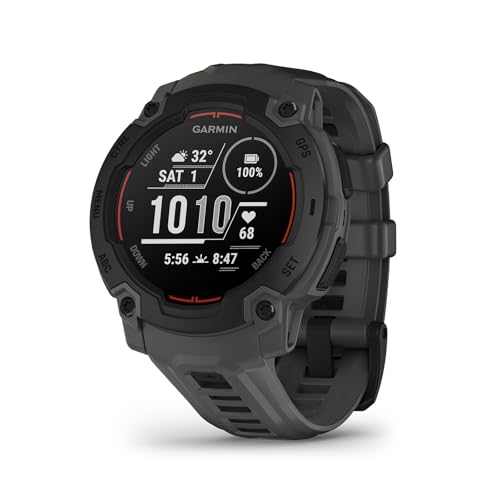
Garmin Instinct E — Best for trails
The Instinct E is the guide’s deliberate detour: a rugged 45mm watch in charcoal whose listing promises a rugged design, essential health and wellness features, built-in sports apps and navigation features. It is not a Forerunner, and trail runners are exactly the people who might prefer that. Where the Forerunners optimise for the stopwatch, the Instinct family optimises for the environment — a case built to take the knock when a root wins, controls that work in gloves and weather, and navigation support for days when the route is a ridge rather than a road.
Trail running changes the data that matters. Pace per kilometre becomes nearly meaningless across a climb; effort, elevation and not being lost become the metrics of the day. The Instinct E’s sports apps cover the activity breadth — this is a multisport watch that runs, rather than a running watch that tolerates other sports — and its wellness tracking keeps the overnight recovery picture running between outings. Road purists will find its run analytics shallower than the 265’s, and that is the correct trade for its audience: depth exchanged for durability and breadth.
Consider it also the pick for the runner whose life includes the watch’s other lives — the fell runner who wild-camps, the obstacle racer, the mountain biker who runs twice a week. In this guide’s terms it is the second watch for the outdoors household and the first watch for the runner who measures routes in weather systems. Its screen philosophy is function-first rather than AMOLED-lush, and on a sleet-covered ridge at dusk, function-first is the aesthetic that matters.
- Case: 45mm rugged design, charcoal as listed
- Focus: essential health and wellness features, built-in sports apps
- Navigation: navigation features per the listing
- Character: multisport durability over run-analysis depth
- Controls: button operation suited to gloves and weather
Strengths
- The toughest case in the guide for runners whose routes involve rock, mud and weather.
- Breadth of sports apps for the runner who also climbs, rides and paddles.
- Navigation support for off-road routes where a breadcrumb home matters.
Trade-offs
- Run-specific analysis is shallower than the Forerunner 265 and 965 offer.
- No music onboard as listed — trail runners wanting tunes carry the phone.
- Its rugged styling is a lot of watch for road-only runners and office wear.
Best for: trail and fell runners, obstacle racers and multisport outdoors people. Not suited for: road racers chasing marginal analysis gains, or music-first runners.
How do the six compare at a glance?
| Watch | Case | Music | Maps | Analysis depth |
|---|---|---|---|---|
| Forerunner 165 | 43mm | No | No | Essential training and recovery |
| Forerunner 165 Music | 43mm | Yes | No | Essential training and recovery |
| Forerunner 265 | 46mm | Yes | No | Advanced metrics and recovery insights |
| Forerunner 965 | 47mm | Yes | Yes | Advanced metrics and recovery insights |
| Forerunner 55 | Compact | No | No | Fundamentals and suggested workouts |
| Instinct E | 45mm | No | Navigation features | Essential wellness, multisport breadth |
The table’s shape is the buying logic of the whole family: two binary questions — music? maps? — and one gradient, analysis depth. Answer the binaries from your habits and the gradient from your ambitions, and the table collapses to one row. Notice what is not a column: raw GPS quality and heart-rate hardware are family-wide foundations here rather than tier prizes, which is precisely why this brand dominates start pens — the cheap seats are not punished with a broken core experience.
What actually matters in a running watch, kilometre after kilometre?
Operability under duress ranks first and is not close. You will interact with this watch while breathing hard, sweating through your eyes, wearing gloves, or all three during a February tempo run. Buttons you can find by shape and press with certainty beat a beautiful touchscreen you must wipe dry to lap a rep. Every watch in this guide respects that hierarchy, and it is the single largest reason the family owns the sport while sleeker rivals own the advertisements.
Second is the honesty of the feedback loop. A running watch earns its place by telling you three things well: what you did, in pace and distance you can plan around; what it means, in recovery and benefit terms a tired runner can absorb; and what to do next, in a suggestion that respects yesterday. Garmin’s suggested workouts and coaching plans are the most mature consumer version of that loop, and the tiers in this guide are mostly about how many layers of meaning get added between the doing and the deciding.
Third is disappearance. The watch should weigh nothing in your attention during the run and nothing on your wrist during the day. Case size, strap quality and screen brightness all serve that invisibility. A watch you notice at kilometre thirty is a watch negotiating for its place in your kit; the 55’s featherweight plainness and the 165’s balanced case both understand the assignment, while the 965 justifies its presence by carrying the map you genuinely need.
How do you train with suggested workouts without becoming their servant?
Treat the morning suggestion as a well-informed training partner’s opinion, delivered before coffee. On most days, follow it — the algorithm’s great strength is enforcing the easy days that runners sabotage with ego, and protecting easy days is where recreational fitness is actually built. On race-specific days, override it: the watch knows your load but not your club’s Tuesday track session or the long run your training partner expects you on. The skill is knowing which voice owns which decision, and it develops within a month of honest use.
Wear the watch overnight if you want the recovery side of the bargain to mean anything. Readiness and recovery estimates are computed substantially from sleep and overnight heart patterns; a watch that sleeps in a drawer produces confident nonsense. Give the system two full weeks of consistent wear before judging its suggestions, because its picture of your baseline is statistical and baselines need data the way fitness needs miles — gradually, then suddenly.
Finally, review weekly, not hourly. The runners who benefit from the 265 and 965 tiers are the ones who sit down on Sunday, look at the week’s load distribution and let it shape next week’s intentions. The runners who refresh their readiness score at lunch are feeding anxiety, not training. The watch is a coach with office hours; visit it then.
What mistakes do runners make when buying a running watch?
Buying the flagship for a five-kilometre habit is the gentle error: the 965 is a magnificent instrument that a three-run-a-week runner will use at a tenth of its depth, while the money’s remainder could have bought the shoes that actually determine comfort. The harsher error is the reverse mismatch — the marathoner who saves on the 55 and spends a season fighting its limits, rebuilding workouts manually and navigating new cities by phone. Match the watch to the training you will really log this year, not the training of your best-ever year or your vaguest intentions.
Confusing the 165 pair is the specific trap this guide exists to disarm: they are one watch with and without music, so decide the phone question once and buy accordingly. A subtler mistake is judging GPS by a single city-centre run; tall buildings bend satellite signals for every brand, and a wandering trace downtown says little about the same watch on open roads. Judge across your typical routes. And the perennial mistake: treating readiness scores as medical truth. They are estimates synthesised from consumer sensors — a useful second opinion about training, never a verdict about your health, and a low score alongside genuine symptoms is a reason to see a doctor, not to consult the watch again tomorrow.
How long will a running watch stay relevant?
Longer than a phone, shorter than a mechanical watch, and mostly determined by software rather than hardware. The GPS and heart-rate foundations of even the 55 remain serviceable for years; what ages is the analysis layer, as new metrics arrive on newer models and the older watch’s ceiling becomes visible. Straps are consumables — budget a replacement each year of heavy training — and the battery’s capacity will fade gradually across hundreds of charges, which matters most to ultra runners planning very long days. Buy the rung you need now, expect three to five honest years from it, and let the ladder still be there when you climb it.
How do battery and GPS behaviour play out across a real training week?
Runners do not experience battery life in the laboratory units of a specification sheet; they experience it as a Sunday question — will it last the long run? The honest framework is proportional. GPS recording is the hungriest thing any of these watches does, music playback rides close behind it, and the bright AMOLED screens of the 165, 265 and 965 generations spend charge every time you raise your wrist to check a split. A five-run week with one long GPS session is a modest load that every watch here absorbs comfortably. A marathon block with two-hour weekend runs, daily suggested-workout compliance and overnight wear for recovery tracking is a heavier rhythm, and it is at that rhythm that the flagship class traditionally separates itself — though, as throughout this guide, we quote endurance only in the terms the listings themselves support, which means qualitatively.
Charging habits deserve the same realism. The runner most likely to face a dead watch at a start line is not the one with the smallest battery; it is the one with no routine. Anchor the charge to an existing habit — the shower after the long run, the desk hour on a rest day — and the question mostly disappears for every model in this guide. Overnight wearers face a genuine scheduling puzzle, because the watch cannot simultaneously track sleep and sit on a charger; the workable answer is a short top-up during the morning routine, which modern fast-charging makes practical across this family. What you should not do is buy a watch whose endurance only works if you also dim the screen, ration the GPS and disable the features you bought it for. That is not endurance; that is a negotiation, and it ends with the watch in a drawer by spring.
GPS behaviour follows a similar pattern of lived detail over laboratory numbers. Every watch here uses satellite positioning to derive the distance, pace and speed its listing promises, and every one of them will draw a slightly drunken line through a city centre or a forest gorge, because that is what satellite signals do among reflections and obstructions. On open roads, riverside paths and tracks — where most training kilometres actually happen — the traces settle into the consistency that training decisions need. Judge a running watch by the steadiness of its pace readout on your usual loop and the sanity of its totals across a month, not by one theatrical trace through a downtown canyon.
What does a marathon block demand that a 10K block does not?
Duration, mostly, and the management of accumulated fatigue. A 10K improver trains in sessions rarely longer than ninety minutes, where any watch in this guide records happily and the suggested workouts carry the planning load. A marathon block stretches the long run past two hours, stacks five or six sessions a week, and turns recovery from a nicety into the limiting factor of the whole project. That is the context in which the 265’s and 965’s advanced metrics stop being decoration: when the difference between a breakthrough and a stress fracture is how honestly you read three weeks of load, a trend line earns its keep.
Navigation joins the list for the same reason. Marathon trainees run out of familiar routes; the long run becomes an expedition into the next county, often in the dark months, and the 965’s maps convert that from a phone-in-hand chore into a glance. Fuelling reminders, course loading for race day itself, and the confidence of knowing the watch will still be awake at kilometre forty are marathon-shaped concerns that simply never arise at 10K. None of this makes the smaller watches inadequate — it makes them correctly sized for a different project. The error is buying for the project you admire rather than the one on your calendar, in either direction.
There is also a psychological line between the blocks worth naming. Ten-kilometre training rewards enthusiasm; marathon training rewards restraint, repeated weekly for five months. The watches that serve the marathoner best are the ones whose recovery voices are hardest to argue with at 6 a.m. in February, and that is a software quality — the credibility of the suggestion — more than a hardware one. It is why this guide keeps returning to the feedback loop rather than the sensor count: in month four of a block, you will not care what the watch can measure. You will care whether you still believe what it tells you.
How do you upgrade within the family without losing your running history?
The quiet advantage of an all-Garmin shortlist is that graduation is painless. Your runs, personal records, training history and the baselines behind the suggestions live in your Garmin account rather than in the watch, so the runner who starts on a 55 in January and climbs to a 265 the following spring carries the whole story across; the new watch inherits a trained understanding of its owner instead of starting from flattery and guesses. That continuity is a real argument for entering the family at the rung you can afford rather than waiting outside it for the flagship — the data you bank early is the asset, and the hardware is replaceable in a way two years of history are not.
Upgrading also clarifies what the money buys at each step, because you feel the additions against a known baseline. The ex-55 owner who moves to a 165 notices the screen and the recovery framing immediately, having earned the context to value them. The 165 owner who adds music discovers within one run whether the phone-free life was a genuine desire or a brochure fantasy — and the family’s structure means the discovery costs one edition change, not an ecosystem migration. Even the final step, to maps on the 965, is legible: you will know within a month whether you are an explorer who needed cartography or a creature of three loops who bought a beautiful irrelevance. Few technology categories let you audition their tiers this honestly, and runners planning a multi-year relationship with the sport should weigh that when a rival’s single glamorous model tempts them to start over.
What should you do in the first month with a new running watch?
Resist the urge to judge it by its first week. The suggestions a Garmin offers in week one are built on defaults and your declared history; by week four they are built on you. Run your normal routes at your normal efforts, wear it overnight, and let the baselines form before you let any readiness figure talk you out of a session you wanted. Log the runs you would have logged anyway. The watch is learning your easy pace, your sleep rhythm and your recovery speed, and feeding it a theatrical first fortnight of hero workouts teaches it a person you are not.
Set the data screens once, deliberately, and then leave them alone for the month. For most runners the honest screen is current pace, heart rate and elapsed time or distance; lap pace joins it for interval days. Every additional field is a small tax on attention at exactly the moments attention is scarcest. Configure alerts sparingly too — a vibration at each kilometre split is information, while a wrist that buzzes for heart-rate zones, hydration reminders and encouragement messages is a heckler. By the month’s end you will know which two alerts you would actually miss, and the rest can stay off permanently.
End the month with the Sunday review habit if you bought a 265 or 965: ten minutes with the week’s load, the sleep trend and next week’s intentions. That single ritual is the difference between owning an instrument and wearing a gadget, and it is the point at which the tiers justify themselves — the 55 owner reviews the week in totals, the 165 owner in suggestions followed, the flagship owner in trends interpreted. All three are legitimate relationships with the same sport. The watch that fits yours is the one this guide has been pointing at all along.
How do running watches cope with the rest of a training life?
Few runners only run. The strength session, the pool recovery swim and the Sunday ride all compete for the same wrist, and the Forerunner family’s built-in sports apps — with the Instinct E’s breadth the widest here — record those days well enough that the training picture stays whole. That wholeness matters more than any single session’s precision, because the recovery and load logic these watches sell is only as honest as the record it reads; a watch that misses your two weekly gym sessions will keep suggesting runs as if you had rested through them. Wear it for the cross-training, even when the metrics there are simpler, and the running advice improves as a side effect.
Fit is the unglamorous detail that decides whether any of this works. A running watch must sit snug enough that the wrist heart-rate sensor keeps contact through arm swing, yet not so tight that it numbs fingers at kilometre fifteen when hands swell. The practical rule is one notch tighter for the run than for the desk, positioned a finger’s width above the wrist bone, and the strap material matters across a season: silicone for winter rain and summer sweat alike, with a rinse under the tap after long efforts to keep salt from chewing at both strap and skin. Runners who race in the 47mm flagship sometimes move it to the other wrist for sleep, purely for comfort — a legitimate trick the 43mm pair rarely requires.
What separates a good race-day watch from a good training watch?
Training rewards information; racing rewards calm. The watch that serves both is the one whose race-day face you have rehearsed — a single screen with the few numbers you will act on at kilometre thirty-five, when arithmetic fails and only recognition works. All six here can be reduced to that face, but the discipline of reducing it is yours, and it belongs in the final training week, not the start pen. Battery certainty is the other race-day virtue: a watch that begins the marathon fully charged and trusted is worth more than a theoretically longer-legged one you have never tested past two hours, which is another argument for buying early in the block rather than upgrading mid-season. Your future self, tying shoes in a cold car park, is the customer every section of this guide has been serving.
Can a running watch make you faster, honestly?
Not directly, and any guide implying otherwise is selling something. What the evidence of ordinary running lives supports is narrower and more useful: a watch makes training more consistent, and consistency is the ingredient recreational runners are actually short of. The mechanism is mundane. A suggested workout removes the morning negotiation. A recorded streak makes skipping feel like breaking something. A recovery estimate gives tired legs an authoritative excuse that pride would otherwise overrule, and a pace readout teaches the easy-day discipline that lets hard days work. Stack those small effects across forty weeks and the watch has, in every practical sense, made its owner faster — by making them a person who trains.
The tiers modulate the effect rather than create it. The 55 builds the habit. The 165 pair refines the pacing and the recovery judgement. The 265 and 965 protect the ambitious from themselves across long blocks, which is where the largest time gains and the largest injury risks both live. Choose the tier that matches the failure mode you actually have — inconsistency, overenthusiasm, disorientation in new places — and the watch becomes a tool aimed at your real limiter. Choose by envy of another runner’s wrist and it becomes jewellery with a battery. That distinction, more than any feature in this guide, is the one your next personal best depends on.
Should you buy now or wait for the next Forerunner cycle?
Garmin refreshes this family on a rhythm measured in years rather than months, and the improvements between generations tend to be screens, sensors and software polish rather than reinventions of the running watch. A runner in training today gains more from ten weeks with a current model than from a season spent waiting for a marginally better one, because the baselines and habits the watch builds are the durable asset. The exception is the runner whose purchase would land within days of a known launch and who specifically wants the new generation’s headline change. For everyone else the ladder is standing there now, every rung honest, and the start line is not getting any closer while you deliberate.
A last word on straps, screens and winter running
Small things decide February. A strap with a keeper that actually keeps, a screen you can read through rain-spattered glasses, buttons that answer a gloved thumb — these are the specifications no launch event photographs, and they are the ones a running watch is judged by at the end of a wet tempo run. Every watch in this guide was chosen with that evening in mind. Fit the strap before the first run, set the screen before the first week, and let the watch prove itself in weather rather than in the kitchen. The ones above will.
What if you run only twice a week?
Then buy like it. Twice-weekly runners gain the most from the habit machinery — suggested sessions, recorded streaks, a pace reference that stops easy runs becoming races — and the least from deep analysis, because two data points a week cannot feed a trend. The 55 or the standard 165 will serve that life completely and honestly, and the money saved buys the shoes, socks and headtorch that twice-weekly winter running actually consumes. Ambition can upgrade later; the family’s upgrade path, covered above, means nothing is wasted by starting small.
Final Recommendation
Start at the 165 and make the other watches argue their way in. If your phone stays home, the argument ends at the 165 Music — the same watch, plus the tunes, full stop. If your training has become a season-long project with personal bests attached, the 265’s deeper metrics earn their rung. If your long runs explore and your calendar holds a marathon, the 965 is the complete instrument. Beginners should take the 55 without a flicker of embarrassment, and trail runners should take the Instinct E for the same reason road runners take the Forerunners: it was designed where they actually run. The runner who buys by those rules will forget the watch is on the wrist by the second week — which, in this category, is the highest praise a finish line can give.
Frequently Asked Questions
What is the actual difference between the Forerunner 165 and 165 Music?
Music. The Music edition stores and plays music from the wrist to Bluetooth earbuds; the standard 165 does not. Case size, GPS, coaching, screen and training features are the same, so the choice reduces entirely to whether your phone joins your runs.
Do I need maps on a running watch?
Only if your running includes unfamiliar territory: travel training, trail networks, city exploring. On familiar loops, maps are a feature you will open twice — once to admire, once to show someone. The 965 is the pick here that carries them.
Can these watches replace a training plan?
For most recreational goals, the combination of Garmin Coach plans and daily suggested workouts covers the ground a static plan would, with better adaptation to missed days and poor sleep. Runners with a human coach should treat the watch as the recording and feedback instrument and let the coach own the plan.
How accurate is the GPS on these watches?
No listing here publishes an error margin, and real-world performance shifts with tree cover, buildings and weather, so we make no numerical claim. What the family is known for — and what start-pen consensus reflects — is consistency across typical road and trail conditions, which is what training decisions actually need.
Should a beginner really start with the Forerunner 55?
Yes, if the budget or the learning curve matters. It teaches pace, distance and consistency without analysis overload, and nothing about starting there closes doors: the upgrade path to the 165 or 265 is the same ecosystem, with your history carried across.
Are the recovery and readiness scores medical measurements?
No. They are algorithmic estimates built from heart patterns, sleep and training load — useful for pacing a training block, meaningless as health findings. Persistent worrying symptoms belong in front of a clinician, not interpreted through a readiness number.
Related Guides
If your running is one part of a broader training life, our best fitness and music smartwatches guide looks at the music-and-workout shelf from the gym side. Men choosing a single everyday watch should also read the best mens smartwatches roundup, where case size and phone platform take priority over pace. And because recovery begins overnight, the best smartwatches with sleep tracking guide examines the sleep-first designs that complement a runner’s training watch.


