What's inside
- Where to buy
- Key Takeaways
- Quick Picks
- How did we choose these six projectors?
- What is the real difference between short throw and ultra short throw?
- Which of these projectors fits a small gaming room?
- How much brightness does a small room really need?
- What screen should a short throw projector actually use?
- Why does sound deserve its own budget line?
- The six projectors, reviewed one by one
- How do the six compare side by side?
- How do you set up a short throw projector without ruining the picture?
- What mistakes do short throw buyers keep making?
- What does ownership look like after the first month?
- Final Recommendation
- Frequently Asked Questions
- Related Guides
As an Amazon Associate I earn from qualifying purchases. This post may contain affiliate links at no extra cost to you.
gizmoverdict.com is reader-supported. When you buy through links on our site, we may earn an affiliate commission.
Where to buy
Short on floor space but not on ambition? The best home theater projectors short throw buyers can set up this year solve a very specific geometry problem: how to fill a proper cinema-sized screen when the sofa sits almost on top of the wall. All six machines below are sold through Amazon in the United States, and each product name in the Quick Picks table and in the detailed reviews carries a direct listing link so you can confirm the current bundle, the throw specification and the warranty terms before you commit. Short throw models sell in smaller volumes than standard projectors, so stock of a particular variant can thin out without warning; if the exact model you want shows as unavailable, the neighbouring picks in this guide are the honest substitutes rather than a random alternative from a search page.
Here is the distinction that organises everything that follows. A conventional projector needs several metres of clear air between lens and screen, which means it lives behind the seating, often on a ceiling mount, with cables crossing the room. A short throw projector compresses that distance dramatically: placed a metre or two in front of the screen, it throws a large image upward at a steep angle, so nobody walking to the kitchen crosses the beam and nobody’s head prints a shadow puppet onto the film. An ultra short throw projector goes further still, sitting centimetres from the wall on a low cabinet, firing almost straight up. Three of the picks below are true short throw machines built for gaming dens and spare rooms; three are ultra short throw designs that behave more like a television replacement. They solve related problems, but they are not interchangeable, and the reviews keep that boundary visible.
Resolution language in this corner of the market needs the same care. Two of the six are native 1080p machines and proud of it. Two more accept a 4K signal and are described by their makers as 4K HDR compatible, which means they can decode the input, not that they display four thousand pixels across. The two premium ultra short throw models are genuine 4K-class designs using triple laser light engines. None of that makes the 1080p pair bad purchases: at short throw distances in small rooms, fed by consoles and streaming sticks, a sharp 1080p image with low input lag routinely matters more than a resolution badge. What matters is knowing which claim you are actually paying for, and that is the thread running through every review below.
Key Takeaways
- Measure your room before you fall for a model: short throw machines want roughly a metre or two of throw distance, while the ultra short throw trio here wants centimetres and a seriously flat wall.
- The BenQ TH671ST is the small-room all-rounder of this set, pairing a maker-rated 3,000 lumens with low input lag, dual HDMI and a three-year warranty from its listing.
- Optoma’s GT2400HDR brings a laser light source and a maker-rated 4,200 lumens to the short throw gaming brief, which suits golf simulation and bright spare rooms.
- Ultra short throw models such as the AWOL VISION LTV-3000 Pro trade placement freedom for a television-like footprint, and they reward an ambient light rejecting screen more than any other upgrade.
- Where a listing says 4K HDR compatible rather than 4K, read it as input support: the picture on the wall is still a 1080p picture, however good the source looks.
- Built-in speakers on short throw projectors are a convenience for casual viewing; a soundbar transforms dialogue clarity in a small room and costs less than stepping up a projector tier.
Quick Picks
| Pick | Badge | Why it earns its place |
|---|---|---|
| BenQ TH671ST | Small-Room All-Rounder | A 1080p short throw with low input lag, auto vertical keystone and dual HDMI that fits a games room as comfortably as a film night. |
| Optoma GT2400HDR | Laser Power for Bright Rooms | Laser light, a maker-rated 4,200 lumens and gaming-grade lag figures aimed squarely at simulators and lively living spaces. |
| Optoma GT1080HDR | Lamp-Based Short Throw Value | The established short throw formula with 4K HDR input support for buyers who want the geometry without the laser premium. |
| Optoma Photon GO UST | Portable Ultra Short Throw | An ultra short throw laser with Google TV, twin 10-watt speakers and a built-in battery for rooms that rearrange themselves often. |
| AWOL VISION LTV-3000 Pro | Premium Laser TV | Triple laser 4K with Dolby Vision and Atmos support, built to anchor a dedicated media wall at sizes up to a claimed 150 inches. |
| XGIMI MIRA UST | Smart UST with Serious Sound | Triple laser light, Google TV and Harman Kardon audio in an ultra short throw body that wants to replace the television outright. |
How did we choose these six projectors?
We started from the room, not from a spec sheet. A short throw projector is bought because a particular wall, a particular sofa position and a particular ceiling that cannot take a mount have already decided the geometry. So the first filter was throw: every pick here produces its big image from well inside the distance a standard projector would demand, and the set deliberately spans both halves of the family, conventional short throw and ultra short throw, because buyers constantly confuse the two and the confusion is expensive. The second filter was honesty of specification. Listings that state their resolution, their light source and their brightness basis plainly were favoured; where a figure is a maker figure, the reviews say so rather than laundering it into a lab result.
After geometry and honesty came use. A short throw projector in a rented flat lives a different life from one bolted into a golf simulator bay, so the six split across gaming-first machines with low input lag, portable designs that move between rooms, and premium ultra short throw models intended to sit under a screen for years. Smart platforms were treated as a convenience rather than a headline: Google TV built in is genuinely useful, but a streaming stick can be added to any HDMI port, whereas a throw ratio can never be upgraded after purchase. Sound was judged the same way. Built-in speakers earned credit for casual viewing and portability, yet no pick was allowed to pretend that a small internal driver replaces a soundbar in a room where films are the main event.
Finally, we weighted the ownership details that listings actually document: warranty length where a maker states it, the number and type of inputs, keystone correction for imperfect placement, and whether the light source is a lamp that will eventually need replacing or a laser that will not ask that of you. Those are unglamorous criteria, but in a category defined by placement constraints, the unglamorous details are usually the ones that decide whether a projector is loved in month six or listed for resale.
What is the real difference between short throw and ultra short throw?
Throw ratio is the quiet number behind this entire category. It expresses how far the projector sits from the screen for a given image width. A standard projector might need three or four metres to fill a 100-inch screen. A short throw model does the same job from roughly a metre to a metre and a half, which is why the BenQ and the two Optoma GT models can live on a low table between sofa and screen. An ultra short throw model shrinks the gap to centimetres: the Photon GO, the AWOL VISION and the XGIMI MIRA sit on a cabinet directly beneath the image, lens pointing up at a steep angle, and the picture assembles itself on the wall above like a television that forgot its panel.
Each geometry carries its own discipline. Short throw placement is forgiving about surfaces: a decent screen or a smooth painted wall both work, and a few centimetres of positioning error can be absorbed by zoom and keystone. Ultra short throw placement is the opposite bargain. Because the light strikes the wall at such an oblique angle, every ripple, bump and bow in that wall is magnified into a visible wave in the picture, which is why ultra short throw owners are steered towards fixed-frame ambient light rejecting screens that hold a perfectly flat surface. In exchange, the ultra short throw room needs no ceiling work, no long cable runs and no furniture rearrangement; the projector simply joins the media cabinet.
There is also a human difference. With a short throw projector on a table, people can still walk between lens and screen if they hug the side walls, and their shadows will announce them when they forget. With ultra short throw, the beam hugs the wall so closely that the room stays fully usable during a film: children can cross the room, a dog can patrol, and the picture never blinks. Households that watch together, move around and treat the projector as the family screen tend to end up in the ultra short throw camp once the budget allows. Households building a focused gaming den or simulator bay tend to prefer the conventional short throw machines, whose placement above or ahead of the player keeps the hitting zone and the seating exactly where muscle memory expects them.
Which of these projectors fits a small gaming room?
Gaming redraws the projector priority list. Brightness still matters, and resolution still matters, but input lag — the delay between a controller input and the picture responding — jumps to the top, because a projector that trails your inputs by a wide margin makes fast games feel like steering through syrup. The listings for the BenQ TH671ST and both Optoma GT models all foreground low input lag, and the Photon GO states a 27-millisecond figure at 1080p in its listing, which gives buyers at least one hard number to compare. Treat single lag figures carefully: they are usually measured in a specific game mode at a specific refresh setting, and engaging that mode can disable some image processing. The honest reading is directional — these machines were designed with consoles in mind, and their makers say so in plain language.
Short throw geometry is itself a gaming feature. In a small room, a standard projector behind the sofa puts the player between the lens and the screen, so every lean and gesture throws a shadow. A short throw unit ahead of the seating removes the player from the beam entirely. That is doubly true for golf simulation, the use case two of these listings name outright: the hitting mat, the impact screen and the projector must coexist in one bay, and a short throw lens lets the projector sit close enough to the screen that a backswing never enters the light path. If simulation is your actual plan rather than a vague someday, the GT2400HDR and GT1080HDR were quite literally marketed at your garage.
Refresh behaviour and connectivity finish the gaming picture. Dual HDMI on the BenQ means a console and a streaming box can both stay connected without a cable swap ritual before every session. Built-in speakers on all six picks are adequate for menu music and casual play, but positional audio in competitive games wants headphones or a soundbar, and Bluetooth or an HDMI audio path is how you will get there. None of these machines should be bought as a monitor replacement for a desk; they are big-picture devices, and their gaming strengths show at 100 inches, not at arm’s length.
How much brightness does a small room really need?
Small rooms flatter projectors. The image is smaller than the 150-inch ambitions of the premium marketing, the seating is closer, and the walls that confine you also bounce light back towards the screen in a way that lifts perceived brightness. This is why a maker-rated 3,000 lumens in the BenQ can look genuinely punchy in a spare bedroom while a nominally brighter machine can look washed out across a vast, sunlit lounge. Brightness is not a property of the projector alone; it is a relationship between light output, screen size, screen material and the ambient light competing for your eyes. Shrink any one of the demands and the same projector suddenly seems stronger.
The discipline is to match the machine to the worst viewing condition you actually care about, not the worst you can imagine. If films happen after dark with curtains drawn, nearly every pick in this guide has output to spare, and your money works harder spent on resolution, sound or the screen itself. If the projector doubles as the daytime television in a room with unshaded glass, the calculation inverts: brightness headroom and an ambient light rejecting screen stop being luxuries. Notice, too, that the brightest picture mode of any projector is rarely its most accurate — makers quote lumens at the setting that produces the biggest number, while film viewing usually happens in a calmer mode with gentler colour. The gap between the brochure figure and the cinema-mode reality is normal, expected and worth remembering whenever two listings are compared by their headline numbers alone.
Screen gain quietly rewrites the arithmetic again. A standard matte white surface returns light evenly in all directions, which suits wide seating. Higher-gain and ambient light rejecting surfaces concentrate the image’s light towards the viewers and refuse light arriving from windows and ceiling lamps, which is precisely the trade a bright room wants. Ultra short throw owners get a dedicated version of this technology, with a sawtooth surface structure that accepts the steep upward beam and rejects almost everything else. None of this makes a dim projector bright, but it routinely makes a mid-brightness projector sufficient — a far cheaper outcome than climbing a whole projector tier for lumens you may not need.
What screen should a short throw projector actually use?
The screen conversation splits cleanly along the same line as the projectors. Conventional short throw models are the flexible half: a fixed-frame screen is ideal, a good pull-down screen is fine, and a smooth painted wall is a respectable starting point that thousands of owners never feel compelled to leave. The lens geometry behaves much like a standard projector’s, so the surface mainly needs to be flat, matte and neutral in colour. Portable screens pair naturally with the table-top lifestyle of these machines, letting a rented room become a cinema on Friday and revert to a plain spare room on Monday.
Ultra short throw models play by stricter rules. Their light arrives at a glancing angle that stretches every surface flaw into a visible distortion, so the screen must be genuinely flat — which rules out wavy pull-down materials and most painted walls — and the dedicated ambient light rejecting screens built for this geometry add the sawtooth structure described above. That screen is a significant purchase in its own right, and it belongs in the budget from the first day rather than arriving as an apologetic upgrade in month three. Owners who skip it are not saving money so much as declining to see what their projector can do.
One more surface deserves a mention because small rooms improvise: the ceiling. A short throw projector can fire upward at a bedroom ceiling for lying-down viewing, and the Photon GO’s portable design practically invites the experiment. Treat it as a novelty rather than a setup — ceilings are rarely the right colour, texture or distance, keystone correction works overtime, and necks forgive more readily than picture geometry does. As a party trick for children’s films it is delightful. As your main screen it will quietly disappoint, and the wall you already own is the better canvas.
Size is the final screen decision, and restraint usually wins. A short throw room is by definition a small room, and an image that fills your peripheral vision also fills your eye movements: at very large sizes in a short viewing distance, you will watch films by scanning them. The 90-to-120-inch band suits most of the rooms these projectors serve, keeps brightness demands sane, and leaves the 150-inch claims of the premium models as headroom rather than obligation. Measure your seating distance, be honest about it, and let the screen fit the room instead of the brochure.
Why does sound deserve its own budget line?
Every projector in this guide can make noise on its own, and the two smart ultra short throw models make genuinely respectable noise. Yet film sound is not a garnish. Dialogue carries plot, and dialogue lives in the centre channel that a small projector speaker, firing from beside or below the screen, can only approximate. In a small room the fix is neither large nor expensive: a soundbar centred under the image restores speech intelligibility at low volumes, which matters doubly in flats where the neighbours set your maximum level. The XGIMI MIRA’s Harman Kardon system and the Photon GO’s twin 10-watt speakers push back against this advice for casual viewing, and for news, sport and children’s films they may well settle the question. For the Friday film, external sound remains the cheapest transformation available to any of these six machines.
Connection planning prevents the common fumble. A soundbar fed by an HDMI audio return path from the projector, or by an optical lead, stays in sync and switches with the picture; a Bluetooth speaker is wonderfully flexible for the portable Photon GO but can introduce a whisper of delay that lips will betray in close-up dialogue. Gamers should route audio with the same care as video, since the low input lag they paid for is wasted if the sound arrives late to the explosion. None of this needs deciding before the projector arrives — but the shelf space, the socket and the cable path are far easier to arrange while the room is already in pieces for installation day.
The six projectors, reviewed one by one

BenQ TH671ST — Small-Room All-Rounder
The TH671ST is the projector this guide would hand to a friend whose brief was simply: small room, big picture, films on Friday and console games the rest of the week. Its listing describes a 1080p short throw home entertainment projector with a maker-rated 3,000 lumens, low input lag, auto vertical keystone, dual HDMI and a built-in speaker, backed by a three-year warranty. Read that specification as a whole and a personality emerges — nothing here chases a record, and everything here answers a real small-room problem. The keystone correction forgives a projector that sits slightly low or slightly high on its table. The second HDMI forgives a household with more sources than patience. The warranty forgives, well, time.
Picture expectations should be set by the room it serves. At 1080p across a screen in the 80-to-110-inch range, viewed from a sofa a couple of metres back, this BenQ produces the kind of image that makes visitors ask why they bothered with a large television. The maker-rated brightness is aimed at rooms that dim rather than rooms that blackout: curtains drawn and lamps off, the picture has punch; with afternoon sun competing, any projector in this class fades, and this one is no exception. Console gaming is where the design brief shows most clearly, since low input lag and a short throw that keeps the player out of the beam turn a spare bedroom into a convincing arcade without a single ceiling fixing.
- Resolution as listed: Full HD 1080p, native
- Brightness as listed: 3,000 lumens, maker figure
- Correction: auto vertical keystone for table placement
- Inputs: dual HDMI, so console and streamer can coexist
- Warranty as listed: three years
Strengths
- Short throw geometry that suits rented rooms where ceiling mounting is forbidden or impractical.
- Low input lag positioning that makes console play feel responsive at cinema sizes.
- A three-year warranty stated in the listing, longer than the coverage typical of this shelf.
Trade-offs
- Native 1080p only, so buyers chasing genuine 4K detail should look at the ultra short throw pair instead.
- The built-in speaker handles dialogue nights, not blockbuster dynamics; budget for external sound.
- A lamp-era design means an eventual lamp replacement belongs in the long-term ownership picture.
Best for: gamers and film fans furnishing a small room without drilling a single hole. Not suited for: buyers who want native 4K or a projector that lives permanently under the screen.
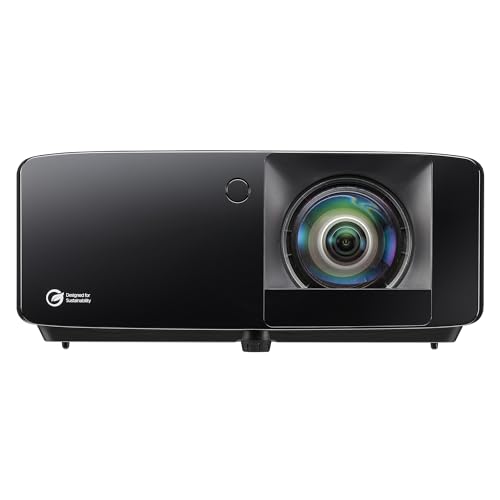
Optoma GT2400HDR — Laser Power for Bright Rooms
Optoma’s GT line has always been the gaming branch of its short throw family, and the GT2400HDR updates the formula with the two changes that matter most: a laser light source and a maker-rated 4,200 lumens. The listing frames it as a Full HD 1080p short throw projector with low input lag, explicitly ready for golf simulation. Laser light changes the ownership rhythm of a projector like this. There is no lamp dimming towards a replacement deadline, the machine reaches full brightness quickly, and a simulator bay that gets switched on and off between practice sessions stops punishing the light source for the habit.
The brightness figure deserves its usual translation. Four thousand two hundred lumens is the maker’s number, and real-world output in an accurate picture mode will sit below it, but the headroom is the point: a garage simulator bay or a living room that never fully darkens needs lumens in reserve, because screen size eats brightness quickly and ambient light eats what is left. Paired with the short throw lens, the GT2400HDR can sit close to an impact screen, clear of the swing, and still flood it with light. For film-first buyers in a controlled room, some of that muscle goes unused, and the premium over its lamp-based sibling buys durability rather than visible drama. For the bright-room and simulator briefs it was designed around, the muscle is exactly what is being purchased.
- Resolution as listed: Full HD 1080p
- Light source: laser, per the listing
- Brightness as listed: 4,200 lumens, maker figure
- Positioning: low input lag gaming and golf simulation
- Throw: short throw, for bays and compact rooms
Strengths
- Laser light source removes lamp replacements from the ownership calendar entirely.
- Generous maker-rated brightness for rooms and simulator bays that cannot be fully darkened.
- Short throw placement keeps the projector ahead of the player and out of the swing path.
Trade-offs
- 1080p native resolution in a market segment where rivals advertise 4K badges at similar money.
- Brightness-first tuning means film purists will spend time in the dimmer, more accurate picture modes.
- Simulator buyers still need to budget for the screen, mat and enclosure around the projector itself.
Best for: golf simulator builds and bright-room gaming where the laser’s stamina earns its keep. Not suited for: blackout-room cinephiles who would rather spend the same money on resolution.

Optoma GT1080HDR — Lamp-Based Short Throw Value
The GT1080HDR is the elder statesman of this line-up: a Full HD 1080p short throw projector with a maker-rated 3,800 lumens, described in its listing as 4K HDR compatible and ready for home entertainment and golf simulation. That compatibility phrase is the one to read twice. It means the projector accepts a 4K HDR signal from a modern console or streamer and maps it onto its 1080p image, which is genuinely convenient — no source device needs re-configuring — but the picture on the wall remains a 1080p picture. Buyers who understand that distinction tend to be very happy with this machine. Buyers who skim the badge and expect native 4K are the ones who feel misled, and the fault sits with badge language across the industry, not with this particular projector.
What the GT1080HDR offers in return for its older light source is a proven, understood package. The short throw lens serves the same table-between-sofa-and-screen geometry as its BenQ rival, the low input lag positioning is aimed at the same consoles, and the brightness headroom covers the same dimmed-but-not-dark rooms. Lamp ownership is the honest counterweight: a lamp dims gradually over its life and eventually needs replacing, which is a modest recurring cost and a small ritual of maintenance that laser owners skip. In a household that projects a few evenings a week, that lamp can serve for years before the question arises. In a simulator business running daily hours, the arithmetic tilts towards the laser model above, and the reviews are written so that both kinds of reader can see their own answer.
- Resolution as listed: Full HD 1080p, with 4K HDR input compatibility
- Brightness as listed: 3,800 lumens, maker figure
- Positioning: low input lag gaming, home entertainment, golf simulation
- Light source: lamp-based design (replacement lamps are part of ownership)
- Throw: short throw for tables and simulator bays
Strengths
- Accepts modern 4K HDR sources without fuss, even though the displayed image is 1080p.
- Strong maker-rated brightness for a lamp-based short throw at this end of the range.
- A long-established model line, so accessories, mounts and owner knowledge are easy to find.
Trade-offs
- The 4K HDR wording invites misunderstanding; the native picture is 1080p and nothing more.
- Lamp replacement is a real future cost that the laser picks in this guide do not carry.
- No built-in smart platform is promised by the listing, so plan on a streaming stick or console.
Best for: buyers who want the classic short throw gaming and simulator setup and understand the lamp bargain. Not suited for: anyone who reads 4K HDR compatible as native 4K, or who hates maintenance of any kind.

Optoma Photon GO UST — Portable Ultra Short Throw
The Photon GO — listed under its ML1080UST model name — rethinks what an ultra short throw projector is for. Instead of anchoring one media wall forever, it is a portable 1080p laser projector with Google TV built in, two 10-watt speakers and a built-in battery, designed to be carried to whichever wall the evening chooses. That battery changes the social life of projection. A projector that can run untethered can serve a bedroom ceiling showing, a garden wall after dusk or a borrowed holiday home without a negotiation about extension cables, and when it does sit in one place, the ultra short throw lens keeps it centimetres from the wall on any low surface.
The listing’s one hard performance number is a 1080p input figure of 27 milliseconds, which places it in the casual-to-keen gaming band rather than the competitive tier: party games, platformers and big-screen adventures will feel perfectly at home, while tournament fighting-game players should keep a monitor for serious sessions. Google TV onboard means the streaming apps live inside the projector, so the battery-powered, cable-free promise survives contact with reality — no dangling stick, no second remote hunt. The discipline this design demands is the ultra short throw discipline in miniature: the wall must be flat, the surface it sits on must be stable, and a nudge mid-film means re-aligning the picture. Portable and precise are uneasy partners, and this projector asks you to accept a minute of setup care in exchange for its freedom.
- Resolution as listed: 1080p ultra short throw
- Light source: laser, per the listing
- Smart platform: Google TV built in
- Audio: two built-in 10-watt speakers, per the listing
- Power: built-in battery for untethered sessions
- Input figure as listed: 1080p at 27ms
Strengths
- Battery power plus built-in streaming makes it the only genuinely take-anywhere pick in this set.
- Ultra short throw placement keeps the beam hugging the wall, so people can cross the room freely.
- Twin 10-watt speakers give portable viewing a voice without a separate speaker hunt.
Trade-offs
- 1080p resolution and a 27ms figure suit casual gaming better than competitive play.
- Every relocation demands a fresh alignment, and wavy walls will show in the picture.
- Battery sessions are finite; a full film night near a socket is still the safer plan.
Best for: renters, movers and multi-room households who want a big picture that follows them around the home. Not suited for: a fixed, perfectly calibrated theatre wall that never changes.
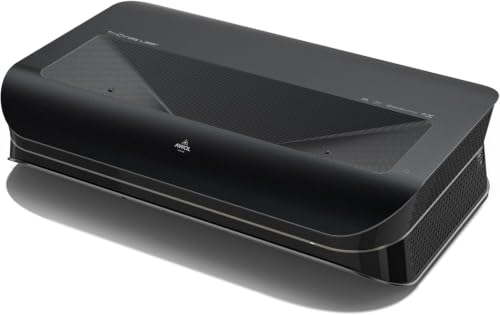
AWOL VISION LTV-3000 Pro — Premium Laser TV
The LTV-3000 Pro belongs to the category its maker calls a laser TV, and the listing supports the ambition: a 4K ultra short throw projector with a triple laser light engine, Dolby Vision and HDR10+ support, Dolby Atmos audio support and image sizes quoted up to 150 inches. Triple laser architecture matters because each colour gets its own laser source, which is how this class reaches the wide, saturated colour that single-laser designs strain towards. Dolby Vision support matters for a different reason: it means the projector can follow the per-scene brightness instructions embedded in premium streams rather than applying one compromise to a whole film.
Ownership of a machine like this is an installation project, and the review would be dishonest if it pretended otherwise. The projector wants a fixed position on a solid, low cabinet, aligned once with patience, and it wants a screen worthy of it — at these sizes, an ambient light rejecting screen designed for ultra short throw geometry is close to mandatory in any room with windows, because it is engineered to accept light from below and reject light from everywhere else. Sound follows the same pattern: Atmos support in the listing signals passthrough and processing ambitions that deserve a proper soundbar or separates system rather than the projector’s own drivers. Buy the LTV-3000 Pro as the engine of a planned media wall and it is the most capable machine in this guide. Buy it as a casual upgrade plonked on a coffee table and its talents will spend their lives waiting for the room to catch up.
- Resolution as listed: 4K ultra short throw
- Light engine: triple laser, per the listing
- Formats as listed: Dolby Vision, HDR10+, 3D support in the title claims
- Audio as listed: Dolby Atmos support
- Image size as listed: up to 150 inches
Strengths
- Triple laser colour and Dolby Vision support put it in the genuine premium tier of this guide.
- Ultra short throw footprint replaces a television without ceiling work or long cable runs.
- Scales to very large screens for rooms that can give it a proper wall and a proper screen.
Trade-offs
- The total installation — screen, cabinet, sound — costs far more than the projector alone.
- Placement is a one-time precision job; this is not a machine to move between rooms.
- Its advantages shrink in a small, dark room where the 1080p picks already look excellent.
Best for: dedicated media walls and television-replacement builds planned as a complete system. Not suited for: casual or portable use, or walls that cannot host a fixed flat screen.

XGIMI MIRA UST — Smart UST with Serious Sound
XGIMI built its name on lifestyle projectors that behave like consumer electronics rather than AV equipment, and the MIRA applies that philosophy at the ultra short throw, 4K end of the market. The listing describes a triple laser projector with a maker-rated 2,000 ISO lumens, a 20,000:1 dynamic contrast ratio, the company’s ISA 5.0 setup intelligence adapted for ultra short throw, Google TV, Dolby Vision and Harman Kardon audio. Two of those phrases deserve unpacking. ISO lumens is a measured-standard figure rather than a marketing invention, which makes the 2,000 here more trustworthy than larger numbers elsewhere in the category. Dynamic contrast, by contrast, is a best-case ratio achieved with the light engine modulating, so treat it as a flavour note rather than a laboratory constant.
The MIRA’s wager is that the winning ultra short throw projector is the one a household actually uses every day, and daily use is a software and sound story as much as an optics story. Google TV with licensed apps removes the streaming stick and its second remote. Harman Kardon audio raises the built-in sound ceiling well above the token speakers of most projectors, enough that news, drama and casual films may never trigger the soundbar purchase. Automated setup assistance lowers the alignment pain that ultra short throw geometry usually charges. Against that, the brightness rating — honest though it is — marks this as a dim-room machine: it will glow beautifully after dark and merely cope in a sunlit lounge, where the AWOL’s muscle or a smaller screen would serve better. Choose the MIRA for the room it describes and it is a coherent, elegant answer.
- Resolution as listed: 4K ultra short throw
- Light engine: triple laser, per the listing
- Brightness as listed: 2,000 ISO lumens, maker figure on a measured standard
- Smart platform: Google TV, with Dolby Vision support
- Audio: Harman Kardon, per the listing
- Setup: ISA 5.0 assistance adapted for ultra short throw
Strengths
- Honest ISO-rated brightness and triple laser colour in a television-replacement footprint.
- Harman Kardon audio that can genuinely carry everyday viewing without extra hardware.
- Setup assistance that softens ultra short throw’s usual alignment fuss considerably.
Trade-offs
- Two thousand ISO lumens asks for a dimmed room; bright lounges will wash it out.
- Still bound by the flat-wall rule every ultra short throw projector obeys.
- Buyers wanting the largest possible screen should compare its ceiling against the AWOL.
Best for: living rooms replacing a television, where sound, software and looks matter alongside the picture. Not suited for: sun-flooded rooms or screen sizes at the very top of the ultra short throw range.
How do the six compare side by side?
| Projector | Throw family | Resolution as listed | Light source | Defining trait |
|---|---|---|---|---|
| BenQ TH671ST | Short throw | 1080p native | Lamp-era design | Balanced gaming and film spec with a three-year warranty |
| Optoma GT2400HDR | Short throw | 1080p native | Laser | Highest maker-rated brightness of the conventional trio |
| Optoma GT1080HDR | Short throw | 1080p, 4K HDR input | Lamp | The established simulator-friendly formula |
| Optoma Photon GO | Ultra short throw | 1080p | Laser | Battery portability with Google TV inside |
| AWOL VISION LTV-3000 Pro | Ultra short throw | 4K | Triple laser | Dolby Vision media-wall flagship |
| XGIMI MIRA | Ultra short throw | 4K | Triple laser | Harman Kardon sound and ISO-rated brightness |
Read the throw column first, because it decides where the projector physically lives, and no other specification can compensate for a geometry your room rejects. Read the light source column second: laser models trade a higher entry point for a life without lamp shopping, while the lamp-based GT1080HDR spreads its cost across the years instead. Resolution comes third and should be weighed against screen size and viewing distance rather than treated as a league table — in a small room at 90 inches, the gap between the 1080p machines and the 4K pair narrows to something many viewers only spot in test patterns and fine text. Brightness, finally, is a room-matching exercise: the GT2400HDR’s headroom is wasted in a blackout den and invaluable in a garage bay, while the MIRA’s honest rating is perfectly judged for the dim living room it was designed to serve.
How do you set up a short throw projector without ruining the picture?
Begin with the screen position, not the projector. Decide where the image will live, mark its corners at the size you intend, and only then place the projector at the distance its throw demands to fill that outline. Work in small movements. Short throw lenses magnify positioning errors because the geometry is compressed: a centimetre of shift at the projector becomes a visibly lopsided rectangle at the wall. Use the optical zoom, where fitted, to fine-tune size, and use physical movement to square the image before touching keystone correction, because keystone works by discarding and resampling pixels — it straightens the rectangle at a small cost to sharpness that a careful first placement avoids paying.
Height is the second discipline. A short throw projector on a low table fires upward, so the table’s height sets the image’s bottom edge; too low and the picture crowds the skirting, too high and it climbs towards the ceiling. Ultra short throw models are stricter still, since the cabinet height and the gap to the wall jointly fix the image position, which is why their owners measure twice and slide once. Focus last, at the centre and then the corners, after the machine has warmed for a few minutes, because lenses drift almost imperceptibly as they heat. Then leave it alone. The most common setup failure in this category is not a wrong setting but a household that keeps nudging the projector and wondering why the geometry never settles.
Cabling deserves one paragraph of foresight. Table-placed short throw projectors sit between the seating and the screen, which means their power and HDMI leads cross the room’s walking line unless you route them deliberately along a wall or under a rug rated for the job. Ultra short throw cabinets solve this by hugging the wall where sockets usually live. Either way, connect your sources, test every input at the resolution and refresh rate you actually use, and only then tidy the cables away. Discovering that a bargain lead cannot carry your console’s full signal is a much better experience before the furniture goes back than it is afterwards, with the sofa already repositioned, the rug relaid and the whole household standing around in its socks waiting for a picture that refuses to arrive in full.
What mistakes do short throw buyers keep making?
The classic error is buying the projector before measuring the room. Throw distance is not a suggestion, and a model that needs a metre and a half cannot be bullied into a metre by keystone without visible damage to the image. The second error is its mirror image: assuming ultra short throw means placement does not matter. It matters more, not less — the oblique angle that makes the format possible also turns a subtly bowed wall into a funhouse screen, and no software correction fully rescues a wavy surface. Renters with old plaster walls are often happier with a conventional short throw and a portable screen than with an ultra short throw firing at lumps.
Resolution badge confusion runs third. A projector described as 4K HDR compatible accepts the signal; it does not display the resolution, and buyers who pay a premium for words they have not parsed end up disappointed by a perfectly good 1080p machine. Fourth comes sound neglect. Every pick here includes speakers because portability and casual viewing demand them, but dialogue in films is mixed for systems with a real centre channel, and a modest soundbar will improve perceived picture quality — by clarifying speech — more than a projector upgrade at the same money. Fifth, and quietest, is forgetting the light source’s future: lamp owners should note the replacement lamp model while it is still stocked, and laser owners should remember that no lamp anxiety does not mean no filter cleaning or ventilation care.
What does ownership look like after the first month?
The honeymoon of any projector ends at the first dusty filter, the first firmware prompt and the first time a guest asks why the picture leans slightly to the left. Short throw ownership is kinder than most. Table-placed machines are easy to reach for cleaning, their lenses wipe without a ladder, and their alignment can be checked in seconds because the projector sits within arm’s reach of the seating. Keep the vents unobstructed — small rooms tempt owners to hem a projector in with books and consoles — and give the fan exhaust somewhere to go, because heat is the quiet enemy of both lamps and laser light engines alike.
Lamp and laser models diverge as the months accumulate. The lamp-based GT1080HDR will dim almost imperceptibly across its lamp’s life, and the honest owner notices it only when a new lamp restores the original punch in a single evening; noting the correct replacement lamp model in a phone note on day one is a two-minute kindness to your future self. The laser picks — the GT2400HDR, the Photon GO and both ultra short throw flagships — simply decline that entire subplot, holding their brightness with a consistency that suits heavy daily use. What they ask instead is ventilation discipline and surge protection, since a light engine built to last for years deserves a power supply that will not shorten the story.
Software becomes the third ownership thread for the smart models. Google TV projectors update like televisions, which is mostly a blessing and occasionally an evening’s delay; keeping the projector on standby power rather than switched off at the wall lets updates happen overnight instead of at film time. Households with children should also settle the remote question early — a second inexpensive remote, or a phone app configured before the original disappears into the sofa, has saved more movie nights than any picture setting ever will. None of these chores is burdensome. They are simply the difference between a projector that feels like furniture and one that feels like equipment, and a few minutes a month keeps all six of these machines firmly in the furniture camp.
Final Recommendation
For most small rooms, the BenQ TH671ST is the answer we would defend at the checkout: its geometry is forgiving, its gaming credentials are genuine, its warranty is stated plainly, and it asks nothing exotic of the room around it. Step up to the Optoma GT2400HDR when the room is bright, the hours are long or a simulator bay is the real destination, because laser stamina and brightness headroom are exactly what those briefs consume. The GT1080HDR remains the sensible lamp-based route into the same shapes. Among the ultra short throw trio, the Photon GO owns portability, the XGIMI MIRA owns the everyday living room, and the AWOL VISION LTV-3000 Pro owns the planned media wall. Small rooms punish big televisions and reward clever geometry, and a short throw projector chosen with a tape measure first will fill your wall long after a bigger, dumber screen would have filled your doorway instead.
Frequently Asked Questions
How far from the screen does a short throw projector actually sit?
For screens around 100 inches, conventional short throw models typically sit roughly a metre to a metre and a half away, while ultra short throw models sit within centimetres of the wall. Always confirm the exact figure for your chosen screen size in the listing’s throw guidance before buying furniture around the plan.
Can I just project onto a painted wall?
A smooth, matte, light-coloured wall works acceptably for conventional short throw models, and many households start there. Ultra short throw models are far less forgiving, because their steep angle exposes every undulation; a fixed-frame screen, ideally an ambient light rejecting design, is the upgrade their owners consistently rate as transformative.
Is 1080p enough at 100 inches?
At typical sofa distances in small rooms, a good 1080p image looks sharp and cinematic, particularly with film and console content. The case for the 4K picks strengthens as screens grow beyond roughly 120 inches, as seating moves closer, or when fine detail such as PC text and simulator instruments fills the frame.
Does low input lag matter if I only watch films?
Hardly at all. Input lag describes the delay before your actions appear on screen, which films never test. It matters for gaming, and even there the figures quoted in listings usually apply to a dedicated game mode, so check which settings the number assumes if fast play is your priority.
Why do ultra short throw projectors cost so much more?
Their lenses are complex mirror-and-optics assemblies that must throw a huge, undistorted image across a few centimetres, and the premium models here add triple laser light engines, Dolby Vision support and serious built-in audio. You are paying for the television-like footprint as much as for the picture itself.
Can children and pets walk around during a film?
With an ultra short throw model, yes — the beam stays within a hand’s breadth of the wall, so the room remains fully walkable and nobody’s silhouette gatecrashes the second act. With a table-placed short throw model, the beam crosses the gap between table and screen, so teach the household the side-wall route and expect the occasional giant head during the first week, before the new geography becomes habit.
Will a short throw projector work in a bright room?
It will work, with managed expectations. Higher maker-rated brightness, a smaller image and an ambient light rejecting screen all help, and the GT2400HDR is this guide’s pick for that fight. Direct sunlight landing on the image area defeats any projector at any price, so shade the wall first and buy lumens second.
Related Guides
Placement is only one branch of the projector decision. If the light source itself is the question, our guide to Best Laser Home Theater Projectors looks at lamp-free ownership across standard throws. Buyers planning a fixed installation should read Best Ceiling Mounted Projectors before drilling anything, and anyone fighting a bright lounge will find the lumen arithmetic in Best Bright Projectors worth an evening of their time. The shelf below short-throw — pocketable and app-led — is compared in the best mini bluetooth projectors.



[…] light answers the lamp question, but placement writes its own rules. Our guide to Best Home Theater Projectors Short Throw covers the geometry of small rooms, while Best Ceiling Mounted Projectors walks through permanent […]