What's inside
- Key Takeaways
- Quick Picks
- How Were These Trail Cameras Selected?
- What Does a Hiking Camera Need That Other Cameras Do Not?
- Trail-Tested on Paper: Weight, Sealing and Reach Compared
- How Do Rain, Dust and Altitude Rank These Six in Practice?
- What Happens to Cameras in Real Cold, and How Do You Prepare?
- How Do You Pack and Power a Camera on a Multi-Day Trail?
- Which Trail Habits Ruin Otherwise Good Cameras?
- How Should You Shoot Landscapes and Companions on the Trail?
- What About Filming the Walk Itself?
- What Should a Hiker’s Camera Settings Look Like at the Trailhead?
- Which Single Lens Would You Add to Each Outfit Next?
- Final Recommendation
- Frequently Asked Questions
- Related Guides
As an Amazon Associate I earn from qualifying purchases. This post may contain affiliate links at no extra cost to you.
gizmoverdict.com is reader-supported. When you buy through links on our site, we may earn an affiliate commission.
Where to buy: The five system cameras below link to the exact outfits reviewed, four as kits and one as a body, and the sixth pick is linked with a warning label attached in every place it appears: it is a fixed-lens pocket camera, not a system camera, and it is in this guide as a companion rather than a competitor. Read its review before its price tempts you into the wrong category. Weights in this guide are given as carried outfits wherever the figure is certain, because a body weight quoted without its lens is the oldest trick in the hiking catalogue.
The best mirrorless cameras for hiking are chosen by a ruthless editor: the trail itself. Every gram is audited at kilometre fifteen, every control is operated by cold fingers or gloved ones, every battery is a promise made to a summit that has no socket. A studio camera’s virtues, resolution, speed, a lens for every occasion, invert on a mountain, where the best camera is the one still being carried at the top and still working after the weather that was not in the forecast.
Two axes decide this guide, and the reviews return to them constantly: weight, meaning the whole outfit as carried, and weather sealing, meaning whether a squall is an inconvenience or an ending. Around those axes orbit the supporting questions: stabilisation for dawn and dusk at camp, lenses that cover a landscape and a summit portrait without a change in the wind, batteries that survive cold nights, and controls that work when the photographer is tired, because on a trail the photographer is always, eventually, tired.
There is a social dimension too, easily missed in specification talk. A hiking camera photographs companions more than landscapes in most real archives, and it does so at the day’s least guarded moments, the refuge table, the col in the wind, the summit embrace. A camera that is quick, quiet and unintimidating, that does not turn a break into a photo shoot, earns photographs a grander instrument never gets offered. Several picks here were favoured partly on that manners test, and the Ricoh passes it best of all, being barely larger than the phone it replaces in the moment.
Five of the six picks are interchangeable-lens system cameras, from OM System’s sealed trail specialist through Sony’s, Fujifilm’s, Nikon’s and Canon’s compact outfits. The sixth, Ricoh’s GR IIIx, is a fixed-lens pocket camera with a 40mm-equivalent lens that does not come off, included deliberately as the pocket companion pick: the camera for the hiker whose main camera is a system body, or whose photography is the walk itself and whose pockets are the bag. It is not a system camera, it cannot change lenses, and it is recommended here for exactly the hikers who understand that sentence as a feature.
Key Takeaways
- Judge outfits as carried: body, lens, battery, strap and the case or clip that holds them, weighed together at home on the kitchen scale before the trail weighs them for you at altitude.
- Weather sealing divides this guide; the OM-5 Mark II carries a formal IP53 rating, the others offer varying degrees of resistance.
- Four Thirds and APS-C dominate this class for a simple physical reason: their lenses shrink with their sensors, and on a trail the lens is most of the weight you feel.
- Stabilisation is a low-light tool at camp and dawn and a video tool on the move; it earns its grams whenever the tripod stays home, which on most real hikes is always.
- The Ricoh GR IIIx is a fixed-lens pocket companion, not a system camera; buy it as the second camera or the only-pocket camera.
- Cold eats batteries; the spare belongs against your body, not in the pack’s coldest pocket, and the day’s shooting plan should assume the gauge is lying optimistically by the time the sun drops behind the ridge.
Quick Picks
| Pick | Badge | Why it is here |
|---|---|---|
| OM System OM-5 Mark II with 12-45mm PRO kit | Best overall | IP53 sealing, a weatherproof PRO zoom and computational tricks that replace a tripod and filters. |
| Sony a6700 with 16-50mm kit | Best compact system | The strongest sensor and focusing here in a small APS-C outfit with the big battery. |
| Fujifilm X-T50 with 15-45mm kit | Best dials and film sims | Forty megapixels, real dials for gloved adjustments and colours that finish at the summit. |
| Nikon Z50 II with 18-140mm bundle | Best one-lens range | A single zoom from wide to telephoto, so the lens never changes in the wind. |
| Canon EOS R10 (body) | Best value body | A fast, light Canon body that pairs with small RF-S zooms for a budget trail outfit. |
| Ricoh GR IIIx | Pocket companion pick | A fixed-lens 40mm pocket camera, not a system camera, for the hiker whose bag is a jacket. |
How Were These Trail Cameras Selected?
We applied the trail’s own tests. Could the outfit be carried all day by a person who also carries water, food and layers? Does its sealing story survive scrutiny, a rating where one exists, honest resistance language where it does not? Can its controls be worked with cold hands and its screen read in hard sun? Does its battery plan survive a cold night and a long dawn? And does its lens, as kitted, cover what a hiker actually photographs: the wide valley, the companion on the ridge, the detail at the feet, the summit cross at distance?
We also required honesty about category. Hiking guides routinely smuggle in pocket compacts beside system cameras as if the difference were a detail; here the difference is labelled wherever it matters, because a hiker who buys the Ricoh expecting to add a telephoto next season has been failed by the guide, not by the camera. Each pick below is excellent at being what it is, and the reviews work hard to keep the categories clean.
We also walked the outfits mentally through the four seasons, because a hiking camera’s year is not a summer. Spring’s mud and meltwater test sealing and boots in equal measure; summer’s dust and glare test screens and finders; autumn’s rain returns the argument to the rated body; winter’s cold rewrites the battery plan entirely. A camera that only makes sense in July is a fair-weather friend, and the six below were each asked, in the reviews, what they do in the other three seasons.
What Does a Hiking Camera Need That Other Cameras Do Not?
It needs to forgive. Forgive being carried against a hip belt for six hours, forgive a drizzle that becomes a downpour, forgive a photographer whose fine motor control left with the feeling in their fingers. That forgiveness is built from sealing, from simple control layouts with real dials or deep menus avoided, from stabilisation that rescues the dawn photograph taken before the gloves come off, and from a weight that never gives its owner a reason to leave it in the tent, which is where most hiking photographs go to die.
It also needs a power plan. Cold saps batteries, screens drain them, and the trail offers no mains. The bodies here differ meaningfully in battery size and appetite, and the reviews treat the spare battery not as an accessory but as part of the camera, carried warm, rotated at camp, and budgeted in grams like everything else.
It also needs to be repairable by its owner’s morale. A hiking camera will be dropped, knocked against rock and rained on in ways a studio camera never meets, and the bodies that survive a decade of trails are those whose owners never started treating them as precious. Buy the camera you can afford to use roughly, insure it if the trip is expensive, and let the scratches accumulate as the archive’s frame. The one unforgivable specification in this class is fragility of spirit, the camera so costly or delicate that its owner hikes defensively, and none of the six below asks that of anyone.
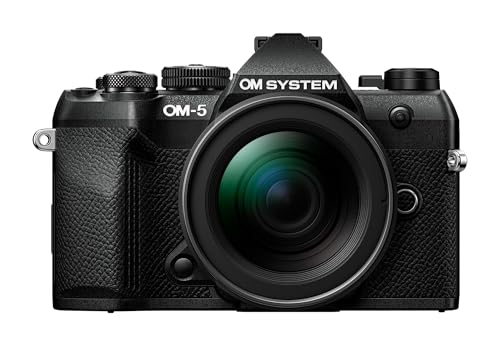
OM System OM-5 Mark II with 12-45mm PRO kit — Best overall
This kit is the trail’s own answer, designed as a unit: a body rated IP53 against dust and splashing, paired with the M.Zuiko 12-45mm F4 PRO, a weather-sealed zoom whose constant aperture and close focusing suit everything from the valley panorama to the alpine flower at your boot. The Four Thirds sensor’s smaller size is the kit’s founding advantage, because the lens that covers this range for a larger sensor weighs and bulks noticeably more, and on a trail that difference is measured in whether the camera rides on the strap or in the pack.
The computational toolkit reads like a hiker’s wish list written by hikers. Live ND simulates neutral-density filters, turning a midday waterfall silky without carrying glass filters. Handheld high-resolution mode stacks frames into a larger file for the summit panorama that deserves printing. Live Composite builds star trails and lightning exposures while you watch, at camp, with the camera doing arithmetic no film body could. Stabilisation is a five-axis system refined over generations, and it shows in dawn shots taken while the tripod, correctly, stayed in the tent.
The debits are the format’s: at high ISO in true darkness the bigger sensors elsewhere pull ahead, the 20.4-megapixel files crop less generously, and OM’s menus reward a setup evening before the trip. None of that survives contact with an actual wet weekend as a serious objection. For the hiker who photographs in the weather rather than about it, this is the guide’s first recommendation.
A second scenario suits it just as well: the macro mile. Mountain flowers, fungi after rain, frost feathers on the tent fly: the 12-45mm PRO focuses close enough to make a walk’s smallest subjects into its archive, and the system’s focus tools turn a rest stop into a studio. Owners also praise the small thing nobody lists, that the whole outfit rinses the day’s weather off with a wipe and a night in the tent’s porch, rated seals making the care routine a formality rather than a prayer.
- Sensor: 20.4MP Four Thirds
- Kit lens: M.Zuiko 12-45mm F4 PRO, weather-sealed
- Sealing: IP53 dust and splash rating, body and kit lens
- Stabilisation: 5-axis in-body
- Computational: Live ND, handheld high-res, live composite
- Video: 4K with log options
Strengths
- The only formal weather rating here, matched by its kit lens.
- Computational modes replace a tripod and a filter wallet.
- Smallest serious zoom outfit in the guide as carried.
Trade-offs
- High-ISO ceiling trails the APS-C bodies at campfire light.
- Files crop less than the 40MP Fujifilm’s do.
- Menus ask for one deliberate setup session at home.
Best for: hikers who walk in all weathers and photograph waterfalls, stars and summits.
Not suited for: pixel-peepers whose night work is all at the highest ISOs.

Sony a6700 with 16-50mm kit — Best compact system
The a6700 kit pairs the strongest electronics in this guide with the humblest lens, and the combination is smarter than it looks. The body’s 26-megapixel sensor, AI subject recognition and five-axis stabilisation are flagship-grade; the little power-zoom 16-50mm keeps the carried outfit small for the approach miles, and Sony’s E-mount means the lens upgrade path, a fast wide prime for astro, a longer zoom for wildlife, is the deepest in this guide when the hiker’s ambitions grow. It is the system pick for the photographer who hikes, rather than the hiker who photographs, if that distinction means anything at the trailhead.
Practical trail virtues accumulate: the battery is Sony’s large pack, the best stamina here per charge, which matters across a cold weekend; autofocus finds a companion’s eye or a bird’s with an assurance none of the others quite match; and 4K video to 120p serves the hiker who films the route as a record or a channel. The debits are that the body is weather-resistant rather than rated, the kit zoom is the outfit’s optical ceiling until replaced, and the grip with a future telephoto will want support. None prevents it being the most capable compact system on the mountain.
Buy it when the photography is the point of the hike and the pack can be built around it. Its files at dawn, its focusing on a moving companion against a bright glacier, and its video at the summit give back more than its extra grams over the lightest options here ever cost.
Its growth path deserves one more trail-specific note. Sony’s small telephotos and the third-party E-mount zooms mean the wildlife hiker can start with this kit and add reach season by season without changing bodies, and the a6700’s bird and animal recognition will be waiting when the long lens arrives. No other outfit here scales from the walk-around kit to a serious wildlife rig inside one mount so smoothly, and for the hiker whose ambitions are still rising, that headroom is worth grams.
- Sensor: 26MP APS-C BSI CMOS
- Kit lens: E PZ 16-50mm F3.5-5.6 OSS, stabilised power zoom
- Autofocus: AI-based subject recognition
- Stabilisation: 5-axis in-body
- Video: 4K up to 120p, 10-bit
- Battery: large Z-series pack, best stamina here
Strengths
- Sensor, focusing and video lead the guide outright.
- Battery life suits multi-day trips with fewer spares.
- E-mount offers every future lens a hiker could grow into.
Trade-offs
- Sealing is resistance, not a rating; rain covers still earn their place.
- Kit zoom is a starting point the sensor quickly outgrows.
- Body weight is mid-pack, and long lenses will unbalance it.
Best for: photographers who hike to locations and want the best files per trip.
Not suited for: ultralight purists counting every hundred grams twice.

Fujifilm X-T50 with 15-45mm kit — Best dials and film sims
The X-T50 in silver is the camera other hikers ask about at the refuge, and its charms are functional as much as visual. Dedicated dials for shutter speed and exposure compensation, plus Fujifilm’s film simulation dial, mean the adjustments a trail photographer makes most, as cloud crosses the sun or the ridge goes into shadow, happen by touch, with gloves thinned by wear if not by design. Inside sits the 40.2-megapixel X-Trans sensor, the resolution champion of this guide, with in-body stabilisation rated up to seven stops and files that crop a summit detail into a second photograph.
The kit lens, the XC 15-45mm power zoom, is the outfit’s compromise, chosen for size and price; it is stabilised, wide enough for valleys, and the natural first upgrade when its owner falls for one of Fujifilm’s small primes. The film simulations deserve their trail reputation: a finished JPEG at the summit, in a chrome look for granite or a soft colour look for evening alpenglow, is a photograph delivered before the walk down, and for many hikers that immediacy is the hobby. The debits are weather resistance that is present on the body but not a rating, a battery smaller than Sony’s, and autofocus that, while modern and subject-aware, does not quite match the a6700’s tenacity on erratic wildlife.
Buy it when the hike is also an aesthetic outing and the camera’s company matters as much as its files. It is the pick most likely to be carried on walks that are not expeditions at all, which is where, over a year, the largest archive quietly accumulates.
Winter walkers should note a dial virtue that screens cannot claim: with gloves on, the X-T50’s physical controls remain operable while every touchscreen in this guide becomes a negotiation, and its viewfinder keeps the bright-snow exposure judgement honest. The 40-megapixel files also forgive the hiker’s commonest framing sin, the horizon of interest too small in a wide frame, by cropping the distant chapel, the far summit cross, the tiny figure on the ridge into usable separate photographs back at home.
- Sensor: 40.2MP APS-C X-Trans CMOS 5 HR
- Kit lens: XC 15-45mm F3.5-5.6 OIS PZ, stabilised
- Stabilisation: in-body, up to 7 stops
- Controls: shutter and compensation dials, film simulation dial
- Finish listed: silver
- Video: up to 6.2K; 4K at practical rates
Strengths
- Resolution that turns one summit frame into several photographs.
- Dials suit cold fingers and changing mountain light.
- Film simulations finish photographs at the moment of taking them.
Trade-offs
- Kit zoom is the outfit’s ceiling until a prime joins it.
- No formal weather rating; care in downpours is still required.
- Battery is mid-sized; a spare is part of the outfit.
Best for: aesthetic hikers who shoot JPEG and love traditional controls.
Not suited for: storm chasers who need a rated seal more than a dial.

Nikon Z50 II with 18-140mm bundle — Best one-lens range
The trail argument for this outfit can be made in one sentence: the lens never comes off. The Z DX 18-140mm covers wide valley to telephoto summit detail in a single stabilised zoom, so there is no lens change in wind, dust or drizzle, no second lens in the pack, and no moment missed while glass is swapped on a ridge. The body is Nikon’s modern Z50 II, with EXPEED 7 subject detection, a bright viewfinder for hard sun, an articulating screen and creator colour presets, here in a seller bundle whose extras, card, spare battery, case and more, should be read on the listing and valued as packing material around a sound core outfit.
The compromises are a superzoom’s own: aperture narrows toward the long end, so dusk telephoto work pushes ISO; ultimate sharpness is a prime’s game; and the outfit, while light for its range, is the largest single-lens package here. The bundle framing deserves the same honesty as the Fujifilm bundle elsewhere on this site: the camera and lens are the purchase, the accessories are a starter drawer. Judged on its core, this is the outfit for the hiker whose subjects refuse to be scheduled, the marmot at distance, the companion across the col, the valley behind, all within one twist of the zoom ring.
Buy it when versatility per gram is the metric and the photography is opportunistic. Families hiking together, scout and group leaders, and travellers walking hut to hut will find it the least fussy serious camera in this guide, and the one whose photographs most resemble the whole day rather than its widest moments.
Group leaders will recognise another virtue: the Z50 II’s colour presets and easy sharing make it the camera whose photographs reach the group’s phones before the walk ends, and its articulating screen handles the high and low angles, over the parapet, down at the boot-level flower, that a fixed screen turns into guesswork. It is the sociable pick of the six, built for days whose photographs are a shared record rather than a private portfolio, and there are more of those days in most hiking lives than summits.
- Sensor: 20.9MP APS-C (DX) CMOS
- Lens: Z DX 18-140mm f/3.5-6.3 VR, stabilised
- Autofocus: EXPEED 7 subject detection
- Video: 4K up to 60p (cropped at 60p)
- Bundle: seller-packed card, battery, case and accessories
- Stabilisation: lens-based
Strengths
- Whole-day range without a single lens change in the weather.
- Modern Nikon focusing and finder serve bright, moving days.
- One-lens simplicity keeps the pack honest.
Trade-offs
- Superzoom aperture taxes dusk shots at the long end.
- Bundle accessories are extras, not camera value.
- Largest single-lens outfit in the guide.
Best for: hut-to-hut walkers and family hikers who shoot everything that happens.
Not suited for: prime-lens perfectionists who change glass happily in a gale.

Canon EOS R10 (body) — Best value body
The R10 body is the value route onto the trail, and its value is specific: Canon’s DIGIC X generation of subject-detection autofocus and burst speeds up to 15 frames per second mechanical in a light body that costs the least here, leaving budget for the lens decision that actually shapes the outfit. Paired with the compact RF-S 18-45mm it is a minimal walk-around; paired with the RF-S 18-150mm it becomes a one-lens outfit rivalling the Nikon’s; paired with the RF-S 55-210mm it reaches toward wildlife. The body-only listing is therefore not an omission but the point: the trail outfit is assembled by its owner.
The body’s trail manners are good rather than luxurious. It is light, about 429 grams with battery and card, its grip is the most secure here for its size, and its menus are Canon’s friendly standard. It has no in-body stabilisation, so stabilised lenses are mandatory thinking, no formal weather sealing, so a rain cover is part of the kit, and a single card slot and smaller battery mark its tier. Video is 4K with crops at the higher rates, entirely adequate for route records and summit clips.
Buy it when the budget must cover boots and poles as well as a camera, or when a second, lighter Canon body is wanted beside a bigger one at home. It is the pick that proves a serious trail camera is an outfit decision, and that the cheapest body here, dressed well, out-photographs dearer bodies dressed carelessly.
There is a teaching virtue in the body-only route too. The R10 owner must think about focal lengths before the trip, choose the day’s lens like a film photographer chose the day’s roll, and that deliberation improves trail photography more than any feature in this guide. Canon’s affordable RF-S zooms keep the experiment cheap, and the body’s speed means the experiment is never punished by a missed moment. As a first serious trail camera for a young hiker, it educates while it performs, which is the best thing a value pick can do.
- Sensor: 24.2MP APS-C CMOS with DIGIC X
- Listing: body only; lens chosen by owner
- Burst: 15 fps mechanical, 23 fps electronic
- Weight: about 429 g with battery and card
- Stabilisation: lens-based only
- Video: 4K up to 60p (cropped at top rates)
Strengths
- Fastest bursts and modern focusing at the guide’s friendliest body price.
- Light body leaves the gram budget for the right lens.
- Canon menus and grip suit tired, cold operation.
Trade-offs
- No sealing rating and no in-body stabilisation.
- Outfit quality depends entirely on the lens chosen for it.
- Smaller battery means the spare is not optional.
Best for: budget-conscious hikers assembling their own outfit lens-first.
Not suited for: buyers wanting a complete sealed kit in a single box.

Ricoh GR IIIx — Pocket companion pick
State it first, as this guide promised: the GR IIIx is not a mirrorless system camera. Its lens is fixed, a 40mm-equivalent f/2.8 in front of a 24-megapixel APS-C sensor, it has no viewfinder built in and no mount of any kind, and it belongs in this article in one role only, the pocket companion. In that role it has no rival here. At about 257 grams with battery it lives in a jacket or hip-belt pocket, wakes almost instantly, and offers snap focus, a preset focus distance that makes it the fastest camera in this guide from pocket to photograph, faster than any system body can be raised, switched and focused.
Its photographic character suits the trail diary: the 40mm view is the classic reportage framing, wide enough for the refuge interior and the companion portrait, honest enough for the landscape that does not need drama. In-body stabilisation, Ricoh’s SR system, steadies dusk shots at camp, the files are excellent, and the controls, though tiny, are designed by a cult following’s feedback over generations. What it cannot do is the list that defines its category: no telephoto for the ibex, no wide zoom for the cirque, no weather sealing worth the name, and a small battery that counts its shots in the low hundreds.
Buy it as the second camera beside a system body, for the summit push where the big outfit stays at the refuge, or as the only camera for the fast-and-light hiker whose photography is the walk itself, taken at arm’s length from the day. Buy anything else in this guide if lenses are in your future. Understood on those terms, it is not the compromise of the article; for its owners it is the point of it.
Its limitations even teach the right lessons. A single focal length forces the oldest trail skill, walking to the photograph, and its files reward the walk with a quality that embarrasses zoomed phone shots from the same viewpoint. Owners pair it with a phone for the reach it lacks and find the division of labour natural: the phone for the record, the Ricoh for the photograph. On multi-day trips its USB charging and tiny battery make power planning trivially light, provided the shot count’s modesty is accepted as part of the discipline it imposes.
- Type: fixed-lens compact, NOT an interchangeable-lens system camera
- Lens: fixed 40mm-equivalent F2.8
- Sensor: 24MP APS-C CMOS
- Weight: about 257 g with battery
- Stabilisation: in-body SR (sensor-shift)
- Focus: snap focus preset distances plus conventional AF
Strengths
- Pocketable in the literal sense no system body matches.
- Snap focus makes it the fastest camera here to a finished frame.
- APS-C files from a camera that asks nothing of the pack.
Trade-offs
- One focal length, forever; no zoom, no lens changes, no exceptions.
- No meaningful weather sealing for storm work.
- Small battery counts shots in hundreds, not thousands.
Best for: fast-and-light hikers and system owners wanting a pocket second camera.
Not suited for: anyone whose next purchase is a lens, because there is nowhere to mount it.
Trail-Tested on Paper: Weight, Sealing and Reach Compared
| Camera | System | Sealing story | As carried | Reach as kitted | Trail personality |
|---|---|---|---|---|---|
| OM-5 Mark II 12-45 PRO kit | Four Thirds | IP53 rated, lens included | Lightest sealed zoom outfit | Wide to short telephoto, constant f/4 | All-weather specialist |
| Sony a6700 16-50 kit | APS-C E-mount | Resistance, no rating | Compact body, big battery | Wide to portrait; grows by lenses | Photographer’s system |
| Fujifilm X-T50 15-45 kit | APS-C X-mount | Resistance, no rating | Light body, dials up top | Wide to standard; primes beckon | Aesthetic companion |
| Nikon Z50 II 18-140 bundle | APS-C Z DX | Resistance, no rating | One lens, no changes | Wide to telephoto in one zoom | Opportunist’s outfit |
| Canon EOS R10 body | APS-C RF-S | None claimed | About 429 g body; lens decides | Whatever the owner mounts | Assemble-your-own value |
| Ricoh GR IIIx | Fixed-lens compact | None | About 257 g, pocket-sized | 40mm equivalent, fixed | Pocket companion, not a system |
The sealing column is the one to read twice. Only one row carries a rating, and the honest language in the others, resistance, is a maker’s description rather than a tested standard. Hikers who walk in rain as a plan rather than an accident should buy the rated row or carry protection for the unrated ones, and the reviews say which is which without varnish.
The reach column hides a subtlety worth surfacing: equivalent reach is not the same as carried reach. The Four Thirds kit’s zoom frames like a longer lens on a bigger sensor while weighing like a shorter one, which is the format’s founding bargain and the reason its row punches above its sensor size on a trail. Conversely the body-only row’s reach is a promissory note, redeemable in exactly the focal lengths its owner chooses to fund, which is either the guide’s best value or its emptiest promise depending on the owner’s follow-through.
How Do Rain, Dust and Altitude Rank These Six in Practice?
Rain is the OM kit’s home fixture and the others’ away game. The rated body-and-lens pairing can be shot through a shower with a wipe between frames; the resistance-only bodies want a cover, a plastic sleeve at minimum, and the discipline of drying at camp, while the Ricoh should simply be pocketed until the weather relents, which its owners accept as the price of its size. Dust reverses some of the ranking: the fixed-lens Ricoh never opens its body to the trail, the one-lens Nikon rarely does, and the body-only R10’s exposure depends entirely on its owner’s lens-change habits.
Altitude itself bothers cameras less than it bothers photographers, but its side effects, fierce sun, hard shadows, cold nights and thin patience, shape the choice. Bright finders and honest screens matter at altitude, which flatters the Nikon and Sony; exposure compensation on a dial matters when the light swings, which flatters the Fujifilm; and the photographer’s reduced capacity for fiddling promotes every simple control layout in this guide. The mountain does not care about your camera. It cares whether you are still functioning, and the camera that asks least of a tired operator at 3,000 metres is a safety feature disguised as a convenience.
What Happens to Cameras in Real Cold, and How Do You Prepare?
Cold attacks a trail camera on three fronts. Batteries deliver less of their charge, sometimes dramatically below freezing, which is why the spare lives against the body and why the a6700’s larger pack and the rotation habit matter more than any capacity figure. Lubricants and fingers both stiffen, which promotes the dial-led bodies and punishes fiddly buttons. And breath and tent warmth conspire to fog lenses at exactly the dawn moment, which the sealed-bag warm-up and a lens cloth carried dry in an inside pocket exist to prevent.
Preparation is a packing list rather than a purchase: batteries rotated and warmed, a microfibre cloth in a sealed bag, silica sachets in the camera pouch to drink the night’s condensation, and a camera allowed to cool and warm at the bag’s pace rather than the room’s. Photographers who winter-camp with these bodies report that the discipline, once habitual, makes the cold a subject rather than an adversary, and the photographs, frost, breath, low raking light, are frequently the year’s best.
How Do You Pack and Power a Camera on a Multi-Day Trail?
Carry the camera where the photographs are: on a chest harness, a shoulder strap under the pack’s strap, or a hip-belt pouch, never inside the pack, because a camera in the pack photographs only rest stops. The system bodies here all suit a capture-clip or harness; the Ricoh suits a pocket, which is its entire thesis. Protect the outfit with the bag’s own weather: a dry bag for river days, a simple rain cover for the unrated bodies, and the discipline of wiping down and airing the kit at camp before the tent’s condensation claims it.
Power is a rota, not a hope. Start each day with the warmest battery, the one slept beside you, keep the spare against your body on cold mornings, and download or duplicate cards at camp on multi-day trips when the photography matters. Screens are the silent drain; use the viewfinder on the bodies that have one, dim everything, and let the camera sleep between viewpoints rather than glow at your chest for six hours. A small power bank shared with the phone is the modern multi-day answer, and USB-C charging across these bodies makes that answer simple.
Straps deserve their sentence in the packing doctrine. The neck strap in the box is the worst way to carry a camera with a pack, swinging against the hip belt and announcing every step; a cross-body sling under the pack strap, a chest harness, or a belt capture clip keeps the camera still, accessible and off the neck. Whichever system is chosen should be rehearsed at home with the actual pack, because a carry method first assembled at the trailhead in the rain will be abandoned by the second stile, and an abandoned carry method is how cameras end up in the pack, photographing nothing.
Which Trail Habits Ruin Otherwise Good Cameras?
The commonest is the lens change in the wind, dust and grit volunteering for the sensor at exactly the moment the hiker is coldest and least careful; the Nikon’s one-lens answer and the Ricoh’s fixed lens both exist because of this habit. The second is the camera carried loose in a pack against a water bottle and a stove, arriving at the summit with a scratched screen and a dented dial. The third is condensation shock, bringing a cold camera straight into a warm, steamy refuge and watching the lens fog from the inside of the experience; the remedy is the sealed bag trick, letting the camera warm slowly inside a closed dry bag before it meets the room.
The fourth is battery optimism, the belief that a gauge reading half at the refuge will somehow survive a cold dawn of long exposures and screen reviews. The fifth is leaving the camera behind on the summit push because the pack felt heavy at breakfast, a decision regretted at exactly the altitude where the light is best. Every pick in this guide was chosen to make that fifth mistake unnecessary, and the lightest of them, the pocket Ricoh, exists for the hiker who has made it before and sworn not to again.
How Should You Shoot Landscapes and Companions on the Trail?
For landscapes, the trail kit’s virtues align: stabilisation permits handheld dawn and dusk work at camp, the OM’s Live ND and high-res modes reward the deliberate stop, and the Fujifilm’s resolution rewards the printed panorama. Work at the ends of the day, keep the horizon honest with the level every body here offers, and expose for the sky’s highlights, because mountain light forgives lifted shadows more readily than blown cloud. A polarising filter is the one filter worth its grams for sky and water, and it fits in a pocket the size of the Ricoh’s.
For companions, the focusing systems earn their keep: eye detection on the Sony, Nikon and Canon holds a face against bright snow or backlit ridge, and the trick is to expose for the face and let the landscape fall where it may, because nobody frames a photograph of a friend whose face is a silhouette against a perfectly exposed mountain. Shoot the summit portrait before the celebration, while everyone still looks like the achievement feels, and take the group photograph with the self-timer on a mini tripod or a flat rock, with the photographer in it, because archives are audited by families for exactly that absence.
Wildlife on the trail rewards patience over reach more often than gear pages admit. The marmot habituated to the refuge, the chamois at dawn near the hut, the raptors riding the ridge lift: these come close to the hiker who sits still, and the Z50 II’s zoom and the a6700’s recognition are there for the ones that do not. Shoot the animal’s behaviour rather than its portrait when distance is short, keep the shutter quiet where the body allows, and remember that the photograph of the encounter, however imperfect, outranks the technically perfect photograph of the animal fleeing your approach.
What About Filming the Walk Itself?
Trail video divides hikers into those who film the walk for others and those whose stills occasionally move. For the first group, stabilisation and autofocus carry the day: the a6700’s video specification and subject tracking lead, the OM’s stabilisation makes walking footage watchable without a gimbal, and the Fujifilm’s colours publish straight from the card. For the second group, any body here records a summit panorama and a camp scene beautifully, and the deciding factors revert to stills.
Two trail-specific warnings apply to every body. Wind defeats built-in microphones at altitude with a consistency that borders on comedy, so filmed speech on a ridge needs a muff or a sheltered moment. And video drains the shared battery bank faster than any stills habit, so the filming hiker’s power plan is a different, heavier document than the photographer’s. Decide which document you are packing before the trailhead, because the mountain will not negotiate.
What Should a Hiker’s Camera Settings Look Like at the Trailhead?
Set the camera before the boots, while fingers and patience are warm. Aperture priority with auto ISO and a sensible minimum shutter speed suits most trail stills; eye autofocus for companions, a flexible single point for landscapes and detail; the level and grid on; image stabilisation on for handheld work and off only when a tripod is genuinely in use. JPEG shooters on the Fujifilm choose the day’s simulation at breakfast, raw shooters everywhere confirm the card has room for the day the light refuses to quit.
Two settings deserve deliberate thought rather than defaults. Drive mode: single frame for landscapes, a modest burst for wildlife and companions in motion, because a card full of near-identical frames is weight carried in editing time. And the power-saving menu: an aggressive sleep setting preserves the battery across a long day of occasional photographs, and every body here wakes fast enough that the setting costs nothing. Arrive at the summit with a camera already configured and the photography becomes the walk’s pleasure rather than its admin.
Which Single Lens Would You Add to Each Outfit Next?
For the OM kit, a fast prime for camp evenings or the longer PRO zoom for wildlife, depending on whether your archive lacks dusk or distance. For the Sony, the fast wide prime that unlocks astro and interiors, because the sensor has been waiting for it. For the Fujifilm, one of the small f/2 primes that complete the dial-and-JPEG philosophy. For the Nikon, nothing: the outfit’s premise is completeness, and its next purchase is a better bag. For the R10, the lens is the outfit, so the answer is the one the first season’s files request. For the Ricoh, the honest answer is a system camera, bought later and knowingly, when the pocket companion has taught its owner what they actually photograph.
Final Recommendation
For most hikers the OM-5 Mark II kit is the answer this guide was written to reach: rated sealing, a sealed lens, computational help and an outfit weight that never argues with the walk. Photographers first should take the a6700 and build around its sensor and battery; romantics should take the X-T50 and its dials; opportunists the Nikon’s single far-reaching zoom; the budget-minded should dress an R10 body with the lens their trails demand. And the hiker who has read this far while thinking of their jacket pocket has already chosen the Ricoh, correctly, as the companion it is. Weigh the outfit, respect the weather, keep the battery warm, and the camera will still be with you where the photographs are. That presence, repeated over seasons, is worth more than any single specification in this article, because trails are not photographed by the best camera in the shop but by the one on the strap at the moment the light breaks.
Frequently Asked Questions
How much camera weight is reasonable on a long hike?
It depends on the hiker’s total load and honesty. As a working rule, an outfit up to about a kilogram disappears for most walkers with a proper harness or strap; beyond that, each hundred grams should have to argue its case in photographs. The kits here sit mostly under that line as carried, the R10’s total depends on its lens, and the Ricoh renders the question moot, which is precisely its appeal to the weight-obsessed.
Is weather sealing actually necessary for hiking?
For fair-weather day hikes with a rain cover in the pack, resistance suffices for most bodies. For multi-day trips, coastal weather and any walking where rain is a plan rather than a possibility, a rated seal, the OM-5 Mark II’s IP53 with its sealed lens, changes behaviour: you keep shooting through weather that sends other cameras into bags, and those are often the day’s best photographs. Judge by your climate’s honesty, not its brochure.
Why is a fixed-lens camera in a mirrorless guide at all?
Because hikers asked for it, and because it fills a role no system body can: the true pocket camera for summit pushes and fast days. It is labelled as a fixed-lens pocket companion in its heading, its table row and its review, never as a system camera, and it is recommended only to buyers who want exactly that. Readers who need interchangeable lenses should choose from the other five, which is most readers, and the guide’s structure keeps the categories separate so nobody buys the Ricoh by misunderstanding.
Which of these is best for wildlife on the trail?
The Z50 II’s 18-140mm outfit for reach without lens changes, with the a6700 the choice when a dedicated telephoto will be carried, because its subject recognition for birds and animals leads the guide. The R10 with a telephoto RF-S zoom is the budget version of the same idea. The Ricoh, at a fixed 40mm, is for the wildlife that walks up to you, which on real trails is a shorter list than photographers hope.
How do I protect the sensor when changing lenses outdoors?
Mostly by not changing lenses outdoors: plan the day’s lens at the trailhead, which the kits here are designed to make easy. When a change is unavoidable, turn your back to the wind, point the body downward, have the next lens uncapped in hand before the first comes off, and be quick rather than ceremonial. A rocket blower at camp finishes what care started, and a sensor that never meets trail dust never needs the lesson twice.
Can I charge these cameras from a power bank on the trail?
Yes, USB-C charging is common across these bodies, and a shared bank for phone, headtorch and camera is the standard multi-day arrangement. Charge at camp rather than while walking, keep the bank’s capacity honest against cold nights, and remember that charging is slower than swapping: the spare battery remains the summit-day answer, with the bank as the expedition’s reserve.
Is a phone good enough for hiking photography now?
For the record of the day, increasingly yes, and this guide’s Ricoh pick exists partly because some hikers want only slightly more than that. For reach, for dawn and dusk quality, for prints and for the deliberate photograph, the system cameras here remain in another class, and the hiker who has once watched a phone’s telephoto dissolve a distant ridge into watercolour understands the difference without further argument. Carry both, by all means; know which is the camera.
Do I need a tripod for summit and night shots?
Stabilisation has retired the tripod for most trail stills, and the OM’s handheld high-res and live composite modes retire it further. A mini tripod or gorilla-style legs still earn their grams for group summit photographs, long star exposures and time-lapses at camp. Full-size tripods belong to photographers whose hike is a vehicle for the photograph, a legitimate choice that should be made at the packing stage rather than regretted at kilometre nine.
Related Guides
Hikers choosing their first system may want the wider picture in our compact mirrorless roundup for everyday carry before specialising, astro campers should continue to the mirrorless cameras that perform best in low light for the night half of the trip, and those who fall for Fujifilm’s dials on the trail can explore the Fuji mirrorless range from pocket to medium format.
Related guides
- Best 3D Art Tablets
- Best Canon Point and Shoot Digital Cameras: PowerShot Picks From Pocket Compacts to Travel Zooms
- Best Balancing Stabilizers for Mirrorless Cameras: Payload, Balancing and Native Vertical Shooting
- Best Basic Phones Camera Buyers Can Trust: Flip Phones and Simple Handsets That Still Take a Photograph


