What's inside
- Key Takeaways
- Quick Picks
- How Were the Compact Contenders Chosen?
- What Do You Give Up When a System Camera Shrinks?
- Small Bodies, Honest Trade-Offs: The Compact Six Measure Up
- APS-C or Four Thirds: Which Small Sensor Serves You Better?
- Why Carry a Compact Camera When the Phone Is Already There?
- How Do You Make a Small Camera Fit a Real Hand?
- Which Compact Suits Which Kind of Day Out?
- How Should You Pair a Compact Body With Its First Lens?
- What Mistakes Do Compact-Camera Buyers Repeat?
- How Do You Carry and Set Up a Compact for Daily Use?
- Is a Compact Body a Sensible Second Camera for a Professional?
- How Does Video Separate These Small Bodies?
- Final Recommendation
- Frequently Asked Questions
- Related Guides
As an Amazon Associate I earn from qualifying purchases. This post may contain affiliate links at no extra cost to you.
gizmoverdict.com is reader-supported. When you buy through links on our site, we may earn an affiliate commission.
Where to buy: Four of these six are listed as bodies alone and two as kits, and the reviews treat that difference as information rather than inconvenience: a body-only listing assumes you own or will choose a lens, while the two kits are complete outfits for a trip taken next month. Follow the link on the pick whose shape matches your shelf. If you own no lenses at all, the two kits are the honest starting points, and the body-only listings become relevant the day a second body or a deliberate lens choice enters the plan.
The best compact mirrorless digital cameras begin with a definition this guide will not blur: compact here means small interchangeable-lens system bodies, cameras whose lenses come off and whose systems grow, not fixed-lens compact cameras with a zoom glued to the front. Fixed-lens compacts are a fine category with its own champions, and one appears in this site’s hiking guide as a pocket companion, but they are not what follows. What follows are the smallest serious system cameras from five makers, bodies that slip into a jacket or a small sling yet accept the full lens catalogues of their mounts.
Why insist on the distinction? Because the two categories age differently. A fixed-lens compact is a finished object, bought for what it is. A small system body is a beginning: the same camera that travels light with a pancake prime this year takes a fast telephoto to a school match next year and becomes a second body when its owner upgrades. Compact system cameras are how manufacturers answer the phone’s challenge, not by out-conveniencing it but by being nearly as portable while remaining unmistakably cameras.
The six below divide by temperament. Sony’s a6700 is the technical flagship in miniature. Fujifilm’s X-M5 is the smallest X-mount body with the film simulations intact. Canon’s EOS R50 V is the creator’s tool, video-first and viewfinder-free. OM System’s OM-5 Mark II is the weather-sealed outdoors body. Nikon’s Z50 II in its two-lens kit is the complete photographer’s outfit. And Canon’s EOS R10 with the 18-150mm zoom is the one-lens travel answer. All six are APS-C or Four Thirds; that is not a limitation of the guide but the physics of small, because a compact system is only as compact as the lenses it must carry, and smaller sensors are what let the lenses shrink with the bodies.
Key Takeaways
- Compact in this guide means small system bodies with interchangeable lenses, not fixed-lens compacts.
- Smaller sensors are the enabler: APS-C and Four Thirds lenses shrink with the bodies, which full-frame compacts cannot claim.
- The a6700 is the specification leader; the X-M5 the size leader; the OM-5 Mark II the only one sealed to an IP53 rating.
- Two picks omit a viewfinder entirely, the X-M5 and the R50 V, which suits screen-first shooters and nobody else.
- The two kits solve different problems: Nikon’s two lenses for range, Canon’s single 18-150mm for simplicity.
- Carry is a system weight, body plus lens plus the bag that holds them; judge complete outfits, never bodies alone, before buying anything in this class.
Quick Picks
| Pick | Badge | Why it is here |
|---|---|---|
| Sony a6700 (body) | Best overall | A flagship’s brain and video in an APS-C body that still counts as compact. |
| Fujifilm X-M5 (body) | Smallest with film sims | The tiniest X-mount body, with a film simulation dial and 6.2K video hiding inside. |
| Canon EOS R50 V (body) | Best for creators | A video-first compact with livestreaming manners and Canon’s friendliest focusing. |
| OM System OM-5 Mark II (body) | Best weather-sealed compact | IP53 sealing and computational tricks in the smallest serious outdoor body here. |
| Nikon Z50 II two-lens kit | Best kit value | A modern photographer’s body with wide-to-telephoto coverage in one box. |
| Canon EOS R10 with 18-150mm kit | Best one-lens travel kit | One lens from wide to telephoto on a fast, light body that shoots like a bigger Canon. |
How Were the Compact Contenders Chosen?
We set a carry test before a specification test: each candidate had to make sense as an everyday outfit with one small lens, the camera a person brings because it asks nothing of them. That ruled in the APS-C and Four Thirds classes and ruled out the small full-frame bodies, which are compact only until a full-frame lens is mounted. Within the class we looked for genuine variety of intent, because a compact camera is a personality purchase: video-first, stills-first, outdoors-first and kit-complete arguments all deserved a representative.
We also paid attention to what makers removed to reach the size. Every gram saved costs something, a viewfinder, a stabiliser, a grip, a dial, and the reviews name each removal in plain terms so the saving is a choice rather than a discovery. A compact bought knowingly is a delight for a decade; a compact bought on a spec sheet that hid its omissions is a return label waiting to be printed.
We also weighed each maker’s commitment to the small end of its own system, because a compact body is only as good as the small lenses made for it. Sony and Fujifilm stock deep shelves of compact primes and zooms; OM System’s entire catalogue is built around smallness; Canon and Nikon are actively growing their APS-C shelves, with the kits in this guide evidence of the direction. A body whose mount offers only large lenses is a compact in name alone, and none of the six survived that test by accident.
What Do You Give Up When a System Camera Shrinks?
Physics collects its toll in predictable places. Batteries shrink, so shots per charge fall and a spare stops being optional. Grips slim down, so long lenses feel front-heavy and long days tire hands sooner. Viewfinders shrink or vanish, as two of these six demonstrate. Heat has nowhere to go, so the highest video modes on small bodies may be time-limited in warm rooms in a way their bigger siblings’ are not. And control layouts compress, which is why the compact class divides so sharply between dial-rich bodies for photographers and simplified bodies for creators.
What you do not give up, in 2026, is image quality or autofocus. The sensors in these six are the same generation as their larger stablemates’, and the focusing systems on the Sony, the Canons and the Nikon would shame professional bodies of a decade ago. The compact bargain has never been better; it has simply moved from the sensor to the shell, which is why this guide spends its words on shells.
One more toll is worth itemising because it surprises buyers: ports and doors shrink too. Some small bodies charge and transfer through a single USB-C port and omit headphone monitoring, weather flaps grow fiddlier, and the accessory shoe may carry power and audio duties that bigger bodies give their own sockets. Creators in particular should inventory their microphones, monitors and capture gear against the specific body, the R50 V being designed around exactly that inventory while the stills-led compacts treat it as an afterthought.

Sony a6700 (body) — Best overall
The a6700 is what happens when a maker refuses to treat its compact body as a lesser one. Its 26-megapixel back-illuminated sensor pairs with Sony’s AI processing unit, giving it the subject recognition of the company’s flagships, people, animals, birds, vehicles, insects, and video that runs to 4K120 with 10-bit colour and log profiles that accept LUTs for monitoring. In a guide about small cameras it is the specification outlier, a body whose capabilities embarrass full-frame cameras of a few years ago while fitting, with a small prime, into a coat’s larger pocket.
The compact compromises are the honest ones: the viewfinder is good rather than huge, the grip is shaped for small lenses and asks for help with long zooms, and the body-only listing means your first lens is a separate decision, with Sony’s deep E-mount catalogue making that decision pleasant at almost any budget. Stabilisation is a five-axis system rated around five and a half stops, battery life is from Sony’s large modern pack and is the best here, and the weather resistance is real if not rated to a number. For stills it bursts fast, focuses faster, and produces files with the family’s characteristic flexibility.
Buy it as the compact that will not be outgrown: the travel body that is also the video body, the second body that keeps embarrassing the first. Its only true rival in this guide is the concept of simplicity, because the a6700’s menus and modes reward an owner who sets it up deliberately, and punish, mildly, the owner who never opens them.
One scenario flatters it particularly: the working photographer on holiday. The a6700 shares batteries, colour and lens mount logic with Sony’s professional bodies, accepts the same fast glass when the day demands it and the pancake primes when it does not, and produces files a client could not distinguish from the big camera’s at ordinary sizes. Owners who shoot Sony professionally describe it as the body that restored their personal photography, which is perhaps the strongest claim any compact in this guide can make.
- Sensor: 26MP APS-C BSI CMOS
- Video: 4K up to 120p, 10-bit, log with LUT handling
- Autofocus: AI-based recognition across many subject types
- Stabilisation: 5-axis in-body
- Listing: body only; lens chosen separately
- Battery: Sony’s large Z-series pack class
Strengths
- Flagship focusing and video in the guide’s most capable compact.
- Battery stamina that embarrasses the rest of the class.
- E-mount’s lens depth makes the body-only listing a pleasure.
Trade-offs
- Grip and finder are sized for the body, not for long glass.
- Menu depth asks for a deliberate setup session.
- No lens in the box means the outfit price is a second step.
Best for: enthusiasts who want one compact body that does everything at a high level.
Not suited for: hands that shoot long telephotos all day without a grip or support.

Fujifilm X-M5 (body) — Smallest with film sims
The X-M5 is the smallest interchangeable-lens Fujifilm, a body so compact that its party trick is disappearing into the day. Fujifilm kept the essentials that make the brand itself: the 26.1-megapixel X-Trans sensor, the film simulations, now selected by a dedicated dial on the top plate, and video that startles for the size, up to 6.2K recording with serious codecs for creators. What it surrendered is equally clear: there is no viewfinder and no in-body stabilisation, the two omissions that define whether this camera can be yours.
For the screen-first generation it was designed for, those omissions are features wearing disguises. Composing on the fully articulating screen, filming vertically for social formats with dedicated modes, and carrying a camera that weighs less than the phone-plus-case combinations it replaces: the X-M5 is a creator’s stills-and-clips instrument whose photographs happen to carry Fujifilm’s beloved colour. Its autofocus is the modern subject-detecting kind, a generation beyond the X-T30 II elsewhere on this site, and its microphone arrangements suit the vlogging it expects.
Buy it if your camera lives on a small gimbal, a desk arm or a jacket pocket and your subjects are people, food, streets and days out. Traditionalists who compose through a finder should look at the X-T50 in this site’s Fuji guide and pay the size difference gladly. The X-M5 knows its owner precisely, and rewards them with the smallest serious outfit in this guide when paired with Fujifilm’s compact primes or the little 15-45mm zoom.
Its stills deserve a separate sentence, because the creator framing can undersell them. The X-Trans sensor and simulations produce the same finished JPEGs that built Fujifilm’s following, the subject-detection autofocus is genuinely modern, and the body’s smallness changes behaviour: it goes to the market, the school run, the friend’s kitchen, the places where photographs of a life actually accumulate. A camera that is present for a thousand ordinary evenings will out-produce a superior camera that attended three occasions, and the X-M5 is engineered entirely around that arithmetic.
- Sensor: 26.1MP APS-C X-Trans CMOS 4
- Video: up to 6.2K; vertical shooting modes for social formats
- Viewfinder: none
- Stabilisation: none in-body; lens and electronic for video
- Controls: dedicated film simulation dial
- Listing: body only
Strengths
- The smallest system body here, with film colour intact.
- Video specification that belongs on a larger camera.
- Simulation dial makes Fujifilm’s looks a physical habit.
Trade-offs
- No viewfinder rules it out for finder traditionalists.
- No in-body stabilisation; slow lenses need care at dusk.
- Small body and bigger zooms are an unbalanced pairing.
Best for: creators and minimalists who compose on screens and travel with one small lens.
Not suited for: viewfinder shooters and low-light handheld purists.
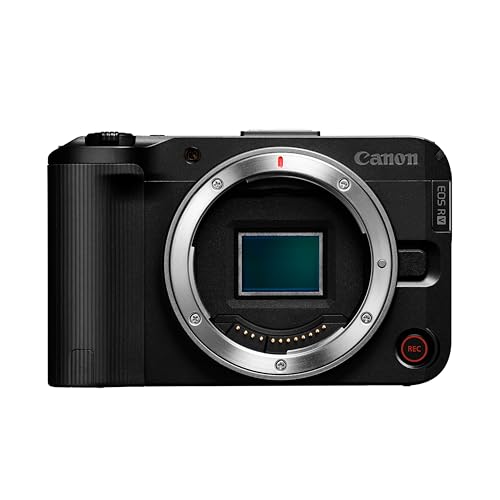
Canon EOS R50 V (body) — Best for creators
Canon’s R50 V takes the well-liked R50 and re-aims it at the camera-on-a-tripod-facing-a-person market, and the changes are more than cosmetic. There is no viewfinder, because its owner composes on the articulating screen; there is a dedicated video control layout, a tally lamp, livestreaming features that treat a USB connection to a computer as a first-class route, and vertical-video support for the formats its audience publishes. The sensor is the family’s 24.2-megapixel unit with Dual Pixel CMOS AF II, and the 4K video is oversampled in the quality mode, with higher frame rates available for slow motion.
As a stills camera it remains a competent Canon, sharing the RF-S lens mount and the friendly menus, though photographers will feel the missing finder and the simplified stills controls more than creators will. The body-only listing suits its audience, who typically pair it with one wide lens for a desk setup or the compact RF-S zooms for carrying. Heat manners are those of a small body: ordinary filming is untroubled, marathon streaming should be tested in your room and your settings before a launch depends on it.
Buy it when the camera’s main job is facing you: teaching, streaming, reviewing, demonstrating. It is the most honest tool here for that work, designed rather than adapted, and its stills are a bonus rather than a pretence. Photographers who want a compact Canon for pictures first should take the R10 kit below and accept the larger outfit as the price of the finder and the controls.
Its design details repay the intended user specifically. A proper microphone input and clean HDMI behaviour for capture cards, a record button where a presenter’s hand expects it, product-showcase style focus behaviour inherited from Canon’s creator line, and menus that assume filming rather than apologising for it. Canon also kept the price of entry honest by sharing the RF-S mount, so the lens bought for the desk today fits the photographer’s Canon bought tomorrow. As a first camera for a channel, a classroom or a small business’s video presence, it is the most purpose-fit compact here.
- Sensor: 24.2MP APS-C CMOS
- Video: 4K oversampled quality mode; livestream via USB
- Viewfinder: none
- Autofocus: Dual Pixel CMOS AF II with subject detection
- Controls: video-oriented layout, tally lamp, vertical video support
- Listing: body only
Strengths
- Purpose-built for facing-the-camera work, streaming included.
- Canon’s focusing and colour flatter presenters automatically.
- Compact enough to live permanently on a desk setup.
Trade-offs
- No viewfinder and simplified stills controls limit photography-first use.
- Small-body heat manners need a personal test for marathon sessions.
- Body-only listing means the lens budget is a second decision.
Best for: streamers, tutors and reviewers whose camera points at them all day.
Not suited for: photographers who compose through a finder as a matter of identity.

OM System OM-5 Mark II (body) — Best weather-sealed compact
The OM-5 Mark II is the compact for weather, and it carries the paperwork: an IP53 rating for dust and splash resistance, the only formal ingress rating in this guide, on a Four Thirds body whose small sensor is precisely what makes its lenses so carryable. A fast zoom for this system can weigh half its APS-C equivalent, which is why the OM-5’s natural habitat is the trail, the coast path and the festival field rather than the studio. Its 20.4-megapixel sensor is the modest count here, and its files are nonetheless sharp, colourful and stabilised by a five-axis system that OM System has refined for longer than most rivals have offered one.
The computational toolkit is the brand’s signature: Live ND that simulates neutral-density filters for silky water in daylight, handheld high-resolution mode that stacks frames into larger files, live composite for star trails and light painting, and focus tools that macro shooters swear by. Video is 4K with log options, competent rather than headline. The body’s debits are the small sensor’s low-light ceiling, a step behind the APS-C bodies at high ISO, a viewfinder and screen that are good rather than grand, and a menu system that rewards the owner who customises it once and thoroughly.
Buy it when compact means carried outdoors in real weather for real miles. Paired with OM’s small sealed primes and zooms it forms the lightest weatherproof system in this guide, and for hikers, travellers and macro enthusiasts that system property outranks every sensor argument the bigger bodies can make.
Macro and nature close-ups are its second homeland. The Four Thirds sensor’s deeper depth of field at a given framing, the focus bracketing and stacking tools, and lenses that focus close without accessories make it the compact most likely to be found photographing fungi, frost and insects at dawn. That specialism, plus the sealing, explains the loyalty the OM line commands out of proportion to its market size: its owners are not waiting for a better camera, because for their subjects this already is the considered answer.
- Sensor: 20.4MP Four Thirds
- Sealing: IP53 dust and splash resistance
- Stabilisation: 5-axis in-body
- Computational: Live ND, handheld high-res, live composite
- Video: 4K with log profile options
- Listing: body only
Strengths
- Formal weather rating and tiny sealed lenses for outdoor carry.
- Computational features that replace filters and tripods.
- Stabilisation expertise shows in handheld video and stills.
Trade-offs
- Smaller sensor trails APS-C at high ISO in the dark.
- Menus reward setup effort more than rivals do.
- Its video toolkit trails the hybrid-focused bodies in this line-up.
Best for: outdoor travellers and hikers who need sealing and small glass.
Not suited for: night-event shooters who live at the highest ISOs.

Nikon Z50 II two-lens kit — Best kit value
This listing answers the compact question with completeness: a Z50 II body and two DX zooms, the retractable 16-50mm that makes the outfit pocketable and the 50-250mm telephoto that turns it toward wildlife, sport and distant detail. The body is the modern Nikon of this guide’s entry article, with EXPEED 7 subject-detection autofocus, a bright viewfinder, an articulating screen and colour presets, here valued as a photographer’s compact rather than a beginner’s first camera, because in this company its handling and focusing are near the top of the class.
The kit logic deserves respect. Most compact outfits fail at the long end: the small standard zoom runs out of reach at the zoo, the match, the far shore. Nikon’s pairing covers wide to telephoto with two lenses that are stabilised, light and designed for the sensor, and the whole outfit still carries like a compact system should. The debits are those of any two-lens answer, changing lenses in the field, a bag that must hold the second lens, and the DX catalogue’s relative thinness if the owner later wants exotic glass. Video is strong, 4K60 with a crop at the top rate, and the body’s lack of in-body stabilisation is covered by the lenses’ own systems for most work.
Buy it when compact means a complete photographer’s kit rather than a minimal one: the family documentarian, the travelling enthusiast, the birder starting out. It is the listing here that needs nothing added on day one except a card and a bag, and that completeness is its own form of value.
Consider the arithmetic of the alternative: a body-only compact plus two separately chosen lenses usually costs more, arrives in three decisions, and risks one lens being out of stock or ill-matched. Nikon’s kit compresses that into a single purchase whose components were designed together, with the retractable standard zoom keeping the whole outfit honest to the compact idea. For a gift buyer, a parent equipping a keen teenager, or an adult returning to photography after the phone years, the absence of a second decision is worth real money, and the camera at the kit’s centre is good enough to end the search for years.
- Sensor: 20.9MP APS-C (DX) CMOS
- Kit lenses: Z DX 16-50mm and Z DX 50-250mm, both stabilised
- Autofocus: EXPEED 7 subject detection
- Video: 4K up to 60p (cropped at 60p)
- Screen: fully articulating touchscreen
- Stabilisation: lens-based
Strengths
- Wide-to-telephoto coverage in one box, nothing else to buy.
- The best viewfinder-and-grip combination among the compacts.
- Modern subject detection serves sport and wildlife attempts.
Trade-offs
- Two lenses mean changes in the field and a bigger bag.
- No in-body stabilisation for unstabilised primes later.
- DX lens shelf remains the slimmest for future exotica.
Best for: travelling photographers who want range without a second purchase.
Not suited for: one-lens minimalists who refuse to swap glass on a pavement.

Canon EOS R10 with 18-150mm kit — Best one-lens travel kit
The R10 kit takes the opposite bet from Nikon’s: one lens, the RF-S 18-150mm, whose range runs from wide-angle to a telephoto long enough for wildlife park and harbour detail, mounted on the most photographically serious small Canon here. The body brings a 24.2-megapixel sensor, DIGIC X processing, subject-detection autofocus and burst rates up to 15 frames per second mechanical and 23 electronic, figures that belong to sports cameras of the recent past. For travel, the proposition is simple: nothing to change, nothing to leave at the hotel, and a camera fast enough for the unexpected.
Superzoom compromises are real and should be stated: the 18-150mm is dim at its long end, so dusk telephoto work pushes ISO, and its sharpness, while good, is not a prime’s. The body has no in-body stabilisation, relying on the lens’s system, and a single card slot and modest buffer mark its tier. Against that, the outfit’s total weight and simplicity are the entire argument, and Canon’s colour and focusing make it the compact most likely to be lent to a family member and returned with good pictures.
Buy it for the trip where the camera must justify its space daily against a phone: it does so with reach the phone cannot match and speed the phone cannot approach. Owners who later add Canon’s compact primes will find the body entirely worthy of them, which makes this kit the quiet growth path in a guide full of louder ones.
There is a family argument for it too. The R10 is the compact here most comfortable being shared: a proper grip and finder for the enthusiast parent, friendly automatic modes and Canon’s colour for whoever picks it up, and enough speed for the school sports day that defeats lesser compacts. Households that buy one camera rather than one per person should weight that shareability heavily, and the 18-150mm’s range means the shared camera is never wearing the wrong lens when it changes hands at the crucial moment.
- Sensor: 24.2MP APS-C CMOS with DIGIC X
- Kit lens: RF-S 18-150mm F3.5-6.3 IS STM, stabilised
- Burst: 15 fps mechanical, 23 fps electronic
- Autofocus: subject detection for people, animals, vehicles
- Video: 4K up to 60p (cropped at top rates)
- Stabilisation: lens-based only
Strengths
- One-lens range that covers a whole holiday without a swap.
- Burst speed and focusing borrowed from serious sports bodies.
- Light total outfit with a proper viewfinder and grip.
Trade-offs
- Superzoom aperture pushes ISO at the long end after dusk.
- No in-body stabilisation and a single card slot mark the tier.
- Prime-lens sharpness awaits a second purchase.
Best for: travellers who want reach and speed with zero lens changes.
Not suited for: low-light telephoto specialists, who need faster glass than any superzoom.
Small Bodies, Honest Trade-Offs: The Compact Six Measure Up
| Camera | Sensor | Viewfinder | In-body stabilisation | Sold as | Defining idea |
|---|---|---|---|---|---|
| Sony a6700 | 26MP APS-C | Yes | Yes | Body only | Flagship capability, compact shell |
| Fujifilm X-M5 | 26.1MP APS-C | No | No | Body only | Smallest body, film colour, creator video |
| Canon EOS R50 V | 24.2MP APS-C | No | No | Body only | Streaming and presenting tool |
| OM System OM-5 Mark II | 20.4MP Four Thirds | Yes | Yes | Body only | IP53 sealing, tiny lenses |
| Nikon Z50 II kit | 20.9MP APS-C | Yes | No (lens IS) | Two-lens kit | Complete photographer’s outfit |
| Canon EOS R10 kit | 24.2MP APS-C | Yes | No (lens IS) | One-lens kit | Reach and speed, no swaps |
Two columns do the deciding for most readers. If the viewfinder column says no and that fact bothers you even slightly, believe yourself and strike those rows. If the sold-as column matters because a lens decision feels like homework, the two kits are your shortlist and the argument between them is range-by-two-lenses against range-by-one.
Notice, too, what the table cannot show: colour character, menu temperament and the sound a shutter makes are real properties of a daily camera, and they are why handling a body, or at least reading owners rather than only reviewers, belongs in a compact purchase. The six here were chosen partly because their owners’ long-term reports are affectionate, which is a statistic no laboratory publishes and few daily tools survive without earning.
APS-C or Four Thirds: Which Small Sensor Serves You Better?
Five of these bodies use APS-C sensors and one, the OM-5 Mark II, uses the smaller Four Thirds format, and the difference is a genuine fork rather than a ranking. APS-C gathers roughly a stop more light, which shows in cleaner high-ISO files and shallower depth of field from the same aperture, and its lenses, while small, are sized for that sensor. Four Thirds gives the light back and takes size in exchange: its lenses can be dramatically smaller for the same reach, its depth of field is deeper at the same settings, which macro and landscape shooters often prefer, and its telephoto reach per gram is the best in this guide.
The deciding evidence is your subject list. Evenings, interiors, portraits with blurred backgrounds: APS-C. Miles, weather, macro, birds at a distance on a budget of grams: Four Thirds has been the connoisseur’s answer for two decades for a reason. Both formats print superbly at sane sizes, both have mature lens catalogues, and the photographers who regret the choice are almost always those who bought the sensor for its reputation rather than for their subjects.
Why Carry a Compact Camera When the Phone Is Already There?
The question deserves a straight answer rather than a defensive one, because for snapshots in good light the phone wins on convenience and often on immediate shareability. The compact system camera earns its space in the three places the phone cannot follow: optical reach, where a real telephoto resolves the far subject instead of cropping toward it; low light with control, where a fast lens and a large sensor produce a photograph rather than a computational impression of one; and deliberate work, where a viewfinder, dials and a lens chosen for the subject change the photographer’s behaviour and therefore the photographs.
There is also the archive argument. Files from these bodies, raw or carefully made JPEG, print large, edit deep and survive software fashions, while phone images are increasingly processed artefacts whose look is decided by an algorithm’s current taste. Families who print albums and photographers who exhibit both notice the difference at exactly the moments that matter most. The compact is not a rejection of the phone; it is the admission that some photographs deserve a dedicated instrument, carried precisely because it is dedicated.
How Do You Make a Small Camera Fit a Real Hand?
The compact class’s open secret is that ergonomics, not electronics, decide long-term satisfaction, because a camera held for six hours teaches its owner whether it was shaped by someone who holds cameras. The kits’ bodies, the Z50 II and R10, carry proper grips and feel like scaled-down enthusiast cameras. The a6700’s grip is competent and improves with the small extension grips Sony’s ecosystem offers. The X-M5 and R50 V assume two-handed, screen-first handling and short sessions, and the OM-5 sits between, small but deliberately shaped.
The remedies are cheap and worth budgeting: a thumb rest for the flat bodies, a wrist strap that lets the camera dangle safely, a half-case that adds the grip the maker omitted, and for the video bodies a small cage that restores the mounting points and handle the size removed. None of these is an admission of failure; they are the compact owner’s equivalent of choosing a strap for a big camera. What cannot be remedied is a viewfinder that does not exist or a grip that fights a long lens, which is why those two facts headline the relevant reviews.
Which Compact Suits Which Kind of Day Out?
The city day, museums, markets, cafés and the walk between them, belongs to the X-M5 with a small prime and to the a6700 when the evening will end in low light and high ISOs. Both disappear into a small bag, both produce files with a finished look, and the choice between them is the viewfinder question wearing a scarf. The family day, zoo, match, birthday, belongs to the kits: the Z50 II’s two lenses when range must be complete, the R10’s single zoom when the day is chaotic and lens changes are a fantasy.
The wet day belongs to the OM-5 Mark II without a contest in this guide, because it is the one body whose sealing is a rated promise, and its lenses keep the promise affordable. The working day, the desk, the studio corner, the classroom, belongs to the R50 V, which is barely a travel camera at all and should be judged as furniture for a creator’s workflow. Naming your most common day out is the fastest honest shortcut in this entire article, faster than any specification comparison, and it has the further virtue of being a question about your life rather than about a manufacturer’s brochure.
How Should You Pair a Compact Body With Its First Lens?
The classic compact outfit is a fast prime near the sensor’s natural standard view: it keeps the outfit small, opens wide for interiors and evenings, and teaches framing with the feet. Every system here offers one affordably, and Fujifilm’s and Sony’s shelves are particularly deep in small primes that suit these bodies. The alternative classic is the small standard zoom, less romantic, more practical for travel where scenes cannot be approached, and the two Canon and Nikon kits embody the two versions of that practicality.
Resist the long telephoto as a first lens, however tempting the specification. On compact bodies, long glass unbalances the outfit, gets left behind, and teaches the owner that the camera is a burden, the exact lesson this class exists to un-teach. Buy reach second, from evidence: if your files keep cropping the far shore, the telephoto has earned its place in the bag, and the Z50 II’s kit simply pre-empts that discovery for buyers who already know.
What Mistakes Do Compact-Camera Buyers Repeat?
The first is comparing body weights and ignoring outfits. A compact body with a heavy zoom is a heavy camera, and the honest comparison is the working combination on a strap at hour four. The second is buying a viewfinder-free body while privately preferring a viewfinder, a mismatch no specification can repair, which is why the X-M5 and R50 V reviews state their omission in the first paragraph rather than the last. The third is assuming compact means casual about cards and batteries: smaller batteries and single slots are the class norm, so spares and a download routine matter more, not less.
The fourth mistake is category confusion at the search box itself, the confusion this article opened with: ordering a fixed-lens compact when a system body was wanted, or the reverse, because the word compact describes both. Check for a lens mount in the description, check whether the lens in the photograph is the lens forever, and the category error disappears. The fifth is neglecting the strap and the case; a compact camera’s whole value is presence, and presence is protected by carrying comfort, which is a ten-minute decision owners postpone for a year.
A sixth deserves its own paragraph because it wastes real money: buying the compact body and then mounting the large, fast zoom bought for a different camera, and concluding the compact idea failed. The outfit failed, not the idea. Compact bodies have compact lenses designed for them in every mount here, and the discipline of pairing like with like is what keeps the class’s promise. Judge any compact by its intended outfit, and lend your big glass to your big body.
How Do You Carry and Set Up a Compact for Daily Use?
Set the camera so it wakes fast and shoots faster: a sensible default of aperture priority, auto ISO with a floor shutter speed matched to your lens, face or eye autofocus for people and a single point for things, and the screen’s brightness honest rather than flattering. Assign the one custom button your system allows to the setting you change most, and then leave the menus alone for a month; compact cameras reward muscle memory more than configuration tourism.
Carry is the other half of the setup. A wrist strap for the smallest outfits, a cross-body sling for kit outfits, and a pouch that fits the camera with its working lens mounted, because a camera that must be assembled is a camera that stays home. Keep the spare battery in the same place every day, download on the day rather than the month, and let the compact be what it is: the camera that is there, whose files, accumulated daily, will out-value the masterpiece the big camera was saving itself for.
Add one protective habit to the routine: because these cameras live in jacket pockets and tote bags rather than padded cases, the lens cap and a soft pouch are not optional courtesies, and a UV or clear protective filter on the working lens is the cheapest insurance in the outfit. Check the sensor at lens changes in windy or dusty places, change lenses body-down and quickly, and the small camera’s openness to the world stops being its vulnerability. Compacts die of neglect in bags far more often than of defects.
Is a Compact Body a Sensible Second Camera for a Professional?
It is one of the class’s most satisfied use cases, and it explains the a6700’s and OM-5’s followings. A professional’s compact shares the working system’s lenses, batteries where possible, colour and menus, and covers the personal work, the location scout and the holiday without risking the main kit or its insurance excess. The requirement is mount loyalty: the compact must belong to the same system as the working bodies, or its lenses become a second collection and its files a second colour pipeline.
For everyone else the same logic inverts into a warning. A compact bought as a toe in a system’s water is a commitment to that system’s lenses, and the six mounts represented here differ in lens prices and depth as much as the bodies differ in size. The compact is small; the decision is not. Read the body reviews as system proposals, price the prime and the zoom you would add within two years, and the right small camera usually survives the arithmetic with its charm intact.
How Does Video Separate These Small Bodies?
All six film respectably; they diverge in intent. The a6700 is the hybrid’s compact, with 4K120, 10-bit colour and log tools that belong to a production workflow. The X-M5 is the social creator’s, with its 6.2K headline, vertical modes and short-clip features designed around phones as the destination. The R50 V is the presenter’s, optimised for one person, one desk, long conversations and streams. The Z50 II and R10 are photographers’ cameras that film very well, the order of priorities reversed, and the OM-5 Mark II is the outdoors camera whose video is a capable extra rather than the plot.
The deciding questions are therefore practical. Will the footage be graded, or published as shot? Filmed in clips, or in hours? By a person in front of the camera, or behind it? Each answer promotes a different body in this guide, and none of the answers is about resolution, because at 4K every one of these cameras resolves more than its owner’s audience will ever see. Buy the workflow, not the number.
Audio follows the same logic. The creator bodies assume external microphones and provide the inputs and shoe arrangements for them, while the stills-led compacts treat sound as the video’s supporting act. A compact bought for filming people talking should be auditioned with its intended microphone in its intended room before the first real recording, because in video the microphone is half the camera and in this class the halves are sold separately.
Final Recommendation
Take the Sony a6700 if you want the compact with the longest capability list and the battery to match; take the Fujifilm X-M5 if smallness and colour are the point and screens are your native language; take the Canon R50 V when the camera works facing you. Outdoors, the OM-5 Mark II’s sealing and tiny lenses make it the traveller’s instrument, while the two kits settle the completeness question in opposite ways, Nikon’s two lenses for the photographer, Canon’s one lens for the traveller. One last consideration cuts across all six: buy the compact you will carry on the ordinary Tuesday, not the one that impresses on the exceptional Saturday, because a life is mostly Tuesdays and so is a photo archive. Measure the outfit, not the body, respect the viewfinder question, and the compact you choose will be the camera your phone finally cannot replace.
Frequently Asked Questions
What is the difference between these and fixed-lens compact cameras?
These are system cameras: their lenses detach, and each body is an entry into a mount’s whole catalogue of primes, zooms and accessories. A fixed-lens compact, such as the premium pocket models, keeps one lens forever and trades that growth for absolute simplicity and, in the best cases, a larger sensor in a smaller body. Neither is superior; they are different purchases, and this guide covers the system kind only, as its opening states.
Is APS-C image quality enough, or will I want full frame soon?
For travel, family, street and most enthusiast work, these sensors are more than enough, and their smaller lenses are the reason the outfits stay compact. Full frame tempts when low-light work deepens, when shallow depth of field becomes a style, or when professional deliverables enter the picture. Many owners run both: a compact APS-C outfit for daily carry and a full-frame body for deliberate work, which is a healthier end-state than one large camera left at home.
Why do two of these cameras have no viewfinder?
Because their intended owners compose on screens: creators filming themselves, and the screen-native generation Fujifilm aimed the X-M5 at. Removing the finder saves size, cost and weight. It is a legitimate design choice with a clear consequence, which is that photographers who frame through a finder, especially in bright sun, should choose from the other four and not attempt to adapt.
Which compact is best for travel photography?
The R10 with its 18-150mm for the traveller who wants one lens and no decisions, the OM-5 Mark II for the traveller whose weather is unreliable, and the Z50 II kit for the traveller who packs a small bag but thinks like a photographer. The a6700 with a compact prime is the connoisseur’s answer. All four judgements assume the camera is carried daily; a travel camera left in the hotel safe has no image quality at all.
Do compact bodies overheat when filming?
Small bodies shed heat slowly, so the highest video modes in warm conditions can be time-limited on some models, while ordinary 4K filming is generally untroubled. The a6700 and X-M5 offer ambitious video for their size; owners planning long continuous takes should test their exact settings in their own climate, and creators recording whole events should consider whether a larger body or the streaming-oriented R50 V’s workflow suits the job better.
How long do these small batteries actually last?
Long enough for a day of stills on the a6700’s large pack, and a half to a full day on the smaller bodies, with video, screen brightness and cold weather all shortening the figure. The class habit is a spare in the pocket rather than anxiety about the gauge; batteries for these bodies are small and relatively inexpensive, and a two-battery rotation is the compact owner’s version of the professional’s charging case.
Can a compact body handle a big telephoto for wildlife?
Mechanically yes, since the mounts are the full systems’ mounts, and the focusing on the Sony, Nikon and R10 is up to the task. Ergonomically the outfit becomes lens-with-a-camera-attached, best used on a monopod or with the lens’s own tripod foot carrying the weight. Occasional wildlife is fine on any of these; a wildlife specialism deserves a bigger grip, which is a body decision rather than a sensor one.
Are compact bodies durable enough for daily carry?
Yes, with the pouch-and-cap discipline the setup section describes. These are consumer and enthusiast bodies rather than professional tanks, and their shutters, mounts and dials are rated for years of ordinary use; what daily carry adds is cosmetic wear and the occasional knock, which a half-case absorbs gracefully. The OM-5 Mark II is the pick when durability must include weather, and the magnesium touches on several rivals are reassurance rather than necessity for the lives these cameras lead.
What lens should I add first to a body-only compact?
A fast prime near the standard focal length for your sensor, unless your photographs already argue otherwise. It completes the compact idea, small, light, bright, and it teaches more per dollar than any other purchase in photography. Zoom owners should add the prime second for evenings; prime owners should add reach second only when their files keep asking for it.
Related Guides
Shoppers who started here but suspect they need a first camera rather than a small one should read our entry-level mirrorless recommendations for new photographers, while those who like the OM-5’s weather argument can follow it into the mirrorless cameras we would actually carry up a mountain, and brand loyalists will find Fujifilm’s mirrorless line compared body by body useful after meeting the X-M5.


