What's inside
- Where to Buy, and Why Autofocus Decides Which Camera You Keep
- Key Takeaways
- Quick Picks
- How Did We Judge Autofocus Across Five Systems?
- Which Camera Focuses Fastest When It Matters?
- How Do the Best Autofocus Mirrorless Cameras Stack Up as Focus Systems?
- What Do Phase Detection, Contrast Detection and AI Recognition Actually Mean?
- How Do You Set Up Autofocus for Portraits, Sports and Video?
- Which Autofocus Mistakes Cost Beginners the Most Photographs?
- How Much Does the Lens Matter to Autofocus?
- Final Recommendation
- What Should Wildlife and Sports Shooters Honestly Expect at This Level?
- How Do You Test a Camera’s Autofocus Before You Commit?
- How Does Focus Breathing and Video Polish Separate These Cameras?
- Which System Are You Really Buying Into?
- How Do You Care for an Autofocus System So It Stays Fast?
- Frequently Asked Questions
- Related Guides
As an Amazon Associate I earn from qualifying purchases. This post may contain affiliate links at no extra cost to you.
gizmoverdict.com is reader-supported. When you buy through links on our site, we may earn an affiliate commission.
Where to Buy, and Why Autofocus Decides Which Camera You Keep
The best autofocus mirrorless cameras are not necessarily the ones with the most megapixels or the prettiest retro dials. They are the ones that find a face in bad light, hold it while the subject moves, and let you think about the photograph instead of the focusing. Autofocus used to be a specification you compared in tables; in the mirrorless era it has become the personality of the camera, the difference between a body that collaborates with you and one you are constantly supervising.
This guide compares six APS-C and Micro Four Thirds cameras from five different systems, and the honest headline is that their autofocus philosophies differ as much as their sensors. Sony builds its reputation on relentless subject tracking with dedicated processing for recognising eyes. Canon’s Dual Pixel system made focus so undramatic that beginners forget it exists. Fujifilm leans on film-era charm backed by competent face and eye detection. Nikon aims its Z30 squarely at people filming themselves. Panasonic’s contrast-based system in the G100 is the elder technology here, and we will be candid about where that shows.
All six are sold through Amazon and camera retailers as body or kit configurations, several as the bundles and renewed-adjacent listings common in this market, and all six sit in the APS-C or Micro Four Thirds classes where autofocus development currently moves fastest and costs least to enter. We judge them on autofocus behaviour in the situations photographers actually meet — children who will not sit still, dogs at the park, a speaker pacing a stage, your own face on a tripod — rather than on laboratory charts, because that is where the differences between these systems stop being marketing and start being photographs kept or missed.
Key Takeaways
- Sony’s a6700 has the most advanced autofocus here, with a dedicated AI processing unit recognising people, animals, birds and vehicles.
- The a6400 remains the tracking bargain: real-time Eye AF and tenacious subject lock from an older, cheaper body.
- Canon’s EOS R50 pairs Dual Pixel CMOS AF II with the friendliest handling for photographers upgrading from a phone.
- Fujifilm’s X-T30 II brings dependable face and eye detection to the most tactile, dial-driven body in the group.
- Nikon’s Z30 is tuned for self-filming creators, with eye-detection autofocus that minds your face while you talk.
- Panasonic’s Lumix G100 uses contrast-based DFD autofocus — fine for deliberate work and vlogging, weakest here for fast action.
Quick Picks
| Camera | Award | The case for it |
|---|---|---|
| Sony a6700 | Best Autofocus Overall | AI-driven subject recognition and sticky tracking make missed focus feel like a choice, not an accident. |
| Sony a6400 with 16-50mm | Best Value Tracking | Real-time Eye AF and rapid acquisition in a compact kit that undercuts newer bodies. |
| Canon EOS R50 with RF-S 18-45mm | Best for Beginners | Dual Pixel autofocus that simply works, wrapped in the most approachable controls here. |
| Fujifilm X-T30 II with XC 15-45mm | Best for Stills Photographers | Confident face and eye detection inside a small, dial-led body that rewards deliberate shooting. |
| Nikon Z30 with 16-50mm | Best for Video Creators | Eye-detection autofocus and creator-first design for people whose main subject is themselves. |
| Panasonic Lumix G100 | Best Compact Vlogging Kit | A tiny Micro Four Thirds kit with tracking audio, whose contrast AF suits calm subjects best. |
How Did We Judge Autofocus Across Five Systems?
We broke autofocus into the four behaviours photographers actually depend on. Acquisition: how quickly the camera finds a subject when you raise it, because the moment is usually already happening. Tracking: whether it stays with that subject across the frame and through partial obstruction, because children, athletes and wildlife do not move in straight lines toward the camera. Eye detection: whether it finds and holds the eye — human or animal — since a portrait with the eyelashes sharp and the eye soft is a near-miss that feels worse than honest blur. And video behaviour: whether focus transitions look like decisions rather than hunting, because viewers forgive many things before they forgive a face pulsing in and out of clarity.
We were equally careful about what we did not claim. Autofocus performance varies with the lens mounted, the light available and the firmware installed, and every system here has improved through updates since launch. Where a camera’s reputation rests on a specific, verifiable mechanism — Sony’s AI processing unit, Canon’s Dual Pixel architecture, Panasonic’s depth-from-defocus contrast system — we describe the mechanism and its practical consequence rather than inventing point counts or millisecond figures. A guide that exaggerates autofocus teaches you to distrust the photographs you take with it.
We also read the manufacturers’ own claims with a sceptic’s pencil. Subject-detection categories are real only when the camera demonstrably acts on them, focus-point totals are coverage rather than intelligence, and phrases like “AI-powered” describe everything and nothing until a subject turns away from the lens and the camera either follows or does not. The assessments below rest on the mechanisms each system verifiably uses and the behaviour those mechanisms predict, checked against the accumulated experience of the photographers who shoot these bodies daily.
Finally, we weighted the whole camera around the autofocus. A brilliant tracking system in a body with poor battery life, a dim viewfinder or a lens catalogue you cannot afford to enter is a compromised recommendation. The six below balance focus performance against handling, lens ecosystems and the kind of photography each system quietly encourages, so that the autofocus verdict arrives in the context where you will actually use it.
Which Camera Focuses Fastest When It Matters?

Sony a6700 — Best Autofocus Overall
The a6700 is where Sony’s autofocus story becomes slightly unfair to everyone else. It pairs a 26-megapixel back-illuminated APS-C sensor with a dedicated AI processing unit whose entire job is recognising subjects — not merely faces, but the posture and structure of people, the shapes of animals and birds, and the forms of cars, trains and planes. In practice the camera does not just find an eye; it anticipates where the eye will be when a head turns, and it keeps a subject registered through the moments that break lesser systems, when a footballer spins away from camera or a dog darts behind a tree and emerges still locked.
For stills photographers the consequence is a higher keeper rate in exactly the genres where keepers are scarce: wildlife at the edge of a wood, youth sports under indifferent floodlights, street scenes that assemble and dissolve in seconds. For video, the same recognition steadies focus on moving presenters and products, and the body adds the modern creator toolkit — 4K recording, log profiles with LUT handling — without surrendering its stills pedigree. The tracking settings reward ten minutes of learning: choose the subject category honestly rather than leaving the camera to guess, and the system’s confidence becomes almost boring in its reliability.
The reservations are ergonomic rather than optical. The body is compact to a fault for large hands, the viewfinder is good rather than grand, and Sony’s menu depth still asks new owners to build a custom button layout before the camera feels like theirs. None of that changes the verdict for this guide’s question. If autofocus performance is the reason you are buying — if your subjects move, erratically and in poor light — the a6700 is the most capable focusing instrument in this group and the one against which the others are measured.
- Sensor: 26MP APS-C, back-illuminated
- Autofocus: AI processing unit, subject recognition for people, animals, birds, vehicles
- Video: 4K with log shooting and LUT support
- Mount: Sony E, the deepest APS-C lens catalogue here
- Form: compact body, sold as body-only in this listing
Strengths
- Subject recognition that holds focus through turns and obstructions
- Equally convincing for stills tracking and video work
- Access to Sony’s extensive E-mount lens range
Trade-offs
- Small body and modest viewfinder for the price class
- Menus and customisation demand an evening of setup
- Body-only listing means budgeting for a lens immediately
Best for: Wildlife, sports and family photographers whose subjects never cooperate, plus hybrid shooters. Not suited for: Buyers who want the simplest possible first camera, or very large hands seeking a chunky grip.

Sony a6400 with 16-50mm — Best Value Tracking
The a6400 is the proof that autofocus excellence ages slowly. Launched as the camera that brought Sony’s real-time Eye AF and real-time tracking down from the flagship tier, it still acquires a face and holds it with a tenacity that embarrasses newer rivals at higher prices. Point it at a child crossing a playground and the focus box does the thing owners describe with the same phrase again and again: it just sticks. Human eye detection is fast and confident, animal eye AF arrived by firmware for the pet photographers, and the tracking initiation — half-press on your subject and let the camera take over — remains one of the most intuitive implementations anywhere.
This listing pairs the body with the compact 16-50mm power-zoom kit lens, a combination that slips into a jacket pocket and covers the everyday range from group shots to portraits. The 24-megapixel sensor is a known quantity with pleasing colour, the flip-up screen serves vloggers who film themselves, and 4K video is present for creators whose ambitions are growing. As a system entry it is genuinely strategic: every lens you later buy for this body also fits the a6700 above it, so the a6400 can be a first step into the same ecosystem rather than a detour from it.
Its age shows in the margins rather than the middle. There is no in-body stabilisation, so handheld video leans on the lens and your technique; the battery is the smaller older unit, so a spare is a wise purchase; and the touchscreen’s role in the menus is limited in a way that feels dated. But judged on the question this guide asks — how well does it focus, especially on eyes, especially on moving people — the a6400 remains a remarkable amount of autofocus for the money, and the easiest recommendation here for families and travellers.
- Sensor: 24.2MP APS-C
- Autofocus: real-time Eye AF and real-time subject tracking
- Kit lens: 16-50mm power zoom included in this listing
- Video: 4K recording, flip-up selfie screen
- Stabilisation: none in body — lens-based
Strengths
- Eye AF and tracking that still embarrass newer cameras
- Compact kit that genuinely travels in a coat pocket
- Shares the E-mount upgrade path with the a6700
Trade-offs
- No in-body stabilisation for handheld video
- Smaller battery — plan on carrying a spare
- Menu and touchscreen behaviour show the body’s age
Best for: Families, travellers and first-time mirrorless buyers who want tracking they can trust immediately. Not suited for: Video specialists needing in-body stabilisation, or anyone who hates carrying spare batteries.

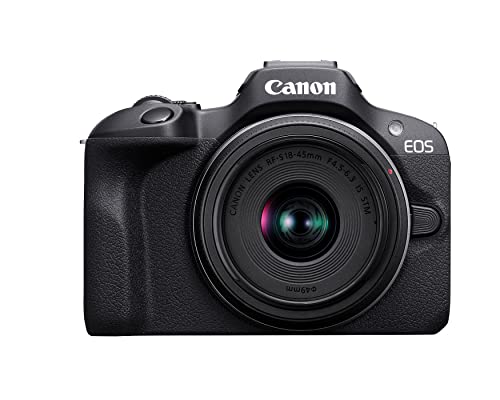
Canon EOS R50 with RF-S 18-45mm — Best for Beginners
Canon’s Dual Pixel CMOS AF II is the autofocus system for people who do not want to think about autofocus systems. Every pixel on the R50’s 24.2-megapixel sensor participates in phase detection, which gives the camera a calm, decisive quality: tap the screen or let it choose, and focus lands where the subject is, then follows people, animals and vehicles with subject detection that sorts out heads, eyes and bodies in the right order. There is very little of the nervous hunting that teaches beginners to distrust their equipment, and that absence is precisely the feature — the R50’s autofocus disappears into the act of photographing.
The body around it is designed with unusual empathy for the phone upgrader. The controls are approachable, the guided interfaces explain rather than intimidate, the vari-angle screen flips forward for self-recording, and 4K video covers the creator ambitions most beginners actually have. Canon’s colour science flatters skin tones straight out of camera, which matters to the R50’s audience more than raw-file latitude. In this kit the RF-S 18-45mm lens covers the learning range, and the RF mount behind it opens onto Canon’s growing catalogue when the hobby takes hold.
The honest limitations are about depth rather than competence. The RF-S lens range for APS-C is still the youngest here, so exotic glass is scarcer than in Sony’s or Fujifilm’s systems; the buffer for long action bursts is modest; and the camera’s subject detection, while excellent for people and animals, lacks the a6700’s breadth across trains, planes and insects. None of that should trouble the buyer this camera is for. If your priority is a first mirrorless camera whose autofocus simply refuses to be the problem, the R50 is the most reassuring purchase in this guide.
- Sensor: 24.2MP APS-C CMOS
- Autofocus: Dual Pixel CMOS AF II with people, animal and vehicle detection
- Kit lens: RF-S 18-45mm included in this listing
- Screen: vari-angle touchscreen, forward-facing for vlogging
- Video: 4K recording for creators
Strengths
- Focus that lands calmly and rarely hunts in good faith
- The friendliest controls and guidance for newcomers
- Pleasing colour for portraits straight from the camera
Trade-offs
- APS-C RF-S lens selection is still growing
- Modest buffer for sustained sports bursts
- Subject categories narrower than Sony’s AI system
Best for: Beginners, families and creators upgrading from a phone who want focus handled for them. Not suited for: Advanced action specialists who need deep buffers and exotic telephoto glass today.
Fujifilm X-T30 II with XC 15-45mm — Best for Stills Photographers
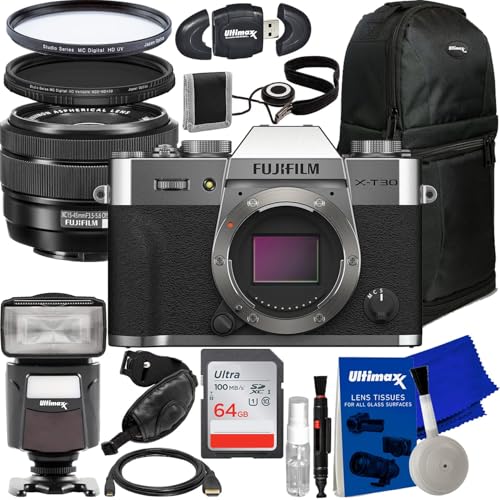
The X-T30 II is the contrarian’s entry in an autofocus guide: a camera whose appeal begins with dials you turn before you ever press the shutter, yet whose face and eye detection is quietly dependable when the moment arrives. Fujifilm’s system, driven by the X-Processor 4, recognises faces and eyes and holds them through the portrait session, the family gathering and the street scene, acquiring focus quickly in good light and staying composed as light falls. It does not chase Sony’s subject-recognition breadth — this is a camera that knows people, and knows them well — but within that brief it rarely embarrasses its owner.
What you are really buying is a way of photographing. The shutter-speed dial, the aperture rings on Fujifilm’s lenses, the film simulations that render colour with intent rather than neutrality — these make the X-T30 II the camera in this group most likely to be carried for pleasure, and a carried camera focuses on infinitely more subjects than a superior one left at home. The 26-megapixel X-Trans sensor produces stills with a character its owners defend passionately, and this listing bundles the XC 15-45mm lens with a starter kit of accessories, so the box opens onto a working outfit rather than a body awaiting purchases.
The caveats align with its stills-first soul. Video autofocus is serviceable rather than class-leading, the body has no in-body stabilisation, and the tracking of fast, erratic subjects — the dog at full sprint, the winger cutting inside — is a step behind the Sonys. Bundle accessories in listings like this vary in quality and should be treated as a bonus, not a reason. Buy the X-T30 II because you want photography to feel like photography and your subjects are people at human speeds; on that brief its autofocus is a trustworthy partner rather than a limitation.
- Sensor: 26.1MP APS-C X-Trans CMOS 4
- Autofocus: face and eye detection, fast phase-detection coverage
- Kit: XC 15-45mm lens plus bundle accessories in this listing
- Character: film simulations, tactile exposure dials
- Video: capable, but stills are the priority
Strengths
- Dependable people-focused AF in a joyful body
- Film simulations make autofocus results worth keeping
- Compact system with a beloved lens catalogue
Trade-offs
- Tracking of fast action trails the Sony pair
- No in-body stabilisation
- Bundle extras vary — judge the camera, not the box
Best for: Stills photographers who shoot people and places at human pace and love tactile controls. Not suited for: Serious sports or wildlife work, or video-first creators.

Nikon Z30 with 16-50mm — Best for Video Creators
The Z30 was designed backwards from a tripod facing its owner. Nikon removed the viewfinder entirely — a decision that startles stills photographers and delights vloggers — and spent the savings on the things self-filming creators actually use: a vari-angle screen you can monitor while you talk, eye-detection autofocus that keeps your face sharp as you lean toward the lens to make a point, and long 4K recording sessions without the overheating anxiety of earlier creator cameras. Its autofocus brief is narrower than the a6700’s and it fulfils it completely: find the person, hold the person, do not wander off to the bookshelf behind them.
In continuous autofocus for video, the Z30 behaves with the steadiness that talking-head work demands, transitioning focus smoothly when you hold a product up to the lens and returning to your eye when you lower it — the single most repeated focus manoeuvre in creator video, and the one audiences notice when it pulses or hunts. The kit’s collapsible 16-50mm lens keeps the whole outfit small enough for a desk arm or a travel tripod, and Nikon’s Z mount means the same body can grow into serious glass for stills, where its autofocus — with animal detection included — is competent and improving by firmware.
The missing viewfinder is a genuine fork in the road: photographers who compose at the eye will not convert, and the Z30 does not ask them to. It also lacks in-body stabilisation, so walking footage leans on the lens and your gimbal. But within its intended parish — creators whose subject is a person, usually themselves, at conversational distance — its eye-detection autofocus is among the most trustworthy here, and the camera’s whole design conspires to keep you creating rather than configuring.
- Sensor: 20.9MP APS-C (DX) CMOS
- Autofocus: eye-detection AF for people, animal detection included
- Design: no viewfinder; vari-angle screen for self-filming
- Kit lens: collapsible 16-50mm zoom in this listing
- Video: long 4K recording sessions for creators
Strengths
- Eye-detection that minds your face while you present
- Creator-first layout with a proper front-facing screen
- Compact kit that lives happily on a desk or travel tripod
Trade-offs
- No viewfinder rules it out for eye-level stills shooters
- No in-body stabilisation for walk-and-talk footage
- Subject recognition breadth is modest beside Sony’s
Best for: Vloggers, streamers and educators who film themselves and need focus they can forget. Not suited for: Viewfinder traditionalists or action stills photographers.

Panasonic Lumix G100 — Best Compact Vlogging Kit
The G100 requires the most honest paragraph in this guide, because its autofocus technology is fundamentally different from the other five. Panasonic’s Depth From Defocus system is contrast-based: it reads the image and infers focus from how blur changes, rather than measuring distance with phase-detection pixels on the sensor. For the work the G100 was built for — a vlogger at arm’s length, a product on a table, a calm scene composed deliberately — it focuses accurately and its face and eye detection does its job. Ask it to track a sprinter or a swooping bird and the system’s age shows in visible hunting that the phase-detection cameras here simply do not exhibit.
That candour delivered, the G100’s charms are real and specific. It is the smallest, lightest complete kit in this group, built on the Micro Four Thirds mount with the enormous, affordable lens catalogue that system has accumulated. Its party trick is audio: a built-in microphone array with tracking that follows the direction of the subject, designed for exactly the run-and-gun creator filming this camera courts. The 12-32mm kit lens collapses into near-nothing, the controls are simplified for newcomers, and the whole package asks very little money or bag space for a genuine interchangeable-lens camera.
Position it correctly and it is a delight; position it as a sports camera and it will disappoint you in ways this guide has now warned about twice. There is a real audience for exactly this trade — travellers who film themselves and their surroundings at walking pace, in good humour and decent light — and for them the G100’s simplicity is a feature that faster, heavier systems keep designing away. Slow autofocus in video by phase-detection standards, a cropped 4K mode and contrast-AF hesitation in low light are the boundaries. Inside them — travel vlogging, desk recording, family documentation at walking pace — the G100 is a likeable, capable tool whose autofocus is adequate for its subjects. It closes this list as the specialist in smallness, not in speed.
- Sensor: 20.3MP Micro Four Thirds
- Autofocus: contrast-based DFD with face/eye detection
- Audio: built-in directional microphone array with tracking
- Kit lens: collapsible 12-32mm in this listing
- System: Micro Four Thirds — vast, affordable lens range
Strengths
- Tiniest complete interchangeable-lens kit here
- Clever built-in audio tracking for solo creators
- Micro Four Thirds lenses keep the system cheap to grow
Trade-offs
- Contrast AF hunts on fast or erratic subjects
- Video focus transitions are the least confident here
- Smaller sensor gathers less light than the APS-C rivals
Best for: Travel vloggers and minimalists filming calm subjects who prize size and audio. Not suited for: Sports, wildlife or any subject whose defining trait is speed.
How Do the Best Autofocus Mirrorless Cameras Stack Up as Focus Systems?
| Camera | AF system | Eye detection | Subject recognition | Honest weakness |
|---|---|---|---|---|
| Sony a6700 | Phase detection + AI unit | People and animals, highly sticky | People, animals, birds, vehicles, more | Menus and small body |
| Sony a6400 | Phase detection, real-time tracking | People; animals via firmware | General subject tracking | No in-body stabilisation |
| Canon EOS R50 | Dual Pixel CMOS AF II | People and animals | People, animals, vehicles | Young APS-C lens range |
| Fujifilm X-T30 II | Phase detection, X-Processor 4 | Faces and eyes for people | Primarily people | Fast-action tracking depth |
| Nikon Z30 | Hybrid phase detection | People; animal detection | People and animals | No viewfinder for stills |
| Panasonic Lumix G100 | Contrast-based DFD | Faces and eyes, calm subjects | Basic face/subject detection | Hunts on fast motion |
What Do Phase Detection, Contrast Detection and AI Recognition Actually Mean?
The vocabulary matters because it predicts behaviour. Phase-detection autofocus measures distance directly: light reaching the sensor is compared across paired points, and the camera knows not just that the subject is out of focus but by how much and in which direction, so the lens drives straight to the answer. That is why the phase-detection cameras in this guide — both Sonys, the Canon, the Fujifilm and the Nikon — feel decisive, and why they track moving subjects by continuously predicting position. Canon’s Dual Pixel variant performs this measurement at essentially every pixel, which is the technical root of its calm, hunt-free character in video.
Contrast detection works by trial: the camera adjusts focus while watching the image’s contrast rise and fall, homing in on the peak. At the peak it is extremely accurate — there is no calibration error to forgive — but the search itself takes time and can visibly pulse, especially with moving subjects or in low light where contrast is scarce. Panasonic’s DFD technology accelerates the search by using the known blur signatures of its own lenses to estimate distance, which is why the G100 is quicker than primitive contrast systems yet still a step behind true phase detection when the subject will not sit still. Knowing which system a camera uses tells you more about its real behaviour than any focus-point count printed on the box.
AI subject recognition sits on top of either mechanism and answers a different question: not how to focus, but on what. Trained recognition models identify an eye, a head, a bird’s body or a racing car’s silhouette and instruct the autofocus where its priority lives, holding that instruction through turns and partial occlusions. Sony’s dedicated processing unit in the a6700 is the most developed implementation here; Canon and Nikon offer capable detection for the common categories; Fujifilm concentrates on people. The practical translation is simple — the broader and smarter the recognition, the less often you intervene, and the more your attention is free for composition, timing and light.
How Do You Set Up Autofocus for Portraits, Sports and Video?
For portraits, make the camera’s life easy and it will repay you. Select eye detection, use a continuous or servo focus mode even for still subjects — people sway, children especially — and choose a focus area that lets the camera find the face rather than demanding you place a single point on an eye at f/1.8. On the Sonys and Canon that means trusting the wide or zone area with subject detection engaged; on the Fujifilm, face/eye detection switched to the eye you prefer. Then check the near eye in playback at full magnification for your first few sessions, because learning your camera’s habits at home beats discovering them at a wedding.
For sports and wildlife, the recipe inverts: you choose the subject, the camera follows it. Start tracking with the subject under a small zone or grouped area — handing the camera a hint massively improves its confidence — then let continuous AF and subject recognition maintain the lock while you pan. Set tracking sensitivity to favour stickiness when other players or branches cross your subject, and responsiveness when you are switching between athletes. On the a6700, naming the correct subject category is the single highest-value setting; on every camera here, a fast lens matters as much as the body, because focus motors in the lens are half the system.
For video, smoothness outranks speed. Lower the focus transition speed so movements between subjects read as deliberate pulls rather than snaps, enable eye detection for any piece to camera, and rehearse the product-shot manoeuvre — raise the object, let focus settle on it, lower it, confirm focus returns to your face — before recording anything that matters. The Z30 and R50 are tuned kindly for exactly this; the G100 asks for slower, more deliberate movements, which is a workable style if you adopt it knowingly rather than discover it in the edit.
Which Autofocus Mistakes Cost Beginners the Most Photographs?
The costliest is leaving the camera in single-shot focus for moving subjects. One-shot mode locks focus at the half-press and serenely photographs where your child was; continuous mode exists precisely because subjects decline to freeze, and every camera here implements it well. The second is fighting the subject detection: placing a single focus point manually while eye AF is available is like steering a self-parking car — possible, slower and usually worse. Beginners often do it because the point feels like control, but the photograph does not care which method found the eye, only whether the eye is sharp.
Third, owners blame the body for the lens. Autofocus is a system of sensor, processor and focus motor, and a slow kit zoom in dim light will make any of these cameras feel hesitant; the same body on a bright prime becomes eager. Before concluding your camera focuses poorly, test it in good light on a static subject — if it snaps in confidently there, your problem is photons or glass, not electronics. Fourth, firmware neglect: every manufacturer here has materially improved autofocus behaviour through free updates, and cameras ship from warehouses with whatever version was current at manufacture. Updating firmware in your first week is the cheapest performance upgrade in photography. Finally, unrealistic low-light expectations — autofocus needs contrast, so give it an edge to bite on: a collar line, a patterned sleeve, the boundary of a face against a wall. The camera is not failing you in the dark; it is asking, reasonably, for something to see.
How Much Does the Lens Matter to Autofocus?
More than the marketing of camera bodies admits. The lens contributes the focus motor, the optical brightness and the physical mass being moved, and all three set the ceiling on what the body’s intelligence can achieve. A modern lens with a fast, quiet linear motor on the a6700 or R50 feels telepathic; an older screw-driven or slow-stepping design on the same body feels like a different, older camera. Kit zooms — the 16-50mm, 18-45mm, 15-45mm and 12-32mm bundled across this guide — are competent all-rounders chosen for size and price, and their autofocus is perfectly serviceable in daylight, which is why these kits are sensible starting points rather than traps.
Brightness is the quiet variable. Autofocus sensors work with the light the lens delivers, and an f/1.8 prime gathers several times the light of a kit zoom at its long end, which is why the classic first upgrade — an affordable fast prime in your system’s mount — transforms low-light focus confidence out of proportion to its price. It also transforms depth of field, which raises the stakes: at f/1.8 the eye must be exact, and that is where the eye-detection systems in this guide earn their keep nightly. When you budget for any of these cameras, reserve something for that prime; the body finds the eye, but the lens is what lets it see the eye in a dim hall in the first place.
Third-party lenses deserve a balanced word. The E-mount and Micro Four Thirds ecosystems offer extensive third-party catalogues whose autofocus is generally excellent on current bodies; the younger RF-S system is more restricted. Whatever you mount, keep its firmware in mind too — modern lenses update like cameras do — and remember that adapters, where they exist, can slow or complicate autofocus in ways native glass does not. The system’s promise is that body and lens were raised together; the closer you stay to that promise, the more invisible focus becomes.
Final Recommendation
Buy the autofocus that matches your subjects. If they run, fly or refuse to pose, the Sony a6700 is the strongest focusing tool in this guide and worth its premium; the a6400 delivers most of that tracking character for considerably less and remains the value champion. If you are new to interchangeable-lens cameras and want focus to simply never be the lesson of the day, Canon’s R50 is the kindest teacher. Fujifilm’s X-T30 II serves the stills photographer who shoots people and loves the process, Nikon’s Z30 serves the creator whose subject is their own face, and Panasonic’s G100 serves the minimalist vlogger who understands its contrast-AF boundaries and works happily inside them.
One last consideration cuts across all six: rent or borrow before you buy if your subjects are demanding and your budget is committed, because a weekend of your own football matches, dance recitals or bird hides will confirm in a way no review can which system’s behaviour matches your reflexes. Whichever system you enter, learn its focus settings in your first week, update its firmware, and save for one bright prime lens. Autofocus rewards the owners who set it up once, properly — after that, the best autofocus mirrorless cameras do something quietly wonderful: they make sharpness the assumption and let the photograph become the problem again, which is the problem worth having.
What Should Wildlife and Sports Shooters Honestly Expect at This Level?
Realism protects wallets. The a6700’s bird and animal recognition genuinely changes what an APS-C camera can do at the edge of a field — it will find a heron’s eye through reeds and hold a dog through a full sprint — but every camera in this guide is working with smaller sensors and, in kit form, shorter and slower lenses than dedicated wildlife rigs. Birds in flight against a featureless sky remain the hardest autofocus problem in consumer photography, and success there is a collaboration: the camera’s recognition, a lens long and bright enough to give it something to work with, and your panning technique keeping the subject in the zone where the system can help. Expect the Sonys to reward practice generously, the Canon to handle stadium sports and school athletics happily, and the Fujifilm, Nikon and Panasonic to shine a step down in subject speed.
Settings matter as much as hardware at this level. Limit the focus area to a zone rather than the whole frame when clutter surrounds your subject, because an eager system left fully automatic will occasionally choose the nearer branch, the other player, the fence. Set continuous focus to prioritise staying locked rather than instantly leaping to whatever crosses the frame. Use burst shooting judiciously — a tracked burst of the decisive second beats thirty frames of approach — and review your keeper rate honestly after each outing; it is the only autofocus metric that has ever mattered, and it improves with your technique faster than with any upgrade.
There is also a lens budget truth specific to these genres: reach is purchased by the millimetre and paid for heavily. The wise path in any of these systems is the body whose autofocus you trust, one versatile zoom for general work, and then a telephoto chosen for your actual subject — the sideline, the garden feeder, the airshow — rather than the most extreme specification. The cameras here are good enough that the lens, the light and the photographer will decide the results; that is what a mature autofocus market looks like, and it is good news for everyone except the marketing departments.
How Do You Test a Camera’s Autofocus Before You Commit?
If a shop allows handling, or during the return window at home, run the tests that imitate your life rather than the internet’s charts. The walking test: have a partner walk toward you at a normal pace while you shoot continuous bursts, then repeat with them walking diagonally and turning away — diagonal motion and the turn are where tracking systems quietly lose their nerve. The child-or-dog test, if available, is the same idea at higher chaos. The dim-room test: focus on a face lit by a single lamp, then on a low-contrast subject like a grey cushion on a grey sofa, and note which cameras hesitate — hesitation in the shop becomes heartbreak at the evening event.
For video, record yourself performing your actual format. Talk to the lens while swaying naturally, hold a book or product toward the camera and lower it, walk a few steps toward and away, and watch the footage for the two unforgivable behaviours: pulsing, where focus breathes in and out on a still subject, and desertion, where the camera prefers the background. Check how the camera behaves when a second person enters the frame, because interviews and family videos both hinge on which face the camera chooses and whether it tells you. Finally, test the exit door: how quickly can you override to a chosen point or manual focus when the automation guesses wrong? Every system here allows it; the ones that make it a single button press are the ones you will forgive on the day it matters.
Write down your impressions the same day, model by model, because autofocus feel blurs in memory into a general impression of niceness. What you are buying is behaviour under your conditions, and a half hour of structured testing tells you more than a month of reviews — including this one, which is why we would rather teach you the tests than ask to be believed.
How Does Focus Breathing and Video Polish Separate These Cameras?
Beyond finding focus, video shooters live with how focus moves. Focus breathing — the slight zoom effect as a lens shifts focus between near and far subjects — is a lens property that camera bodies increasingly compensate for electronically, and the newer bodies here handle it more gracefully than the older ones. For talking-head creators the effect is minor; for anyone filming product work or interviews with deliberate focus pulls, it is worth a test recording before an important job. The a6700 and R50 represent the current, polished state of video autofocus in this class: subject-aware, smooth, and configurable in transition speed so the camera’s decisions look like a camera operator’s.
Audio and monitoring complete the video picture, because focus you cannot verify is focus you are gambling on. The Z30’s whole design — the front screen, the tally cues, the microphone options — assumes the operator is also the subject, and its autofocus reliability is best appreciated in that loop: you can see the eye box on your own face and trust it. The G100 counters with its directional built-in audio, the strongest standard microphone arrangement here, though its focus transitions ask for a slower shooting style. The a6400 remains a capable video tool whose flip screen serves the same self-filming pattern, with the stabilisation caveat already noted. Judge video autofocus as a system — lens motor noise in quiet rooms, screen visibility outdoors, heat over a long recording — and the right choice usually announces itself by the second test clip.
Which System Are You Really Buying Into?
A camera body is a three-to-five-year decision; a lens mount is closer to a decade, and autofocus development now happens at the level of the system. Sony’s E mount offers the deepest APS-C catalogue and the fastest cadence of autofocus innovation — each generation’s recognition advances have historically arrived in bodies at several price levels, which is why the a6400-to-a6700 path feels like one continuous story. Canon’s RF system is younger for APS-C shooters, with autofocus that is already excellent and a lens range expanding from a smaller base; buying the R50 is partly a bet on that expansion, and Canon’s history suggests it is a reasonable one.
Fujifilm’s X mount serves photographers who value lenses with aperture rings and bodies with dials, and its autofocus development has concentrated on making people photography dependable rather than chasing every subject category — a coherent philosophy if people are your subject. Nikon’s Z mount shares glass with its full-frame line, so the Z30’s owner who grows serious about stills inherits an upgrade path without selling a lens. Micro Four Thirds, shared by Panasonic and OM System, counters with sheer accumulated choice and small, affordable telephotos whose effective reach flatters wildlife beginners — paired, in the G100’s case, with the autofocus caveat this guide has been careful to repeat.
The practical advice is to shop the system backwards: list the two or three lenses you realistically want within two years, confirm they exist in the mount at prices you accept, and let that list arbitrate between bodies whose autofocus is all, the G100’s action limits aside, genuinely good. Photographers rarely regret choosing the ecosystem that contained their next lens; they often regret choosing a body in a system whose catalogue they had never actually read. Autofocus gets you the photograph today — the mount decides which photographs are available to you in five years, and the wisest buyers weigh both before the first box is opened.
How Do You Care for an Autofocus System So It Stays Fast?
Autofocus performance quietly degrades through neglect rather than failure, and the remedies are humble. Keep the rear element of the lens and the sensor clean — dust near the sensor plane shows up in images and can confuse the contrast evaluation every system performs. Keep lens contacts clean and dry, because the body and lens negotiate focus through those pins dozens of times per second, and a corroded contact produces the intermittent hesitations owners misdiagnose as a dying camera. Store the camera with a body cap or lens attached, and let cold equipment warm up sealed in its bag when coming indoors, so condensation forms on the bag rather than inside the lens where focus motors live.
Software care matters as much. Keep body and lens firmware current, as this guide has already urged, and revisit your saved autofocus settings after each update, because manufacturers occasionally change default tracking behaviour and your careful configuration deserves a check. Batteries deserve a mention too: ageing batteries that sag under load can make burst shooting and continuous focus feel tired, so rotate in a fresh battery before concluding the camera has slowed. Treated this way, an autofocus system does not really wear out — the cameras in this guide will focus as decisively in year five as in week one, provided their owners keep the glass clean, the contacts bright and the firmware young.
Frequently Asked Questions
Is eye autofocus reliable enough for professional portrait work?
On the phase-detection cameras in this guide, yes — modern eye detection from Sony, Canon, Nikon and Fujifilm is trusted daily by working portrait and wedding photographers. The professional habits remain worthwhile: confirm focus in playback at magnification during a session’s first frames, and keep a single-point fallback ready for veils, glasses glare and other edge cases that can confuse any system.
Why does my camera hunt for focus in low light?
Because autofocus feeds on contrast and low light starves it. The camera is searching for an edge it can measure, so help it: aim at a boundary between tones, use a brighter lens, or add light. Phase-detection systems cope better than contrast-based ones, but no system in this guide can focus on a featureless subject in darkness, and expecting it to is a misunderstanding of the physics rather than a fault of the camera.
Does more focus points mean better autofocus?
Not meaningfully. Point counts describe coverage, not intelligence. What decides real performance is the detection method, the processor’s subject recognition and the lens motor. A camera with fewer points and excellent tracking will out-photograph a camera with a forest of points and no idea what it is looking at, which is why this guide evaluates behaviour rather than reciting point totals.
Can firmware updates really improve autofocus?
Yes, materially. Manufacturers have added animal eye detection, new subject categories and tracking refinements to cameras in this very guide through free firmware. A camera bought today may focus better next year than the day it arrived. Check for updates when you unbox, and again before any important shoot.
Which of these cameras is best for filming children?
The Sony a6400 and a6700, for the same reason: their tracking assumes the subject will move unpredictably and holds on anyway. The a6400 is the family-value expression of that ability in a pocketable kit; the a6700 adds broader subject recognition and better video tools. Canon’s R50 is the gentler alternative if you also value the simplest controls.
Is autofocus or image stabilisation more important?
They solve different failures. Autofocus decides whether the subject is sharp; stabilisation decides whether camera shake blurs the whole frame at slower shutter speeds. For moving subjects, autofocus matters more because no stabilisation freezes motion. For static subjects in dim light, stabilisation buys you shutter speed. Video shooters want both, which is why the a6700’s combination of strong AF and in-body stabilisation is so valued.
Do I need subject detection if I mostly shoot landscapes?
Honestly, no. Landscape and architecture photography uses small apertures, deliberate single-point focus and often a tripod, so any camera here focuses those subjects perfectly. Buy for your other photography — the family, the travel, the events — because the landscape will be equally sharp from all six, and it is the moving subjects that separate these systems.
Should I worry that the G100 uses contrast autofocus?
Only if your subjects are fast. For vlogging, travel documentation and deliberate stills, its DFD system focuses accurately and its small size encourages carrying it. For sports, wildlife or energetic children, the phase-detection cameras in this guide are honestly better suited, and no technique fully closes that gap.
Related Guides
Continue building your kit with our companion guides: best mirrorless cameras for beginners for a wider first-camera shortlist, best camera backpacks to carry whichever body you choose, and best variable ND filters for controlling light in video work.