What's inside
- Key Takeaways
- Quick Picks
- How Did We Choose the Best Mini LED TVs?
- What Actually Makes a Mini-LED Picture Better?
- Which HDR Formats and Platforms Should You Expect?
- How Big Should Your Mini-LED TV Be, and How Far Should You Sit?
- What Should Gamers Look for Beyond the Refresh Rate?
- Our Six Mini-LED Picks in Detail
- Mini-LED, OLED or Ordinary LED: Which Technology Fits Your Room?
- Which Smart Platform Will You Still Like in Three Years?
- What About Sound From a Thin Television?
- How Do the Six Compare Side by Side?
- How Do You Set Up a Mini-LED TV for Film, Sport and Games?
- What Mistakes Do Mini-LED Buyers Keep Making?
- How Should You Test a New Mini-LED TV During Its First Week?
- Final Recommendation
- Frequently Asked Questions
- Related Guides
As an Amazon Associate I earn from qualifying purchases. This post may contain affiliate links at no extra cost to you.
gizmoverdict.com is reader-supported. When you buy through links on our site, we may earn an affiliate commission.
Where to buy: each television below carries its own Amazon listing for the 65-inch size named in its heading, and that page is where you confirm the stand style, the VESA pattern and the exact panel in the carton before you check price on Amazon and place an order.
Shoppers hunting the best mini led tvs in 2026 are really shopping for control. A conventional LED television lights its picture with a modest row of bulbs behind the panel and hopes for the best; a mini-LED set replaces those bulbs with thousands of far smaller diodes grouped into dimming zones, each zone brightening or darkening in step with the scene. That single architectural change explains nearly everything good about the category: blacker blacks beside bright highlights, HDR that actually startles, and daytime pictures that hold together when sunlight floods the room.
Six 65-inch models anchor this guide, drawn from the three brands that dominate the segment. TCL sends its flagship QM8L and the step-down QM6K. Samsung counters with the QN90H and QN70H from its Neo QLED line. Hisense brings the U8, a specification sheet with a television attached, plus the U6 Pro wearing a Fire TV interface. Every pick is the 65-inch listing of a wider series, so if your wall or your room calls for a smaller or larger screen, the same engineering usually travels across the size range, though zone counts and brightness can shift with panel size and you should confirm the figures for the exact size you order.
Brightness numbers need a warning label before we go further. When a maker advertises a peak figure, that is a claim measured under that brand’s own test conditions, often on a small window of the screen rather than the full panel. Treat those numbers as a rough ranking inside one brand’s lineup, not as laboratory truth you can compare across brands. The same caution applies to local-dimming zone counts: more zones generally means finer control, yet the dimming algorithm steering them matters as much as the raw tally. This guide attributes every such figure to the maker that published it, and judges each set on the whole picture it builds rather than on a single heroic statistic.
Key Takeaways
- Mini-LED quality is decided by dimming behaviour in mixed scenes, not by the biggest brightness figure on the box; a well-tuned algorithm with fewer zones can look cleaner than a careless one with thousands.
- Hisense publishes the boldest maker claims in this group, including up to LD5600 dimming and 5,000 nits on the U8 listing, while Samsung leans on glare control and processing polish instead of headline numbers.
- Platform choice is a genuine fork here: Google TV on the TCL and Hisense U8 sets, Samsung’s own smart system on the QN90H and QN70H, and Fire TV inside the U6 Pro.
- Gamers are unusually well served by this category, with native refresh rates of 144Hz or higher on the TCL pair and both Hisense models as their listings state.
- All six picks are 65-inch listings from broader series, so measure your space for the size you actually want and verify that size’s specifications separately.
Quick Picks
| Pick | Badge | Why it earns its place |
|---|---|---|
| TCL QM8L 65-inch | Best overall | TCL’s flagship SQD-Mini LED panel pairs a 144Hz native rate with Dolby Vision IQ and IMAX Enhanced certification for viewers who want one set to do everything. |
| Samsung QN90H 65-inch | Best for bright rooms | The Glare Free finish Samsung lists for this Neo QLED tackles window reflections head-on, which is the single biggest picture problem in most living rooms. |
| Hisense U8 65-inch | Best specification value | Hisense claims a native 165Hz panel, VRR up to 288 and 4.1.2-channel built-in audio, a combination no rival here matches on paper. |
| TCL QM6K 65-inch | Best step-down buy | It keeps the 144Hz panel, Dolby Vision and IMAX Enhanced badges of the flagship line while trimming the extras that push the QM8L upward. |
| Samsung QN70H 65-inch | Best colour-first choice | Samsung rates this Neo QLED at 100% Color Volume with Quantum Dot, aimed at viewers who notice saturation in HDR before they notice anything else. |
| Hisense U6 Pro 65-inch | Best for Fire TV households | A native 144Hz mini-LED panel wrapped in Amazon’s Fire TV interface, with a glare-free screen and Alexa+ built in. |
How Did We Choose the Best Mini LED TVs?
Selection started with the backlight, because the category name is a promise about hardware. Each candidate had to be a genuine mini-LED design with full-array local dimming, not a standard LED set wearing quantum-dot colour and borrowing the glow of its neighbours. From there we weighed the panel’s native refresh rate as printed on the listing, the HDR format list, the smart platform, and the audio hardware, because a television at this level is expected to carry a room without immediate help from a soundbar.
Brand spread mattered too. TCL, Samsung and Hisense approach mini-LED from three different philosophies: TCL pushes panel technology and gaming rates, Samsung invests in processing, anti-glare finishes and its Vision AI layer, and Hisense competes by publishing aggressive specifications at aggressive positions in the range. Forcing all three philosophies into one shortlist shows you the trade-offs clearly instead of crowning whichever brand shouted loudest this season.
We also screened for the unglamorous details that separate a good purchase from a good specification: a glare strategy for real rooms, an audio plan that does not immediately demand another purchase, and a settings structure that lets film, sport and games each have their own picture memory. A television is a five-to-ten-year appliance for most households, and the choosing process weighted that horizon over launch-week excitement.
Finally, we favoured series with breadth. A recommendation that only exists at 65 inches helps one room; a series spanning several sizes lets you apply the same verdict to a bedroom, a main lounge or a media room. Every pick below is presented as the 65-inch listing we linked, with the understanding that its series reaches other sizes whose detailed specifications deserve a fresh look on their own listing pages.
What Actually Makes a Mini-LED Picture Better?
Picture a night scene in a film: a streetlamp flares at the top of the frame while the alley beneath it should sit near black. On a basic LED television the backlight behind that whole region glows at one level, so the alley turns grey and the lamp looks tame. A mini-LED set divides its backlight into hundreds or thousands of zones, dims the zones behind the alley toward darkness and drives the lamp’s zone hard. Contrast stops being a specification and becomes something your eyes register immediately.
Two failure modes separate good mini-LED from mediocre. The first is blooming, a halo of leaked light around bright objects on dark backgrounds, visible on subtitles and starfields. Tight zone control and a fast, well-judged algorithm shrink it. The second is black crush, where an over-eager dimming system swallows shadow detail so that dark coats, hair and night interiors merge into one shape. Makers tune against both problems at once, which is why two sets with similar zone counts can look noticeably different on the same scene.
Quantum-dot colour layers ride on top of this backlight in every pick here, widening the colour gamut so HDR content can show the saturated reds and greens that plain LED panels wash out. Samsung brands its implementation Neo QLED, Hisense folds it into ULED and Hi-QLED language, and TCL calls the QM8L’s panel SQD-Mini LED. The names differ; the underlying bargain is the same — a brighter, finer backlight plus a colour film that can use it.
Which HDR Formats and Platforms Should You Expect?
HDR support splits along brand lines in ways worth knowing before you buy. The TCL pair and the Hisense models list Dolby Vision, the dynamic-metadata format used by most premium streaming, with the QM8L and U8 carrying the IQ variant that adapts to room light. Samsung’s sets take a different road: Samsung does not license Dolby Vision, relying instead on its own HDR handling and processing, so if your library is built around Dolby Vision discs and streams, weigh that absence seriously. HDR10 appears across the group as the common baseline.
The platform question is simpler but just as personal. Google TV on the TCL sets and the U8 offers a content-first home screen and, on the QM8L, Google’s Gemini assistant according to TCL’s listing. Samsung’s QN90H and QN70H run Samsung’s smart environment with its Vision AI features and Alexa built in. The U6 Pro is the Fire TV entry, natural for households already invested in Amazon services and Alexa routines, with Alexa+ named on its listing. None of these is objectively best; the right answer is the interface your household already understands.
How Big Should Your Mini-LED TV Be, and How Far Should You Sit?
All six listings in this guide are 65-inch models, a size that has quietly become the centre of the market: large enough to feel cinematic, small enough to fit a normal stand and a normal wall. The useful rule for 4K seating is to sit roughly one to one-and-a-half times the screen’s diagonal away for mixed viewing — far enough that the panel fills your view for film, near enough that fine detail in games and text stays legible. For a 65-inch screen that works out to a sofa distance in the region of two to two-and-a-half metres, which describes most main rooms honestly.
Series breadth rescues households outside that band. Each of these model lines is sold in several sizes, and the sensible workflow is to decide the series first using this guide, then pick the size using your tape measure, then read that size’s own listing carefully. Brightness capability and zone counts are not guaranteed identical across a range; a smaller panel physically fits fewer zones, and makers sometimes reserve their best backlight for larger screens. None of that invalidates the series verdict — it simply means the fine print belongs to the size you actually buy.
Wall mounting changes the arithmetic slightly. A mounted set can sit a little larger for the same room because the panel rests closer to the wall and the seating distance grows by the depth of the old stand. Check the VESA pattern and the set’s weight on the listing before ordering a bracket, and remember that mini-LED panels with full-array backlights are not the lightest televisions in their size class.
What Should Gamers Look for Beyond the Refresh Rate?
A native 144Hz or 165Hz panel is the headline, yet the gaming experience is assembled from several parts. Variable refresh rate lets the panel match the console or PC’s frame output moment by moment, removing tearing without the stutter of fixed sync; the Hisense U8’s listing claims VRR support up to 288, while the TCL models and the U6 Pro build their gaming pitch around their high native rates. Auto low latency mode, where supported, switches the television into its fastest picture path the moment a console wakes, sparing you a settings dive before every session.
Input lag itself is rarely printed on retail listings, so treat any guide that quotes precise millisecond figures for these sets with suspicion unless the numbers come from instrumented testing. What you can verify from the listing is the panel rate, the VRR claim and the gaming features the maker chose to name. Port allocation matters as well: high-bandwidth HDMI sockets are not always provided on every input, and one is commonly shared with the eARC audio return duty, so a household running two consoles plus a soundbar should study the port diagram on the product page before assuming everything fits at full capability.
For console players specifically, the practical ceiling today is 4K at 120Hz, which every high-rate panel here exceeds on paper. PC players with powerful graphics cards are the audience who can genuinely use 144Hz and 165Hz at 4K, and for them the U8 and the TCL pair are the natural shortlist within this shortlist.
Our Six Mini-LED Picks in Detail

TCL QM8L 65-inch — Best overall
TCL builds its flagship argument around the panel itself. The QM8L’s listing describes an SQD-Mini LED design, TCL’s current branding for its most advanced backlight, and pairs it with claims of ultimate colour, brightness and contrast — marketing language, certainly, but the supporting cast is concrete: a native 144Hz refresh rate, Dolby Vision IQ, Dolby Atmos and IMAX Enhanced certification. For a buyer who wants a single television to anchor films, sport and a games console without a compromise list, this is the most complete sheet in the group.
Film nights are where the QM8L should justify itself. Dolby Vision IQ adjusts the picture using a light sensor, which matters in real rooms that are never fully dark at 7 p.m. IMAX Enhanced certification speaks to a picture and sound mode tuned for that catalogue. Gamers, meanwhile, get the 144Hz native panel that TCL prints on the listing, headroom that suits high-frame-rate PC play as well as consoles. Google TV with Gemini, per the listing, runs the interface, so voice search and recommendations sit inside Google’s ecosystem rather than a brand-specific shell.
There is also a longevity argument for buying a maker’s flagship panel generation. Backlight control algorithms improve through firmware, and flagship models tend to sit first in line for those refinements because they are the sets reviewers and enthusiasts scrutinise. The QM8L’s position at the top of TCL’s range means the dimming behaviour you buy is the best TCL currently knows how to ship, and the processing headroom leaves room for the platform to stay responsive as apps grow heavier over the years.
- Panel: 65-inch SQD-Mini LED QLED, 4K
- Native refresh: 144Hz, as listed by TCL
- HDR: Dolby Vision IQ, HDR10-family support per listing
- Audio: Dolby Atmos decoding
- Platform: Google TV with Gemini
- Extras: IMAX Enhanced certified
Strengths
- Flagship backlight technology from TCL’s range, with the dimming finesse that position implies
- Dolby Vision IQ adapts HDR tone mapping to the light actually in your room
- 144Hz native panel gives gaming headroom beyond console requirements
Trade-offs
- Flagship positioning means you pay for panel refinements a casual viewer may never notice
- Google TV’s recommendation rows are not to every taste and cannot be fully silenced
- Ultimate-brightness claims are TCL’s own framing, so judge the picture rather than the adjectives
Best for: the buyer who wants TCL’s best mini-LED effort in the main room and watches a genuine mix of film, sport and games. Not suited for: anyone committed to Samsung’s or Amazon’s smart ecosystems, or a small room where 65 inches overwhelms the seating distance.
Ownership note: TCL’s flagship rewards a proper first setup — run the picture wizard in your actual lighting, then revisit it after dark, because the IQ light-sensing behaves differently across the day. If that sounds like your kind of evening, use the QM8L listing to confirm the current bundle and see today’s price on Amazon.

Samsung QN90H 65-inch — Best for bright rooms
Most television reviews obsess over dark-room performance, yet most televisions live opposite a window. The QN90H’s listing leads with a Glare Free 4K panel, and that priority shapes the whole set: Samsung’s Quantum Mini LED full-array backlight supplies the contrast, the anti-glare finish protects it from your room, and the NQ4 AI Gen2 processor handles upscaling and picture decisions behind the scenes. In a sunlit lounge, that combination is worth more than a rival’s extra dimming zones dissolving into reflections.
Samsung Vision AI is the other pillar named on the listing, the umbrella for the set’s adaptive picture and sound features, with Alexa built in for voice control. What you do not get is Dolby Vision, Samsung’s longstanding omission across its range; its HDR presentation relies on its own tone mapping. Households deep into Dolby Vision streaming should weigh that honestly, while viewers whose content comes mainly from broadcast, standard HDR10 streams and games will rarely feel the gap.
Consider, too, what the anti-glare treatment does for group viewing. Reflections do not only wash out the centre seat’s picture; they punish the angled seats at the ends of the sofa, where a glossy panel mirrors the window precisely toward the guest you seated there. A finish that scatters that reflection lifts every seat in the room at once, which is why this set makes sense for households that watch together rather than alone in the dark.
- Panel: 65-inch Neo QLED Mini LED, Quantum Mini LED full array
- Finish: Glare Free, per Samsung’s listing
- Processor: NQ4 AI Gen2
- Platform: Samsung smart TV system with Vision AI
- Voice: Alexa built in
- HDR: Samsung HDR processing (no Dolby Vision)
Strengths
- Anti-glare panel treatment that directly answers the most common living-room picture problem
- Samsung’s upscaling polish flatters broadcast and older content
- Full-array Quantum Mini LED backlight delivers strong contrast behind the matte finish
Trade-offs
- No Dolby Vision support, a real consideration for premium streaming libraries
- Glare-fighting finishes can soften perceived black depth slightly in a fully dark room
- Samsung’s interface promotes its own content services prominently
Best for: bright, window-heavy rooms where reflections have ruined previous televisions, and viewers who value processing polish. Not suited for: Dolby Vision completists, or dedicated cinema rooms where glare control buys nothing.
A practical test before ordering: sit where you normally watch at the brightest hour of your day and note what reflects in your current screen. If the answer is the whole garden, the QN90H exists for you; its listing page is the place to check price on Amazon once you have measured your stand width.

Hisense U8 65-inch — Best specification value
Hisense writes listings the way specification sheets ought to be written, and the U8’s is the boldest in this guide. The maker claims up to LD5600 local dimming and peak brightness of 5,000 nits — figures we repeat as Hisense’s own claims, measured its way — alongside a native 165Hz panel and VRR up to 288 for gaming. Even allowing generous marketing latitude, the direction of travel is unmistakable: this is a set engineered to top comparison charts.
Beyond the headline numbers, the U8 covers bases rivals charge extra for. The listing names 4.1.2-channel audio built in, a genuine attempt at immersive sound without a soundbar, plus Dolby Vision IQ, Dolby Atmos, HDR10+ and IMAX Enhanced. Google TV runs the show. For gaming households, the native 165Hz rate with that wide VRR range makes the U8 the natural partner for a capable PC, while console players get far more headroom than their hardware can use — never a bad position.
The built-in audio deserves one more moment, because it changes the buying maths. A 4.1.2-channel arrangement, as Hisense lists it, includes height-channel capability that most television speaker systems simply omit, so film sound gains a vertical dimension that normally requires a soundbar with up-firing drivers. It will not replace a dedicated system for a committed listener, yet it postpones that purchase honourably, and for smaller rooms it may retire the idea altogether.
- Panel: 65-inch ULED Mini-LED QLED, 4K
- Native refresh: 165Hz per Hisense; VRR up to 288 as claimed
- Brightness/dimming: up to 5,000 nits and LD5600, both maker claims
- HDR: Dolby Vision IQ, HDR10+, IMAX Enhanced
- Audio: 4.1.2-channel built-in system, Dolby Atmos
- Platform: Google TV
Strengths
- The most ambitious gaming specification here, with native 165Hz and a very wide VRR window
- Built-in 4.1.2 audio is a serious step above typical television speakers
- Full HDR format coverage including both Dolby Vision IQ and HDR10+
Trade-offs
- Headline brightness and dimming figures are Hisense’s own claims and not cross-brand comparable
- Specification-first tuning can need picture-mode adjustment to look natural on film
- The feature density makes the settings menus genuinely deep for casual users
Best for: gamers and specification hunters who want the strongest paper performance in the class, plus buyers skipping a soundbar for now. Not suited for: viewers who prefer a set-and-forget picture with minimal menu exploration.
If the U8 tempts you, spend your first evening in its picture settings rather than its app store; Filmmaker-style modes tame the showroom punch into something accurate. The U8’s Amazon page lets you check price on Amazon for the 65-inch 65U8QG listing named in its title.
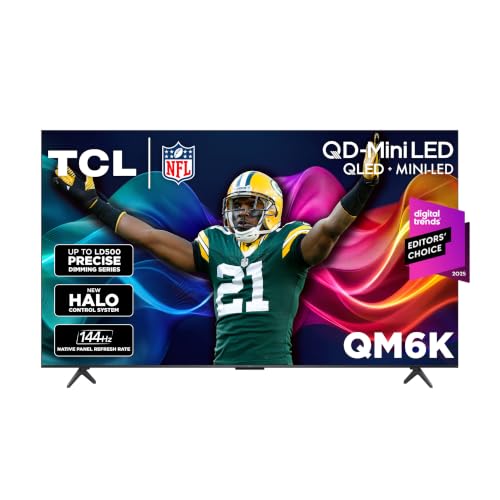
TCL QM6K 65-inch — Best step-down buy
Every flagship line needs an honest understudy, and the QM6K is TCL’s. The listing keeps the essentials that make the series interesting — a QLED Mini LED panel at a native 144Hz, Dolby Vision, Dolby Atmos audio decoding and IMAX Enhanced certification — while stepping down the backlight sophistication that separates it from the QM8L above. In practice that trade suits a great many rooms: you keep the gaming rate and the HDR formats, and surrender the last degree of highlight finesse.
Think of the QM6K as the recommendation for the second-most-important screen in a keen household, or the main screen in a household that watches plenty of sport and streaming but does not grade shadow detail. Its Google TV interface matches the flagship’s, so households standardising on one platform can mix the two sets without relearning anything. High brightness is claimed on the listing in general terms rather than with a specific figure, which is refreshingly restrained for this category.
There is a sensible upgrade logic to this model as well. Because the QM6K keeps the series’ gaming rate and HDR format list, the money it saves can be redirected at the parts of a setup that outlast any single television: a solid soundbar, a tilting mount, blackout curtains for the window that fights your Saturday matches. A system bought as a system usually pleases longer than a flagship panel surrounded by compromises.
- Panel: 65-inch QLED Mini LED, 4K
- Native refresh: 144Hz per TCL’s listing
- HDR: Dolby Vision, HDR10, IMAX Enhanced
- Audio: Dolby Atmos decoding, voice remote included
- Platform: Google TV
- Position: step-down model below the QM8L in TCL’s range
Strengths
- Retains the 144Hz native panel that many step-down models sacrifice
- Dolby Vision and IMAX Enhanced both survive the move down the range
- Same Google TV experience as the flagship, simplifying multi-set households
Trade-offs
- Backlight control is a tier below the QM8L, so demanding night scenes show the gap
- No Dolby Vision IQ light-adaptive variant named on the listing
- Buyers close to flagship money anyway may regret not stretching once they see both
Best for: buyers who want genuine mini-LED gaming and HDR performance without flagship pricing logic. Not suited for: home-cinema perfectionists who will spend dark scenes hunting for blooming.
The decision between this and the QM8L comes down to your room and your habits, not your worth as a viewer. Head to the QM6K listing to check price on Amazon, and put whatever you save toward a soundbar or a proper wall mount.

Samsung QN70H 65-inch — Best colour-first choice
Samsung positions the QN70H as the accessible doorway into Neo QLED, and its listing argues in colour: 100% Color Volume with Quantum Dot is the headline claim, meaning — in Samsung’s framing — the set sustains saturation even at high brightness, where lesser panels wash out. The Quantum Mini LED backlight and NQ4 AI processor with 4K upscaling complete a package aimed squarely at viewers whose eyes go to colour richness first.
That emphasis makes sense for the content most people actually watch. Saturated sport kits, animated films, nature documentaries and games all live or die on colour volume, and they are daytime-friendly genres where the QN70H’s priorities pay off. Samsung Vision AI features and Alexa built in round out the smart side. As with its QN90H sibling, Dolby Vision is absent, and the same advice applies: know your library before you decide how much that matters.
One audience should pay this model particular attention: players of colourful games and watchers of animated content, two groups poorly served by panels that reserve their saturation for small highlights. Colour volume is precisely the quality those genres consume, because their palettes fill the whole screen rather than a candle flame in a corner. If your evenings are bright, animated and social, the QN70H’s priorities align with your screen time more closely than a contrast-first flagship’s would.
- Panel: 65-inch Neo QLED Mini LED, 4K
- Colour: 100% Color Volume with Quantum Dot, per Samsung’s claim
- Processor: NQ4 AI with 4K upscaling
- Platform: Samsung smart system with Vision AI
- Voice: Alexa built in
- HDR: Samsung HDR handling (no Dolby Vision)
Strengths
- Colour volume is the stated design priority, suiting sport, animation and games
- Neo QLED mini-LED backlight at a more approachable rung of Samsung’s ladder
- Strong upscaling for the broadcast and catalogue content that fills most evenings
Trade-offs
- Sits below the QN90H on backlight and finish, so bright-room buyers should compare carefully
- Dolby Vision remains unsupported, as across Samsung’s range
- Colour-volume claim is Samsung’s own measurement framing
Best for: colour-led viewers stepping into mini-LED through Samsung’s ecosystem. Not suited for: pitch-dark cinema rooms chasing the deepest possible blacks, where the flagship tier earns its keep.
Judge this set with the content you love most: a saturated football kit under stadium lights will tell you more than any test pattern. When you are ready, the QN70H’s listing is where to confirm the current price on Amazon for this 65-inch class model.

Hisense U6 Pro 65-inch — Best for Fire TV households
The U6 Pro brings mini-LED to the rung of Hisense’s range where value arguments get serious, and it wraps the panel in Fire TV rather than the Google TV used by its U8 sibling. Hisense lists a native 144Hz panel — the number that matters — alongside a Motion Rate 480 figure, which is the maker’s processing-based metric rather than a native rate, and the distinction is worth learning here because you will meet it across the industry. Dolby Vision IQ, Dolby Atmos and HDR10+ all appear, as does a glare-free screen finish.
For an Alexa-centred household, the fit is natural: Alexa+ is built in per the listing, and Fire TV’s interface will already be familiar to anyone with a Fire TV Stick in a drawer. The gaming credentials at native 144Hz are strong for the tier. What you trade against the U8 is specification headroom — dimming ambition, audio hardware and peak claims all step down — in exchange for a simpler proposition at the friendlier end of the range.
Renters and first-time buyers form this set’s quiet constituency. Fire TV needs no additional box, the panel specification is strong enough to remain satisfying when the television moves to a bigger room later, and the glare-free finish forgives the uncontrolled lighting of rented spaces where you cannot install curtains or rearrange the architecture around a screen. It is a set that tolerates real life gracefully.
- Panel: 65-inch Mini-LED ULED Hi-QLED, 4K
- Native refresh: 144Hz per Hisense; Motion Rate 480 is a maker processing figure
- HDR: Dolby Vision IQ, HDR10+
- Audio: Dolby Atmos decoding
- Platform: Fire TV with Alexa+
- Finish: glare-free screen, per the listing
Strengths
- Fire TV integration suits Amazon-centric households better than any rival here
- Native 144Hz panel keeps gaming credentials honest at this tier
- Glare-free finish plus Dolby Vision IQ is a thoughtful real-room combination
Trade-offs
- Motion Rate language invites confusion; only the native 144Hz figure describes the panel
- Steps down from the U8 in dimming ambition and built-in audio
- Fire TV’s home screen leans into Amazon content promotion
Best for: Alexa households wanting mini-LED contrast and a real gaming panel without flagship commitment. Not suited for: Google TV loyalists, or buyers who planned to top the range anyway.
One setup tip specific to this set: explore the Fire TV picture presets per input rather than globally, since game and film sources want different motion handling. After that, a visit to the U6 Pro listing to view its current Amazon price completes the homework.
Mini-LED, OLED or Ordinary LED: Which Technology Fits Your Room?
Ordinary LED televisions remain the budget floor of the market, and their weakness is exactly the backlight this guide is about: a small number of lights, broad dimming or none at all, and HDR that brightens the whole frame when one corner should blaze. If your viewing is news, soaps and casual streaming in a lit room, that floor can be enough. The moment you watch films with dark scenes or play games with HDR highlights, the grey wash over shadow detail becomes the thing you cannot unsee.
OLED sits at the opposite philosophical pole: every pixel makes its own light, so blacks are absolute and contrast is effectively infinite, with no blooming at all. Its constraints are peak brightness in large bright areas, the need for some care with static content over years, and pricing at large sizes. Mini-LED is the engineering compromise that has largely won the mainstream: not pixel-perfect, but bright enough to defeat sunlight, free of burn-in anxiety, and available in sizes and tiers OLED does not contest. Most buyers cross-shopping this guide will be happiest with the compromise, which is why the category has swallowed the middle of the market.
Where does that leave the six picks? They are all expressions of the same compromise tuned toward different rooms: the Samsung pair toward bright, reflective spaces and processing polish; the Hisense pair toward published performance and gaming rates; the TCL pair toward panel technology with a flagship and an understudy. Technology choice first, brand second, size third — in that order — is the decision sequence least likely to end in a return.
Which Smart Platform Will You Still Like in Three Years?
A television’s platform ages faster than its panel. The backlight in any of these six will look much the same in five years, while the interface will receive redesigns, gain advertising surfaces and occasionally lose an app whose maker changed strategy. Choosing the platform your household already inhabits is therefore a durability decision, not merely a taste one. Google TV rewards households invested in Google accounts, Chromecast habits and Android phones; its Gemini features on the QM8L point at where Google’s television ambitions are heading. Fire TV suits Prime-centred homes where Alexa routines already run the lights. Samsung’s system ties into its wider device ecosystem and offers its own free-content channels.
App coverage is effectively universal for the major streaming services on all three platforms represented here, so the real differences are texture: how search results are ranked, whether recommendations can be tamed, how profiles work for children, and how gracefully the system handles a household that mostly watches two inputs — a console and one streaming app — rather than browsing a content mall. If that last description fits you, every platform here can be subdued into near-invisibility with ten minutes in the settings, and the panel should resume its rightful place as the deciding factor.
Voice control deserves a sober sentence. Alexa built into the Samsung pair and Alexa+ on the U6 Pro, plus Google’s assistant on the Google TV sets, all make changing inputs and searching by actor genuinely easier. They also mean a microphone lives in your remote. Every platform here lets you limit or disable voice features; decide your comfort level once, set it, and move on rather than relitigating it nightly.
What About Sound From a Thin Television?
Panel technology gets the glory, yet the soundtrack carries half of every scene, and thin cabinets are acoustically hostile: drivers point downward or backward, enclosures have no volume, and bass is a rumour. Against that background the Hisense U8’s listed 4.1.2-channel system is the standout here, a configuration with dedicated height capability that most rivals do not attempt. The other five decode Dolby Atmos where their listings say so, which matters when you add an Atmos soundbar later, but their built-in speakers should be auditioned with dialogue, not music, because speech clarity is what television audio lives or dies by.
A pragmatic plan for most buyers in this guide: live with the built-in sound for a fortnight, noting exactly what bothers you — muffled voices, no bass weight, volume swings between programmes. That list then writes your soundbar brief precisely instead of generically. Connect any bar through the eARC socket so volume stays on one remote, and if your set offers a mode that pairs television speakers with the bar, try it; on some systems it lifts dialogue noticeably. Sound is the cheapest upgrade in home cinema, and the only one you can make after the television is already on the wall.
How Do the Six Compare Side by Side?
| Model | Panel and size | Native rate (listing) | HDR highlights | Platform |
|---|---|---|---|---|
| TCL QM8L | SQD-Mini LED QLED, 65-inch | 144Hz | Dolby Vision IQ, IMAX Enhanced | Google TV |
| Samsung QN90H | Neo QLED Mini LED, 65-inch, Glare Free | Not headlined on listing | Samsung HDR processing | Samsung with Vision AI |
| Hisense U8 | ULED Mini-LED QLED, 65-inch | 165Hz, VRR to 288 claimed | Dolby Vision IQ, HDR10+, IMAX Enhanced | Google TV |
| TCL QM6K | QLED Mini LED, 65-inch | 144Hz | Dolby Vision, IMAX Enhanced | Google TV |
| Samsung QN70H | Neo QLED Mini LED, 65-inch | Not headlined on listing | Samsung HDR processing | Samsung with Vision AI |
| Hisense U6 Pro | Mini-LED ULED Hi-QLED, 65-inch | 144Hz | Dolby Vision IQ, HDR10+ | Fire TV |
Read the table as three philosophies rather than a league ladder. Hisense competes on published numbers, TCL on panel generations and gaming rates, Samsung on finish, colour and processing. The right column for your household is the platform one more often than shoppers expect, because you will touch the interface every single day while the backlight differences appear mainly in demanding scenes.
Notice what the table cannot show: dimming behaviour in a real scene, the feel of each remote, how quickly the interface wakes from standby, and the quality of each maker’s upscaling on a scruffy broadcast feed. Those are the qualities that decide satisfaction in month six, and they are why this guide keeps returning to use cases rather than crowning a winner by spreadsheet. If two picks remain tied after the table, choose by the room each was designed for — bright, dark, gaming-led or platform-led — and the tie usually breaks itself.
The table also quietly records how far the category has travelled. A few seasons ago, a native rate above 120Hz belonged to specialist gaming displays, Dolby Vision IQ was a flagship garnish, and 4.1.2-channel audio inside a television was unheard of at any price. All three appear here, spread across the six, which is the practical meaning of mini-LED maturing: yesterday’s halo features are now checklist items, and the competition has moved to execution.
How Do You Set Up a Mini-LED TV for Film, Sport and Games?
Start by defeating the showroom settings. Most sets ship in a vivid or standard mode tuned to fight shop lighting, with motion smoothing turned up and colour pushed hard. For film, choose the movie or filmmaker-style preset your set offers, because it aims for the colour temperature and gamma the content was mastered at, and it usually disables the smoothing that gives drama a soap-opera glide. Give your eyes a full evening to adjust; accuracy looks dull for twenty minutes and then simply looks right.
Sport wants the opposite temperament. Broadcast feeds arrive at lower frame rates and often in lesser quality than streaming film, so upscaling quality and judicious motion handling earn their keep. A dedicated sports preset, where offered, typically raises brightness and sharpens edges; use it for the match, then leave it there rather than letting it bleed into film night. If your set allows per-input picture memories — most at this level do — assign the broadcast box its own settings and stop compromising.
Games need the game mode on the input your console uses, full stop: it is the switch that unlocks the low-latency path and, on these high-rate panels, the VRR behaviour the hardware promises. Check that the console’s own video output settings are set to allow 120Hz and variable refresh, because a television cannot display what the source refuses to send. Finish with sound: run the set’s room or adaptive audio routine if it offers one, and if a soundbar joins later, connect it to the eARC socket so the television remote keeps control of volume.
What Mistakes Do Mini-LED Buyers Keep Making?
Comparing brightness claims across brands is the classic error. A nit figure is only meaningful inside the measurement method that produced it, and makers do not share methods. Use the numbers to rank models within one brand’s range; across brands, lean on format support, platform fit and the kind of scenes you watch.
Assuming more zones automatically means a better picture runs a close second. Zone count sets the ceiling for dimming precision, but the algorithm decides how close a set gets to that ceiling, and an aggressive algorithm can introduce flicker or crush that a calmer design avoids. Reviews and return policies protect you here; a specification sheet cannot.
Room fit gets skipped surprisingly often. A glare-free finish matters more than extra brightness in a bright lounge, while in a dedicated dark room the same finish buys little. Measure your viewing distance as well: 65 inches suits typical main-room distances, yet the series behind these picks offer other sizes precisely because rooms differ.
Ignoring the stand is a quieter mistake with louder consequences. Several modern sets offer two stand-foot positions or a central pedestal, and the difference decides whether the television fits the furniture you own. The listing’s dimension drawings answer this in seconds; discovering it with the panel half out of its box is the miserable alternative. The same drawings give the VESA pattern for wall brackets.
Finally, buyers forget the sound plan. The U8’s 4.1.2 system is the exception in this group; most thin televisions sound thin. Budget a soundbar into the project from the start rather than discovering the gap during your first film night.
How Should You Test a New Mini-LED TV During Its First Week?
Use the return window as a laboratory, because panel variation is real and a disciplined first week protects you. Begin with uniformity: display a dark-grey full-screen image in a dim room and look for blotches, bright corners or a dirty-screen effect in the centre. Some variation is normal for LCD panels; a glaring patch in the middle of the screen is not, and it will haunt every dark scene you ever watch on the set.
Next, test the dimming with the content that stresses it. Subtitled drama at night exposes blooming around text and faces; a starfield or a candlelit scene reveals whether shadow detail survives. Watch a familiar film rather than a demo reel, because you know how its scenes should look and deviations announce themselves. Check motion with a football match or a racing game, watching the ball and the background panning for smearing or judder that your chosen settings cannot tame.
Finish with the mundane checks that matter in month two: wake-from-standby speed, the remote’s behaviour in the dark, app sign-ins surviving a power cut, and the console handshake at 120Hz if you game. A television that passes the picture tests but annoys you daily at the interface will be replaced in your affections long before its backlight fades. If your set clears the week, register the warranty, save the receipt with the serial number, and stop testing — the point of the exercise was permission to enjoy it.
Final Recommendation
One last piece of sequencing advice applies whichever model you choose: order the television before you order accessories, live with its built-in sound and stand for a week, and let the room itself tell you whether a soundbar, a mount or bias lighting earns the next purchase. The six sets here are all strong enough that the room, not the catalogue, should finish the specification.
For most households, the TCL QM8L is the mini-LED set to beat: flagship backlight, Dolby Vision IQ, a 144Hz native panel and Google TV in one coherent package. Bright-room households should look hard at the QN90H’s glare control, specification chasers and gamers at the Hisense U8, and value seekers at the QM6K or U6 Pro depending on platform loyalty, with the QN70H serving Samsung fans who think in colour first. Whichever you choose, you are buying backlight control — and once a streetlamp has glowed over a truly black alley in your own lounge, ordinary LED never looks ordinary again.
Frequently Asked Questions
Is mini-LED better than OLED for a bright living room?
For bright rooms, generally yes. Mini-LED sets sustain high brightness across large areas of the screen, which keeps daytime sport and news punchy, while OLED’s strengths peak in controlled light. In a dark cinema room the contest reverses, because OLED pixels switch off entirely. Your room, more than any ranking, should make this call.
Do more local dimming zones always mean better contrast?
No. Zones define the finest possible control, but software decides how intelligently that control is used. A set with fewer zones and mature dimming logic can show less blooming and steadier blacks than a higher-zone set tuned carelessly. Treat zone counts as one clue among several.
Why do Samsung’s picks here lack Dolby Vision?
Samsung has declined to license Dolby Vision across its television range for years, relying on its own HDR tone mapping instead. Streaming services fall back to HDR10 on these sets, which still looks strong, but collectors with Dolby Vision disc libraries should factor the omission into their decision.
What does a Motion Rate number actually mean?
Motion Rate and similar branded figures describe a maker’s combination of panel rate, backlight behaviour and motion processing, expressed as a larger effective number. The panel’s native refresh rate — 144Hz on several picks here — is the figure that describes the hardware and the one to compare.
How long should a mini-LED television last?
LED backlights dim very gradually over many years rather than failing suddenly, and a set used a few hours daily should serve a household well beyond its warranty period. Heat and constant maximum brightness accelerate ageing, so sensible backlight settings are also a longevity habit.
Does mini-LED suffer from burn-in like OLED can?
No. Mini-LED is an LCD technology with an LED backlight, so it does not carry OLED’s risk of permanent image retention from static elements. That makes it a relaxed choice for news channels with permanent tickers, sports score bugs and long game HUD sessions. LCD panels have their own ageing behaviours, but burn-in is not among them.
Should I buy the 65-inch or a different size in the same series?
Choose by seating distance and wall space, then verify the exact size’s listing, because brightness and zone counts sometimes vary across a series. The engineering character carries over; the fine print may not.
Related Guides
Continue with Best QLED 4K TVs to see how the wider quantum-dot field compares, explore Best OLED TVs for Movies and Video Games for the self-lit alternative, or check Best TVs With Hdmi 2 1 and 120hz if gaming connections are your deciding factor. For live sport specifically, motion and brightness are ranked in the best tvs for viewing sports.
Related guides
- Best 1080p IP Cameras: PoE Domes, Turrets, Bullets and a PTZ That Earn Their Cable
- Best 43 1080p TVs: Why 43 Inches Went 4K — and Where True Full HD Survives
- Best Doorbell Cameras No Subscription: Local Storage Picks, and the Ring/Blink Truth
- Best AC Powered Wireless Security Cameras: Wi-Fi Data, Mains Power, Zero Sleep


