What's inside
- Key Takeaways
- Quick Picks
- How Did We Judge Cameras for a Day That Cannot Be Repeated?
- Why Is Low Light the Whole Examination?
- How Do the Six Wedding Bodies Compare on the Day Itself?
- How Do You Position Cameras for a Ceremony Without Becoming Part of It?
- How Do You Light a Reception Without Killing It?
- How Does a Wedding Day Actually Test a Camera, Hour by Hour?
- How Do Professionals Protect the Footage Before, During and After the Day?
- How Do You Work Alongside Photographers, Planners and the Couple?
- What Else Decides the Film Besides the Camera?
- When Do High Frame Rates Earn Their Place at a Wedding?
- How Does the Edit Change Which Camera Was Right?
- What Mistakes Do Wedding Filmmakers Make When Choosing a Camera?
- How Do Seasons Change the Wedding Camera Equation?
- When Should You Hire a Second Body Instead of Buying One?
- Final Recommendation
- Frequently Asked Questions
- Related Guides
As an Amazon Associate I earn from qualifying purchases. This post may contain affiliate links at no extra cost to you.
gizmoverdict.com is reader-supported. When you buy through links on our site, we may earn an affiliate commission.
Where to buy: The listings below link to verified stock in several different forms: most are body-only, while the Panasonic S5 IIX listing is a kit with the 20-60mm zoom and a 50mm prime included. Read each pick’s format line before comparing totals, and remember that a wedding camera is a system purchase — cards, batteries and a second body are part of the real budget, not accessories to it.
The best cameras to film a wedding are not chosen the way other cameras are chosen, because a wedding is not a shoot that can be repeated. The vows happen once, in light chosen by architecture rather than by you, at a distance dictated by an officiant who has never met your zoom lens. The speeches run long or short without consulting your recording limit. The first dance happens in a room lit like a cave with a disco ball. A wedding camera is therefore judged, before any question of beauty, on a single brutal criterion: does it keep recording, in focus, in the dark, without complaint, for twelve hours — and only then on how lovely the result looks.
That ordering explains this guide’s shape. Low-light performance is treated as a survival trait rather than a luxury, because receptions are where wedding films go to die. Recording limits and thermal manners are examined camera by camera, because a body that pauses during the father of the bride’s best story has failed at its only job. Dual card slots are weighed as insurance, autofocus as a colleague, and battery behaviour as the logistics of a day with no natural breaks. The glamorous specifications — high frame rates, exotic codecs, internal RAW — appear here in their proper place: as the rewards a reliable camera earns the right to offer, never as substitutes for reliability.
One more honesty note before the rankings. Most working wedding filmmakers shoot with two bodies, and several own the cameras below as a main and a backup rather than as rivals. Read the list that way: the top picks are ceremony cameras, the middle picks are the versatile partners, and the right answer for a professional is often a pairing — a low-light sovereign for the reception beside a hybrid that also shoots the stills nobody warned you about. Solo shooters and small teams will find their one-camera answer here too, but it is chosen by the same unforgiving standard.
Key Takeaways
- Weddings cannot be reshot, so recording reliability outranks every glamorous specification.
- Reception darkness is the real examination: clean high-ISO video is a survival trait.
- Check recording limits and heat manners per camera; ceremonies and speeches are longer than spec sheets assume.
- Dual card slots are insurance for the one day whose files cannot be replaced.
- The Panasonic S5 IIX listing includes two lenses; the other five picks are body-only purchases.
- Professionals should read this list as pairings — a main body and its partner — not only as rivals.
Quick Picks
| Pick | Badge | Why it made the list |
|---|---|---|
| Sony a7S III (body) | Best overall | The low-light sovereign: a 12MP full-frame sensor that sees receptions the way guests remember them. |
| Sony FX3 | Best cinema body | The a7S III’s sensor in a cinema-line body built for rigs, crews and long professional days. |
| Canon EOS R6 Mark II (body) | Best hybrid | The stills-and-video all-rounder for the shooter the couple also expects to photograph everything. |
| Panasonic Lumix S5 IIX | Best value full frame | Unlimited recording, phase autofocus and two lenses in the listing — the small-team bargain. |
| Panasonic Lumix GH7 | Best Micro Four Thirds | Internal ProRes, serious cooling and the deepest video toolkit in a compact body. |
| Nikon Z6 III | Best RAW video value | Internal RAW recording and a fast partially stacked sensor at a price that undercuts the cinema lines. |
How Did We Judge Cameras for a Day That Cannot Be Repeated?
Reliability was scored first and in three parts: whether the camera records without an arbitrary clip limit in its main modes, how it behaves thermally through a summer ceremony and a warm reception, and whether dual slots let it write every frame twice. Low light came second, judged not by the highest sensitivity a menu offers but by the highest sensitivity whose footage a professional would deliver — skin tones intact, colour honest, noise fine rather than blotchy. Autofocus was scored on faces in motion at wide apertures in poor light, the exact conditions of a first dance, and on the grace with which it handles a bride walking toward camera down a dim aisle.
Stabilisation was judged as a social feature as much as a technical one. The wedding filmmaker works handheld in crowds, at receptions, in the press of a dance floor, where a tripod is an obstacle and a gimbal is a statement. The bodies whose in-body and lens stabilisation let their operator move like a guest while filming like a professional — the Canon and the Sonys especially, with the Panasonics close behind in their stabilised modes — earn a practical advantage that laboratory shake tests understate, because the footage it produces is not merely steadier. It is closer, warmer and less self-conscious, shot from inside the celebration rather than at it.
Only then did the craft specifications enter: frame rates for slow-motion confetti and bouquet work, colour profiles and codecs for the edit, stabilisation for handheld mingling footage, and the lens ecosystem behind each mount for the fast primes wedding work consumes. Price was read as system price — body, media, batteries, the second body the professional will eventually add — which is why a kit listing like the Panasonic’s scores its value so strongly and why the cinema body’s premium is judged against the rig it replaces rather than against the hybrid beside it.
Why Is Low Light the Whole Examination?
Because the wedding day is a tour of photography’s worst lighting, taken in order. Morning preparations happen in hotel rooms lit by a window and optimism. Ceremonies happen in churches, barns and marquees where the light is dim, mixed and forbidden to supplement. The reception — the emotional summit of the film, the speeches and the dancing — happens in rooms deliberately darkened for atmosphere, lit by candles, fairy lights and a DJ’s coloured wash, while the subjects move unpredictably and the moments refuse to repeat. A camera that is merely good in daylight is a camera that fails at the exact hours the couple will rewatch for fifty years.
This is why the a7S III’s design philosophy — fewer, larger photosites on a full-frame sensor, devoted entirely to sensitivity and dynamic range — remains the wedding benchmark years after its launch. It is also why the honest comparisons in this guide talk about usable sensitivity rather than maximum sensitivity: every camera here will dial to a number that produces footage, and the professional question is which of those numbers produce footage you would put your name on. Judge by that number, and the ranking below largely explains itself.

Sony a7S III (body) — Best overall
The a7S III was designed around a single insight that wedding filmmakers had been begging for: that twelve enormous megapixels, each gathering light like a bucket, beat thirty small ones when the room goes dark. Its full-frame sensor records 4K with a cleanliness at high sensitivities that still defines the class — reception footage at sensitivities that would reduce other cameras to impressionism stays detailed, coloured and calm. The dual-native sensitivity structure means the camera has two clean gears rather than one, and the second gear engages exactly where candlelit dancing lives. Autofocus is Sony’s mature, face-and-eye certainty, the stabilisation steadies handheld mingling shots, and dual slots write to fast media with the redundancy the day demands.
Its manners match its sensor: recording runs long, thermal behaviour is composed, and the menus and controls are those of a camera that expects to work rather than to be admired. The honest debits are the design’s own shadow — twelve megapixels is a video-first resolution that stills shooters will feel, and the body asks professional money. For the filmmaker whose deliverable is the film, neither debit touches the brief. Put the fastest primes you own in front of it and the a7S III will film a wedding in light the guests themselves could barely see across, which is, in the end, the entire job description.
- Sensor: 12.1MP full-frame BSI CMOS
- Video: 4K up to 120p, 10-bit colour
- Sensitivity design: dual native ISO structure for clean low-light video
- Autofocus: Real-time Eye AF for people
- Cards: dual slots, CFexpress Type A or SD
- Listing format: body only, from the verified listing
Strengths
- Reception footage that stays clean where other cameras dissolve.
- Long, composed recording with professional thermal manners.
- Face and eye focus that can be trusted at f/1.4 in candlelight.
Trade-offs
- Twelve megapixels limits stills ambition and heavy cropping.
- Professional pricing, with fast media adding to the system cost.
- Its video-first design is wasted on a stills-led workflow.
Best for: the dedicated wedding filmmaker whose film is the deliverable. Not suited for: hybrid shooters who need high-resolution stills from the same body all day.

Sony FX3 — Best cinema body
The FX3 takes the a7S III’s celebrated sensor and rehomes it in Sony’s Cinema Line thinking: a body built to be rigged, caged, monitored and crewed. The differences are practical rather than photographic — a top handle with professional audio inputs in the system’s accessory story, tally lamps that tell the room the camera is rolling, mounting points everywhere, controls arranged for video-first hands, and cooling and recording manners specified for the long professional take. For a wedding team running two shooters, external monitors and a sound recordist’s feed, those differences are not cosmetics. They are the working day, organised.
Image-making is the a7S III story retold with the same happy ending: the low-light sovereignty, the dual clean sensitivities, the autofocus certainty, now in a package that integrates with cinema accessories and matches colour with the larger FX bodies a production might also field. The premium over its sibling is the honest question, and the answer is workflow: a solo shooter gains little over the a7S III, while a team gains rigging speed, audio integration and a body that never has to apologise to a professional set. Weddings shot like films deserve cameras built like cinema, and this is the one in the guide that is.
- Sensor: 12.1MP full-frame, shared philosophy with the a7S III
- Video: 4K up to 120p, S-Cinetone colour included
- Design: cinema body with tally lamps and extensive mounting points
- Audio: professional input options via the system’s handle accessories
- Autofocus: Real-time Eye AF
- Listing format: body only; lenses are the next decision
Strengths
- The low-light champion’s sensor in a rig-ready cinema body.
- Tally lamps and pro audio paths suit crewed wedding teams.
- Colour matches Sony’s wider cinema line for multi-camera days.
Trade-offs
- The premium buys workflow, not better pictures than its sibling.
- No viewfinder; monitor-based shooting is the design’s assumption.
- Rigging accessories add cost before the first wedding.
Best for: wedding film teams and cinema-style solo shooters with rigs. Not suited for: run-and-gun minimalists who would carry its capabilities unused.

Canon EOS R6 Mark II (body) — Best hybrid
Many wedding commissions arrive with an unspoken second job: the couple, the families and the venue all assume the person with the camera is also the photographer. The R6 Mark II is the finest answer in this guide to that double life. Its 24.2-megapixel full-frame sensor shoots stills at professional speed and quality all day, then records 4K video — oversampled and detailed in its quality modes — with Canon’s Dual Pixel autofocus holding faces in the dependable, unhurried way that wedding work rewards. Skin tones are Canon’s traditional gift, and on a day when every frame is a face, that gift compounds hourly.
Video manners are strong with one discipline required: the finer 4K modes generate heat on long, warm takes, so the professional habit is to choose recording modes with the ceremony’s length and the room’s temperature in mind, exactly as its many working wedding owners do. Stabilisation is excellent for handheld work, the RF lens range offers the fast primes receptions demand, and dual slots guard the stills and video alike. As a pure cinema instrument the Sonys out-specialise it; as the one camera a hybrid shooter can build a wedding business on, nothing else here argues as completely.
- Sensor: 24.2MP full-frame CMOS
- Video: 4K, oversampled quality modes plus high frame rates
- Autofocus: Dual Pixel CMOS AF II with people detection
- Stabilisation: in-body, coordinated with RF lenses
- Cards: dual SD slots
- Listing format: body only — no lens is included
Strengths
- A genuine professional stills camera that also films beautifully.
- Faces rendered with Canon’s flattering, dependable colour.
- Stabilisation that makes handheld reception work graceful.
Trade-offs
- Long, hot 4K takes ask for mode discipline against heat.
- Low-light video is strong, a step behind the 12MP Sonys.
- No internal RAW video for the colourist-minded.
Best for: hybrid shooters carrying both the film and the photographs. Not suited for: pure filmmakers who should spend the same money on a video-first body.

Panasonic Lumix S5 IIX — Best value full frame
The S5 IIX is the small team’s charter: a full-frame camera whose specification reads like a wedding filmmaker wrote the request list. Unlimited recording in its main modes, with active cooling that treats a July marquee as a working condition rather than a threat. Phase-detection autofocus — the upgrade that transformed this line — tracking faces with the confidence wedding work requires. Recording to external SSDs, streaming capability built in, a mature log profile and colour that editors respect. And this listing is a kit: the 20-60mm zoom, a genuinely useful wide-to-portrait range for ceremonies, plus a fast 50mm prime for the reception’s darkness, both in the box.
Value judgements need the whole ledger, and the ledger is kind: two lenses that a body-only rival’s owner must buy separately are already here, the L-mount lens range behind them is shared across three manufacturers, and the body’s video toolkit — waveforms, shutter-angle thinking, anamorphic support — belongs to a class above its price. Low-light footage is strong rather than sovereign, a step behind the 12MP Sonys in the darkest rooms, and the stills side is competent rather than headline. For a two-person team equipping itself to film weddings properly without cinema-line money, this is the most rational purchase in the guide.
- Sensor: 24.2MP full-frame
- Video: 5.8K ProRes-class options, 4K extensive modes, unlimited recording in main modes
- Kit contents: 20-60mm zoom and 50mm f/1.8 prime in this listing
- Autofocus: phase-detection hybrid system
- Cooling: active fan for long takes
- Extras: SSD recording over USB, live-streaming support
Strengths
- Unlimited, actively cooled recording for ceremonies of any length.
- Two lenses included turn the listing into a working kit.
- A professional video toolkit at a non-professional total.
Trade-offs
- Darkest-room footage trails the low-light Sonys.
- Autofocus, though transformed, still trails the class leaders in chaos.
- The fan’s faint presence is a consideration for silent ceremonies.
Best for: small teams and value-led professionals filming full days. Not suited for: shooters whose receptions are near-pitch-black and who need the last stop of sensitivity.
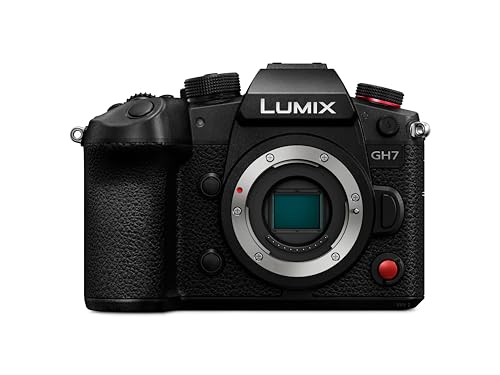
Panasonic Lumix GH7 — Best Micro Four Thirds
The GH7 is the video specialist’s compact: a Micro Four Thirds body whose internal recording menu reads like a cinema camera’s — internal ProRes recording, high-quality codecs throughout, real-time LUT application so the couple’s preview looks graded on the day, and cooling specified for unlimited work in its main modes. The format’s virtues are wedding virtues nobody advertises: depth of field that keeps a moving couple in focus more forgivingly at wide apertures, lenses so small that a three-prime kit fits a jacket’s worth of pockets, and a body that can live on a gimbal from preparations to the last dance without the operator’s arms filing a complaint.
The trade is the format’s eternal one. The smaller sensor gathers less light, so the darkest receptions push its sensitivities harder than the full-frame bodies here, and the shallow-focus look that full-frame primes give for free must be bought with the fastest Micro Four Thirds glass — which exists, and is gloriously compact, but is a deliberate purchase. Autofocus is phase-detect equipped and the best Panasonic has made, and the Adobe-integrated workflow touches will delight the editor who receives its files. For the solo filmmaker who values a complete, cool-running, gimbal-friendly video system over the last stop of darkness, the GH7 is the connoisseur’s answer.
- Sensor: 25MP-class Micro Four Thirds
- Video: internal ProRes recording, extensive high-quality codecs
- Colour: real-time LUT application, Adobe workflow integration
- Autofocus: phase-detection hybrid
- Cooling: fan-cooled for long recording
- Listing format: body only, as listed
Strengths
- Cinema-grade internal recording in the smallest system here.
- Gimbal-friendly weight for all-day handheld and flown shots.
- Forgiving depth of field keeps moving couples sharp.
Trade-offs
- Low-light ceiling sits below the full-frame picks.
- The shallow-focus look needs fast, deliberate lens purchases.
- Stills are a sideline to its video-first design.
Best for: solo video specialists and gimbal-led filmmakers. Not suited for: darkness-first shooters or stills-led hybrid commissions.

Nikon Z6 III — Best RAW video value
The Z6 III brings a specification to this guide that used to require a cinema budget: internal RAW video recording, up to 6K, in a hybrid body at a hybrid price. For the wedding filmmaker who grades seriously — who wants to rescue a mixed-light ceremony’s colour, to rebalance a reception’s tungsten and LED chaos in post — RAW is not a vanity format but a second chance built into every frame. The partially stacked sensor reads fast, keeping rolling shutter mannerly on pans across the dance floor, the viewfinder is the brightest and clearest here for the stills moments, and Nikon’s subject-detection autofocus handles the aisle walk with assurance.
Around that headline, the wedding fundamentals are properly kept: strong full-frame low-light performance a step behind the 12MP specialists and ahead of most hybrids, dual slots, a Z-mount lens range whose fast primes and zooms have matured into a complete wedding arsenal, and recording manners that suit full days when modes are chosen sensibly. The same body appears in this site’s wildlife guide wearing a different hat, which tells its own story about versatility. For the colourist-filmmaker building a one-body business, the Z6 III is the value argument in RAW.
- Sensor: 24.5MP full-frame, partially stacked
- Video: 6K internal RAW, extensive 4K modes
- Autofocus: subject detection for people and more
- Viewfinder: exceptionally bright, high-resolution EVF
- Cards: dual slots, fast media supported
- Listing format: body only; budget the glass separately
Strengths
- Internal RAW at a price the cinema lines cannot answer.
- Fast readout keeps dance-floor pans clean.
- A complete hybrid: excellent stills beside the video story.
Trade-offs
- RAW files demand storage and editing power to match.
- Low-light crown still belongs to the 12MP Sonys.
- Serious colour work is required to realise RAW’s advantage.
Best for: grading-led filmmakers who want RAW without cinema prices. Not suited for: shooters who deliver fast turnarounds with minimal post-production.
How Do the Six Wedding Bodies Compare on the Day Itself?
| Camera | Sensor | Recording character | Low-light standing | Sold as |
|---|---|---|---|---|
| Sony a7S III | 12.1MP full frame | Long and composed | The benchmark | Body only |
| Sony FX3 | 12.1MP full frame | Cinema manners, rig-ready | The benchmark, crewed | Body only |
| Canon EOS R6 Mark II | 24.2MP full frame | Strong; mind heat on long fine-mode takes | Strong | Body only |
| Panasonic S5 IIX kit | 24.2MP full frame | Unlimited, fan-cooled | Strong | Kit with two lenses |
| Panasonic GH7 | Micro Four Thirds | Unlimited, fan-cooled, ProRes inside | Format-limited | Body only |
| Nikon Z6 III | 24.5MP full frame | RAW internally, fast readout | Strong | Body only |
Read the recording column as the day’s timetable: the ceremony’s length, the speeches’ unpredictability, the reception’s heat. The cameras that treat those as design briefs — the cooled Panasonics, the composed Sonys — are the ones professionals trust at the moments with no retake, and the table’s honesty about the Canon’s heat discipline and the GH7’s format ceiling is there so that trust is placed knowingly.
How Do You Position Cameras for a Ceremony Without Becoming Part of It?
The ceremony is a piece of theatre with a strict fourth wall, and the camera plan respects it. The main camera belongs on the centre line or just off it, at a height that sees faces over shoulders, close enough that a standard zoom frames the couple’s exchange of rings and far enough that its operator’s movements leave the guests’ sightlines alone. A second camera, locked off wide from the rear or the balcony, holds the architecture and the processional — the shot that rescues the edit if anything crosses the main frame at the decisive second. A third angle, where a team allows it, lives at the side for the reactions: the parents’ faces during the vows are worth more, in the finished film, than a fourth angle on the couple.
Movement is rationed by reverence. The professional repositions during music, readings and the congregation’s own motion, and stays statue-still during the vows themselves; the cameras in this guide reward that discipline with autofocus that can be trusted to hold a face while the operator’s attention is on the room rather than the screen. White balance is set manually for the building’s light — a church’s tungsten and stained-glass daylight will send automatic systems wandering mid-vow — and exposure is locked for the same reason. The ceremony is the one part of the day where the correct camera technique is, mostly, to have finished all your thinking before it began.
How Do You Light a Reception Without Killing It?
The reception’s darkness is not an accident to be corrected but an atmosphere the couple paid for, and the filmmaker’s lighting craft is the art of adding just enough. A small LED on the camera, dimmed to a whisper and bounced or diffused wherever possible, lifts the first dance’s faces without flattening the room behind them; a pair of small lights on stands at the dance floor’s corners, set before the evening begins, models the speeches and the dancing with a consistency no sensitivity figure can fake. The cameras ranked highest here need the least of this help — that is the practical meaning of the low-light crown — but even the Sonys’ footage gains dimension from a room that has been given a little shape.
Colour is the reception’s second trap. DJ lighting cycles through saturated hues that turn skin magenta, green and blue in rotation, and the filmmaker’s defences are patience and profiles: shoot the moment the wash passes through white or warm, lean on the cameras’ colour science in the standard profiles for the dancing, and save log and RAW heroics for the rooms whose light is mixed rather than theatrical. The Z6 III’s RAW earns its paragraph here, because a reception whose colour can be rebalanced frame by frame in the edit is a reception half-rescued before it is filmed. Technique, as ever in this guide, is the specification that matters most and prints least.
How Does a Wedding Day Actually Test a Camera, Hour by Hour?
Preparations test colour and discretion: window light, white dresses that punish exposure carelessness, and a room where the camera should be a guest rather than a production. The ceremony tests recording manners and autofocus together — a long, unbroken take, a processional walking toward the lens through dim light, vows spoken by people whose faces must stay found at wide apertures. Portraits between the events test the hybrid virtues and the couple’s patience, which is to say they test speed: the camera that is ready frames the laugh; the camera that is being reconfigured frames the apology.
The drinks reception and group photographs test a quieter virtue: social speed. The camera must come up, focus and fire in the seconds a genuine laugh lasts, then vanish before it becomes the event’s furniture. Compact rigs and confident autofocus are social graces here, and the filmmaker who masters them gathers the candid material that couples actually frame.
Speeches test endurance and audio above all: forty unscripted minutes, a microphone feed to capture or a room to record honestly, faces at a top table lit by candles and hope. The reception tests everything at once — darkness, motion, heat, battery, the operator’s own stamina — and it is where the rankings in this guide were truly decided. A camera buying decision made by walking this timetable honestly, hour by hour, will not be the decision the specification sheets would have sold you. It will be the right one.
How Do Professionals Protect the Footage Before, During and After the Day?
Data discipline is the invisible half of wedding filmmaking, and the cameras here are specified to support it. Dual-slot bodies write every clip to two cards simultaneously, which converts the commonest catastrophe — a card failure — into a shrug. The professional’s rotation builds on that foundation: cards are formatted in the camera they will serve, labelled by body and hour, retired into a hard case the moment they leave a camera, and never, under any deadline pressure, reused on the day they were shot. Batteries follow the same liturgy — charged, counted, rotated, with the day’s spent cells physically separated from the fresh ones so a tired hand at midnight cannot marry them.
The night of the wedding ends at a computer, not at the venue. Footage is copied to two drives before the filmmaker sleeps, one of which leaves the building the next day, because the statistics of loss are dominated not by card failures but by the week after — the stolen bag, the dropped drive, the house’s ordinary accidents meeting the year’s least replaceable files. Cloud backup joins the chain as soon as bandwidth allows. None of this appears in the film, and all of it is the film, in the only sense the couple will care about in thirty years: that it still exists. Choose the camera whose slots, media and manners make this discipline easy, and you have understood the deepest criterion in this guide.
How Do You Work Alongside Photographers, Planners and the Couple?
A wedding has one director, and it is not the filmmaker: it is the day’s own timetable, administered by the planner or the venue, shared with a stills photographer whose needs interleave with yours at every set piece. The professional relationships that make films possible are built in the unglamorous minutes — the morning’s introduction, the agreed positions for the ceremony, the shared understanding at the portraits about who leads and who follows. Cameras help here in their quiet ways: silent or near-silent recording manners during the ceremony, compact bodies that do not dominate the couple’s eyeline, screens that let an operator work from the waist in a crowd without broadcasting the production to the room.
The couple themselves are the final client of every technical decision in this guide, and they experience none of them directly. They experience a filmmaker who was calm when the timetable slipped, invisible when the vows cracked, and present — rolling, in focus, in the dark — when the dance floor erupted. The cameras ranked above are ranked, in the end, by how completely they let their operator be those three things. Specifications are the means. The couple’s memory of barely noticing you, attached to a film that noticed everything, is the end.
What Else Decides the Film Besides the Camera?
Audio, again and always. The vows and speeches are the film’s soul, and they are captured by planning, not by the camera’s built-in microphones: a recorder on the officiant or the groom, a feed from the venue’s desk where one exists, a microphone on the camera for the room’s truth. Every body here supports the external audio path that professional work requires, and the FX3’s cinema audio ecosystem states the priority in hardware. Light comes second: a small on-camera LED for the dance floor’s worst corners, used with restraint, rescues more receptions than any sensitivity figure. And the second body — even a modest one, locked off at the back of the ceremony — is the professional’s true insurance, because it turns every failure mode in this guide from a catastrophe into an edit decision.
Cards and batteries are the day’s logistics, and they are budgeted like film stock once was: more than the plan requires, formatted and labelled, rotated with a discipline the assistant — or the solo shooter’s own checklist — enforces at every natural break. The couples who rewatch their film for decades will never know any of this happened. That invisibility is the craft, and the cameras above are ranked by how completely they disappear into it.
When Do High Frame Rates Earn Their Place at a Wedding?
Slow motion is the wedding film’s poetry and its most abused device. Used with intent — confetti suspended in doorway light, the bouquet’s arc, a dress turning in the first dance, children running through evening sun — the 120-frame modes on the Sonys and the high-rate options across this list give the edit a register that real-time footage cannot speak in. Used as a default, it inflates the day into a perfume advertisement and starves the film of the thing weddings actually run on, which is voices. The professional ratio is a garnish’s ratio: the overwhelming majority of the finished film plays at the speed life happened, and the slow passages land precisely because they are rare.
There is a technical honesty to attach to the garnish. High frame rates cost light — each frame gets a fraction of the exposure — and they cost resolution or crop on some bodies in some modes, so the darkest reception is the wrong place to reach for them; the cameras’ low-light crowns were earned at normal rates, in the dark, where the speeches live. Plan the slow-motion shots for the day’s bright chapters — the exit, the confetti, the golden-hour portraits — and let the reception’s darkness be filmed at the rates and sensitivities this guide ranked it by. The film will cut together like a day actually feels: vivid in the light, tender in the dark, honest in both.
How Does the Edit Change Which Camera Was Right?
Every wedding film is made twice, and the second making has opinions about the first. Multi-camera ceremonies cut on audio waveforms and timecode discipline, which rewards the bodies with professional timecode and sync manners and punishes any camera whose clips drift or whose file naming fights the editor. Colour matching across bodies is the edit’s daily labour, and it is why matched pairs — two Sonys, two Panasonics — recur throughout this guide’s advice: a film shot on twins grades in an evening, while a film shot on three brands grades in a week of apologies. The real-time LUT on the GH7 and the shared colour science within each maker’s line are workflow features wearing specification clothing.
Delivery shapes the last decision. Most couples watch their film on a television and a phone, in that order, for decades; the 4K masters these cameras produce are already beyond both, and the archive that matters is the carefully stored master and its project files, not a resolution arms race. What the edit truly needs from the camera is consistency — exposure that does not wander, colour that does not drift between clips, audio that syncs and stays synced — and consistency, the reader will notice, is the same virtue this guide called reliability when the day was being filmed. It is one virtue with two names, and it outranks spectacle in both halves of the work.
What Mistakes Do Wedding Filmmakers Make When Choosing a Camera?
Choosing by daylight showreel is the first: every camera here films a garden beautifully, and the wedding happens after dark. The second is ignoring the recording column — discovering a clip limit, a heat shutdown or a fan’s absence during the longest speech of the year. The third is buying one body with the whole budget, leaving nothing for the audio kit, the fast prime and the backup that turn a camera into a wedding business. And the fourth is falling for resolution: 4K delivered beautifully beats a higher number delivered anxiously, on every television the couple will ever own.
There is also the rehearsal that never happened. A new body — however highly this guide ranks it — should meet its first wedding only after it has filmed a full day somewhere expendable: a family event, a friend’s party, a long walk through changing light with the record button down. Every camera here has a personality under pressure, in heat, in darkness and in the hand at hour ten, and the professional’s calm on the day is simply the memory of having met that personality before, when the stakes were a Sunday rather than a marriage.
A subtler mistake is renting unfamiliarity. Professionals hire extra bodies for big days, and the ones who thrive hire the same model they own, because a wedding is no place to learn a menu. Whichever camera in this guide becomes yours, the second one should be its twin — a rule that quietly favours the bodies whose ecosystems and prices make twinning painless.
How Do Seasons Change the Wedding Camera Equation?
Summer weddings are the thermal examination. A ceremony in a sunlit marquee at thirty degrees, followed by speeches in a room full of dancing bodies, is the precise scenario the cooled Panasonics were designed inside of, and the scenario in which every body in this guide should be mode-planned rather than merely trusted: choose the recording format for the room’s heat as deliberately as for its light, keep direct sun off a black body between set pieces, and treat a warm camera’s warning indicators as schedule information rather than betrayal. Winter weddings invert the test — darkness arrives by the portraits, ceremonies glow by candlelight, and the low-light ranking in this guide stops being a preference and becomes the whole story, with batteries also draining faster in the cold and spares riding in an inside pocket to stay warm.
Outdoor ceremonies in any season add weather to the charge sheet. None of these bodies should be asked to work unprotected in real rain, but their sealing and build decide how calmly a shower over the vows is handled, and a simple rain cover in the bag is the professional’s actual specification. The lesson across seasons is the guide’s lesson in miniature: the wedding environment is a variable, the couple’s day is a constant, and the camera’s job is to absorb the difference without ever making it the couple’s problem.
When Should You Hire a Second Body Instead of Buying One?
Hiring is the professional’s pressure valve, and it follows a simple rule: hire for the calendar’s peaks, buy for its plateau. A filmmaker booked solid through the summer owns a matched pair by the second season, because hire costs compound and familiarity pays; a filmmaker with six weddings a year hires the twin for those six weekends and keeps the capital in lenses and audio, where it works all year. Either way, the hired body should be the owned body’s twin — same menus, same media, same colour — because the second camera’s whole purpose is to disappear into the system, and a stranger’s interface at a ceremony is a risk purchased at exactly the wrong moment.
The hire decision also stress-tests this guide’s rankings usefully. Bodies that rental houses stock deeply — the Sonys above all, the Canon close behind — are bodies a growing business can scale around without owning every unit, while the newer entries earn their place as the owned core that hired support gathers around. A wedding business is a logistics company that makes films, and the camera that fits its logistics — available, twin-able, serviceable — has a professional virtue no laboratory can measure.
Final Recommendation
For the dedicated wedding film, the Sony a7S III remains the answer: nothing here sees a reception like it, and its manners have carried more unrepeatable days than any rival. Take the FX3 instead if your weddings are crewed and rigged, the Canon R6 Mark II if the commission is honestly half stills, the Panasonic S5 IIX kit if a small team needs unlimited recording and two lenses for one decision, the GH7 if your films are flown on a gimbal and finished in a serious edit, and the Nikon Z6 III if RAW colour work is your signature. Whichever body stands on your tripod when the music starts, test its longest take in a warm room before the day, write every frame twice where the camera allows it, and remember that the couple will never ask what you filmed it on — only whether you were rolling when it mattered, and on the evidence of these six, you will be.
Frequently Asked Questions
Do I really need two cameras to film a wedding?
Professionally, yes — a second body is simultaneously a second angle and the only true backup against failure. Solo beginners can start with one of these bodies plus a locked-off second angle from a simpler camera, and should graduate to a matched pair as bookings grow.
Which of these handles a dark reception best?
The two 12-megapixel Sonys, by design. Their large photosites and dual clean sensitivity ranges were built for exactly that room. The other full-frame bodies are strong; the GH7 works hardest in the same light and rewards fast lenses.
What does unlimited recording actually mean here?
It means the camera imposes no fixed clip-length cap in its main recording modes, so a ceremony or speech runs to the card’s capacity rather than the firmware’s patience. Heat, media and battery still apply as physical limits, which is why the cooled bodies score so highly in this guide.
Should I film a wedding in a log profile?
If you grade confidently and the light is mixed, log earns its keep; if the turnaround is fast or the light is kind, the standard profiles on these cameras deliver beautiful, honest colour with a fraction of the post-production. The Z6 III’s internal RAW is the furthest step along that road — powerful, and priced in storage and edit time.
What lens matters most for wedding filming?
A fast standard prime or a fast standard zoom — the lens that lives on the camera through preparations, portraits and the reception’s heart. Wide and telephoto lenses serve specific moments; the fast standard serves the day, which is why the S5 IIX kit’s included 50mm prime is such a considered inclusion.
Can one of these replace a dedicated stills camera at a wedding?
The R6 Mark II and Z6 III are genuine professional stills cameras in their own right, and hybrid shooters build whole businesses on either. The 12MP Sonys and the GH7 shoot stills capably but are video-first instruments; a stills-led commission should choose accordingly.
What is the first upgrade after the camera for a wedding filmmaker?
Audio, without a close second: a recorder and a lapel microphone for the vows themselves, a proper plan for the speeches, and decent headphones to verify both on the day. After audio, a fast prime for the reception, and after that the second body — in that order, because that is the order in which weddings punish their absence.
Should I use autofocus or manual focus for the ceremony?
Modern face-tracking autofocus, supervised. Set the camera’s people detection, confirm it has the right face before the vows begin, and keep a hand near the focus control for the moment a guest crosses the frame. Manual focus remains the choice for a locked-off wide camera, where nothing about the scene’s geometry will change.
Do I need special fast cards for these cameras?
For the higher-bitrate and RAW modes, yes — the Z6 III’s internal RAW and the Sonys’ fastest modes assume fast media, and a slow card will refuse the mode or stop the take. Buy cards rated for the modes you actually plan to use, test them at home at full length, and treat media as part of the camera purchase rather than an afterthought at the checkout.
What frame rate should the main ceremony be filmed at?
The delivery cadence of your region and style — the rate the finished film will play at — because the ceremony is the one passage that should never be slowed, sped or converted. Save the high frame rates for the confetti and the dancing highlights, and let the vows play at the speed the couple remembers them.
How important is in-body stabilisation for wedding video?
Very, for the handheld majority of the day — preparations, mingling, the dance floor’s edge — and less for the ceremony’s locked-off heart. Every body here offers meaningful stabilisation in its system, and the practical difference shows in how freely the operator can move among guests without the footage announcing the movement.
Which camera is best for a one-person wedding business?
The S5 IIX kit is the strongest one-decision answer — unlimited cooled recording, two lenses included, professional colour tools — with the a7S III the choice when receptions are exceptionally dark and the budget allows the body-plus-lenses arithmetic. The R6 Mark II joins them whenever the one person is also the photographer.
How many batteries and cards should I bring to a wedding?
More than the simple arithmetic suggests, because the wedding day always runs long and the last hour is the one nobody can reshoot. Working professionals carry batteries in rotation with a clear fresh-and-spent system, and cards enough that no card needs formatting on the day itself; the exact counts scale with bodies and hours, but the principle does not — media and power are the cheapest insurance in the entire production.
Is a gimbal necessary for wedding filming?
No, and the best wedding films predate their ubiquity. A gimbal earns its place for processionals, venue reveals and dance-floor movement, and the GH7’s light system is built to live on one, but stabilised handheld work and a disciplined monopod cover most of the day with less fuss and no balancing ritual between locations.
What should a guest who films weddings as a hobby choose?
The S5 IIX kit or the R6 Mark II, depending on whether stills matter equally. Both film a family wedding to a standard that will astonish the family, both behave for a full day without professional crew habits, and neither requires the cinema infrastructure the FX3 rewards.
Related Guides
Complete the wedding kit properly with our full guide to recording wedding audio, from lapel recorders to desk feeds, choose the glass carefully in the best fast prime lenses for low-light events and receptions, and plan the business side properly in how wedding filmmakers build a dependable two-camera kit on a budget.
Related guides
- Best Balancing Stabilizers for Mirrorless Cameras: Payload, Balancing and Native Vertical Shooting
- Best 1080p IP Cameras: PoE Domes, Turrets, Bullets and a PTZ That Earn Their Cable
- Best Basic Phones Camera Buyers Can Trust: Flip Phones and Simple Handsets That Still Take a Photograph
- Best Sony Full Frame Cameras for Astrophotography: Sensitivity vs Resolution


