What's inside
- Where to Buy a Beginner DSLR — After Reading the Part Most Guides Skip
- Key Takeaways
- Quick Picks
- How Did We Choose Beginner DSLRs in a Category the Industry Has Left?
- Which Beginner DSLRs Still Deserve a Beginner’s Money?
- How Do the Six Options Compare?
- What Should a Beginner Understand About Lenses Before Buying the Body?
- What Does an Optical Viewfinder Teach That a Screen Does Not?
- How Should a Beginner Spend the First Month With a DSLR?
- Which Beginner DSLR Mistakes Waste the Most Money?
- How Does Each Camera Fit a Different Beginner’s Life?
- Final Recommendation
- Frequently Asked Questions
- Related Guides
As an Amazon Associate I earn from qualifying purchases. This post may contain affiliate links at no extra cost to you.
gizmoverdict.com is reader-supported. When you buy through links on our site, we may earn an affiliate commission.
Where to Buy a Beginner DSLR — After Reading the Part Most Guides Skip
Start with the sentence this entire guide is built around: manufacturers have essentially stopped releasing new DSLRs. Canon and Nikon, the two houses that defined the category, now pour their development into mirrorless systems, and the beginner DSLRs still on sale are mature designs from the format’s final generation. That is not a reason to refuse them — the five linked cameras below are excellent teachers, their lenses are plentiful and often inexpensive, and their prices reflect a technology at the end of its production life rather than its capability. It is, however, a fact a beginner deserves before spending money, because it changes what a wise purchase looks like: buy the DSLR as a complete, self-contained learning system at a fair price, not as the first instalment of a growing lens empire.
The five verified cameras divide by temperament. The Canon EOS Rebel T7 is the default starter, the most common first DSLR in North America, with Wi-Fi and a vast tutorial universe behind it. The Nikon D3500 is the lightweight endurance champion, famous for battery life that embarrasses cameras costing several times more. The Canon EOS Rebel SL3 is the small one with the modern touches — a swivelling touchscreen, Canon’s best beginner autofocus and a 4K mode with an honest asterisk. The Nikon D5600 is the enthusiast’s beginner body, with the articulating screen and connectivity of a class above. The Pentax K-50 is the weather-sealed elder, an older design whose ruggedness and value still argue for it, provided its age is understood.
The sixth entry breaks the pattern deliberately. It is a prose-only place held by the mirrorless alternative — the direction a beginner should take if the budget stretches and the ambition is long-term — written without a purchase link because this guide’s role is to explain that turning point honestly, not to pretend the choice does not exist. Readers who finish this page should be able to defend either choice: the DSLR bought knowingly, as a superb and finite learning instrument, or the mirrorless bought knowingly, as a platform with a future. The only indefensible purchase is the one made in ignorance of the industry’s direction.
Why learn on a DSLR at all, in a mirrorless age? Because the constraints are the curriculum. An optical viewfinder shows the scene without a screen’s mediation. A mature, inexpensive lens shelf lets a beginner try portrait, landscape and macro focal lengths without financial drama. Battery life measured in days rather than hours removes one anxiety from every outing. And the cameras’ very maturity means every question a beginner can ask has been asked and answered, in forums, books and videos, thousands of times. A DSLR in 2026 is not the future of photography; it may still be the best classroom photography has ever built.
Key Takeaways
- New DSLR development has effectively ended; the cameras below are the format’s final, mature generation, and should be bought as complete learning systems.
- The Canon Rebel T7 is the safest default first DSLR, with the largest community of tutorials and secondhand lenses around it.
- Nikon’s D3500 pairs the lightest body in the class with battery endurance that still embarrasses modern mirrorless cameras.
- The Rebel SL3 is the choice for beginners who also shoot video, with the caveat that its 4K mode crops the frame heavily.
- The Pentax K-50 offers weather sealing nothing else here matches, balanced against the oldest design and a smaller lens ecosystem.
- Our sixth slot is a prose-only mirrorless signpost, included because a beginner with long-term ambitions deserves to see the fork in the road clearly.
Quick Picks
| Camera | Badge | Why it earned its slot |
|---|---|---|
| Canon EOS Rebel T7 | Best default starter DSLR | The complete beginner package — big sensor, friendly guidance, Wi-Fi and the deepest pool of lenses and lessons on earth. |
| Nikon D3500 | Best for battery and weight | The lightest body here with legendary stamina, a guide mode that teaches while you shoot and a kit lens that collapses for travel. |
| Canon EOS Rebel SL3 | Best beginner DSLR for video | Canon’s smallest DSLR adds a swivel touchscreen and Dual Pixel autofocus, with a cropped 4K mode described honestly below. |
| Nikon D5600 | Best step-up beginner body | A tilting touchscreen, SnapBridge connectivity and a more enthusiast-grade control layout reward a beginner who plans to stay. |
| Pentax K-50 | Best weather-sealed value | A sealed body and kit lens at a beginner price, offered with a clear account of its age and its smaller ecosystem. |
| The mirrorless alternative | Prose-only: the fork in the road | No link and no single model pushed — an explanation of when a beginner should skip DSLR entirely and start with a living mirrorless system. |
How Did We Choose Beginner DSLRs in a Category the Industry Has Left?
Verification came first, as it does in all our camera coverage: only listings confirmed through our pool carry purchase links, with full titles preserved in the sources file. That mattered doubly here, because ageing categories attract ageing listings — bundles assembled by third parties, imported variants, and descriptions written when these cameras were new. Each pick below is described as its verified listing presents it, kit lens included or body noted, so that the camera discussed is the camera that would arrive.
The judging criteria were a beginner’s actual first year. Teaching quality led: does the camera explain itself, through guide modes, sensible automation and controls that build habits transferable to any future system? Image quality followed, where all five linked bodies share the large-sensor advantage that makes DSLR photography feel like a revelation after a phone. Lens economics came third — the cost and availability of the second and third lenses a beginner will want — because a starter camera is really a lens system wearing a body as an introduction. Video honesty, battery life, size and the secondhand market’s depth completed the scoring.
We also scored each system as a destination. Canon’s EF-S and Nikon’s DX shelves are enormous and inexpensive precisely because they are finished; Pentax’s K-mount is smaller, older and fiercely loyal. A beginner who will shoot for two years and stop loses nothing to a finished system and gains its prices. A beginner who suspects photography will become a decade’s passion should read the prose-only sixth entry twice, because for them the destination matters more than the departure lounge.
Which Beginner DSLRs Still Deserve a Beginner’s Money?

Canon EOS Rebel T7 — Best default starter DSLR
The Rebel T7 is the camera a generation of North American beginners started on, and its verified listing states the formula plainly: a 24.1-megapixel APS-C sensor, Full HD video, built-in Wi-Fi and the EF-S 18-55mm kit lens. Around that formula has grown the largest support ecosystem in beginner photography — every technique a new owner wants to learn exists as a T7-specific tutorial, every lens curiosity can be satisfied secondhand for modest money, and every camera club contains someone who started on a Rebel and remembers exactly which setting is confusing you.
As a teacher, the T7’s virtues are patience and clarity. Its scene modes and creative filters let a beginner produce pleasing photographs on day one, while its manual controls sit in plain sight, inviting the gradual takeover that is the real curriculum. The sensor’s size delivers the shallow depth of field and low-light reach that make a first DSLR feel like a different species from a phone, and the optical viewfinder teaches composition without a screen’s distractions. Battery life, in the DSLR tradition, is measured in days of shooting rather than in a nervous afternoon.
The honest debits belong to its generation. Video stops at Full HD and the autofocus in live view is leisurely beside Canon’s Dual Pixel bodies, the rear screen neither tilts nor touches, and the body is a mature design that will receive no successor’s improvements. None of that dents its role. The T7 is not bought for its specifications; it is bought as the cheapest reliable ticket into serious photography’s big room, with the world’s largest library waiting inside. For the beginner who wants the well-lit path, it remains the default answer.
- Sensor and kit: 24.1MP APS-C sensor with EF-S 18-55mm lens per the listing
- Video: Full HD recording for casual clips and coursework
- Connectivity: built-in Wi-Fi for phone transfers
- Teaching assets: the largest tutorial and community base in the class
- Battery character: DSLR stamina, days rather than hours
Strengths
- Every beginner question has a T7-shaped answer somewhere online.
- Secondhand EF and EF-S lenses make experimentation inexpensive.
- Big-sensor image quality delivers the full first-DSLR revelation.
Trade-offs
- Fixed, non-touch rear screen feels dated beside its siblings.
- Live-view and video autofocus are the slowest in this guide.
- A finished design: no firmware-era surprises, good or bad, remain.
Best for: the true beginner who wants the most-supported first step into serious photography. Not suited for: a beginner whose heart is set on video as a co-equal pursuit.

Nikon D3500 — Best for battery and weight
The D3500 makes its argument in the hand and in the battery compartment. It is the lightest DSLR in this guide, built around a deep grip that makes its small size feel secure rather than toy-like, and its battery endurance became the stuff of review legend — the kind of stamina that lets a beginner shoot a whole holiday on a charge and forget where the charger was packed. Its verified listing pairs the body with the AF-P DX 18-55mm VR kit lens, a compact zoom that retracts for travel and carries vibration reduction for the slower shutter speeds beginners inevitably use.
Nikon’s Guide Mode is the D3500’s signature teaching feature, and it deserves its reputation: rather than burying technique in a manual, the camera walks a beginner through achieving a chosen effect — soften a background, freeze motion, capture a sunset’s colour — adjusting settings as it explains them. It is the closest any camera here comes to a patient instructor riding in the bag. Image quality from its 24-megapixel-class sensor is excellent, with Nikon’s colour rendering giving skin and landscapes a pleasing directness that needs little editing from a beginner still learning what editing is.
The sacrifices were made to hit its size and price. There is no touchscreen, the screen neither tilts nor flips, video autofocus is contrast-based and unhurried, and connectivity leans on Bluetooth stills transfer rather than full Wi-Fi remote control. The D3500 also represents the end of its line in the most literal sense: Nikon built no successor, so the camera a beginner buys is the finished article in every sense. Judged as a stills-first teacher that can be carried all day without complaint, it remains arguably the purest beginner DSLR ever made — and its owners’ loyalty suggests the judgement is widely shared.
- Sensor and kit: 24MP-class APS-C sensor, AF-P 18-55mm VR lens per the listing
- Teaching: Guide Mode walks beginners through real techniques
- Battery: the endurance benchmark of the entire beginner class
- Body: lightest DSLR in this guide, with a deep secure grip
- Video: Full HD with simple, stills-first manners
Strengths
- Battery life removes a whole category of beginner anxiety.
- Guide Mode genuinely teaches rather than merely automating.
- Featherweight body encourages the daily carrying that builds skill.
Trade-offs
- No touchscreen or tilting screen for awkward angles.
- Video features are the most basic in this guide.
- The line ends here; there is no D3600 waiting with improvements.
Best for: stills-first beginners, travellers and students who will carry the camera everywhere. Not suited for: beginners planning to vlog or film seriously from the start.

Canon EOS Rebel SL3 — Best beginner DSLR for video
The SL3 is what happened when Canon asked how small and modern a DSLR could become, and its verified listing reads like a bridge between eras: an EF-S 18-55mm kit, built-in Wi-Fi, Dual Pixel CMOS autofocus and a 3.0-inch vari-angle touchscreen, all in the smallest body Canon put its name on in this class. That touchscreen changes the beginner experience materially — settings become tappable rather than menu-bound, focus points are placed by finger, and the swivelling screen makes self-recording, high shelves and ground-level pet portraits equally natural.
Dual Pixel autofocus is the SL3’s second gift, giving live view and video the smooth, confident focus that the T7’s generation lacked. For a beginner splitting time between stills and video — the increasingly normal pattern — the SL3 is the DSLR in this guide that respects both halves. Its 4K mode requires the honest asterisk promised in the introduction: recording in 4K applies a heavy crop to the frame, narrowing the view considerably, so most owners will shoot the excellent Full HD mode for anything involving the kit lens at a desk’s distance and treat 4K as a special-purpose tool for distant subjects or deliberate cropping.
Against those modern manners stand the system’s facts, which this guide refuses to soften: the SL3 is a late, final-generation DSLR on a finished mount, its viewfinder is a touch smaller than the T7’s class norm, and its price historically sat close enough to entry mirrorless bodies to demand the comparison our prose-only entry makes. None of that diminishes what it is — the most complete beginner DSLR Canon built — but it does mean the SL3 buyer should be choosing the DSLR experience deliberately, for its viewfinder, battery life and lens prices, rather than drifting into it.
- Sensor and kit: APS-C sensor with EF-S 18-55mm lens per the listing
- Autofocus: Dual Pixel CMOS AF for smooth live view and video
- Screen: 3.0-inch vari-angle touchscreen per the listing
- Video: 4K available with a heavy crop; Full HD is the working mode
- Body: the smallest Canon DSLR in this guide
Strengths
- Touchscreen and swivel display modernise the DSLR experience.
- Dual Pixel focus makes video a genuine strength among DSLRs.
- Small size keeps the daily-carry habit alive.
Trade-offs
- The 4K crop surprises anyone who skipped this paragraph.
- Price invites direct comparison with entry mirrorless bodies.
- Still a finished system, however modern its manners feel.
Best for: beginners splitting their time between photographs and video at a desk or on a tripod. Not suited for: a buyer who will judge the camera by its 4K specification alone.

Nikon D5600 — Best step-up beginner body
The D5600 is the beginner DSLR for the beginner who already suspects they will not stay one. Its verified listing describes a DX-format body with the AF-P 18-55mm VR kit lens, and the specification around that pairing reaches a class upward: a fully articulating touchscreen, SnapBridge connectivity that keeps a low-energy link to a phone, and a control layout with the extra dials and buttons that enthusiasts reach for instinctively. Where the D3500 simplifies, the D5600 invites — and for a learner, invitation is a feature.
The articulating touchscreen transforms the camera’s range of subjects. Overhead food shots, ground-level flowers, self-portraits and video diaries all become natural rather than acrobatic, and touch focus in live view, while not the equal of Canon’s Dual Pixel for video, serves stills work gracefully. The sensor delivers the same big-leap image quality as its sibling, the body adds a microphone input that video-minded beginners will appreciate, and the whole package remains light enough for a day bag. It is, in effect, the D3500’s curriculum with the training wheels made optional.
Its position in history is the familiar one, sharpened: the D5600’s generation is where Nikon’s beginner DSLR line effectively crested, and no successor refined it further. SnapBridge’s early reputation for fussiness also deserves honesty — the connection works, but it asks for a patient first pairing. Buyers should therefore value the D5600 as a finished, capable instrument whose secondhand lens shelf is deep and cheap, rather than as a stepping stone Nikon intends to build upon. As a two-to-four-year camera for a serious learner, few beginner bodies anywhere have matched its balance.
- Sensor and kit: DX-format sensor, AF-P 18-55mm VR lens per the listing
- Screen: fully articulating touchscreen for creative angles
- Connectivity: SnapBridge Bluetooth link to a phone
- Audio: microphone input for video work
- Controls: a step up in dials and customisation over entry bodies
Strengths
- The articulating touch screen unlocks angles other beginners cannot reach.
- Enthusiast-leaning controls grow with the owner’s ambition.
- Microphone input respects the video half of a modern hobby.
Trade-offs
- SnapBridge pairing can test a new owner’s patience.
- Live-view autofocus trails Canon’s Dual Pixel for video.
- A crest-of-the-line design with no refined successor coming.
Best for: ambitious beginners who expect to outgrow training modes within a year. Not suited for: the beginner hoping for the simplest possible first month in photography.
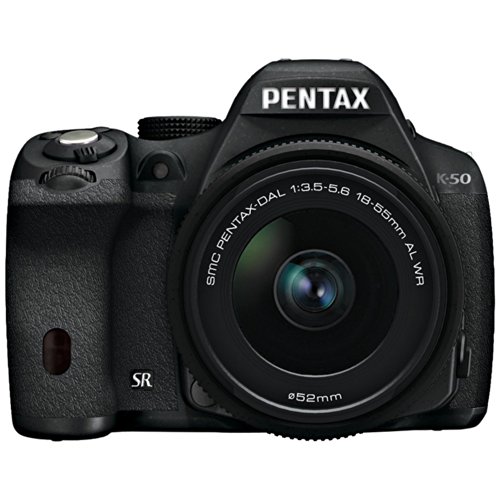
Pentax K-50 — Best weather-sealed value
The K-50 is the elder of this guide and makes no secret of it in this section: its verified listing describes a 16MP DSLR kit with the DA L 18-55mm WR lens, and that WR — weather resistant — is the headline. Body and kit lens are sealed against rain and dust to a degree nothing else in this guide attempts at a beginner price, which turns the K-50 into the camera for the beginner whose photography lives outdoors in British weather, on beaches, at festivals and on winter hillsides. Where other beginners shelter their cameras, the K-50’s owner keeps shooting, and photographs accumulate accordingly.
Pentax’s other gifts are characterful. In-body stabilisation works with every lens mounted, including the decades of inexpensive K-mount glass that make Pentax the connoisseur’s budget system; the viewfinder is a proper glass prism, brighter and clearer than the mirrors in rival beginner bodies; and the control layout, with twin dials, teaches enthusiast habits from the first month. The community around the mount is small, devoted and generous with exactly the kind of knowledge a beginner needs, and the secondhand lens shelf, while narrower than Canon’s or Nikon’s, is famously good value.
Age, however, must be priced in without flinching. The K-50 is the oldest design here: its sensor is a generation behind the others in resolution and high-sensitivity polish, its video is basic, its autofocus belongs to an earlier era, and Pentax’s modern presence in many retail markets is faint. A buyer choosing it should be choosing the sealed, prism-viewfinder, lens-value experience specifically, with eyes open about the ecosystem’s size. For the right beginner — the outdoors obsessive on a budget — it is not a compromise at all. It is the only camera in the guide built for their actual life.
- Sensor and kit: 16MP sensor with DA L 18-55mm WR lens per the listing
- Sealing: weather-resistant body and kit lens, unique at this level
- Viewfinder: glass prism, brighter than typical beginner mirrors
- Stabilisation: in-body, working with every K-mount lens
- Ecosystem: decades of affordable K-mount lenses, smaller community
Strengths
- Weather sealing lets a beginner shoot in rain without fear.
- In-body stabilisation dignifies every cheap vintage lens mounted.
- The prism viewfinder is a small luxury rivals charge more for.
Trade-offs
- The oldest sensor and autofocus in this guide, visibly so.
- Video capability is the most basic of the five linked bodies.
- The smallest ecosystem and thinnest retail presence here.
Best for: outdoor-obsessed beginners on a budget who shoot in all weather. Not suited for: beginners who want the largest community, the newest features or a video future.
The Mirrorless Alternative — Prose-only: the fork in the road
This place in the guide is held, without a purchase link, by the option a growing share of beginners should honestly take: skipping the DSLR entirely and starting on a current mirrorless system such as Canon’s RF mount, Sony’s E mount or Nikon’s Z mount. The reasoning is structural. Mirrorless is where every manufacturer’s development now lives — new bodies, new lenses, improving autofocus that tracks eyes, animals and vehicles with a certainty no DSLR here can match. A beginner starting mirrorless buys into a system that will still be releasing the lens they want in five years, and skills transfer identically, because exposure, composition and light do not care what flaps or does not flap inside the camera.
The mirrorless route’s costs are equally structural and deserve the same plain speech. Entry mirrorless kits generally cost more than the finished-generation DSLRs above, their lenses — being current — command current prices, and battery life remains a fraction of DSLR stamina, turning spare batteries from an accessory into a routine. Electronic viewfinders divide opinion: they preview exposure beautifully and tire some eyes. A beginner with a strict budget will extract more photography per unit of currency from the T7 or D3500 and their cheap lens shelves than from any living mirrorless system, and pretending otherwise to sound modern would be a disservice.
So the fork is genuine, and this guide’s counsel is to choose by horizon and budget rather than by fashion. Two or three years of learning on a fixed budget: the DSLR, bought knowingly, is the rational instrument, and its photographs will be indistinguishable from a mirrorless beginner’s. A decade-long ambition with money to grow: start mirrorless, accept the battery discipline, and let the system grow with you. Either way, refuse the middle ignorance of buying a DSLR while believing it is a current platform — that belief, and only that belief, is what this entry exists to prevent.
- Role: a signpost entry, deliberately without a purchase link
- Systems named: Canon RF, Sony E and Nikon Z as living examples
- Advantages: current development, superior subject-tracking autofocus
- Costs: higher body and lens prices, far shorter battery life
- Choose it if: the horizon is long and the budget can grow
Strengths
- A platform with new lenses and bodies still arriving.
- Eye and subject tracking autofocus that transforms keeper rates.
- Skills learned transfer perfectly; only the hardware future differs.
Trade-offs
- The most expensive route into interchangeable-lens photography.
- Battery life measured in hours demands spares and habits.
- Current lens prices lack the finished systems’ secondhand bargains.
Best for: beginners certain that photography is a long-term pursuit worth funding. Not suited for: a fixed, finite budget that needs maximum photography per coin today.
How Do the Six Options Compare?
| Option | Linked | Screen | Video character | Defining trait |
|---|---|---|---|---|
| Canon EOS Rebel T7 | Yes | Fixed | Full HD, simple | Largest beginner support universe |
| Nikon D3500 | Yes | Fixed | Full HD, stills-first | Lightest body, legendary battery |
| Canon EOS Rebel SL3 | Yes | Vari-angle touch | 4K cropped, strong Full HD | Smallest DSLR, Dual Pixel AF |
| Nikon D5600 | Yes | Articulating touch | Full HD, mic input | Step-up controls and screen |
| Pentax K-50 | Yes | Fixed | Basic | Weather sealing, prism finder |
| Mirrorless alternative | No — signpost | Varies | Current and improving | A living system with a future |
The table’s most instructive column is the last one, because each row’s defining trait is a different answer to the same question — what does a beginner actually need? Support, stamina, video manners, growth room, weather courage or a future. Notice, too, that no row wins the sensor argument, because all five linked bodies share the large-sensor leap that matters; the differences that decide satisfaction live in screens, systems and stamina, which is why this guide spends its words there.
The screen column quietly predicts daily happiness more than any specification. Fixed-screen bodies teach viewfinder discipline and cost less; articulating touchscreens open creative angles and video confidence. Beginners who know their subjects — children and pets at floor level, food from above, themselves on camera — should weight that column as heavily as any other, because a screen that cannot move will eventually refuse a photograph its owner can already see in their mind.
What Should a Beginner Understand About Lenses Before Buying the Body?
The kit lens is a beginning, not a boundary. The 18-55mm zooms bundled with every linked camera here cover the wide-to-portrait range where a beginner’s first year naturally lives, and they are better than their reputation — modern kit lenses are sharp, light and stabilised. The second lens is where a system’s character reveals itself, and for most beginners it should be a fast prime: a 50mm-class lens whose wide aperture delivers the blurred backgrounds and low-light ability that make people fall in love with interchangeable-lens photography. On the finished Canon and Nikon systems, that lens exists in plentiful, inexpensive secondhand supply; on Pentax, vintage primes offer the same lesson for even less, stabilised by the K-50’s body.
Mount literacy prevents the expensive misunderstandings. Canon’s EF-S lenses fit these DSLRs and, with adapters, some mirrorless bodies, but they are not a future-proof collection. Nikon’s DX lenses share the F mount’s long history and its finished future. Pentax’s K mount reaches back decades, which is its charm and its limit. None of this should frighten a beginner whose horizon is the learning years — a lens bought cheaply, used for two years of photographs and sold for most of its price has cost less than a streaming subscription — but it should be known, in writing, before the third lens rather than after it.
Can a beginner explore telephoto and macro subjects without serious money?
On these finished systems, remarkably yes — and this is where the end-of-format economics become a beginner’s quiet superpower. Modest telephoto zooms that bring a child’s football match or a garden bird within reach circulate secondhand at prices that would buy a phone case in a current system, because thousands of owners are selling them as they migrate. Macro curiosity can be satisfied even more cheaply with close-up accessories and reversing rings that turn the kit or prime lens into a microscope of sorts, teaching focus discipline at millimetre scales. Wildlife and macro specialists eventually outgrow such improvisation, but a beginner’s first year of curiosity should be fed at these prices, not starved by flagship ones. The finished systems’ shelves are, in effect, a lending library that charges a small deposit — buy the lens, learn the genre, sell it onward if the passion fades, and the education has cost almost nothing but time.
How long will these DSLRs remain usable and supported?
Usable, for many years: a DSLR has no subscription to expire, no app to be delisted, and its failure points are mechanical and repairable by independent technicians long after official service winds down. Batteries and chargers for these popular models circulate widely, memory cards are universal, and the files are standard formats every future computer will open. Supported is the softer word — firmware updates have ended, official parts will thin over the decade — but a beginner’s realistic horizon sits comfortably inside the cameras’ practical lifespan. The format is finished; the cameras are not, and the distance between those two statements is exactly where their value lives.
How do printing and sharing work from a camera without modern apps?
Beginners raised on phones sometimes imagine a DSLR’s photographs are trapped inside it, and the truth is more old-fashioned and more robust. The Wi-Fi and Bluetooth features in these bodies move images to a phone well enough for sharing, if with more patience than a modern mirrorless demands, and the memory card — read by any computer, tablet or print kiosk on earth — remains the most universal transfer mechanism photography has ever had. Printing deserves emphasis, because a DSLR’s large-sensor files print beautifully at sizes a phone’s cannot sustain, and beginners who print their best frame each month learn composition faster than those who scroll past a thousand. The photograph on the wall is the curriculum’s diploma, and every body in this guide can produce it from the first week.
Is a used DSLR an even better beginner bargain?
Often, yes, and this class is where the used market shines brightest: shutter counts are checkable, bodies are durable, and finished systems keep prices gentle. The checks are mechanical and learnable — fire the shutter at several speeds, inspect the sensor with a small-aperture shot of a plain wall, work every dial, and confirm the kit lens focuses quietly and zooms smoothly. Buy from sellers who describe honestly and accept returns, and a used T7 or D3500 may be the single best value in all of photography education. This guide’s linked listings remain the recommendation for buyers who want a warranty’s peace, but the used route deserves its blessing here.
What Does an Optical Viewfinder Teach That a Screen Does Not?
The DSLR’s defining piece of glass is worth a section of its own, because it shapes the photographer’s education in ways that persist long after the camera is replaced. Looking through an optical viewfinder, a beginner sees the scene itself — not a processed preview of it — with the focus point glowing in a field of real light. That directness teaches anticipation: the decisive moment must be imagined before it happens, because the viewfinder offers no replay of what the exposure will look like, only the scene and the photographer’s judgement of it. Generations of photographers consider that discipline the foundation of their eye, and its absence from mirrorless cameras is the one loss their converts still mention with genuine nostalgia.
The practical dividends are immediate. An optical finder never lags, never blacks out the world at the crucial instant in the way early electronic finders could, never drains the battery while its owner composes, and remains readable in the brightest sunlight that washes out rear screens. For beginners photographing sport, wildlife or children — subjects whose gift is unpredictability — the finder keeps them inside the scene rather than watching it on television. The K-50’s glass prism finder is the finest expression of this in the guide, and even the humbler mirrors in the Canon and Nikon entries deliver the essential experience faithfully.
Honesty requires the counter-ledger, because the electronic viewfinder’s advantages are real and growing. It previews exposure, white balance and depth of field before the shutter fires, overlays focus aids and histograms, and shows exactly the file the sensor will write — a teaching tool of the first order, and one reason mirrorless beginners’ keeper rates climb so quickly. The DSLR beginner learns exposure by review and reasoning; the mirrorless beginner learns it by preview. Neither education is counterfeit. They produce slightly different instincts — anticipation versus verification — and a beginner choosing between this guide’s five bodies and its prose-only sixth is, whether they know it or not, choosing which instinct to build first.
How Should a Beginner Spend the First Month With a DSLR?
Week one belongs to automation with attention. Shoot in the camera’s intelligent auto or program mode, but review every photograph asking one question — what did the camera choose, and do I agree? Read the exposure information under your images until shutter speed, aperture and sensitivity stop being vocabulary and start being a story about light. Carry the camera daily, even briefly; the D3500 and SL3 were designed to make that easy, and frequency teaches faster than intensity.
Week two isolates aperture. Switch to aperture-priority, photograph the same subject at the widest and narrowest settings, and watch backgrounds melt and sharpen — the single most magical lesson in photography, delivered by your own hands. Week three isolates shutter speed at anything that moves: water, traffic, children, the dog. Week four puts the camera in full manual for one deliberate outing, slowly, with permission to fail, because manual mode’s real gift is not control but comprehension: after it, every automatic decision the camera makes becomes legible. By the month’s end, the guide modes and scene settings will feel like training wheels on a bicycle you can already ride — which was always their purpose.
Which Beginner DSLR Mistakes Waste the Most Money?
Buying a DSLR believing it is a growing platform is the mistake this guide has circled from its first paragraph, and it wastes money in a specific way: the buyer over-invests in lenses for a finished system at new prices, expecting a future that the manufacturers have publicly moved away from. The same lenses bought secondhand, for a defined learning period, are bargains. The camera was never the trap; the story told about the camera was.
Skipping the second lens is the quieter waste. Beginners who shoot only the kit zoom for a year often conclude that they lack talent, when what they lack is a fast prime’s aperture — the blurred portrait, the candlelit dinner, the night street — that makes photography feel like revelation rather than documentation. Budget for the prime when the body is bought, even if it arrives a month later as a reward for the first month’s practice, and the hobby’s survival odds improve more than any accessory could manage.
The third mistake is buying for the photographer you wish to be instead of the one your calendar permits. The weather-sealed K-50 serves no one in a studio apartment’s portrait practice; the video-minded SL3 is wasted on a landscape purist; the featherweight D3500’s charms are lost on a tripod-bound macro specialist. The five linked bodies are temperaments with sensors attached, and the beginner who matches temperament to actual Tuesdays, rather than to aspirational Sundays, is the one still shooting in year two.
How Does Each Camera Fit a Different Beginner’s Life?
Consider the student first, because beginners so often are. Their budget is a fixed pool, their subjects are friends, campus, part-time jobs and the occasional trip home, and their camera competes for bag space with books and a laptop. The D3500 was practically designed in their image: light enough to carry by default, frugal enough with batteries to survive a forgotten charger, and paired with a lens shelf whose secondhand prices respect a student’s arithmetic. The T7 runs it close and wins whenever the student’s course involves video coursework or the campus camera society happens to be Canon-flavoured, because borrowing lenses from friends is a real economic system and matching the local majority mount is a legitimate strategy.
The parent beginner presents the opposite profile: money a little easier, time brutally scarce, subjects overwhelmingly children in motion and in mixed light. For them the SL3’s touchscreen and Dual Pixel focus, or the D5600’s articulating screen, convert directly into kept photographs — grandparents at floor level, school plays from the aisle, the toddler who will not repeat the moment for a better angle. Battery stamina matters less than focus forgiveness, because their sessions are short and their subjects are merciless. This is also the beginner most tempted by mirrorless eye-tracking, and the prose-only entry was written with their honest alternative in mind.
The outdoors beginner — hiker, angler, gardener, storm-watcher — should read the K-50’s section twice and the others once. Their photography happens in weather, at dawn, with gloves, and the camera that survives and operates in those conditions will outproduce a technically superior body left in the car. Pentax’s sealed kit, prism finder and stabilised vintage primes form a coherent philosophy for that life, and its smaller community is disproportionately populated by exactly such shooters, which makes its forums a better school for them than larger, more general ones.
Finally, the deliberate learner — the beginner who has read this far and is building a curriculum — should choose by lens economics and teaching materials. Canon’s Rebel line offers the deepest library; Nikon’s pair offers Guide Mode and the D5600’s growth room; both offer a secondhand prime for the price of a family takeaway. What the deliberate learner must not do is postpone the purchase in search of a perfect answer, because the first hundred hours of practice teach more than the next hundred hours of research, and every camera in this guide is sufficient for those hours. Sufficiency, promptly used, beats optimality indefinitely deferred.
What does a complete starter kit actually include beyond the camera?
Less than retailers suggest, but more than the box contains. A memory card of honest speed and capacity is the only true necessity beyond the kit itself. A second battery matters for the mirrorless route and barely for these DSLRs, whose stamina is their legend. A bag that fits the camera with the prime mounted encourages carrying, which is the whole game. A microfibre cloth, a rocket blower for dust and a printed cheat-sheet of the exposure triangle complete the working kit; filters, tripods and flashguns should all be bought in response to a specific frustration encountered while shooting, not in anticipation of one imagined while shopping. Beginners who follow that rule arrive at month six with equipment that maps their actual photography, rather than a cupboard mapping their anxieties.
How should a beginner divide a fixed budget between body and lenses?
As a rough discipline that has served generations: the body and kit lens take the majority, the fast prime claims the next slice as soon as the first month’s practice justifies it, and nothing else is bought until the photographs themselves file a request. On the finished systems in this guide, that discipline goes unusually far, because the secondhand shelves are deep — a portrait prime, a wider zoom for interiors, even a modest telephoto for wildlife curiosity can each be added for less than a mirrorless system’s single current lens. The budget’s enemy is not any individual purchase but the belief that the next purchase is the one that unlocks the photography. The first prime genuinely does unlock something. Almost nothing after it unlocks anything comparable until technique, not glass, becomes the limit — and technique is free, which is the best news in this entire guide.
Final Recommendation
For the beginner who wants the surest start, buy the Canon EOS Rebel T7 and a fast prime lens, and spend the savings on photographs — travel, prints, time. For the beginner who will carry the camera everywhere and shoot stills above all, the Nikon D3500’s weight and stamina make it the connoisseur’s choice. The SL3 serves the video-leaning beginner, the D5600 the ambitious one, and the K-50 the weatherproof romantic, each with its caveats stated in its section and none of them hidden. And if the horizon is long and the budget can grow, take the prose-only entry’s advice and start mirrorless without a backward glance. What no beginner should do is buy any DSLR in this guide — or anywhere — believing the format has a future it has already honourably completed; bought as what it is, a finished masterpiece of a teaching instrument at a finished format’s prices, a beginner DSLR remains one of the wisest first cameras money can buy.
One practical closing note: whichever body you choose, buy it in time to use it this week, and take it somewhere that matters to you within the first seven days — a family lunch, a familiar walk shot deliberately, a friend’s portrait in kind light. Cameras become teachers only when they are present for real occasions, and the beginner who bonds with the instrument early will forgive its finished format everything. The photographers who started on Rebels and D3000-series bodies a decade ago are today’s professionals and devoted amateurs; their cameras’ lack of a future never limited them, because the future was in the photographer all along, and a camera that teaches honestly for three years, across seasons and subjects and steadily improving hands, has repaid its price in the only currency that a beginner should be counting: photographs they are proud to have made, and the skill to make better ones on whatever system comes next.
Frequently Asked Questions
Are DSLRs obsolete for a beginner in 2026?
As a product category, the development has ended; as tools, they are anything but obsolete. A T7 or D3500 takes the same photographs it took when it was current, its files open everywhere, and its lenses are cheaper than ever. Obsolescence matters to manufacturers’ roadmaps and to buyers building decade-long systems. For a beginner buying a teacher for the next few years, a finished format at finished prices is a rational bargain rather than a relic.
Will my DSLR lenses work on a future mirrorless camera?
Sometimes, with adapters, and with caveats that vary by system. Canon and Nikon both built adapters that carry many of their DSLR lenses onto their mirrorless mounts with autofocus intact, though the smaller DSLR-format lenses may cover only the cropped area of larger sensors. Treat adaptability as a pleasant possibility rather than a plan: buy DSLR lenses for the photographs they will take on the DSLR, at prices that make sense even if they never mount anything else.
How many megapixels does a beginner actually need?
Every linked body here has more than enough. The 24-megapixel-class sensors in the Canon and Nikon entries print large, crop generously and resolve far beyond a beginner’s technique for the first year; even the K-50’s 16 megapixels produce beautiful prints at sane sizes. Technique, light and lenses will limit a beginner’s photographs long before pixel counts do, which is why this guide spends its words on screens, systems and stamina instead. There is a related trap worth naming while we are here: the beginner who crops every photograph severely in editing and concludes the camera lacks resolution, when the honest diagnosis is framing — the feet were not used, the zoom was not turned, the moment was taken from too far away. A 24-megapixel file forgives a modest crop gracefully, and learning to fill the frame in the camera, rather than rescuing it afterward, is worth more resolution than any sensor upgrade on any roadmap, living or finished.
Is the 4K video on the Rebel SL3 worth choosing it for?
Only with the crop understood. The SL3’s 4K mode narrows the field of view substantially, which makes desk-distance recording with the kit lens impractical and pushes most owners to its excellent Full HD mode for everyday video. Choose the SL3 for its touchscreen, its Dual Pixel autofocus and its size — a genuinely modern DSLR package — and treat 4K as a special-purpose extra for distant subjects, not as the reason for the purchase.
Which of these cameras is best for a child or teenager learning photography?
The D3500 and the T7 share the honour, for different reasons. The D3500’s Guide Mode actively teaches and its light weight suits smaller hands on long days; the T7’s enormous tutorial universe means a young photographer can find a video answering any question in seconds. Either, paired with a fast prime and a parent willing to print the good frames, has started more photographic lives than this guide can count. For younger children whose interest is real but whose care standards are still developing, the calculus shifts toward value and replaceability: a used body from the cheaper end of either system, bought with the checks described in this guide’s used-camera section, teaches the same lessons with a smaller catastrophe attached to the inevitable drop. Photography learned young compounds for a lifetime, and a first camera’s job is to survive long enough to be outgrown — a job these durable, unfashionable bodies were practically engineered to perform.
Should a beginner worry that shops will stop stocking DSLR lenses?
Not on any horizon that matters to a first camera. The finished Canon and Nikon systems left behind one of the largest secondhand markets in consumer technology, stocked by decades of production and by owners migrating to mirrorless and selling excellent glass gently. Retailers continue to list the popular primes and zooms, rental houses hold deep inventories, and the sheer installed base guarantees a long twilight of availability. A beginner’s realistic lens collection — kit zoom, fast prime, perhaps a modest telephoto — will be findable at fair prices for many years, which is precisely the timescale a first camera is bought for. The same depth of supply covers the unglamorous essentials that keep a camera working: batteries from reputable third parties, chargers, remote releases, straps and bags all exist in abundance for these high-volume models, and camera shops that have serviced Rebels and Nikon DX bodies for a decade will not forget how because a roadmap changed. A beginner is buying into an installed base, not a product launch, and installed bases decay over decades rather than seasons.
Related Guides
Beginners weighing their next step may also find our guide to the best cameras streaming useful, since several of its bodies double as excellent second cameras, and our survey of the best point and shoot waterproof cameras covers the rugged companion a DSLR should never be asked to imitate.
Related guides
- Best Affordable Android Tablets: Five True Android Slates and One Fire OS Specialist, Clearly Labelled
- Best 400 FPS High Speed Cameras: The Honest Truth About Burst Slow Motion
- Best Kids Smartwatches for Texting and Calling: Six Watch-Phones Under Parent Control
- Best Fast Charge Qi Wireless Chargers: Qi2 at 15W and Qi2.2 at 25W


