What's inside
- Where to buy
- Key Takeaways
- Quick Picks
- How did we judge machines where every dollar is visible?
- The picks in detail: best 600 dollar gaming laptops, compromises named and priced in honesty
- What can an RTX 3050 laptop honestly play?
- Why is the memory upgrade such a theme of this tier?
- How do you stretch a budget laptop’s gaming life?
- What should parents and gift-buyers know about this tier?
- What is daily life with a budget gaming laptop actually like?
- How do the three Victus models really differ, and why are there three?
- What about connecting a monitor, and other grown-up tricks?
- How does this tier handle school, work and everything between games?
- What should you check in the first fortnight?
- Why does this tier exist at all, in a world of consoles and cloud gaming?
- How will these machines age, and what does year three look like?
- A short guide to reading any budget gaming listing like a professional
- What about the secondhand shortcut at this budget?
- One last thought on value, from the cheap seats
- Comparison table
- What mistakes do buyers at this level keep making?
- Final Recommendation
- Frequently Asked Questions
- Related Guides
As an Amazon Associate I earn from qualifying purchases. This post may contain affiliate links at no extra cost to you.
gizmoverdict.com is reader-supported. When you buy through links on our site, we may earn an affiliate commission.
Where to buy
Amazon is the natural hunting ground for the best 600 dollar gaming laptops, because this tier — described throughout in qualitative budget terms, never by an individual machine’s price tag — lives on configuration churn: the same Victus or TUF name can cover three different processors and two different memory amounts in a single week of listings. That churn is why every pick below links to one specific configuration and why this guide will keep telling you to read the configuration line like a contract. At this level of spending, the difference between a bargain and a disappointment is rarely the brand. It is the small print, read or unread.
Let us set expectations with the honesty this tier deserves. Around this budget, a gaming laptop is a negotiated settlement between your library and physics. You will not maximise the newest releases; you will play an enormous catalogue — esports, indies, the great games of the last decade and a good share of the current one — at 1080p with settings chosen by a grown-up. Screens will be fast but not colourful. Memory will sometimes arrive at 8GB and ask for an upgrade. Plastics will be plastics. And yet, chosen well, these are real gaming machines with real graphics cards, not office laptops in a costume, and for a first gaming laptop, a younger player’s machine, or a household’s second computer, they can be exactly the right amount of computer.
The six picks here share a discipline: each one spends its limited money on the graphics card and the screen refresh rate first, and each one’s compromises are named in its own section rather than averaged away. Three of them are HP Victus variants, which is not laziness — the Victus line dominates this tier because HP prices it aggressively in several configurations — and the guide distinguishes those three carefully, because their processors and memory differ in ways that matter. Two ASUS TUF models bring the durability argument, and one AMD-graphics Victus brings a genuinely different silicon choice that its section treats with complete candour.
Key Takeaways
- The graphics story of this tier is the RTX 3050: a real ray-tracing card with DLSS that plays the catalogue at 1080p, provided settings are chosen sensibly.
- The top Victus pick is the only machine here with 16GB of memory fitted, and that single line of its specification is worth more than any processor badge in this list.
- Most picks ship with 8GB of memory; all of them can be upgraded, and planning that upgrade is part of buying correctly at this level.
- The AMD-powered Victus uses a Radeon RX 6550M, an entry-level mobile GPU positioned for esports and lighter titles — a legitimate choice, described here at its true level rather than by any seller’s comparison claims.
- Every pick has a 144Hz screen except where noted, because at this tier a fast panel is the cheapest large pleasure available.
- Screens in this class trade colour richness for refresh rate; if you edit photos for money, this is not your tier, and the guide will not pretend otherwise.
Quick Picks
| Pick | Badge | Why it is here |
|---|---|---|
| HP Victus 15 (Core i5-12450H) | The Complete Package of the Tier | The only pick with 16GB of memory fitted, alongside an RTX 3050 and a 144Hz screen — the fit-and-forget choice here. |
| HP Victus 15 (Core i5-12500H) | Strongest Processor Variant | A twelve-core-class Intel chip with an RTX 3050 and 8GB of memory, for buyers whose non-gaming work is as demanding as their games. |
| ASUS TUF Gaming A15 (Ryzen 5) | Toughest Build at the Level | The TUF line’s durability focus and a 144Hz screen wrapped around an RTX 3050, for laptops that travel in school bags. |
| HP Victus 15 (Radeon RX 6550M) | The AMD Alternative | An entry-level Radeon GPU with FreeSync Premium on a 144Hz screen — an honest esports and light-gaming option, at its true level. |
| ASUS TUF A15 (Ryzen 7) | Most Processor Muscle in a TUF | A Ryzen 7 with an RTX 3050 for players whose second workload — editing, streaming, coursework — leans on the CPU. |
| HP Victus Gaming 15 (Core i5-13420H) | Newest Intel Variant | The most recent Intel chip of the three Victus models, with an RTX 3050 and the tier’s standard 8GB caveat. |
How did we judge machines where every dollar is visible?
At this level the judging inverts: instead of asking what a machine has, you ask what it chose not to have, and whether the choice was wise. The wise cuts are consistent across our picks. Manufacturers saved on chassis materials, on speaker quality, on screen colour coverage and on the fancier species of port, and they spent on the graphics card, a 144Hz panel and a processor that will not embarrass either. The unwise cuts — the ones that excluded machines from this list — are equally consistent: a last-generation integrated-graphics machine wearing gaming stickers, a 60Hz screen in 2026, memory soldered at 8GB with no path upward, or a graphics card from two generations ago at this generation’s money.
The RTX 3050 deserves a fair hearing, because it anchors five of the six picks. It is an entry-level card of its generation, with 4GB of video memory in its common laptop form, hardware ray tracing that is more checkbox than experience at this level, and — its saving grace — DLSS upscaling, which in supported games buys back the headroom its raw power lacks. At 1080p with medium-to-high settings it plays the great majority of the catalogue enjoyably, and in esports titles it is simply more than enough. The RX 6550M in the AMD Victus is judged in its own section at its own level: an entry mobile Radeon for esports and lighter gaming, with the advantage of FreeSync on its paired screen.
Memory was the third judge, and the harshest. Eight gigabytes is this tier’s standard compromise, and we kept 8GB picks only where the chassis allows an upgrade — which, across these six, it does — and where the rest of the specification justified the errand. The one 16GB pick tops the Quick Picks for a reason that has nothing to do with favouritism: it is the only machine here that asks nothing further of its buyer. Storage is 512GB across the board, which is this tier’s other known quantity: enough to begin, small enough that library management becomes a hobby within the year, and expandable in most of these chassis when that day comes.
The picks in detail: best 600 dollar gaming laptops, compromises named and priced in honesty

HP Victus 15 (Core i5-12450H) — The Complete Package of the Tier
Start with the line of specification that decides this tier: this Victus carries 16GB of memory. Around it, the rest of the machine is the class formula executed properly — a Core i5-12450H with its mix of performance and efficiency cores, an RTX 3050 for the gaming, a 512GB PCIe SSD, Wi-Fi 6, a backlit keyboard and a 15.6-inch FHD screen at 144Hz. Nothing in that list is exotic, and that is precisely the point. This is the configuration a knowledgeable friend would assemble for you at this budget if they had to answer for it in a year: no hero component, no starved one, and the one upgrade this tier usually demands already done at the factory.
In use, that balance shows up as an absence of asterisks. Games load from the SSD at modern speeds, Windows multitasks without the swapping stutters that haunt 8GB machines with a browser open, and the 3050 — fed properly and cooled by the Victus’s competent dual-fan design — delivers its honest 1080p performance hour after hour. The Victus styling helps the machine’s second life as a school or work laptop: it looks like a laptop, full stop, and can sit in a classroom or a meeting without performing its hobby. If your buying temperament is to choose once and stop researching, this is the pick the rest of the list is measured against.
- Display: 15.6-inch FHD 144Hz panel
- Processor: Intel Core i5-12450H
- Graphics: NVIDIA GeForce RTX 3050
- Memory and storage: 16GB memory, 512GB PCIe SSD
- Connectivity: Wi-Fi 6, backlit keyboard
- Character: the tier’s one fit-and-forget specification
Strengths
- 16GB of memory fitted — the tier’s decisive advantage
- Balanced specification with no component left behind
- Understated design suits school and work as well as play
Trade-offs
- RTX 3050 sets a real ceiling in the newest, heaviest titles
- Screen colour coverage is the class’s usual economy grade
- 512GB storage will need managing as the library grows
Best for: first-time buyers, students and gift purchases where the machine must simply work, completely, from day one.
Not suited for: players set on high settings in this year’s most demanding releases.
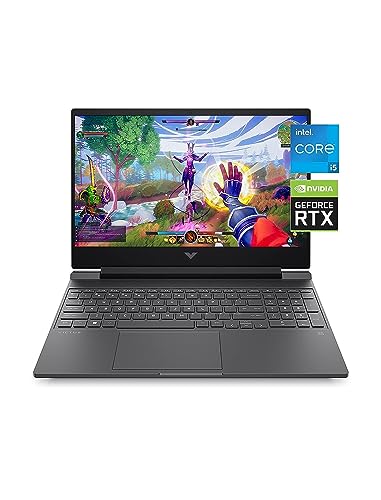
HP Victus 15 (Core i5-12500H) — Strongest Processor Variant
The second Victus in the list differs from the first in a way that looks like an upgrade and is, in one specific direction. Its Core i5-12500H is the stronger processor — a twelve-core design that out-muscles the 12450H in multi-threaded work — paired with the same RTX 3050, the same 512GB of storage and the same FHD gaming screen. The exchange is memory: this variant ships with 8GB where its sibling ships with 16GB. Whether that trade suits you depends entirely on what the laptop does when it is not gaming. For coursework that involves virtual machines, for a hobbyist editor, for the household power user who keeps forty tabs and three applications alive, the stronger processor is a daily pleasure — once the memory has been upgraded to feed it.
That last clause is the honest centre of this pick. An i5-12500H behind 8GB of memory is a racehorse on a short tether in multitasking, even though games themselves, run tidily, remain comfortable. The Victus chassis makes the upgrade a screwdriver job, and this guide’s position is simple: buy this variant if the processor matters to you, and schedule the memory upgrade in the same breath. Bought that way, it is arguably the most capable machine in the list. Bought as-is and never opened, it is a slightly frustrated version of its sibling above, which is why the sibling, not this one, wears the tier’s top badge.
- Display: 15.6-inch FHD gaming panel
- Processor: Intel Core i5-12500H, twelve cores
- Graphics: NVIDIA GeForce RTX 3050
- Memory and storage: 8GB memory, 512GB SSD
- Design: Victus chassis with backlit keyboard, Windows 11 Home
- Character: processor-rich, memory-poor — one planned upgrade from excellence
Strengths
- Strongest Intel processor in this guide
- Same honest 3050 gaming core as the top pick
- Upgrade path is simple and inexpensive when the time comes
Trade-offs
- 8GB of memory limits the processor’s multitasking advantage until upgraded
- Screen and speakers are class-standard economies
- Requires an owner’s intention to open it, sooner or later
Best for: power users and older students whose non-gaming work is processor-heavy and who will do the memory upgrade.
Not suited for: buyers who want the finished article out of the box with no errands attached.

ASUS TUF Gaming A15 (Ryzen 5) — Toughest Build at the Level
The TUF argument at this tier is not about frames; it is about survival. ASUS builds the TUF line to a durability standard, tests it accordingly, and sells it to exactly the people whose laptops fall off sofas, ride in school bags and get borrowed by siblings. Inside this A15 the specification is the class formula with an AMD accent: a Ryzen 5 7535HS, an RTX 3050, 8GB of DDR5 memory and 512GB of Gen 4 storage, driving a 15.6-inch FHD screen at 144Hz. The Ryzen chip is a six-core part with a reputation for efficiency, which gives this machine comparatively civilised manners away from the wall socket for its class.
Set the TUF beside the Victus models and the choice clarifies. The Victus machines are the better pure value on paper in most weeks; the TUF is the better bet for a hard life, with a chassis that feels screwed together by people who expected it to be dropped. Its 8GB of memory carries the tier’s standard caveat and the same simple remedy, and its screen, while fast, shares the class’s modest colour coverage. For a younger player’s first gaming laptop — the machine most likely in this entire guide to be treated roughly by its loving owner — the TUF’s construction is not a luxury. It is the feature the whole purchase will be remembered by.
- Display: 15.6-inch FHD 144Hz panel
- Processor: AMD Ryzen 5 7535HS
- Graphics: NVIDIA GeForce RTX 3050
- Memory and storage: 8GB DDR5 memory, 512GB PCIe Gen 4 SSD
- Build: TUF durability-focused chassis, Wi-Fi 6
- Character: the survivor of the tier
Strengths
- Durability-focused build for bags, desks and younger owners
- Efficient Ryzen processor gives it good manners unplugged
- 144Hz screen and Gen 4 storage keep it feeling modern
Trade-offs
- 8GB of memory, with the tier’s usual upgrade advice attached
- RTX 3050 ceiling in the heaviest current titles
- Utilitarian styling will not win design awards
Best for: younger players, students in shared houses and anyone whose laptops lead a physical life.
Not suited for: buyers chasing the last frame per unit of money in a safe, static desk setup.

HP Victus 15 (Radeon RX 6550M) — The AMD Alternative
This Victus is the list’s genuinely different machine, and it deserves a description at its true level, without borrowed glory in either direction. Its graphics are AMD’s Radeon RX 6550M, an entry-level mobile GPU built for esports and lighter gaming: think of it as a card for League of Legends, Counter-Strike, Rocket League, Minecraft, older AAA titles and the indie catalogue, played at 1080p with settings chosen sensibly. It is not a rival to the RTX 3050 machines here for heavy modern releases, and any suggestion otherwise — including comparative claims that appear in seller titles for this model — should be discounted. What it is, honestly, is a coherent budget gaming chip paired with one real advantage: the 15.6-inch FHD IPS screen runs at 144Hz with AMD FreeSync Premium, so in the games this card plays best, motion is tear-free and smooth in a way that flatters the whole machine.
The supporting specification is familiar Victus: a Ryzen 5 7535HS, 8GB of DDR5 memory, a 512GB SSD and the same understated chassis as its siblings. The buying case is specific. If your library is esports and lighter titles, if you value the FreeSync screen, and if this configuration is the one priced kindly on the day you shop, it is a legitimate and enjoyable machine. If your ambitions run to the newest big releases, the RTX 3050 picks exist precisely for you, and this section’s candour is intended to route you to them rather than to let a seller’s headline route you here. Different is not worse; different is a direction, and directions should be chosen knowingly.
- Display: 15.6-inch FHD IPS 144Hz with AMD FreeSync Premium
- Processor: AMD Ryzen 5 7535HS, six cores
- Graphics: AMD Radeon RX 6550M — entry-level mobile GPU for esports and lighter titles
- Memory and storage: 8GB DDR5 memory, 512GB SSD
- Design: Victus chassis with backlit keyboard
- Character: the all-AMD alternative, honestly positioned
Strengths
- FreeSync Premium screen makes its best games look effortlessly smooth
- All-AMD platform with an efficient six-core Ryzen
- Victus build and manners shared with its RTX siblings
Trade-offs
- Entry-level GPU sits below the RTX 3050 picks for demanding games
- No DLSS; upscaling options are AMD’s, with thinner game support at this level
- 8GB of memory carries the tier’s standard caveat
Best for: esports and lighter-library players who like the all-AMD route and the FreeSync screen.
Not suited for: players whose ambitions centre on the newest, heaviest releases.

ASUS TUF A15 (Ryzen 7) — Most Processor Muscle in a TUF
The second TUF in the list takes the first one’s formula and spends its difference on the processor: a Ryzen 7 7435HS, an eight-core chip that gives this machine the strongest AMD CPU in the guide, paired with the same RTX 3050, 8GB of DDR5 memory, 512GB of storage and 144Hz FHD screen as its Ryzen 5 sibling. Who is that for? The player whose laptop moonlights: the student editing coursework video, the hobbyist streaming their sessions, the home user whose photo library and spreadsheets are not light duties. In games alone the two TUFs are near-identical, because the 3050 sets the ceiling for both; outside games, the Ryzen 7’s extra cores are felt every day.
One specification of this chip deserves a buyer’s attention, stated neutrally: the 7435HS is a performance part without the integrated-graphics frugality of some rivals, so this machine’s unplugged endurance is the modest end of the class, and it is best thought of as a desk-and-sofa laptop that occasionally travels rather than a lecture-hall marathoner. Its 8GB of memory, again, is the tier’s standard promissory note, redeemable with a screwdriver. Judged as a whole — TUF toughness, eight honest cores, a real graphics card, a fast screen — it is the pick for the buyer whose second workload is the deciding vote.
- Display: 15.6-inch FHD 144Hz panel
- Processor: AMD Ryzen 7 7435HS, eight cores
- Graphics: NVIDIA GeForce RTX 3050
- Memory and storage: 8GB DDR5 memory, 512GB PCIe SSD
- Connectivity: Wi-Fi 6, Windows 11
- Character: TUF toughness with the guide’s strongest AMD processor
Strengths
- Eight-core Ryzen 7 excels at editing, streaming and coursework
- TUF build quality for a machine that will be moved and used hard
- Balanced gaming core with a fast 144Hz screen
Trade-offs
- Unplugged endurance is the modest end of this class
- 8GB of memory until you perform the standard upgrade
- Gaming performance matches, rather than beats, its Ryzen 5 sibling
Best for: creator-students and streamers whose non-gaming work justifies processor muscle.
Not suited for: buyers who need long battery life away from a socket for lectures or travel.

HP Victus Gaming 15 (Core i5-13420H) — Newest Intel Variant
The third Victus completes the trio with the newest Intel silicon of the three: a Core i5-13420H, an eight-core 13th-generation chip, driving an RTX 3050 with 8GB of DDR4 memory and a 512GB NVMe drive behind a 15.6-inch FHD 144Hz screen. Read that specification with this guide’s eyes and two details stand out. The processor is modern and entirely sufficient — in games it will not be the limit, because the 3050 is. And the memory is DDR4 rather than the DDR5 fitted to most rivals here, a small economy that matters less for today’s performance than for the feel of the specification: this is the Victus line trimmed to its essentials, current chip, honest card, fast screen, nothing decorative.
Its role in the list is the role of the sensible third option. If the 16GB Victus is unavailable and the 12500H variant is priced unkindly, this is the configuration that keeps the Victus proposition — balanced, understated, properly cooled — within reach, with the same single homework assignment as most of the tier: memory, when you can, taking it to the level the rest of the machine deserves. Buyers choosing among the three Victus models should decide by the two lines that actually differ — how much memory arrives fitted, and which processor suits their second workload — and ignore everything else, because everything else is the same well-judged laptop wearing three slightly different hearts.
- Display: 15.6-inch FHD 144Hz panel
- Processor: Intel Core i5-13420H, eight cores, 13th generation
- Graphics: NVIDIA GeForce RTX 3050
- Memory and storage: 8GB DDR4 memory, 512GB NVMe SSD
- Design: Victus chassis, Windows 11 Home
- Character: the essentials-only Victus with the newest Intel chip
Strengths
- Current-generation Intel processor with ample gaming headroom
- The balanced Victus formula intact: cooling, screen and design
- Straightforward upgrade path for its one thin specification
Trade-offs
- DDR4 memory where most rivals here fit DDR5
- 8GB fitted, with the tier’s usual upgrade advice
- No advantage over its siblings for a pure gamer beyond availability
Best for: buyers who find this variant kindly priced, or who prefer the newest Intel platform in the Victus line.
Not suited for: buyers who can get the 16GB Victus instead — that machine remains the tier’s finished article.
What can an RTX 3050 laptop honestly play?
More than its critics admit and less than its marketers promise, and the honest map looks like this. Esports titles — the games with the largest player counts on earth — run at high frame rates that fill these 144Hz screens, which is why this tier exists in such volume. The great single-player games of the last decade run at 1080p with high settings in most cases, because they were built for hardware of this class or weaker. Current releases run with medium-to-high settings and DLSS in quality mode, and the heaviest handful ask for medium and a tolerant owner. Ray tracing, at this level, is a screenshot feature rather than a gameplay one; leave it off and the card’s real virtues — DLSS, efficiency, price — carry the experience.
The 4GB of video memory in the common laptop 3050 is the boundary that will arrive first, showing up as texture settings that must ease downward in the newest titles. That is a graceful degradation, not a cliff: games remain playable and good-looking, with the settings page asking for a little more humility each year. Owners who understand that contract get three to four good years from this tier. Owners who expected a flagship get a disappointment that was printed, in fairness, on the specification sheet all along — which is why this guide keeps translating specification sheets into expectations.
Why is the memory upgrade such a theme of this tier?
Because 8GB is where the modern software stack starts queueing. Windows itself, a browser with real tabs, a chat application and a game together press against the limit, and when memory runs out the machine borrows from the SSD, which is slower by orders of magnitude and announces itself as stutter — in games, as hitching at exactly the moments of action; in work, as a general sense that the laptop is thinking about something else. Sixteen gigabytes removes the queue entirely at this performance level, which is why the guide treats the upgrade not as enthusiast tinkering but as the completion of the purchase, and why the one machine that arrives complete wears the top badge.
The practicalities are kind. In these chassis the memory sits under a bottom panel in standard slots; the job takes minutes, the part is among the cheapest in computing, and matching the existing stick’s speed keeps everything simple. If opening a laptop is beyond your confidence, a repair shop will do it while you wait, for a fee that keeps the total economics of this tier intact. What matters is not who turns the screwdriver but that the plan exists before the frustration does — ideally, written into the purchase decision itself, as several sections above keep insisting.
How do you stretch a budget laptop’s gaming life?
With settings literacy, which is free. Learn the three adjustments that buy frames at the lowest visual cost in almost every game: shadow quality down one notch, volumetric effects down one notch, and DLSS or resolution scaling engaged before anything else is touched. Cap the frame rate a little below the screen’s maximum in fast games for steadier pacing. Keep the machine’s rear vents unobstructed and its underside lifted — a stand, or a book under the back edge while you test the theory — because a cool 3050 is a faster 3050. Update the graphics driver through NVIDIA’s app a few times a year, not weekly, and skip the driver releases that your games do not need.
And manage the library like the 512GB reality it is. Keep the current rotation installed, archive the rest to an external drive if you own one, and resist the screenshot-and-clip hoarding that fills drives with forgotten gigabytes. A budget laptop rewards an owner with habits; it is, in the end, a machine that trades money for attention, and the attention is mostly pleasant — the ordinary craft of looking after a tool that looks after your evenings.
What should parents and gift-buyers know about this tier?
That it is the right tier for a first gaming laptop, and that the choice within it should be made on completeness rather than excitement. A young player’s machine will be carried, dropped, borrowed and filled with a library that changes monthly; it will also do homework, and it will be expected to last years rather than seasons. The 16GB Victus is the gift that needs no follow-up. The TUF models are the gifts that survive the lifestyle. The 8GB machines are fine gifts only when the giver also gives the upgrade — fitted by a shop before wrapping, ideally — because a child should receive a finished laptop, not a project with a ribbon on it.
Set the machine up before it is given, if you can: accounts created, the games library started, the manufacturer’s bloat pruned, a backup arranged, and the parental or family settings of the platform configured while the mood is generous. The first evening with a first gaming laptop is a memory a person keeps, and it is better spent playing than updating. That small kindness is available at every tier, but it matters most here, where the machines ask a little more of their owners and repay it so well when they get it.
What is daily life with a budget gaming laptop actually like?
Noisier than an office laptop and prouder than its price suggests, in roughly equal measure. Under a demanding game every machine here makes itself heard — these are twin-fan designs moving real heat — though through the headset every owner should own, the sound vanishes from the experience entirely. The keyboard decks warm under load, the big exhausts breathe on the desk behind them, and the power bricks, while not the monsters of the flagship tier, are still bricks. None of this is a defect; it is the sound and warmth of a real graphics card earning its keep, and owners acclimatise within a week.
Away from games, the compromises rearrange themselves. Battery life as ordinary laptops is respectable rather than remarkable — a school day of notes and browsing is achievable with brightness discipline, a full day of lectures is a hope rather than a plan, and gaming unplugged is a brief, throttled novelty on every machine in this class, so judge endurance by coursework, not by play. Weight sits in the honest middle: carryable daily without resentment, noticeable by Friday. The screens, fast but colour-modest, are at their best exactly where their owners live — in games — and at their most ordinary in bright rooms and photo work. A budget gaming laptop, in short, is a machine with its priorities worn openly, and there is something likeable about a product that knows what it is for.
How do the three Victus models really differ, and why are there three?
Because HP builds the Victus as a range, not a model, and retailers stock whichever configurations the season produced. Strip the three in this guide to their differences and the picture is simple. The i5-12450H machine is the complete one: slightly older processor, full 16GB of memory, nothing owed. The i5-12500H machine is the processor play: the strongest Intel chip here, halved memory, an upgrade owed. The i5-13420H machine is the current-platform play: the newest Intel generation, DDR4 memory where its siblings use DDR5 in some configurations, and the same upgrade owed. Everything else — the RTX 3050, the 512GB drive, the Victus cooling and design — is shared DNA.
The decision procedure follows from that anatomy. If the machine will be used as it arrives for years, take the complete one. If its owner multitasks heavily and will open the bottom panel, take the processor play. If availability or a kind configuration price points at the newest chip, take it without anxiety, because the gaming experience across all three is fraternal rather than hierarchical. What you should not do is choose by the size of the number in the processor’s name alone, which is how a buyer ends up with the strongest chip in the list and the weakest daily experience — a parable this tier teaches with unusual consistency.
What about connecting a monitor, and other grown-up tricks?
This tier docks better than its reputation suggests. An RTX 3050 drives a 1080p external monitor without complaint, and the laptop’s own fast screen becomes the second display — chat, a guide, a stream dashboard — that makes a small desk feel like a command centre. Use the HDMI port, tell the system which display is primary, and keep the laptop’s vents clear in its docked position, because a machine suffocating against a wall will throttle in the middle of the evening’s best moment. A simple hub gathers the mouse, keyboard and monitor into one plug, and for a student whose laptop migrates between desk, library and home, that one-plug ritual is worth more than any single specification in this article.
There is a longer game here, too. A budget gaming laptop that docks well becomes the family computer, the homework machine and the living-room games box in succession as its owner upgrades over the years. The picks with honest port selections and standard memory and storage slots age into those second roles gracefully. Buying for the first role alone is natural; buying with the second roles in peripheral vision is wisdom, and it costs nothing at the moment of purchase except the minute it takes to check a port list.
How does this tier handle school, work and everything between games?
Competently, which is the underrated headline. Every processor in this list — the Intel i5s, the Ryzen 5s, the Ryzen 7 — is a genuinely capable chip for documents, browsing, spreadsheets, video calls and the creative coursework of a school or college life. The graphics cards accelerate the creative applications that support them. The keyboards are full-size and backlit, the webcams adequate for the calls they will actually join, and the designs — the Victus models especially — are anonymous enough for any room. The two honest limits are battery endurance, covered above, and screen colour, which matters only if the work is colour-critical.
That competence is why this tier, and not the one below it, is the correct answer for the combined-use purchase. A cheaper machine with integrated graphics does the schoolwork identically and the gaming not at all; a pricier machine does the gaming better and the schoolwork identically. The machines here are the joint in the curve where both jobs are done properly by one device, and for households counting devices rather than frames, that joint is the most valuable point in the entire laptop market. Buy it knowingly, upgrade its memory where needed, and it will be the hardest-working object in the house.
What should you check in the first fortnight?
The return window is the buyer’s laboratory, and at this tier it matters doubly, because budget machines vary more from unit to unit than flagships do. Begin with the screen under solid colours: dead pixels and blotchy backlight are swap-now findings. Play the most demanding game you own for an hour and listen — a smooth fan note is health, a rattle or a surge is a conversation to have while the conversation is still free. Type a full page, plug something into every port, take one video call, and sleep and wake the machine across several days, since sleep faults are the cockroaches of modern laptops: common, persistent and far easier to exchange than to exorcise.
Then verify the machine against its own listing. Open the system information and confirm the processor, the graphics card, the memory amount and the storage size are the ones you paid for, because configuration mix-ups at this tier are frequent, usually innocent and always easier to resolve in week one than in month two. Run the battery through one ordinary day of your real use and note the result; that number is your baseline, the figure future-you will compare against when wondering whether the machine has faded. Keep the box until the window closes. None of this requires expertise — only the decision to inspect while inspection is powerful, which is the closest thing this entire guide has to a moral.
Why does this tier exist at all, in a world of consoles and cloud gaming?
Because it does three things neither alternative does. It plays the PC catalogue — the mods, the indies, the strategy games, the decades of back catalogue that never reach a console — on hardware you own outright, with no subscription standing between you and your library. It doubles, without apology or accessory, as the computer for school, work and household life, which neither a console nor a streaming stick attempts. And it teaches its owner the transferable craft of PC gaming: settings, drivers, upgrades, maintenance — the literacy that makes every future machine cheaper to own and easier to choose. For a young player especially, that education is not a side effect of the purchase. Arguably, it is the purchase.
Cloud gaming deserves its sentence: it is a fine way to sample heavy titles on light hardware, and a poor substitute for owning the machine when the connection falters, the subscription lapses or the library rotates. The laptops in this guide ask for money once and attention occasionally, and in return they are simply yours — on a train with no signal, in a house with contested bandwidth, in a country where the service never launched. At this tier that ownership argument is at its strongest, because the alternative ways of spending the same money each surrender something — a catalogue, a second job, or permanence — that these six machines keep.
How will these machines age, and what does year three look like?
Year three for a well-kept machine from this tier looks better than its critics predict. The esports and back-catalogue core of its library plays exactly as it did on day one, because those games do not move. The newest releases ask for medium settings and DLSS, and get them. The battery has lost a slice of its youth, the fans have been cleaned twice, the memory — if it started at 8GB — was upgraded long ago and the machine multitasks like a richer laptop. What has not happened is the failure people fear: the graphics card has not become obsolete in any absolute sense, because the catalogue it was bought for still exists and still delights. Gaming laptops age by library, not by calendar, and a library chosen honestly ages slowly.
The end-of-life paths are kind, too. A tier like this produces the classic hand-me-down: the machine that taught one player the craft becomes a younger sibling’s first laptop, a parent’s household computer, a living-room box for party games on the television. Standard parts and openable chassis make those second lives practical rather than sentimental. When you buy at this level you are not buying a disposable appliance; you are buying the first chapter of a long household service record, and the small disciplines this guide keeps repeating — the upgrade, the cleaning, the backup, the kept box — are what write the later chapters well.
A short guide to reading any budget gaming listing like a professional
Everything in this article generalises, and it is worth stating the method once, plainly, because you will meet listings this guide has never seen. Read a budget gaming listing in a fixed order and stop the moment an answer fails. First, the graphics card: a discrete card of a known class, or the listing is not a gaming laptop at all. Second, the memory: how much, and can it grow. Third, the screen: resolution and refresh rate, both stated, or the omission is the statement. Fourth, the storage: enough to begin, and a path to more. Fifth, the processor: last, because at this tier it is the component least likely to be your problem and most likely to be the advertisement’s hero.
Then apply the two sanity checks that catch what specifications hide. Search the model name alongside the words ‘review’ and ‘teardown’ and spend ten minutes with people who have opened the machine; the upgrade paths, the fan character and the screen quality will all be documented by someone. And read the seller’s own returns terms before the seller’s own superlatives, because the terms are the part of the listing written by lawyers rather than by hope. A buyer armed with that order of reading is, for practical purposes, unhurried and unfooled — and in this tier, where the spread between the best and worst use of the same money is wider than anywhere else in the laptop market, being unfooled is worth more than any single component you could buy.
What about the secondhand shortcut at this budget?
Every buyer at this level eventually asks whether the same money buys more machine secondhand, and the honest answer is: sometimes, with homework. An older flagship — the previous generation’s mid-range, a well-kept RTX 3060 laptop — can outplay everything in this guide, and the inspection discipline described in our guide to the 3070 generation applies to it word for word. What the secondhand route surrenders is the warranty, the certain battery and the returns window, and what it demands is exactly the inspection labour that a first-time buyer may not yet know how to perform. For an experienced owner, it is a legitimate and often brilliant route. For a first gaming laptop, a gift, or a school requirement with a deadline, the new machines here — warranted, returnable and complete — are the wiser spend. Choose the route that matches the inspector, not just the money.
One last thought on value, from the cheap seats
There is a tendency, in technology writing, to treat the budget tier as a waiting room for the real products. A year of evenings with machines like these corrects that snobbery. The catalogue they play is most of the catalogue that exists; the screens they carry are faster than the flagships of a few years ago; the craft they teach their owners is the real craft of the hobby. If the six machines in this guide share a virtue beyond their specifications, it is that none of them is pretending. Each is a known quantity of computer for a known quantity of money, with its compromises printed where its buyer can read them — which, in a market fluent in exaggeration, is a form of respect.
Comparison table
| Pick | Graphics | Screen | Memory / Storage | Defining trait |
|---|---|---|---|---|
| HP Victus 15 (i5-12450H) | RTX 3050 | 15.6-inch FHD 144Hz | 16GB / 512GB | Only fit-and-forget specification here |
| HP Victus 15 (i5-12500H) | RTX 3050 | 15.6-inch FHD | 8GB / 512GB | Strongest Intel processor variant |
| ASUS TUF A15 (Ryzen 5) | RTX 3050 | 15.6-inch FHD 144Hz | 8GB / 512GB | Durability for hard lives |
| HP Victus 15 (RX 6550M) | Radeon RX 6550M | 15.6-inch FHD IPS 144Hz FreeSync | 8GB / 512GB | Entry AMD GPU for esports and light titles |
| ASUS TUF A15 (Ryzen 7) | RTX 3050 | 15.6-inch FHD 144Hz | 8GB / 512GB | Strongest AMD processor in a TUF |
| HP Victus 15 (i5-13420H) | RTX 3050 | 15.6-inch FHD 144Hz | 8GB DDR4 / 512GB | Newest Intel variant, essentials trim |
What mistakes do buyers at this level keep making?
The first is buying a machine with a gaming name and no gaming card — integrated graphics in a colourful chassis — which this list exists to prevent. The second is the mirror error: chasing a stronger processor badge while accepting 8GB of memory and never upgrading it, so the machine stutters through its whole life with a fine engine and no fuel. The third is believing seller superlatives about entry-level graphics, including comparative claims in listing titles; a card is what it is, and this guide has described each one at its level. The fourth is ignoring the screen’s refresh rate, the one luxury this tier reliably affords. And the fifth is spending the whole budget on the laptop and nothing on the mouse, the stand and the eventual memory stick that complete it. Every one of these mistakes is a failure of the same kind — reading the advertisement instead of the specification — and every one is avoidable in the ten minutes before you pay.
Final Recommendation
Buy the 16GB Victus if you can: it is the only machine here that arrives finished, and finished is worth a great deal at this level. If its configuration is out of reach, choose by life rather than by logo — the TUFs for rough handling and processor-heavy second jobs, the other Victus variants for their processors, the AMD Victus for an esports library and its lovely FreeSync screen — and write the memory upgrade into the plan wherever 8GB appears. Do that — read the configuration line, check the machine in its first fortnight, keep its box until the window closes, and clean its fans before they ask you to — and the laptop that arrives will not be a cut-down apology for gaming but a small, honest machine that plays far more of the catalogue than its tier has any right to, on evenings that belong entirely to you.
Frequently Asked Questions
Can a laptop at this level really be called a gaming laptop?
Yes, with the definition stated plainly: it has a discrete graphics card, a fast screen and the cooling to use both, and it plays the majority of the PC catalogue enjoyably at 1080p. What it is not is a flagship, and the guide’s whole effort has been to keep that line bright and uncrossed.
Is the Radeon RX 6550M as fast as an RTX 3050?
No, and this guide will not pretend otherwise. The RX 6550M is an entry-level mobile GPU positioned below the 3050, intended for esports and lighter titles, where it performs enjoyably and where its FreeSync screen shines. Seller titles sometimes imply more; judge the card by its class, as its section here does.
How soon will I need the memory upgrade on an 8GB model?
For gaming alone with a tidy system, you may be comfortable for a while; for gaming alongside browsers, chat and coursework, you will feel the limit within weeks. Treat the upgrade as part of the purchase and the question answers itself — the machine becomes the one it should have been.
Will 512GB of storage be enough?
Enough to start, not enough to forget. A handful of large modern games plus the operating system and a normal life of files will fill it inside a year or so. Most of these chassis accept more storage later, and an external drive archives the back catalogue cheaply in the meantime.
How long should a laptop from this tier last?
Three years of enjoyable service is a fair expectation, more for esports and back-catalogue players. Settings will ease gradually in new releases; the memory upgrade and a fan cleaning in year two are the two acts that most extend its prime.
Should I wait for a sale, or buy the configuration I need when I find it?
Buy the configuration, not the calendar. This tier’s listings rotate constantly, and the exact variant you need — the right card, the right memory, the right screen — is worth more than a seasonal discount on a variant that misses one of those lines. If a sale happens to meet the right configuration, take it with both hands; if it offers you the wrong machine at a kind price, let it pass, because you will live with the machine for years and with the saving for a week.
Related Guides
Widen the view before you decide: step up to the next budget tier of gaming laptops to see what the extra money removes from the compromise list, browse the neighbouring tier just above this one for its RTX 4050 machines, and read our affordable laptops with gaming capabilities guide for the models that split the difference between work and play.



[…] out your shortlist with best 1080p gaming laptops for the resolution-first view of this market, best 14 inch laptop gaming laptops if portability […]