What's inside
- Where to buy
- Key Takeaways
- Quick Picks
- How did we choose these six drafting tables?
- What should you check before choosing a tilting art table?
- Which tilt angle suits which kind of artwork?
- How do you care for glass and wooden tops differently?
- How do the best adjustable art desks compare side by side?
- How do you set up a drafting station that stays comfortable?
- Which mistakes do first-time drafting table buyers make?
- What accessories actually earn their place on a drafting table?
- Final Recommendation
- Frequently Asked Questions
- Related Guides
As an Amazon Associate I earn from qualifying purchases. This post may contain affiliate links at no extra cost to you.
gizmoverdict.com is reader-supported. When you buy through links on our site, we may earn an affiliate commission.
Where to buy
All six of the best adjustable art desks in this guide are sold through Amazon in the United States, and each detailed section below links straight to the listing we checked, so the top material, the tilt range and the drawer count you read about are the ones attached to that exact product. One further model, the SD Studio Designs Futura Station, is discussed in prose further down because it suits a narrower kind of studio corner, and it carries no link here.
Anyone shopping for the best adjustable art desks usually arrives with a sore neck and a flat kitchen table to blame. Drawing flat forces a constant hunch: the shoulders roll forward, the page sits at a reading distance that suits novels rather than pencil work, and after an hour the lower back starts filing complaints. A tilting top changes the geometry of the whole session. The work rises toward your eyes instead of dragging your head down toward the paper, the forearm rests at a natural angle, and media that misbehave on the flat — charcoal dust, loose pastel, pooling watercolour — suddenly behave differently, for better or worse, which is exactly why the tilt mechanism deserves more scrutiny than the styling.
Adjustability in this category actually means three separate things, and listings blur them deliberately. First comes top tilt, the headline feature, which on these six tables runs from a gentle reading slope to a near-easel steepness. Second comes overall height, fixed on most of the picks and genuinely adjustable on one. Third comes the small stuff that decides whether a table earns its floor space: drawers that swallow pencils without swallowing the budget, a lip that stops a pen rolling into the void, casters that let the whole station migrate toward the good window light in winter. This guide separates those threads for six tables that approach the same job from genuinely different directions — glass against wood, split tops against single slabs, bundled stools against bring-your-own seating.
A quick honesty note about surfaces before the picks. A glass top feels wonderful under a pen, cleans to a squeak with one wipe, and doubles as a light surface when a lamp or pad sits beneath it, but it refuses most clamps and shows every fingerprint in afternoon sun. A wood-effect MDF top grips paper more kindly, accepts a clamp lamp along its back edge, and forgives the knife slips that would leave glass owners wincing. Neither material wins outright; the right answer depends on whether your art leans toward ink and tracing or toward paint, cutting mats and general craft chaos. Keep that fork in mind, because the six picks below split almost evenly along it.
Key Takeaways
- Tilt does the heavy lifting on every table here, so judge the hinge and the locking positions before admiring the finish or the drawer fronts.
- Glass tops wipe clean and welcome light from underneath, while MDF tops accept clamps and treat paper more gently during heavy pencil pressure.
- Only the Yaheetech, ZENY and VECELO listings here bundle a stool, so seating is a separate purchase beside the other three tables.
- The Studio Designs Graphix II splits its top, letting one half stay flat for a laptop or reference tablet while the drawing half tilts.
- Drawers matter more than they look in photographs: shallow pencil trays and deep supply drawers solve entirely different storage problems.
Quick Picks
| Pick | Badge | Why it earns its place |
|---|---|---|
| VECELO Drafting Table | Complete starter station | Two drawers and a bundled stool make this the quickest route from empty corner to working art setup. |
| Yaheetech Adjustable Drafting Table | Deepest tilt range | Its MDF top swings through a stated 0 to 60 degrees, the widest arc among the six tables compared. |
| Landpink Glass Drafting Table | Glass-top value route | A clear glass surface at the calmer end of the category, suited to ink work and tracing alike. |
| Athena Collection Glass Drafting Table | Moves on casters | Rolling feet let this grey-framed glass table chase daylight around a room instead of anchoring one spot. |
| ZENY Adjustable Drafting Table with Stool | Outlet on board | A built-in power outlet keeps a desk lamp or charger fed without trailing cables across the studio floor. |
| Studio Designs Graphix II Pro Line | Split-top specialist | Height adjustment plus a divided worktop serves illustrators who mix screens with traditional media daily. |
How did we choose these six drafting tables?
We started from the questions readers actually ask after their first month with a cheap drawing board: does the top stay where it is set, does the frame wobble when an eraser works hard, and where do the pencils live between sessions? Every candidate had to offer a genuinely tilting worktop, because a fixed flat desk wearing an art label helps nobody. Beyond that gate, we weighted the quality of the tilt hardware, the usefulness of the included storage, and whether the listing describes its own product honestly — a table that admits its top is MDF earns more trust than one hiding behind stock photography of a walnut slab.
Variety was the second filter. Six near-identical black steel frames would make a tidy table and a useless guide, so the final six deliberately span the category’s real branches: two glass tops with different mobility stories, two MDF-topped stations with bundled stools, one split-top design from a specialist drafting brand, and one value glass model for smaller rooms. Where a listing states a figure — a tilt arc, a worktop measurement — we repeat it as the maker’s own claim rather than dressing it up as our measurement. Where a listing stays silent, on weight capacity for instance, we say nothing instead of inventing a reassuring number.
The Futura Station from SD Studio Designs deserves its prose mention here. It is a well-known glass drafting design with a folding shelf arrangement that many small-studio artists love, and readers cross-shop it against the Landpink and Athena picks constantly. In this guide it sits outside the linked six because its folding-shelf layout answers a slightly different question — how to fold a station away — while the six detailed picks all assume the table stays up and working. If your studio corner must vanish when guests arrive, research the Futura alongside these; if the table lives permanently in place, the six below are the sharper comparison.
What should you check before choosing a tilting art table?
Measure your steepest working angle against your media. Pencil and ink tolerate, even enjoy, a dramatic slope; a loaded watercolour wash does not, because gravity edits your painting in real time. If you paint wet, favour tables whose tilt locks at shallow increments rather than offering two positions called flat and steep. Charcoal and pastel artists face the opposite calculation: a steeper top sheds dust away from the sheet instead of letting it settle into the tooth of the paper, which is one reason traditional drafting tables lean so far.
Then look at the ledge. Every tilting top needs a retaining lip along its lower edge to hold paper, boards and the occasional runaway pen, and the lip’s height matters more than its looks. A lip that stands too proud digs into the forearm during long sessions; one that sits too shy lets a heavy sketchbook slide at the worst moment. Photographs in listings rarely show the lip in profile, so read the detailed sections below for which picks build the ledge into the frame and which treat it as an afterthought, and plan on a strip of grip tape or a drawing board with its own clip if your favourite pick skimps here.
Paper size deserves a mention of its own, because it silently eliminates half the catalogue for some artists. If your work lives on A4 and letter sheets, every top here swallows it with room for tools beside the page. If you draw on A3 or half-sheet watercolour blocks, start checking the tilting area specifically rather than the overall width, since side shelves and split sections inflate headline measurements. And if you work truly large, be honest that a drafting table may serve as your preparation and detail station while the biggest sheets still belong on a wall easel or a flat plan chest — furniture chosen for the work you do most beats furniture bought for the exception.
Finally, walk the room in your head. A drafting table at full tilt is a tall object; check the swing of the top against shelves, sloped ceilings and the arc of a nearby door. Glass models with casters forgive a bad first placement. Fixed MDF stations punish it, because moving them means emptying drawers and recruiting a second pair of hands. The honest sequence is tape on the floor first, purchase second — unglamorous advice that has saved more studios than any single product feature.

VECELO Drafting Table — Complete starter station
The VECELO arrives aimed squarely at the artist setting up a first dedicated corner, and its pitch is completeness: a tilting top, two storage drawers beneath it, and a stool included in the same box, so the distance between delivery day and first sketch is measured in assembly minutes rather than further shopping trips. The drawers sit under the work surface where they belong, close enough that a pencil swap never requires standing, and their presence shapes the whole character of the piece — this is a station that expects to hold your materials permanently, not a bare frame waiting for you to solve storage separately.
In daily use the VECELO’s appeal is how little it asks you to think about furniture. The tilt handles the standard drafting repertoire — sketching, inking, light watercolour on a board — and the bundled stool, while basic, is height-matched to the table in a way a random kitchen chair rarely is. Artists upgrading from a dining table will notice the drawers most: the slow migration of tools into the station, the clearing of the worktop at the end of a session, the small pleasure of a surface that starts each morning empty. Its limits are the limits of its class. The frame is light rather than monumental, so lean hard on a corner while erasing and you will feel the structure think about it, and the drawers favour pencils, tubes and small pads over bulky sketchbooks.
Consider who shares this table across a week. In a household where a teenager does homework at it on weekdays and a parent sketches at weekends, the VECELO’s drawers quietly arbitrate: one side accumulates pencils and rulers, the other keeps the art tools from migrating into school bags. The tilt mechanism asks for a deliberate hand when you change angles, which suits that shared rhythm — nobody knocks it out of position brushing past with a mug. It also assembles into a recognisably finished piece of furniture rather than a kit of parts, so it sits comfortably in a living-room corner where a raw steel frame would argue with the sofa. For a first station bought with mixed duties in mind, that domestic politeness is a genuine feature, not a compromise dressed up.
- Worktop: tilting drawing surface with a raised lower edge to hold boards and loose sheets
- Storage: two drawers built into the body beneath the worktop
- Seating: matching stool included in the box, per the listing
- Frame: metal supports under a wood-tone top, styled for home studios
- Best setting: a permanent corner in a bedroom, spare room or shared studio
Strengths
- Everything needed to start working arrives together, including the seat most rivals leave off the list.
- Under-top drawers keep daily tools within arm’s reach without eating any of the drawing surface.
- The station footprint suits spare-room corners where a full studio desk would dominate.
Trade-offs
- The bundled stool is a starting point rather than long-session seating, so serious sitters will upgrade it eventually.
- A lightweight frame asks for a gentle hand during vigorous erasing or heavy leaning.
- Drawer depth suits hand tools and small pads, not large-format sketchbooks or portfolio cases.
Best for: new art students and returning hobbyists who want one purchase to create a working station. Not suited for: artists who lean their full weight into large sheets or need archival-scale flat storage.

Yaheetech Adjustable Drafting Table — Deepest tilt range
Yaheetech publishes the number most drafting shoppers hunt for and most listings hide: its MDF worktop tilts from flat through to 60 degrees, a range the listing states plainly and one that covers everything from flat craft work to a near-easel posture for charcoal. That breadth matters because tilt preference is personal and evolves; a beginner who draws at twenty degrees in January may ink at forty-five by June, and a table with intermediate stops grows with its owner instead of being outgrown. The wood-tone MDF surface suits that journey too, gripping paper with a friction glass cannot offer and shrugging off the craft-knife work that shares many home studios.
The supporting cast is thoughtfully chosen. Storage drawers ride beneath the top, and a stool comes in the box, so like the VECELO this is a complete station — but the Yaheetech tilts the balance toward the top itself rather than the bundle. In practice the MDF surface is the one to choose if a clamp lamp lives on your desk, because the edge takes a clamp the way glass edges should not be asked to. Homework, pattern drafting and mixed-media collage all sit comfortably on this surface, which explains why the listing name-checks schoolwork alongside art. The honest caveats: MDF edges dislike repeated soaking, so wet media belongs on a board, and the tilt hardware rewards a two-handed adjustment rather than a one-handed yank mid-drawing.
There is a learning curve worth naming. Sixty degrees is steeper than most newcomers expect, and the first session at full tilt can feel like drawing on a lectern while your paper threatens to slide into your lap. Start shallow, raise the top a notch each week, and let your wrist adapt; within a month most artists settle into a personal band they return to for each medium. The Yaheetech supports that experiment better than rivals with two or three fixed stops, because its range invites exploration instead of prescribing an answer. Students heading toward architecture or technical illustration courses will also appreciate how naturally the steep settings suit ruler-and-compass work, where looking straight down the page distorts the geometry you are trying to keep honest.
- Worktop: MDF surface on a metal frame, tilting through a stated 0 to 60 degree range
- Storage: drawers integrated under the worktop for tools and materials
- Seating: stool bundled with the table, according to the listing
- Surface character: matte and grippy, friendly to clamps and cutting mats
- Typical work: drawing, crafts, pattern work and homework sharing one surface
Strengths
- The published tilt arc is the widest here, giving real choice rather than a token slope.
- MDF takes clamp lamps, cutting mats and heavy pencil pressure without complaint.
- Drawers plus stool make it a self-contained station for a student’s room.
Trade-offs
- Wet media needs a board between painting and top, since MDF edges and standing water are poor companions.
- Adjusting the tilt is a deliberate two-handed job, not a mid-stroke gesture.
- The wood-tone finish shows ring marks and knife scores more readily than glass shows anything.
Best for: students and multi-craft households wanting one surface that swings from homework flat to drawing steep. Not suited for: painters who work directly in standing water or anyone wanting a light-box effect through the top.
Landpink Glass Drafting Table — Glass-top value route
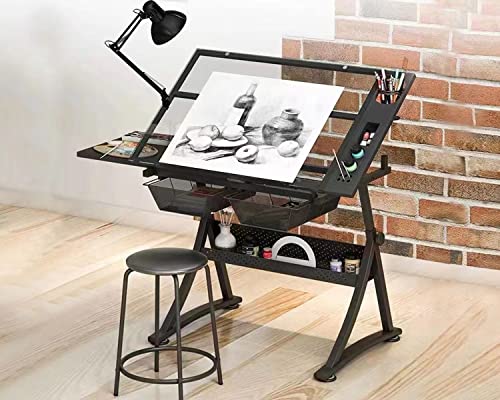
The Landpink makes the case that a glass drafting top does not have to arrive dressed as professional studio equipment with a price of admission to match. Its clear glass worktop delivers the qualities glass devotees actually care about: a surface that wipes from inky to spotless in seconds, a cool smoothness under pen and brush pen, and the option of sliding a light source beneath the sheet for tracing work. Positioned as an artwork and craft station for home studios, it strips the formula back to frame, glass and tilt, and lets the money you do not spend go toward the materials you will actually consume.
Living with glass teaches small rituals. A sheet of paper behaves differently here — it glides, which inking artists love and heavy-handed pencil users sometimes chase across the surface — and a drawing board or a sheet of backing card becomes standard kit. Clamps are off the menu; a gooseneck lamp needs a floor stand or a nearby shelf instead of biting the top’s edge. In exchange, cleanup after ink, gouache or glue is genuinely trivial, and the transparent top keeps a small room feeling open where a solid slab would loom. The Landpink does not bundle a stool, so budget and plan for seating you already own or choose separately, and treat its storage story as minimal: this table is a surface first, and your shelves and caddies do the rest.
Tracing deserves a fuller word, because it is where this table quietly outclasses wooden rivals costing similar money. Lay a reference under the glass, place a small lamp or light pad on the floor or a low shelf beneath, and the image ghosts through a fresh sheet with enough clarity for clean line work — the daily bread of tattoo flash preparation, pattern transfer for embroidery, and redrawing rough animation frames. No, the effect is not as even as a dedicated light box, and thick watercolour paper will defeat it entirely. But for the thin papers most tracing uses, the Landpink folds a second tool into the furniture you already own, and in a small flat that kind of double duty is how a studio survives at all.
- Worktop: clear glass panel with an adjustable tilt for drawing and drafting
- Frame: studio-style supports finished to suit home craft rooms
- Surface character: non-porous, fast to clean after ink or paint sessions
- Seating: no stool named in the listing, so plan your own chair
- Tracing: transparent top pairs naturally with a light placed underneath
Strengths
- Glass shrugs off ink, glue and paint that would permanently mark a wooden top.
- The see-through surface doubles as a tracing aid with any lamp positioned below.
- A pared-back specification keeps the focus, and the spend, on the working surface itself.
Trade-offs
- Paper slides more freely than on MDF, so boards or backing sheets become everyday necessities.
- Clamp-on lamps and vises have no safe purchase on a glass edge.
- Storage and seating are your own problem to solve around the table.
Best for: ink artists, calligraphers and tracers who prize a cleanable surface above built-in storage. Not suited for: heavy erasers, clamp-lamp devotees or anyone wanting drawers in the same purchase.

Athena Collection Glass Drafting Table — Moves on casters
Most drafting tables make one decision for you — where the studio is — and enforce it for years. The Athena Collection table in grey declines to do that. Its rolling casters turn the station into something that migrates: toward the window for morning watercolour light, against the wall when the room hosts dinner, into a patch of winter sun that the fixed desk across the room never reaches. Combined with a tilting glass top and built-in storage, that mobility makes the Athena the pick for renters, shared rooms and anyone whose creative space is borrowed from another purpose every evening.
The glass top brings the familiar glass virtues — instant cleanup, tracing potential, a surface that feels cool and precise under a pen — while the storage built into the frame answers the obvious objection that a mobile station sheds its supplies every time it moves. Yours travel with the table. The grey finish reads calmer and more contemporary than the black steel that dominates this category, which matters in a room that must also pass as a living space. The mobility bargain has two honest costs. Casters and hard floors are natural partners, while thick carpet makes rolling a negotiation, and any wheeled station needs its brakes or wheel locks respected before you lean into a detailed passage — a rolling table that creeps mid-line teaches the lesson once, vividly.
Think about seasons, because that is where the casters stop being a novelty. Summer mornings might put the best light by an east window that doubles as a breakfast spot; winter pushes usable daylight into a south-facing corner that hosts the Christmas tree in December. A fixed station picks one compromise and lives with it for years, while the Athena renegotiates monthly. The built-in storage keeps that renegotiation painless, since the pencils, boards and current project travel inside the furniture rather than in a tote bag you must pack each time. Artists working in rented rooms with strict no-marks rules also gain something subtle: a station that rolls never needs wall anchors, shelf brackets or any of the fixings that landlords itemise on deposit day.
- Worktop: tilting glass surface in a grey-finished frame
- Mobility: rolling casters fitted as standard equipment
- Storage: built into the frame so supplies travel when the table moves
- Assembly: presented by the maker as straightforward for home setup
- Room fit: shared spaces, rentals and studios that reconfigure often
Strengths
- Wheels convert light-chasing and room-sharing from fantasies into daily habits.
- Onboard storage means the station stays complete wherever it currently sits.
- The grey palette blends into living rooms better than industrial black frames.
Trade-offs
- Deep carpet blunts the mobility that justifies the design in the first place.
- Wheel locks must become a reflex before detailed work begins.
- Glass still rules out edge clamps, so lighting needs a floor or shelf solution.
Best for: renters and multi-use rooms where the art corner must earn its place every single day. Not suited for: carpeted studios or artists who plant a station once and never move it again.

ZENY Adjustable Drafting Table with Stool — Outlet on board
The ZENY’s signature is a small rectangle of plastic that changes daily life more than most headline features: a built-in outlet on the workstation. A lamp plugs in where you work. A phone charges beside the sketchbook instead of migrating to a distant wall socket. Anyone who has tripped over the cable strung between a drafting table and the room’s only conveniently placed outlet understands instantly why this matters, and the ZENY builds the rest of its station — tilting top, storage drawers, included stool — around that quietly practical centre.
As a working surface it follows the classic home drafting formula, and that is a compliment: a top that tilts for drawing and reading, drawers that keep the everyday tools corralled, and a stool in the box so the station is complete on arrival. The outlet also future-proofs the corner in small ways — a small fan in summer, a daylight lamp in winter, a charger for the tablet holding your reference photo. Two cautions keep the picture honest. A powered table still needs one cable run to the wall, so the cord problem shrinks rather than vanishes, and the outlet’s convenience invites clutter creep, with every device in the house lobbying for a place on your drawing surface. Discipline, not hardware, solves that one.
The outlet also changes which lamp you can buy. Without power at the table, artists gravitate toward battery lamps that dim by hour three of an evening session, or they accept a trailing extension lead as permanent décor. With a socket on the station itself, a proper mains daylight lamp — the kind with a long, even throw that makes colour mixing trustworthy after dark — becomes practical in corners that previously ruled it out. That single upgrade improves winter drawing more than most furniture features ever will. Just keep the cable discipline the design deserves: route the table’s own lead along a wall, tape or clip it where feet pass, and let the short hop from outlet to lamp be the only free cable in the arrangement.
- Worktop: tilting drawing surface for art, craft and reading angles
- Power: outlet built into the workstation for lamps and chargers
- Storage: drawers under the top for everyday art supplies
- Seating: stool included with the table per the listing details
- Setting: home offices and studio corners short on spare wall sockets
Strengths
- Power at the point of work removes the worst cable run in most small studios.
- Drawers, stool and tilt arrive together as one coherent, ready station.
- The outlet keeps a reference tablet alive through long drawing sessions.
Trade-offs
- One wall cable remains necessary, so placement still answers to the room’s sockets.
- Convenient power tempts non-art devices onto a surface meant for drawing.
- The bundled stool covers basic seating rather than all-evening comfort.
Best for: corner studios far from wall power, and artists whose lamp and tablet both live on the desk. Not suited for: minimalists who want a purely mechanical table with nothing electrical aboard.

Studio Designs Graphix II Pro Line — Split-top specialist
Studio Designs builds drafting furniture as a specialism rather than a sideline, and the Graphix II shows what that focus buys: a split top. The tilting section — a work surface the listing sizes at 39.5 by 30 inches — handles the drawing, while the adjoining flat section stays level for the things that must never slide: a laptop, a reference tablet, a mug, a pile of source books. Anyone who has watched a pencil case toboggan off a fully tilted table understands the problem this solves, and the Graphix II adds the category’s rarer second adjustment, height, so the station can be tuned to the chair and the artist rather than the other way round.
The white finish and pro-line framing give it a studio rather than bedroom character, and in use the split layout reshapes workflow in a subtle way: the flat zone becomes a genuine second workspace, so digital and traditional stages of one project coexist instead of taking turns. Tracing artists should note the top is a solid work surface rather than glass, so under-lighting tricks belong to the Landpink and Athena picks instead. The Graphix II also asks the most of its buyer in setup thought — height and tilt both need dialling in, and the divided top means your largest boards must fit the tilting section alone, not the combined width the eye first measures. No stool is bundled, which at this level reads as respect: seating this considered deserves choosing separately.
Digital-traditional hybrid work is where this design stops being a luxury and becomes the obvious tool. Picture the common modern workflow: a photograph or a 3D render glows on the laptop, the drawing develops by hand on the tilted section, and a graphics tablet waits flat for the cleanup pass. On a conventional drafting table those three stages queue for the same sloping real estate, and something always ends up balanced on a knee. The Graphix II gives each stage a home simultaneously. Comic artists inking over printed blue-line pages, illustrators checking values against a reference on screen, and students copying master drawings from a tablet all feel the benefit within the first session — and none of them would trade the flat section away again.
- Worktop: split design, tilting section listed at 39.5 by 30 inches beside a level side surface
- Adjustment: top tilt plus overall height adjustment, the broadest range here
- Finish: white frame and top with a professional studio appearance
- Seating: none included, leaving chair choice entirely to the buyer
- Workflow: traditional drawing alongside a laptop or tablet on the flat section
Strengths
- The level side surface ends the era of belongings sliding off a tilted top.
- Height adjustment lets the station fit unusual chairs, tall artists or standing breaks.
- A specialist maker’s hardware shows in smooth, deliberate tilt movement.
Trade-offs
- Oversized boards must fit the tilting section alone, which is narrower than the full top suggests.
- A solid top rules out tracing with light shone from beneath the surface.
- Two adjustments mean a longer, more thoughtful initial setup session.
Best for: illustrators blending screen reference with hand drawing who want one station tuned precisely to them. Not suited for: tracing-led workflows or buyers wanting a stool and drawers bundled in.
Which tilt angle suits which kind of artwork?
Flat is not a failure state; it is the correct setting for a surprising amount of studio work. Cutting paper, ruling long straight borders, assembling collage, mounting finished pieces and photographing your work for a portfolio all belong at zero degrees, and any table that makes flat awkward — some cheap designs never quite level out — will irritate you weekly. Treat a true, stable flat as the first test when your table arrives, before experimenting with drama.
The shallow band, roughly ten to twenty degrees, is painting country. Watercolour washes move, but slowly enough to steer; gouache stays where it is put; heavy pencil shading gains a friendlier wrist angle without the page feeling like it is escaping. Most mixed-media artists live in this band eighty percent of the time, which is why intermediate locking positions matter more than a spectacular maximum. A table that jumps from flat to forty degrees in one step forces painters to prop boards on books — a workaround that should embarrass the furniture, not the artist.
Steep settings, forty degrees and beyond, belong to dry media and the eyes. Charcoal dust falls away from the sheet instead of grinding into it. Ink lines can be judged at something close to the angle a viewer will eventually see the framed piece, which catches composition problems that hide when you stare down at a foreshortened page. Contour drawing and life-study sketches gain the most, because the hand can swing from the shoulder rather than scribbling from the wrist. The Yaheetech’s stated sixty-degree ceiling exists for exactly this work, and the Graphix II’s split layout lets you go steep while references stay level beside you.
One more angle hides in plain sight: the reading angle. Drafting tables moonlight as superb book and pattern stands, holding an open textbook or a knitting chart at lectern height while your hands work on the flat surface of a neighbouring desk or your lap. Households that sew, build models or practise calligraphy from copybooks will find this second career justifies the tilt mechanism even on weeks when no drawing happens. When you test a table in your first days, spend one session using it purely as a stand; if the lip holds a heavy book without complaint, the ledge design is sound for paper too.
How do you care for glass and wooden tops differently?
Glass asks for little but asks regularly. A microfibre cloth and ordinary glass cleaner erase a week of fingerprints, ink mist and charcoal smudge in under a minute, and that speed is precisely why ink artists forgive glass its other quirks. The real enemies are grit and point impacts: a single grain of sand dragged under a drawing board can score a line you will see forever, and a dropped metal ruler corner is the classic way these tops die. Develop the wipe-before-you-slide habit, keep a soft desk pad for heavy tools, and glass will outlast the frame beneath it.
MDF and wood-tone tops need the opposite temperament — less frequent attention, more protection in advance. A cutting mat should live on the surface permanently if knives come out even occasionally, coasters are not optional under drinks, and standing water from a rinsing jar must be wiped the day it spills, not the week after, because edges swell quietly and never fully forgive. In return the surface tolerates clamps, tape, pins at the margins and the general productive violence of a craft room. A light beeswax or furniture polish twice a year keeps the finish from looking tired, and small scores can be disguised with a wax filler stick in a matching tone.
The hardware common to both materials deserves a shared routine. Tilt hinges and locking knobs collect dust and loosen gradually; a quarterly pass with a cloth, plus a quarter-turn check on every accessible fastener, prevents the slow wobble that owners often blame on the frame. Stool joints and caster axles benefit from the same afternoon of attention. None of this is skilled work, but scheduling it — many artists tie it to changing the studio clock or swapping seasonal supplies — is what separates a station that feels solid in year three from one that creaks by Christmas.
How do the best adjustable art desks compare side by side?
| Table | Top material | Defining feature | Storage | Stool |
|---|---|---|---|---|
| VECELO Drafting Table | Wood-tone top | Complete boxed station | Two drawers | Included |
| Yaheetech Adjustable | MDF | Tilt stated to 60 degrees | Drawers | Included |
| Landpink Glass | Glass | Cleanable tracing surface | Minimal | Not included |
| Athena Collection | Glass | Casters for mobility | Built into frame | Not included |
| ZENY with Stool | Wood-tone top | Built-in outlet | Drawers | Included |
| Graphix II Pro Line | Split solid top | Split top plus height adjustment | Flat side surface | Not included |
Read the table as a map of priorities rather than a league ladder. The two glass models trade storage and clamping for surfaces that clean instantly and trace beautifully, and they divide between them on mobility: the Athena rolls, the Landpink stays. The three wood-tone stations compete on completeness, bundling drawers and stools so a beginner’s corner works on day one, and they divide on their extras — VECELO on balanced simplicity, Yaheetech on tilt range, ZENY on power. The Graphix II stands apart as the specialist’s instrument, spending its budget on adjustment and layout rather than bundles. A buyer who knows which row of that map matches their habits has effectively already chosen.
How do you set up a drafting station that stays comfortable?
Begin with the chair and work upward, because the table adjusts to the sitter and not the reverse. Sit with feet flat and thighs roughly level, then set seat height so your forearm rests on the tilted top without your shoulder hiking toward your ear. On fixed-height tables, the stool or chair does all of this work, which is why bundled stools — matched to their table by the maker — often feel righter than a taller dining chair borrowed for the purpose. If your shoulders creep upward within twenty minutes, something in that chain is wrong, and it is cheaper to fix with a cushion or footrest than with a new table.
Light comes next, and it should arrive from the side opposite your drawing hand so the hand’s shadow falls away from the line being drawn. Right-handed artists want light from the left, and both matter more than raw brightness. On glass tops, experiment with a small lamp beneath the surface for tracing sessions, then remove it for ordinary drawing so glare stays out of your eyes. Finish the setup with a parking rule: pencils live in the drawer or the ledge, never loose on a tilted plane, because gravity collects its toll in snapped leads and lost kneaded erasers with perfect reliability.
Storage layout finishes the setup. Assign the top drawer or the nearest shelf to the tools used in every session — pencils, eraser, sharpener, the three pens you actually reach for — and exile occasional supplies to deeper storage across the room. A station that opens with your daily kit already staged removes the ten-minute rummage that quietly eats sketching time, and it keeps the tilted surface itself clear for work rather than warehousing. Review the arrangement monthly; stations drift toward clutter by default, and a two-minute reset is cheaper than a Saturday excavation.
Build the habit of resetting the tilt. Flat for cutting, measuring and craft assembly; shallow for painting and heavy pencil shading; steep for ink, charcoal and long contour work. Artists who pick one angle and freeze there are using a third of the furniture they bought. A strip of masking tape on the frame, marked with your three favourite positions, turns that advice into a ten-second routine.
Which mistakes do first-time drafting table buyers make?
The classic error is buying the top and forgetting the seat. A tilting table paired with a chair at the wrong height delivers worse posture than the flat desk it replaced, because the slope brings the work closer to a body that is sitting too low. The second error is material mismatch: the watercolourist who buys grippy MDF and fights it, the inker who buys glass and then mourns every clamp they own. Both mistakes are visible in the listings before purchase, which is why the detailed sections above dwell on surfaces more than styling.
A third mistake is measuring the room with the top flat and forgetting the tilt swing, the drawer pull and the stool’s footprint behind you. A station needs an operating envelope, not just a parking space. Fourth comes overvaluing drawer count: two drawers you open daily beat five shallow ones stuffed with supplies you forgot you owned. And the final recurring error is treating the bundled stool as a lifetime seat. Bundled stools are honest starters; artists who draw for whole evenings should expect to upgrade seating within the first year, whatever table they choose.
What accessories actually earn their place on a drafting table?
Skip the accessory avalanche marketed at new studio owners and start with three things. A drawing board slightly smaller than your tilted top gives every sheet a firm, portable backing, lets you rotate work without fighting the ledge, and protects wooden surfaces from knife work. A simple lipped pencil tray that hooks or rests along the lower edge catches the tools that gravity keeps volunteering to drop. And a lamp you can position — floor-standing beside glass tops, clamp-mounted on wooden ones — will improve more drawings than any other purchase in this price neighbourhood.
After a month of real sessions, let your own annoyances write the next shopping list. If reference photos keep sliding, a small tablet stand for the flat zone or the Graphix II’s side surface solves it. If tracing becomes a weekly habit on an MDF top, a slim light pad that sits on the surface replaces the under-glass tricks of the Landpink and Athena. If your back complains despite correct heights, the money belongs in the chair, not the table. Accessories bought in that order — driven by friction you have actually felt — build a station that fits one artist precisely, rather than a catalogue photograph that fits nobody in particular.
Final Recommendation
For most readers, the Yaheetech earns the first look: its published tilt range is the broadest here, its MDF top tolerates the widest mix of media and clamps, and its drawers and stool complete the station without further errands. Choose the VECELO if a balanced, slightly gentler bundle suits a first corner better, and the ZENY if your room’s sockets are scarce and a lamp must live on the table. Glass devotees should decide between the Landpink’s simplicity and the Athena’s wheels based on whether the station ever moves. The Graphix II is the connoisseur’s answer, worth its premium in thought when screens and sketchbooks genuinely share your process. Buy the surface your media demands, respect the seat as half the purchase, and the right table will quietly disappear beneath the work — which is the highest compliment furniture for drawing can earn, because the page, not the desk, should hold your attention.
Frequently Asked Questions
Does a tilting top really help posture while drawing?
A slope brings the page closer to your natural line of sight, so most artists find they hunch less than over a flat surface, especially during long contour or inking sessions where a flat page drags the head steadily downward. It is a comfort and working-angle improvement rather than a medical fix, and chair height still does half the work: raise the seat until your forearm meets the tilted sheet without your shoulder lifting, keep your feet supported, and take standing breaks on long pieces. Artists with existing back or neck conditions should treat the table as one variable among several and take advice from a clinician rather than from furniture listings.
Can I paint watercolour on a tilted table?
Yes, at shallow angles, ideally with the paper taped to a board so the board takes the tilt hardware’s grip and the sheet itself stays removable mid-painting. Very steep angles pull washes downward, so painters should favour tables whose tilt locks at gentle positions, not just flat and steep. Many watercolourists actually exploit a slight slope deliberately, coaxing pigment toward one edge for graded skies, which is another reason intermediate stops beat a two-position hinge.
Is glass or MDF better for a first art desk?
MDF forgives more beginner behaviour — clamps, cutting, heavy pressure — while glass rewards ink and tracing work with easy cleaning. Mixed-media beginners usually settle faster on MDF; dedicated ink artists rarely miss it. If your budget allows only one table for years of mixed projects, MDF is the safer generalist, and a separate slim light pad can add tracing later.
Do these tables arrive with stools?
Only some. In this guide the VECELO, Yaheetech and ZENY listings include a stool, while the Landpink, Athena and Graphix II expect you to supply seating, so check the detailed section for your pick before assuming.
How much room does a drafting station need?
Plan for the table’s footprint plus space behind for the stool, room in front for drawers to open, and headroom for the top at full tilt — a steep sheet leans back over the frame and can meet low shelves or a sloped ceiling. Add elbow room on your drawing-hand side for the natural swing of longer strokes. Taping the outline on the floor before ordering, then miming a full session inside the tape, catches most surprises while they are still free to fix.
Can a drafting table double as a regular desk?
Every pick here flattens to serve as a writing or laptop surface, though the Graphix II does it best thanks to its permanently level side section, which never asks you to clear and re-level the drawing area just to answer an email. On single-surface models, flattening takes seconds, but build the habit of sweeping the ledge first — pencils and erasers love hiding there until the top moves. Just remember a tilted top must return to flat before anything round or liquid trusts it, and that a laptop on a freshly flattened top deserves a quick check that the tilt lock has fully engaged before you lean on the keyboard.
Related Guides
Keep exploring studio furniture and drawing gear in our companion roundups: best animation desks for light-pad tracing stations, best art desks for storage-heavy alternatives, and best adjustable desks if a full sit-stand workstation tempts you instead.
Related guides
- Best 1440p 165Hz Monitors: One Native 165Hz Pick, Three 180Hz Upgrades, an Overclock Headline and a 160Hz Ultrawide
- Best 13×19 Professional Printers
- Best 3rd Party MacBook Chargers: 96W-Class Alternatives, the 100W Cable Rule, and the Apple Benchmark
- Best Built PC: Six Prebuilt Gaming PCs Judged on Parts, Power and Upgrades


