What's inside
- Where to buy
- Key Takeaways
- Quick Picks
- How did we shortlist chargers with this many bays?
- Why does a full sixteen-bay load charge slower than the box suggests?
- How do the six compare on the things fleet owners ask about?
- What does a good sixteen-bay charging station look like?
- How do wireless microphone fleets actually run on these chargers?
- What should event photographers demand from a big charger?
- How does bay independence behave when a fleet is genuinely mixed?
- What does cost per bay actually buy as it rises?
- How do you label and track sets when there are dozens of them?
- What mistakes do fleet owners make with big chargers?
- How should you cull and replace cells in a big fleet?
- How do schools, escape rooms and rental fleets use big chargers differently?
- What should you do when one bay misbehaves?
- Where should a sixteen-bay charger live, and how should it be powered?
- What changes if part of your fleet is still NiCd?
- Final Recommendation
- Frequently Asked Questions
- Related Guides
As an Amazon Associate I earn from qualifying purchases. This post may contain affiliate links at no extra cost to you.
gizmoverdict.com is reader-supported. When you buy through links on our site, we may earn an affiliate commission.
Where to buy
The five linked chargers below are sold on Amazon’s US store as listed; the sixth pick, a premium eight-bay analyser from Powerex, is covered in prose only because no verified listing for it sits in our pool, and it is included because any honest survey of high-bay charging has to reckon with it. With the generic brands that dominate this category, confirm the bay count and plug type on the listing itself — near-identical shells ship in eight, twelve and sixteen-bay versions.
There is a specific kind of battery chaos that only the best 16 bay battery chargers can tame: the Friday-night pile. Twenty-odd flat AA cells from wireless microphones, camera flashes, LED candles, game controllers and a swarm of children’s toys, all needing to be full again by Saturday morning, and a four-slot charger staring back at you like a toll booth on a motorway. Sixteen bays do not make any single cell charge faster — they abolish the queue. Everything goes on at once, everything finishes overnight, and the person running the fleet stops doing shift-work as a battery attendant. This guide compares the four true sixteen-bay units worth considering, plus two eight-bay alternatives for readers whose pile turns out to be smaller than their frustration suggested.
One warning belongs at the top, because sixteen bays invite sixteen mistakes: every unit here charges NiMH and, where stated, NiCd rechargeable cells only. Ordinary single-use alkaline batteries must never be loaded into them — alkalines cannot accept charge safely and can leak, swell or rupture when forced. At fleet scale the temptation to toss a stray alkaline into an empty slot is real, especially in shared spaces, which is why several sections below return to labelling and station discipline.
Key Takeaways
- Sixteen bays solve a queuing problem, not a speed problem — a full load shares the charger’s total current, so per-cell pace drops as slots fill.
- Headline “one-hour” claims describe a few lightly loaded cells; plan your fleet around overnight full-load charging instead.
- Tenergy’s TN438 is the established-brand option here, with the longest track record in high-bay consumer charging.
- The Powerex MH-C980, covered in prose, is the analyser-class alternative: fewer bays, far more information and conditioning per cell.
- EBL’s eight-bay sibling is the honest downgrade for households whose real fleet is a dozen cells, not thirty.
- At this scale, a labelled charged/spent box system matters as much as the charger itself.
Quick Picks
| Pick | Badge | Why it is here |
|---|---|---|
| EBL 16-Bay Charger with LCD Display | Fleet Screen | A status display across sixteen bays, so a full load stays readable at a glance. |
| BONAI 16-Bay Charger | No-Fuss Sixteen | Independent bay control and plain LED feedback in a unit a volunteer can operate untrained. |
| POWEROWL 16-Bay Charger | Smart LED Bank | Sixteen slots with per-bay smart lights, aimed squarely at toy- and gadget-heavy homes. |
| Tenergy TN438 16-Bay Charger | Established Name | The veteran high-bay design, from a battery specialist rather than a generalist marketplace brand. |
| EBL 8-Bay Individual Charger | Half-Size Sibling | The same family’s eight-bay unit for fleets that top out around a dozen cells. |
| Powerex MH-C980 Analyzer Charger | Analyser Class (Prose-Only) | Eight bays with capacity testing and conditioning for users who manage cells by data. |
How did we shortlist chargers with this many bays?
High-bay charging is a small, strange corner of the battery market. The famous consumer brands mostly stop at four or eight slots, leaving sixteen-bay units to value brands, one battery specialist in Tenergy, and the professional analyser makers. Our shortlist therefore started with a census rather than a ranking: which sixteen-bay AA/AAA chargers are actually sold, supported and reviewed by fleet users — theatre technicians, event photographers, teachers, escape-room operators — rather than bought once and forgotten?
Each candidate was checked on the mechanics that matter at scale. Are the bays independently controlled, or do cells share channels in ways that punish mismatched sets? How is completion signalled when sixteen cells finish at sixteen different times? What happens to charge rate as the unit fills? And what does the maker’s own documentation, as opposed to its banner headline, promise about full-load behaviour? Units that hid their full-load figures entirely were marked down for it, and one well-known “fast” claim is examined in plain language in the EBL section below.
We deliberately included two eight-bay chargers. Experience with fleet buyers says a share of them are really eight-bay users with a four-bay charger’s frustration, and a guide that sells everyone the biggest box serves nobody. The Powerex, meanwhile, represents the fork in the road: when a fleet’s problem is not volume but knowledge — which cells are dying, which sets are mismatched — an analyser answers questions no sixteen-bay unit can.
Why does a full sixteen-bay load charge slower than the box suggests?
Every charger has a total power budget set by its power supply and thermal design. Spread that budget across two cells and each drinks deeply; spread it across sixteen and each sips. Listings that advertise one-hour charging are describing the shallow end of that pool — a small number of modest-capacity cells aboard — because that is the scenario marketing departments are allowed to photograph. The same unit with sixteen high-capacity AAs aboard will take several hours, which is not a scandal and not a defect. It is arithmetic.
The practical consequence is that fleet routines should be built around the overnight session, not the heroic turnaround. Load at the end of the working day, harvest in the morning, and the per-cell rate never enters your life. The exception is the genuine emergency turnaround — a second show, a back-to-back wedding — and the honest solutions there are a second charger or a reserve set of pre-charged cells, not a faster claim on a box. Buyers who internalise this stop being disappointed by sixteen-bay chargers; buyers who chase the headline number stay disappointed by physics.
There is a thermal footnote. Sixteen cells charging at once generate collective warmth even at modest per-cell rates, and bays in the middle of a long row sit in their neighbours’ heat. Sensible fleet practice leaves the charger on an open shelf rather than in a closed cupboard, and treats any single cell that runs noticeably hotter than its fifteen companions as a cell announcing its retirement.

EBL 16-Bay Charger with LCD Display — Fleet Screen
EBL’s sixteen-bay unit is the one we reach for when a fleet station needs to be legible to more than one person. Its LCD display reports the state of the bays, and at sixteen slots that stops being decoration: a technician resetting a room between events can see which cells are ready to harvest without touching a single one, and a photographer can spot the set that finished hours ago versus the set still working. In shared spaces, legibility is a feature with the same practical weight as charge current.
The “1-hour fast charging” language on its listing needs the translation given in the section above: with a few cells aboard, this charger can indeed move quickly; with all sixteen bays occupied, expect an overnight rhythm and plan accordingly. EBL positions this unit at heavy households and small venues, and that is where it convinces — microphone fleets, flash kits, holiday properties with a drawer of remotes and locks. As with EBL’s smaller chargers, the finish is functional rather than luxurious and the brand is a value name, so the sensible routine is to test every bay on arrival and keep the packaging through the first month. Judged as a fleet appliance rather than a precision instrument, it is the most complete sixteen-bay package in this guide.
Worth knowing: this same charger headlines our AA and AAA guide as the bulk option, and the two reviews agree on the essentials — strong value per bay, honest performance once the marketing number is translated, and a size that demands a permanent shelf rather than a drawer.
- Format: 16 bays for AA and AAA NiMH cells
- Display: LCD status readout for the bank
- Power: AC mains, plug cable included
- Control: per-bay charging management
- Setting: permanent counter or charging-shelf installation
Strengths
- The screen keeps a sixteen-cell load understandable to anyone on the team.
- Lowest cost per bay among the screened units in this roundup.
- Fast turnaround when only a handful of cells are loaded for a quick top-up.
Trade-offs
- Full sixteen-cell loads charge at a shared, slower per-cell rate.
- Value-brand build and support; verify all bays during the return window.
- Too large and too much for households with modest cell counts.
Best for: venues, studios and big households running a labelled charging shelf with several operators. Not suited for: travel, tiny kitchens, or anyone whose fleet fits a four-bay unit.

BONAI 16-Bay AA AAA Charger — No-Fuss Sixteen
BONAI strips the sixteen-bay idea down to its skeleton: a long row of independently controlled slots, an LED for each, a standard American mains plug, and nothing else to learn. That austerity is a genuine design position. In a school hall, a church tech cupboard or a rental property’s utility room, the charger will be loaded by whoever is on duty, and a unit with no modes and no screen to misread survives that reality better than a cleverer device. Each bay minds its own cell, so a mixed handful of AAs and AAAs at different depths of discharge can go on together and come off one by one as their lights report completion.
The expectations to set are the generic-brand ones, stated plainly. Quality control on marketplace brands varies by batch, so the first session should be a supervised one: load a spread of cells, confirm every bay’s light behaves, and feel for any slot running hot. After that probation, owners report the dull reliability you actually want from a fleet charger. What you give up versus the EBL above is information — no progress detail, no screen-level overview — and what you gain is a lower price and an interface that cannot confuse a substitute operator at midnight. For single-operator fleets the EBL’s screen is worth having; for stations where the operator changes daily, BONAI’s simplicity argues back hard.
- Format: 16 bays, AA and AAA NiMH
- Control: independent charging per bay
- Indication: one LED per slot
- Power: standard US AC plug
- Interface: none — load and leave
Strengths
- Anybody can run it correctly with a single sentence of instruction.
- Independent bays forgive mixed sizes and mixed states of charge.
- Among the lowest entry prices for true sixteen-bay capacity.
Trade-offs
- No display means harvesting finished cells is a lamp-by-lamp scan.
- Batch-to-batch consistency is the known generic-brand gamble.
- Long body needs a fixed home on a shelf or in a cupboard.
Best for: shared stations in schools, halls and clubs where operators rotate and simplicity rules. Not suited for: users who want per-cell progress data or established-brand support channels.

POWEROWL 16-Bay AA AAA Charger — Smart LED Bank
POWEROWL aims its sixteen-bay charger at the domestic end of fleet life — the home where rechargeable cells run a small army of toys, torches, LED decorations, game controllers and seasonal gadgets — and equips it with smart per-bay indicator lights that distinguish charging from complete at a glance. The pitch is supervision without a screen: walk past, read the row of lights, pull what’s green. For a parent running the family’s battery drawer from the top of a washing machine, that is honestly the right amount of information, delivered in the right way.
The unit accepts NiMH and NiCd cells, which matters in homes where older NiCd batteries still serve in solar garden lights and elderly cordless devices. As with its rivals, the full-load caveat applies — sixteen cells share the available current — and POWEROWL’s “high speed” language should be read as brisk-with-a-few, patient-with-a-full-house. Where this charger edges the BONAI is feedback clarity per bay; where it trails the EBL is the absence of a consolidated display. It sits, deliberately, in the middle of this guide’s sixteen-bay trio, and for the toy-heavy family home it may be the most natural fit of the three.
- Format: 16 bays for AA and AAA cells
- Chemistry: NiMH and NiCd rechargeable
- Indication: smart LED per bay
- Power: mains plug for home use
- Audience: high-consumption family households
Strengths
- Per-bay smart lights make a full row readable in one glance.
- NiCd acceptance keeps older household cells in service.
- Sized and priced for domestic fleets rather than pro venues.
Trade-offs
- No central display for progress across the whole bank.
- Full loads slow per-cell charging, as with every rival here.
- Generic-brand support is thinner than Tenergy’s or Powerex’s.
Best for: families whose toys and gadgets consume cells by the handful each week. Not suited for: data-minded users, or venues needing a screen a whole team can read.
Tenergy TN438 16-Bay Charger — Established Name
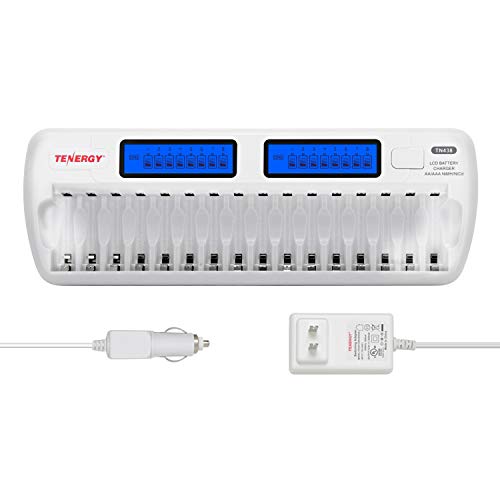
Tenergy is the closest thing this category has to a household name that only makes batteries and chargers, and the TN438 has been the default answer to “I need to charge a lot of AAs” for years. Sixteen bays for AA and AAA NiMH or NiCd cells, per-bay status lights, and a design that has survived long enough in the market for its failure modes to be known and unremarkable — that longevity is itself a specification, and for buyers burned by anonymous marketplace electronics it may be the deciding one.
The TN438 is not the fastest or the most informative unit here, and its charging is deliberately unhurried, which fleet veterans tend to read as a virtue: gentle rates, modest heat, cells that live long. It ships with a mains adapter and has historically offered a car adapter option in the range, suiting the field kits of wildlife photographers and survey crews who charge from a vehicle between sites — check the current listing for what is in the box. If your instinct is to pay a little more for the brand that will still answer its support email in three years, this is your sixteen-bay charger, and the premium over the generic trio is modest for what it buys in peace of mind.
- Format: 16 bays, AA and AAA
- Chemistry: NiMH and NiCd rechargeable cells
- Indication: per-bay status lights
- Power: AC wall adapter; check listing for car adapter inclusion
- Character: conservative charge rates, long market history
Strengths
- A battery specialist’s product with a long, known track record.
- Gentle charging behaviour suits cells you intend to keep for years.
- Better support and documentation than the generic alternatives.
Trade-offs
- No display; feedback is lights only, like the simpler rivals.
- Unhurried pace even with light loads — plan overnight sessions.
- Costs more per bay than EBL, BONAI or POWEROWL.
Best for: fleet owners who value brand accountability and gentle charging over speed or screens. Not suited for: rapid-turnaround event work on a tight budget.

EBL 8-Bay Individual Charger — Half-Size Sibling
Every sixteen-bay guide needs an honesty valve, and this is ours: EBL’s eight-bay charger, the smaller sibling of the screened fleet unit above, included because a large share of shoppers who arrive convinced they need sixteen bays actually run fleets of ten to fourteen cells. Eight individually controlled bays clear that fleet in one session, occupy half the shelf, and cost meaningfully less. The discipline of this guide is matching the box to the pile, and for the household tier — controllers, toys, torches, a flash or two — eight bays is where the pile usually ends.
Technically it mirrors its big sibling’s approach at half scale: individual control per bay for NiMH and NiCd AA or AAA cells, per-slot status lights, no screen. The per-cell rate holds up better under a full load simply because the load is smaller, which makes this the better tool for the semi-urgent evening turnaround — a full eight-cell set charged between dinner and bedtime is a realistic expectation rather than a marketing scenario. Buy the sixteen for a fleet with a schedule; buy this for a home with a habit. Confusing those two briefs is the most common purchasing error in the whole category.
- Format: 8 bays, AA and AAA
- Chemistry: NiMH and NiCd rechargeable
- Channels: individual control per bay
- Indication: per-slot status lights
- Footprint: roughly half the sixteen-bay units
Strengths
- Right-sized for real household fleets, at a right-sized price.
- Full loads still finish within an evening, not just overnight.
- Individual bays handle odd counts and mixed sizes gracefully.
Trade-offs
- A genuine sixteen-plus fleet will queue behind it on big nights.
- No display and no analysis functions.
- Same value-brand caveats as its larger sibling.
Best for: households graduating from four bays whose weekly cell traffic is a dozen or fewer. Not suited for: microphone, flash or venue fleets with fixed schedules and big counts.
Powerex MH-C980 Analyzer Charger — Analyser Class (Prose-Only)
The Powerex MH-C980 is the pick that argues with the premise of this guide, and it deserves its place for exactly that reason. It offers eight bays, not sixteen — but each bay is an instrument. The MH-C980 can analyse a cell’s real capacity, run conditioning cycles that exercise tired NiMH batteries back toward their potential, and charge with a level of per-cell attention that fleet chargers do not attempt. Powerex’s MH-C9000 line built a devoted following among photographers and technicians for this reason, and the C980 carries that analyser philosophy into a wider bank.
Who should choose analysis over acreage? The fleet owner whose problem is not “sixteen cells by morning” but “which of my forty cells are quietly dying” — the wedding photographer whose flash recycle times have started wandering, the theatre tech whose microphone batteries fade unevenly. An analyser turns those suspicions into numbers, lets you cull a fleet scientifically, and can pay for itself by extending the useful life of the cells you keep. It is covered here in prose only, without a purchase link, because no verified listing for it sits in our pool; buy it from a specialist battery retailer. Treat it as the professional fork: volume buyers go sixteen-bay, knowledge buyers come here.
- Format: 8 bays, AA and AAA NiMH
- Functions: charging plus capacity analysis and conditioning
- Display: detailed per-bay information
- Audience: technicians and photographers managing cell health
- Availability: specialist retailers; prose-only in this guide
Strengths
- Measures actual cell capacity instead of guessing from behaviour.
- Conditioning cycles can recover some tired cells’ performance.
- Per-bay data makes fleet culling a decision, not a hunch.
Trade-offs
- Eight bays only — half the throughput of the true sixteen-bay units.
- Premium pricing well above the generic fleet chargers.
- Its information is wasted on users who just need cells by morning.
Best for: professionals diagnosing fleet health and extending cell life. Not suited for: bulk overnight charging of large fleets on a budget.
How do the six compare on the things fleet owners ask about?
| Charger | Bays | Feedback | Analysis | Best setting |
|---|---|---|---|---|
| EBL 16-Bay LCD | 16 | LCD display | No | Shared venue stations |
| BONAI 16-Bay | 16 | LED per bay | No | Rotating operators |
| POWEROWL 16-Bay | 16 | Smart LED per bay | No | Toy-heavy family homes |
| Tenergy TN438 | 16 | Status lights | No | Brand-conscious fleets |
| EBL 8-Bay | 8 | Status lights | No | Ordinary household fleets |
| Powerex MH-C980 | 8 | Detailed display | Yes | Cell-health management |
The table’s real message is that “sixteen bays” is where agreement ends. Feedback style decides who can run the station, brand decides who answers when it fails, and the Powerex column — analysis — decides whether you are managing batteries or merely feeding them. Choose the row that matches your actual bottleneck.
What does a good sixteen-bay charging station look like?
The charger is only the middle of a working station. Around it you need a landing zone for spent cells, a clearly different container for charged ones, and a rule — enforced by layout, not memory — that cells travel in one direction through the three. Venues that do this well use colour: a red tub by the stage door for microphone cells coming off a show, the charger on the shelf, a green tub for the morning harvest. Nobody has to remember anything, because the furniture remembers for them.
Add a label on the charger stating its chemistry rule in words a substitute operator cannot misread — rechargeable NiMH only, never ordinary batteries — and a recycling tube for cells that run hot, leak, or finish suspiciously fast. Finally, keep sets together with elastic bands or divided boxes even at fleet scale; sixteen independent bays forgive mixed loading, but the devices at the other end, taking two or four cells in series, do not forgive mixed sets. The station’s discipline, far more than the charger’s brand, decides whether a fleet feels effortless or cursed.
One more piece of furniture earns its mention: a small whiteboard or card above the station carrying three lines — what is charging, what is ready, and what is suspect. Fleets with several operators fail through silence more than through hardware; the board is where a night operator leaves word that one bay’s set ran hot, or that the charged tub is two sets short for tomorrow. Thirty seconds of writing at handover saves the morning operator a forensic investigation, and stations that keep the habit find their cell losses and mysteries dwindling within a season.
How do wireless microphone fleets actually run on these chargers?
Talk to anyone who runs sound for a school, a church or a small theatre and a pattern emerges: the microphone fleet is where sixteen-bay charging stops being a convenience and becomes infrastructure. A modest production might field ten wireless channels — handhelds for presenters, belt packs for actors, a couple of spares — each eating two AA cells per show, with rehearsals doubling the burn. Twenty to forty cells a week is ordinary, and the cost of failure is not a dead remote but a silent lead actor in the second act.
The working routine those technicians converge on looks like this. Cells live in numbered sets, each set married to a channel; a set that runs a full show comes off, goes on the charger that night, and returns to the charged tub by morning. Spares rotate through the least demanding channels so no set is worked to death while others idle. The charger’s job in that system is pure reliability at volume — which is why theatre techs in our research valued the Tenergy’s boring consistency and the EBL’s readable display over every speed claim ever printed. A charger that finishes sixteen cells by 7 a.m. without being touched since midnight is, for this world, perfect.
The same world explains the analyser’s cult following. A microphone that crackles and drops at range is often a cell with climbing internal resistance rather than a radio fault, and swapping in a measured-good set is a faster diagnosis than any amount of antenna fiddling. Fleets that add one Powerex to a bank of bulk chargers use it as the clinic: suspects go there, get measured, and either return to service with a number attached or leave for recycling with no argument.
What should event photographers demand from a big charger?
Photographers stress fleets differently. A speedlight on full power can chew through a set of four AAs in a few hundred frames, recycle speed depends directly on cell health, and a wedding day offers no pause in which to nurse a charger. The photographer’s fleet is therefore smaller than the theatre’s but far more pampered: sets are matched, dated, retired early, and charged the night before with the same ceremony as cleaning lenses.
For that user, the sixteen-bay question is really about the double-header weekend — two events, one turnaround — and the honest answer is that bay count plus a reserve rotation beats charge speed every time. Sixteen bays let Friday’s cells and Saturday’s cells exist as separate populations, so nobody is gambling on a four-hour charge between events. Photographers also feel the analyser argument most keenly, because a flash makes cell weakness visible as lengthening recycle times mid-reception; measuring sets in the off-season and culling the laggards is the difference between a kit you trust and a kit you apologise for.
One photographer-specific habit deserves copying by every fleet: the go-bag reserve. A sealed set of charged cells, plus a set of quality disposable lithium AAs as the emergency floor, lives in the camera bag permanently and is never raided for household duty. Fleets fail at the edges — the forgotten charge, the borrowed set — and a reserve that nobody touches is cheap insurance against the one day the system slips.
How does bay independence behave when a fleet is genuinely mixed?
Real fleets are never uniform. Capacities range across purchases made years apart, brands mix, and cells return from devices at every depth from barely touched to stone flat. On a pair-wired charger that mixture is a slow disaster, because the charger sees couples, not cells, and the weaker partner in each pair sets the terms. On the independent-bay units in this guide, mixture is merely untidy: each slot reads its own cell, pushes its own current, and signs off when that cell is done.
Two limits deserve honesty. Independence at the charger does not create independence in the device — a four-cell flash still runs its set in series, and one tired cell still caps the set’s performance, which is why set discipline survives every charger upgrade. And independence does not rescue cells that should not be charged together in the safety sense: a damaged, leaking or corroded cell belongs in recycling no matter how smart its bay is. The charger’s per-bay judgement is electrical, not moral; the fleet owner’s still has to be both.
There is a subtler benefit that only appears at scale: pattern visibility. When sixteen cells charge side by side and one bay’s light always finishes first or last, the fleet is talking to you. Owners who glance at the row while harvesting learn their cells’ personalities within a month, and the cell that suddenly changes its behaviour — finishing in minutes, or never finishing — gets pulled before it fails in a microphone or a flash. Big chargers, used attentively, are diagnostic instruments whether or not they carry an analyser badge.
What does cost per bay actually buy as it rises?
Divide the price by the bays and this category sorts itself into three honest tiers. At the bottom, the generic sixteen-bay units buy capacity and independence — the fundamentals — with thin documentation, variable quality control and support that ranges from responsive to theoretical. That tier is rational for buyers who can test on arrival, keep receipts, and treat the purchase as a consumable with a multi-year life rather than an heirloom.
The middle tier, where Tenergy sits, buys accountability: a brand with a reputation to protect, consistent batches, manuals that match the hardware, and a support channel that answers. For a venue whose charger failing on a Friday night means a Saturday crisis, that accountability is not a luxury tax; it is the product. The top tier, Powerex territory, buys knowledge — measurement and conditioning — and its price only makes sense against the value of the fleet it manages. An analyser guarding two hundred premium cells is cheap; the same analyser serving twelve household AAs is jewellery.
Notice what no tier buys: exemption from discipline. Every tier still needs labelled sets, a charged/spent separation, ventilation and a culling rule. Money in this category buys reliability and information, never magic — and the fleets that run best are usually mid-tier chargers operated with top-tier habits.
How do you label and track sets when there are dozens of them?
The system that survives contact with reality is embarrassingly simple: a paint pen or fine marker, a number on every cell, and a notebook or phone note that maps numbers to purchase dates. Sets get a letter, cells within a set get the letter plus a position number, and the whole fleet’s biography fits on two pages. Anything more elaborate — apps, spreadsheets with colour codes — tends to be abandoned by February, and an abandoned perfect system loses to a pencil every time.
Rotation follows from the labels. Use sets in order, so wear spreads evenly and no set is flogged weekly while its siblings rest; when a set is demoted — after a failure, a suspicious charge time, or simply great age — mark it down a duty grade, from microphones to remotes, from flashes to clocks. Demotion is the fleet owner’s kindness and economics in one act: a cell too weak for a transmitter still has a year of honest work in a wall clock, and squeezing that year out of it is the whole point of owning rechargeables.
Finally, write the cull date on the calendar, not in your intentions. Twice a year, charge everything, run the swap tests, read the charger’s behaviour, and recycle without negotiation whatever fails. Fleets die of deferred decisions far more often than of bad hardware.
What mistakes do fleet owners make with big chargers?
Believing the headline charge time is the first, and it leads to the second: scheduling a fleet around a one-hour turnaround that a full load cannot deliver, then blaming the hardware at showtime. The third mistake is thermal — sixteen bays in a closed cupboard, in summer, under a stack of programmes — because collective warmth shortens cell life even when no single cell feels hot. Ventilation is a fleet feature; arrange it.
The fourth is the stray alkaline. In any drawer that holds both rechargeable and disposable cells, one will eventually be loaded by a tired person at midnight, and at sixteen bays the odds multiply. Separate storage is the only real cure. And the fifth is buying capacity you never use: a sixteen-bay charger running four cells a week is not headroom, it is counter clutter that a smaller, better-placed unit would have avoided. Audit your pile honestly for a fortnight before you buy, counting cells, not frustrations.
How should you cull and replace cells in a big fleet?
Fleets fail gradually and then all at once, because cells bought together age together. The defence is staggered replacement: each season, retire the oldest fraction of the fleet — the sets with the earliest date marks — before they fail in service, and fold fresh sets in. A microphone that fades during a school concert teaches this lesson publicly; a calendar teaches it privately and cheaply.
Between culls, watch for the tells: a cell that finishes charging long before its set-mates, one that self-discharges within days, one that warms while others stay cool. On light-feedback chargers these signs are all you get, which is why the seasonal audit matters; on the Powerex they become measurements. Either way, the rule is the same — a suspect cell leaves the fleet the day it is identified, because in series-powered devices it will take its partners’ reputation down with it.
How do schools, escape rooms and rental fleets use big chargers differently?
Each fleet culture bends the same hardware to its own rhythm. Schools run on term time: science departments and drama programmes charge in bursts around productions and practical exams, then the fleet sleeps for holidays — which is precisely the pattern low-self-discharge cells exist for, and why a school should charge everything before the summer break and store cells in their tubs rather than leaving them on a charger for six weeks. The school’s other peculiarity is operators: pupils. Chargers in classrooms need the BONAI virtues — nothing to configure, nothing to break — and a chemistry rule posted where small hands can read it.
Escape rooms run the tightest ship of all, because their props reset on a clock measured in minutes and a dead battery mid-game is a refund conversation. Their fleets are small but cycled brutally, often daily, and their chargers live where the game masters reset rooms, loaded as part of the reset checklist rather than as a separate chore. For them the EBL’s screen earns its keep: a resetter glancing at the bank knows instantly whether the charged tub is full enough for the evening’s bookings. Rooms that thrive treat batteries as part of the game infrastructure, inspected like locks and hinges.
Rental fleets — camera hire, audio hire, tool libraries — face the strangest load: cells that leave the building with strangers. Their answer is over-provisioning and ruthless culling, because a cell that fails in a customer’s hands costs reputation out of proportion to its price. Rental desks also date-stamp more aggressively than anyone, retiring sets on schedule rather than on symptoms. If your home fleet feels over-managed by comparison, take the hint in the other direction: borrow the rental desk’s calendar cull and the theatre’s numbered sets, and leave the rest of their paranoia to the professionals.
What should you do when one bay misbehaves?
Sixteen bays are sixteen small circuits, and over years of service one may drift: finishing instantly, never finishing, or running its cell warm. The diagnosis order matters. First, move the suspect cell to a known-good bay and a known-good cell into the suspect bay; blame follows whichever component carries the symptom. A cell that misbehaves everywhere is retired. A bay that misbehaves with every cell is marked — a strip of tape across it — and the charger continues life as a fifteen-bay unit while you decide whether the fault earns a replacement.
Clean before condemning. Pocket lint, oxidation and the residue of a long-ago leaked cell all collect in bay contacts, and a cotton bud with a little isopropyl alcohol restores more bays than any other intervention. Springs lose tension too; a bay that only charges when the cell is wedged is telling you its contact is tired. None of this is user-serviceable beyond cleaning — these are sealed mains appliances, and opening one to poke at it is firmly outside sensible behaviour. Mark, clean, demote, replace: that is the whole ladder, and it keeps a fleet running for years on hardware that costs less than the cells it serves.
Where should a sixteen-bay charger live, and how should it be powered?
Placement sounds trivial until a fleet fails because of it. The charger belongs where spent cells naturally arrive — beside the stage door, in the utility room where torches dock, on the media department’s workbench — because a station that requires a special trip will be bypassed on busy nights, and bypassed stations are how cells end up in desk drawers instead of bays. It needs open air on a hard surface, away from radiators, sunny sills and the top of other warm electronics, and it needs its own socket rather than a daisy-chained strip shared with a kettle or a space heater; sixteen bays draw modest power, but the strip’s other tenants are the fire risk, not the charger.
In venues, mount the routine to the furniture: charger at standing eye height if possible, charged tub to its right, spent tub to its left, recycling tube beneath, and the one-line chemistry rule on the wall. Left-to-right flow matches how people read and stops the two tubs swapping identities over a term. At home the same flow compresses onto one shelf, and the household that bothers to set it up once will run it unthinkingly for a decade.
Power cuts deserve a sentence in areas where they are common: smart chargers generally resume or restart safely when power returns, but a fleet that must be ready by a fixed hour should be loaded with margin, not at the last possible moment. The overnight session is forgiving precisely because it holds hours of slack; protect that slack and the grid’s moods become irrelevant.
What changes if part of your fleet is still NiCd?
Plenty of long-lived fleets carry a NiCd tail: garden solar lights, older cordless phones, legacy RC gear and tools whose packs were rebuilt years ago. NiCd tolerates abuse that would shorten a NiMH cell’s life, but it brings its own rules — it genuinely benefits from occasional full discharge cycles in its device, it self-discharges briskly, and its cadmium content makes the recycling tube a legal duty rather than a courtesy when a cell dies. The chargers here that accept NiCd handle the chemistry’s different voltage behaviour per bay, which is exactly why mixed-chemistry fleets belong on independent channels and nowhere else.
The fleet-management advice shifts slightly with NiCd aboard. Keep the chemistries in visibly different tubs, because a NiCd cell promoted into a NiMH set by mistake will underperform and confuse your culling notes for months. Expect to replace NiCd stragglers on a faster rhythm, and consider every NiCd failure a small migration opportunity: the device it served usually accepts a modern NiMH cell happily, and each quiet substitution shrinks the toxic tail of the fleet. Within a few seasons most mixed fleets become NiMH fleets by attrition, which simplifies everything downstream.
Final Recommendation
For most genuine fleets, the EBL sixteen-bay with its display is the practical centre of this guide: readable by a whole team, cheap per bay, and honest once you translate its speed claim into overnight terms. Choose the BONAI where untrained hands will run the station, the POWEROWL for a family drowning in toy batteries, and the Tenergy when you want a battery specialist standing behind the box. Step down to EBL’s eight-bay without shame if your fortnight’s counting says the pile is smaller than the frustration, and step sideways to the Powerex when the question changes from “how many” to “how healthy”. Sixteen bays will not make your batteries immortal — but loaded in the evening, harvested in the morning, and culled without sentimentality, a fleet on any of these chargers simply stops being a problem you think about.
Frequently Asked Questions
Do sixteen-bay chargers charge each battery independently?
The units in this guide control their bays individually, so each cell is monitored and finished on its own schedule rather than in fixed pairs. That matters at fleet scale, where cells return at wildly different depths of discharge after every event.
Why does my full charger take all night when the box promised an hour?
Because the headline figure assumes a light load. A charger’s total current is shared across occupied bays, so sixteen cells charge at a fraction of the two-cell rate. Overnight for a full load is normal behaviour, not a fault — build the routine around it.
Can I leave a sixteen-bay charger plugged in all the time?
These chargers are designed to live on a shelf, and their per-bay termination stops charge properly. Still, unload finished cells within a day or so, keep the unit ventilated, and treat permanent residence as a reason to buy a reputable unit rather than the cheapest shell available.
Is an analyser charger worth it for a home user?
Only if you enjoy or need the data. Most households need cells by morning, not capacity reports; the Powerex earns its premium in professional fleets where one dying cell can spoil an event and culling by measurement saves real money.
Can these chargers handle C, D or 9V batteries?
No — every pick here is built for AA and AAA cells. Larger formats need their own chargers, and forcing a fit is not an option; the slots, currents and termination logic are all sized for the small cylindrical formats.
How many rechargeable cells should a fleet actually own?
A workable rule is the device count times its cell requirement, plus half as many again in rotation, so a full set is always charged and waiting while another is on the charger. More than that and cells age on the shelf faster than they wear out in service.
Can I charge batteries for two different events at once?
Yes, and it is one of the quiet strengths of independent bays: load both events’ cells together, then harvest by set rather than by bay. Keep the sets physically grouped as you load — one event’s sets in the left half, the other’s in the right — and label the tubs before the charger finishes, not after, because sixteen identical green lights will not remember your plan for you.
Should a venue keep a spare charger?
Any operation whose event fails when charging fails should own a second unit, even a smaller eight-bay one, kept boxed in a different room. Chargers are cheap compared with cancelled events, and a spare also absorbs the overflow on the two or three biggest nights of the year, when even sixteen bays run a queue. Rotate the spare into service monthly so it is known-good rather than merely presumed-good.
Do big chargers use much electricity sitting idle?
Very little — a modern multi-bay unit idles at a trickle comparable to a phone charger left in the wall, and the energy in a full sixteen-cell charge is a small fraction of a kettle boil. The honest cost of a fleet is not electricity but replacement cells, which is another argument for the gentle chargers and culling discipline this guide keeps returning to: the electricity is nearly free, the batteries are not, and the charger’s manners decide how often you buy them.
Is it worth repairing a faulty sixteen-bay charger?
Almost never, beyond the cleaning and contact care described earlier. These are sealed mains-powered appliances sold at prices that make professional repair uneconomical, and amateur repair of anything connected to the wall belongs in the same category as charging alkalines: firmly declined. A unit with a dead bay can serve honourably for years as a fifteen-bay charger; a unit with erratic behaviour across many bays should be retired whole, recycled as electronic waste, and replaced — ideally by the tier above the one that just disappointed you.
Does a sixteen-bay charger need its own circuit or a special socket?
No. Even fully loaded, these units draw a modest amount of power — far less than a kettle or a heater — and any ordinary household socket serves them. What they do deserve is a socket of their own rather than a crowded multi-strip shared with high-draw appliances, plus a surge protector in venues with elderly wiring, because the charger will live plugged in for years and quiet electrical manners protect its electronics.
Related Guides
New to rechargeable life and starting smaller? Begin with our guide to the best AA and AAA battery chargers for everyday households. If your fleet includes cylindrical lithium cells for torches and vapes, the safety rules change completely — read our 18650 charger guide and its cell-safety section before charging any of them. And for radio-controlled hobbies, where lithium polymer packs rule, see the affordable LiPo charger roundup with balance and storage charging explained.


