What's inside
- Key Takeaways
- Quick Picks
- How Did We Judge Two Different Species in One Guide?
- Why Does the Mirror Position Work So Well for a Reversing Screen?
- How Do the Six Compare, Species by Species?
- How Do You Install a Mirror Camera Kit Cleanly?
- What Mistakes Do Mirror Camera Buyers Keep Making?
- Do Mirror Dash Cams Raise Legal or Privacy Questions?
- What Is It Actually Like to Live With a Digital Rear View?
- How Do Memory Cards and Storage Shape Dash Cam Ownership?
- Which Mirror Species Suits Which Vehicle?
- What About Glare, Night Driving, and Screen Brightness?
- How Should a Household Choose When Drivers Disagree?
- A Pre-Purchase Checklist for Both Species
- What Happens When Something Goes Wrong at Year Two?
- Why This Category Will Keep Splitting Rather Than Merging
- One Scenario Each Species Handles Best
- A Closing Word on Trust and the Three-Second Rule
- What Should You Do in the First Week After Installing?
- One Last Distinction: Gifts and Second Cars
- Final Recommendation
- Frequently Asked Questions
- Related Guides
As an Amazon Associate I earn from qualifying purchases. This post may contain affiliate links at no extra cost to you.
gizmoverdict.com is reader-supported. When you buy through links on our site, we may earn an affiliate commission.
Where to buy: four products below carry Amazon links, and two familiar names appear as prose-only entries because no verified listing was available for them. Anyone researching the best aftermarket rearview mirror backup cameras quickly discovers the category is secretly two categories wearing one name. The first is a mirror with a hidden display that simply shows the reversing camera — nothing records, nothing stores, the mirror is a window. The second is a full dash cam disguised as a mirror, recording front and rear video continuously, with the reversing view as one feature among many. Confusing them leads to buying recording hardware you never wanted, or wanting evidence after an incident from a mirror that never kept any.
This guide therefore labels every pick with its true species. The AUTO-VOX and Peojek entries are pure mirror monitors: they wake in reverse, show the blind wedge, and return to being mirrors. The two Wolfbox entries are mirror dash cams: larger screens strapped over your existing mirror, GPS and memory cards and loop recording, parking surveillance, the complete evidence apparatus. Both species are legitimate. They answer different anxieties — one about the three seconds of reversing, the other about everything that happens on the road before and after those seconds.
Size divides them further. Pure monitors hide a modest display inside standard mirror dimensions, preserving a factory look. Dash cam mirrors stretch to ten or twelve inches, trading subtlety for a cinematic rear view that many drivers, once accustomed, refuse to surrender — a wide digital rear view unobstructed by passengers, headrests, and cargo. Decide which species you are shopping for before comparing specifications, because cross-species comparisons produce nonsense rankings and disappointed owners in both directions.
Key Takeaways
- Pure mirror monitors like the AUTO-VOX and Peojek only display the reversing camera; they record nothing at all.
- Wolfbox’s G840S and G930 are dash cams in mirror form, recording front and rear footage to a memory card.
- Replacement mirrors look factory-fitted, while strap-over dash cam mirrors install faster and show far more.
- A twelve-inch digital rear view can transform visibility in vans and SUVs loaded with passengers or cargo.
- Two prose-only entries, the AUTO-VOX T2 and Pelsee’s mirror range, are discussed without links for completeness.
Quick Picks
| Pick | Badge | Why it earns a slot |
|---|---|---|
| AUTO-VOX OEM Rear View Mirror Camera with 4.3-inch Monitor | Pure monitor, factory look | A replacement mirror hides its display until reverse, with an IP68 camera and strong night tuning outside. |
| WOLFBOX G840S 12-inch 4K Mirror Dash Cam | Full recording flagship | Twelve inches of 4K front and rear recording with GPS and a card included, for drivers wanting evidence. |
| WOLFBOX G930 10-inch 4K Mirror Camera | Recording, slightly smaller | A ten-inch touchscreen trims the flagship’s footprint while keeping 4K dual recording and night tools. |
| Peojek Backup Camera and 4.3-inch Mirror Monitor Kit | Pure monitor, budget route | Nine night LEDs and a clip-on mirror display deliver reversing vision at the category’s gentlest cost. |
| AUTO-VOX T2 | Pure monitor classic, prose-only | A widely used earlier mirror kit discussed for orientation, without a verified listing to link here. |
| Pelsee Mirror Dash Cam range | Recording alternative, prose-only | A known mirror dash cam name included for comparison, likewise without a verified listing in our pool. |
How Did We Judge Two Different Species in One Guide?
By refusing to score them against each other on the wrong axes. Pure monitors were judged on invisibility, wake speed in reverse, night clarity at bumper distance, and installation permanence — the virtues of an appliance. Mirror dash cams were judged on recording quality front and rear, screen size against cabin obstruction, storage and GPS completeness, and the rear camera’s double duty as both reversing aid and rolling witness. A monitor that recorded nothing lost no points for it; a dash cam whose reversing view lagged or dimmed lost many.
Installation realism shaped both assessments. Replacement mirrors demand more work and reward it daily. Strap-over units install in minutes and announce themselves forever. Wireless claims, where they appear in this category generally, were treated skeptically in favor of the wired rear cameras these particular picks employ, because a reversing image must arrive without negotiation. Night performance was weighted heavily for every pick, since the mirror’s moment of truth is usually a dark driveway rather than a sunlit lot.
Finally, we considered the ownership tail. Dash cams introduce memory cards that wear out, firmware that updates, and files that may matter legally — responsibilities pure monitors never impose. Some drivers want exactly that apparatus and its protection. Others want a mirror that minds its business. The guide respects both temperaments and asks only that you choose yours deliberately, with the species labels above kept in view from the first section to the last.
Why Does the Mirror Position Work So Well for a Reversing Screen?
Because habit is the strongest interface ever designed. A driver’s eyes have traveled to the rearview mirror ten thousand times before any camera arrives, and in the stressful half-second when a reversing decision forms, eyes go where habit sends them, not where a product designer wishes they would. A display living inside that mirror is therefore consulted automatically, while a dashboard screen — however large — requires a deliberate glance downward that competes with steering, mirrors, and shoulder checks.
The mirror position gains a second advantage in the dash cam species: elevation. A screen at mirror height showing a rear camera’s wide view can replace the optical mirror’s narrow, obstructed slot entirely, which is why loaded vans, trucks with campers, and family SUVs full of heads and headrests benefit disproportionately. The digital rear view does not care what is stacked behind the rear seats. That transformation, more than recording, is what converts many mirror dash cam skeptics during their first week of ownership.

AUTO-VOX OEM Rear View Mirror Camera with 4.3-inch Monitor — Pure monitor, factory look
Representing the pure-monitor species at its most polished, this AUTO-VOX replaces your mirror with an OEM-style unit whose four-point-three-inch display sleeps invisibly behind the glass. Engage reverse and the picture materializes; disengage and the car looks showroom-standard again. Nothing records. Nothing beeps for your attention. For owners whose only problem is the blind wedge behind the bumper, this restraint is the product’s entire elegance, and it is executed with unusual finish.
The rear camera carries an IP68 waterproof rating and night tuning the maker treats as a headline, aimed at unlit driveways where a reversing camera earns or loses its reputation. The live view arrives over a wired connection with the smoothness that category demands, and the automatic wake means there is no button ritual to forget when a child is waiting and the morning is already late. Installation involves the mirror mount and a cable route to the rear — more involved than a clip-on, less visible forever after.
Its boundaries are the species’ boundaries, stated plainly. The display is modest in size, suited to cars rather than long rigs. There is no recording, so the driver wanting incident evidence must look at the Wolfbox entries or a conventional dash cam. And a replacement mirror commits you: returning to stock means reinstalling the original. Within the pure-monitor brief, though, this is the reference design — the reversing camera for people who do not want to see a reversing camera, from a brand that has specialized in exactly that discretion for years.
- Species: mirror monitor only — displays the reversing camera, records nothing
- Display: 4.3-inch screen concealed within an OEM-style replacement mirror
- Rear camera: IP68 waterproof with emphasized night performance
- Activation: automatic display when reverse gear engages
Strengths
- Factory-grade discretion keeps the cabin looking entirely unmodified.
- Automatic waking makes daily use frictionless for every driver in the household.
- Strong sealing and night tuning suit year-round driveway duty.
Trade-offs
- No recording capability of any kind for incident evidence.
- Modest display size limits detail for larger vehicles.
- Replacement installation is more committed than strap-on alternatives.
Best for: car owners wanting invisible, automatic reversing vision and nothing else. Not suited for: drivers seeking recorded evidence or a large digital rear view.

WOLFBOX G840S 12-inch 4K Mirror Dash Cam — Full recording flagship
Now cross the species line. The G840S is a dash cam that happens to wear a mirror’s body: twelve inches of screen strapped over your existing mirror, recording the road ahead in 4K and the road behind through its rear camera, with GPS data and a thirty-two-gigabyte card included in the box. When you select reverse, that rear camera’s view expands with parking guidance. The rest of the time, the screen serves as a sweeping digital rear view that renders headrests, passengers, and cargo piles irrelevant to what you can see behind you.
The digital rear view is the feature owners evangelize. A wide, bright, elevated picture replaces the optical slot, and night driving gains particular relief because the camera’s exposure handles headlights behind you more gracefully than a mirror’s glare. Recording quality up front is the other pillar: 4K capture gives license plates a fighting chance at distance, and the GPS log anchors footage with speed and location when an insurer asks questions nobody wants to answer from memory.
Ownership carries the dash cam’s full responsibilities. The unit is large and visibly an accessory, however handsome. Memory cards wear and need periodic replacement, the rear camera’s cable must be routed the length of the cabin, and parking-surveillance features draw on the battery in ways that demand proper hardwiring and voltage protection. Drivers who accept that apparatus gain the most capable mirror in this guide. Drivers who merely wanted to reverse safely should notice they have wandered into a different product’s section — an excellent product, but a different one.
- Species: mirror dash cam — records front and rear continuously
- Display: twelve-inch screen strapping over the existing mirror
- Recording: 4K front capture, GPS included, 32GB card in the box
- Rear camera role: reversing display plus rolling rear witness
Strengths
- Digital rear view abolishes obstruction from passengers and cargo.
- 4K front recording with GPS gives incident footage real evidentiary weight.
- Included card and mature accessory ecosystem ease the first setup.
Trade-offs
- Twelve-inch presence is unmistakably an add-on in tidy cabins.
- Cards, firmware, and parking-mode power draw create ongoing homework.
- Capability far exceeds the needs of a driver who only fears reversing.
Best for: high-mileage drivers, van and SUV owners, and anyone wanting recorded evidence. Not suited for: minimalists seeking a discreet reversing-only aid.

WOLFBOX G930 10-inch 4K Mirror Camera — Recording, slightly smaller
The G930 answers the most common objection to its flagship sibling: not every cabin can host a twelve-inch screen gracefully. At ten inches with a touchscreen interface, it keeps the species-defining assets — 4K front recording, a rear camera serving both reversing display and rear recording, night-vision tools with wide dynamic range for tunnel exits and headlight glare — while sitting more proportionately in midsize cars and smaller SUVs. Drivers cross-shopping the pair should think in terms of windscreen real estate first and specifications second, because the lived difference is size.
Touch control changes daily interaction meaningfully. Swiping between front, rear, and split views becomes a gesture rather than a menu excavation, and reviewing a clip at the roadside — after the incident everyone hopes never happens — is feasible on the device itself. The 5.8GHz WiFi connection speeds transfers to a phone for the sharing and archiving that footage ultimately exists for. In reversing duty the rear view arrives with the clarity modern sensors provide, a different universe from the grainy mirror kits of a decade ago.
Compromises track the format. Ten inches still announces itself as equipment, the strap-over mounting can vibrate on rough roads if rushed, and the recording apparatus brings the same card maintenance and power considerations as the G840S. Its rear camera, like all dual-duty units, must be aimed to serve two masters — the rolling rear view while driving and the downward reversing view when parking — a calibration worth doing slowly with a helper and a tape measure. Set up well, the G930 is the balanced Wolfbox: nearly the flagship’s capability in a footprint more households can welcome.
- Species: mirror dash cam with front and rear recording
- Display: ten-inch touchscreen strapped over the existing mirror
- Recording: 4K front capture with WDR and night-vision support
- Connectivity: 5.8GHz WiFi for faster footage transfer to a phone
Strengths
- Ten-inch size fits midsize cabins the flagship overwhelms.
- Touch gestures make view-switching and clip review genuinely quick.
- Faster WiFi band shortens the footage-to-phone journey considerably.
Trade-offs
- Still visibly an accessory compared with any pure mirror monitor.
- Dual-duty rear camera aiming requires patient calibration.
- Card upkeep and parking-mode power planning remain the owner’s job.
Best for: drivers wanting mirror dash cam capability in a midsize footprint. Not suited for: anyone prioritizing an invisible, factory-style installation.
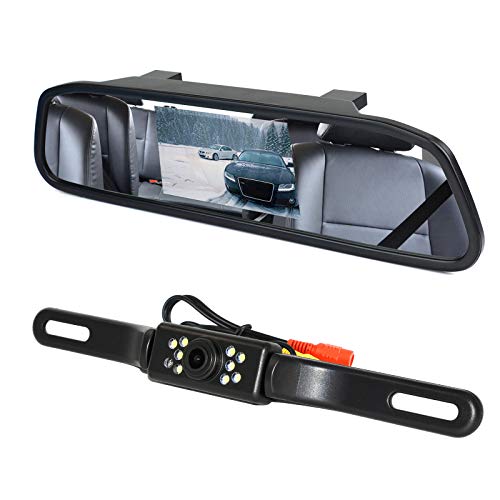
Peojek Backup Camera and 4.3-inch Mirror Monitor Kit — Pure monitor, budget route
Peojek returns the guide to the pure-monitor species at its most accessible. The kit pairs a waterproof rear camera — assisted by nine LED lights for darkness — with a four-point-three-inch display presented in a mirror monitor at the rearview position. It records nothing, connects by cable, and costs the least of the linked picks here, which frames its purpose exactly: the essential reversing view for a small car whose owner refuses dashboard clutter and large expenditures alike.
In daily service the Peojek does the one job it promises. Reverse engages, the wedge behind the bumper appears where your eyes already are, and the LEDs lift the immediate meters behind the car out of darkness adequately for careful maneuvering. For city hatchbacks threading into tight bays and older sedans in suburban driveways, that is the complete requirement, and paying for recording apparatus or a giant screen would buy capabilities the owner never consults.
Its limits deserve the same clarity as the AUTO-VOX’s, plus one degree more. The image is smaller and less refined than the premium monitor’s, glare can contest the shared mirror surface on bright days, and nine LEDs illuminate the reversing zone rather than the whole street. Long vehicles should not apply. But as the honest floor of the mirror-monitor market — the kit that proves a reversing camera need not be expensive, recording, or visible — the Peojek earns its place and its many budget-conscious owners.
- Species: mirror monitor only — reversing display without recording
- Display: 4.3-inch screen presented at the rearview mirror position
- Rear camera: waterproof unit with nine-LED night assistance
- Character: wired essentials at the guide’s gentlest linked cost
Strengths
- Lowest-cost route to a mirror-position reversing display.
- LED assistance covers the close zone where reversing decisions happen.
- Simple wired design avoids apps, pairing, and recording maintenance entirely.
Trade-offs
- Image size and refinement trail the premium AUTO-VOX monitor.
- Bright sunlight can fight the picture on the shared mirror surface.
- Unsuitable scale for trucks, vans, and other long vehicles.
Best for: small-car owners wanting budget reversing vision without cabin clutter. Not suited for: drivers wanting recordings, large displays, or long-vehicle coverage.
AUTO-VOX T2 — Pure monitor classic, prose-only
The T2 is the mirror monitor many drivers already know by sight of its reputation: an earlier, widely sold AUTO-VOX kit that helped define the pure-monitor species before its siblings refined the formula. It appears here without a purchase link because our verified pool held no listing for it, and this section serves orientation rather than shopping. Owners researching a secondhand unit, or comparing a friend’s recommendation against this guide, deserve to know where the T2 sits in the family tree.
Conceptually it matches the linked AUTO-VOX above: a mirror-position display that wakes for reversing, a wired rear camera with night assistance, and no recording whatsoever. The refinements of newer kits — slimmer integration, improved night tuning, tidier cabling — mark the distance between generations, but the T2’s core proposition remains sound, which is why used examples circulate and why the name surfaces in every forum thread on this category. A secondhand T2 at a fair price from a seller demonstrating it working is a rational purchase; the same unit untested is the usual used-electronics wager.
New buyers with access to the linked range should generally prefer current kits for their warranties and incremental polish, treating the T2 as the benchmark of what the species should feel like: invisible at rest, immediate in reverse, and silent about everything else. If your research began with the T2’s name, let this guide’s linked AUTO-VOX entry serve as its modern translation, and let the Peojek stand as its budget translation. The species matters more than the vintage.
- Species: mirror monitor only, an earlier-generation AUTO-VOX design
- Availability: discussed without a link; no verified listing in our pool
- Role in this guide: orientation benchmark for the pure-monitor species
- Buying note: secondhand units should be demonstrated working before payment
Strengths
- Proven concept that established the discreet mirror-monitor formula.
- Simple wired operation with no recording apparatus to maintain.
- Wide installed base means community installation knowledge is plentiful.
Trade-offs
- Newer kits refine night performance and integration noticeably.
- Secondhand purchases carry the usual untested-electronics risk.
- No verified route to buy it accompanies this discussion.
Best for: researchers comparing a known name and secondhand shoppers buying demonstrated units. Not suited for: buyers wanting a warrantied, current-generation kit today.
Pelsee Mirror Dash Cam range — Recording alternative, prose-only
Pelsee occupies the mirror dash cam shelf beside Wolfbox in most shoppers’ research, and honesty requires acknowledging the name even though our pool held no verified listing to link — a listing was seen in search but never fetched and verified, so this guide will not attach a purchase route it cannot stand behind. Treat this entry as a map annotation: if your research leads to Pelsee’s mirror units, classify them correctly as recording dash cams in mirror form, comparable in species to the Wolfbox pair rather than to the pure monitors.
The comparison questions to carry into that research mirror this guide’s Wolfbox criteria. How large is the screen against your cabin’s proportions? What resolution does the front camera truly record, and does the rear unit serve reversing duty with guidelines and a fast wake? Is a card included, is GPS present, and how does parking surveillance draw power? A Pelsee unit answering those as well as the linked Wolfboxes is a legitimate alternative; one answering them vaguely deserves the skepticism this category’s spec inflation has earned.
Why include an unlinked brand at all? Because buyers do not research in the orderly pools reviewers construct, and a guide that pretends a major name does not exist sends its readers elsewhere for the classification that matters most. The prose-only treatment keeps the map complete without inventing a link. When a verified listing joins a future pool, this entry can be revisited; until then, let the Wolfbox pair carry the recording species’ linked recommendations, and let Pelsee stand as the reminder to classify before comparing.
- Species: mirror dash cam family — front and rear recording devices
- Availability: no verified listing in our pool, hence prose-only discussion
- Role in this guide: classification reference for a commonly researched name
- Evaluation frame: screen size, true resolutions, card and GPS inclusion
Strengths
- Represents a genuine alternative lineage in the recording species.
- Researching it with this guide’s criteria prevents species confusion.
- Competition in this segment keeps the linked brands honest on features.
Trade-offs
- No verified purchase route accompanies this entry.
- Specifications vary across its range and demand model-by-model checking.
- Support and firmware ecosystems must be assessed independently by the buyer.
Best for: comparison shoppers who encountered the name and need it classified correctly. Not suited for: buyers wanting a verified link and a settled recommendation today.
How Do the Six Compare, Species by Species?
| Pick | Species and screen | Principal caution |
|---|---|---|
| AUTO-VOX OEM Mirror | Pure monitor, 4.3-inch hidden display | Records nothing; replacement installation |
| WOLFBOX G840S | Dash cam, twelve-inch recording mirror | Size, card upkeep, parking-mode power |
| WOLFBOX G930 | Dash cam, ten-inch touchscreen mirror | Still visibly an accessory; dual-duty aiming |
| Peojek Mirror Kit | Pure monitor, 4.3-inch mirror display | Small image; glare in bright sun |
| AUTO-VOX T2 | Pure monitor classic, prose-only | Earlier generation; secondhand risk |
| Pelsee range | Dash cam family, prose-only | No verified listing; specs vary by model |
Read the table by its first column of identity rather than by size. Monitors compete on discretion and simplicity; dash cams compete on recording merit and screen experience. The moment a shopper ranks the AUTO-VOX below a Wolfbox for lacking recording, or a Wolfbox below the AUTO-VOX for lacking invisibility, they have graded a fish on tree-climbing. This guide’s ordering walks from the purest monitor to the fullest recorder so that each reader can exit at the exact point their needs end.
How Do You Install a Mirror Camera Kit Cleanly?
Begin by choosing your mounting philosophy. Replacement mirrors unbolt the original — usually a wedge or screw mount on the windscreen button — and demand respect for any electronics living in the stock mirror, from compass displays to garage transmitters you may lose. Strap-over dash cam mirrors keep the original and grip it with straps, trading a thicker profile for total reversibility, a trade leaseholders should notice. Either way, test-fit the screen’s view before routing a single wire: sit normally, check that the display neither blocks the windscreen’s useful area nor reflects the rear window into uselessness at noon.
The rear camera’s journey mirrors the companion guide’s advice: plate mounting, protected routing through an existing grommet where possible, cable secured away from hinges and heat, and power tapped so the reversing display wakes with reverse gear. Dash cam species add a second consideration — the rear camera records while driving too, so its aim must serve the rolling view first and the reversing view second, with the display’s guideline overlay calibrated afterward against measured distances on level ground.
Finish with the unglamorous verifications. Confirm the mirror still dims or displays correctly at night, check that a strap-over unit does not buzz against the original mirror on rough pavement, and set the dash cam’s clock, loop length, and card formatting before the first real journey. A recording with a wrong timestamp is weakened evidence; a monitor that wakes half a second late is a weakened safety device. The installation hour is where both species earn their keep, and it repays slowness more reliably than any other hour in car electronics.
What Mistakes Do Mirror Camera Buyers Keep Making?
The species confusion this guide opened with remains mistake number one, and its most painful form is discovering after a parking-lot incident that your mirror monitor kept no footage because keeping footage was never its job. The mirror image of that error — buying a recording flagship to solve a simple reversing worry, then resenting its cards and cables — wastes money instead of evidence. Name your need in one sentence before shopping, and half the category’s disappointment evaporates.
Oversizing follows. A twelve-inch screen in a small convertible overwhelms the windscreen and invites theft, while a hidden four-inch display in a panel van under-serves a genuinely difficult reversing task. Third is neglecting the rear camera’s aim, particularly on dual-duty dash cams, where a camera angled for highway following distances shows mostly sky when you need the bumper’s final meter. Fourth is powering parking surveillance naively and meeting a flat battery on a Monday. Each mistake is a planning failure, not a product failure, which is good news: planning is free.
Do Mirror Dash Cams Raise Legal or Privacy Questions?
In most places, recording the road from your own vehicle is broadly accepted, and footage routinely assists insurance and police after collisions. Audio recording inside the cabin is the sensitive layer, since conversation-recording rules vary and passengers rarely consent formally; many owners mute the microphone permanently and lose nothing they value. Parking surveillance in public spaces follows similar norms to dash cams generally. None of this is legal advice — it is a prompt to check your local rules once, set the device accordingly, and then enjoy the protection with a clear conscience.
Pure monitors sidestep every one of those questions by recording nothing, a privacy purity some households actively prefer for a family car carrying children and their friends. That preference is legitimate product design input, not technophobia, and it is one more reason the two species will coexist rather than the recorder simply winning. Choose the apparatus your household is comfortable living under, because a camera resented by its passengers gets switched off, and an off camera protects nobody.
What Is It Actually Like to Live With a Digital Rear View?
The first drive feels theatrical. The mirror shows a wide, bright, cinematic panorama where a narrow slot of headrests used to be, and the temptation is to watch it like television. Within a week the novelty inverts: the view becomes so obviously superior for awareness — merging traffic visible earlier, cyclists tracked longer, the loaded cargo bay rendered irrelevant — that driving a car without it feels like peering through a mail slot. Night amplifies the conversion, because the camera’s exposure tames following headlights that used to flare in the optical mirror, though very bright lights directly behind can still bloom on the sensor.
Honesty requires the drawbacks owners report. Rain on the rear camera smears the digital view exactly when you want it most, and unlike a mirror it cannot be cleared by the rear wiper unless the camera sits within the wiper’s arc — a mounting consideration worth planning. Depth perception flattens on a screen, so distances in the digital view need the same calibration humility as any backup camera. And a failed camera or cable leaves a strap-over unit as a merely ordinary mirror, which is a graceful failure mode, while a replacement-monitor car keeps its dignity too. Live with those caveats knowingly and the technology’s converts make complete sense.
How Do Memory Cards and Storage Shape Dash Cam Ownership?
A mirror dash cam is a small surveillance system, and its card is a consumable, not a keepsake. Continuous rewriting wears consumer cards within a year or two of heavy driving, and the failure mode is silent — the incident you needed is the one the dying card skipped. High-endurance cards rated for surveillance workloads are the correct purchase, formatting them monthly is the correct ritual, and replacing them on schedule rather than on failure is the correct temperament. The G840S including a starter card in the box gets you rolling honestly; upgrading its capacity extends the loop before old footage overwrites, which matters on long trips where an early incident should survive until home.
Loop recording deserves a sentence of respect for what it prevents: a full card stopping the record at the worst moment. Set the loop, protect important clips with the lock function after any incident, and offload footage you intend to keep rather than trusting the card as an archive. Drivers who build that small discipline own a witness. Drivers who never touch the settings own a decorative screen that may or may not have been recording — the difference is entirely in the owner’s habits, not the hardware’s price.
Which Mirror Species Suits Which Vehicle?
Panel vans, trucks with campers, and any vehicle whose rear window is decorative belong to the digital rear view without argument; the Wolfbox pair was effectively designed for them, and the reversing camera then doubles as the only honest rearward vision the vehicle has. Family SUVs split by cargo habits: permanently loaded seven-seaters gain from recording mirrors, while school-run cars that reverse into one familiar driveway are served completely by a pure monitor’s discretion.
Sedans and coupes reward restraint. Their rear windows work, their cabins are design objects, and the AUTO-VOX replacement mirror’s invisibility respects both facts. Convertibles and small roadsters, with tiny mirrors and precious little windscreen, should avoid the twelve-inch class entirely and consider whether a pure monitor or even a dashboard kit from the companion guide serves better. Classic cars, finally, vote for reversibility above all: a strap-over unit or clip-on monitor that leaves no trace preserves both the car’s value and its owner’s conscience, while adding a safety net its original designers never imagined.
What About Glare, Night Driving, and Screen Brightness?
Mirror displays live in the most contested light environment in the car: direct sun through the rear window at noon, headlight glare at midnight, and a driver whose eyes are adapted to neither the screen’s brightness nor its mood. Good units auto-dim intelligently and keep the reversing image’s contrast weighted toward obstacles rather than sky. Cheap implementations wash out exactly when a low sun aligns with the rear camera, which is why the premium monitor’s tuning and the Wolfbox screens’ brightness headroom matter more than their daytime showroom appearance suggests. Test any installation at the worst hour, not the best, before declaring victory.
There is also the question of what the screen does to night vision. A blazing twelve-inch panorama in a dark cabin can dazzle, and thoughtful owners lower brightness or let the display sleep to a true mirror state on empty night highways, waking it for towns and maneuvers. Pure monitors win this paragraph by temperament: dark when unused, lit only for the reversing seconds, they never ask your eyes to negotiate with them at seventy miles per hour. Each species’ relationship with darkness is a genuine buying criterion, not a footnote, for anyone whose driving is mostly nocturnal.
How Should a Household Choose When Drivers Disagree?
One partner wants evidence of everything; the other wants the car to feel like a car, not a cockpit. This argument is common enough to deserve a mediation protocol. Start by separating the reversing need, which both usually share, from the recording desire, which is personal. If the recording advocate is also the primary driver, the Wolfbox’s apparatus will be maintained by willing hands and the household should buy it. If the minimalist drives most, a recorder’s neglected cards and cables will decay into exactly the unreliability the minimalist predicted, and the pure monitor’s zero-maintenance peace is the wiser collective purchase.
A hybrid path exists and deserves mention: a pure mirror monitor for reversing, paired with a small conventional dash cam for front recording only. It lacks the digital rear view’s magic and the rear witness, but it respects both temperaments and keeps each device simple at its own job. Households that choose deliberately — by primary driver, by maintenance temperament, by where the car sleeps — rarely regret either species. Households that buy by headline alone usually end up owning the argument instead of the solution.
A Pre-Purchase Checklist for Both Species
Measure your existing mirror’s width and height, then stand outside the car and look at the windscreen as a thief and as a valuer would: a large glowing accessory changes both conversations. Confirm what your stock mirror currently does — auto-dimming, compass, garage buttons, integrated displays — because replacing or covering it has consequences beyond cameras. Check your rear plate area for a sane camera mounting and cable entry, and decide honestly whether your installation temperament is replacement-grade, strap-grade, or professional-grade, pricing the professional into the budget if that is the truthful answer.
For the recording species, add storage arithmetic: how many hours of dual-channel footage do you want buffered before overwrite, and does the included or planned card deliver it at the resolutions you will actually run? For the monitor species, add the darkness test: whose driveway, how unlit, and does the chosen kit’s night tuning match it? Run those questions in the car itself, at the hour you most often reverse, and the category’s fog of similar names burns off remarkably fast.
What Happens When Something Goes Wrong at Year Two?
Support separates the species’ brands more than launch specifications do. A pure monitor that fails usually fails simply — a camera, a cable, a display — and diagnosis follows the companion guide’s short logic of power, signal, and ground. A mirror dash cam adds software to the fault tree: firmware states, card health, app pairing, and settings that an update may rearrange. Brands with living support channels, published firmware, and replaceable standard cables age gracefully; orphaned units become e-waste with a nice screen. The linked names in this guide were favored partly for that living presence, and the prose-only entries carry their caveat precisely because verification, not reputation, is this guide’s currency.
Why This Category Will Keep Splitting Rather Than Merging
It is tempting to predict that recording will simply absorb the monitor species, the way phones absorbed the compact camera. The analogy fails on temperament. A monitor is an appliance judged by its invisibility, and every recording feature added to it subtracts exactly that virtue while adding maintenance its owners explicitly declined. Meanwhile the recorder species keeps growing toward full vehicle-surveillance systems with cloud uploads and driver assistance, drifting further from the mirror’s humble station with every generation. Expect the shelf to keep both species, labeled more honestly as years pass — and expect guides like this one to keep insisting on the label, because the buyer’s first classification decision remains the one that determines whether they love what arrives.
One Scenario Each Species Handles Best
Picture a narrow alley behind a row of houses at midnight, bins out, a cat in negotiations with the darkness. The pure monitor’s driver engages reverse, the hidden display wakes inside a factory-looking mirror, the camera’s night tuning lifts the bins and the cat into view, and the maneuver completes with the cabin returning to stock silence. Nothing was recorded, nothing needed to be, and the technology’s total footprint on the evening was eleven seconds of light. That is the monitor species’ perfect scene, and it happens in driveways a million times a night.
Now picture the loaded family SUV on a holiday motorway, rear window a mosaic of luggage and sleeping heads, when the car behind misjudges a lane change. The mirror dash cam’s panorama shows the approach early enough to matter, its front lens holds the whole event in 4K, and its GPS pins the story to a place and speed no one’s adrenaline could recall accurately. That evening, the footage settles an insurance conversation in one email. Two species, two perfect scenes, and a buyer who can see their own life in one picture or the other has finished the real work of this guide.
A Closing Word on Trust and the Three-Second Rule
Every product in this guide is ultimately judged in three seconds: the time between engaging reverse and committing to the maneuver. In those seconds the driver either believes the screen or does not, and belief is built from wake speed, image honesty, calibration against real distances, and a lens kept clean enough to deserve confidence. Specifications court belief; only setup earns it. Whichever species you install, spend the calibration half-hour, wipe the lens at fuel stops, and recheck the aim after any rear-end work. The mirror will repay that small faith with years of unhesitating service, which is all any safety device has ever really promised.
What Should You Do in the First Week After Installing?
Drive deliberately. Reverse into your own driveway at three different hours to learn the display’s behavior against sun, dusk, and full darkness. For dash cam owners, review one ordinary clip end-to-end and confirm the timestamp, the rear channel, and the audio setting all match your intentions, because discovering a misconfiguration after an incident is the category’s bitterest sentence. Lock one clip deliberately so the gesture is learned. Then put the whole subject out of your mind and let the device become furniture — trusted, maintained lightly, and noticed only in the seconds it was bought for. That ordinariness is the finish line of every good installation in this guide.
One Last Distinction: Gifts and Second Cars
These products make unusually thoughtful gifts for parents driving older cars, with one rule: include the installation. A mirror monitor handed over with a booked installer appointment is a safety upgrade; the same box handed over alone is a chore wearing a ribbon. For a household’s second car — the runabout, the station car, the teenager’s hand-me-down — the Peojek’s budget honesty or a strap-over recorder that can move to the next vehicle both make more sense than permanent replacement hardware. Match the permanence of the device to the permanence of the car, and the purchase ages gracefully in either direction.
Final Recommendation
Decide your species first. If reversing is the whole problem, take the AUTO-VOX replacement mirror for factory discretion, or the Peojek for the same idea at a budget scale, and enjoy a car that simply shows you what is behind it. If the road itself is the concern — the commute, the near misses, the loaded van’s blind rear — the Wolfbox pair earns its apparatus, with the G840S for maximum screen and the G930 for a footprint most cabins accept more easily. The prose-only T2 and Pelsee entries complete the map for researchers meeting those names elsewhere. Whichever species you choose, install it slowly, aim it against real distances, and let the mirror do quietly, every day, the job you bought it for.
Frequently Asked Questions
Should I keep my original mirror after a replacement install?
Absolutely, without hesitation. Store it padded in the box the new unit arrived in, because a future sale, lease return, or change of heart may want the car restored to stock, and an original mirror is far easier to keep than to source years later. Strap-over dash cam owners have the simpler version of the same wisdom: their original mirror never leaves, so the car can return to factory form in roughly the time it takes to unclip two straps.
What is the real difference between a mirror monitor and a mirror dash cam?
A mirror monitor only displays the reversing camera’s live picture and stores nothing at all, ever, under any setting. A mirror dash cam is a recorder wearing a mirror’s shape, capturing front and rear footage to a card, usually with GPS, loop recording, and parking modes. They share a mounting position and almost nothing else, so classify any product before comparing its price or specifications.
Will a strap-over mirror dash cam fit my car?
Almost certainly, since the straps adjust to standard mirror sizes, but measure your mirror carefully first and check the screen’s width against your sun visors’ swing and the headliner’s edge. Very small mirrors in compact cars suit the ten-inch class better than twelve, and vehicles whose stock mirror carries essential displays or controls may be better served by keeping it visible beneath a strap-over unit.
Can the rear camera on a mirror dash cam really replace my mirror?
Legally and practically, the digital rear view can serve as your main rearward view while driving in most everyday situations, and many owners quickly come to prefer its unobstructed width. Keep the optical mirror beneath as backup for electrical failures, and check local regulations if you intend to rely on the camera view exclusively, particularly where equipment rules specify mirror requirements by name.
How long does installation take for each species?
A strap-over mirror dash cam’s screen mounts in mere minutes, though routing its rear camera cable the full length of the cabin is the real job and typically consumes an hour or more done tidily. A replacement mirror monitor adds the mirror swap itself and suits a unhurried afternoon or a professional’s shorter visit. In both species, budget calibration time afterward as part of the installation rather than an optional extra, because an unaimed camera is, quite simply, an unfinished one.
Do pure mirror monitors need any maintenance?
Almost none beyond the universal backup-camera ritual of wiping the rear lens clean during fuel stops and confirming the display still wakes crisply in reverse. There are no cards to wear out and no firmware to chase. That near-zero upkeep is precisely the pure-monitor species’ enduring appeal for set-and-forget owners. Once a season, glance at the cable where it flexes near the tailgate or boot hinge, because that single chafe point accounts for most elderly installations’ eventual signal complaints.
Can a mirror dash cam’s rear view be used while driving forward?
Yes — that continuous digital rear view is the format’s signature benefit, showing an unobstructed wide panorama while you drive, entirely separate from its reversing mode and available at any speed. Many owners buy for the recording and stay for this view. Pure mirror monitors, by contrast, keep their displays dark outside reverse gear, which is their own philosophy: a mirror should be a mirror until the moment it needs to be a window.
What size memory card should a mirror dash cam use?
As large as the unit supports, from the high-endurance surveillance class, because dual-channel recording consumes capacity quickly and card wear is this category’s silent, invisible, footage-stealing killer. The G840S’s included card starts you honestly, but drivers logging long days should plan a larger endurance card and a replacement rhythm measured in driving years, not in failures witnessed too late.
Will a mirror camera interfere with my car’s electronics?
A clean installation on standard power circuits does not disturb vehicle systems in any way, but sloppy taps near airbag wiring or sensitive electronic modules are how problems begin. Route cables away from airbag paths, use proper fuse taps, and let a professional handle vehicles whose mirror carries integrated electronics you cannot identify. The technology is mature; only haste makes it risky.
Is parking surveillance worth the battery risk?
Only when installed properly with a hardwire kit that monitors voltage and cuts power before the battery suffers, and only when the places your car parks genuinely justify a standing watch. Drivers in high-risk parking environments gain real protection; everyone else may find the feature’s appetite outweighs its benefit and disable it, which the Wolfbox units permit. Decide based on where the car actually sleeps, not on the feature list’s flattery.
Related Guides
Still torn between the species after all of this? Borrow the tiebreaker that installers use: ask what you would miss if the device vanished tomorrow. If the honest answer is only the reversing picture, you are a monitor household and should buy the simpler thing proudly. If you would miss the footage, the panorama, and the witness, you are a dash cam household and should embrace the apparatus completely rather than apologizing for it. Readers who decide a dashboard display suits them better can step across to our aftermarket backup camera kit roundup, those wanting recording without the mirror format should see the front-and-rear dash cam comparison, and anyone planning the cable route themselves may appreciate our car camera installation walkthrough before the trim tools come out.


