What's inside
- Key Takeaways
- Quick Picks
- How Should You Judge a 2.1 System — Desk Ear or Room Ear?
- How Do You Place a 2.1 System for a Desk Versus a Television?
- What Should You Spend on in This Category — and What Should You Skip?
- How Do These Systems Handle Music, Film and Games Differently?
- What About Neighbours, Floors and Late-Night Listening?
- How Long Do 2.1 Systems Last, and What Fails First?
- Which Questions Should You Ask Before Ordering Any 2.1 System?
- How Does a 2.1 System Compare With 2.0 Speakers Plus a Later Subwoofer?
- What Role Does the Room Itself Play in the Final Sound?
- How Should a Shared Household Choose One System?
- What Is the Sensible Upgrade Path From Laptop or Monitor Speakers?
- How Do You Run a Fair First Listen Before the Returns Window Closes?
- Comparison Table
- What Are the Most Common Mistakes When Buying 2.1 Speakers?
- Final Recommendation
- Frequently Asked Questions
- Related Guides
As an Amazon Associate I earn from qualifying purchases. This post may contain affiliate links at no extra cost to you.
gizmoverdict.com is reader-supported. When you buy through links on our site, we may earn an affiliate commission.
Where to buy: Four systems below carry links to listings verified through this site’s product pool. Two further names — a hi-fi favourite and a design icon — are covered in prose only, because no listing for either was verified in the pool; their sections say so plainly and explain how to approach them elsewhere.
The best 2.1 speakers share a simple architecture — two satellites, one subwoofer — and serve two surprisingly different lives. At a desk, a 2.1 system is a nearfield instrument: one listener, a metre away, asking for clarity at modest volume and bass that supports rather than swamps. In a small room, the same architecture becomes a television and music system: several seats, a few metres of distance, a remote’s worth of convenience, and enough output to give a film its weather. Many buyers shop for one life and drift into the other, which is why this guide separates the two jobs explicitly, pick by pick, instead of crowning a single winner and leaving the rest to implication.
The four linked systems divide the territory cleanly. Two are wired desk heavyweights with THX certification and long production histories — one from Logitech, one from Klipsch — that remain the reference points for nearfield power. One is a Bluetooth-equipped Logitech built for desks where phones join the source rotation. And one, from Edifier, is a hi-fi-flavoured system with digital inputs and a remote that crosses the border into small-room television duty more convincingly than any desk-first rival. The prose-only pair widen the lens: a Swan system representing the hi-fi hobbyist route, and Harman Kardon’s SoundSticks representing the design-led route, both discussed honestly without links.
Before the picks, fix the question the whole guide turns on: where will you sit? Measure the distance from your ears to the speakers in your real life — not the room’s dimensions, but your chair’s position — and most of the shortlist sorts itself. Under a metre and a half, the desk systems rule. Beyond two metres, the Edifier’s scale and remote begin to outweigh the heavyweights’ nearfield virtues. Every section that follows returns to that measurement, because in this category the seat is the specification that matters most.
Key Takeaways
- Desk and small-room duty are different jobs: the wired heavyweights win the desk, the Edifier wins the dual-duty room.
- Logitech’s Z623 and Klipsch’s ProMedia 2.1 are the THX-certified wired references — satellite controls against horn-loaded detail and a headphone hub.
- Edifier’s S351DB is the current model succeeding the S350DB, and its optical input plus remote make it the television-capable pick.
- Logitech’s Z407 is the streaming pick, with Bluetooth and a wireless dial for hybrid desks.
- Swan and Harman Kardon SoundSticks systems are covered in prose only — no listings for them were verified in this guide’s pool.
- Subwoofer placement and level decide more of the final sound than the badge on the satellites does.
Quick Picks
| Pick | Badge | Why it is here |
|---|---|---|
| Logitech Z623 | Desk heavyweight | THX-certified output with the controls on the satellite — the fixed-desk reference for games and films. |
| Klipsch ProMedia 2.1 | Detail-first desk pick | Horn-loaded satellites and a control pod with a headphone hub, for listeners who chase clarity. |
| Edifier S351DB | Small-room and TV pick | Digital inputs, a remote and hi-fi scale — the one system here built to leave the desk behind. |
| Logitech Z407 | Streaming desk pick | Bluetooth plus a wireless dial, for desks where a phone is a first-class source. |
| Swan 2.1 systems (M50W class) | Prose only — hi-fi route | The hobbyist favourite family, discussed without a link because no listing was verified in the pool. |
| Harman Kardon SoundSticks | Prose only — design route | The sculptural classic, covered in prose for the same verification reason and judged as the design piece it is. |
How Should You Judge a 2.1 System — Desk Ear or Room Ear?
Bring two ears to the decision, because the format asks to be judged twice. The desk ear cares about the first metre: stereo imaging between close satellites, dialogue intelligibility at low volume, a subwoofer that integrates at the crossover instead of announcing itself, and controls that fall under the hand without looking. The room ear cares about the third metre: output that stays composed across a sofa, a remote that means nobody crosses the room to change volume, inputs that welcome a television, and bass that reaches the seating rather than pooling around the cabinet. A system can be excellent by one ear and merely adequate by the other, and most disappointment in this category is a judging error — a desk champion asked to fill a room, or a room system squeezed onto a desk it overwhelms.
The crossover is where both ears agree. In every good 2.1 design, the subwoofer handles the low foundation and the satellites handle everything the ear localises, and the handover between them is tuned by the maker. When it is right, a cello sounds like one instrument wherever its notes travel; when it is wrong, the system sounds like two unrelated boxes negotiating. Cabinet quality, driver size and amplifier headroom support that handover, which is why this guide weighs construction and control design more heavily than advertised wattage, a figure the industry measures too inconsistently to rank by.
Finally, judge the ownership shape. Desk systems live within reach and can be as simple as two knobs; room systems live across the room and need remotes, standby manners and inputs that switch without a menu expedition. The picks below were chosen to be the strongest honest representatives of each shape, with their shapes declared, so the reader’s only job is the agreeable one of recognising their own room in the descriptions.
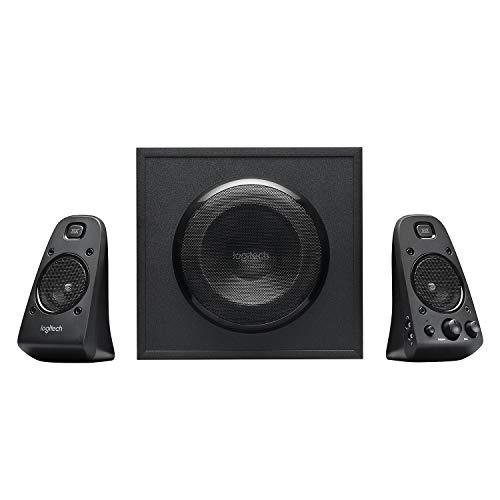
Logitech Z623 — Desk heavyweight
For the desk ear, the Z623 remains the system to beat. Its verified listing title carries THX certification and a 400-watt peak figure, and the hardware behind those words is a large subwoofer and a pair of compact satellites with volume and bass controls mounted on the right one. At a metre’s distance the effect is authority without effort: game worlds gain physical floor, film scores gain weather, and the system never sounds as though it is working at the edge of itself. The subwoofer’s level, set with the restraint this format always demands, integrates into a foundation that flatters everything played through it.
For the room ear, the same system shows its desk-first design. There is no remote, so volume lives where the seated desk user sits; there is no optical input, so a television connects by analogue if at all; and there is no streaming, so a phone joins by cable. None of that diminishes the Z623 in its native habitat — generations of fixed desks testify otherwise — but it defines the border of that habitat precisely. A small room whose main seat is a desk chair can happily adopt it. A small room whose main seat is a sofa should read the Edifier’s section first.
Placement notes for this heavyweight: the subwoofer is the largest in the guide and wants a floor position with air around it, out of the corner, with its cable run planned before the desk is pushed back. Owners who give it that position and set its level by ear — up from zero until the bass supports, never until it leads — get the system’s full measure. Owners who wedge it into the only gap and turn it up get boom, and then blame a design that was never given its conditions. The Z623 rewards the first kind of owner for years.
A closing observation on the heavyweight: its longevity in the market is itself evidence. Powered speakers live or die by returns and word of mouth, and a design that remains a default recommendation across many buying cycles has survived the harshest testing regime there is — thousands of real desks, real rooms and real subwoofer placements, including the bad ones. That survival does not make it the right system for a sofa or a studio flat’s television, and this guide has marked those borders carefully. Inside them, it is as close to a sure thing as the category offers.
- Format: 2.1 system, THX certified, 400W peak per the verified listing title
- Inputs: analogue, computer-first
- Controls: volume and bass on the right satellite — no remote
- Subwoofer: largest in this guide, floor placement required
- Wireless: none fitted
Strengths
- Nearfield authority that smaller systems cannot imitate at any setting.
- Everyday controls exactly where a desk user sits, with nothing to lose or charge.
- Composure under demanding soundtracks — headroom you hear as calm.
Trade-offs
- No remote and no optical input make sofa-distance television duty awkward.
- The subwoofer’s footprint rules out tight under-desk spaces.
- Analogue and wired only: phones connect by cable or not at all.
Best for: desk-first listeners playing games and films at a fixed workstation. Not suited for: sofa-centred rooms or television-first setups.

Klipsch ProMedia 2.1 — Detail-first desk pick
Klipsch built the ProMedia around a hi-fi conviction: that a desk listener deserves the company’s horn-loaded tweeter technology, not a watered-down substitute. The verified listing confirms THX certification for the system, and the listening character follows the hardware — immediate, detailed and alive at nearfield distance, with dialogue, game cues and acoustic textures presented with a clarity that flatters the desk ear in particular. Where the Logitech heavyweight impresses with weight, the Klipsch impresses with light: you hear the edges of things.
Its control pod shapes its daily life. Volume and subwoofer controls sit in a small desktop unit that also hosts a headphone connection and an auxiliary input, making the ProMedia a natural hub for a gaming desk where a headset joins for voice chat and leaves for shared listening. The subwoofer is smaller than the Logitech flagship’s, easing placement in compact rooms, and its tuning favours definition — basslines with their rhythm intact — over the deepest possible extension. For a desk in a bedroom or a study, that balance of footprint and articulation is often the wiser engineering.
By the room ear, the ProMedia is a desk system with the same borders as its rival: wired, analogue, remote-free. Its horn character also deserves a taste warning — listeners who love detail will call it clarity, while listeners who prefer a soft, warm blanket of sound may find the top end forthright until the satellites are angled and the level settles. Toe the satellites toward the chair, keep volumes honest, and the system’s personality becomes its charm. It has kept a loyal following for years by being the desk 2.1 for people who listen closely.
The ProMedia’s following among gamers has a specific root worth naming: positional clarity. Horn tweeters project a focused image at nearfield distance, so the direction of a sound in a game — a footstep’s side, a voice’s position — reads cleanly at volumes low enough for a shared house. That is a different virtue from raw fidelity, and for the player it may be the decisive one. Combined with the pod’s headset socket, it explains why this system, alone among the heavyweights, is so often described by owners as part of their gaming equipment rather than part of their furniture.
- Format: 2.1 THX-certified computer speaker system
- Satellites: horn-loaded tweeters in the Klipsch tradition
- Controls: desktop pod with volume, subwoofer level, headphone and aux connections
- Subwoofer: compact, tuned for punch and definition
- Wireless: none fitted
Strengths
- Detail and immediacy that make games and dialogue feel close and clear.
- The pod’s headphone hub suits mixed solo and shared desk listening.
- A friendlier subwoofer footprint than the flagship class demands.
Trade-offs
- The lively treble is a flavour some listeners must acclimatise to.
- Wired and remote-free, so the room-ear virtues belong to other picks.
- Design details vary across its long production life; check the current listing.
Best for: detail-focused desk listeners and gamers who use a headset half the time. Not suited for: sofa-distance rooms or fans of a laid-back, warm presentation.

Edifier S351DB — Small-room and TV pick
The S351DB is the pick that walks out of the study and into the living room. Edifier builds it like a compact hi-fi system — bookshelf satellites in wooden cabinets, a substantial subwoofer, a full remote — and its verified listing confirms Bluetooth 5.1 with aptX among a connection set that also includes optical and coaxial digital inputs. One clarification, because the wider internet blurs it: the S351DB is the current model and the direct successor to the S350DB, which no longer holds a verified listing in the pool used here. The system linked and reviewed in this section is the successor, and its combination of inputs is what makes it this guide’s dual-duty champion.
By the room ear, everything about it fits. The remote runs volume, bass, treble and source from the sofa. The optical input takes a television’s digital output cleanly, giving dialogue a solidity that television speakers cannot approach and giving the subwoofer the film work it was built for. The satellites, larger than desk speakers, project across a few metres without strain, and the subwoofer reaches low enough to give a small room genuine cinema foundation. By the desk ear it is equally capable but more demanding: it wants stands or a wide desk, ear-level placement, and an owner willing to set it up like the small hi-fi it is.
That dual citizenship is its value and its cost. Buyers with one room doing both jobs — the studio flat, the spare room that is office and cinema in rotation — get a single system that serves both seats honestly, which no other pick here attempts. Buyers with a small desk and no television ambitions pay for scale and inputs they will not use, in a footprint that crowds a monitor. The S351DB is the best 2.1 speaker in this guide for the room beyond the desk; it simply asks the buyer to be sure that room is theirs.
Prospective owners should plan the S351DB’s first evening as a setup session rather than a delivery celebration. Stands or shelves at ear height for the satellites, the subwoofer walked through two or three floor positions, bass and treble trimmed against a familiar film scene and a familiar album — an hour of this turns a good system into the right system for its room, and the remote makes the trimming pleasant rather than punitive. Few purchases in this guide repay an hour as reliably; the Edifier’s ceiling is set by its placement more than by its price class.
- Format: 2.1 system, bookshelf satellites plus wooden subwoofer
- Wireless: Bluetooth 5.1 with aptX
- Inputs: Bluetooth, optical, coaxial and analogue
- Controls: full remote — the room-friendly control set
- Lineage: current model, succeeding the Edifier S350DB
Strengths
- The only pick equally fluent at a desk and under a television.
- Digital inputs and a remote make sofa-distance life genuinely convenient.
- Cabinet scale delivers midrange body and film weight in small rooms.
Trade-offs
- The largest footprint here; small desks need not apply.
- It rewards deliberate setup — placement and levels are part of the purchase.
- Nearfield-only listeners may never use the scale they paid for.
Best for: dual-duty rooms and small living spaces with a television to serve. Not suited for: compact desks or buyers who listen only at arm’s length.
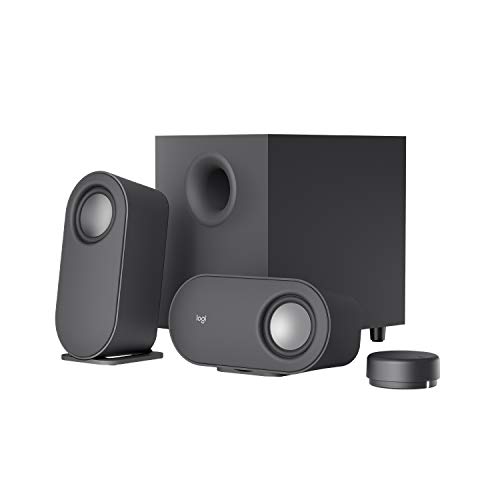
Logitech Z407 — Streaming desk pick
The Z407 answers the desk ear’s newest question: what if the source is not the computer at all? Its built-in Bluetooth receiver admits phones and tablets as first-class sources, its wired input keeps the computer connected, and its wireless control dial — a smooth puck for volume and playback — lets the listener run the system from wherever the chair happens to be. In a guide organised around seats and sources, the Z407 is the pick for the rotating desk: work laptop by day, phone playlists between tasks, a streamed film in the evening, all through one tidy system.
Its sound is scaled to that brief. The satellites are compact and voiced for close listening, keeping speech clear for calls and podcasts; the subwoofer supplies the foundation that laptop and monitor speakers lack, at a size that disappears under a desk. The dial’s wireless freedom has a placement consequence owners appreciate: the subwoofer can sit where the bass sounds smoothest rather than where a control cable reaches, which in small rooms is often the difference between boom and balance. Pairing is remembered between sessions, so the system’s daily manners are those of a appliance that simply works when sat down at.
By the room ear, its limits are the honest ones of a desk design: output sized for nearfield listening, no optical input for a television, no remote in the sofa sense — though the dial travels happily to a coffee table within its range. Buyers whose listening is truly desk-centred lose nothing to those limits and gain the most modern source handling in this guide. Buyers drifting toward television duty should let the Edifier’s section change their mind, because the Z407’s virtues are desk virtues, proudly so.
There is a generational point to the Z407’s design that deserves emphasis. Earlier 2.1 systems assumed a single, stationary source and treated every other device as a guest with a cable. The Z407 assumes a household of sources — laptops arriving and leaving, phones that carry the music library, a tablet for the evening’s film — and treats the computer as one citizen among several. That assumption matches how listening actually works now, and it is why this comparatively modest system earns a place beside heavyweights with far more output: it is built for the present tense of the desk.
- Format: 2.1 system with compact satellites and subwoofer
- Wireless: Bluetooth audio receiver built in
- Controls: wireless desktop dial for volume and playback
- Inputs: Bluetooth plus wired computer connection
- Positioning: hybrid desks with rotating sources
Strengths
- Streaming from a phone without a cable, a dongle or a settings expedition.
- The dial decouples subwoofer placement from control reach.
- Call-clear voicing at the low volumes of a working day.
Trade-offs
- Nearfield scale — a large room will find its ceiling quickly.
- No digital input, keeping television use a secondary role.
- Bluetooth delay means the cable still serves fast games best.
Best for: hybrid desks where phones and computers share the listening. Not suited for: television-first rooms or maximum-output gaming setups.
Swan 2.1 systems (M50W class) — Prose only — hi-fi route
Swan — the speaker brand of HiVi — occupies the hobbyist corner of this category: 2.1 systems built with hi-fi priorities, wooden cabinets, and a reputation earned in enthusiast communities rather than in computer shops. The M50W class is the name most readers will meet, a satellite-and-subwoofer set long recommended to listeners who found mainstream computer speakers too plastic in build and too excitable in tuning. It is covered here in prose only, because no Swan listing was verified in the pool checked for this guide; presenting it as a clickable pick would misstate its availability through the checked channel.
The appeal, for the room ear and the desk ear alike, is a calmer, more natural balance — the hi-fi virtues of integration and tonal honesty applied to the 2.1 layout. The cautions are the hobbyist route’s usual ones: availability comes and goes by region and importer, model names and revisions require careful reading, and after-sales support depends heavily on the seller. A listener who enjoys that landscape, and who finds a genuine unit through a reputable channel, will likely be very happy. A listener who wants a verified listing and a painless return should stay with the linked picks, which is precisely the division this guide exists to draw.
Swan’s presence in this guide also serves as a useful measuring stick for the linked picks. When a reader wonders whether the Edifier’s hi-fi leanings are genuine or marketing, the Swan class is the reference the claim is measured against — real cabinets, hobbyist scrutiny, a tuning philosophy from the loudspeaker world. That the Edifier survives the comparison respectably, while offering a verified listing and a remote, is the practical story. The Swan remains the purist’s route; the Edifier is the purist’s compromise that most households will actually buy, and there is room in an honest guide for both truths.
- Format: hi-fi-oriented 2.1 systems, wooden cabinets
- Status: no verified listing in this guide’s pool — prose coverage only
- Character: natural, integrated, hobbyist-approved tuning
- Availability: varies by region and importer
- Buying route: reputable specialist channels, model revision checked
Strengths
- The most hi-fi sensibility in this guide’s landscape.
- Cabinet construction a clear step beyond plastic desk speakers.
- A tuning that flatters long listening sessions at either seat.
Trade-offs
- No verified listing here — sourcing is the buyer’s own project.
- Support and returns depend on the individual seller’s quality.
- Model revisions and regional variants demand careful verification.
Best for: hi-fi-leaning listeners comfortable sourcing through specialist channels. Not suited for: buyers who want a verified listing and a simple returns path.
Harman Kardon SoundSticks — Prose only — design route
The SoundSticks are the 2.1 format as sculpture: transparent satellites, a clear-domed subwoofer, and a silhouette recognised well beyond audio circles. Later editions of the line added Bluetooth, making the family a legitimate member of this category rather than a styling detour. No listing for the line was verified in this guide’s pool, so the SoundSticks are discussed in prose — admired where admiration is due, and fenced with the same availability honesty applied to every prose pick here.
Sonically, the design has always been more serious than its novelty suggests: sweet detail from the satellites, a subwoofer voiced for integration, and a presentation scaled to a desk or a small room’s near corner rather than to a party. The compromises are those of any design object — controls that favour minimalism, cabinets that display every fingerprint and cable, and output that serves its intended seat rather than a hall. Generation differences matter greatly with this line, in connections and in Bluetooth support, so any purchase elsewhere should begin by pinning down exactly which edition is on offer. Bought knowingly, the SoundSticks remain the answer for the buyer whose speakers must earn their place visually as well as sonically.
A note on living with transparency: owners report that the SoundSticks change how a room treats its speakers. Visitors ask about them; hosts find themselves keeping the desk tidier around them; the subwoofer’s dome becomes a small landmark. That social life is part of the product, for better and worse — a design icon invites care, and care is a cost as well as a pleasure. Buyers who relish that dynamic will find the system delightful for years. Buyers who want their speakers to vanish should let the heavyweights’ black boxes do what they do best.
- Format: 2.1 system, transparent satellites and domed subwoofer
- Wireless: Bluetooth on later editions — verify the generation
- Status: no verified listing in this guide’s pool — prose only
- Character: design-led, nearfield and small-corner scale
- Controls: minimal, varying by edition
Strengths
- The only system here people display as deliberately as they listen to it.
- Refined sound that suits vocal and acoustic material at close range.
- Bluetooth editions make the design a genuine streaming option.
Trade-offs
- Editions differ significantly; listings often blur them together.
- Clear cabinets show dust, marks and cable runs without mercy.
- Output is modest beside the wired heavyweights in this guide.
Best for: design-led desks and studios where looks are part of the brief. Not suited for: buyers chasing maximum output or unwilling to verify editions.
How Do You Place a 2.1 System for a Desk Versus a Television?
The two seats want different geometry. At a desk, satellites flank the monitor at ear height, angled toward the chair, roughly as far apart as they are from the listener; the subwoofer goes under or beside the desk, near the wall, out of the corner. In a television room, satellites flank the screen at the seating’s ear height — stands or shelves help — spread wider to match the picture, and the subwoofer goes near the front wall where its output can load the room evenly. The shared rule is the subwoofer level ritual: start at zero, raise until the foundation just appears, and stop. Rooms need a touch more than desks; corners need a touch less than open walls.
Cable reality shapes both. Satellite leads in desk systems are sized for monitor distances, so a television layout with wide spacing may need the system’s own extensions or a different system altogether — the Edifier’s bookshelf satellites, designed for stands, travel better than desk satellites on short leads. Plan the layout with a tape measure before ordering, and remember that a subwoofer’s best position is the one your chair hears, not the one the photograph suggests: test from the seat, always from the seat.
What Should You Spend on in This Category — and What Should You Skip?
Spend on the subwoofer and the cabinets, because that is where the audible money lives: a well-built low-end foundation and satellites that do not resonate or strain. Spend next on controls that match your seat — satellite knobs for a desk, a remote for a room — because you will touch them daily for years. Spend a little on placement, in stands or pads that put tweeters at ear height. Skip the specification theatre: peak wattage comparisons across brands, exotic cables for metre-long runs, and processing modes named after cinemas. The format is mature and honestly priced; the differences that matter are physical, and they are the ones this guide has weighed.
How Do These Systems Handle Music, Film and Games Differently?
Music is the format’s home ground, and the differences are of flavour: the Klipsch’s immediacy flatters acoustic and vocal recordings, the Edifier’s body flatters orchestral and electronic weight, the Logitech heavyweight flatters anything that benefits from foundation, and the Z407 keeps the whole catalogue pleasant at working volumes. Film adds a demand for dynamic range — quiet dialogue one moment, weather and engines the next — which is where headroom stops being a specification and becomes the difference between leaning in and reaching for the volume control; the heavyweights and the Edifier handle that swing natively, while compact systems compress it gracefully. Games add the timing demand: wired connections keep effects locked to the picture, which is why the desk heavyweights remain gaming furniture despite their years.
The practical synthesis is encouraging: a listener does not need three systems. Any pick here covers all three diets at its seat; the ranking merely shifts emphasis. Choose the seat first, as this guide keeps insisting, then let your dominant diet break ties — detail for the gamer, body for the film lover, convenience for the listener whose music arrives from a phone. The format’s maturity means there are no wrong answers among the linked picks, only answers fitted to different rooms.
What About Neighbours, Floors and Late-Night Listening?
A subwoofer is a social instrument: its output travels through floors and walls more readily than the satellites’ sound, and a 2.1 system’s reputation in a building is set by its owner’s restraint. The good news is that every linked pick here can be set to a neighbourly level without losing its character, because their quality lives in integration rather than in sheer level. The technique is simple — subwoofer level set at the listening seat for the evening’s content, a hand’s width of distance from shared walls where possible, and a rug or mat under the cabinet in upstairs rooms to decouple it from the floorboards.
Late-night listeners should also exploit the format’s nearfield nature. At a desk, satisfying sound needs very little absolute volume, and a system balanced at low level — satellites clear, subwoofer present but modest — delivers the full picture without broadcasting it. Headphone sockets, where fitted on pods, complete the courtesy. In short: the same setup discipline that makes these systems sound expensive also makes them good citizens, which is not a coincidence but a property of bass properly integrated.
How Long Do 2.1 Systems Last, and What Fails First?
Powered 2.1 systems are among the longest-lived electronics in a home, because they contain no batteries, no screens and no software demanding updates. The parts that age are mechanical and electrical in simple ways: volume controls grow scratchy if left untouched for years, cable insulation stiffens, a subwoofer’s surround eventually tires. Controls respond well to exercise — a few full turns of each knob, a few times a year, keeps contacts clean — and cables are cheap to replace when they fail. The amplifiers themselves, given air and freedom from dust blankets, routinely outlast the computers they serve.
Wireless models add one ageing factor: standards drift. A Bluetooth receiver bought today will pair with phones for many years, because the standard protects compatibility, but buyers of the streaming pick should still regard its wired input as the permanent asset and its wireless as a long-lived convenience. That is another reason this guide favours systems that do both. When a system finally fails, it is usually one component — a pod, a dial, a satellite — and the popular models’ parts circulate second-hand, extending life further for owners inclined to repair rather than replace.
Which Questions Should You Ask Before Ordering Any 2.1 System?
Run a short checklist and the category becomes simple. Where is my seat, and how far is it from the speakers? What are my sources — computer only, phone as well, a television too? Where exactly will the subwoofer stand, measured, with its cables reaching? Which control will my hand use daily, and is it where my hand will be? Is the model I am reading about current, with a listing I can verify, or a ghost from older coverage? And what is my returns route if the room disagrees with the reviews? Six questions, five minutes, and the shortlist in this guide collapses to the one or two systems that fit a real life rather than a product page.
Notice that none of the six questions concerns wattage, and only one concerns money indirectly. That is the mark of a mature category: the products are honestly differentiated by design, and the buyer’s job is fit, not forensic accounting. Fit the seat, the sources and the subwoofer’s home, and the sound — in this guide’s linked picks, at least — takes care of itself.
How Does a 2.1 System Compare With 2.0 Speakers Plus a Later Subwoofer?
Some buyers are tempted to start with a good 2.0 pair and add a subwoofer when budget allows. The route works only when the pair was designed for it, with a dedicated subwoofer output and a crossover strategy; most desktop pairs are not, and the improvised result — a subwoofer overlapping the satellites, doubling some notes and missing others — is the integration problem this format exists to solve. A factory 2.1 system is, at heart, a crossover decision made by engineers with measurements. Buying that decision whole is why the format survives against the modular temptation, and it is why this guide’s picks are complete systems rather than shopping lists of parts.
The exception proves the rule in the hi-fi direction: separates-based listeners with powered monitors and a planned subwoofer can build something excellent, at several times the cost and effort of anything here. For the desk and small room this guide serves, the integrated systems are the rational purchase — the integration is the product, and it is already done.
What Role Does the Room Itself Play in the Final Sound?
More than any single component. A furnished room with a rug, curtains and bookshelves returns a speaker’s sound softened and even; a bare room with hard floors returns it sharpened and boomy, and the same system can be praised in the first and blamed in the second. Before upgrading a system that disappoints, owners should change the room’s easiest variables — pull the subwoofer from the corner, add soft material near the listening seat, raise the satellites — because the improvement is frequently larger than a model change would bring. Reviewers, including this guide, describe systems in ordinary furnished rooms; a buyer in a minimalist space should mentally add brightness and bass weight to every description.
This is also why in-home returns matter more in audio than in most categories. The room is half the instrument, and no review can play yours. Buy through channels that let the system be heard at home, in the seat it was bought for, and the category’s remaining risk mostly evaporates.
How Should a Shared Household Choose One System?
Shared rooms add voters to the decision, and the wise purchase weights their uses too. A system that serves one person’s gaming desk and another’s film evenings needs the dual virtues this guide has separated — nearfield clarity and room-filling composure — which points toward the dual-duty Edifier or toward accepting the desk heavyweight’s sofa compromises knowingly. Controls matter socially as well: a remote ends the tyranny of the person nearest the satellite knob, and a headphone socket ends the tyranny of the person who wants silence. Households that name these arrangements before buying argue about volume far less after it.
Children change the calculus in one specific way: exposed controls and inviting knobs will be turned, so a system whose settings can be re-found in seconds — marked levels, simple pods — survives family life better than one requiring a menu expedition to restore. The heavyweights’ physical knobs score quietly well on that test, another unlisted virtue of simple design.
What Is the Sensible Upgrade Path From Laptop or Monitor Speakers?
Most readers of this guide are upgrading from sound that came free with a screen, and the size of that step deserves stating: any linked pick here transforms the experience, because laptop and monitor speakers lack both the cabinet volume for bass and the amplifier headroom for composure. The upgrade path inside the category then runs by seat and source, as the reviews describe, but the first step is the largest and the cheapest in satisfaction per unit of money. That is worth remembering when the flagship’s price tempts hesitation — the difference between free speakers and a good 2.1 system dwarfs every difference within this guide, and a buyer who chooses any linked pick has already made the decision that matters most.
It also means the second-hand and prose routes have a legitimate place in a first upgrade: a carefully sourced Swan or SoundSticks, or an older system from a friend’s desk, still delivers the transformation. The guide’s verification discipline is about knowing what you are buying, not about insisting that only new and linked products can sound good — a distinction the honest sections above have tried to keep visible throughout.
How Do You Run a Fair First Listen Before the Returns Window Closes?
Give any new system a structured first week rather than a first impression. Day one is placement and the level ritual. The following days should rotate the material the system was bought for — a full film, a gaming session, an evening of music, a day of calls — at the volumes real life uses, noting any moment the sound draws attention to itself for the wrong reason: a booming note that recurs, a voice that thins, a control that annoys. Small faults found here are usually placement or level faults, and the sections above are the cures. A fault that survives correct placement is information, and the returns window exists to act on it without rancour.
Resist, during that week, the urge to judge by a single spectacular track. Demonstration material flatters every system in this guide; the purchase succeeds or fails on ordinary material at ordinary volumes, which is where integration, manners and control design — the qualities this guide weighed — actually live.
One more seat deserves a mention before the table: the standing desk that moves between heights through the day. Satellites riding the desk stay at ear level automatically, but the subwoofer remains on the floor, so its relative distance changes with the desk’s height and its cables need slack for the full travel. Owners who route that slack once, along a cable spine, forget the problem exists; owners who do not are reminded of it by a tug and a clatter the first time the desk rises during a call. A minute with a tape measure at the desk’s highest setting is the entire fix, and it belongs in the setup routine of any height-adjustable workspace in this category.
Gifting within this category follows the same seat logic: a 2.1 system is a generous, room-changing present for a student, a gamer or a new homeowner, provided the giver has quietly confirmed the two facts that decide fit — a floor position for the subwoofer and a source the system can actually connect to. A gift that fails either check becomes a return errand wearing a ribbon, while a gift that passes both is remembered every day it plays, which for a well-chosen system is most days of the year.
Keep the receipt somewhere findable, too — a system built to serve for years deserves paperwork that lasts as long as its warranty conversation might.
File it with the manual, ideally in the room where the speakers will actually live and work.
Small habits like that are what separate a system that is owned from a system that is merely installed in a room and forgotten about until the day it eventually fails.
Comparison Table
| System | Best seat | Connections | Control style | Character |
|---|---|---|---|---|
| Logitech Z623 | Desk | Analogue | Satellite knobs | Maximum wired authority |
| Klipsch ProMedia 2.1 | Desk | Analogue plus pod hub | Control pod | Detail and immediacy |
| Edifier S351DB | Desk and small room | Bluetooth, optical, coaxial, analogue | Remote | Hi-fi scale, dual duty |
| Logitech Z407 | Desk | Bluetooth plus wired | Wireless dial | Streaming convenience |
| Swan 2.1 systems (M50W class) | Desk and small room | Varies by model | Varies by model | Hi-fi naturalness |
| Harman Kardon SoundSticks | Desk and small corner | Analogue; Bluetooth on later editions | Minimal | Design-led refinement |
What Are the Most Common Mistakes When Buying 2.1 Speakers?
The seat mistake leads: buying a desk champion for a sofa room, or a room system for a desk it dwarfs, then blaming the product for a geography error. The level mistake follows — subwoofers set by excitement rather than by ear, producing boom that the owner then attributes to the brand. Third is wattage shopping, comparing peak figures that share no common measurement and ignoring the cabinet and driver facts that actually predict sound. Fourth is input blindness: discovering after delivery that the television has an optical output the new system cannot accept, or that the phone-first household has bought a system with no streaming at all.
Fifth is the ghost-model trap, meeting a beloved name — a Swan class, a SoundSticks edition, an Edifier predecessor — in older coverage and assuming a current, verified listing exists; this guide’s prose-only treatment of such models is the antidote, and the discipline of checking a model’s present status is worth carrying to every audio purchase. Sixth, and quietest, is neglecting the room: hard floors, bare walls and corner placement will make any of these systems sound worse than a cheaper system in a furnished room, and no badge on a satellite can repeal acoustics.
Final Recommendation
Let the seat decide. If your listening life is a desk — games, films, music at a metre — the Z623 is the heavyweight answer and the ProMedia the detail-lover’s alternative, and either will serve for years without asking anything of you but a sensible subwoofer level. If your desk shares its life with a phone, the Z407 modernises the same idea. If the room beyond the desk is the real destination — a television, a sofa, a small living space — the S351DB is the pick, the successor to its line and the only system here built for both seats. The Swan and SoundSticks routes reward the hobbyist and the design lover who source them carefully. Choose the seat first, the system second, and set the subwoofer low: do those three things, and whichever name ends up under your desk will sound like the right one — because, for your room, it will be.
Frequently Asked Questions
Can a 2.1 system really replace a soundbar for television?
In a small room, a 2.1 system with a digital input and a remote — the Edifier here — can serve television viewers very well, with better stereo separation than many bars. What it will not do is match a soundbar’s wall-mounted neatness or centre-channel focus, so the choice is about the room’s layout as much as its sound.
Why do two picks have no links?
Because no listings for the Swan systems or the SoundSticks were verified in the pool checked for this guide. They are covered in prose so readers meet them honestly — reputation, character and cautions included — without a link the verification process could not support.
Is the Edifier S351DB the same as the S350DB?
No — the S351DB is the current successor model. The S350DB no longer holds a verified listing in this guide’s pool, and the linked, reviewed system here is the newer S351DB, with Bluetooth 5.1 among its updates.
Do I need THX certification for good desk sound?
No, but it is a useful anchor: it means a system was measured against defined criteria. Two certified systems in this guide still sound quite different from each other, so treat certification as a floor of competence and choose between certified rivals by character and controls.
How loud does a 2.1 system need to be for a small room?
Less than marketing suggests. A small room reinforces sound, and a system that stays composed at the volumes a room actually uses beats a louder system that strains. Prioritise composure and subwoofer integration over headline output, especially for rooms with neighbours below the floor.
Can I add a subwoofer later to a 2.0 pair instead?
Only if the pair is designed for it, with a subwoofer output and a sensible crossover plan. Most desktop 2.0 pairs are not, which is why this guide treats 2.1 as a format to buy whole: the integration between subwoofer and satellites is the product, not an accessory.
What if my room is genuinely large?
Then honesty requires saying that this format is nearing its border. A 2.1 system can fill a large room at moderate volume, especially the dual-duty Edifier, but the architecture’s strengths — compact satellites, a single modest subwoofer — are scaled to desks and small rooms. Large rooms belong to larger speakers, multiple subwoofers or a soundbar-and-surround ecosystem. A buyer who stretches a 2.1 system across a hall will blame the format for a mismatch the guide has flagged from its opening paragraphs, so measure the room, respect the border, and let the category do the job it is genuinely best at.
Related Guides
Drill into the desk-first field with our roundup of best 2.1 computer speakers, examine the wireless corner in our guide to best 2.1 Bluetooth speakers, or stay within one brand via our shortlist of best Logitech 2.1 speakers.



[…] the wider field beyond one brand, see our roundup of best 2.1 computer speakers, our honesty-first guide to best 2.1 Bluetooth speakers, and our room-by-room coverage of best 2.1 […]
[…] with best 12-inch active PA speakers and best 10-inch powered speakers for solo performers and how to add a subwoofer to a small PA once the coordinators wire this guide into the live-sound cluster. See also 5.1 wireles […]